



Thick hair looks luxurious until it stops cooperating, and long layered haircuts for thick hair are often the difference between hair that moves and hair that sits there like a curtain. Too much length with no shape can make the ends feel heavy. Too many short layers can turn the whole thing into a puffball. The sweet spot is somewhere in the middle, where the cut keeps its weight in the right places and lets the rest swing.
That balance is trickier than it sounds. Thick hair can hide a bad layer job for a week, then betray it the second you wash it and let it air-dry. One side flips out. The back feels bulky. The face frame looks great from the front and odd from the side. A good cut should solve those problems without stealing the length you wanted in the first place.
What works best depends on where your density lives. Some people have a thick crown and lighter ends. Others have the opposite: heavy mids, blunt ends, a lot of width at the jaw. That is why the best long layered styles for thick hair are not one-size-fits-all. Shape matters. So does where the layers start, how much bulk gets removed inside the cut, and whether the perimeter stays blunt, rounded, or tapered.
1. Soft U-Shaped Long Layered Haircuts for Thick Hair

A soft U-shape is the haircut I suggest first when someone wants movement without a dramatic chop. The back falls in a gentle curve, not a sharp point, so the length still feels full and polished. On thick hair, that shape keeps the ends from looking blocky while still holding enough weight to avoid that wispy, over-thinned look.
Why it works
The U-shape spreads the hair’s bulk across the back instead of dumping all the weight into one blunt line. That matters when your hair is dense enough to sit like a shelf at the bottom. A stylist can start the longest layers low and keep the face frame subtle, usually around the chin or a little lower.
- Best for straight, wavy, or lightly curly thick hair
- Keeps length looking expensive, not heavy
- Easy to wear with a center part or soft side part
- Gives you shape without shouting “layered cut”
Tip: Ask for a soft U, not a deep U. The deeper the curve, the more dramatic the taper, and thick hair can start to look narrow at the ends if the angle gets too steep.
2. V-Cut Layers That Make Thick Hair Swing
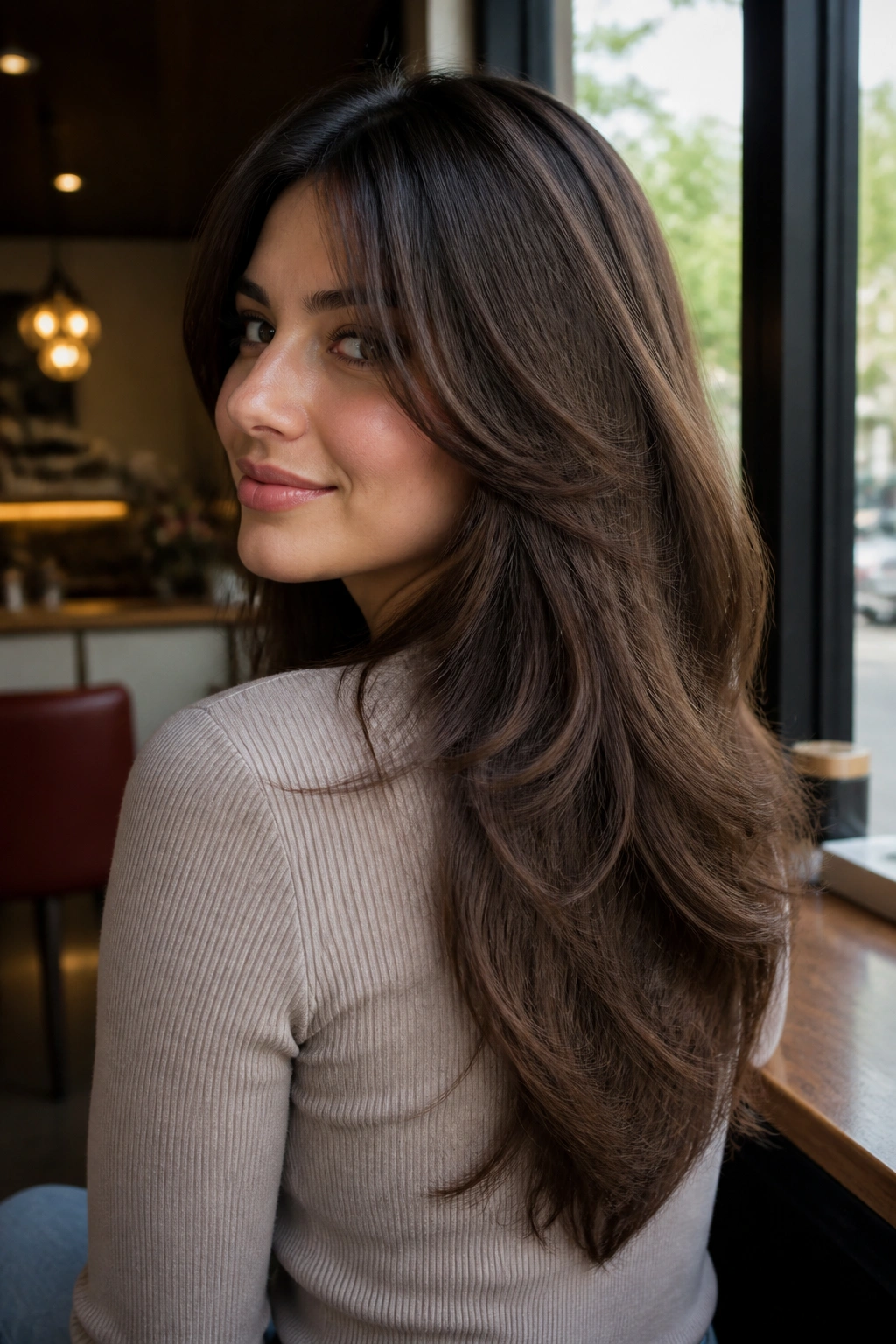
Why do some long cuts feel elegant and others feel boxy? The V-cut is usually the reason. It creates a sharper point down the back, which can make thick hair look lighter and longer at the same time. If you like hair that swings when you walk, this shape has real appeal.
The catch is restraint. On very dense hair, an aggressive V can look thin at the bottom if the stylist gets carried away. The best version keeps the point soft and the layers long, so the shape reads as movement rather than an obvious triangle. I like this cut on hair that reaches past the shoulders and has some natural bend.
It also plays nicely with blowouts. The ends flip in a clean way when you round-brush them under or out, and the shape shows up even when the rest of the hair is tucked behind your shoulders. That sounds small. It isn’t. A V-cut can make thick hair feel ten pounds lighter without actually removing much length.
3. Butterfly Layers for Thick Hair That Needs Lift Up Top

If your hair feels flat at the crown but heavy everywhere else, butterfly layers are the fix that keeps coming up for good reason. The shorter pieces around the top and front create lift, while the long bottom layers stay in place. You get movement near the face and a long tail in back. It looks done, even when the styling is simple.
That shape is especially handy if you wear your hair down most of the time. The top layers can be blown out with a round brush for a fuller shape, then the long section underneath hangs straight or softly bent. The contrast is the point. It gives thick hair some air.
How to ask for it
Tell your stylist you want shorter crown layers that blend into long lengths. Mention where you want the shortest front pieces to hit. Cheekbone? Chin? Collarbone? That choice changes the whole feel.
This cut does ask for styling. It is not a wash-and-go masterpiece on every head. But if you like that bouncy, two-level shape, it is one of the best long layered cuts for thick hair.
4. Long Shag Layers for Hair That Wants Texture
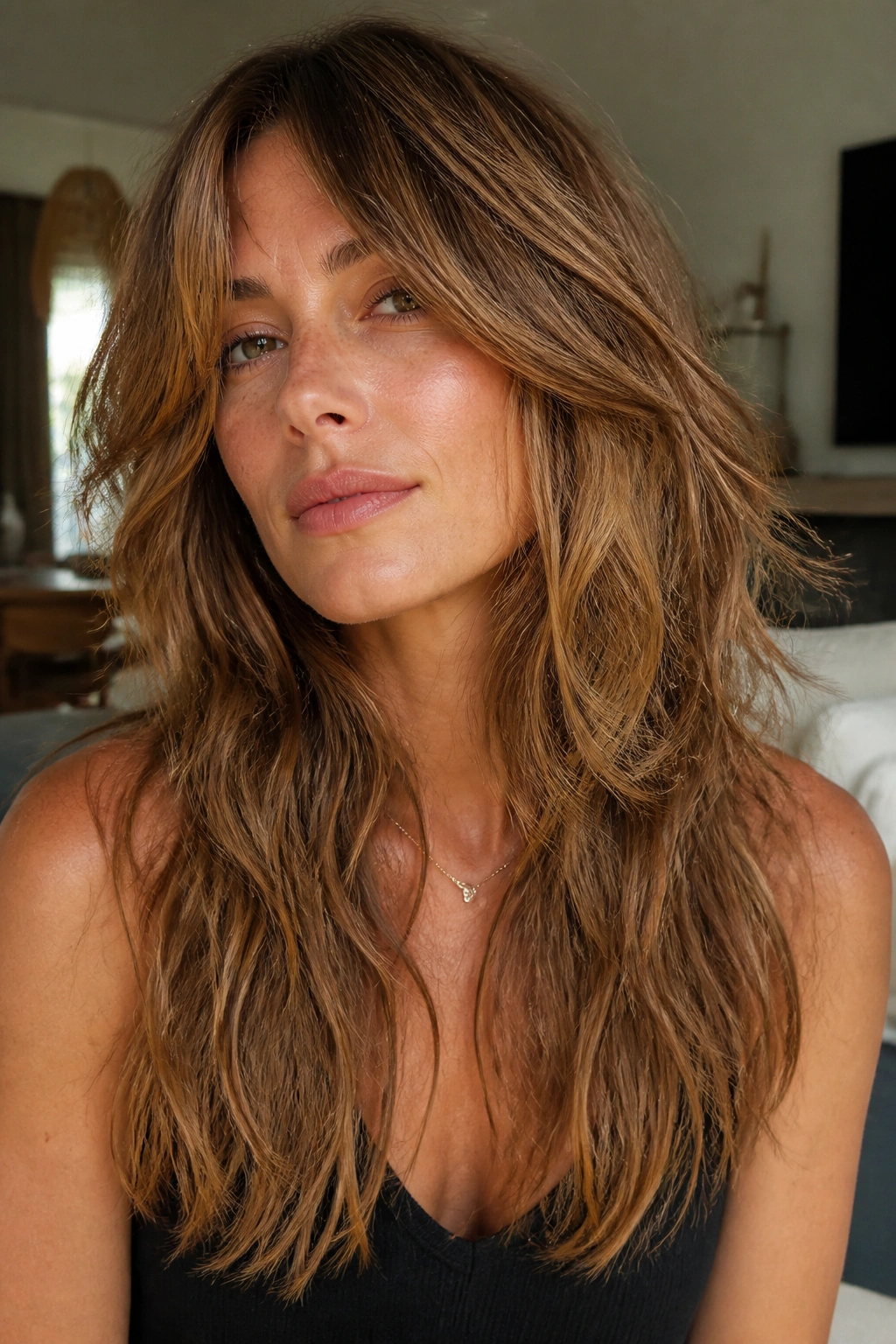
A long shag is not neat. That’s the charm. If your thick hair has a little wave, a little grit, and not much patience for polished blow-dries, the shag gives it permission to look lived in. The layers are choppier, the ends are softer, and the whole cut feels more relaxed than formal.
People often worry that a shag will make thick hair too big. The opposite happens when it’s cut well. By breaking up the density through the crown and around the face, the hair stops forming one solid block. It moves in pieces. That’s the whole game.
- Good if you air-dry more than you blow-dry
- Helps thick wavy hair avoid the triangle shape
- Works with soft bangs, curtain fringe, or no fringe at all
- Needs more shape maintenance than a blunt cut
Pro tip: Don’t ask for “lots of choppiness” and leave it there. On thick hair, that phrase can go off the rails fast. Bring a photo where the layers are long enough to still feel wearable on day three, not just on salon day.
5. Invisible Layers That Remove Weight Without Looking Layered

Invisible layers are the quietest trick in the book. From the outside, the cut can still look almost one-length. Underneath, the stylist has taken out weight in hidden sections so the hair lies flatter and moves better. It is the haircut version of cleaning out a packed closet and leaving the door looking untouched.
This is the one I recommend to people who say they hate layers but also complain that their ends feel like a blanket. You get the control without the obvious tiered look. Thick hair benefits a lot here because the heaviness is inside the shape, not just at the perimeter.
The only real catch is trust. You need a stylist who knows where to remove bulk and where to leave it alone. Too much interior cutting and the ends start to fray. Too little and the whole thing still feels like it weighs a ton. The sweet spot is subtle, and subtle is harder than dramatic.
6. Face-Framing Layers That Start at the Cheekbones

A strong face frame can change the whole haircut. If your hair is thick and all one length, the front can drag your features down a little. Start the layers near the cheekbones, and suddenly the shape opens up. The hair still feels long, but it stops acting like one solid sheet.
What makes it different
This cut is less about removing bulk everywhere and more about giving the front a job. The layers should fall in a way that bends around the jaw and collarbone, not stop awkwardly at the cheeks. Thick hair can carry a bigger face frame than fine hair can, so you do not need to be shy.
- Ask for the shortest piece to hit at cheekbone or jaw
- Keep the back longer and heavier
- Style with a soft bend, not a tight curl
- Best when you want a change without losing much length
Tip: Face-framing layers look best when the front is cut to match where your hair naturally parts. If your part fights the cut, you’ll spend half your morning fixing it.
7. Curtain Bangs in Long Layered Haircuts for Thick Hair

Curtain bangs can be a smart move on thick hair because they break up the front without needing a blunt fringe that sits like a wall. They split in the center or slightly off-center, then blend into the long layers on the sides. The result is softer than full bangs and less fussy than you’d expect.
They also solve a common thick-hair problem: the front can feel too dense compared with the rest. Curtain bangs take some of that weight out and let the face breathe. If you’ve been wearing your hair center-parted for years, this is one of the easiest ways to change the whole mood of the cut without touching the length much.
The best curtain bangs are long enough to tuck behind the ears or blend into a ponytail. Short curtain bangs on thick hair can turn heavy fast. Longer ones move better. They also grow out better, which matters if you do not want to book a trim every few weeks.
8. Cascading Waterfall Layers That Move Like Fabric

Cascading layers are a little smoother than a shag and a little softer than a V-cut. Think of them as a series of long steps that flow into one another. On thick hair, that kind of cut feels graceful because the line keeps descending without harsh jumps.
This shape works especially well when the hair has a natural bend or a loose wave. Each layer catches the one under it, so the hair feels lighter but still full. That matters. I’ve seen too many thick heads of hair get over-layered until they lost their body. Waterfall layers avoid that if the lengths are kept long enough.
They look best with movement. A quick blow-dry with a medium round brush or a loose bend from a large barrel iron will show the structure. Straight and heavy can still work, but the layers read more clearly when the hair swings a little.
9. Blunt Ends with Internal Layers for Thick Hair

A blunt bottom line gives thick hair a stronger shape, and internal layers take the weight out where nobody sees it. That combination is underrated. It keeps the hair looking thick at the ends, which is often where layered cuts can get stringy if they go too far.
This is a good choice if you like a polished look. The outer edge stays clean and full. Inside the cut, the stylist removes some of the bulk so the hair does not feel like a helmet. You get the best part of both worlds. Not magic. Just smart cutting.
How to use it
Ask for a blunt perimeter with hidden internal layers and keep the longest length where you want the most drama. If your hair poofs at the sides, this cut can calm that down without making the bottom look thin.
One warning: this is not the haircut for people who want obvious texture. It is for the person who wants thick hair to look controlled, not airy.
10. Razor-Cut Long Layers for a Softer Edge

A razor cut can make thick hair feel lighter at the ends because it softens the line instead of leaving a hard edge. That softness is lovely on straight or slightly wavy hair. The hair moves. It falls less like a board and more like fabric. Done well, it can look expensive in that “I woke up with good hair” way.
Done badly, though, it frizzes. Fast. Thick coarse hair can react to a razor by puffing up at the cut edge, especially if the hair is dry or already porous. That is why this cut needs a careful hand and, sometimes, a stylist who prefers the razor only in small sections.
If your hair takes heat styling well and you want a lighter finish, it’s a strong option. If your strands get fuzzy at the first sign of humidity, keep the razor discussion limited and ask for softer point-cutting instead.
11. Feathered 90s Layers That Bring Back Bounce

Feathered layers are back because they solve a real problem: thick hair can look gorgeous in motion but too solid at rest. Feathering breaks that mass into airy sections around the face and through the lengths. The effect is soft, rounded, and a little glam without trying too hard.
This style wants a blowout. You will get the most from it if you use a round brush and lift the sections away from the head as you dry. That little bit of bend at the ends is what gives the cut its swing. Air-dried, it still works, but the shape is more relaxed and less polished.
The face frame is the big payoff here. Feathered pieces around the cheekbones and jaw can make thick hair feel lighter without losing the drama of long length. If you like hair that looks full but not bulky, this is a good lane to explore.
12. Bottleneck Bangs with Long Layers
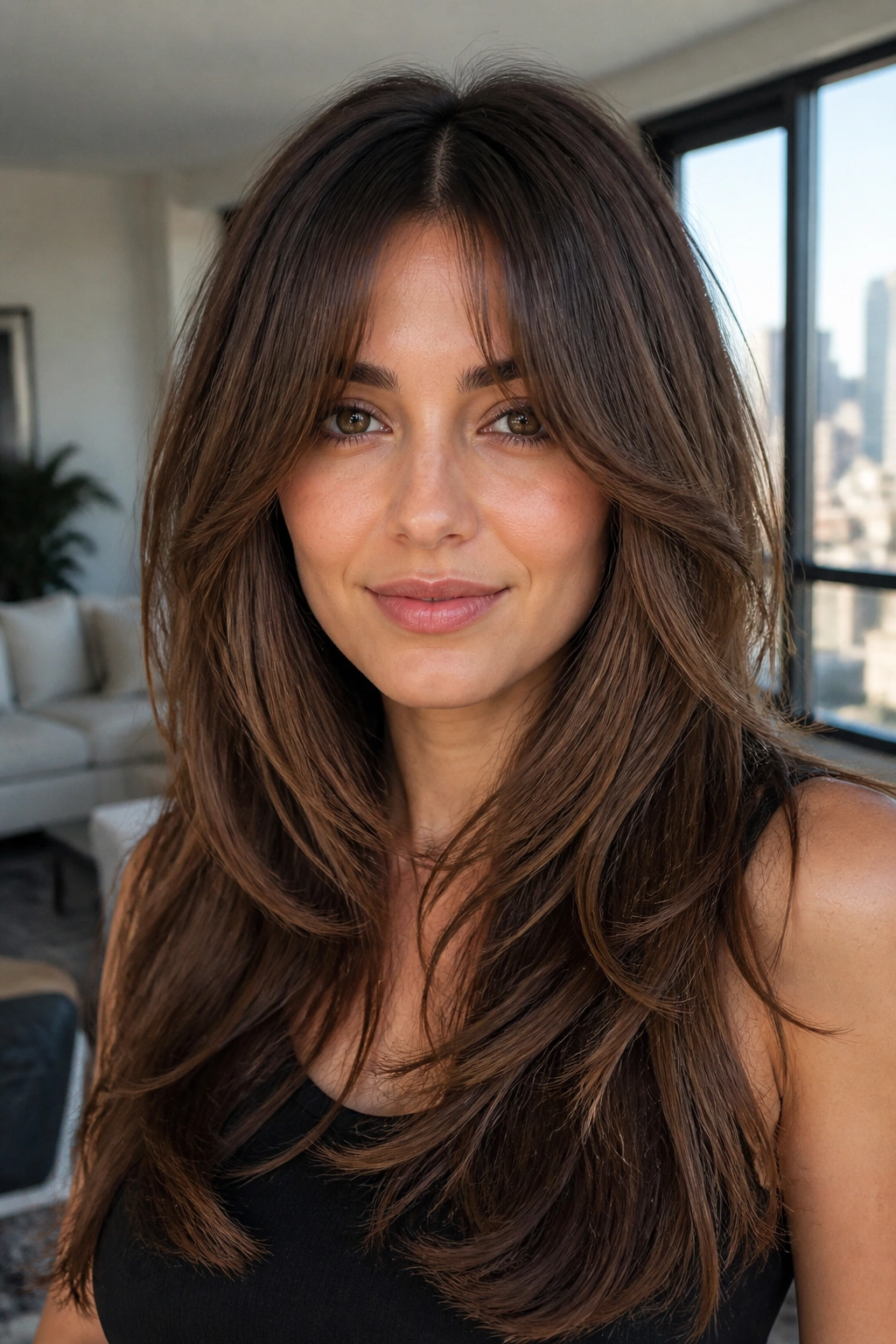
Bottleneck bangs sit in that useful middle space between blunt bangs and curtain bangs. They are shorter in the center, longer at the sides, and they blend into long layers without making the front feel heavy. On thick hair, that matters because a dense fringe can turn into a workout.
What to watch for
The center of the bang should stay narrow enough to feel soft, while the sides sweep into the cheeks or jaw. That shape keeps the forehead open and avoids the blocky look that thick bangs can create.
- Best for people who want fringe without full commitment
- Works well with medium to high density at the front
- Needs trimming to keep the center from getting bulky
- Looks polished with a round brush or hot rollers
If your hairline is cowlick-prone, tell your stylist before they cut. Thick bangs that ignore cowlicks can do their own thing, and not in a cute way.
13. Rounded Layers That Follow the Shape of Your Hair

A rounded cut keeps the silhouette soft instead of pointed or square. That sounds small, but on thick wavy hair it changes everything. The shape follows the curve of the head and shoulders, so the hair falls in a smoother arc. You do not get that odd triangle effect that thick hair loves to create when the ends are too blunt and the middle is too fluffy.
This cut is especially kind to natural texture. Instead of fighting the wave pattern, it lets the layers sit where the hair already wants to move. A stylist who knows what they’re doing will cut with the bend in mind, not against it. That saves you from spending twenty minutes trying to flatten something that wants to bend.
It also grows out well. Rounded layers tend to lose their shape more gracefully than choppy ones. If you like low-drama maintenance, that matters.
14. Deep Side-Part Layers for Thick Hair With a Lot of Volume
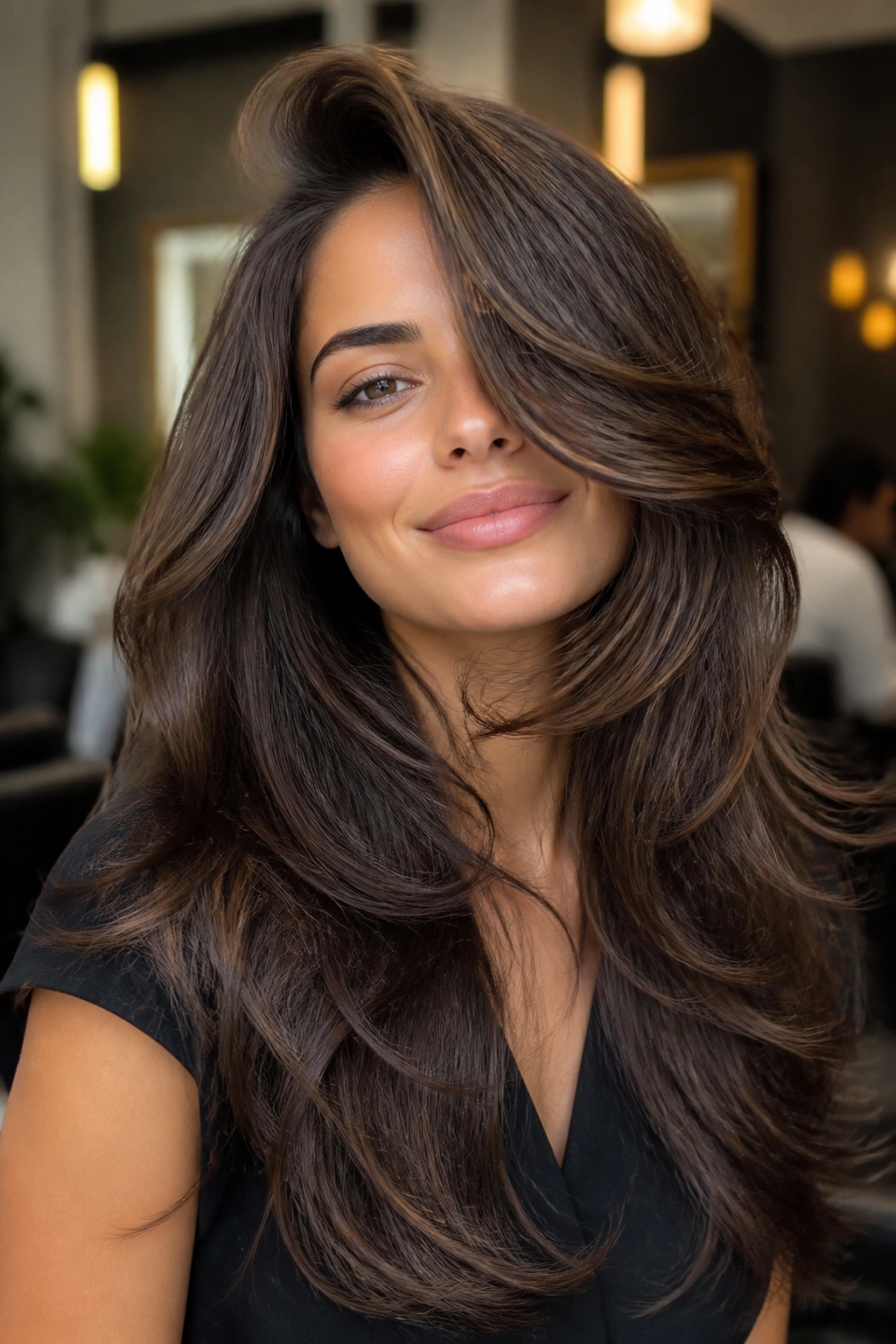
A deep side part can change the way long layers sit before you even pick up a brush. It shifts weight to one side, adds lift at the roots, and gives thick hair a little drama without needing a huge cut. If your hair naturally falls flat at the top but balloons at the sides, this is a useful fix.
Quick cut notes
Tell your stylist where you usually part your hair. A side part cut to a center part habit can look off, and vice versa. The layers should follow your real routine, not an ideal version of it.
- Great for square or round face shapes
- Helps soften a heavy crown
- Gives movement around one side of the face
- Pairs well with face-framing pieces at the chin
A deep side part does not solve everything. But it can make a standard long layered cut look more intentional, especially on hair that has a lot of body and needs direction.
15. Crown-Volume Layers for Hair That Falls Flat on Top

Flat roots and heavy ends are a strange pair, but thick hair gets them a lot. Crown-volume layers address that by lifting the top section while keeping the lower lengths from collapsing into a heavy block. The result is air at the root and shape through the back.
This cut shines when you style with a little root lift. A round brush, velcro rollers, or a quick blast of heat at the crown can make the layers behave. If you skip styling entirely, it still works, but the effect is quieter. That’s fine. Not every haircut has to look like a salon blowout.
The key is balance. Too many short layers at the top and the cut starts to stick up. Too few and the crown stays flat. Thick hair often needs a controlled lift, not a big, fluffy crown.
16. A Soft Wolf Cut for Long Thick Hair

The wolf cut can go too far fast, which is why the soft version is the one I trust more on thick hair. It keeps the cool, shaggy feel of the original but tones down the extremes. You still get shorter layers near the top and longer lengths below, but the whole thing feels wearable instead of costume-y.
It works because thick hair can handle contrast. The top layer gets movement. The ends stay long enough to anchor the shape. If you wear your hair a little messy anyway, this style fits that habit instead of fighting it.
The styling part is forgiving. A little mousse, a rough dry, maybe some bend from a flat iron if you want piecey ends. That’s enough. The haircut is doing most of the work. If you want something with edge but not chaos, this is a good middle ground.
17. Straight-Hair Long Layered Haircuts for Thick Hair

Straight thick hair can look sleek on the surface and heavy underneath. That is why sliced or long-angled layers work so well here. They break the helmet effect without making the ends too thin. You want motion, not holes.
How it behaves
Straight hair shows every line, which means the layering has to be precise. Too many short pieces and the cut can look choppy in a bad way. Too few and it falls flat and wide.
- Ask for long, clean layers rather than chopped ones
- Keep the perimeter solid if you want polish
- Use a flat iron or large round brush to show the shape
- Best if your hair already dries mostly straight
A stylist may use slide cutting or point cutting to soften the edges. Those terms sound technical, but the idea is simple: the cut should move without looking shredded. On straight thick hair, that line matters a lot.
18. Long Layers for Coarse Hair That Need Careful Bulk Removal

Coarse hair is not the same thing as thick hair, and people mix them up all the time. Coarse hair means the strands themselves are strong and wide. Thick hair means there is a lot of it. When you have both, the wrong layer cut can feel bulky, frizzy, and oddly rigid.
That is why conservative layering works best here. Keep the layers long. Avoid over-thinning. Leave enough weight at the ends so the cut does not puff out in humidity or look straggly when it dries. Coarse hair tends to punish aggressive texturizing.
What to ask for
Tell your stylist you want bulk removed without losing density at the ends. That phrase gets at the real problem. You want control, not a fluffy finish.
A good coarse-hair cut often looks better after the first wash than on salon day. The hair settles. The edges soften. Give it a little time before judging it.
19. Length-Preserving Layers for Anyone Who Wants to Keep the Inches
Sometimes the goal is not a new silhouette. It is just to stop thick hair from taking over your head. Length-preserving layers do that by trimming the internal heaviness and leaving the long outer line intact. That means you still get the feeling of long hair, but it does not sit like one giant piece of fabric.
This is the haircut for someone who wants a refresh without visible drama. The face frame may be soft. The back may be subtly tapered. The change is in the movement more than the shape. It sounds modest because it is. And that is the appeal.
If you love pulling your hair into low buns, braids, or half-up styles, this cut is useful because it keeps enough length to work with. The layers help the hair lie better in a ponytail too, which is a small detail until you live with the haircut for a month.
20. Air-Dry Layers That Fall Into Shape on Their Own
Hair that dries well without a full styling routine is worth its weight in gold, especially when it is thick. Air-dry layers are cut so the hair settles into a decent shape as it dries naturally. The layers are usually long, gentle, and placed where the hair wants to bend anyway.
Why it matters
Thick hair can dry with a weird flip at the bottom if the shape is too blunt. A better layer pattern gives the hair somewhere to go, so it does not fight itself. That means less puff, fewer awkward corners, and less time with a blow-dryer in your hand.
- Good for loose waves and soft curls
- Best when the layers start below the chin
- Works with leave-in cream or light mousse
- Avoid heavy oils that weigh the shape down
This is one of those cuts that looks ordinary in the chair and better once you live in it. The cut is doing invisible work, and that’s the point.
21. An Off-Center Fringe With Long Layers
A fringe that sits slightly off-center is a nice compromise if you want shape in front without the symmetry of curtain bangs. It gives thick hair a little asymmetry, which can be flattering because it breaks up the width around the forehead and cheeks. The layers behind it should stay long and soft so the fringe looks intentional, not chopped on as an afterthought.
This style works well if you like to tuck one side behind your ear. The fringe keeps the front lively even when the rest is pulled back. That small detail matters more than people think. Haircuts are built out of those small details.
It’s also easier to grow out than a full blunt bang. The fringe can slide into the face frame over time, which makes the whole cut feel less rigid. That flexibility is useful if you change your mind halfway through the season. Or halfway through the week, honestly.
22. Textured Ends That Break Up a Heavy Bottom Line
Thick hair often looks best when the ends are not too perfect. A little texture at the bottom can stop the cut from reading as one heavy block. The trick is keeping the texture controlled. You want the ends to move, not fray.
A good stylist may use point cutting on the last inch or two, or soft slicing to lighten the edge without making it look shredded. That creates separation, which helps the hair swing. It also makes thick hair easier to air-dry because the ends do not sit in one stubborn line.
A quick warning
Do not let anyone carve chunks out of the bottom to “remove bulk” unless you’ve seen the result on hair like yours. Thick hair can handle texture. It cannot always handle random holes.
Textured ends work especially well with long layers that already have some motion through the mids. The bottom line should look touched, not destroyed.
23. Long Layers That Blow Out Like a Salon Style
Some haircuts are cut to air-dry. Others are cut to look their best under a brush. This one is for the second camp. Long layers with a polished blowout shape give thick hair that round, bouncy finish that sits smoothly at the crown and curves softly at the ends.
That kind of cut needs the layers placed where a round brush can catch them. Too short, and they flip oddly. Too long, and the blowout drops flat. The best version gives the hair a clean sweep through the sides and a little lift around the face.
If you like a glossy finish, this is a smart option. It also works well for events because the shape holds. Thick hair has natural staying power, and when you pair that with a blowout-friendly cut, it can look put together for hours without much fuss.
24. Thick Hair Layers That Tame Side Bulk
Some thick hair doesn’t feel heavy at the bottom. It feels wide at the temples, around the jaw, or just below the ears. That kind of bulk needs a different approach. Side-bulk layers focus on the areas that puff outward and use longer face-framing pieces to pull the shape back in.
What to look for
The layers should not all start in the same place. That’s how you end up with a boxy outline. Staggered layers around the sides help the hair follow the head more closely.
- Keep some weight at the back
- Remove bulk around the sides in soft passes
- Let the face frame fall below the jaw if your hair is wide there
- Style with a brush that smooths the sides inward
This cut is a quiet fix. You may not notice it at first glance, but you will notice that the shape sits better. Thick hair often needs that more than it needs drama.
25. Clean Perimeter Layers
A clean perimeter with long internal layers is the haircut for someone who wants the hair to look full, not frayed. The bottom line stays strong. The layers stay tucked inside the shape. The result is thick hair that still feels like thick hair, only better behaved.
It is a smart choice if you are tired of cuts that look piecey for two weeks and shaggy for the next six. This one grows out with dignity. The ends keep their strength, and the layers soften instead of disappearing. That matters if you like waiting a little longer between trims.
If you are torn between polish and movement, start here. It gives you enough structure to look intentional and enough layering to keep the length from dragging. That balance is hard to beat, and it is probably the reason so many thick-haired people keep circling back to it.
