



Long hair cuts with layers can rescue a shape that feels heavy, flat, or a little too polite. A good layered cut does more than take off weight at the bottom. It changes where the hair bends, how it swings, and how much life you see when you turn your head.
That’s the part people miss. Long hair that hangs in one blunt sheet can look healthy, sure, but it can also look stubborn. Move the weight a few inches higher, soften the outline, and suddenly the whole cut has some air in it. Not fluff. Air.
I have a bias here: I like layers that grow out cleanly. A layered haircut should still look intentional after a few weeks, not like the salon guessed and hoped for the best. That means paying attention to density, texture, and how much styling you’re actually willing to do on a regular morning.
Some women want cheekbone framing. Others want lift at the crown, softer ends, or a way to keep long length without the triangle shape thick hair sometimes gets. The cuts below handle those jobs in different ways, and the first one starts with the simplest fix of all: putting movement right around the face.
1. Long Face-Framing Layers That Start at the Cheekbones

This is the easiest place to start if you want a visible change without losing your length. Face-framing layers pull the eye upward, soften a strong jawline, and keep long hair from sitting like one heavy sheet. When the shortest pieces land around the cheekbones or just below them, the whole cut feels lighter around the face without turning the rest of the hair choppy.
Why stylists reach for this shape
The trick is restraint. If the face frame starts too high, the cut can look busy. If it starts too low, the change disappears under the rest of the hair. Cheekbone to collarbone is the sweet zone for most women, especially if you wear your hair down more often than up.
What to ask for
- Long layers that begin around the cheekbone or upper lip
- Soft graduation around the front, not a sharp notch
- A perimeter that stays long and full
- Light point-cutting through the front pieces for movement
Best for: oval, square, and heart-shaped faces, though I’ve seen it work on almost everyone when the front pieces are customized a little.
One thing I like about this cut: it plays well with both straight hair and loose waves. You can blow it out with a round brush for a polished look, or let it air-dry and keep the face frame as the main feature. Easy. Clean. No drama.
2. Soft Invisible Layers for Fine Long Hair

Fine hair does not need a lot of obvious chopping. In fact, too many short layers can make the ends look thin and wispy, which is the opposite of what most people want. Soft invisible layers solve that by removing a little weight from the inside of the cut while leaving the outside line mostly intact.
That means the hair still looks full at the bottom. It just moves better.
What makes them “invisible”
A stylist usually works with small internal sections and keeps the changes subtle. There’s no chunky stair-step effect. No obvious shelves. The layers are there, but you mostly feel them when you run your fingers through the hair or watch it swing from side to side.
This cut is especially good if your hair slips flat by noon. The inside movement keeps the top from collapsing quite so hard, and a light root spray or mousse can help the lift hold. You do not need a heavy stack of product. That only makes fine hair droop faster.
A tiny warning: ask your stylist to avoid taking too much off the last few inches. Fine hair needs a solid-looking perimeter. Without it, the whole cut can go see-through in the wrong way.
3. Long V-Cut Layers for Heavy, Straight Lengths

A long V-cut is one of those shapes that sounds simple and looks sharper than people expect. The back tapers into a gentle point, and the layers follow that line so the hair falls narrower in the center and fuller toward the sides. On very long hair, that little point can make a big difference.
Why does it work? Because it gives the length somewhere to go.
The shape in plain English
If your hair feels dense but sits flat, a V-cut creates movement without sacrificing the long silhouette. The center back stays longest, while the sides are cut to blend into that point. You get a more obvious shape than a U-cut, but less heaviness than one-length hair.
Best uses for a V-cut
- Thick, straight hair that spreads out at the ends
- Long hair that looks bulky when it’s all one length
- Women who like a visible shape from the back
- Blowouts that need a little swing at the ends
The catch is that very fine hair can look stringy if the point is too narrow. That’s the mistake. A softer, wider V keeps the cut wearable. Ask for a gradual point and long internal layers, not a sharp tail.
4. U-Shaped Layers That Keep the Ends Full

If you like the idea of layers but hate stringy ends, the U-shape is worth a close look. The curve is softer than a V, so the hair keeps more fullness across the bottom while still getting a little movement. It’s a smart middle ground, and honestly, one of the easiest long layered haircuts to live with.
I’ve always thought this cut looks best when the hair is healthy. The arc at the back gives a neat, finished feel, especially when the ends are blunt enough to hold their line. It doesn’t scream “layered haircut.” It just looks balanced.
Why it flatters growing-out hair
A U-shape works well when you are growing from medium length to long length, because the perimeter stays strong while the inner layers take out bulk. The cut also hides uneven density a little better than a blunt line. If one side has more hair than the other, the curve softens the difference.
Good sign: the hair falls in a clean curtain from the back, not in separate chunks.
Not so good: if the curve gets too shallow, the haircut can lose personality. If it gets too deep, it starts behaving like a V. There’s a narrow line here, and a decent stylist will know where to land it.
5. Butterfly Layers with Big Crown Volume

Butterfly layers are for women who want hair that looks like it was blown out on purpose. They keep most of the length, but the top and front sections are cut shorter so the crown lifts and the face opens up. The result is airy up top and long at the bottom, which is why this cut has become such a favorite for women who love volume.
It’s a little dramatic. In a good way.
What gives this cut its shape
The shorter layers usually live around the cheekbone, chin, or collarbone area, while the longer length stays intact underneath. That creates a two-tier feel when the hair moves, especially if you curl the front pieces away from the face. The whole thing looks fuller, but not bulky.
How to wear it
- Blow-dry with a round brush for the classic swoop
- Use large velcro rollers at the crown if you want extra lift
- Let the ends stay straighter if you want a softer finish
- Keep the top layers long enough to tuck behind the ears
Butterfly layers are not the best choice if you want a cut you can ignore completely. They look best with at least some styling. But if you like that soft, bouncy blowout look, this one earns its keep fast.
6. Choppy Shag Layers for Long Hair
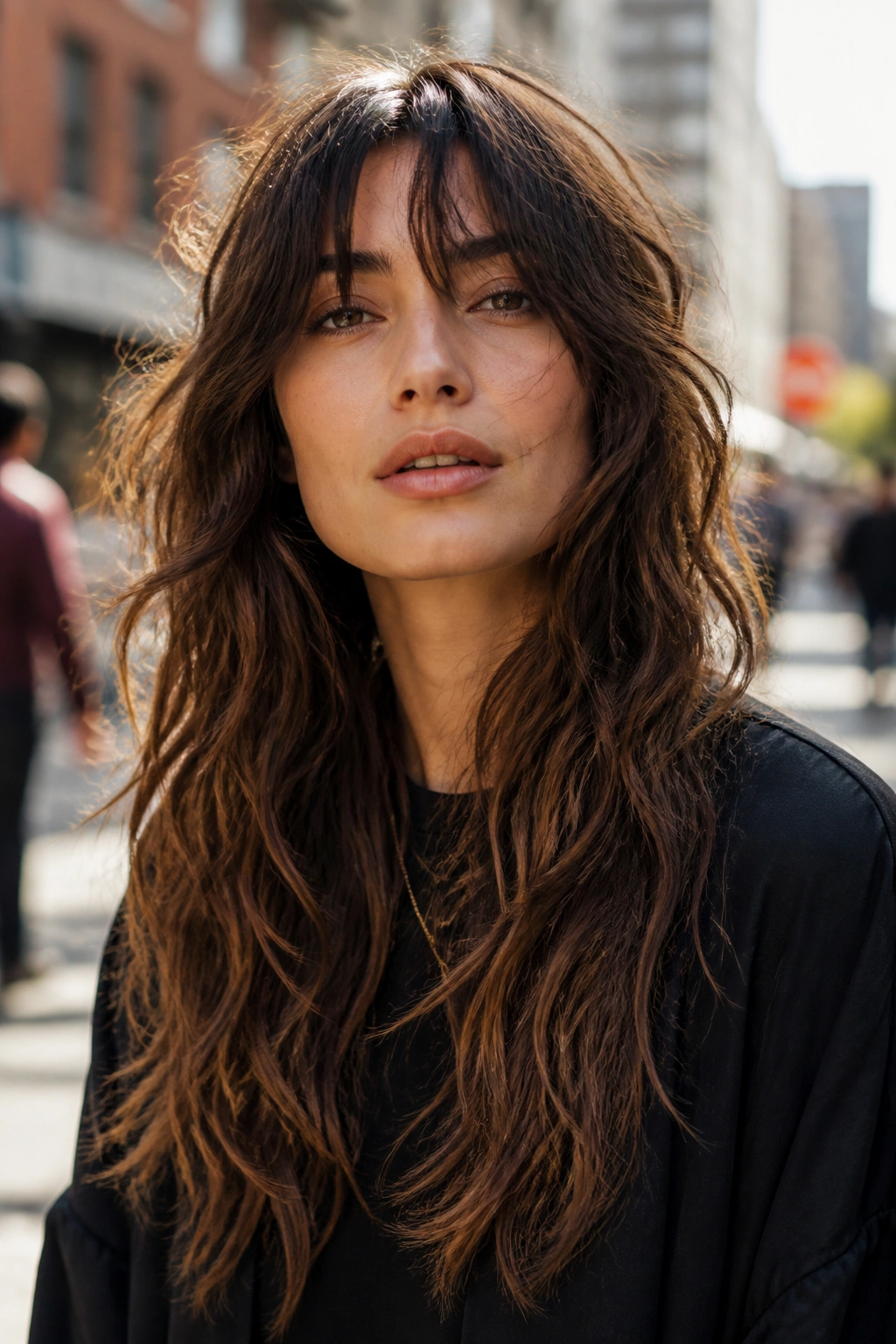
Unlike polished layers, a long shag has a little edge. It feels looser, cooler, and less precious. The crown is usually more layered, the ends are more piecey, and the whole cut has that slightly undone look that works especially well when hair has a natural wave or a bit of grit to it.
This is not the cut for someone who wants everything neat and symmetrical. Good. It should have some attitude.
What makes it different from butterfly layers
A butterfly cut is softer and more styled. A shag gives you separation, texture, and a bit of swing without looking too blown-out. The top layers can be shorter, and curtain bangs often come with the package, but the real point is texture through the whole head.
Best for:
- Thick hair that feels too heavy
- Wavy hair with a natural bend
- Women who like air-drying
- Anyone tired of smooth, flat long hair
The downside? If the layers are too aggressive, the cut can look dated fast. Ask for softness around the ends and keep the shorter pieces deliberate, not random. That’s the difference between a shag and a haircut that just lost a fight with scissors.
7. Feathered Layers That Swing When You Walk

Feathered layers are all about motion. The ends taper lightly, the edges soften, and the hair moves in a way that feels light without becoming thin. There’s a reason this look keeps coming back around: it frames the face, flatters long lengths, and has a classic blowout feel that works on straight or slightly wavy hair.
I like feathering on hair that holds a bend well. The cut almost invites the hair to curve inward at the ends, which makes the whole style feel finished even before you touch a styling tool.
The finish you’re aiming for
Think soft, brushed-out movement, not rough texture. A feathered cut should look like the ends were skimmed, not hacked. That usually means your stylist uses shears or a slicing technique to create a softer edge, then connects the layers so they don’t look broken apart.
A few things help this cut look its best:
- A heat protectant before blow-drying
- A medium or large round brush
- A quick pass with a light serum on the ends
- A trim every 8 to 10 weeks if you want the feathering to stay crisp
Skip this one if your hair is already fragile at the ends. Feathering can look a little sparse on over-processed hair, and that is not the mood.
8. Razor-Cut Layers for a Softer, Airier Edge

Can a razor make long hair look better? Absolutely, but only on the right hair type and in the right hands. Razor-cut layers give long hair a softer edge by slicing into the ends instead of bluntly cutting across them. The effect is lighter, more wispy, and less rigid than scissors alone.
Healthy hair handles this beautifully. Dry, split ends do not.
What a razor changes
A razor removes weight in a way that makes the hair look a little airier through the mid-lengths and ends. That can be a gift for thick hair that feels dense all the way down. It can also soften straight hair that tends to sit too neatly.
What to ask for
- Razor work only on healthy sections
- Long, connected layers instead of short choppy pieces
- Soft ends, not shredded ends
- A test section first if your hair is fine or fragile
This is one of those cuts that can look expensive when done well and messy when done badly. No middle ground. If your hair tends to frizz or split, a razor probably is not the first tool I’d reach for. Scissors and a gentle point-cut may be safer.
9. Long Layers with Curtain Bangs

If you want a change you can feel without giving up length, this is a strong choice. Curtain bangs shift the focus right to the eyes and cheekbones, while long layers keep the rest of the hair from looking weighed down. It’s a good match for women who want movement at the front but still like wearing their hair down and long.
The best part? The grow-out is manageable.
Why the pairing works so well
Curtain bangs break up a heavy front line, and the long layers underneath keep the shape open instead of boxy. Together, they create a softer frame around the face. On round faces, that can add length. On heart-shaped faces, it balances a wider forehead. On long faces, it can make the proportions feel more even.
Styling notes
- Blow the bangs forward first, then sweep them outward with a round brush
- Keep the longest front layers below the chin so the cut blends
- Use a light texture spray if your hair falls too flat
- Trim the bangs more often than the rest of the cut
One honest note: curtain bangs need a tiny bit of maintenance. Not a lot. Just enough to keep them from sliding into your eyes and getting annoying.
10. Cascading Layers for Thick Hair

Thick hair needs shape, not just removal. That is the big difference with cascading layers. The cut moves from shorter pieces on top to longer pieces underneath in a smooth flow, which redistributes weight instead of taking too much from one area. On dense hair, that matters. A lot.
When thick hair is cut all one length, the bottom can feel heavy and the top can feel like a helmet. Cascading layers break that up. The hair starts to fall in stages, so it doesn’t look like one giant block.
What to ask for at the salon
- Internal weight removal through the mid-lengths
- Longer layers at the front and crown
- A perimeter that still feels full
- No aggressive thinning shears at the ends
The key is control. Too much texturizing can make thick hair frizzy and fuzzy, which is the last thing you want. Cascading layers should reduce bulk while keeping the hair glossy and shaped.
If you love ponytails, this cut is useful there too. The layers spill out in a softer way instead of sticking out like a box. Small thing. Nice payoff.
11. Waterfall Layers for Wavy Hair

On a good wavy day, waterfall layers look like the hair is moving on its own. The shorter pieces fall over the longer ones in a soft descent, which lets the wave pattern show instead of getting crushed by weight. That matters more than people think. Wavy hair usually wants structure, but not too much structure.
This is one of my favorite long layered haircuts for women who air-dry often. The layers help the waves separate naturally, so the hair doesn’t puff at the ends and flatten at the roots.
What the cut needs to do
The layers should follow the wave pattern rather than fight it. If the cut ignores the bend in your hair, the ends can kick out in weird places. A good waterfall shape respects the way your waves actually fall, especially when the hair is damp and shrinkage starts to show.
Best for:
- Loose to medium waves
- Hair that gets bulky around the bottom
- Women who like a softer, romantic shape
- Low-effort styling
A diffuser helps, but the cut should work without one. That’s the test I care about. If a layered cut only looks good after 40 minutes of heat, it is asking too much.
12. Deep Side-Part Layers for Instant Lift
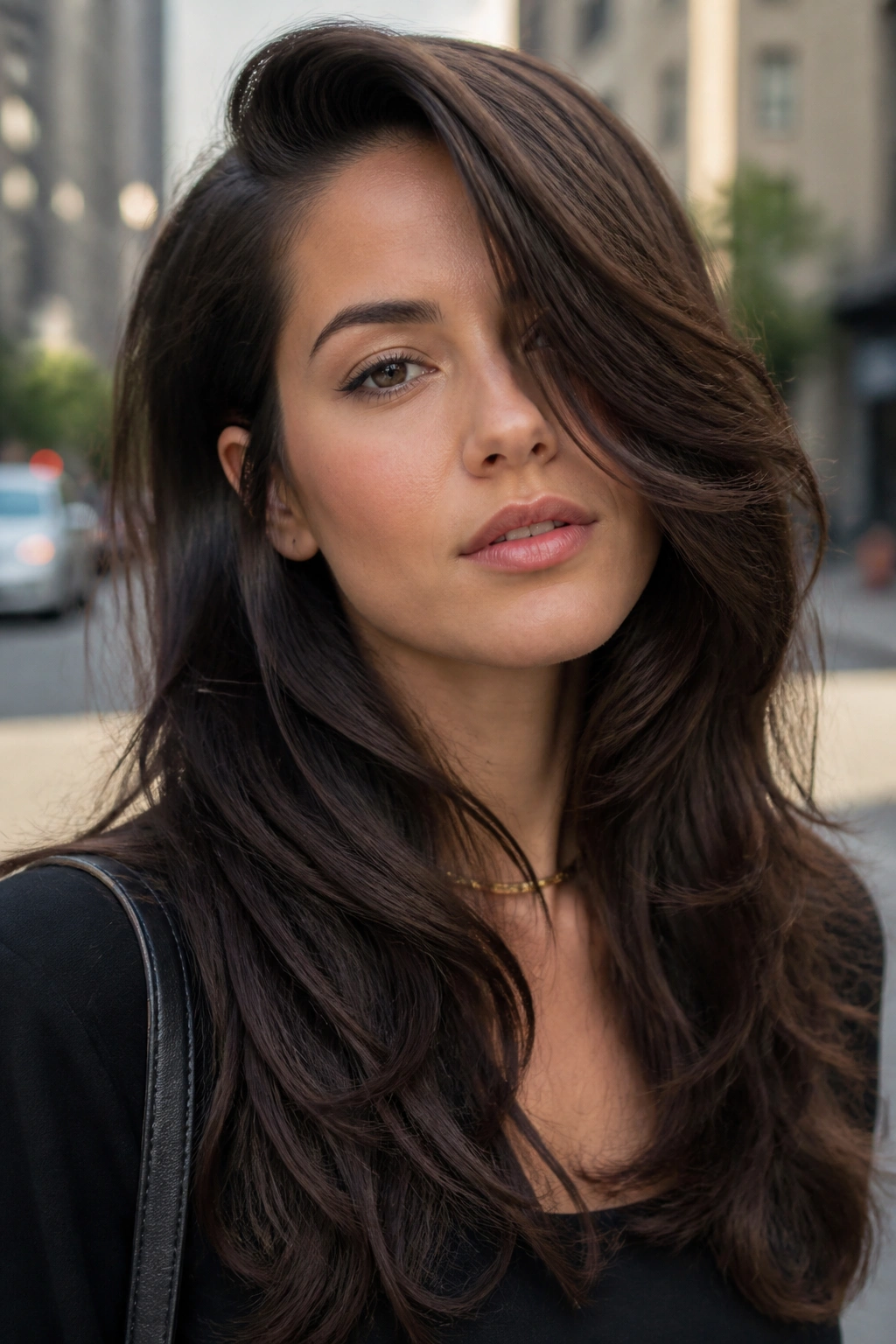
A center part and a deep side part can make the same cut look like two different hairstyles. That is why deep side-part layers are so useful. They build in a sense of lift at the roots and a little sweep across the forehead, which can be a lifesaver if your hair lies flat no matter what you do.
The layers themselves are usually long and soft, but the part does a lot of the visual work. It gives the cut movement before the styling tools even come out.
Why this shape feels fresh
The side part creates an asymmetrical line, so the hair stacks differently on each side. One side gets more body near the cheek, and the other side falls longer and sleeker. That contrast can make long hair look fuller without needing a big chop.
- Good for fine to medium hair
- Helpful when the crown goes flat fast
- Easy to flip back to a center part on lazy days
- Works with straight, wavy, and loose curly textures
This is a nice option if you want volume without curtain bangs. It also pairs well with layered ends that stay long, because the part already gives the top half enough shape.
13. Textured Layers for Straight Hair

Straight hair can be tricky. It shows every line, every gap, every slightly off layer. That is why textured layers need to be done with some care. You want enough movement to keep the hair from looking flat, but not so much chopping that the ends turn thin and broken.
The best versions usually rely on point-cutting or slide-cutting to soften the ends and create a bit of separation. The result is cleaner than a shag, less styled than butterfly layers, and easier to wear than very short face-framing cuts.
What works here
A blunt-ish bottom line with lightly textured layers above it usually looks best. That gives straight hair a sense of density at the ends, which matters because straight textures can go see-through fast if they are over-layered.
Good for:
- Women with naturally sleek hair
- Hair that needs movement, not big volume
- Low-maintenance styling
- Cuts that still look neat in a ponytail
I would not go too short on the top layers here. Straight hair can lose its shape faster than people expect, and once the shortest pieces are gone, there is no easy fix except waiting for growth. Annoying. Also true.
14. Minimal Layers with a Light Face Frame
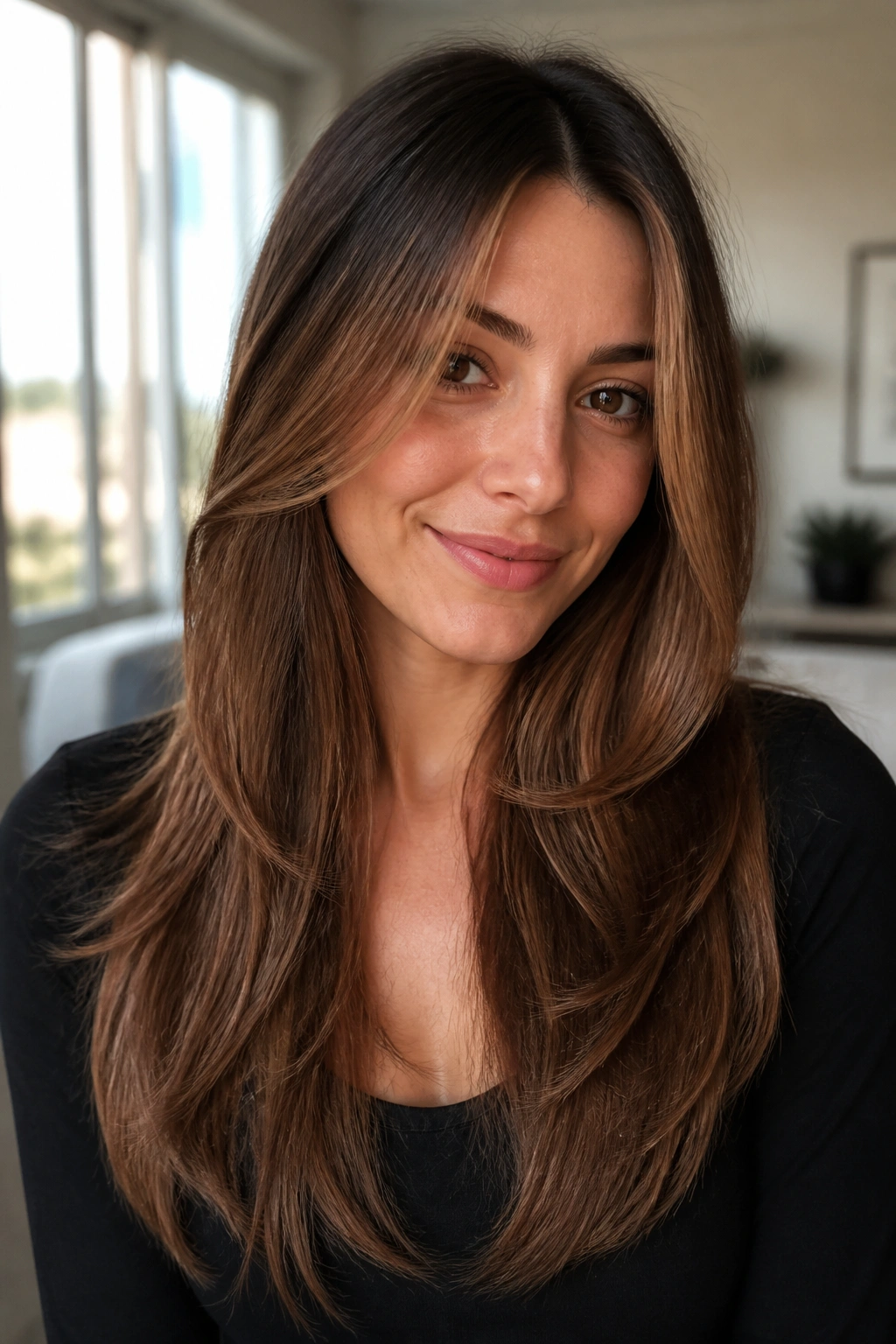
Not every long layered haircut needs drama. Some women just want the ends to stop feeling heavy and the front to stop falling straight down like a curtain. Minimal layers handle that quietly. They take out a little bulk, add a soft front frame, and keep the length looking deliberate.
This is the cut I’d suggest to someone who is nervous about layers but knows the hair needs a little help. It’s also a smart choice if you wear your hair up a lot. Big, obvious layers can make a messy bun feel spiky. Subtle ones do not.
Why this version grows out so well
Because the layers are sparse and long, they stay useful for months. The shape does not collapse fast, and the cut stays friendly even if you miss a trim. That matters if you do not want a haircut that becomes high-maintenance the second you leave the chair.
A minimal layered cut usually keeps:
- The base strong and full
- The face frame soft and long
- The interior lightly thinned, if at all
- The perimeter looking like real length, not leftover length
It may not be the flashiest option on the list. Fine. It is one of the smartest.
15. Long Layers with Bottleneck Bangs
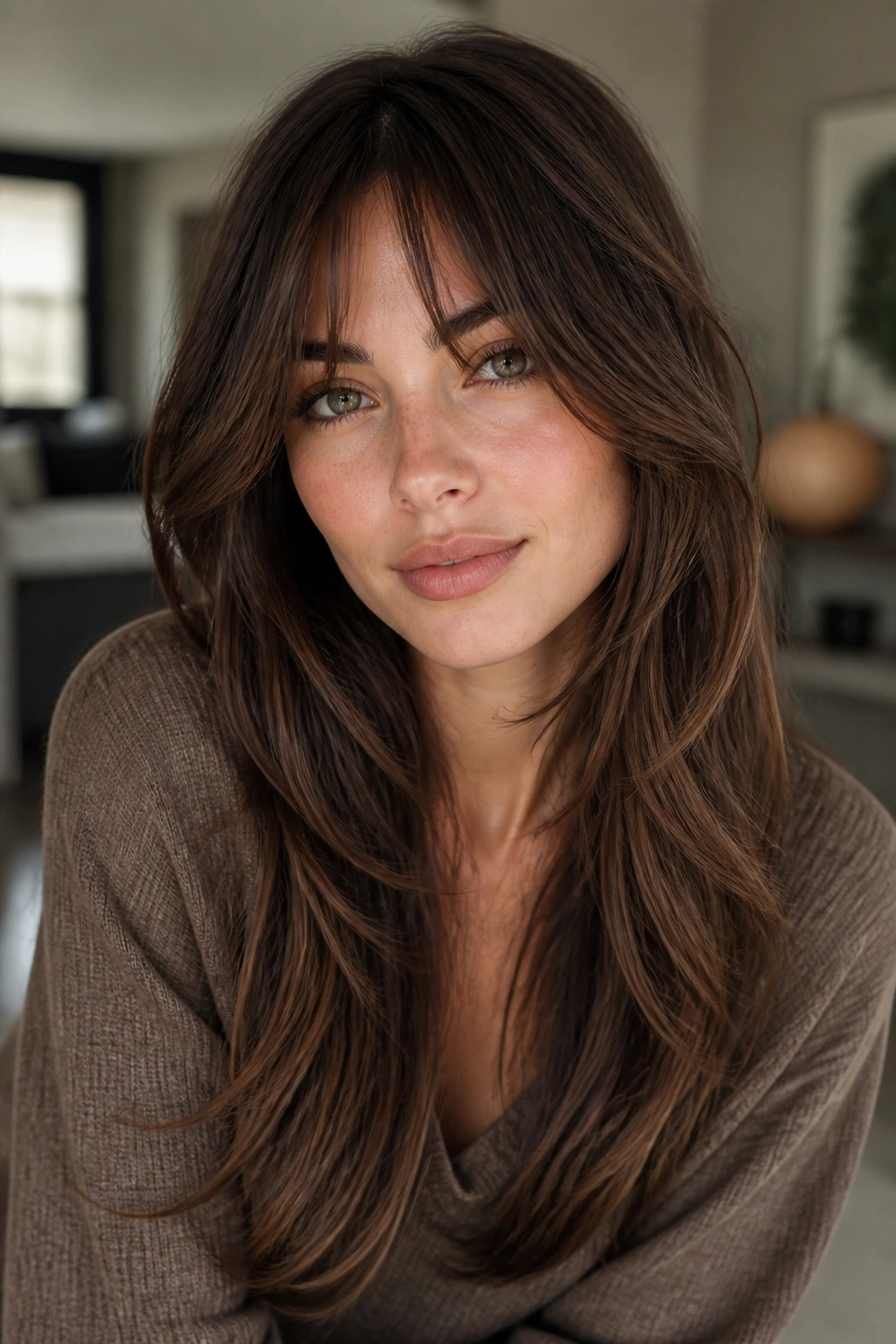
Bottleneck bangs sit somewhere between curtain bangs and a fuller fringe, and they’re a very good partner for long layers. The center is a bit shorter, the sides open out softly, and the whole front section blends into the rest of the haircut without feeling too severe. It gives the face some shape without stealing the show.
That blend is the point.
Why this pairing works
Long layers soften the body of the hair, while bottleneck bangs create a focal point around the eyes and cheekbones. Because the bangs are narrow at the center and wider at the sides, they feel lighter than a solid fringe and easier to grow out than blunt bangs.
How to keep them wearable
- Blow-dry the center forward first
- Direct the side pieces away from the face with a small round brush
- Keep the longest layer under the bang line so the blend stays smooth
- Trim the fringe before it gets into your eyes
This style is especially nice if you want to look styled even on days when the rest of the hair is loose and easy. It has that “I made an effort, but not too much” feeling, which is honestly a useful thing.
16. Long Layers with Blunt Ends

A blunt end line gives long layers a backbone. Without it, layered hair can drift into wispy territory, especially if the hair is fine or medium in density. Keeping the ends blunt while layering the interior gives you the best of both worlds: movement up top and a strong finish at the bottom.
I’m a fan of this for women who like their hair to look thick even when it’s long. The ends hold the eye. They make the whole cut feel intentional.
What the shape does
The layers create movement through the middle and front, but the blunt edge keeps the length looking dense. That means the haircut can still look polished when it’s straight, and it can still move when it’s waved or curled.
This is a good fit if:
- Your hair thins out at the ends
- You like long, sleek lengths
- You want layers without losing the feeling of thickness
- You don’t want the bottom to look choppy
The one thing to watch is balance. If the layers climb too high and the ends stay too blunt, the cut can look disconnected. The goal is a clean handoff from the layers to the perimeter. Smooth. Not heavy.
17. Curly Long Layers That Protect the Pattern
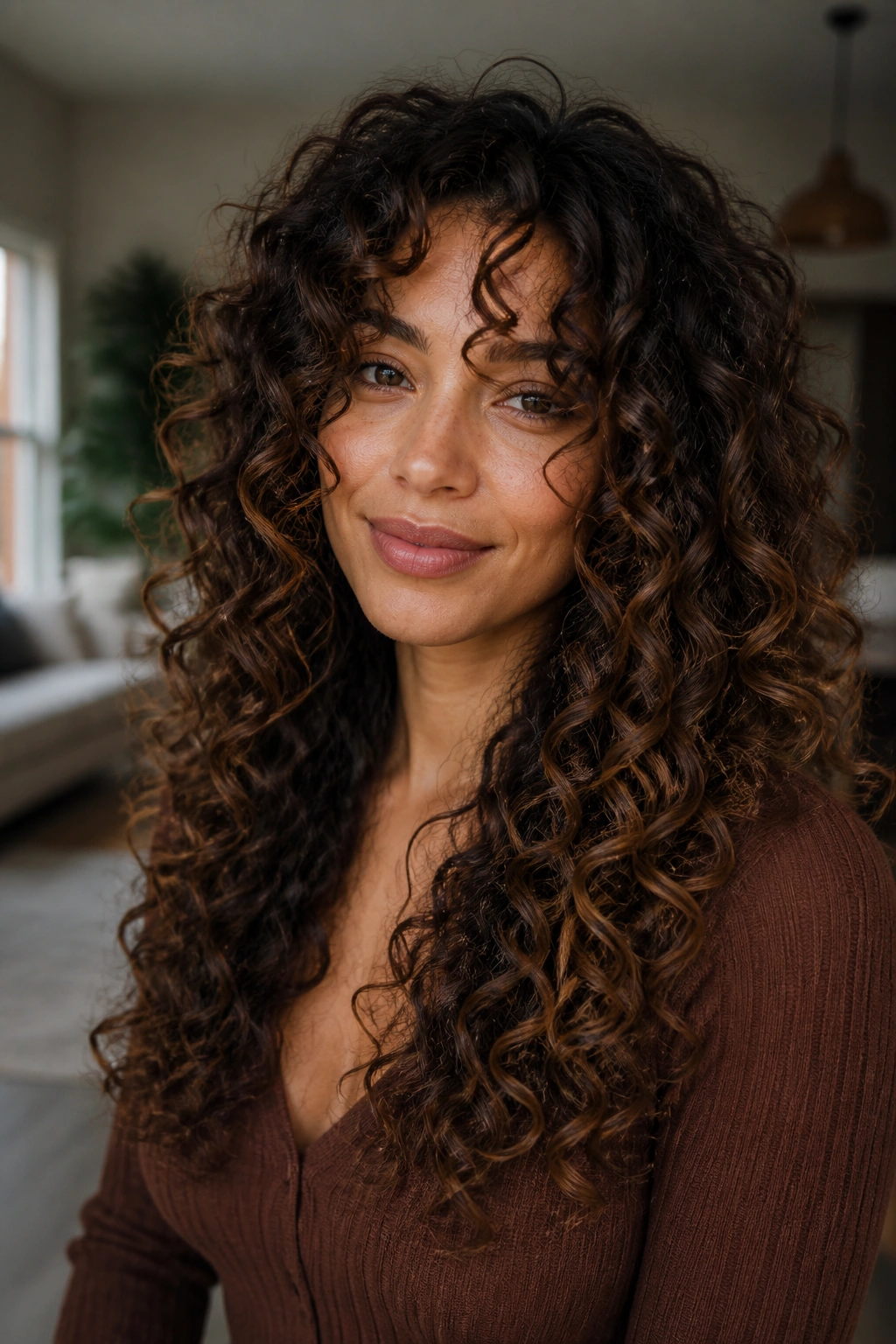
Curly hair needs layers that respect the curl pattern, not fight it. That means the cut should be shaped with shrinkage in mind, because curls can jump up more than you expect once they dry. A good curly layered cut keeps the curls from stacking into a triangle and lets each section live in its own space.
A dry cut is often the smartest move here. It lets the stylist see where the curls actually fall, which is more useful than guessing while the hair is wet and stretched out.
What to tell your stylist
- Show the hair in its natural curl pattern
- Ask for long layers that follow the curl family
- Keep weight removal focused where the hair feels dense
- Avoid thinning shears unless the hair is very thick and resilient
Curly layers should create spring, not frizz. That means the ends need to stay healthy, and the shape needs to be built around the curls you actually have, not the ones you wish were there. There’s a big difference.
If you wear your curls loose, this cut can make them look lighter and more defined. If you usually pull them back, the layers should still gather nicely without puffing around the face.
18. Tapered Long Layers for Maximum Movement

Tapered layers gradually shorten in a way that makes the hair feel like it’s moving from the inside out. The shape is smoother than a shag, less obvious than a V-cut, and very good at stopping that “heavy at the bottom, flat at the top” problem. It’s especially useful if your hair gets too wide through the mid-lengths.
Think of it as a haircut that narrows the bulk without advertising every snip.
Why this one wears well
Tapering keeps the ends from looking stacked or stepped. The layers blend into each other, so the silhouette stays sleek even when there is a lot of movement inside the cut. That’s one reason it looks good in a ponytail too. The pieces fall out softly instead of sticking up like antennae.
A few signs this might suit you:
- Your hair feels bulky in jackets or sweaters
- Your waves or curls expand in the wrong places
- You want motion without a big change in length
- You like a softer back view
This cut is quietly useful. Not flashy. Not boring either. It’s the kind of long layered haircut that solves a real problem and then gets on with its day.
19. Rounded Long Layers That Follow the Head Shape

A rounded layered cut makes the hair curve gently around the head instead of dropping straight down or pointing into a hard V. That small shift changes the whole mood. The shape feels softer, fuller, and a little more polished, especially when the hair is worn loose.
It’s a beautiful choice for women who want fullness around the sides and back, not just around the face.
Where it shines
Rounded layers are strongest when the hair has enough density to hold the curve. On medium to thick hair, the shape can feel lush without getting bulky. On finer hair, the roundness needs to stay subtle, or the cut can fall flat at the sides.
Ask for:
- A rounded perimeter rather than a pointed one
- Long layers that support the curve
- Soft blending at the crown
- Balanced weight on both sides of the head
This is one of those shapes that reads as finished even when air-dried. A quick blow-dry can sharpen the curve, but the haircut itself does a lot of the work. That’s the goal, really. A cut that behaves.
20. Soft Wolf Layers for Long Hair

The wolf cut gets a lot of attention, but the long-hair version is much easier to wear than the sharper versions people argue about online. Soft wolf layers keep the crown a little shorter, taper the sides, and leave the length intact enough that the whole look still feels feminine and long. It has edge, but not chaos.
That is the balance I’d aim for.
Why the long version works better
Short wolf cuts can feel too extreme if you are attached to your length. The long version keeps the dramatic crown shape and texture, but the lower sections stay long enough to pull back, braid, or wear sleek. You get movement and attitude without giving up the ponytail.
Best for:
- Wavy hair that needs personality
- Thick hair that feels heavy all over
- Women who like a lived-in texture
- Hair that looks better a little messy than too polished
A soft wolf cut is not for everyone. If you want neat lines and a classic finish, skip it. If you like a cut that feels a little cool even when you did almost nothing to it, this one has real charm. Especially on long hair.
Final Thoughts
The best long hair cuts with layers are the ones that match your hair’s weight, your face shape, and your morning routine. That sounds simple, but it is where a lot of bad haircuts begin: not from a lack of skill, but from the wrong kind of layering for the person sitting in the chair.
If you hate spending time styling, lean toward softer shapes like invisible layers, a U-cut, or minimal face-framing. If you want movement and a blowout feel, butterfly layers, feathering, and curtain bangs give you more to work with. Thick hair usually needs structure and weight removal. Fine hair usually needs restraint.
Bring photos, sure. Better yet, bring one photo of the shape you like and one of a cut on hair with a texture closer to yours. That second image is the useful one. It saves a lot of guesswork, and your stylist will thank you for it.
