



The best curly layered haircuts for long hair don’t look like they were chopped at random. They look intentional, even when the curls are loose and a little wild around the edges. That’s the whole trick: long curls need shape more than they need length.
A one-length cut can make curls hang like a heavy curtain. Too many layers can do the opposite and leave you with frizz, gaps, or a pyramid shape that only looks good for about ten minutes after styling. The sweet spot sits somewhere in the middle, where the layers follow the curl pattern, lighten the bulk, and still leave enough weight at the ends to keep the shape from blowing apart.
Curly hair is stubborn in the best possible way. It shrinks, bends, expands, and changes personality depending on humidity, product, and how it was cut. A good layered cut respects all of that instead of fighting it.
1. Long Face-Framing Layers

Long face-framing layers are the safest starting point when you want movement without a dramatic chop. They keep the length you spent years growing, then carve out a softer shape around the cheekbones, jaw, and collarbone. On curly hair, that framing matters even more because the curl pattern tends to lift the front of the haircut on its own.
Where the Shape Starts
The best versions usually begin around the cheekbone or just under the chin, then angle down into the rest of the hair. That gives your curls a place to fall instead of bunching up around your face. If your curls are tighter, the shortest pieces should usually stay a little longer than they would on straight hair.
What to ask for: face-framing layers that connect smoothly into the length, not a blunt front section.
- Keeps the perimeter full
- Softens round or square faces
- Works well with side parts or middle parts
- Needs very little daily styling
My take: if you want a visible change without losing length, start here. It’s hard to mess up when the cut is done with restraint.
2. Butterfly Cut for Curly Long Hair

The butterfly cut has a lot of reach because it gives long curls two jobs at once: lift at the crown and length at the ends. The top layers are shorter and feather out around the upper face, while the lower section stays long and swishy. On curls, that contrast can be gorgeous when it’s handled lightly.
What I like about this cut is that it creates the feeling of volume without asking you to sacrifice all the weight at the bottom. That matters if your curls are dense or prone to spreading outward instead of falling down. The shortest pieces should still blend, though. If the layers are too abrupt, the haircut starts looking like two separate haircuts living on the same head.
This one works best when your stylist cuts with your curl pattern in mind and leaves enough length in the upper section for shrinkage. A dry finish tells the truth fast. Wet curls lie.
If your hair tends to collapse at the crown and puff out at the ends, this shape fixes the balance in a way that’s easy to style. A diffuser and a little root lift are usually enough.
3. Soft Curly Shag With a Fringe

The shag is the cut people picture when they want curls to look loose, a little messy, and full of personality. On long hair, the soft shag keeps the edges long but breaks up the bulk through the middle, so the curls move instead of sitting in one heavy block. Add a fringe, and the whole cut gets more interest right away.
Why It Works on Long Curls
A shag creates separation between the crown, mid-lengths, and ends, which helps if your curls get triangle-shaped. The fringe pulls attention upward and gives your face some shape even when the rest of the hair is air-dried. It’s also a forgiving cut on days when you don’t want to do much.
The catch is that a shag needs a hand that understands curl shrinkage. Short layers that look cute when wet can land much shorter once they dry. That’s not a small detail. It changes the whole haircut.
- Best for medium to thick curls
- Good if you like a lived-in look
- Easy to refresh with a quick mist and scrunch
- Less ideal if you hate volume at the crown
A soft shag is one of those cuts that looks more interesting the second day, which is a nice trait to have.
4. Rounded Layers That Build a Halo
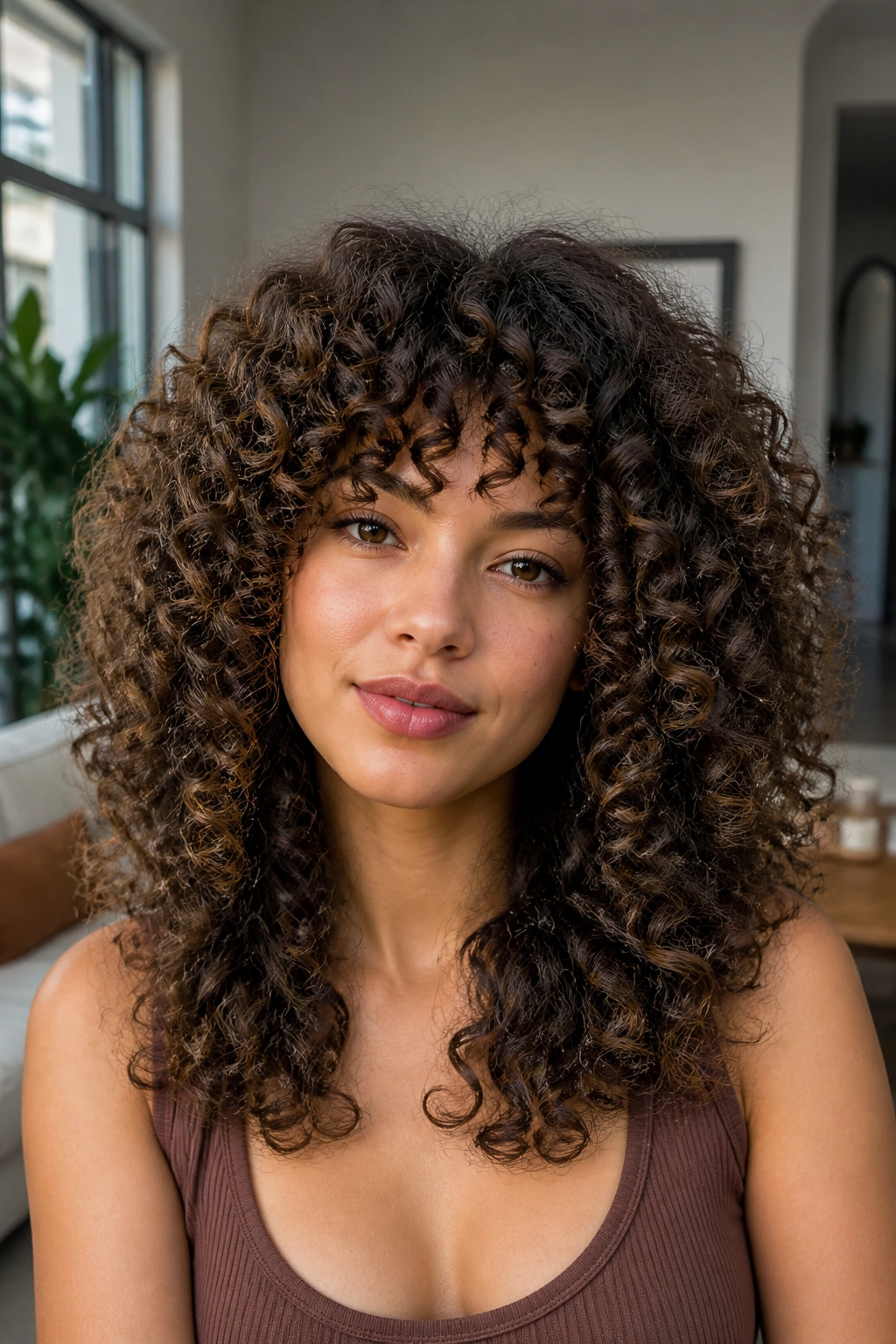
Rounded layers are for people who want their curls to feel full all the way around the head, not heavy in the back and flat near the top. The shape follows the curve of the head, so the hair expands into a soft halo instead of dropping into a boxy outline. It’s a pretty cut, but it’s also practical.
I’ve always liked this shape on long curls because it gives the hair a controlled kind of width. The silhouette feels balanced from every angle. If your curls are dense, rounded layers stop the sides from flaring out like wings. If your hair is finer, they can make the style look more complete without taking off too much length.
The styling is straightforward. Use a lightweight curl cream, rake it through in sections, then scrunch upward and diffuse until the roots feel dry and the curl clumps hold together. Don’t overdo the product. Heavy formulas can collapse the halo effect fast.
This cut shines on people who like fullness and movement more than sleekness. It’s not the quietest shape in the room. That’s part of the charm.
5. V-Shaped Layers for Swing and Length
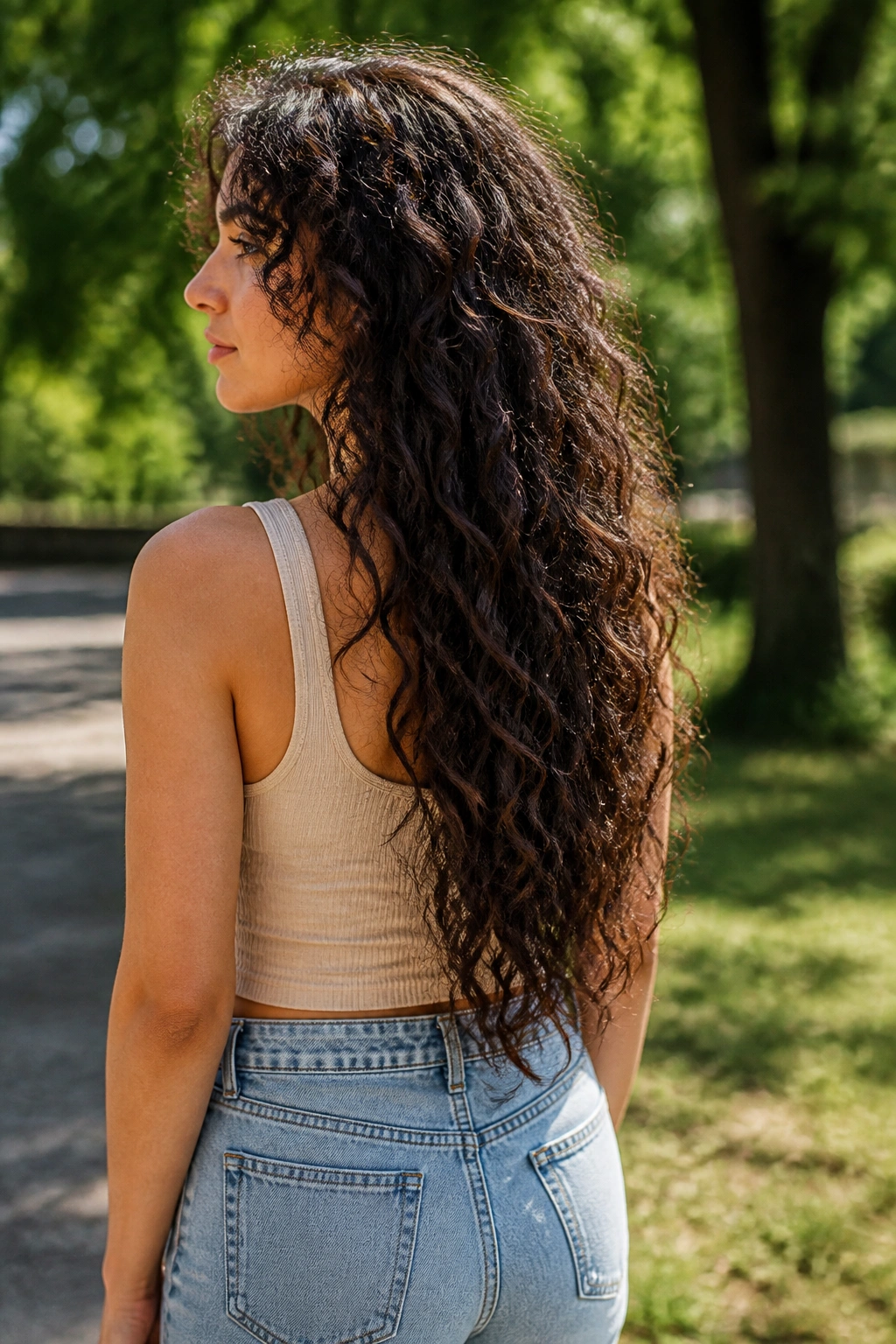
A V-shaped layered cut gives long curly hair a pointed finish in back, with the longest pieces forming a soft tail down the center. It sounds dramatic, but on curls the effect is usually less sharp than it sounds. The result is length that still moves, especially when you turn your head.
The V shape works because it pulls the eye downward. That makes the hair feel longer and leaner while the layers around the sides keep it from looking flat. If your curls are thick, this shape can take away some of the heaviness that makes long hair feel stuck to your shoulders. If your curls are looser, it gives them a little more bounce.
Best Use Case
This is one of the better options if you love wearing your hair half up. The layers fall neatly when worn down, and the point at the back keeps the shape from turning into one solid mass. I’d avoid it if your curls are very fine and you lose density at the ends. A V can look thin there if too much weight comes off.
The cleanest versions keep the point soft rather than severe. That way the cut grows out without looking jagged.
6. U-Shaped Layers With Gentle Fall
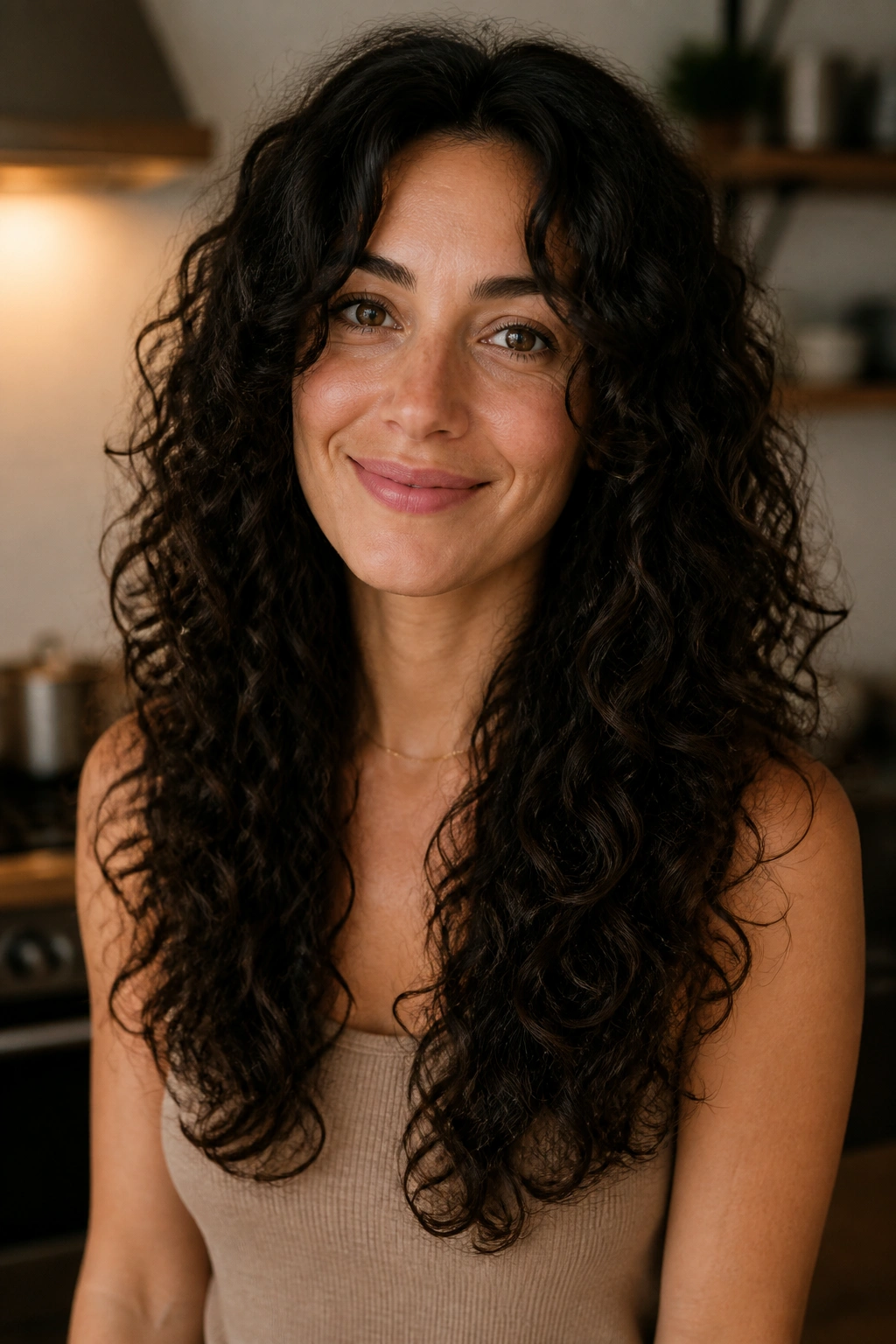
The U-shaped cut is the quieter cousin of the V. Instead of dropping into a pointed back, it curves softly, so the ends feel fuller and more even. On curly long hair, that’s a smart move if you want shape without losing the feeling of abundance.
This cut works because it gives you a controlled outline without making the back look chopped. The sides still sit a little shorter than the center, but the difference is subtle enough that the whole style reads as one shape. That matters when your curls are large and springy, since strong angles can get lost anyway.
It’s also one of the easiest shapes to live with. The grow-out is kind. You won’t be staring at the mirror in six weeks thinking the back looks weird. Instead, the curve just gets a little softer.
A U-shape is a good call if you like polished hair but don’t want the cut to shout. There’s a calmness to it. Sometimes that’s exactly what long curls need.
7. Invisible Interior Layers for Thick Curls
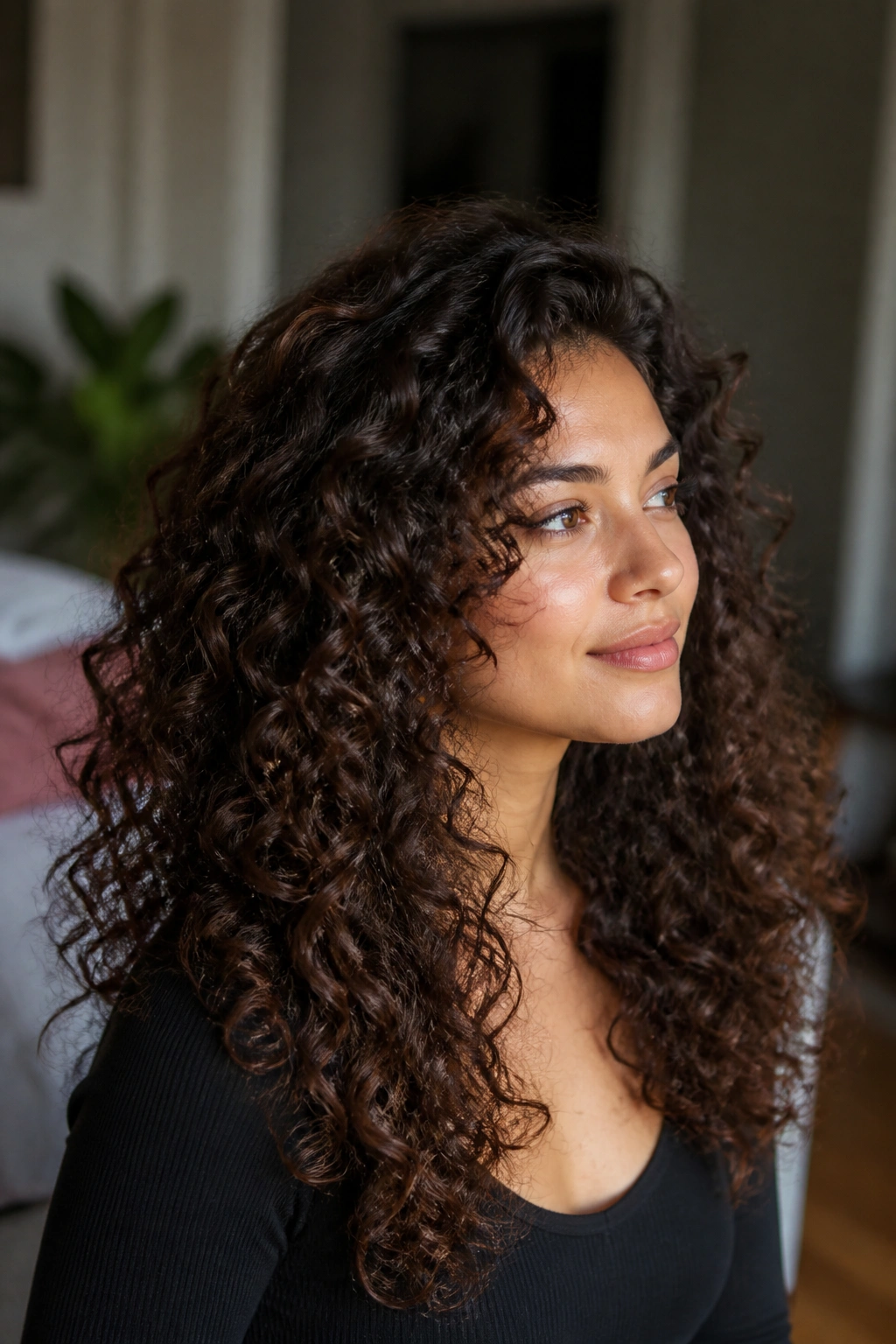
Invisible layers are the workhorse cut for heavy, dense curls that feel like too much hair once they dry. The outer shape stays long and smooth, but the weight gets removed from the inside. That lets the curls sit better without broadcasting every layer from the outside.
This is the kind of cut people often miss because they expect layers to be obvious. Here, they’re not. The trick is to keep the silhouette full while reducing bulk where it causes puffiness and drag. On thick curls, that can mean the difference between hair that collapses forward and hair that actually holds a shape for more than an hour.
What Makes It Different
The outside still looks long and healthy. The inside does the hard work.
- Helps thick curls dry with less bulk
- Keeps the ends from looking sparse
- Reduces the “triangle” shape
- Makes styling faster because the hair has less weight to fight
If your hair takes forever to dry or feels heavy at the roots, this cut can be a relief. It’s not flashy. It’s useful, and honestly, that’s more valuable.
8. Waterfall Layers for Loose Ringlets

Waterfall layers are a nice fit for curls that are looser, shinier, and more defined from root to tip. The layers cascade in a way that lets each section fall over the next, which gives the cut a softer, flowing look. There’s less bluntness, more movement.
What makes this haircut stand out is the sense of motion. As you turn, the curls shift in little waves instead of hanging in one block. That effect is especially good when your ringlets have a bit of stretch and don’t shrink too aggressively. The layers can show off the curl pattern instead of interrupting it.
I’d be careful with this one if your curls tangle easily. Too much layering at the wrong spots can create rough ends that snag. The cut should still leave enough length at the bottom to hold the curl together.
How to Style It
Use a leave-in and a medium-hold gel, then scrunch with a microfiber towel before diffusing on low heat. The definition matters here. If the curl clumps break apart too much, the waterfall look turns fuzzy.
It’s a pretty shape without trying too hard. That’s why it works.
9. Long Curly Wolf Cut

The curly wolf cut is a little rebellious, and that’s exactly why it works. It takes the shag’s choppier energy and pushes it further, with shorter layers up top and longer, looser lengths underneath. On long curls, the style can look very alive. Not neat. Alive.
This cut has a strong personality, so it suits people who like volume, separation, and a little edge around the face. It works especially well when your curls are dense enough to hold a shape without collapsing. If your hair is fine, the same cut can go sparse fast. That’s the price of going choppy.
The best wolf cuts on curly hair keep the top layers high enough to build lift but not so short that the crown sticks out like a helmet. That balance is touchy. You want airy, not cartoonish.
If you air-dry a lot and don’t mind a bit of untamed texture, this one is a blast. It looks better when it’s not trying to be perfect.
10. Curtain Bang Layers That Melt Into the Length

Curtain bangs can change long curly hair fast, and they do it without a full haircut overhaul. The bang section opens in the middle or just off-center, then melts into the face-framing pieces and outer layers. On curls, the result is soft, flattering, and a little romantic without leaning fussy.
The main thing here is length. Curly bangs need to be longer than straight bangs because they spring up after the cut. A stylist who understands that will leave room for shrinkage and shape the bangs in a way that still works dry. Short curly bangs can be cute, but they can also get annoying quickly if you’re not into constant trims.
This cut is a good match for people who want change around the face more than everywhere else. It draws the eye upward and makes the rest of the layers feel intentional. That matters. A random fringe on top of long curls can look like a mistake. A good curtain shape looks like it belonged there all along.
11. Dry Curl-by-Curl Layers
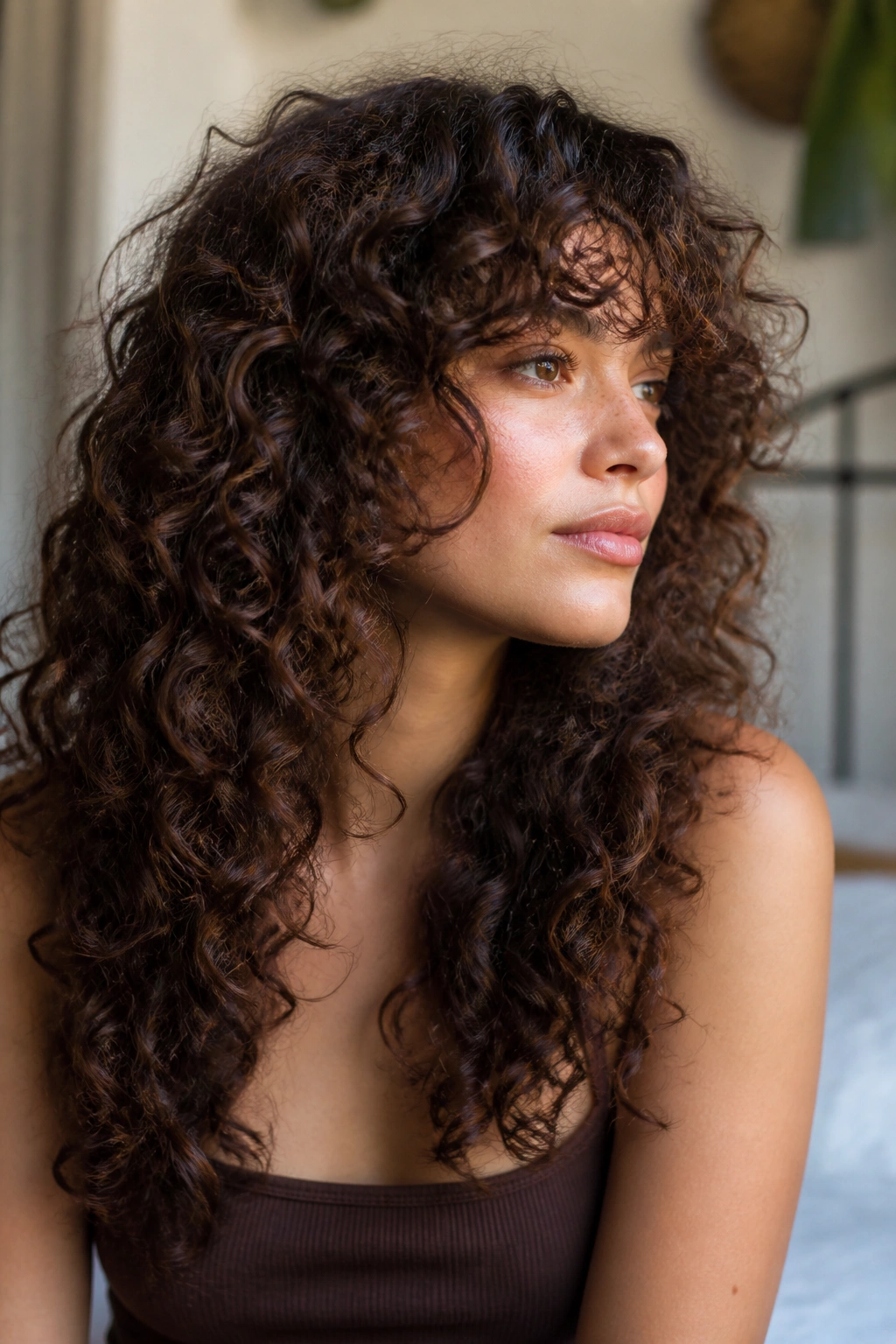
Dry curl-by-curl cutting is a different experience entirely. The hair is cut in its natural state, curl by curl, so the stylist can see exactly how each piece sits, bends, and shrinks. That’s a huge advantage for long curls because the haircut is shaped around the actual texture, not a guess.
The Real Advantage
The cut follows your pattern instead of forcing it into someone else’s idea of symmetry. That sounds simple, but it changes everything. A curl that sits high near the temple may need a different length than the one behind the ear. A wet cut can miss that. A dry cut sees it.
This method takes time, and it should. Rushing a dry cut is a bad idea. You want a stylist who works section by section, checks the balance often, and keeps comparing the sides in natural light if possible.
- Better for people with mixed curl patterns
- Helpful when one side shrinks more than the other
- Good if you’ve had uneven layers before
- Not the fastest salon service
If you’ve ever left a haircut thinking, “This looked different wet,” a dry cut is probably worth trying.
12. Internal Layers for Heavy, Dense Hair

Internal layers are the quiet fix for curls that are long, thick, and a little too much to manage in one shape. Instead of making the outside look chopped, they remove weight from hidden areas inside the haircut. The top line stays clean. The bulk goes down.
That matters because dense curls can eat up volume in bad places. Too much width at the sides, not enough movement at the crown, a heavy shelf at the bottom—those are the usual problems. Internal layers help redistribute the weight so the hair sits closer to the head without losing its natural fullness.
How It Feels in Real Life
You feel the difference when you wash and style. The hair dries a little faster, the roots lift better, and the ends don’t drag as hard. It also helps when you tie your hair back, because the bun or ponytail doesn’t feel like a small backpack.
This is one of those cuts that looks modest on day one and keeps paying off later. Not glamorous. Useful. Which, frankly, is what dense curls need most.
13. Long Layers for Fine Curly Hair
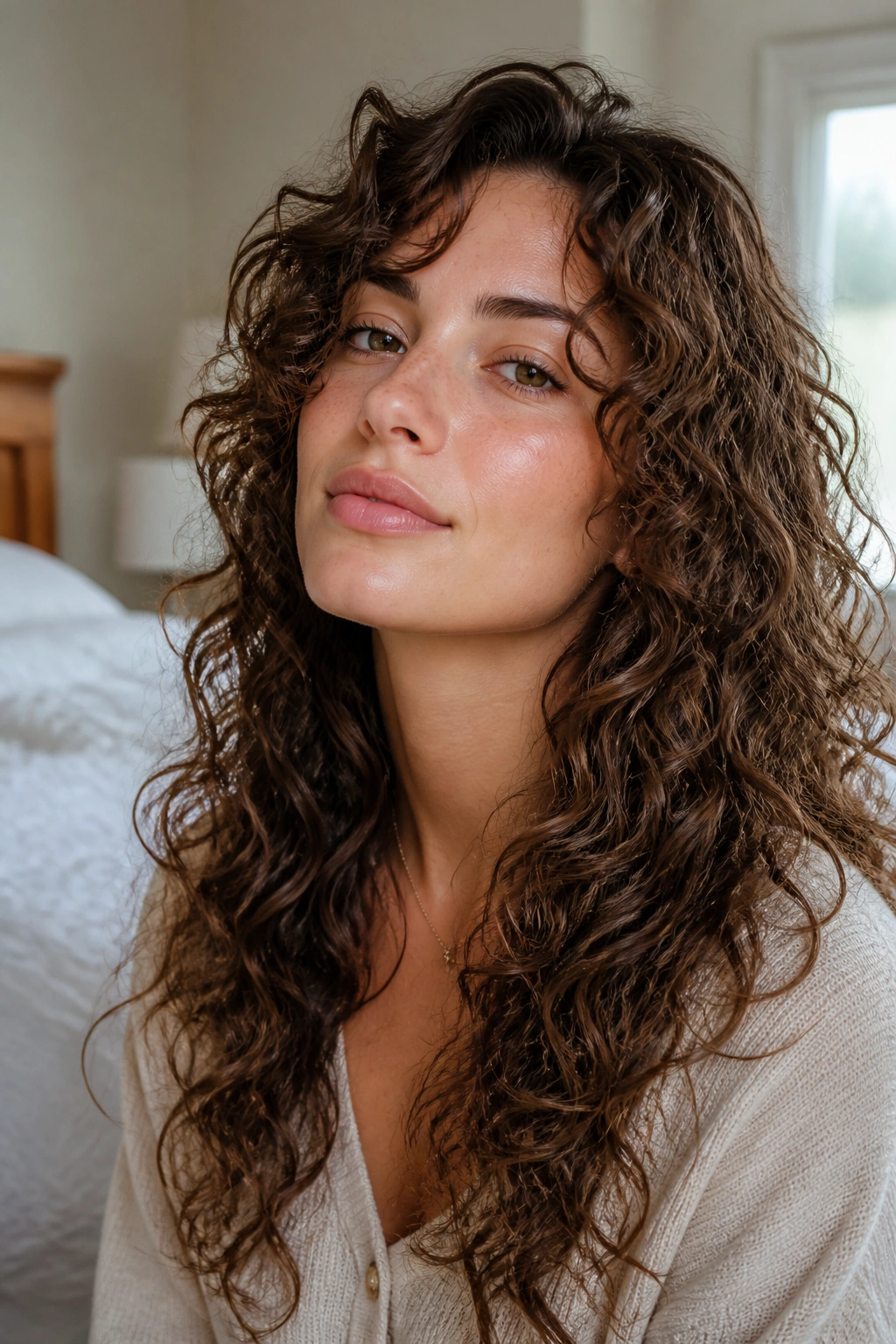
Fine curly hair needs a light hand. Too many layers can steal the body right out of it, leaving the ends see-through and the crown too airy. Long layers keep the length while adding enough lift to stop the style from lying flat against the head.
The key is restraint. The shortest layer should usually stay well below the chin unless your curl pattern is very springy and your hair has enough density to support it. The goal is movement, not holes. I see this mistake a lot: people ask for “lots of layers” because they want bounce, then wonder why their curls look thin after drying.
Long layers give you shape without taking apart the whole outline. They work nicely if your curls are loose to medium and you like to wear your hair down often. The cut grows out neatly, too, which is useful when you don’t want to be in the salon every few weeks.
A little volume spray at the roots can help here. Use a light touch. Fine curls don’t need much pressure to lose their shape.
14. Tapered Layers for Coily Long Hair
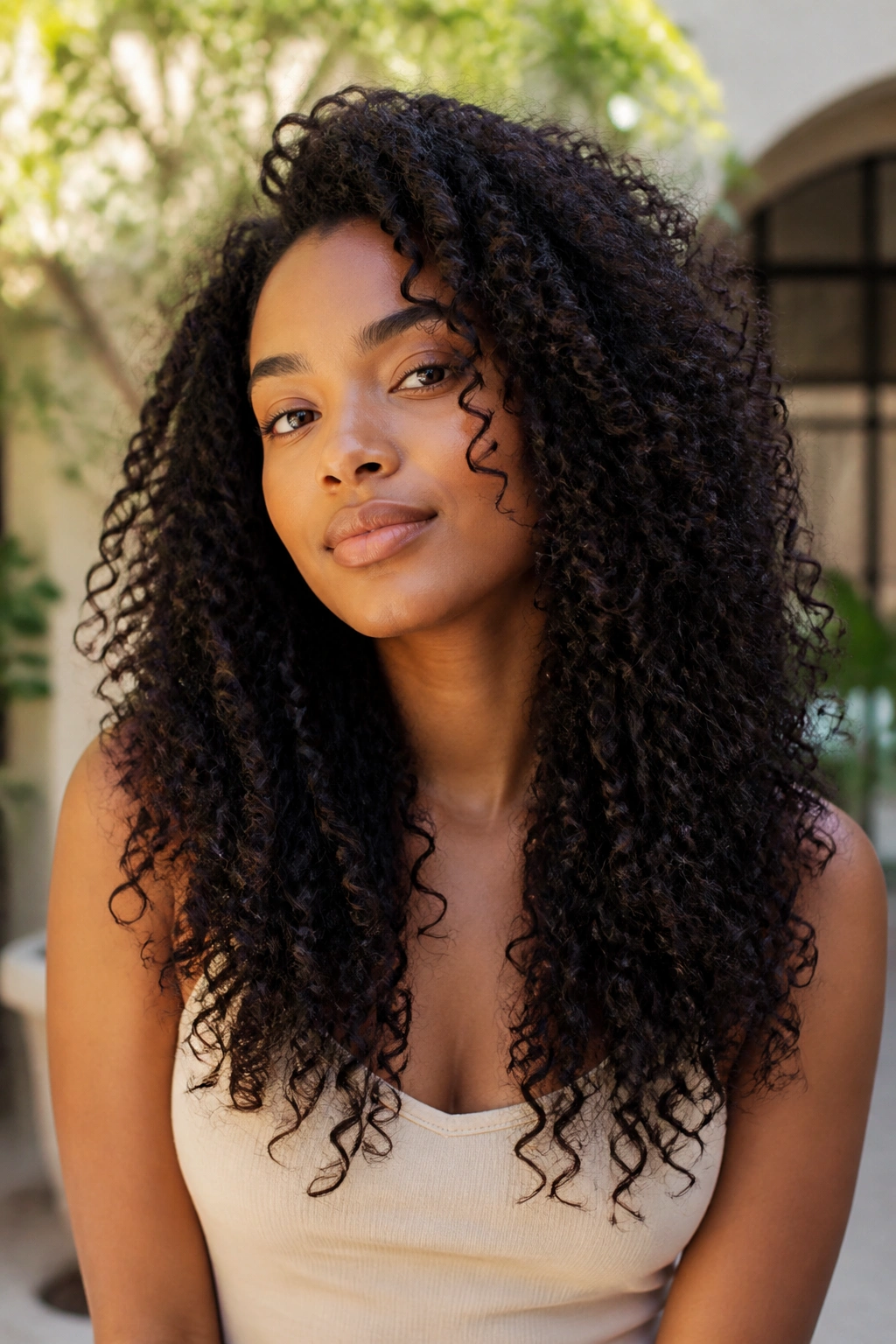
Tapered layers are a smart way to shape long coily hair without fighting the shrinkage. The hair gets progressively shorter in a controlled way, so the silhouette narrows toward the top and stays fuller toward the ends. That avoids the mushroom shape that can happen when coily hair is left one length.
The strongest version of this cut respects curl spring. Coils can shrink a lot more than loose curls, so the haircut needs room to move. A stylist should shape the hair while it’s dry or at least partially dry, then compare each section carefully. Straight-line thinking doesn’t help much here.
What to Watch For
The layers should not break the outline into choppy shelves. That’s the fastest way to make long coily hair look thin in spots. A good taper feels smooth when the hair is worn out and still tucks well when stretched or twisted.
This shape also helps the hair sit better under protective styles. Cornrows, twist-outs, and puffs all behave better when the ends have been given some structure. The cut does some of the work for you.
15. High Face-Frame Layers That Open the Cheeks

This is the cut for someone who wants the face to show up first. High face-frame layers start a little above the classic cheekbone placement and open the sides of the face without shortening the back too much. On long curls, that can make the whole style feel brighter and more lifted.
It’s a bold choice, but not a harsh one if it’s done well. The trick is keeping the transition soft. The shortest pieces should still blend into the rest of the haircut, not hang there like separate bangs that forgot to join the group. A clean diagonal line is what keeps the front from feeling messy.
I like this cut on people who wear glasses, hoop earrings, or heavy collars, because it keeps the face visible. It also helps if your curls naturally pile up around your jaw and you want a little more room there.
This one does ask for a bit of maintenance around the front. A trim every so often keeps the frame from drifting into your eyes. Small price.
16. Minimal Layers for Low-Maintenance Curls
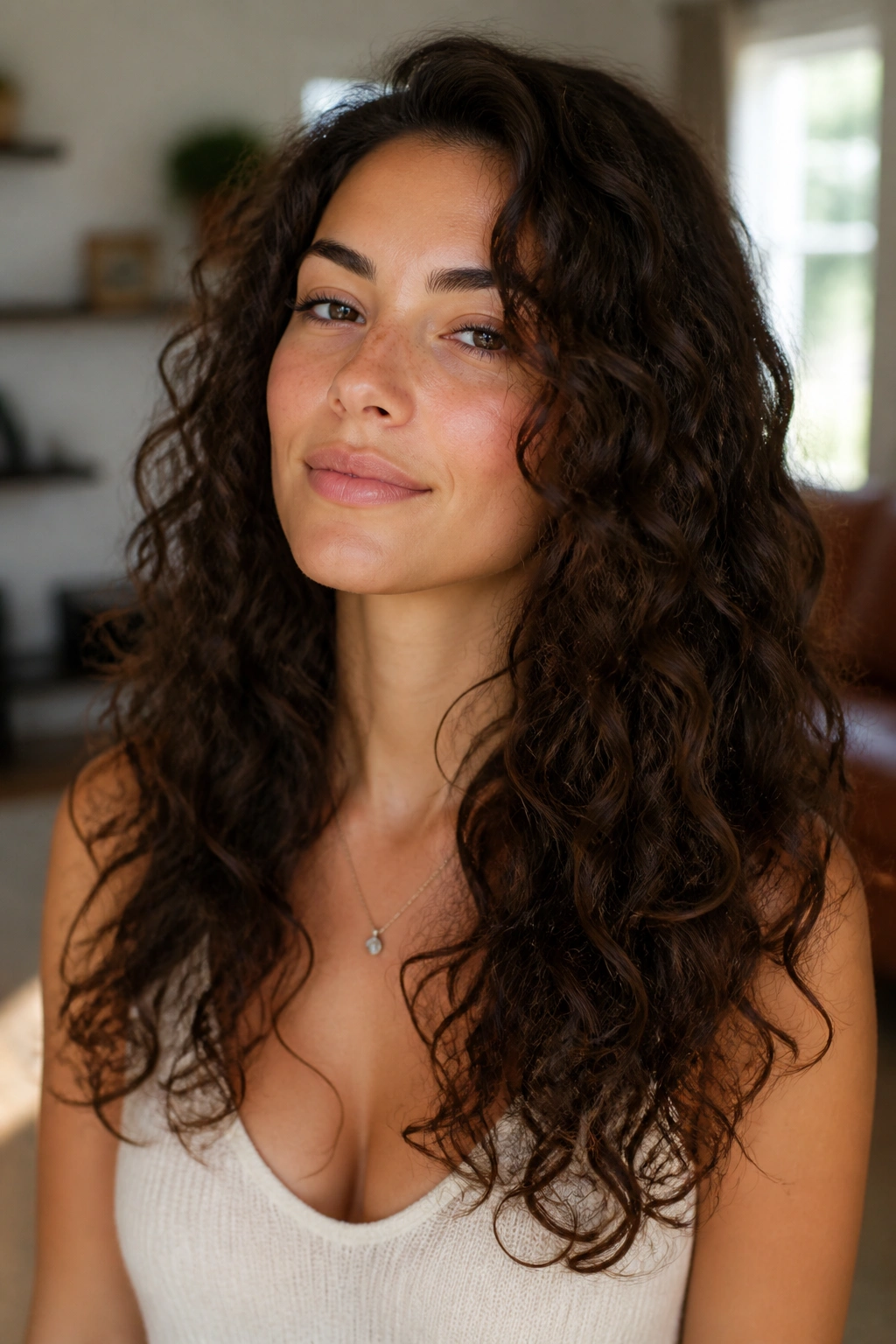
Minimal layers are for people who want shape, not a full style project. You keep most of the length intact and add only enough layering to stop the hair from falling like one heavy sheet. That makes the cut easy to live with and easy to grow out.
The appeal is obvious. Less shaping means fewer strange grow-out phases. Less internal cutting means the hair keeps more weight, which is useful if your curls need a little help staying defined. Minimal layers also work well if you like ponytails, braids, or half-up styles, because the ends still have enough density to look full.
A Good Fit If You…
- Air-dry most of the time
- Don’t want a lot of salon upkeep
- Prefer one simple shape over a lot of movement
- Need a cut that won’t get weird in six weeks
There’s a reason this style stays around. It does the quiet job of making curls behave without stealing the length you care about. Not every haircut needs to make a statement.
17. Crown-Lift Layers for Flat Roots

Some curls have gorgeous ends and a sad little root area that refuses to lift. Crown-lift layers fix that by placing shorter pieces near the top of the head so the hair can rise instead of dragging downward. The result is more body where it matters most.
This cut is especially useful for people whose curls flatten from sleep, hats, or the weight of long length. A lot of the time, the problem isn’t the curl pattern. It’s the way the weight pulls the whole top section down. A well-placed layer or two can change the shape of the entire head of hair.
The danger here is overcutting the top and leaving the crown too sparse. That’s a fast route to frizz. The layers should support lift, not create a hole. If you’re unsure, ask for a small amount of crown shaping first. You can always take more off later.
This style pairs well with root clips, diffusing upside down, and a light mousse at the base. The haircut does part of the job. Styling finishes it.
18. Side-Part Layers With a Sweeping Front
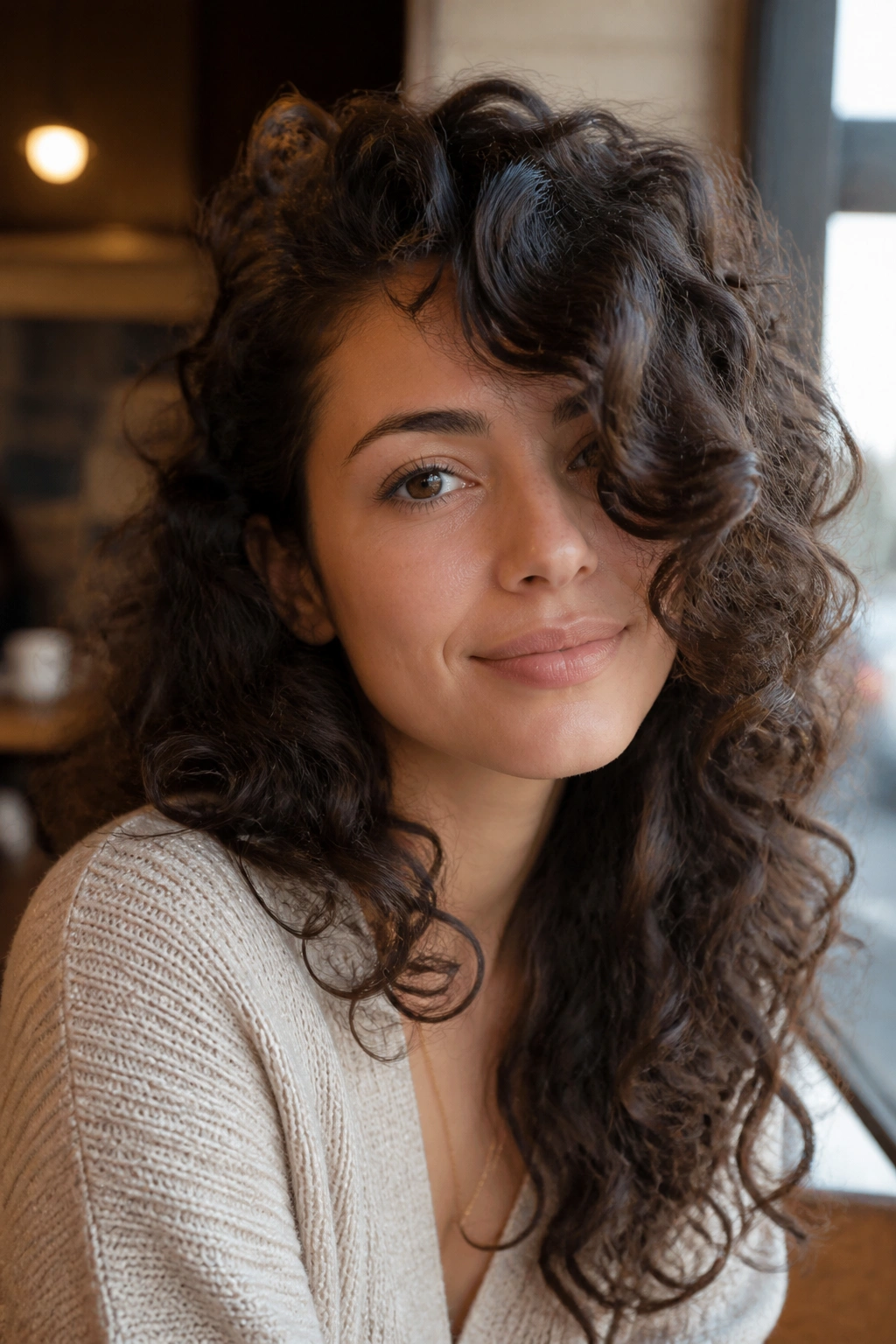
A side part can make long curly layers look more dramatic without adding a single extra snip. The sweep changes where the weight falls, so the hair feels fuller on one side and more open on the other. That asymmetry can be flattering in a way a center part sometimes isn’t.
The haircut itself usually leans into that side movement with longer front layers and a slightly heavier opposite side. It’s a small change, but it changes the whole mood. Curls that looked round and predictable can suddenly feel softer and more sculpted.
What Makes It Different
The side part gives the layers direction. Instead of all the hair falling evenly around the face, the curls travel. That creates a line the eye can follow, which helps long hair feel cleaner and more styled.
- Nice for oval and heart-shaped faces
- Good if one side of your hair is naturally fuller
- Easy to switch back to a middle part later
- Works with soft waves or tighter spirals
If you’re bored with your usual part but don’t want a radical change, this is an easy move. Sometimes the best haircut is the one that shifts the frame, not the whole photo.
19. Layered Cuts That Keep the Ends Full
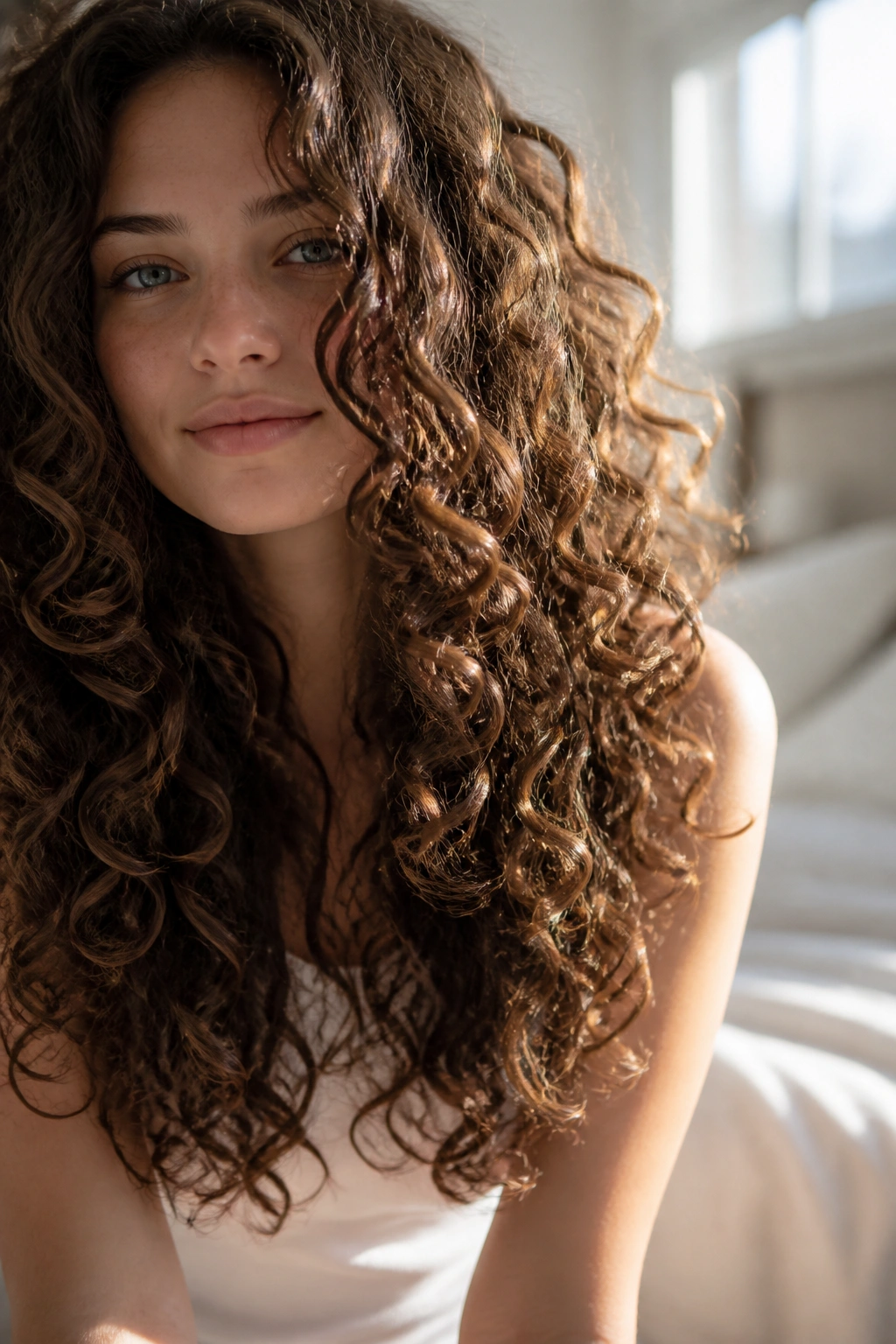
Not every curly layered haircut needs lots of movement at the bottom. Sometimes the smartest choice is to keep the ends dense and full while opening up the top and middle sections. That keeps the hair from looking stringy, especially if your curls are long and fine at the tips.
This cut is useful when the ends have already been worn down by heat, color, or years of tying the hair in the same place. Instead of chasing more layers, the cut preserves the strongest part of the length and avoids making the tail too thin. That kind of restraint is underrated.
The look is clean, heavy in a good way, and easier to braid or twist than a cut with a lot of broken-up ends. It also photographs better in motion because the curls still have enough mass to bounce together. I know, that sounds boring. It isn’t. Full ends are what make long curly hair look healthy.
A trimming schedule matters more here than a dramatic shape. Clean ends carry the style.
20. The Grow-Out Friendly Layered Cut

A grow-out friendly layered cut is the one I’d hand to anyone who wants long curly hair to look good for months without constant repairs. It uses soft layering through the face and mid-lengths, then keeps the overall outline smooth enough that it doesn’t fall apart as it grows. That’s not flashy, but it is smart.
The best grow-out cuts respect the fact that curls change shape between salon visits. Short layers should sit high enough to be useful but long enough to avoid awkward gaps once the hair stretches or shrinks differently on wash day. If the layers are too sharp, you spend the next few months fighting them. If they’re too soft, the haircut barely does anything at all. Finding the middle is the job.
Why This One Stays Useful
It works for people who like to stretch salon visits, wear their hair in buns often, or switch between defined curls and brushed-out volume. The shape keeps its outline without needing constant correction. That alone saves time.
The sweet spot is a cut that still looks deliberate after 8 or 10 weeks. Not every style does. This one does, which is why I keep coming back to it when someone asks for long curly hair that won’t become a maintenance headache.
