



Thick hair and layers get treated like a package deal, but they really aren’t. Short haircuts without layers for thick hair can look sharper, cleaner, and easier to live with than the usual heavily textured cuts, especially when your hair already has enough body to stand on its own.
The mistake I see over and over is people assuming thick hair needs a lot of carving and slicing to behave. Sometimes it does. Often it doesn’t. A blunt perimeter, the right length, and a smart part can tame bulk better than a dozen choppy pieces ever will. Thick hair is heavy by nature; when you keep the line solid, the weight does some of the work for you.
There’s also a big difference between hair that is thick because there’s a lot of it and hair that is thick because each strand is coarse. That matters. A haircut that looks tidy on dense straight hair can puff out on coarse waves, and a cut that lies flat on one person may spring up on another. So the goal here is not “shorter at any cost.” The goal is shape.
And shape, thankfully, comes in more forms than the usual layer-heavy bob everyone keeps recommending. Some of the best short cuts for thick hair are blunt, some are slightly angled, some use a fringe to break up the width, and some rely on a side part or a tucked finish to keep the whole thing from feeling helmet-like. The trick is picking the one that fits your hair’s behavior, not just the photo on the mood board.
1. Chin-Length Blunt Bob for Thick Hair
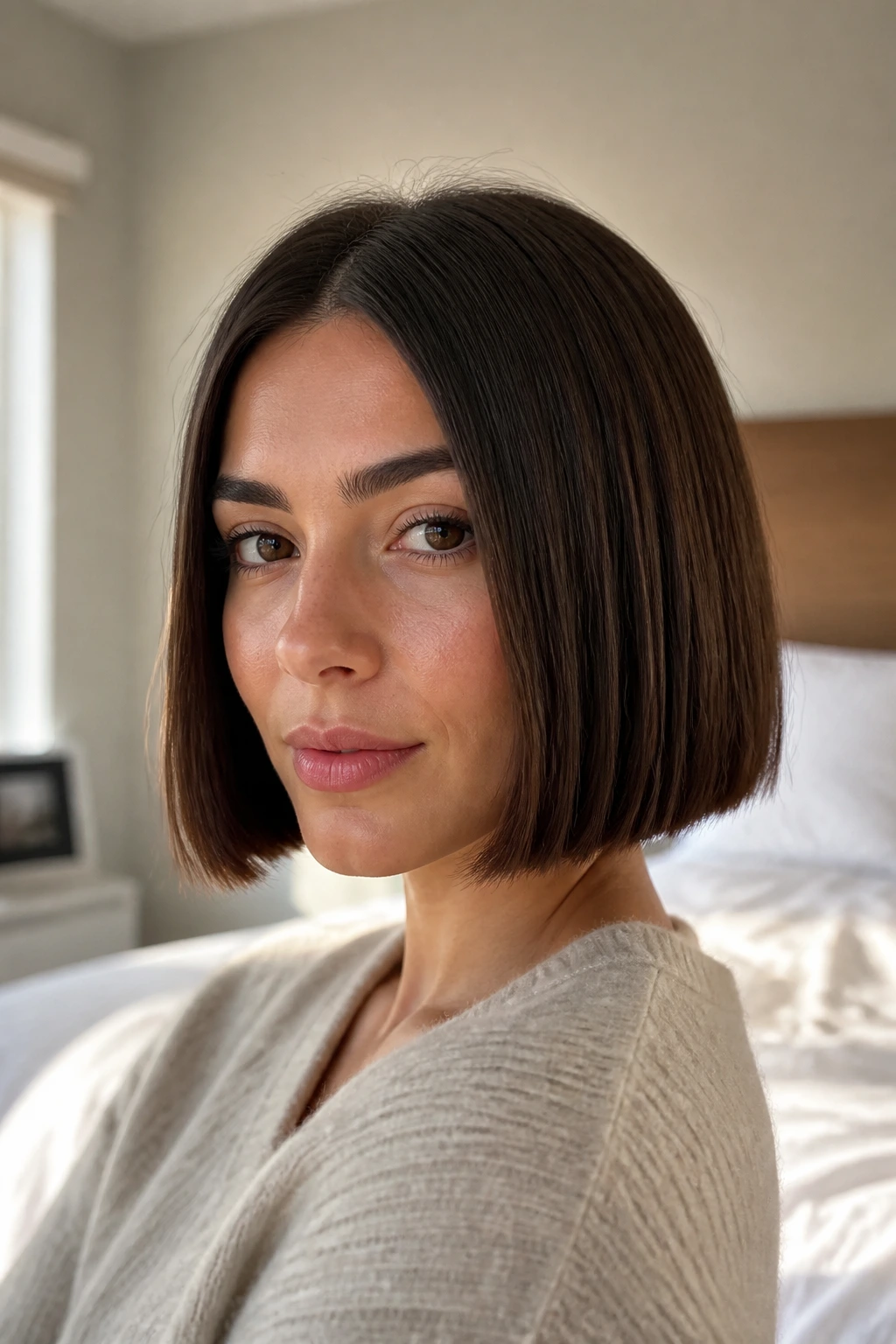
If you want a cut that makes thick hair look controlled instead of poofy, start here. A chin-length blunt bob gives you a hard, clean line right where the jaw starts, which helps the hair fall instead of ballooning outward. It is one of the most reliable short haircuts without layers for thick hair because the shape does the heavy lifting.
Ask for a one-length perimeter with minimal texturizing through the body. You want the ends to feel solid, not feathered. If your stylist reaches for thinning shears all over the place, slow them down. A little removal at the very bottom can help if your ends are bulky, but the whole point is to keep the interior intact.
This cut looks especially good if you wear a center part or a slight off-center part. It also behaves well with a quick blow-dry using a 1.5-inch round brush or a paddle brush and a flat wrap finish. Straight hair will look crisp. Wavy hair will look polished but still have some movement.
One sentence advice: The cleaner the line, the better this haircut behaves.
2. Jaw-Grazing French Bob

Why does the French bob work so well on thick hair? Because it takes the weight and puts it right where you want it. A jaw-grazing length keeps the style compact, and if you add a short fringe or a soft brow-skimming bang, the haircut stops feeling boxy.
Why It Works
Thick hair often looks widest when it hits the cheekbone or upper jaw with too much bulk underneath. A French bob sits close enough to the face to keep that width under control. It has a little attitude too, which helps if you’re tired of “safe” haircuts that do nothing but sit there.
The fringe matters here. It should be full enough to feel intentional, but not so dense that it steals all the light from your face. If your hairline has a cowlick or a strong front swirl, ask for a slightly longer fringe in the center. That tiny bit of extra length makes morning styling much less annoying.
What to Ask For
- Length: right at the jaw or just below it
- Perimeter: blunt, with no visible layers through the sides
- Fringe: optional, but best when kept blunt or softly broken at the ends
- Styling: air-dried with a light cream or blown under with a small round brush
This cut feels less severe when the ends are tucked under just a touch. Not curled. Just bent. That little bend keeps thick hair from looking like a shelf.
3. Micro Bob That Stops at the Ear Line

A micro bob sounds bold because it is. It’s the haircut for the person who’s done with all the extra hair and wants something that feels deliberate, sharp, and low on fluff. On thick hair, the micro bob can look almost architectural.
The key is control. You do not want a stacked shape at the back or a bunch of hidden layers sneaking in to “lighten” the cut. You want the line to stay clean from the nape to the front, usually landing somewhere between the earlobe and the top of the jaw. Any shorter and you’re drifting into crop territory.
This is one of those cuts that looks best when it is maintained. If you wait too long between trims, the shape can widen at the sides and lose the crispness that makes it work. Plan on a trim every 4 to 6 weeks if you care about the line staying neat.
It’s a strong choice if your hair is straight or only lightly wavy. If your hair is very dense and frizzy, it can still work, but you’ll need to keep the surface smooth with a blow-dryer or a flat iron pass. No drama. Just clean edges.
4. Italian Bob With a Heavy Finish

This is the easiest way to make thick hair feel polished without chopping it to bits. The Italian bob keeps a lot of body at the bottom, which sounds counterintuitive until you see how well it sits on dense hair. Instead of fighting the thickness, it uses it.
The cut usually lands somewhere between the jaw and the collarbone, and the ends stay blunt and full. What gives it that soft, expensive-looking movement is not layers. It’s how the hair is styled and how the weight is distributed around the face. Thick hair can hold that plush shape beautifully.
Use a medium round brush and direct the ends under only slightly. You want the top smooth, the sides full, and the bottom line solid. A smoothing cream or a light blow-dry balm helps a lot here, especially if your hair frizzes as soon as there’s humidity in the air.
This is not the cut for someone who wants wash-and-go perfection every day. It looks best when you give it a proper blow-dry. The payoff is worth it, though. Clean, glossy, full, and not at all fussy.
5. Slightly Angled Blunt Bob
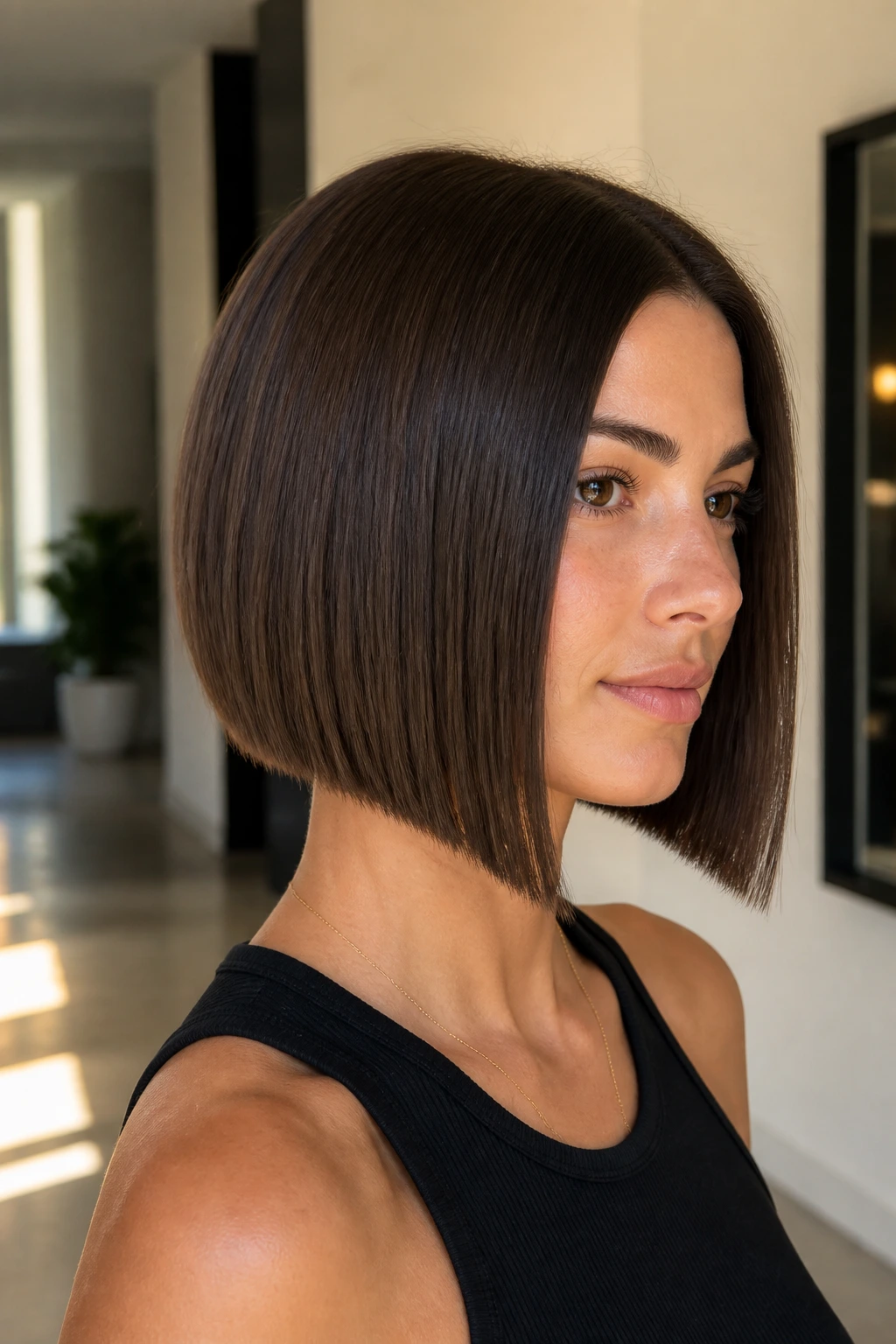
A sharp angle can get messy fast on thick hair. A slight one? That’s useful. The slightly angled blunt bob keeps the back a touch shorter and lets the front fall a bit longer, which helps the haircut feel lighter without actually layering the interior.
The Shape Matters
If the front and back are too different, thick hair can start to look triangular or dated. Keep the drop subtle—usually about half an inch to 1.5 inches from back to front is enough. That small difference gives the style movement when you turn your head, but it doesn’t turn the haircut into a wedge.
This is one of my favorite options for someone who wants polish but hates the feeling of hair sitting on the collarbone. The front pieces skim the face, the back stays neat, and the overall effect is more tailored than soft. That may sound severe on paper. On thick hair, it often looks just right.
Best Way to Wear It
- Side part for a little lift
- Center part for a sharper line
- Flat iron the ends inward by a few degrees
- Skip heavy oils near the crown
The subtle angle is doing most of the work. You don’t need to over-style it.
6. Shoulder-Grazing Blunt Lob

Not every short cut has to sit at the jaw. A shoulder-grazing blunt lob is a smart move if you want to lose weight and bulk but still keep enough hair to tuck, clip, or tie back on a busy day. Thick hair often behaves better at this length than people expect.
The shoulder line gives the hair room to fall, but because the cut is blunt, it doesn’t explode into layers and frizz. That matters a lot if your hair puffs out when it gets cut too short. The weight of the length helps keep the shape calm.
How to Keep It From Flipping Out
A lot of shoulder-length cuts kick out at the ends, and thick hair makes that effect even more obvious. Use a paddle brush when blow-drying, or wrap the ends under with a large round brush if you want a smoother finish. A quick pass with a straightener on the bottom inch can also keep the line tidy.
This is probably the most forgiving cut on the list. It works for office days, gym days, and the “I do not want to think about my hair” days. It’s not the most dramatic, but it might be the one you wear the longest.
7. Box Bob With a Square Edge
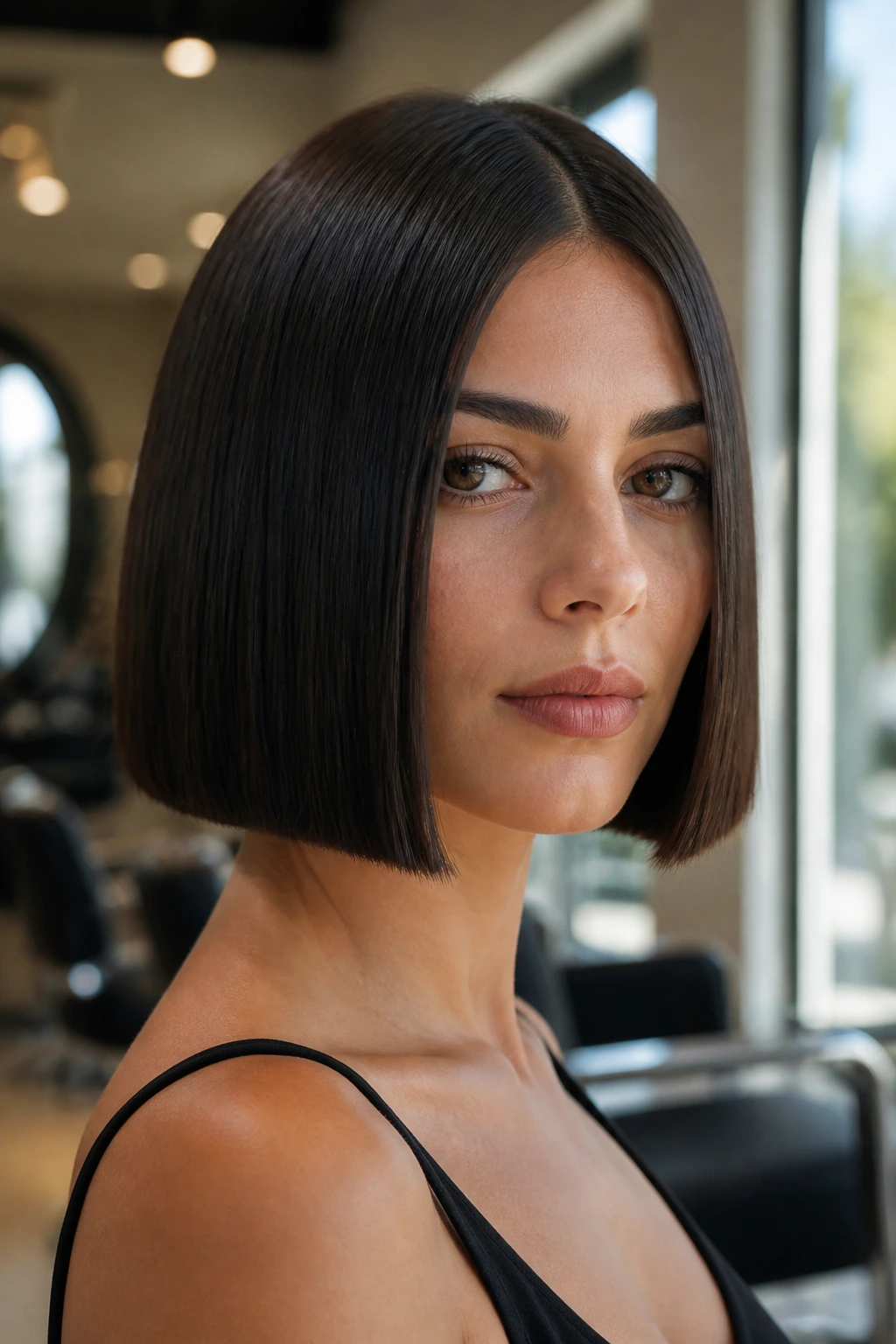
A box bob is for someone who wants the haircut to look deliberate from every angle. The line is straighter, the corners are a little more defined, and the whole shape feels fuller at the sides. Thick hair loves that structure if you keep the ends blunt and resist the urge to soften everything into oblivion.
Unlike a rounded bob, the box bob doesn’t try to tuck itself in. It sits with a more graphic outline, which can be a great match for straight or slightly wavy hair. If your hair naturally grows wide, a box bob can make that width look intentional instead of accidental.
The trick is balance. Ask your stylist not to over-thin the ends or carve into the shape too much. You want density at the perimeter. That’s what gives the bob its clean edge and keeps it from collapsing by midday.
This cut looks especially good with a middle part and strong brows. It has a little fashion-editor energy, but not in an fussy way. More crisp than cute. More tailored than soft.
8. Rounded Bob That Curves In at the Jaw
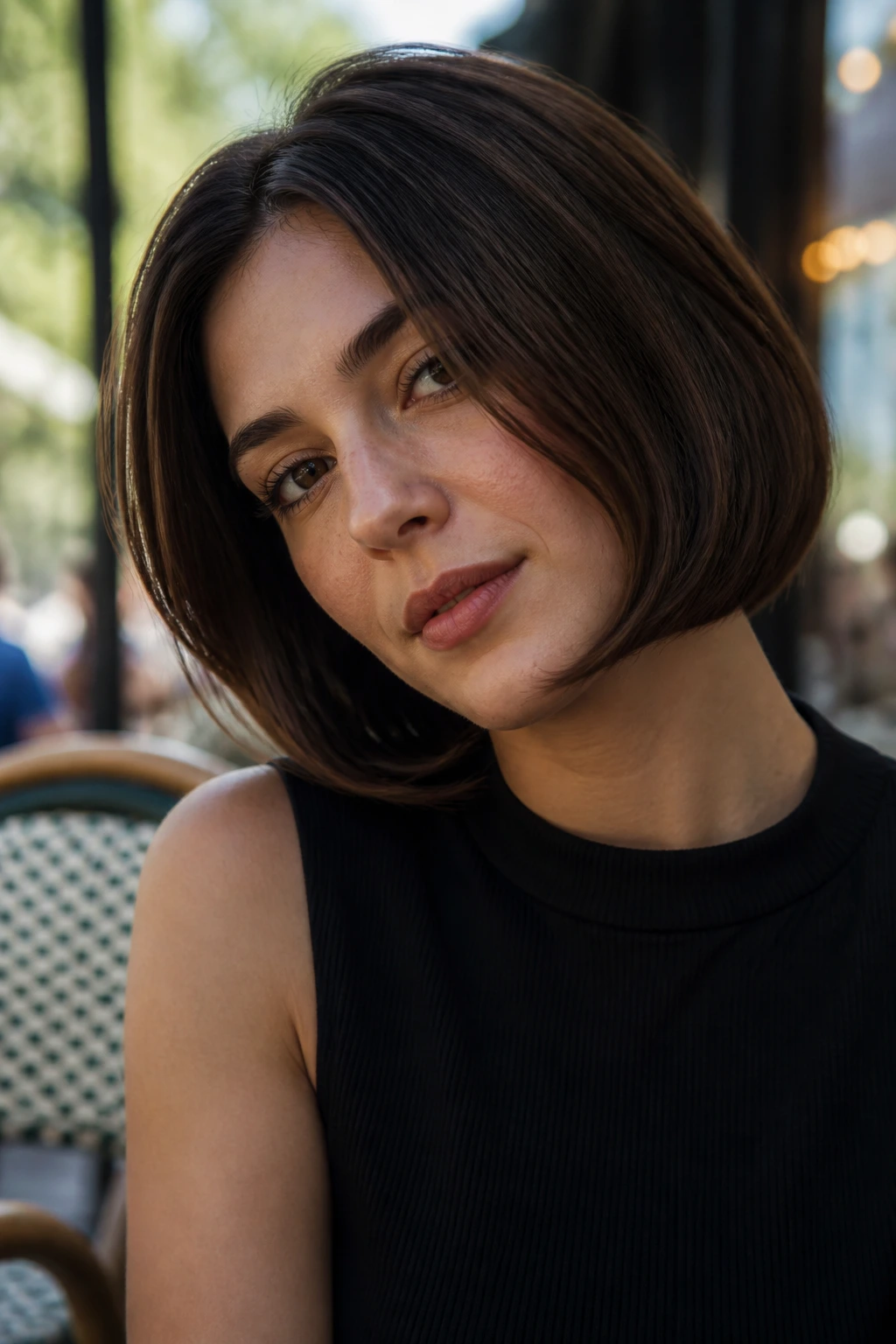
What if your thick hair always turns into a triangle? Then the rounded bob deserves a look. This cut curves inward just enough at the ends to soften the width at the jaw and cheek, which is often the exact place thick hair gets stubborn.
The shape is subtle, not bubble-like. That matters. You are not asking for a retro helmet. You’re asking for a perimeter that bends in instead of hanging straight out. On dense hair, that bend can make the whole head shape look more balanced.
A rounded bob usually needs a little more styling than a box bob. A blow-dry brush, a smoothing cream, and a round brush at the ends help the haircut keep its curve. If you air-dry it with no support, the sides may expand more than you want.
Best for straight, coarse, or wavy hair that has a habit of puffing at the bottom. It can work on curls too, but only if the curl pattern is loose enough to stay controlled at short length. If your curls spring hard, you may want a different shape.
9. Classic Pageboy With a Tucked Under Finish

The pageboy is old-school in the best possible way. It’s neat, blunt, and usually curved under at the ends, which makes it a natural fit for thick hair that wants to spread outward. The style feels tidy without needing a lot of slicing or layering.
What Makes It Different
A pageboy sits closer to the head than many other short cuts. That closeness is part of the appeal. Thick hair gets contained, not chopped up, and the silhouette looks finished even when you do very little to it. Add a full fringe and the shape becomes even more compact.
This haircut is especially kind to straight hair and to people who like wearing glasses. The line frames the face without competing with it. That sounds small. It isn’t. A haircut that plays well with your glasses saves you a lot of styling frustration.
Styling Notes
- Blow-dry the ends under with a round brush
- Keep the fringe blunt or slightly piecey
- Use a light cream, not a heavy paste
- Trim the fringe more often than the rest of the cut
The pageboy can read polished or slightly retro depending on how you wear it. I like it best when the finish is smooth but not shiny to the point of looking stiff.
10. Blunt Crop With a Full Fringe
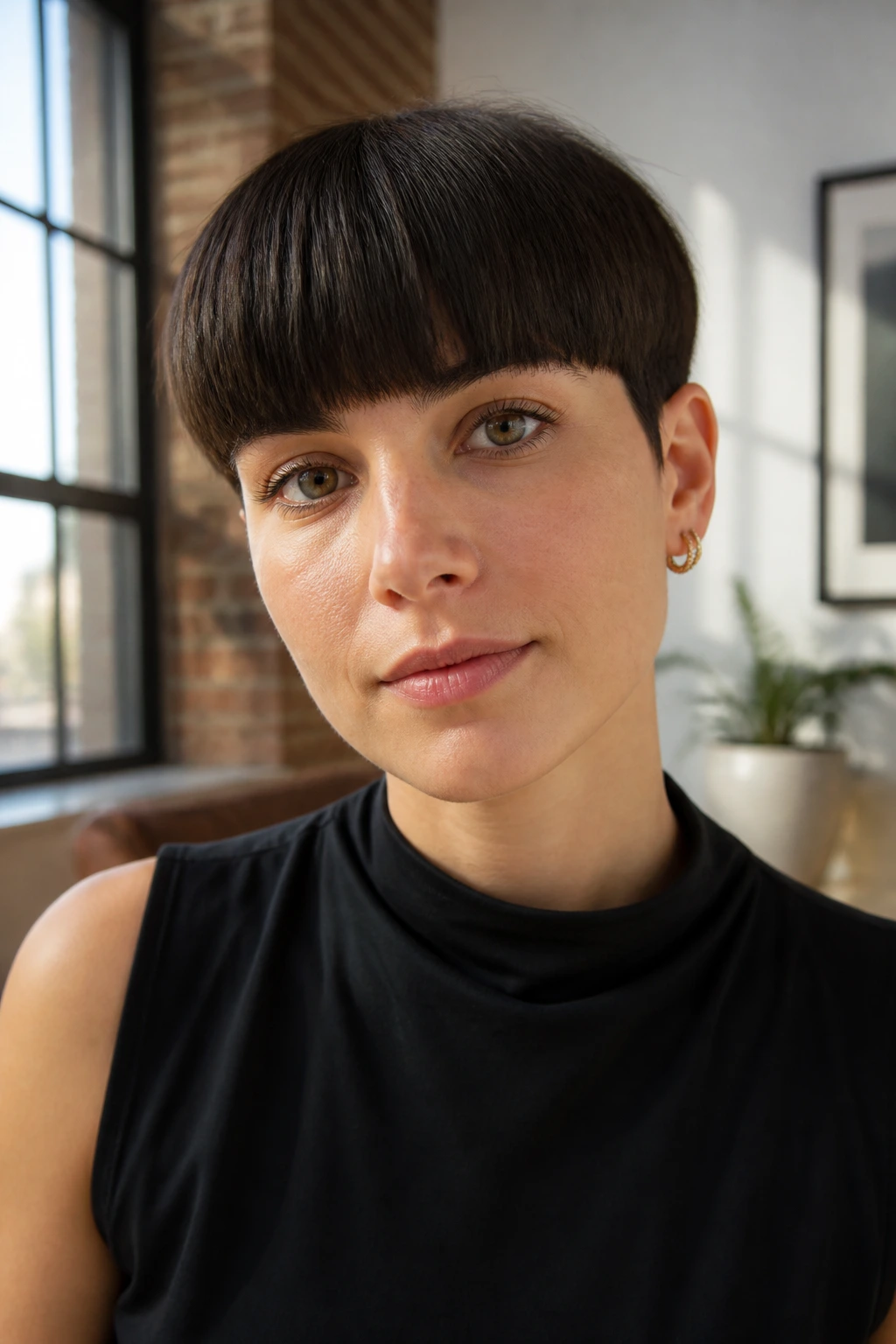
A blunt crop with a full fringe is one of the smartest ways to shorten thick hair without making the head look wide. The fringe takes some of the visual weight off the rest of the haircut, and the cropped length keeps the sides from puffing out too far.
The fringe is the star here. It needs enough density to look intentional, but not so much that it sits like a curtain. If your forehead is narrow, a softer fringe may be better. If it’s broad, a fuller line can look balanced and sharp. Either way, keep it deliberate.
This cut works best when the crop stays compact and the perimeter stays clean. Don’t let anyone sneak in heavy layering at the crown unless your hair absolutely demands it. A blunt crop should look precise, not shattered. That is the whole point.
You will probably need fringe trims more often than full-shape trims. That’s normal. Bangs grow fast and start behaving badly fast. If you hate frequent maintenance, this is not the easiest haircut on the list—but it can be one of the most striking.
11. Asymmetrical Blunt Bob

An asymmetrical bob can be a lifesaver if straight-across cuts make your thick hair feel too boxy. The difference between the sides should be subtle, though. A half-inch to an inch and a half is usually enough. You want a tilt, not a costume.
This style works because the eye follows the longer side, which breaks up the density and keeps the bob from feeling like one giant block. Thick hair often benefits from that tiny bit of visual movement. It takes pressure off the shape without adding layers through the body.
What to Watch For
If the asymmetry is too dramatic, the haircut can look uneven as it grows out. That’s annoying. Keep the angle soft and the perimeter blunt so the cut still feels solid. If your hair is very dense, ask your stylist to check both sides while you’re standing naturally, not only when your head is tilted in the salon chair.
This is a good option if you like clean lines but want something with a little personality. It reads modern without chasing a fad. And because the shape is simple, it’s easier to style than it looks.
12. Undercut Bob for Heavy Thick Hair

Some thick hair needs more than a blunt line. It needs relief. A hidden undercut bob removes bulk from underneath while leaving the top and visible perimeter blunt, so you keep the shape without carrying all that weight at the nape.
This is especially useful if your hair feels hot, bulky, or hard to dry. The undercut can make the whole cut sit flatter against the head, which is a gift if you live with a lot of density. It also helps if your bob tends to balloon at the back no matter how carefully it’s cut.
A Few Things Worth Knowing
- The undercut should stay hidden when the hair is down
- The top section must still look blunt and full
- Maintenance is usually needed every 4 to 6 weeks
- A clipper or trimmer does the work; scissors alone won’t remove enough bulk
This is not a “light trim” kind of idea. It’s a structural choice. If you’re nervous, ask for a small test section first or keep the shaved area very narrow. Once you find the right amount of removal, it can make thick hair feel almost unfairly manageable.
13. Tucked-Behind-the-Ear Bob
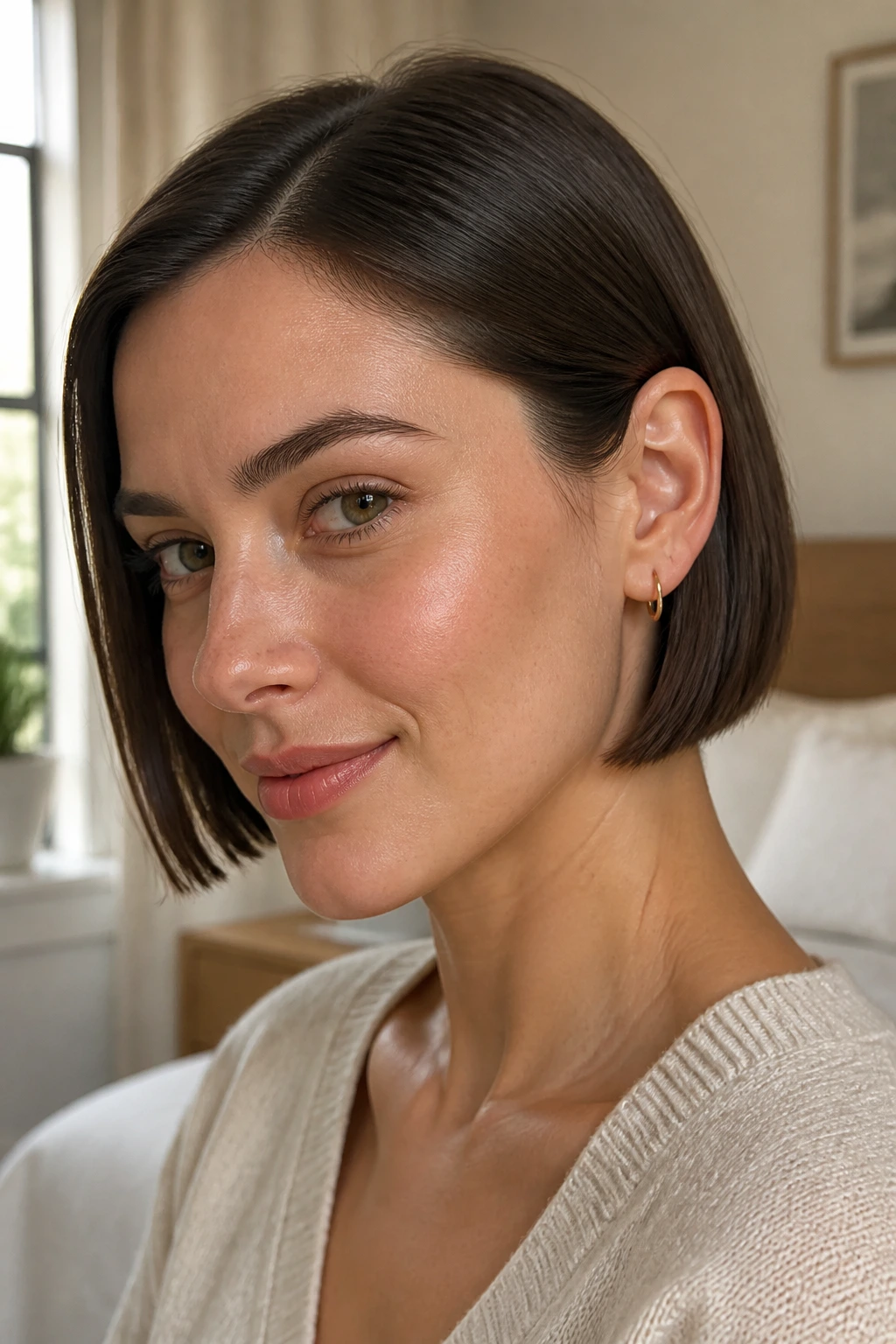
A tucked bob sounds simple because it is, and that’s part of why it works. Thick hair can look bulky around the face when it’s left loose all the time. A cut that sits well behind the ear gives you a neat front view and keeps the sides from hogging the spotlight.
The haircut itself should still be blunt. No scattered layers, no overly chipped ends. The trick is length control. It needs to be long enough to tuck without fighting the ear, but short enough to keep the shape feeling neat and intentional. Chin length is a sweet spot here for many people.
This style also plays nicely with earrings, which sounds like a small thing until you realize how often a haircut changes the way jewelry looks. A tucked bob opens the face in a way that a longer cut often doesn’t. It feels clean in a quiet way.
If your hair bulges when tucked, a quick pass with a flat iron on the front inch can help. Don’t flatten the whole head. Just the part that sits at the cheek and ear.
14. Deep Side-Part Bob With a Clean Perimeter

Can one part change the whole haircut? Yes. Especially on thick hair. A deep side-part bob shifts volume away from the center and gives the top more lift, which makes a blunt cut feel softer and more dynamic without touching the layers at all.
This is a smart choice if your hair tends to fall flat at the crown but puff at the sides. The deep side part interrupts that pattern. It also helps the haircut suit rounder faces by adding vertical height at one side and a little asymmetry around the brow.
How to Wear It
Use the part while the hair is still damp, then blow-dry the roots in the opposite direction for lift before settling the hair back into place. That little trick keeps the part from lying limp. A root spray can help too, but don’t pile on product or you’ll lose the clean line.
The haircut itself should stay blunt, with the ends landing at the jaw or just below it. The part gives you the softness. The cut gives you the structure. Put those together and thick hair often behaves better than people expect.
15. Curly Blunt Crop for Dense Texture

Curly thick hair without layers is tricky, and I’m not going to pretend otherwise. But if your curls are springy and your density is high, a curly blunt crop can look sculpted rather than bulky. The trick is keeping the perimeter controlled and the length short enough that the curl pattern stacks neatly.
This works best when the crop lands somewhere between the cheekbone and the jaw, depending on shrinkage. That shrinkage matters. A cut that looks chin-length wet may land much shorter once it dries, and that can make the shape swing from chic to mushroom fast if nobody accounts for it.
Ask for a dry cut if your stylist knows how to do one, or at least have them check the fall pattern once the hair is dry enough to show its real shape. Curly hair does not behave the way wet hair suggests it will. Ever. That is where a lot of bad haircuts are born.
A curl cream and diffuser on low heat usually help this style settle into place. Skip anything heavy that drags the curls down. You want spring, not slump.
Final Thoughts
Thick hair doesn’t need to be bullied into submission. It needs a shape that respects how much hair there is in the first place. That’s why blunt edges, smart lengths, and clean lines keep showing up in the best short haircuts without layers for thick hair.
If you’re deciding between styles, think about one thing first: how much daily styling you’re actually willing to do. A chin-length blunt bob and a curly blunt crop ask for different effort, and the “best” haircut is usually the one that matches your routine without turning into a project.
Bring photos, yes. But bring useful words too. Say whether you want the ends to sit under, whether you want the hair to tuck, whether you hate width at the sides, and whether you want the fringe to do any work. That conversation matters more than asking for “something flattering,” which is how people end up with a cut they can’t quite explain later.
