



A small forehead changes the balance of a haircut fast. Put the wrong fringe on it, and the face can feel crowded. Put the right shape around it, and suddenly everything looks longer, lighter, and a little more intentional.
That’s why hairstyles for women with a small forehead are less about hiding the forehead and more about giving the upper face some breathing room. You want lift at the crown, movement around the temples, and enough softness near the hairline that the eye doesn’t stop dead at the brow. Heavy, blunt bangs can work on some faces, but they’re touchy here. A little too thick, a little too low, and the whole style starts closing in on itself.
The good stuff is usually more subtle. A part shifted off center by an inch. Layers that begin below the cheekbone. Fringe that breaks into pieces instead of sitting like one solid sheet. Even a ponytail can help, if it leaves a touch of height at the top instead of scraping everything flat.
And yes, you can wear short cuts, bangs, updos, and long hair with a small forehead. The trick is choosing shapes that open the face instead of boxing it in.
1. Deep Side Part With Long Waves
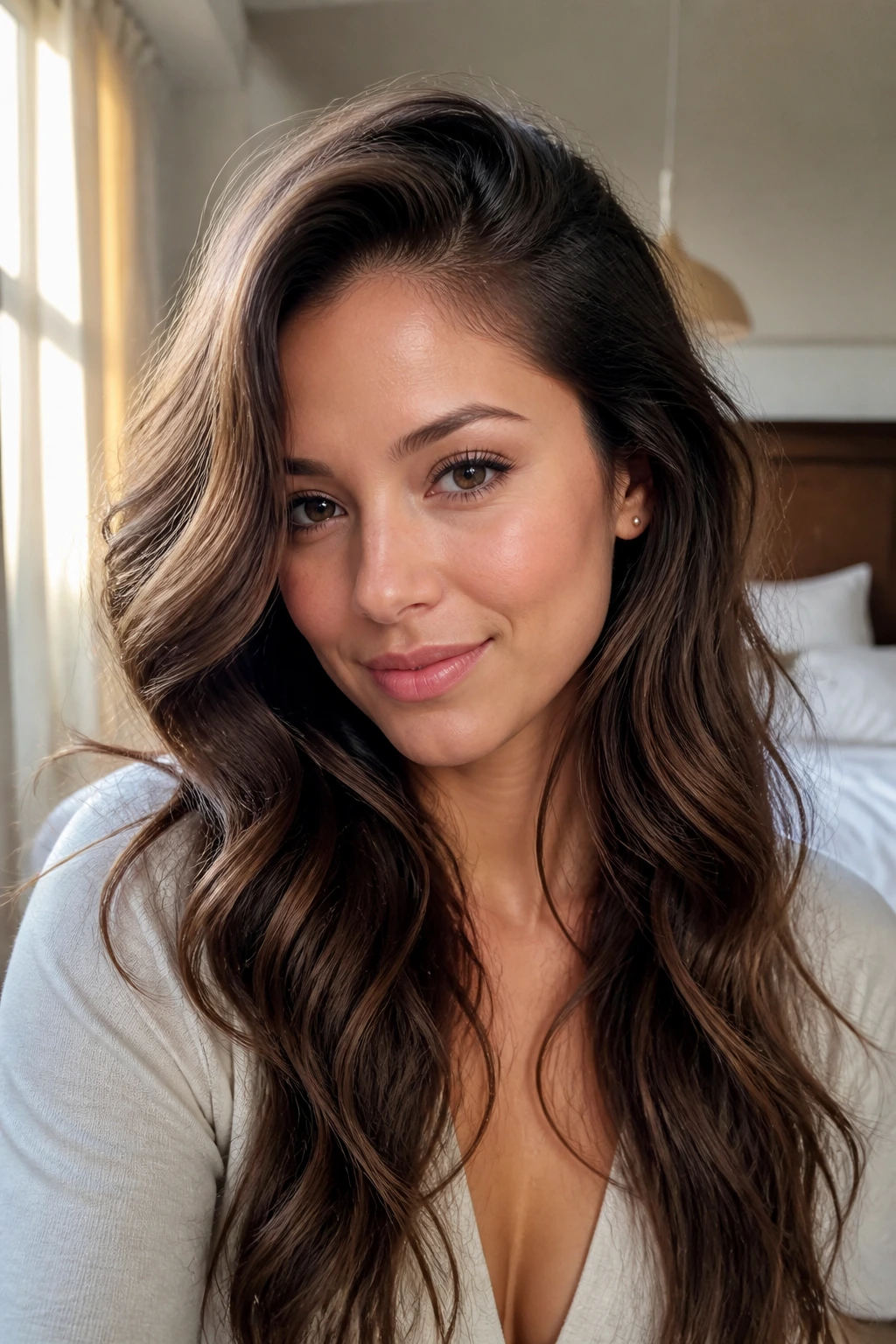
A deep side part is one of the easiest ways to make a small forehead look a touch longer without changing the cut itself. It shifts the eye off the center line, creates instant lift near the crown, and gives the hairline some space to breathe. Simple, but it works.
The part matters more than people think. Move it about 1.5 to 2 inches off center, then blow-dry the roots in the opposite direction before flipping the hair back. That little trick creates a bend at the root that lasts longer than you’d expect, especially if you mist the base with a light mousse first.
Long waves help because they pull the eye downward. You’re not filling the forehead area with heavy shape; you’re building a clean vertical line that starts at the scalp and ends somewhere below the shoulders. The result feels softer, and softer is usually better here.
- Best for medium to long hair
- Works well on straight, wavy, and thick textures
- Use a 1.25-inch curling iron for loose bends, not tight curls
- Brush the waves out once they cool so they look lived-in, not ringlet-y
One small tip: tuck the heavier side behind one ear for ten minutes while the hair cools. It helps the root set with a little extra lift.
2. Curtain Bangs That Start at the Brow Bone
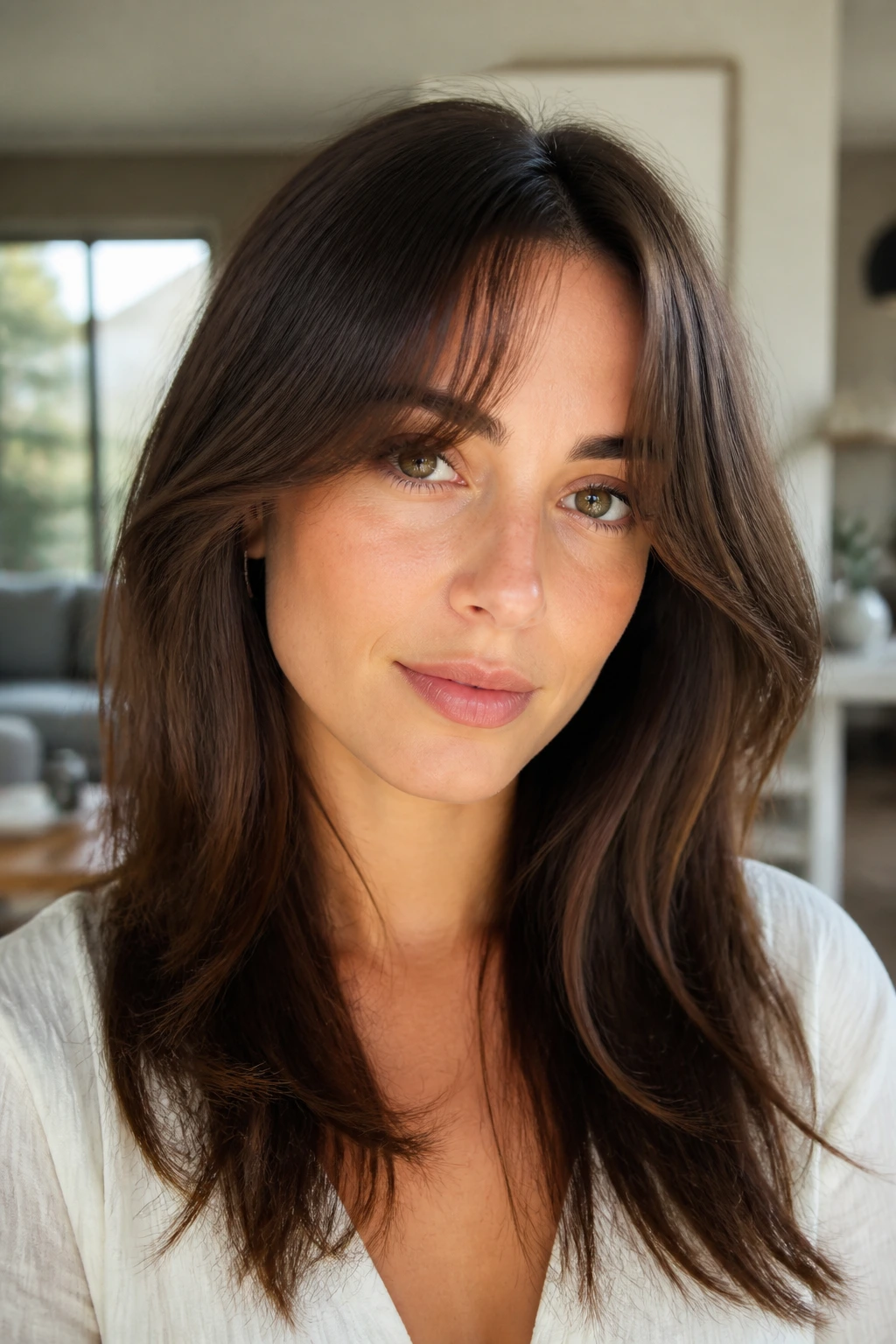
Can bangs work on a small forehead? Absolutely — if they start high enough and stay light enough. Curtain bangs are the safest bet because they open in the middle, skim the temples, and don’t sit like a hard line across the face.
What makes them good is the length shift. Ask for the shortest piece to hit around the brow bone, then let the outer edges fall closer to the cheekbone. That diagonal shape lengthens the upper face in a way blunt fringe never will. It also gives you room to wear them swept apart, tucked back, or blended into layers when you’re in the mood for less forehead coverage.
How to style them
Curtain bangs need movement, not stiffness. Blow-dry them with a medium round brush, rolling the center away from the face and the sides back toward the temples. If you overwork them, they puff up. If you under-dry them, they collapse.
A tiny dab of lightweight cream on the ends keeps the pieces separated. Not slick. Separated.
This style is especially good if you like the idea of bangs but hate the feeling of being stuck with them every single day. On a small forehead, that flexibility matters.
3. High Ponytail With Crown Lift

A high ponytail can be surprisingly flattering on a small forehead because it pulls the whole face upward and out. The forehead stays open, the crown gets height, and the eye doesn’t get trapped low near the brows.
The mistake is making it too tight. If you yank everything straight back, you erase the softness that makes the style work. Leave a little lift at the crown — not a bump, not a helmet, just enough structure so the top of the head looks taller than the forehead. A teasing comb or a velcro roller at the crown for a few minutes does the job fast.
If your hair is very fine, mist the roots with dry texture spray before gathering it. Fine hair tends to collapse, and a pony that droops will shorten the face instead of balancing it. Thick hair has the opposite problem: it can feel heavy and pull the forehead down if the base sits too low.
A few good habits make this style better:
- Place the pony 2 to 3 inches above the ear line
- Wrap a small section of hair around the elastic for a cleaner finish
- Keep the front soft with one or two loose pieces near the temples
- Use a boar-bristle brush if you want a sleek finish, not a gel shell
It’s a sharp look, but not severe. That’s the sweet spot.
4. Collarbone Lob With Soft Ends
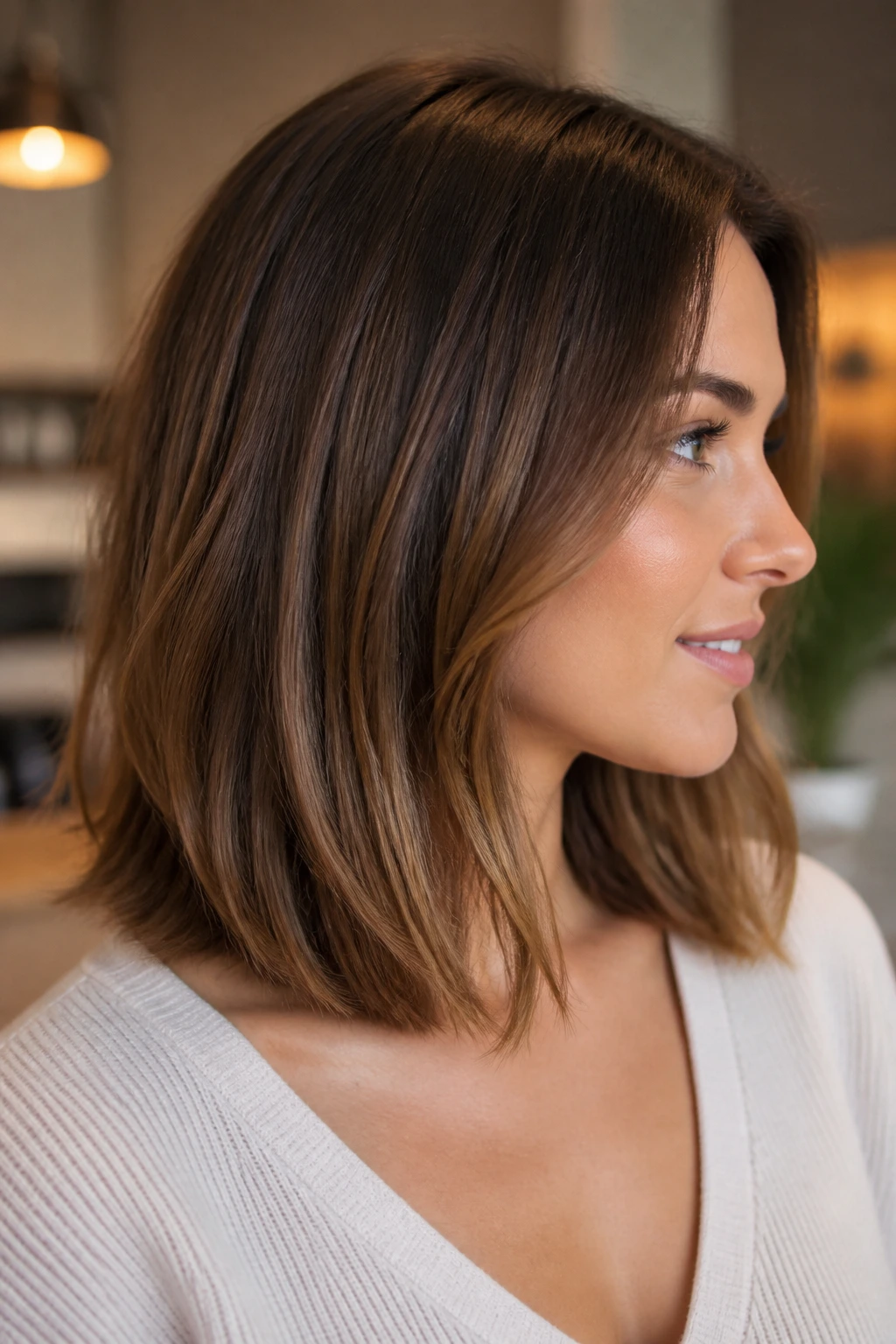
A collarbone lob is one of those cuts that quietly solves a lot of proportion problems. It lands low enough to pull attention away from the forehead, but not so long that it drags the whole face down. The cut sits in that useful middle zone where movement matters more than length.
Soft ends are the thing to ask for. A blunt, one-length lob can look boxy on a small forehead, especially if the front is dense. A slightly beveled edge — just a little shorter in front, just a little longer in back — keeps the silhouette from feeling heavy. You want the hair to skim the collarbone, not hang like a curtain.
I like this cut on straight or slightly wavy hair because it reflects light along the length. That clean line draws the eye down the face, which is exactly what you want when the upper third feels short. If you want more softness, a center part with loose bend at the ends works well. If you want a little more lift, shift the part just off center and tuck one side behind the ear.
This is not a high-maintenance cut. That’s the appeal. It does a lot with very little.
5. Side-Swept Fringe and Low Bun

A side-swept fringe can be a lifesaver if you want something polished but don’t want full bangs committing themselves to your forehead. It moves diagonally across the face, which softens the hairline without closing off the upper face. Paired with a low bun, the whole look feels calm and balanced.
The fringe should not be thick. That’s the whole game. You want enough density to show shape, but not so much that it creates a heavy block across the temple. If the front section is too wide, the forehead shrinks. If it’s too narrow, the style looks accidental. The sweet spot is usually a tapered piece that starts around the arch of the brow and gets longer as it moves toward the cheek.
The bun keeps the style grounded. A low knot at the nape leaves the forehead visible, and the diagonal fringe gives you just enough softness that the face does not feel bare. It’s good for formal events, office days, and those awkward in-between hair lengths when nothing seems to cooperate.
A stray wispy piece near the ear helps, too. It stops the style from feeling too tidy. A little mess is useful here.
6. Chin-Length Bob With Tucked Sides

A chin-length bob can be excellent for a small forehead if it’s cut with a bit of bend and the sides aren’t puffed out too wide. The length hits where the jaw starts to matter, so the eye naturally travels downward instead of camping out on the top third of the face.
The real trick is the tuck. Hair that curves softly inward at the ends helps frame the jaw without swallowing the cheeks. You do not want a round helmet shape. You want a bob that sits close to the head near the temples and then swings slightly under at the chin. That creates clean space above the face, which is where a small forehead needs relief.
If you’re comparing this to a blunt bob, here’s the difference: blunt ends can look dense and compact, especially if your hair is straight and heavy. A softer chin-length shape looks lighter because the ends move. Movement matters. A lot.
- Best on straight, fine, or medium hair
- Ask for soft internal layering, not choppy thinning
- Use a flat brush while blow-drying the top for smoothness
- Add a side part if you want even more length through the face
This is one of those cuts that looks expensive even when it’s not trying to be.
7. Shoulder-Length Layers That Open the Face
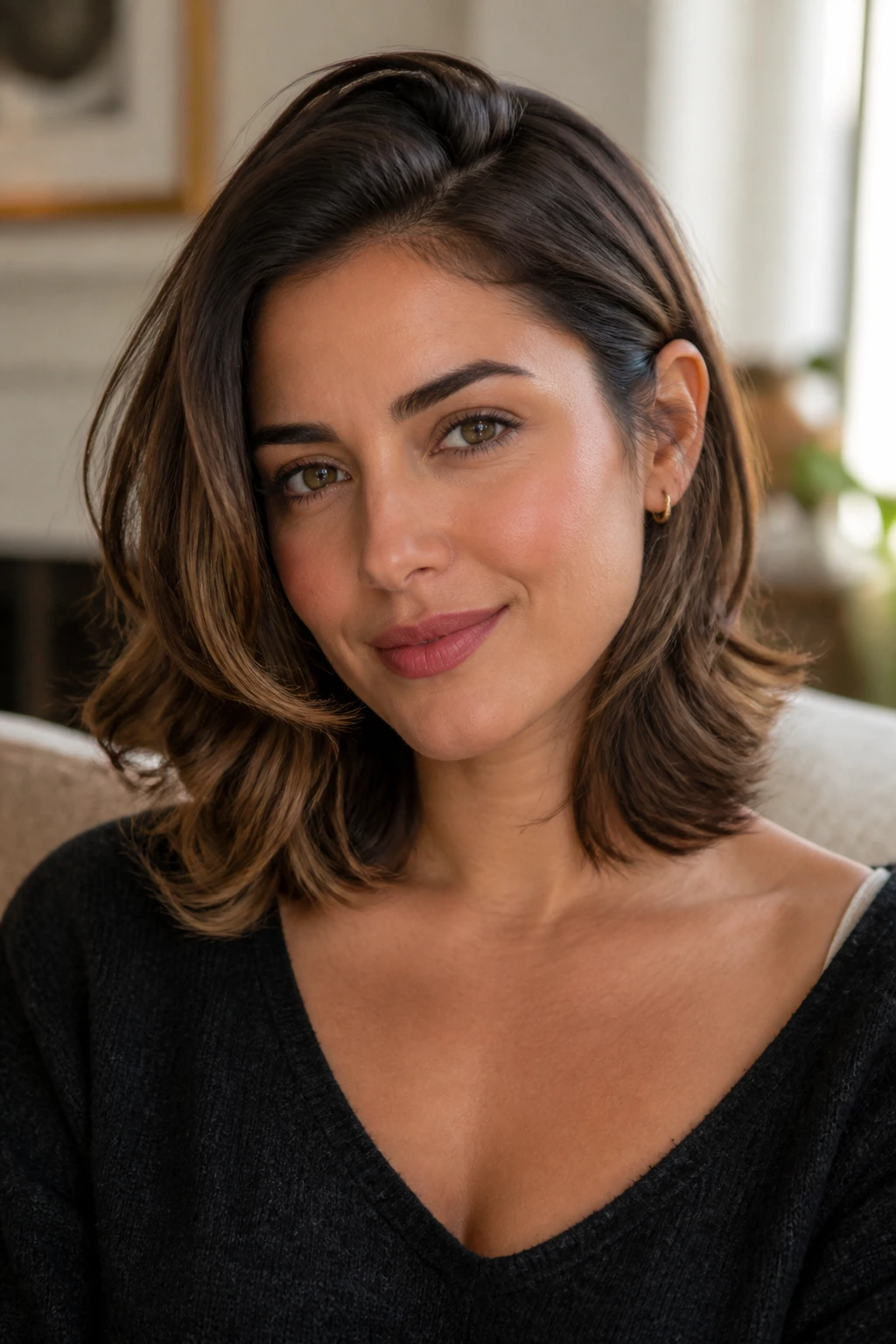
What should shoulder-length layers do for a small forehead? They should start lower than most people think. If the first layer begins near the brow or temple, the upper face can feel crowded. If it starts closer to the mouth or chin, the shape opens up fast.
That lower starting point matters. It pulls attention to the cheekbones and jaw instead of making the forehead the loudest part of the haircut. The hair still has movement, but the movement sits where it helps most. Ask for face-framing pieces that begin around the lip line or chin, then soften into longer layers through the rest of the hair.
What to ask for at the salon
- A light face frame, not a thick fringe
- Layers that remove bulk below the cheekbone
- Soft ends through the perimeter so the cut doesn’t look chopped
- Enough length to tuck behind the ears without losing shape
This cut works nicely if you wear your hair up half the time and down the other half. When it’s down, the layers contour the face. When it’s up, the front pieces still keep the forehead from feeling bare in a harsh way. A lot of shoulder-length cuts miss that balance and end up looking flat near the top. This one doesn’t have to.
8. Messy Top Knot With Loose Tendrils

The messy top knot is one of the most forgiving styles for a small forehead, and frankly, one of the least fussy. The bun sits high enough to lift the eye, while a few loose tendrils soften the hairline so the face doesn’t look stripped bare.
Don’t make the knot too perfect. That’s the mistake. A slick, tiny knot perched high on the head can make the forehead look exposed in a harsh way. A fuller knot, built from slightly roughed-up hair, gives more shape around the crown. Leave out two thin pieces at the temples and maybe one near the cheekbone if you want a little more softness.
I like this style best when the tendrils are narrow. Thick face-framing chunks can feel old-fashioned fast. Thin pieces — the kind that move when you turn your head — look lighter and more modern. Curl them once around a wand if your hair is straight. If it’s curly already, just let the natural texture do the work.
It’s casual, but not careless. There’s a difference, and this style sits right in that difference.
9. Long Layers With an Off-Center Part

A slight off-center part can do more for a small forehead than a dramatic side part, especially if you want the style to stay soft and low-key. It changes the balance just enough to lengthen the face without making the haircut look obviously styled.
Long layers are the other half of the equation. They keep the ends from feeling heavy, which matters when the top section of the face is already compact. If the hair falls in one solid curtain from root to tip, the whole shape gets dense. Layers break that up. They let the hair move, and movement is what keeps the forehead from feeling boxed in.
This style is good for hair that already has some natural body. Wavy hair tends to hold the shape easily, and even straight hair can take on a little swing with a round brush. If your hair is thick, ask for layers that start below the chin so you don’t lose too much weight from the middle. If it’s fine, keep the layering light and focused mostly around the front.
The off-center part should be subtle. About half an inch to 1 inch off center is often enough. You’re not looking for drama here. You’re looking for ease.
10. Sleek Low Ponytail With Crown Volume
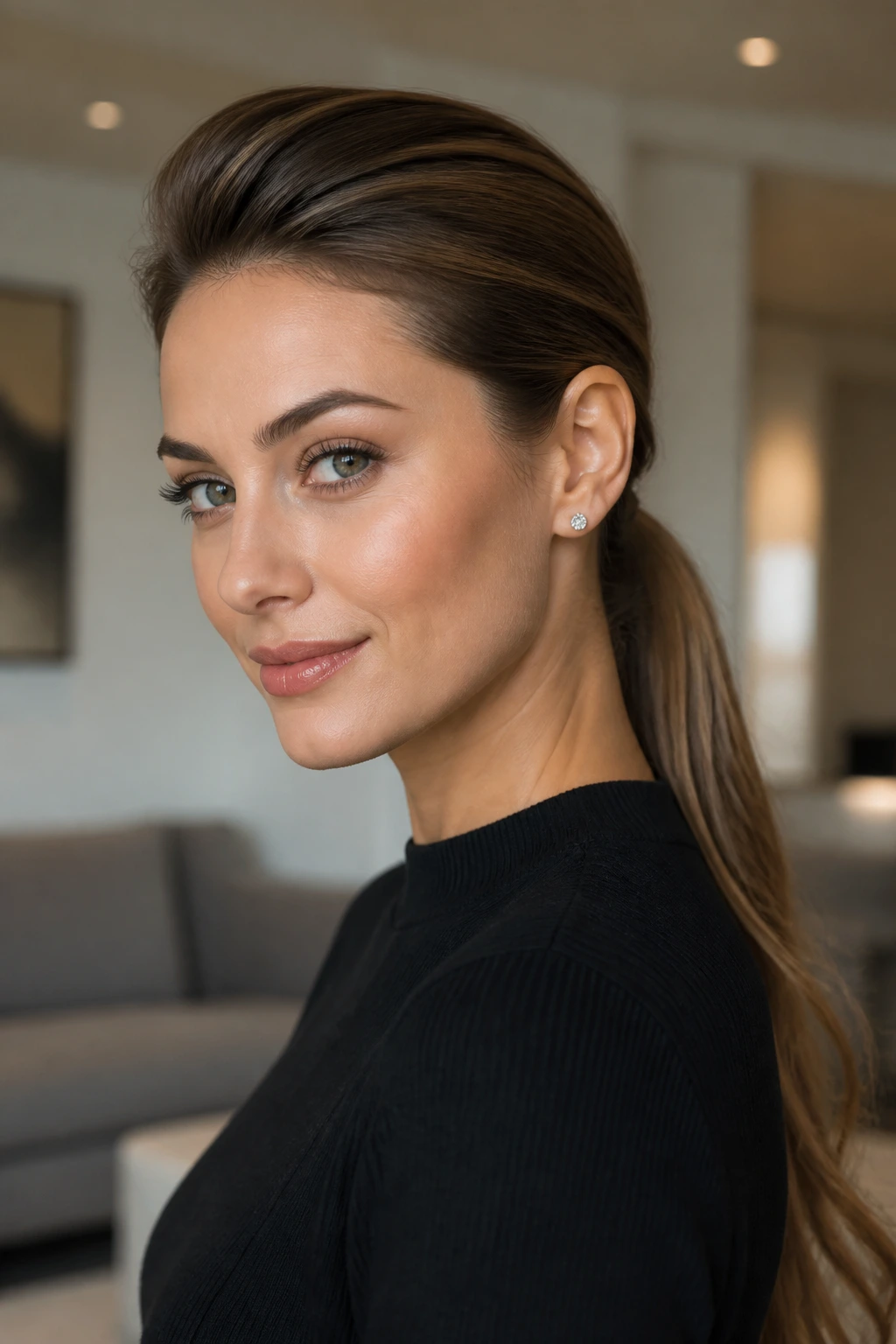
A tight slick-back can be unforgiving on a small forehead. A sleek low ponytail with just a touch of crown volume is a better version of the same idea. It keeps the face open, but it doesn’t flatten the upper head into a single plane.
The crown lift is what saves it. A little height at the top makes the forehead look proportionate, while the low ponytail keeps the overall shape neat and long. If the pony sits right at the nape and the top has a soft bit of lift, the eye moves in a long line from crown to neck. That line is flattering. It just is.
Use a light smoothing cream through the mid-lengths and a toothbrush or edge brush for the hairline if you want the front to stay clean without looking lacquered. Then tease the crown lightly, or lift it with your fingers after blow-drying. You do not need a big bump. You need a hint.
Compared with a super-slick bun, this version feels less severe. Compared with a casual pony, it feels more deliberate. That middle ground is where most women with a small forehead tend to look best.
11. Wispy Pixie With Swept Fringe
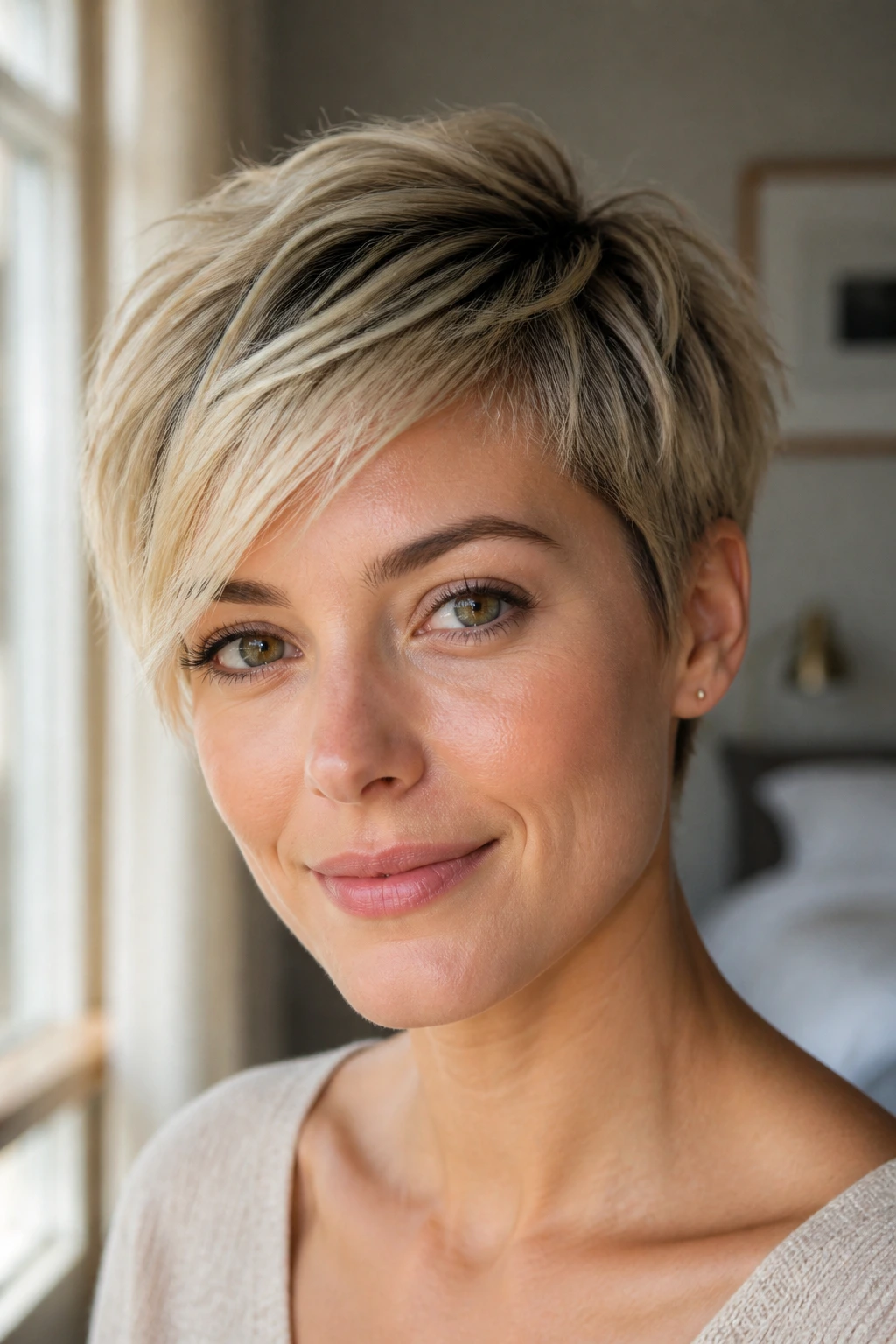
Short hair can work beautifully on a small forehead, and the wispy pixie proves it. The reason is simple: a pixie shows the hairline instead of hiding it, which gives the face more openness right away. Add a swept fringe, and the cut keeps its softness.
The front should be longer than the sides, but not so long that it falls into a heavy bang. Think of a fringe that slides across the forehead in pieces, not one solid strip. Texture is what keeps it from looking severe. Ask for choppy detailing through the top and a little extra length at the front corner so you can sweep it diagonally.
Maintenance matters here. A pixie that grows out unevenly can start to crowd a small forehead in odd ways, especially if the front drops too far. Most people need tidy-ups more often than they expect. That’s not a flaw. It’s just part of wearing short hair well.
- Best for straight to wavy hair
- Use a matte paste for separation, not shine-heavy pomade
- Keep the crown soft and slightly lifted
- Ask for the fringe to be cut dry if possible, so the shape lands where you want it
This is a confident cut. It does not hide anything. That’s why it looks so good when the shape is right.
12. Braided Crown With Height at the Top

Can a braid help a small forehead? Yes, if it starts a little higher than you think and leaves the hairline open. A braided crown pulls attention around the top of the head, which gives the face width and lift without crowding the center.
The placement matters more than braid size. If the braid hugs the hairline too tightly, it can shorten the forehead. If it sits just above the temples and has a little lift at the top, it creates a nice frame. That frame makes the upper face feel more balanced, especially when a few baby hairs or soft strands stay loose.
Where to place the braid
Start the braid about 1 inch above the temple, not directly on the hairline. That one small change makes the style feel lighter and more flattering. You can do a full crown braid, a halo braid, or even a partial braid that wraps one side only.
This style also works well with texture. Slightly rough hair braids better than freshly silked-out hair. If your hair is too slippery, mist it with texture spray first. The braid will hold, and the crown won’t collapse by lunchtime.
It feels romantic, but there’s nothing fragile about it. Good braids are sturdy.
13. Half-Up Half-Down With Lift at the Roots
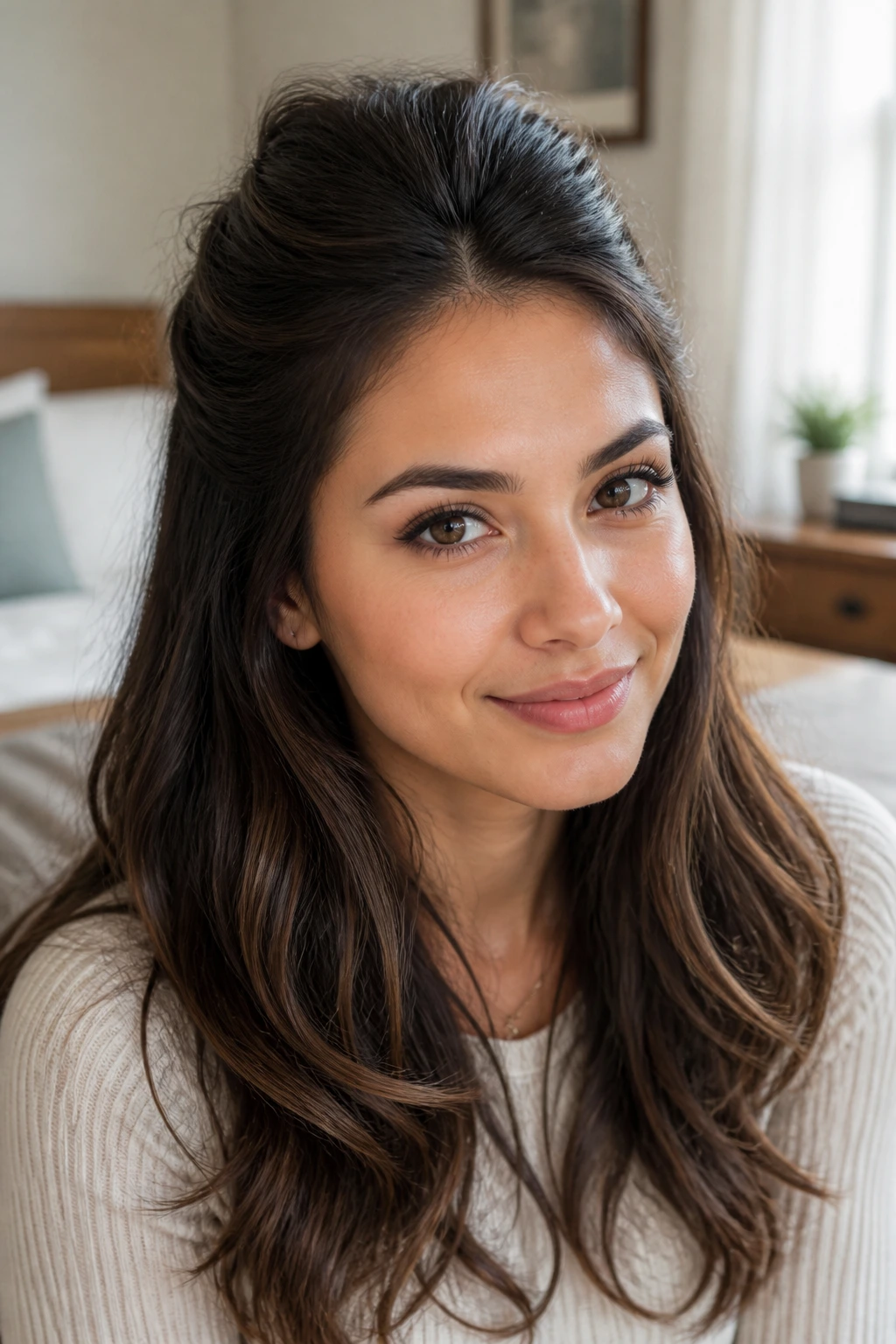
A half-up half-down style is one of the most useful shapes for a small forehead because it gives you the best of both worlds. The top section is pulled back enough to open the face, while the rest of the hair stays down and keeps the style soft.
The lift at the roots is what keeps it from looking flat. If the half-up section sits too close to the head, the forehead can seem shorter. Pull it back 2 to 3 inches from the hairline, then pinch the crown gently with your fingers before you secure it. That tiny bit of lift makes the face look longer without trying too hard.
This style changes depending on texture. On curly hair, the crown can be clipped back while the curls frame the cheeks. On straight hair, a light wave through the lower half keeps the style from feeling stiff. On fine hair, a small twist or mini clip works better than a thick elastic because it does not drag the top down.
A few variations worth trying:
- A half-up knot for casual days
- A half-up twist for weddings or dinners
- A small claw-clip version when you want the forehead open fast
It’s practical, and that’s why people keep coming back to it.
14. Blowout With Side-Swept Ends

A good blowout can do more for a small forehead than a cut change, which is why I always keep it on the list. The combination of root lift and side-swept ends creates a long, airy shape through the face. Nothing feels trapped.
Start with the roots. Dry them upward with a round brush, especially around the front hairline and crown. Then direct the ends away from the face so they fall in a soft curve, not a stiff flip. The curve matters. Straight ends can feel blunt near the jaw, while curved ends guide the eye downward and outward.
If your hair tends to fall flat by midday, set the crown with clips while it cools. That little pause makes a big difference. You can also mist the mid-lengths with a light spray before brushing the shape into place, but keep product away from the roots or the lift disappears.
This style is especially nice on layered hair, because the movement shows up fast. Even on one-length hair, though, a side-swept blowout can create the sense of a taller face. It looks polished, but not stiff. I prefer that every time.
15. Soft Shag With Piecey Bangs

A soft shag might be the best haircut of the bunch if you want texture without losing control of the forehead area. The choppy layers break up the shape around the face, while piecey bangs give you coverage that feels light instead of heavy. That balance is hard to beat.
The shag works because it never sits as one solid block. The layers move at different lengths, so the eye keeps traveling. Around a small forehead, that motion is useful. It keeps the upper face from feeling boxed in, and it gives the style a little edge without turning harsh. If the fringe is cut into separated pieces, not one thick curtain, the forehead stays visible enough to feel open.
Ask for the bangs to be left a touch longer than your first instinct. I mean that. Short piecey fringe can look cute in photos and annoying in daylight. A slightly longer version is easier to live with because you can push it apart, tuck it over, or let it fall softly across the brow when you want more shape.
This is also a smart choice if your hair has some natural wave. The texture does half the styling work for you. A dab of paste on the ends, a quick scrunch, and you’re done. No fuss. No helmet hair. And for a small forehead, that loose, broken-up finish usually looks far better than anything too polished.
Final Thoughts
The best hairstyles for women with a small forehead don’t try to disguise the face. They change the proportions around it. Sometimes that means a deep part. Sometimes it means bangs that open in the middle. Sometimes it means a cut that keeps the top soft and the sides moving.
If I had to narrow it down, I’d start with height at the crown, space at the hairline, and softness around the temples. Those three things show up again and again because they work. The nice part is that you don’t need all three in every style. One good detail can change the whole feel.
And if a cut feels a little too heavy in the front, it usually is. Trust that reaction. Your face will tell you when the shape is fighting it.
