



Some loc styles look great for a photo and fall apart by lunch. Everyday wear is a different test. You need a style that can survive a commute, a long workday, a quick grocery run, and maybe one more errand you did not plan on. If your scalp hurts, the style failed, no matter how neat it looked at 8 a.m.
Locs make that balancing act easier and harder at the same time. Easier, because they hold shape well. Harder, because the weight adds up, the roots can get tender, and one too-tight style around the hairline can turn a cute look into a headache fast. The best loc styles for everyday wear give you shape without begging for a mirror check every hour.
That is why the most useful loc hairstyles are the ones you can do with a few pins, a soft elastic, a claw clip, or a scarf you already own. They do not need perfect parting. They do not need a salon chair. They just need a little judgment about tension, length, and where your locs want to sit naturally.
1. Low Tucked Bun

A low tucked bun is the style I reach for when I want my locs out of the way and I still want the finish to look intentional. It sits close to the nape, which keeps the weight centered instead of dragging on your temples all day. That alone makes it one of the easiest everyday loc styles to live with.
Why It Works So Well
The trick is not to force every loc into the same direction. Gather the locs low, coil them loosely, and tuck the ends underneath the base rather than wrapping them tight around and around. A bun that sits just loose enough will hold better than one pulled so hard it starts slipping an hour later.
- Best on medium to long locs, though shorter locs can fake it with pins.
- Works well with 6 to 10 bobby pins, depending on thickness.
- Keeps ends protected from rubbing on coats, chairs, and seat belts.
- Looks polished with no extra effort.
My favorite part: the bun can look neat even when the locs are not freshly retwisted. A little frizz around the edges does not ruin it; it gives the style some life.
If your scalp is tender, skip the temptation to cinch the bun tighter. Secure the base, tuck the ends, and let the shape do the work.
2. High Ponytail with Wrapped Base

A high ponytail is one of the few loc styles that can look sharp, sporty, and a little dramatic without crossing into overdone. It lifts the face, keeps the neck clear, and gives the locs room to move instead of bunching under your collar. That matters more than people admit.
The wrapped base is what takes it from ordinary to clean. After you secure the ponytail with a strong elastic, take one small loc and wind it around the base to hide the band. Pin the end underneath, not on top, so it disappears into the pony. That little move makes the whole style look more finished.
When you wear this style often, watch the placement. Too high, and the roots can feel strained by the end of the day. Too low, and you lose the lift that makes the style work. The sweet spot is usually at the crown or just above it, where the ponytail sits like it belongs there.
This is a good choice when your locs are thick and you want them to swing a little. It also plays nicely with hoops, a simple tee, or a sharp jacket. No mystery here. It just works.
3. Half-Up, Half-Down
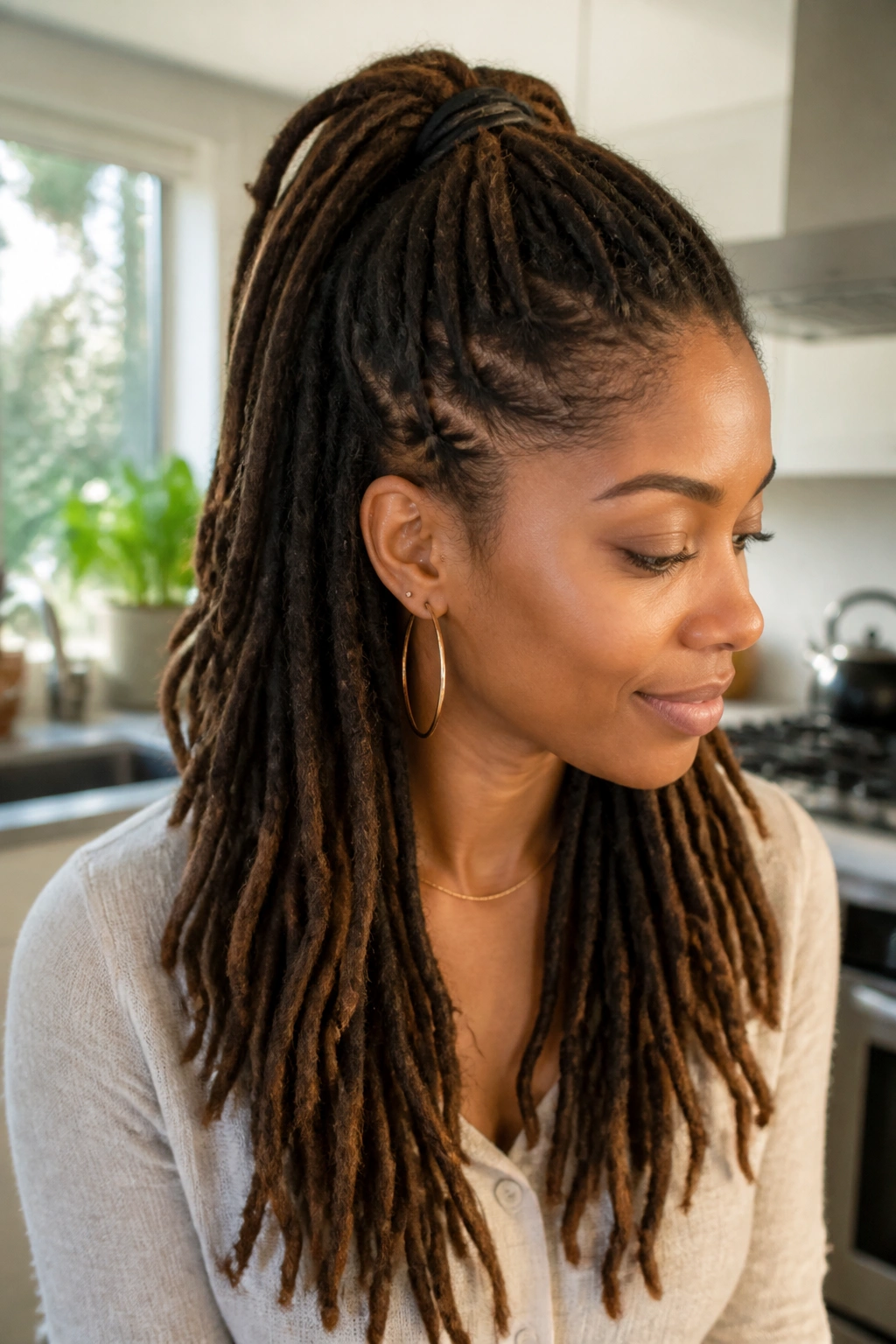
Why do half-up, half-down loc styles last in rotation for so many people? Because they solve two problems at once. You get hair off your face, and you still get to show off the length, texture, and shape of your locs.
Start by sectioning from temple to temple, then gather the top half with a soft elastic or a small clip. The lower half stays loose, which keeps the style from feeling heavy. If your locs are long, the top section can be twisted into a tiny bun instead of a ponytail. That adds a little lift and keeps the back from feeling crowded.
How to Wear It Low-Key
This style can lean casual or neat depending on how smooth you make the front. A clean middle part gives it a tidy look. A side part makes it softer and less formal. Neither is wrong. Pick the one that suits your face and the day you’re having.
A small detail that helps: leave the front locs a touch loose around the temples rather than pinning everything flat. The style reads more relaxed that way, and it is kinder to your hairline too.
It is one of those loc hairstyles that looks easy because it is easy. That is the point.
4. Deep Side-Sweep

A deep side-sweep is what I suggest when someone wants a change without committing to a whole updo. One side gets tucked back or pinned behind the ear, while the rest falls over the opposite shoulder in a soft drape. It has shape, but not too much shape. That balance is why it wears so well.
The style works best when the part is intentional. Comb or finger-part a clean side part, then smooth the smaller side back with a couple of pins or a flat clip. If your locs are layered or different lengths, let that work for you instead of fighting it. The unevenness can look deliberate if the front is clean.
What To Watch For
- Keep the tucked side secure with two pins crossed in an X.
- Use a light edge brush only if needed; don’t press the hairline flat.
- Let the heavier side fall over one shoulder so the weight is distributed.
- Add one clip near the temple if the section wants to slip.
This style is easy to underestimate. It does not need volume to make a point. It just needs direction.
I like it for days when a full bun feels too severe and loose locs feel too ordinary. It sits in that middle space nicely.
5. Two-Strand Twisted Crown

The two-strand twisted crown looks more polished than it feels to wear, which is exactly why it deserves a place in everyday loc styling. You take the front or side locs and twist them toward the back, then pin the ends so they form a crown shape around the head. The result is neat without being stiff.
This style works especially well when your locs are a little older and have enough body to hold a twist. Starter locs can do it too, but you need a lighter hand and fewer pins. Pulling too hard at the front will show up fast, usually by dinner.
What I like here is the stretch. Day one, the crown looks crisp. By day two, it softens a bit and starts to look even better. The lines relax, the locs settle, and the whole style feels lived in rather than frozen in place.
It also handles humidity better than styles that depend on a perfect smooth finish. If a little frizz shows, it reads as texture, not failure. That matters. A lot.
For people who want everyday loc styles that can move between work and a night out, this one is hard to beat.
6. Double Buns

Double buns are the easiest way to make locs feel lighter without doing a full cut or hiding the length. Unlike one large bun, which can feel heavy and pull backward, two buns split the weight across the head. That makes the style feel more balanced, especially if your locs are dense.
You can wear them high, low, or slightly off-center. High double buns feel playful. Low double buns read calmer and a little more grown. Either way, the shape is the point. It gives your locs structure without flattening them.
They are best when you want a style that feels fresh but still works for a real day, not just a mirror photo. Think errands, brunch, class, or a casual office setup where you want your hair up and out of the way. The style stays put best when each bun is compact and pinned from underneath, not stretched into a giant knot that loosens by midday.
If your locs are long, split them first into two equal sections with a clean center part. If they are medium length, let the buns sit a little closer to the head. That keeps them from looking like they are floating.
7. Flat-Twist Front with Loose Back

Some styles are about keeping the front calm. This is one of them.
Flat-twisting the front section of your locs creates a neat frame around the face, and leaving the rest loose keeps the style from feeling too serious. It is a smart everyday option when you want to protect your hairline but still wear your length. The contrast between the controlled front and the loose back gives the whole look some shape.
Why the Front Matters
The front section is where most styles start to feel tight or messy. Flat twists solve that by holding the locs close to the scalp without yanking them back. If you have a sensitive hairline, this is one of the kinder ways to style locs for the day.
- Use 2 or 3 flat twists across the front, not 6 tiny ones.
- Keep the twists loose enough that you can slide a fingertip under them.
- Pin the ends behind the ear or toward the crown.
- Let the back fall naturally so the style keeps movement.
A small bonus: the front twists help on days when your roots are puffier than you want them to be. They smooth the top without making the style look flat.
This is the kind of look that can quietly carry a whole week.
8. Faux Hawk

A faux hawk is for the days when you want locs with a little attitude but still need the style to make sense in daylight. It pulls the sides up and leaves a raised center ridge, so the shape reads bold without needing extra length or a full braided setup. Done right, it feels modern, clean, and practical all at once.
The method is straightforward. Pin the sides upward in small sections, then guide the middle locs into a center line from front to back. The trick is not to make the sides too flat. A little lift around the temples keeps the style from looking pasted on. If your locs are thick, use more pins than you think you need. Thick locs win arguments with weak bobby pins every time.
This style shines when you want your face open but you do not want a plain bun. It also hides uneven growth well, which is useful between retwists. The raised center distracts from frizz at the roots and gives the style a little drama without making it high maintenance.
A faux hawk can be office-friendly, but it depends on how far you push the height. Keep it closer to the head if you want it tame. Push it up if you want the sharper version.
9. Loc Halo Braid

Need a style that can hold up past lunch and still look decent when you catch yourself in a mirror later? A loc halo braid does that better than a lot of simpler updos. It wraps the locs around the head in a crown shape, which keeps the hair tucked and gives the style a clean outline.
How To Keep It From Pulling
The halo braid works best when the braid itself is not overstuffed. Pulling too much loc into one section makes the crown bulky and harder to pin. Split the locs into manageable sections, braid or twist them around the head, and secure the ends where they will not poke out at odd angles.
A few practical details matter here:
- Use long U-pins if your locs are thick.
- Anchor the braid to itself, not to your scalp.
- Tuck the ends under the braid so they stay hidden.
- Sleep with a satin scarf if you want the shape to last another day.
This style takes a little more time than a bun or ponytail, but it pays you back. The edges stay cleaner, the back stays contained, and the whole look has a calm, finished feel.
I reach for this one when I want something that feels dressed up without feeling fussy. It has backbone. That is rare.
10. Claw-Clip Roll-Up

The claw-clip roll-up is the rescue style for mornings when you are running late and your locs need to be out of the way in under five minutes. It is fast, it is repeatable, and it does not ask for perfect parting or precise pinning. You gather the locs, twist or fold them upward, and let the clip hold the bulk in place.
That sounds simple because it is. Still, the size of the clip matters. Small clips snap or slide when locs are dense. A large, sturdy claw clip with a wide opening gives you the grip you actually need. If the clip feels like it is biting too hard, it probably is.
The style can sit high for a loose, casual shape or lower for a calmer profile. Leave the ends spilling out a little if you want a softer look. Tuck them in if you want the front to read cleaner. Either way, the style gives you a break from tension, which your scalp will notice by afternoon.
It is not the fanciest look in the list. I do not think it needs to be. Sometimes the best loc hairstyle is the one that gets you out the door without a fight.
11. Barrel-Twisted Low Ponytail

A barrel-twisted low ponytail is a nice middle ground between a plain ponytail and a more detailed updo. It keeps the hair gathered low, but the twisting along the length gives it more texture and a little more intention. You end up with something that looks styled, not just pulled back.
Start with a low ponytail secured at the nape. Then split the pony into two or three sections and twist them together, or twist each section separately before wrapping them into a barrel shape. If your locs are thick, add a second elastic halfway down so the weight does not drag the twist loose. That tiny extra tie can save the whole style.
This is one of my favorite everyday options for longer locs because it shows length without letting the ends take over. The ponytail stays controlled, the root area stays tidy, and the twist gives the style a cleaner finish than a standard banded pony.
It also plays well with accessories. A few cuffs on the front locs or a single wrap of thread around the twist can make it feel finished without turning it into a special occasion look. Sometimes that is all you need.
12. Accessorized Top Knot with Scarf or Cuffs
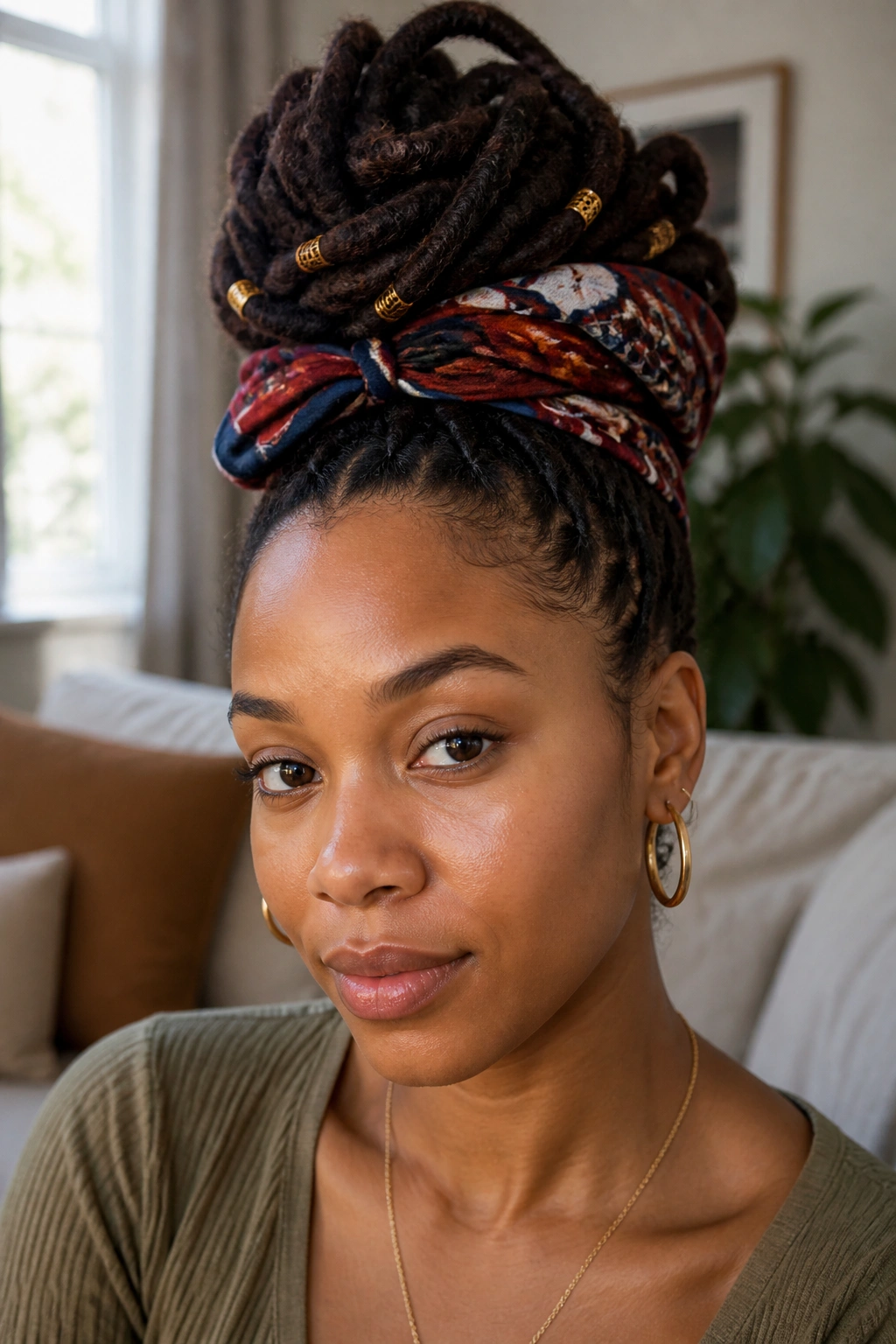
A plain top knot is useful. An accessorized top knot looks like you meant to do more than survive the morning. That is the real difference. Add a scarf, a few loc cuffs, or even a folded bandana, and the style turns from basic to memorable without becoming difficult.
The top knot itself should sit where your head feels balanced, usually near the crown or slightly forward of it. Gather the locs, twist them into a knot, and pin or elastic them securely before adding the accessory. If the knot is too high, it can pull backward. If it is too low, the shape loses its lift. The middle of the head is usually the sweet spot.
Accessories help in ways that go beyond decoration. A scarf can hide frizz around the base. Cuffs can break up a plain line of locs. A bandana can soften the whole style and make it feel a little more casual. Use one detail or two, not all three unless you want the style to take over the room.
If you keep a small styling kit nearby — a few pins, one good claw clip, two soft scrunchies, and a scarf — you can move through most days without overthinking your hair. That is the quiet value of good loc styles for everyday wear. They should give you shape fast, stay kind to your scalp, and leave enough room in the day for everything else.
