



Thick hair can look gorgeous in a bob—right up until the shape starts to puff out at the sides and the whole cut turns into a triangle by lunch. That’s the trap. A good bob should sit close enough to the head to feel clean, but still move when you turn or tuck it behind your ear.
That’s why layered bob haircuts for thick hair are such a smart move. The right layers take out weight where you do not want it, keep the ends from turning heavy, and stop the cut from looking like a solid block. The wrong layers do the opposite. Too much slicing, too high in the crown, and the hair can frizz out or lose its line. Too little, and you’re back to helmet territory.
I’ve always thought thick hair needs shape more than it needs drama. Not more length. Not more product. Shape. A bob with the right internal structure can make coarse, dense, or wavy hair feel lighter without making it look thin, and that balance is the whole game.
The styles below cover the full range: short, midlength, polished, shaggy, curved, angled, blunt, and everything between. Some keep the silhouette sharp. Some lean soft and lived-in. All of them are built to make thick hair behave a little better.
1. Chin-Length Layered Bob That Releases the Bulk

A chin-length bob is one of the cleanest ways to control thick hair without making it feel overworked. The cut lands right around the jaw, which means the weight sits high enough to keep the outline neat but low enough to avoid that boxy width thick hair loves to create.
Why It Works on Thick Hair
The magic is in the placement of the layers, not in making the hair look shredded. A stylist can remove bulk from the interior, then leave the outer line fairly solid so the cut still feels intentional. That keeps the ends from flipping into a wide shelf.
This shape is especially useful if your hair grows out fast. The bob still looks tidy after a few weeks because the line stays close to the face, and the layers do not depend on constant styling to make sense.
What to Ask For
- Length that grazes the chin or sits just below it
- Light internal layering through the middle and back
- Soft point-cut ends instead of a blunt chop
- Minimal thinning near the front so the sides do not collapse
Best for: thick straight hair, soft waves, and anyone who wants a bob that looks neat even on a rushed morning.
2. Stacked Layered Bob With Lift at the Crown

A stacked bob is the one I reach for when thick hair sits flat at the roots and heavy at the ends. The back is cut shorter and built in graduated layers, so the hair naturally lifts at the crown and curves inward at the nape.
Why the Stack Matters
That hidden stack changes the whole feel of the haircut. Instead of hanging like one dense sheet, the hair gets a little spring in the back. The shape is strong, almost architectural, which is exactly why it works so well on dense hair that needs structure.
It’s a good option if you like a polished finish and don’t mind a cut that shows when it grows out. The back will need cleanups more often than a longer lob, but the payoff is a bob that keeps its shape with very little effort.
Styling Notes
- Blow-dry with a round brush, lifting at the roots
- Aim the airflow downward on the top layers so the cut stays smooth
- Use a small dab of mousse at the crown if your hair tends to fall flat
- Finish with a light spray, not a heavy cream
A stacked bob is tidy. Almost stubbornly tidy. That’s part of the charm.
3. Collarbone Lob With Long Internal Layers

If you like the idea of a bob but do not want to lose much length, a collarbone lob with long internal layers is a very smart compromise. It keeps the silhouette long enough to tuck behind the ears or tie back, but it takes away the extra bulk that makes thick hair feel heavy.
A Softer Option for Dense Hair
The length gives thick hair somewhere to fall, which can be a relief if your ends puff out the second they’re cut too short. Long layers help the shape bend instead of balloon. They also let waves and bends show through more clearly.
This is the cut for someone who wants a bob-ish shape without the commitment of a short crop. It reads clean, not fussy. And because the layers stay long, it grows out in a calm way instead of becoming a mess of short pieces sticking out everywhere.
How to Wear It
- Rough-dry for a loose, natural finish
- Wrap only the front pieces around a 1.25-inch iron if you want movement
- Use a center part for a sleeker line or a soft off-center part for more lift
- Keep the ends blunt enough to hold their shape
I like this one because it does not try too hard. It just works.
4. Angled Bob With Longer Front Pieces
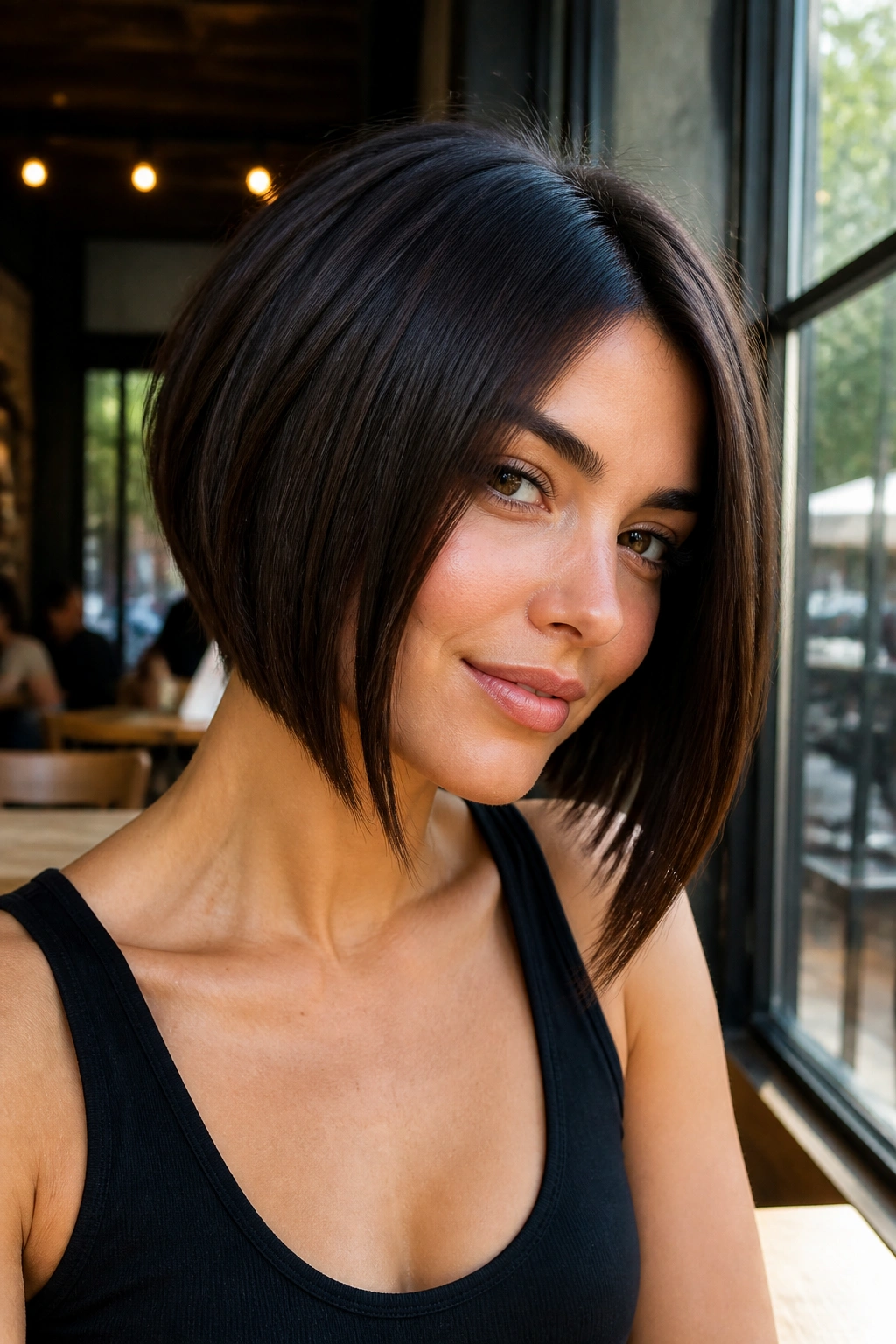
An angled bob is sharp in the best way. The back sits shorter, the front stays longer, and the diagonal line gives thick hair a place to fall without piling up around the cheeks.
The visual effect is immediate. Your eye moves from the nape down toward the jaw, so the cut feels slimmer even when the hair itself is dense. That’s useful if your hair has a lot of body through the sides and tends to widen the face.
It’s also one of the better bob haircuts for thick hair if you want something a little dramatic but still wearable. The angle creates movement even when the hair is straight, and a quick bend with a flat iron makes the whole thing look more deliberate.
Best styling move: smooth the back close to the head and turn only the front ends under by an inch or so. That keeps the line clean without making the haircut look stiff.
5. Feathered Bob With Soft Ends
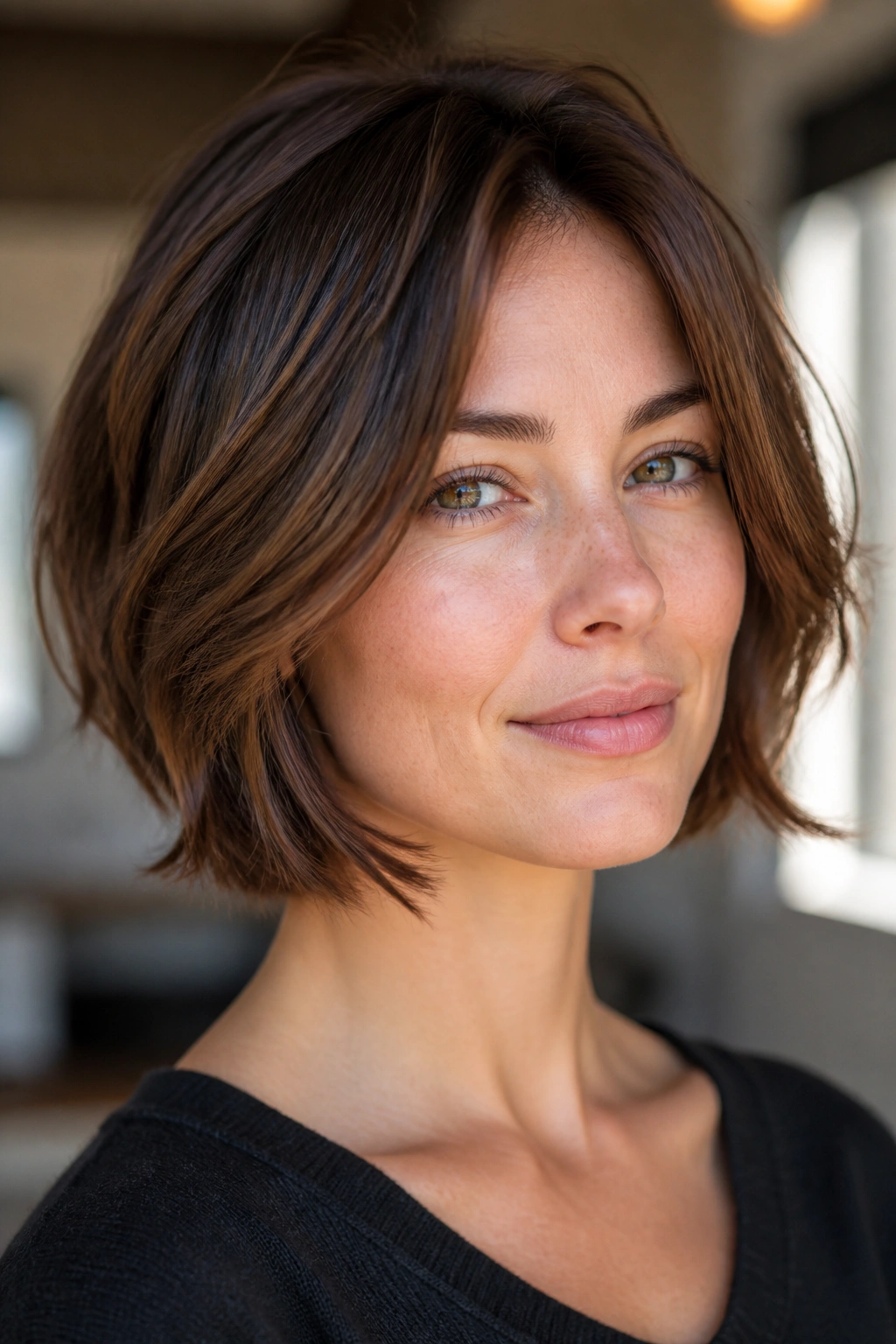
Feathering gets a bad reputation when people picture the big, fluffy cuts from old salon photos. Done well, though, a feathered bob is one of the best ways to take the edge off thick hair.
Why It Looks Airier
The ends are softened so they separate instead of landing in one heavy block. That makes the bob feel lighter when you move, and it keeps the bottom line from looking too blunt for the hair’s density. It’s a gentle kind of layering. Not choppy. Not aggressive.
This cut loves a round brush. You do not need a full salon blowout every day, but you do need a little bend through the ends so the feathering shows. If you air-dry it completely untouched, some of the shape can disappear into the natural volume of the hair.
Best Styling Habits
- Dry the roots first for lift
- Wrap the last 2 inches of hair around the brush so the ends curve softly
- Use a pea-sized amount of cream, not a heavy blob
- Finish with fingers, not a paddle brush, so the feathering stays visible
Feathered bobs are soft without being limp. That’s a nice place to be.
6. Shaggy Bob With Choppy Movement

A shaggy bob is for thick hair that likes to move around. If your hair already has wave, bend, or a little roughness in the texture, this cut can make that feel like a feature instead of a problem.
What Makes It Different
The layers are shorter and more broken up than in a classic bob, so the shape looks lived-in right away. You get a little fringe through the sides, a little lift at the crown, and that easy piecey finish that can make dense hair feel less heavy.
The downside is simple: this is not the cut for someone who wants a neat, tucked-under bob every day. It looks best with texture. If you fight it too much, it can lose the whole point. But if you like a cut that feels relaxed and a bit undone, this one has a lot going for it.
Good products here: texturizing spray, a small amount of matte paste, or a salt-free wave cream. Heavy serums will flatten the whole thing fast.
7. Curly Layered Bob That Shapes the Curl

Curly hair and thick hair are often the same conversation, just louder. A layered bob on curls needs the weight removed in the right places, or the shape turns into a pyramid. Nobody wants that.
Why Curl Pattern Changes Everything
A curly bob should be cut around the curl, not against it. That usually means the stylist works with the natural spring of the hair, sometimes dry, so they can see where each curl sits. The layers help the curls stack without crushing one another, which is what creates a rounder, more balanced bob.
How to Talk to Your Stylist
- Ask for curl-by-curl shaping, not aggressive thinning
- Keep the shortest layers below the widest part of the face if you want less volume at the cheeks
- Leave enough length for the curls to spring up after drying
- Use a diffuser on low heat to keep the curl pattern intact
Curly bobs are not low-effort, and I wish people would say that more honestly. They’re manageable, yes. But they reward a little care, especially on wash day. The payoff is a bob that looks alive instead of puffy.
8. Blunt Bob With Invisible Internal Layers

A blunt bob can work on thick hair if the inside of the haircut carries the weight for the outside. That sounds backwards, but it isn’t. The surface line stays strong and clean, while a few hidden layers inside the shape stop the whole thing from turning into a triangle.
Unlike a fully shagged cut, this style keeps the silhouette crisp. That’s the point. If you love sleek hair, straight ends, and a bob that looks expensive without shouting about it, this is a strong choice.
The trick is restraint. Too many visible layers and the blunt effect disappears. Too much thinning and the ends start to look wispy in a bad way, which thick hair can absolutely do if someone gets scissors-happy.
Best on straight or slightly wavy textures, this cut is a good pick for people who want polish first and movement second.
9. Inverted Bob With a Clean Nape

A friend once described an inverted bob as “business in the front, tidy in the back,” and honestly, that’s not far off. The back sits short and close to the head, then the front length extends forward, creating a shape that lets thick hair lie flatter where it usually wants to puff up.
Why the Shape Helps
The steep angle reduces bulk in the back, which is where thick hair often creates that mushroom effect. The longer front pieces keep the haircut from feeling too severe. You get structure, but not helmet energy.
This cut is particularly useful if your hair is dense at the nape and around the ears. Those areas can feel heavy fast, and a clean inverted shape gives them somewhere to go. It also looks good with a deep side part, which adds another line of movement through the haircut.
What to Watch For
- The back needs precise graduation
- The nape should be tucked in cleanly
- The front should not be so long that the shape stops looking like a bob
- A flat iron bend at the ends helps the angle show
It’s a tidy cut. Sharp, but not cold.
10. Bob With Curtain Bangs and Side Framing

Curtain bangs can make thick hair feel less overwhelming around the face. That’s the simplest way to put it. They split the weight at the front, create a soft opening at the cheeks, and keep the bob from sitting as one solid block from ear to ear.
The best part is how forgiving they are. They grow out more softly than blunt fringe, which matters if you don’t want to be at the salon every few weeks. They also play nicely with layered bob haircuts for thick hair because the bangs can connect to the side layers instead of stopping abruptly.
If your face feels buried under all that density, this is a good fix. It brings the eye up, then lets the rest of the cut fall away from the center. That tiny shift changes the whole mood of the haircut.
Styling note: blow the bangs back and away from the face first, then part them down the center. It keeps them from sticking straight forward like a curtain rod.
11. Deep Side-Part Bob That Rebalances Heavy Hair

A deep side part can do more for thick hair than people expect. It moves the weight off-center, which makes the haircut feel lighter and gives the illusion of lift at the roots on one side.
Why This Simple Shift Works
Thick hair often sits too evenly. That sounds fine until it swallows the face. A side part breaks that symmetry and creates a softer line across the forehead and cheek. It’s a small move with a big effect.
This is one of my favorite options for people who already have a bob and want to refresh it without cutting off another inch or two. You can keep the same length and still make the haircut feel different. Sometimes that’s all you need.
A Few Ways to Style It
- Blow-dry the roots in the direction opposite the part first
- Flip the part back and let it cool before touching it
- Use a light root spray if your hair falls flat fast
- Tuck the heavier side behind one ear for a clean finish
The side part is not flashy. It just works hard.
12. Razor-Cut Bob With Soft, Airy Ends

A razor-cut bob can be lovely on thick hair if the hair is healthy and the stylist knows what they’re doing. The razor softens the ends so they do not sit in a chunky line, which helps dense hair move instead of standing there like a brick.
But I would not hand this cut to everyone. Coarse hair can handle it better than fragile, overprocessed hair. If the ends are already dry, a razor can make them look frayed fast. That’s the catch, and it’s a real one.
The payoff is a bob with a loose edge and a little swing. It feels light in the hand and looks less formal than scissor-cut layers. If you want your bob to have texture without obvious choppiness, razor work can be the right tool.
Best with: a bit of wave, a healthy finish, and regular trims every 6 to 8 weeks so the soft ends don’t look ragged.
13. French Bob With a Layered Interior

The French bob is short, chic, and a little unfussy, which is part of why it’s such a good match for thick hair. It usually hits around the jaw and pairs well with a fringe or soft face-framing pieces, but the real secret is the interior shape.
What Makes It Feel Light
A French bob looks compact from the outside, yet the inside can be thinned and layered just enough to keep the haircut from expanding outward. That gives the style its neat little curve. Thick hair needs that internal control, or the cut can puff out in the wrong places.
This style is especially good if you like hair that looks done even when you’ve barely touched it. It doesn’t need much. A quick blow-dry, a bit of bend at the ends, and you’re done. It’s short enough to feel fresh, but not so short that thick hair turns into a rounded cap.
The mood is confident, not fussy. I like that.
14. Rounded Bob That Curves Under the Jaw

A rounded bob is one of those cuts that sounds simple and ends up being more technical than people think. The shape follows the head and curves gently under at the jaw, which gives thick hair a smooth outline instead of a broad, square one.
The Shape Is the Whole Point
Because the layers are built to follow the curve of the head, the haircut keeps a controlled silhouette from back to front. That’s great for dense hair that needs a little discipline. It also works well if your hair tends to kick out at the bottom, since the round shape encourages it to bend inward.
How to Style It Well
- Use a medium round brush, around 2 inches wide
- Dry the hair in sections so the curve stays even
- Keep the brush under the ends for the last 10 to 15 seconds of heat
- Let the hair cool before moving it with your fingers
This is one of the more polished bob haircuts for thick hair, and it looks especially nice on straight textures that want a softer finish. Clean. Controlled. Not boring.
15. Textured Lob With Soft Waves

A textured lob is the easygoing cousin of the sharper bob. The length usually sits somewhere between the chin and collarbone, which gives thick hair space to fall without building too much width at the sides.
Unlike shorter cuts, this one leaves room for waves to develop naturally. That matters if your hair bends on its own and only needs a little help. A 1.25-inch curling iron, or even a flat iron used in a soft bend, can give the ends enough movement to keep the style from feeling heavy.
This is the cut I’d hand to someone who wants low-fuss hair but still wants shape. It looks good when it’s a little messy. That helps.
If you’re growing out a shorter bob, this is also a useful landing spot. The lob keeps the line intentional while the layers soften the transition.
16. A-Line Bob With Subtle Weight Removal

An A-line bob is built on contrast: shorter in the back, longer in the front, with a diagonal shape that creates a strong line. On thick hair, that diagonal helps keep the sides from spreading too wide.
The subtle weight removal part matters. If the stylist takes out too much, the front can look stringy. If they leave too much, the cut gets bulky and loses the clean slant. The sweet spot is a haircut that still looks full but not heavy.
I like this shape for people who want a little edge. Not punk. Not severe. Just enough angle to make the bob look deliberate. It also plays well with straight styling, which shows off the line, or soft bends, which make the shape look more relaxed.
A good A-line bob does not need much decoration. The cut itself is the statement.
17. Choppy Bob With Piecey Ends

A choppy bob is the haircut that says, “I’m not trying to make every strand behave.” Thick hair often looks better this way than people expect, because the choppy texture breaks up the density and stops the ends from reading as one heavy line.
Why It Feels Lighter
The layers are visible, but not in a fussy way. They separate the hair into pieces, which creates movement and gives the cut some air. That makes this style especially useful if your hair is straight but naturally full, or if your waves need a little help showing themselves.
Best Styling Tricks
- Work a small amount of matte paste through dry ends
- Scrunch in texture spray from mid-length to ends
- Avoid brushing it too much after styling
- Let a few front pieces stay imperfect on purpose
This is not the smoothest bob on the list, and that is the point. It looks best when it has a little grit. If you want soft edges, choose another cut. If you want shape with attitude, this one delivers.
18. Bob With an Undercut Nape
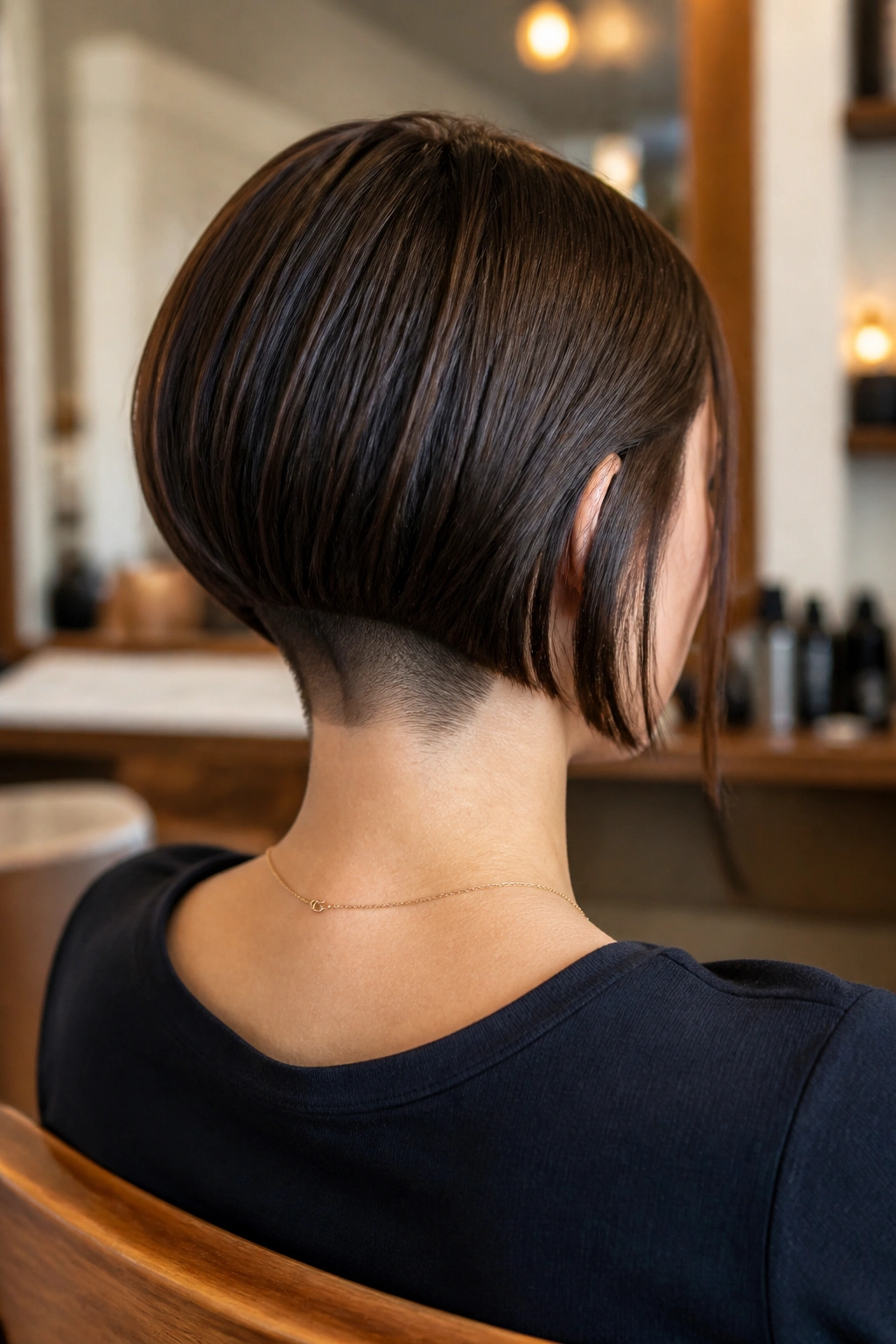
For very thick or coarse hair, a hidden undercut at the nape can be a lifesaver. It removes bulk where nobody sees it, which lets the rest of the bob sit closer to the head and fall more cleanly.
That hidden relief changes the haircut from the inside out. The top layers keep their shape, the back sits flatter, and your neck gets a little breathing room. It’s especially useful if the bottom of your hair feels hot, heavy, or impossible to dry.
This is not a casual maintenance cut. The undercut grows out. Fast. So if you choose it, you need to be okay with regular touch-ups to keep the shape tidy. Still, for some thick-haired people, it’s the difference between loving a bob and fighting it every morning.
It’s also a very practical answer when other layering methods have not been enough. Sometimes the bulk is just too much for scissors alone.
19. Face-Framing Layered Bob With Long Ribbons

A face-framing bob works because it puts the softest movement exactly where thick hair can feel heaviest: around the cheeks, jaw, and neck. The layers start lower, often below the cheekbone, so the haircut keeps most of its strength while still opening up the face.
Why the Front Matters So Much
Thick hair around the face can make a bob feel crowded. Long face-framing pieces break that up. They draw the eye downward and create a lighter path through the haircut, especially if the back is dense.
This is a nice option if you like wearing your hair forward or tucking one side behind your ear. The front pieces look intentional either way. They can also soften strong jawlines or balance a wider forehead without turning the haircut into something too layered or too busy.
Ask for This
- Long ribbons that start at the cheekbone or slightly below
- Internal weight removal through the back
- A soft connection between the front and sides
- Ends that are point-cut, not razor-frayed
I like this style because it respects thick hair instead of trying to fight it.
20. Soft Layered Lob With a Deep Side Part

A soft layered lob with a deep side part may be the most forgiving option here. It keeps enough length to handle thick hair, but the layers and side part keep the style from turning into one giant curtain.
The beauty of this cut is that it works on a lot of textures. Straight hair gets movement. Wavy hair gets shape. Dense hair gets room to breathe. And because the layers are soft rather than choppy, the grow-out stays neat for a long stretch.
It also gives you styling flexibility. Wear it smooth for a cleaner look, add loose bends for movement, or let it air-dry if your hair already has a decent pattern. That kind of range matters when a haircut needs to earn its keep in real life.
If you want one style that sits between polished and easy, this is the one I’d point to first. It’s not flashy. It just gives thick hair a better job to do.
Final Cut
Thick hair needs a bob with a plan. That plan might be a stack, an angle, a hidden undercut, or layers so soft you can barely spot them, but it should always answer the same problem: where does the extra weight go?
Bring photos. Better yet, bring photos from the front, side, and back, because a bob lives or dies on shape, not just length. And if you want the cut to behave between salon visits, tell your stylist how you wear it most days—air-dried, blown smooth, tucked behind the ears, or curled with a small iron.
The best layered bob for thick hair is the one that leaves you with less fighting and more movement. That’s the win.
