



Bantu knot hairstyles on natural hair have a way of looking playful and polished at the same time, which is a hard mix to get right. One minute the style feels sculpted and neat; the next, it feels soft and a little rebellious.
If you’ve ever sat in front of a mirror with a rat-tail comb, three clips, and a tiny bit of patience left, you already know the appeal. Bantu knots can be sharp and clean, but they also forgive a little imperfection. A part can drift. A knot can sit slightly higher than the one next to it. The style still works.
What makes them so useful on natural hair is the range. You can wear them as a full protective style, use them as a set for next-day curls, keep them tiny and detailed, or go bold with jumbo sections and accessories. The shape changes fast depending on parting, section size, and how much product you put at the root. That’s the real trick, and it’s why the same basic style can look sweet, edgy, elegant, or street-smart without much effort.
Some people think Bantu knots are only for one kind of natural hair, usually thick coils with a lot of length. Not true. Short cuts, tapered shapes, stretched curls, and dense 4c hair all behave differently, but they can all wear the style well when the tension is right and the sections make sense. The styles below lean into those differences instead of pretending every head of hair should be treated the same.
1. Classic All-Over Bantu Knots
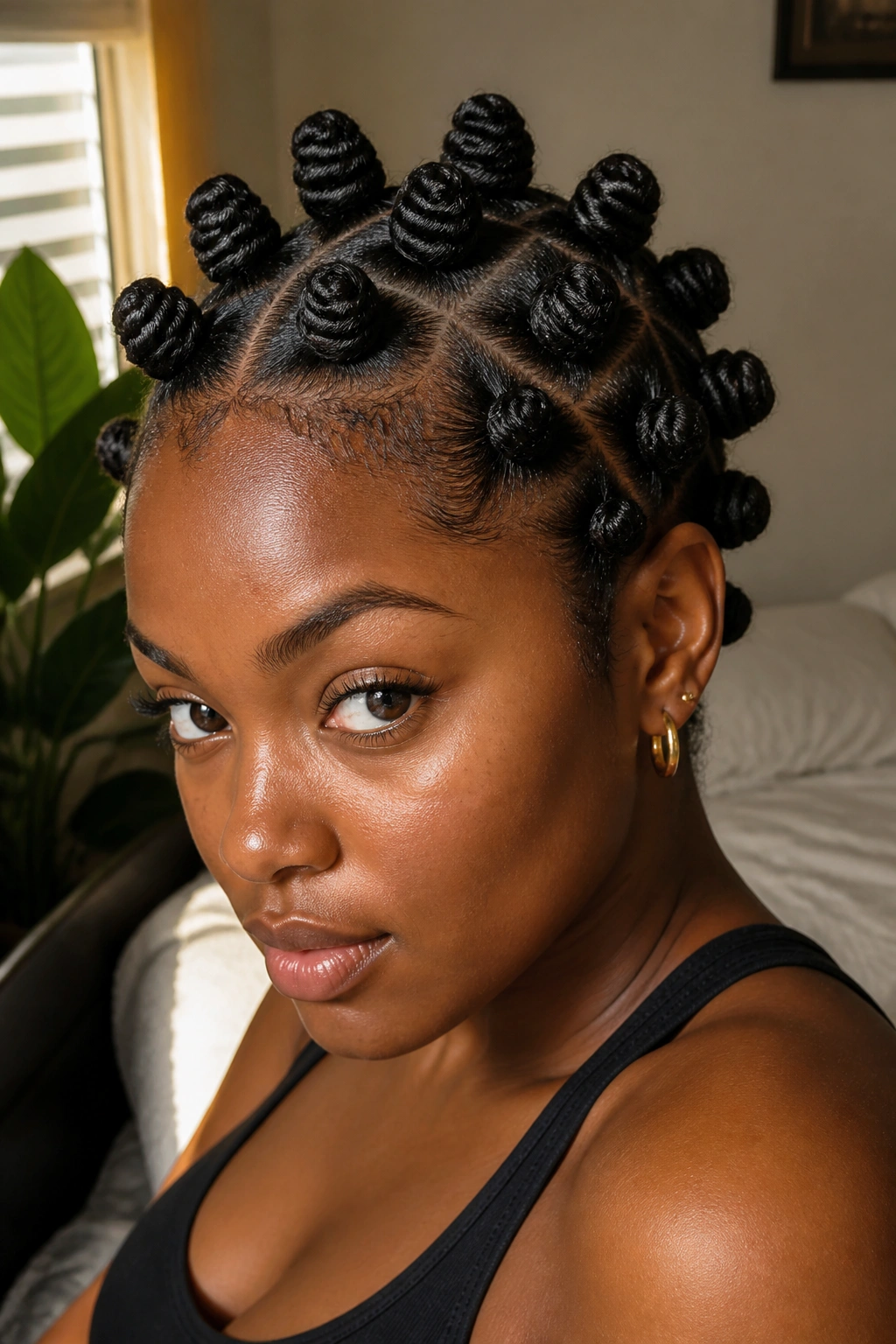
The classic all-over set is the version most people picture first. Clean parts. Even sections. Knots sitting close to the scalp in a tidy grid that makes natural hair look deliberate instead of crowded.
Why the classic set still holds up
The reason it works is simple: balance. When each section is close in size, the whole head reads as finished, even if the knots themselves are slightly different. I like this style best on hair that has been detangled and lightly stretched, because the sections lie flatter and the parts stay visible.
A 1 to 1½-inch section is usually a safe place to start for medium-density hair. Go smaller if your hair is dense or if you want more knots and tighter definition later. Go a little larger if your hair is long and you want the knots to sit up with a little more height.
What to watch for
- Keep the roots smooth before you start twisting the section into a knot.
- Use a light leave-in and a firm but flexible gel; too much product makes the style sticky.
- Work from front to back so the front sections stay neat.
- If a knot starts to puff out, pin the base with a small bobby pin instead of pulling harder.
Tip: clean parting matters more than perfect knot size. Messy parts show up fast on a full-head set.
2. Half-Up, Half-Down Bantu Knots
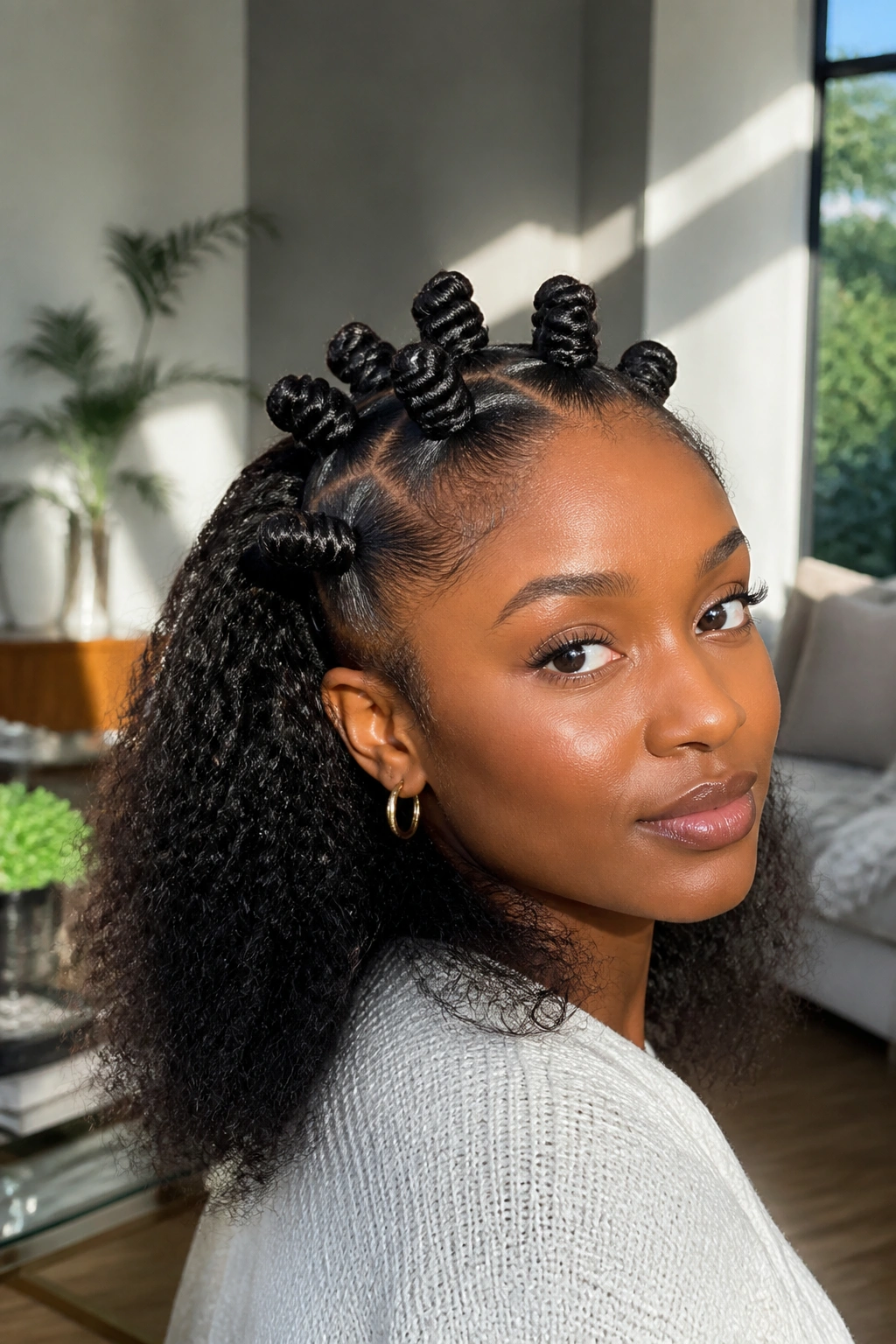
Half-up Bantu knots keep the style fun without hiding all your hair. That’s the appeal. You get the neat shape of knots up top, then the back stays loose, stretched, twisted, or curled depending on what your hair likes best.
This version works because it gives your face structure without committing the whole head to the same finish. The top section can be packed into six to ten small knots, while the back stays soft and full. That contrast feels easy in a good way, not lazy. I like it when the loose part has some texture left in it; pin-straight hair under knots can look a little disconnected.
The half-up shape is also kinder if your hair is in that awkward length zone where a full head of knots feels bulky. You still get the style, but the hair behind it can move.
If your hairline is tender, keep the front knots a touch looser and keep the parting clean rather than tight. No style is worth a sore scalp.
3. Mini Bantu Knots for Tight Definition
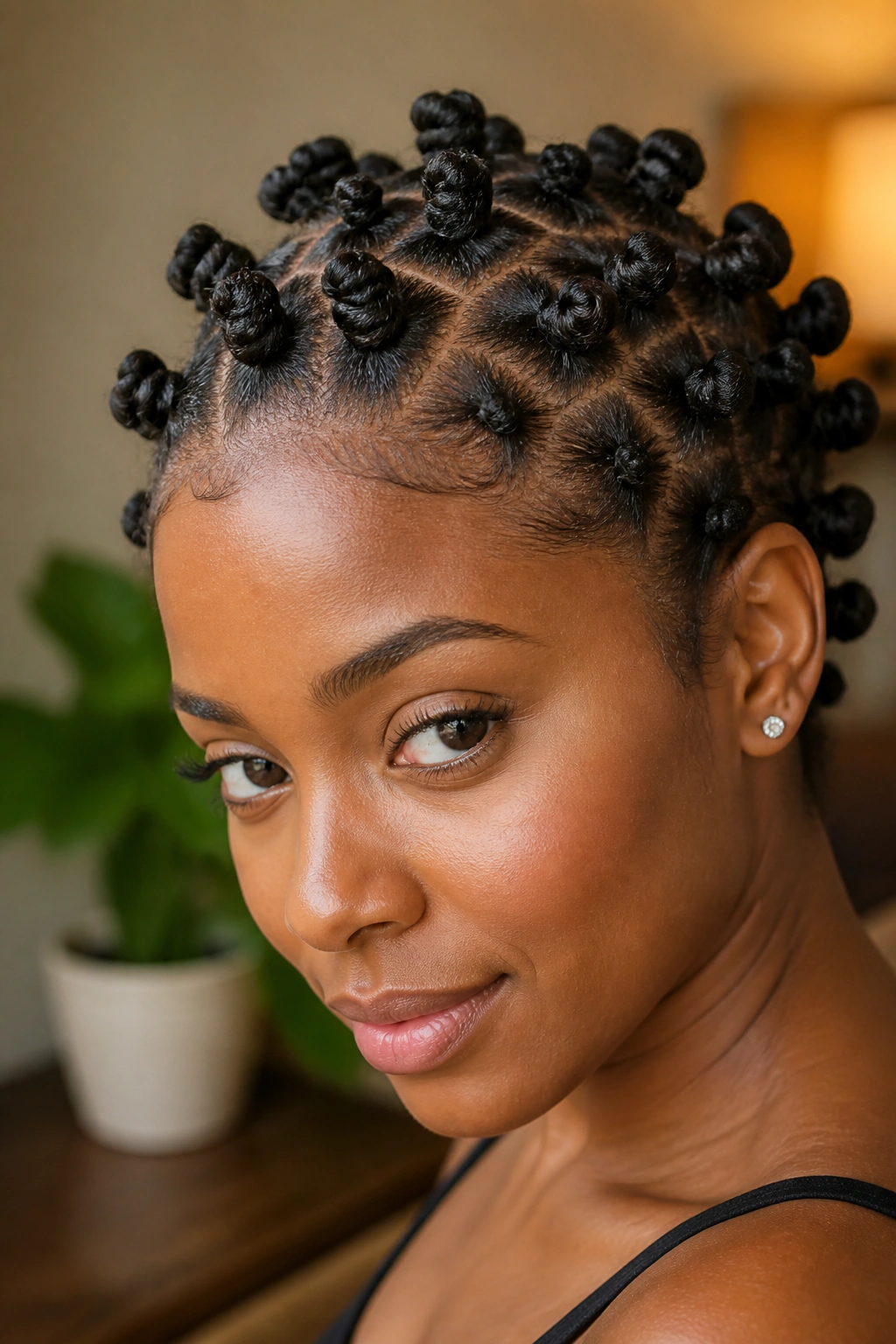
Why do mini Bantu knots look so neat? Because the smaller the section, the more precise the shape. They also give the style that compact, textured look people love when they want detail instead of drama.
Mini knots are a smart choice if you like a lot of movement on the head and a tight curl pattern when you take them down later. The trade-off is time. Plenty of time. A full set of mini knots can eat up an afternoon if your hair is thick or you’re sectioning carefully, but the final look usually feels worth the effort.
Best for smaller sections and sharper curl sets
- Hair that is short to medium in length
- People who want a denser knot-out later
- Coils that hold shape well after a little moisture and cream
- Styles that need a neat, detailed finish
Mini knots dry faster than jumbo knots because each section is smaller, but they also take more fingers and more patience. That’s the part nobody likes saying out loud. The payoff is texture. Lots of it.
4. Jumbo Crown Bantu Knots

Picture a row of larger knots framing the crown while the rest of the hair stays calmer underneath. That’s the jumbo version, and it has a little more presence than the classic grid.
Jumbo Bantu knots work well when you want the style to read from across the room. They can sit along the top and sides like a crown, or they can fill the whole head if you prefer bigger, sculptural sections. Because each knot uses more hair, the overall install is faster, which is a relief on dense natural hair. Fewer sections. Less time. Less hand fatigue.
The catch is that jumbo knots show everything. Uneven parting, frizzy roots, a rushed wrap — all of it. So the part lines need to be crisp, and the sections need to be close in size even if they are bigger than usual.
A style like this looks especially good with large earrings, a strong brow, or a high-neck top. It already has shape; you do not need much else.
5. Deep Side-Part Bantu Knots

A deep side part changes the mood fast. The style stops feeling symmetrical and starts feeling a little more styled, a little less school-photo.
I reach for side-part Bantu knots when I want the hair to frame one side of the face and leave the other side cleaner. It gives the knots a natural sweep, which is useful if your face shape feels too round for a centered grid. The line of the part can be dramatic or soft. Either way, it pulls the eye in one direction and keeps the style from looking too rigid.
The best side parts are not shallow little lines that barely move the hair. They need commitment. That means a clear comb line, sections that follow the angle, and a root product that holds the part in place while you work. If the hair is very fluffy, I like to smooth the roots first and let them set for a few minutes before shaping the knots.
I also think side parts look better when the knots aren’t all the same size. A tiny bit of asymmetry makes the style feel less boxed in.
6. Triangle-Part Bantu Knots
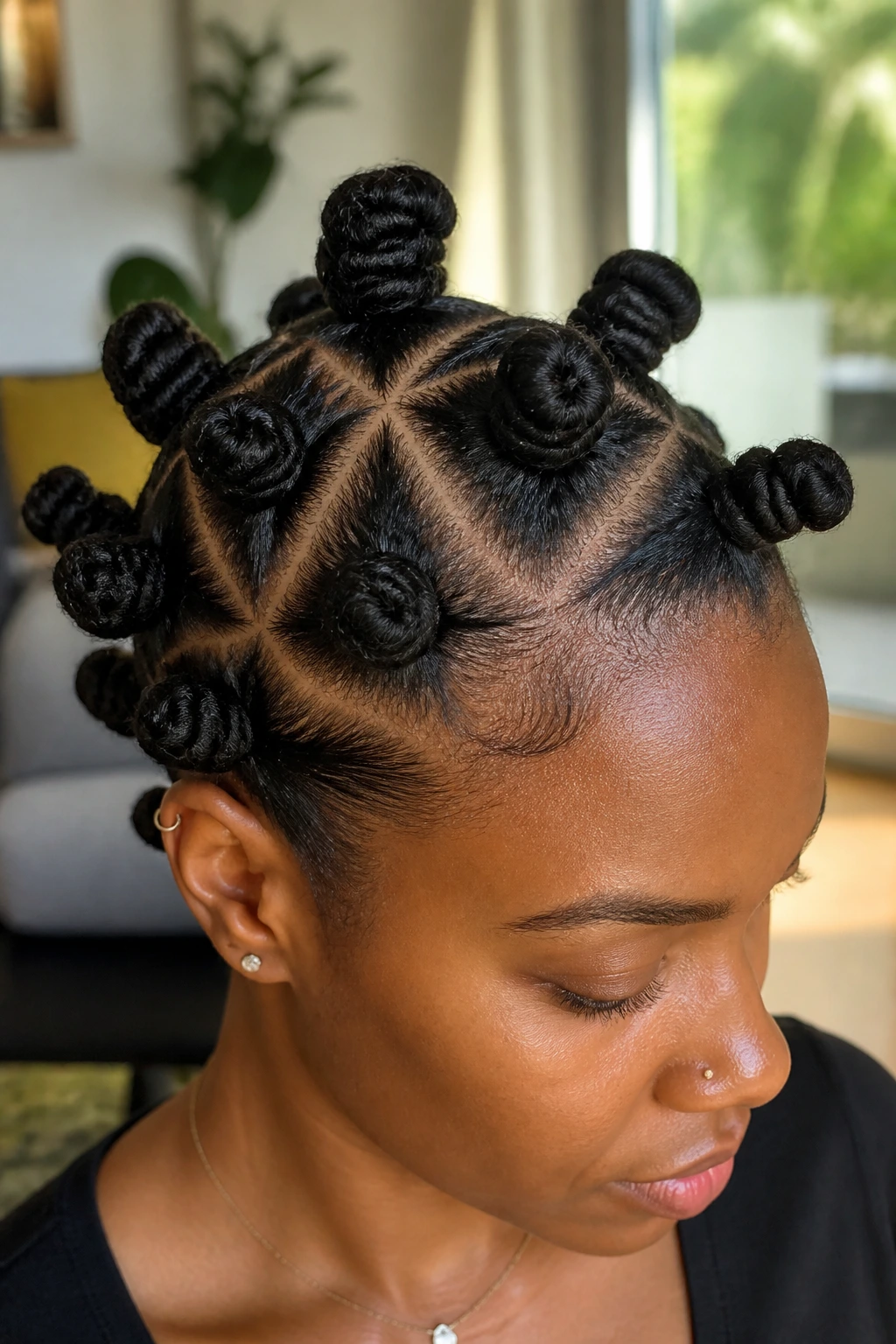
Triangle parts do one thing square parts don’t: they break up the grid. That sounds small, but the visual effect is real. The whole style looks less blocky and a little more organic.
This layout works especially well on natural hair that already has strong volume. Square parts can make the head look too patterned if the hair is dense. Triangle sections soften that look and make the knots sit at slightly different angles, which keeps the style from feeling stiff. I like triangle parts when the knots are medium sized rather than tiny; on very small sections, the shape can get lost.
The downside is time. Triangle parting takes more care, and if you rush it, the points can drift in strange directions. That shows. Parting with a rat-tail comb and clipping each finished section helps more than people think.
Triangle-part Bantu knots also make a good base for a knot-out later because the curl pattern comes out with a bit more variety. That slight irregularity is what keeps the finished curls from looking stamped out of a mold.
7. Braided-Base Bantu Knots
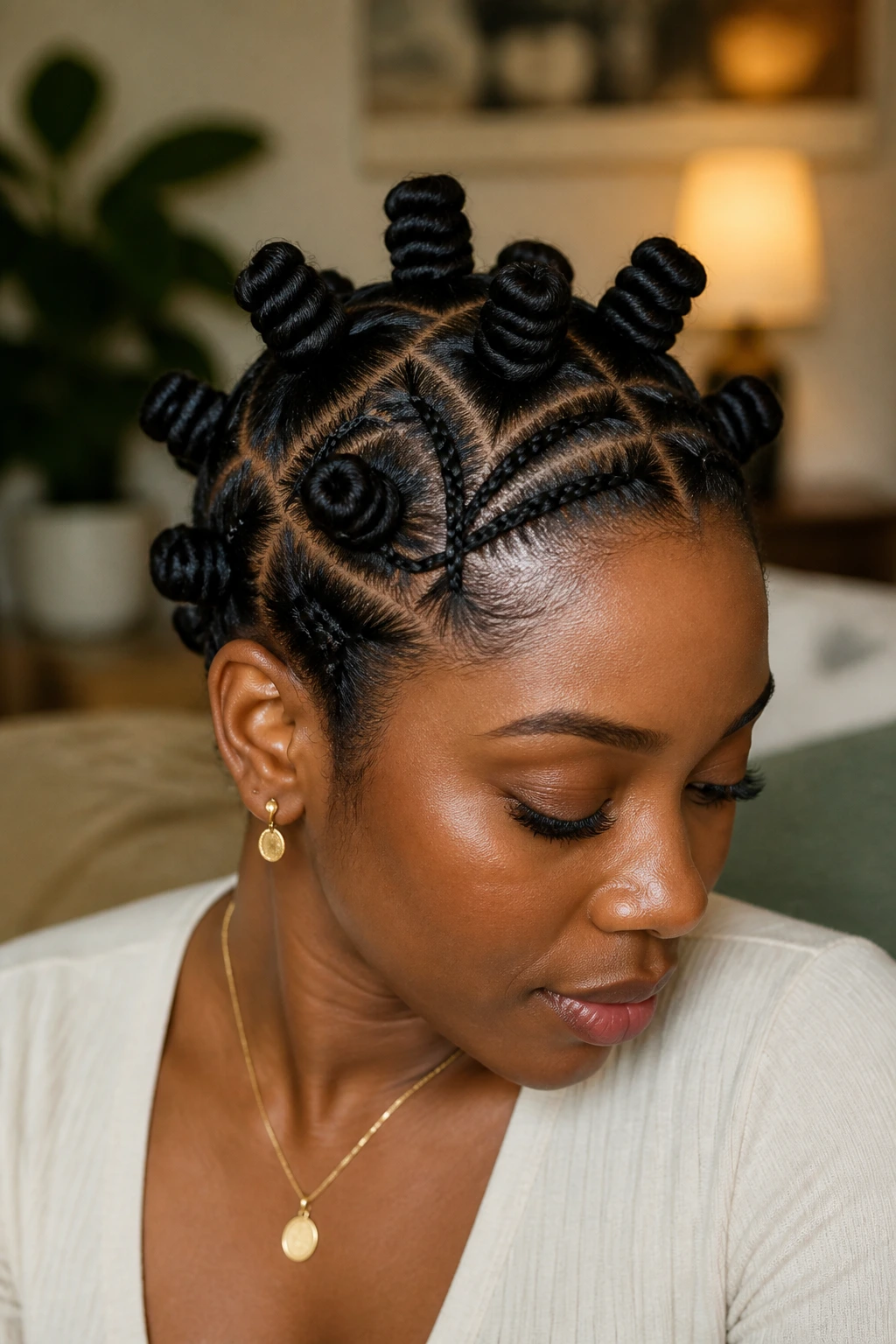
What if your hair slips out of knots before lunch? Braid the root first. That’s the whole point of a braided-base Bantu knot, and honestly, it’s a very practical move.
How the braid changes the shape
The braid gives the style grip. A section that might unravel on soft, slippery, or freshly conditioned hair suddenly has more structure, especially at the base. Once the braid is secure, the rest of the section can be wrapped into the knot with less fuss. That matters on fine natural hair or on hair that gets slick fast after leave-in.
Braided bases also make the style last longer when you want to keep the knots in for more than a day or two. They are not as plush as a pure knot, though. The look is a little more textured, a little more built.
- Best on hair that needs extra hold
- Good for longer wear
- Helpful when you want a stronger knot-out later
- Not ideal if your scalp is already sensitive, because tight braids can tug
A braided base is one of those details that seems minor until you try it. Then you stop fighting your own hair.
8. Bantu Knot-Out Curls
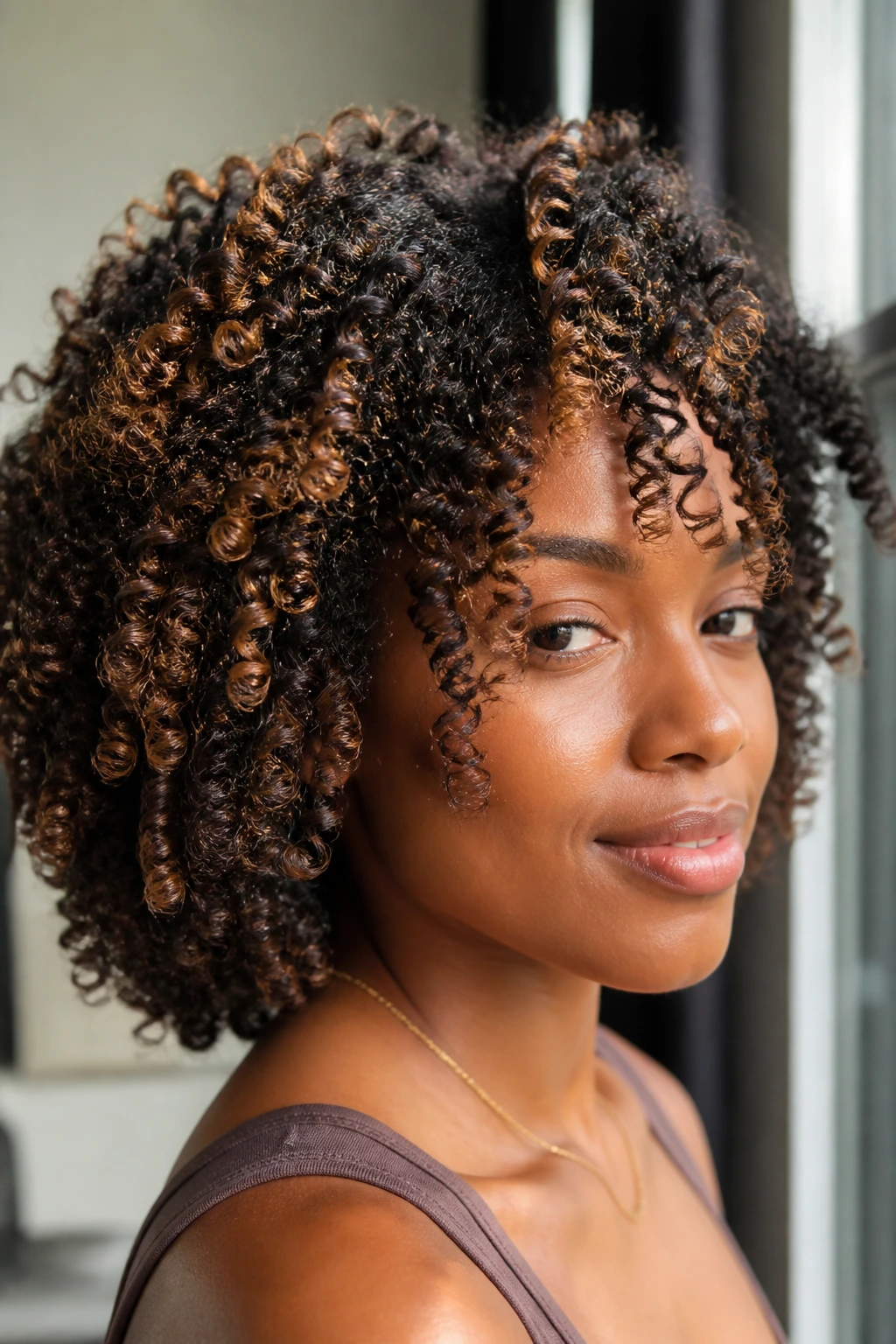
Some people keep the knots. Others keep the curls. The knot-out is still one of the smartest reasons to wear Bantu knots on natural hair in the first place.
The set starts as knots, but the real payoff comes later when you let the hair dry fully and unravel each section with care. The result is a springy, defined curl pattern with more structure than a regular twist-out. Smaller knots make tighter curls. Bigger knots give you broader bends and a softer wave. That difference matters more than people expect.
Do not rush the take-down. Damp hair loses shape fast, and if the inside of the knot is still wet, the curl will fall before you’ve even separated both sides. I like to use a tiny bit of oil on my fingertips while opening each knot. Not much. Just enough to stop frizz from building as the sections come apart.
This style is for people who like the process as much as the finish. The knots are the set. The curls are the reward.
9. Short Natural Hair Bantu Knots
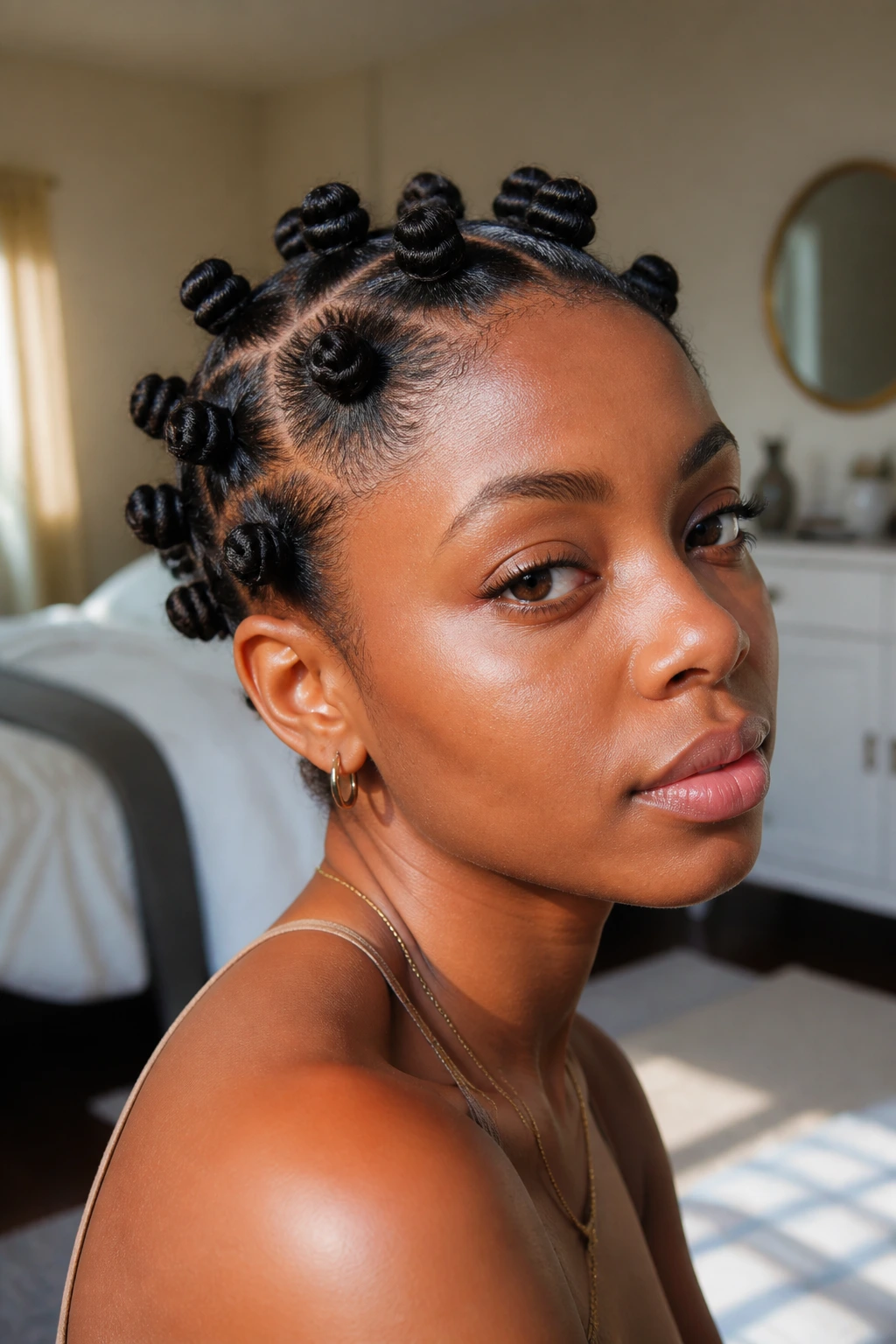
Short natural hair changes the whole game. The style gets smaller, tighter, and more playful, and you start seeing the shape of the head in a different way.
What short hair needs most
- Sections that are no bigger than 1 inch
- A soft gel or cream that helps the ends stay tucked
- Gentle tension at the root, never a hard pull
- Bobby pins for stubborn pieces that refuse to stay wrapped
Hair in the 2- to 4-inch range usually gives enough room to wrap the ends without a fight, but shorter coils can still work if you keep the knots compact. The trick is not to force them into the same size you’d use on longer hair. That’s how you get pieces sticking out and a shape that looks unfinished.
Short-hair Bantu knots often look best when they are not too perfect. A little texture around the hairline keeps the style from feeling stiff. Clean parts still help, though. Short hair shows part lines in a very honest way, which can be a blessing if you enjoy a sharp finish and a problem if you rush.
10. Tapered Cut Bantu Knots

A tapered cut gives Bantu knots a built-in frame. The sides are already short, so the eye goes straight to the top, where the knots can do all the talking.
This is one of my favorite pairings because it feels strong without being heavy. The top section can hold a row of small or medium knots, while the tapered sides stay smooth, brushed, or lightly laid down with gel. That contrast makes the shape look intentional. It also keeps the back of the neck clear, which is a real comfort if you wear your hair up a lot.
A tapered cut works well with a clean fade around the edges, but it does not need one. Even a soft taper gives enough structure. The main thing is keeping the top sections even so the knots sit in a line instead of wandering all over the crown.
If your hairline is delicate, avoid building too much tension where the top meets the tapered sides. The style should look sharp. It should not feel sharp.
11. Beaded Bantu Knots
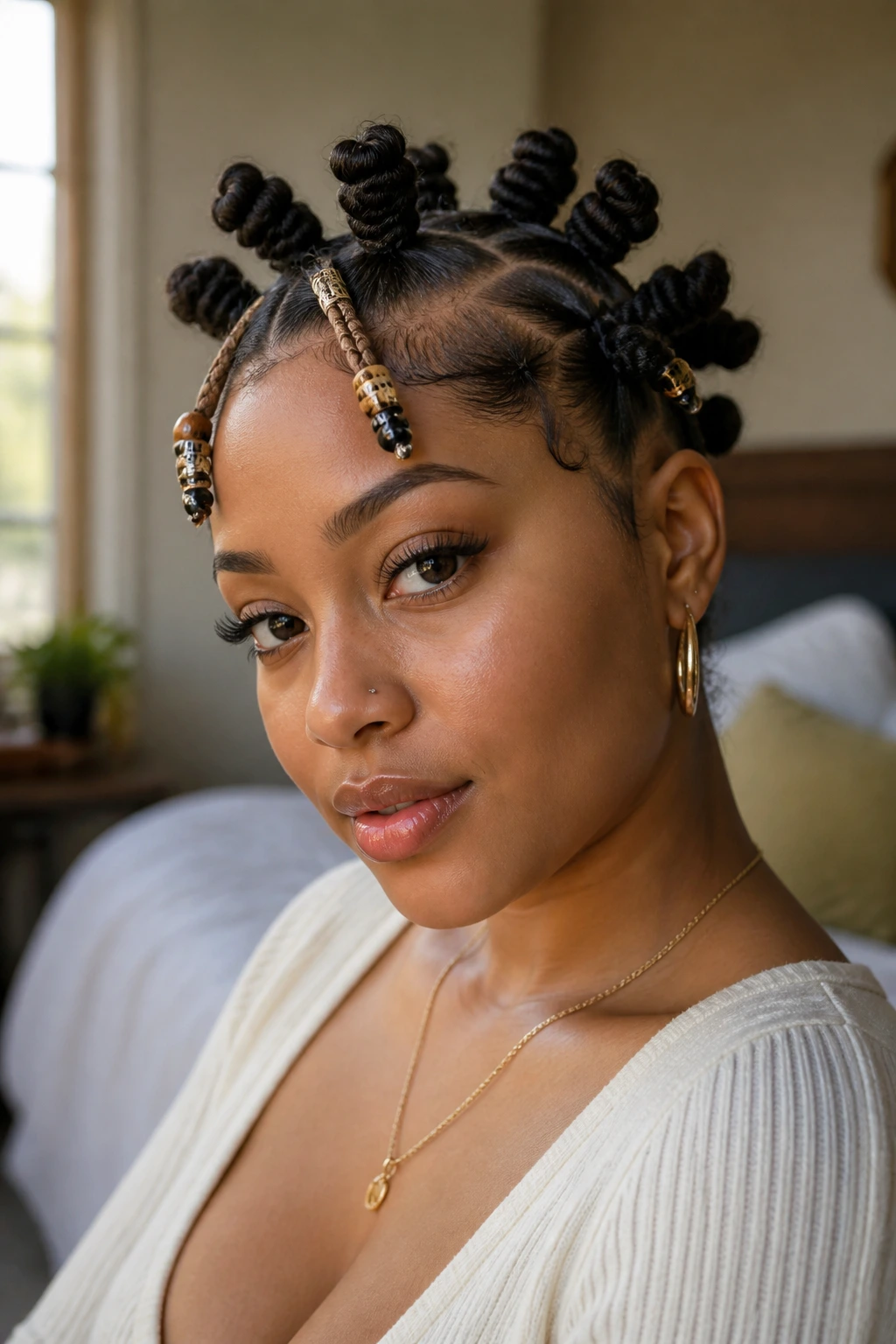
Beads change the rhythm of the style. Not by much, but enough to matter.
Plain Bantu knots already have shape. Add beads or cuffs, and the style gets a little movement every time you turn your head. I like this on styles where the knot sections are fed by small braids or where a few front pieces are braided before they are wrapped. That gives the beads a place to sit without fighting the knot itself.
The key is restraint. Too many beads can make the style feel noisy and heavy, especially near the temples. A few well-placed cuffs near the front or along the parting lines usually do more than a full load of hardware. And yes, weight matters. Heavy beads drag on fine hair and can make the scalp feel tired by the end of the day.
This style suits people who enjoy a little shine and motion without turning the whole head into an accessory display. A couple of metal cuffs. Maybe clear beads. That is enough.
12. Zigzag-Part Bantu Knots
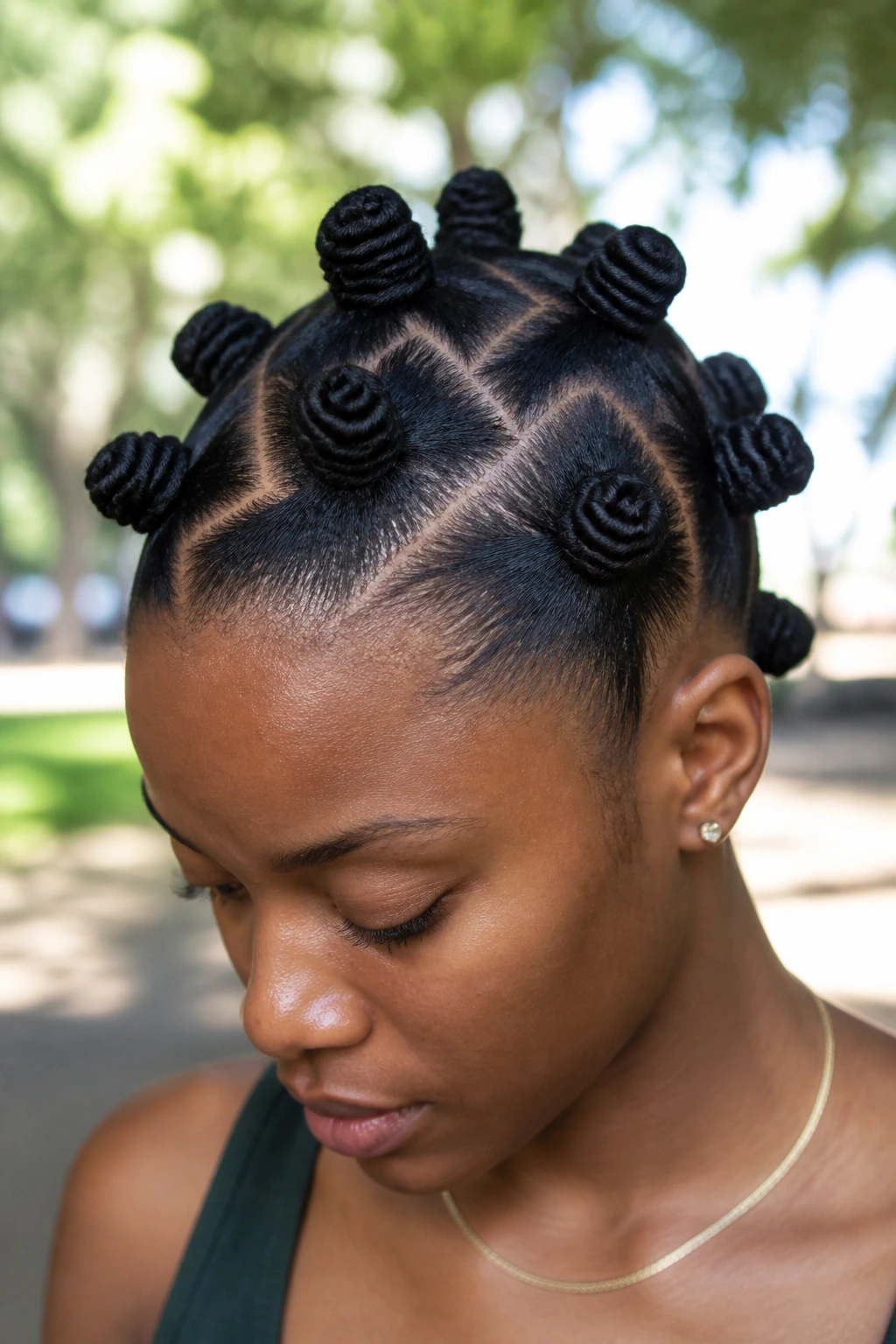
Why do zigzag parts look so lively? Because the part line keeps moving. The eye follows every little turn, and the whole style ends up feeling less rigid than a straight grid.
Zigzag-part Bantu knots are a good choice when you want a playful finish that still looks deliberate. The parts can snake across the head in wide angles or stay tight and close together. Either way, they break the symmetry in a way that flatters natural hair, especially when the knot size is medium and the scalp pattern matters as much as the knots themselves.
Keeping the zigzags crisp
Use a rat-tail comb and trace each turn before you commit to it. A little gel along the part helps the sections stay visible, but don’t drown the roots in product or the lines blur. Clip each section as you go. That keeps the zigzag from collapsing while you work on the other side.
This style is especially nice for kids or for anyone who likes a little edge without extra accessories. The parting does the decorating already.
13. Two-Strand Twist Bantu Knots
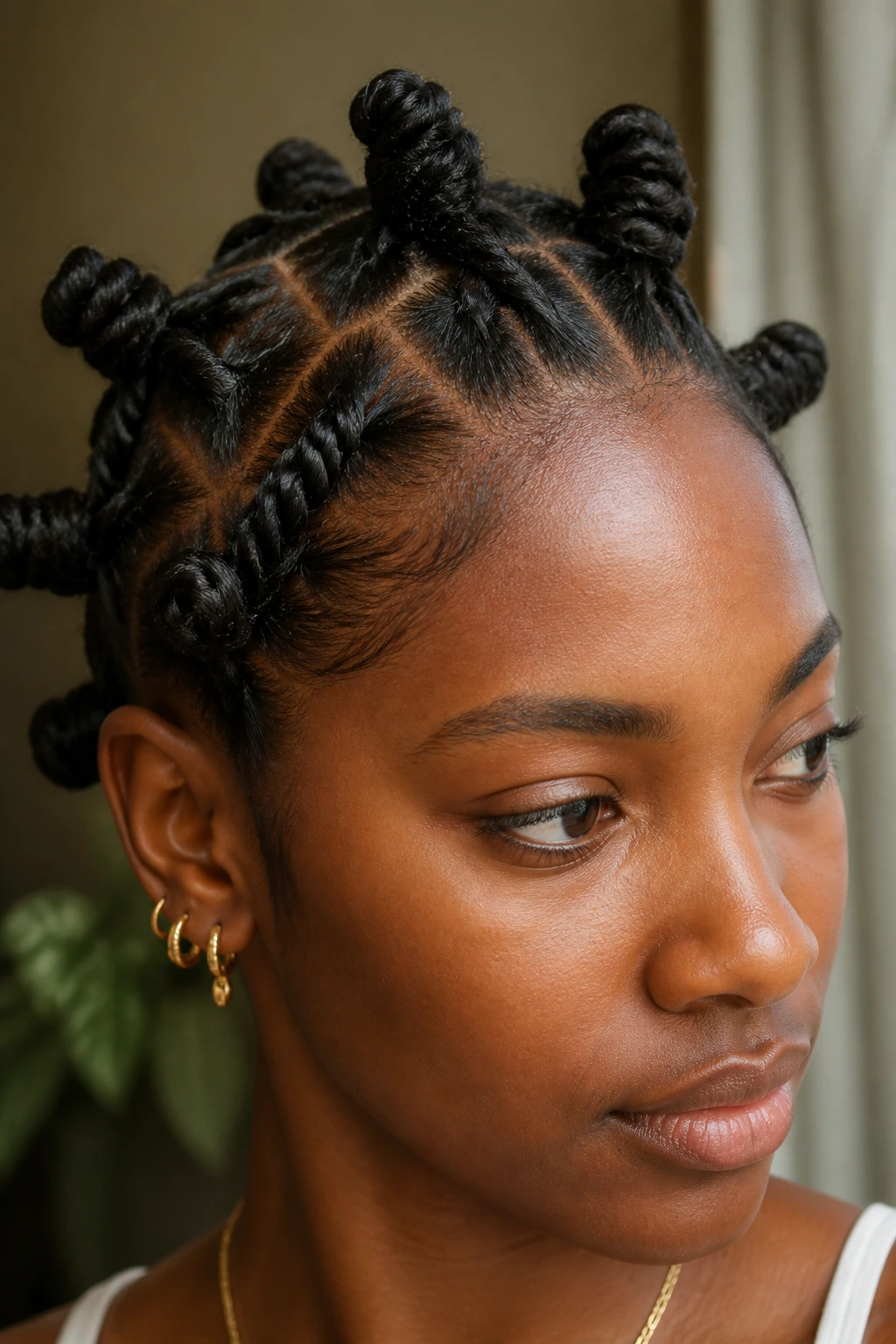
A twist before the knot gives the hair a rope-like texture that plain wrapping doesn’t have. That tiny change makes the whole style feel richer.
Two-strand twist Bantu knots work well on thick natural hair because the twist at the root gives grip and shape before the section coils into the knot. If the hair has different textures in different zones — maybe looser curls at the front and tighter coils at the back — this method helps everything look more even. The twist also keeps the ends from puffing out while you wrap.
What the twist base adds
The twist base gives more texture if you wear the knots as a style. If you take them down later, the curls tend to have a little extra pattern at the root, which is nice when you want a knot-out that looks fuller.
It takes a little more time than a plain knot. No surprise there. But the hold is often better, and the style can look more finished on hair that is very thick or very long.
I like this option when I want something textured without making the knots tiny. It’s a middle ground, and that’s often the sweet spot.
14. Colored-End Bantu Knots
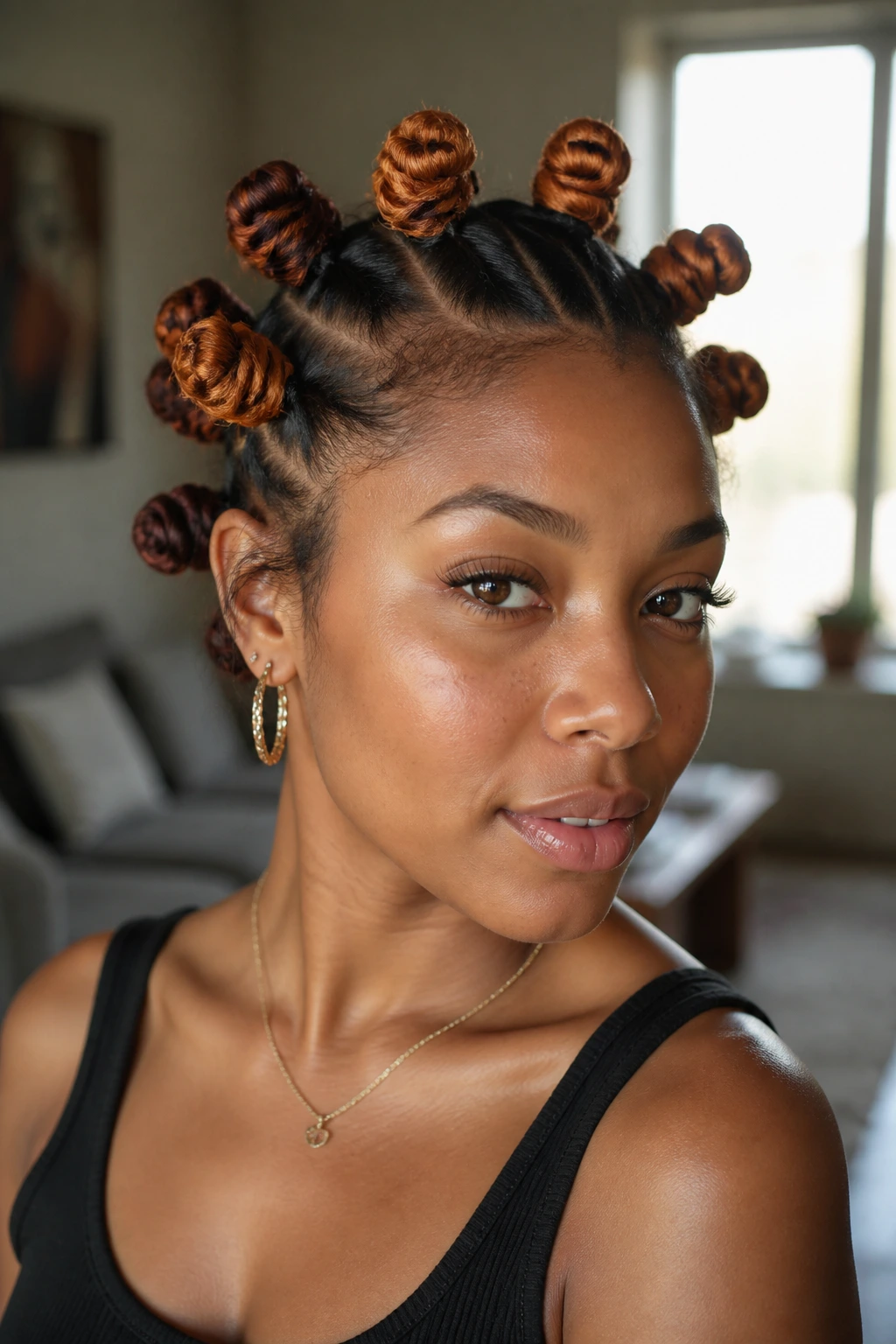
A little color changes the whole read of the style. The knots stop being just shape and start giving contrast, which is a big reason this look gets so much attention on natural hair.
Warm tones — honey brown, copper, auburn, even a soft burgundy — make the coils stand out against darker roots. The texture catches the eye faster because the color traces the twist of each section. If your hair is fragile, keep the color at the ends or use a temporary color spray or wax on the finished style instead of reaching for bleach. That part matters.
I also like colored-end knots on a protective style when you want a fresh look without changing the cut. The color gives movement, but it does not need to be permanent to be effective. Temporary shades wash out, which is useful if you like to switch things up without living with one color for months.
This is one of the few styles where a tiny bit of color goes a long way. You do not need much. One accent is enough.
15. Low Bun Hybrid Bantu Knots
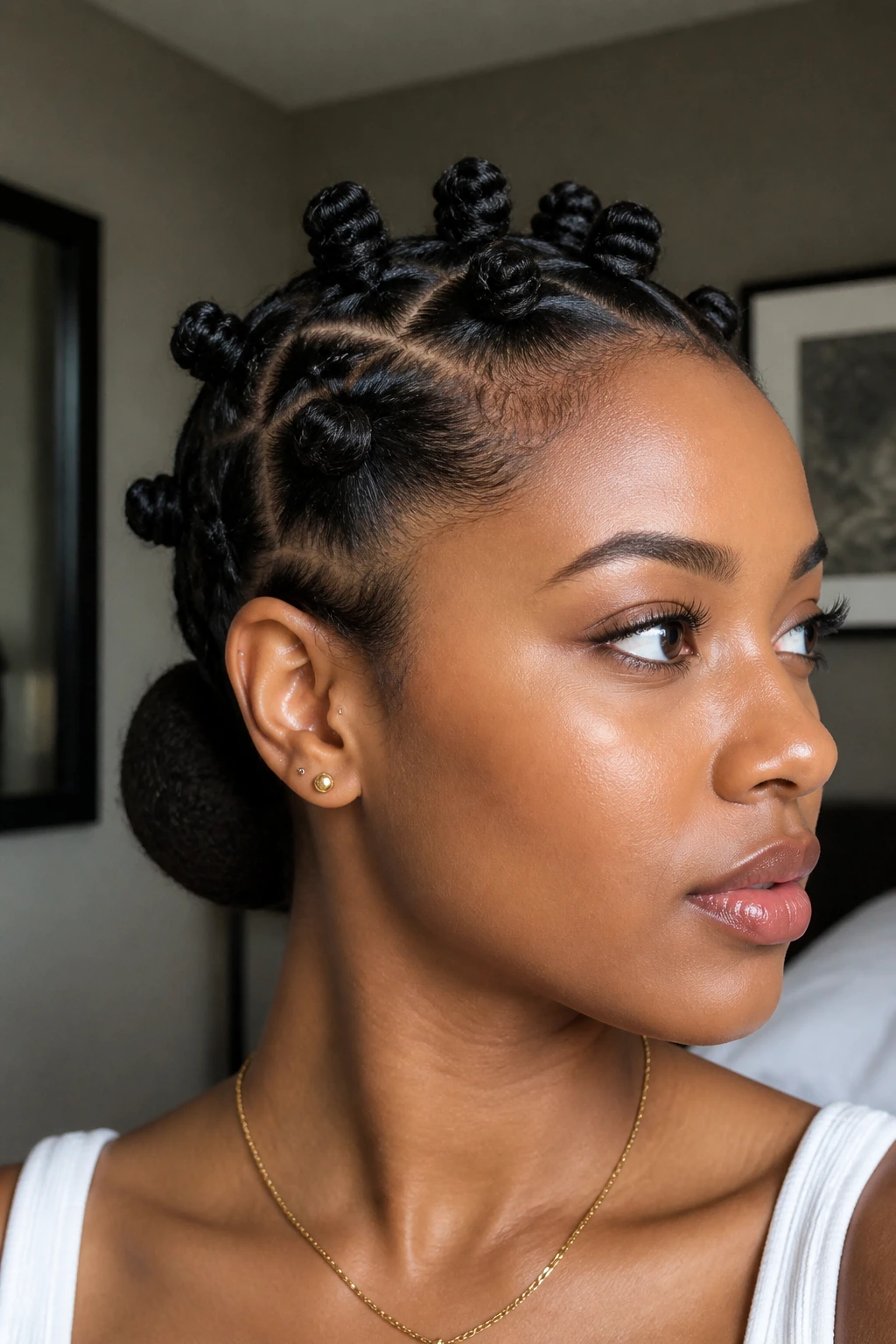
Can Bantu knots look polished enough for a meeting or dinner? Yes, if you tuck the style into a low bun hybrid.
The idea is simple: place a few knots along the crown or the sides, then gather the lower section into a low bun or tucked roll at the nape. The result feels more dressed up than a full grid of knots. It also keeps the neckline clean, which is useful when you want the style to sit nicely with earrings, collars, or a jacket.
This hybrid works best when the knots at the top are smaller and the bun is smooth enough to anchor the whole shape. If the bun is too bulky, the style turns clunky fast. If the knots are too loose, the look loses its shape. The balance is the thing.
I like this version on medium to long natural hair because it gives a bit of height without making the whole head feel crowded. It is tidy, but not boring. That is the sweet spot.
16. Sleek Event-Ready Bantu Knots
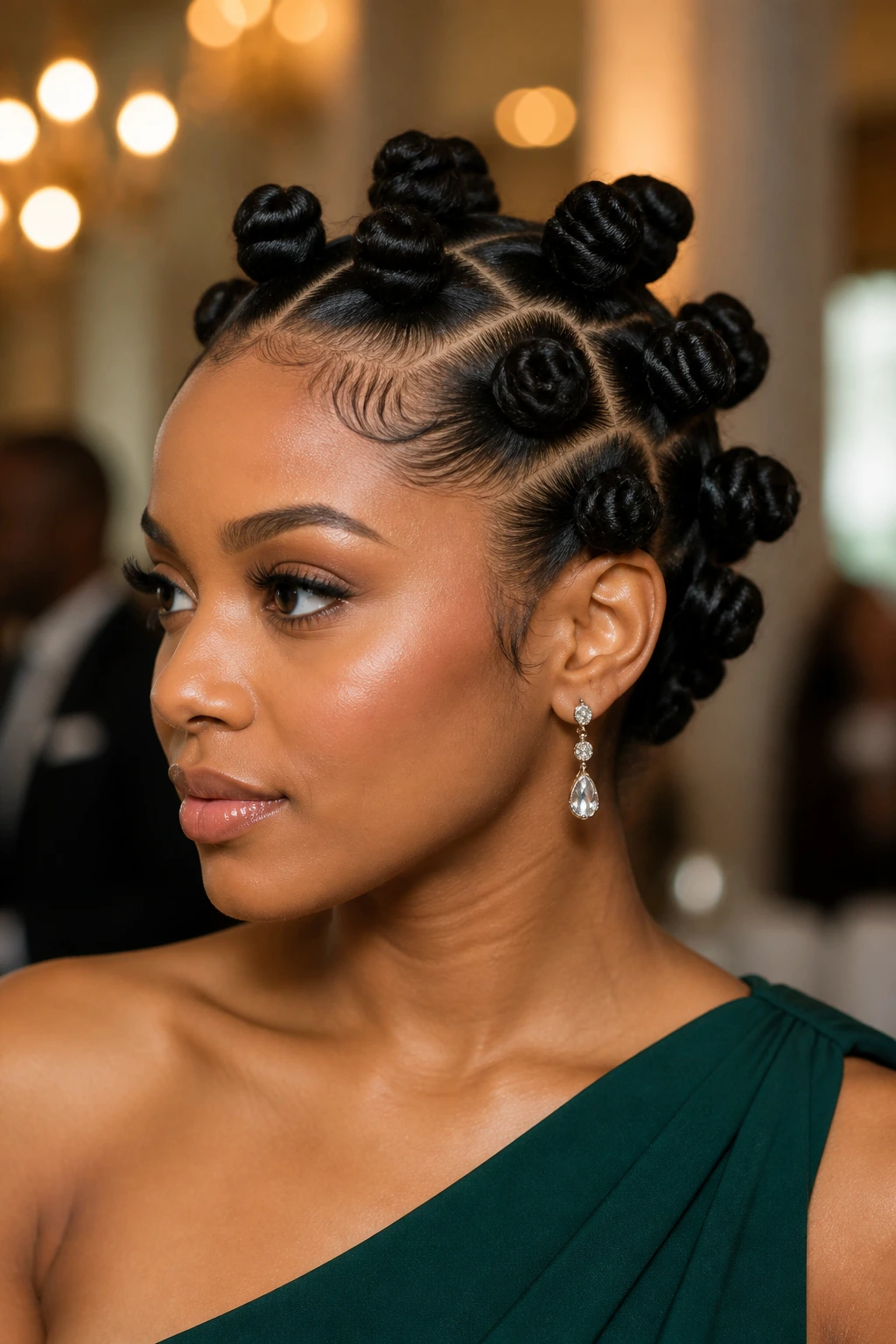
When the parts are crisp and the edges are smooth, Bantu knots can look formal. Not stiff. Formal. There’s a difference.
This is the version I’d pick for a dressy event, a photo day, or any moment when the hair needs to look controlled from every angle. The sections are usually medium-sized, the roots are smoothed with care, and the knots sit close enough to the scalp that the shape feels sculpted. A light shine product on the parts helps, but too much makes the scalp look greasy in person. That line is easy to cross, so go light.
The details that make it look finished
- Use a fine-tooth rat-tail comb for the parts
- Smooth the roots with a brush before wrapping
- Keep the knots even in height, not just size
- Lay the edges only if that suits your hairline
This style does not need glitter, rhinestones, or anything noisy. Clean geometry does the work. If you want the hairstyle to carry the outfit, this is one of the stronger picks.
17. Overnight Bantu Knots for Defined Curls

Overnight knot sets are for people who want next-day curls and do not mind waiting for them. The style starts as knots, but the real point is the take-down.
The hair needs to be dry enough to hold the shape before you wrap your scarf or bonnet. If the knots are still damp at the center, the curls can flatten, frizz, or stretch out before morning. Thick natural hair can take a while to dry fully, so I usually treat overnight as a minimum rather than a guarantee. Sometimes longer is better.
Drying time and take-down
A satin scarf helps keep the roots smooth, but do not tie it so tight that the knots get pressed flat. That can wreck the curl pattern. When you open the style the next day, separate each section slowly and stop as soon as the hair starts to spring. Pulling apart too much makes the curl look frayed instead of full.
This version is less about wearing the knots out and more about what the knots become. The set is only half the story.
18. Kid-Friendly Bantu Knots
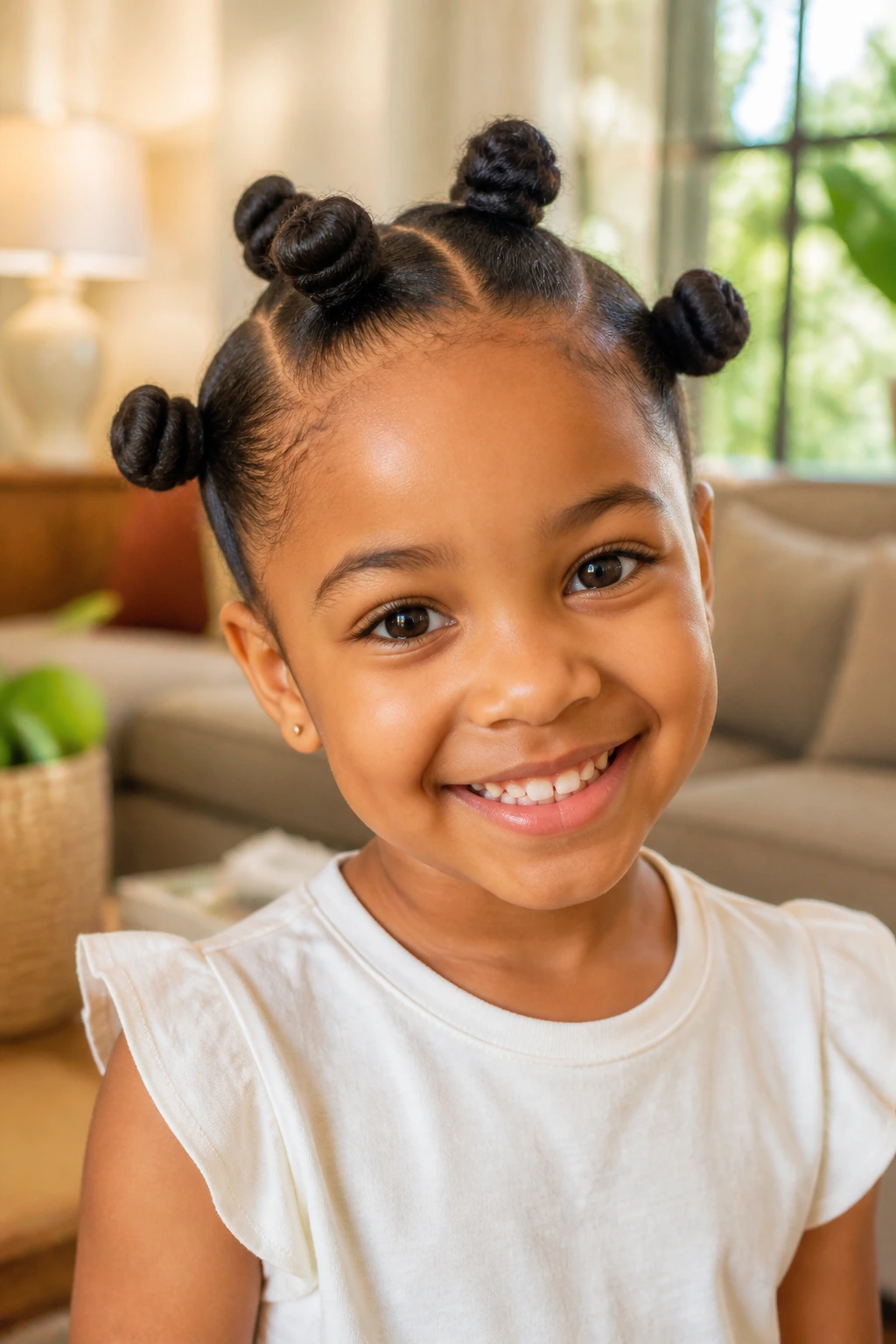
Kids and Bantu knots get along when the sections are larger and the whole process moves quickly. That is the honest version.
A child-friendly set needs comfort first. Tight roots, long styling sessions, and heavy product do not belong here. Softer creams, slightly bigger sections, and fewer knots make the style easier to wear for a whole day. I also like keeping the parting simple — a center part, a few rows, maybe two front knots with the rest pulled back — because complicated grids are hard to maintain on hair that moves around a lot.
Bright clips, small bows, and light-colored bands fit this style well. The accessories should add fun, not weight. If a child keeps touching the knots or complaining about the scalp, the tension is probably too much. That is your sign to loosen up and keep the style easier next time.
This version is cheerful when it stays comfortable. That part matters more than the photo.
19. Stretch-and-Protect Bantu Knots
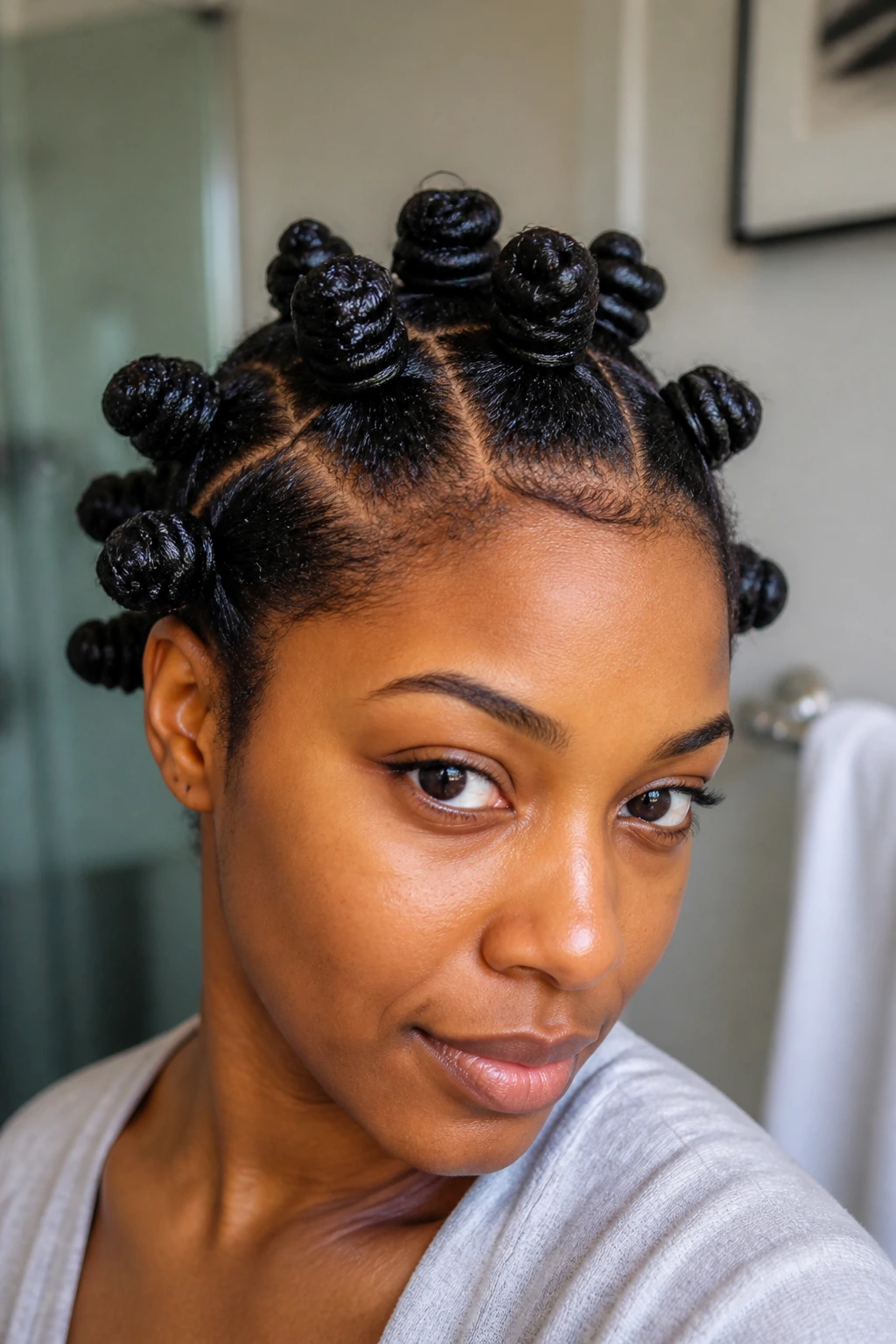
If your main goal is to stretch natural hair without heat, Bantu knots can do that job with a lot less drama than people expect.
The style works as a low-manipulation set when the hair is damp, detangled, and sectioned into medium knots. The hair dries in a stretched shape, so shrinkage is reduced when you take it down later. That makes the style useful for wash-day week when you want length, shape, and fewer tangles in the morning.
Compared with a twist-out, Bantu knots usually give a rounder curl pattern and a little more lift at the root. Compared with braids, they can feel softer and less rope-like. That is why I like them for natural hair that wants movement without losing too much length.
The main mistake is setting the hair too wet. Wet knots hold forever inside, and the inside stays cold and puffy even when the outside looks dry. Start with hair that is only lightly misted or partly air-dried, and the style behaves much better.
20. Faux Hawk Bantu Knots

If you want attitude, put the knots down the center and keep the sides tight. That’s the faux hawk version, and it has a sharp, confident shape without needing a cut to match.
The center line can hold a row of medium knots from forehead to nape, while the sides get braided flat, slicked back, or tucked out of the way. The silhouette does the heavy lifting. It feels bold, but the structure is simple enough that it does not turn into a styling project you dread halfway through.
This style works especially well when the middle knots are uniform and the side sections are kept neat. If the hair is long, the center row can be fuller and more dramatic. If it is shorter, the knots can be smaller and the sides can be pinned flatter so the shape still reads clearly. A few cuffs or a clean middle part can sharpen the look even more, but they are not required.
It is the style I reach for when I want the knots to do the talking. Clean tension, even spacing, and a strong center line — that’s the whole trick, and it’s enough.
