



A pixie cut with a headband can fix a bad hair morning faster than almost anything else in a bathroom drawer. One slim band, one twist of hair, and suddenly the cut looks deliberate instead of half-finished. That matters more than people admit, especially when a pixie is growing out, the fringe keeps slipping into your eyes, or the crown needs a little help.
The funny part is that the headband does not have to do much. It just has to sit in the right place, have the right width, and match the mood of the cut. A narrow satin band can make cropped hair feel polished. A padded band can make it look bold. A scarf or turban wrap can hide awkward lengths without hiding the haircut itself. Small switch. Big change.
I’ve always liked that pixie cuts with a headband give you room to play without asking the haircut to be something it isn’t. Pixies are blunt little cuts. They show everything. That can be thrilling, and it can be unforgiving too. The right band softens hard lines, frames the face, and gives the style a point of view.
So let’s get specific. Different pixie shapes ask for different bands, different textures, and different amounts of structure. Some look better with sleek shine. Others need a little bulk or fabric. A few want almost no ornament at all. Those differences are the whole game.
1. Side-Swept Pixie With a Slim Satin Headband
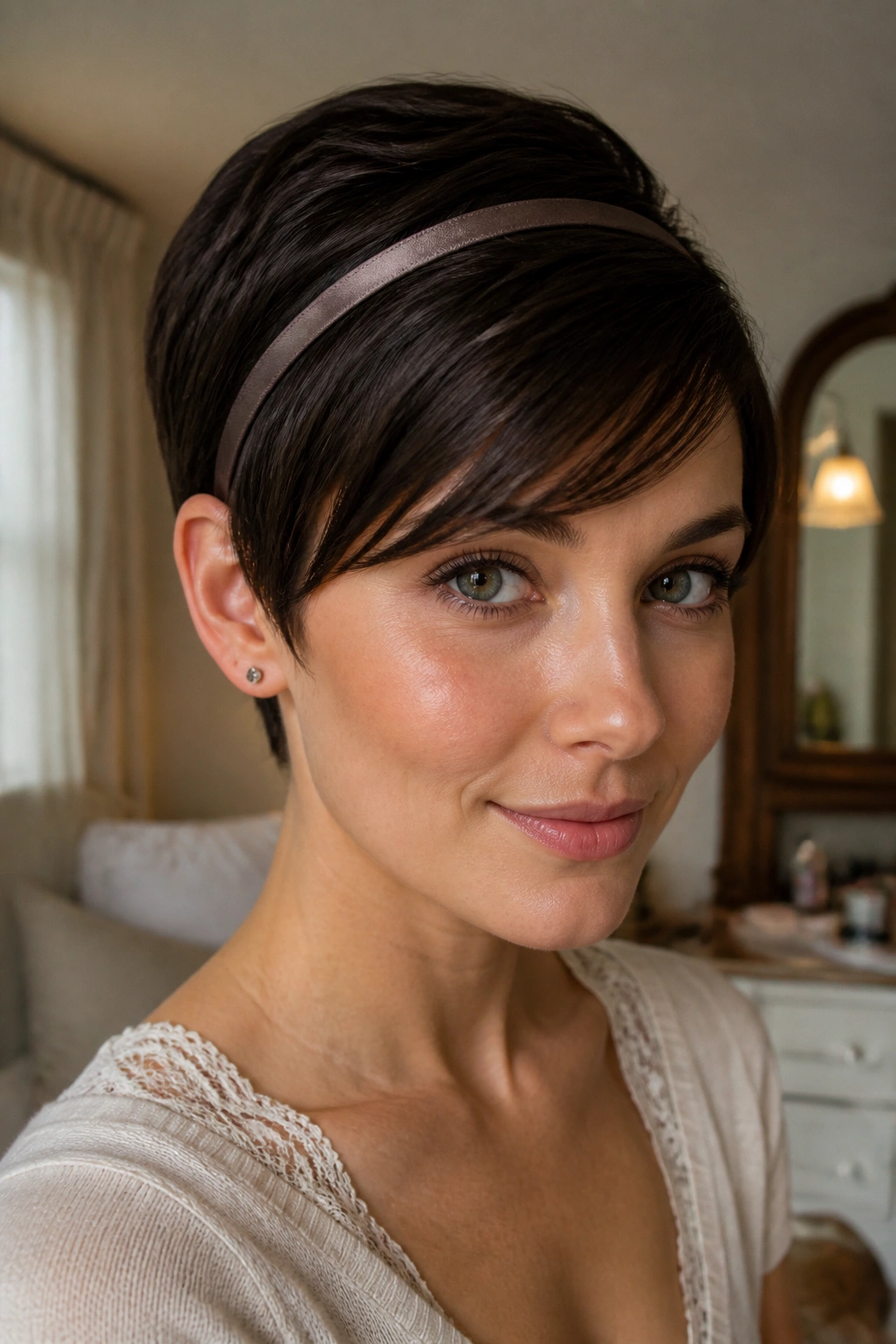
A slim satin headband is the easiest way to make a side-swept pixie look finished without stealing attention from the haircut. The satin sheen keeps the style light, and the narrow width lets the side part stay visible instead of getting buried under fabric.
Why the satin finish works
Satin sits in that nice middle ground between plain and dressed up. It reflects enough light to look intentional, but not so much that it turns the cut fussy. On fine hair, that matters. You want the band to read as a detail, not as the whole story.
Place it about half an inch behind the hairline and let the front section sweep across the forehead in one smooth curve. If the pixie has a longer top, tuck the heavier side just behind the ear on one side only. That unevenness gives the style shape.
- Best with: straight or lightly bent hair
- Good band width: ¼ to ¾ inch
- Works well for: office days, dinners, and simple outfits that need one strong detail
- Avoid: thick foam bands that cover too much crown
My favorite move: keep the ends a little piecey with a dab of light cream, not a shiny serum. Too much gloss makes the whole thing feel slippery.
2. Choppy Pixie With a Knotted Knit Headband
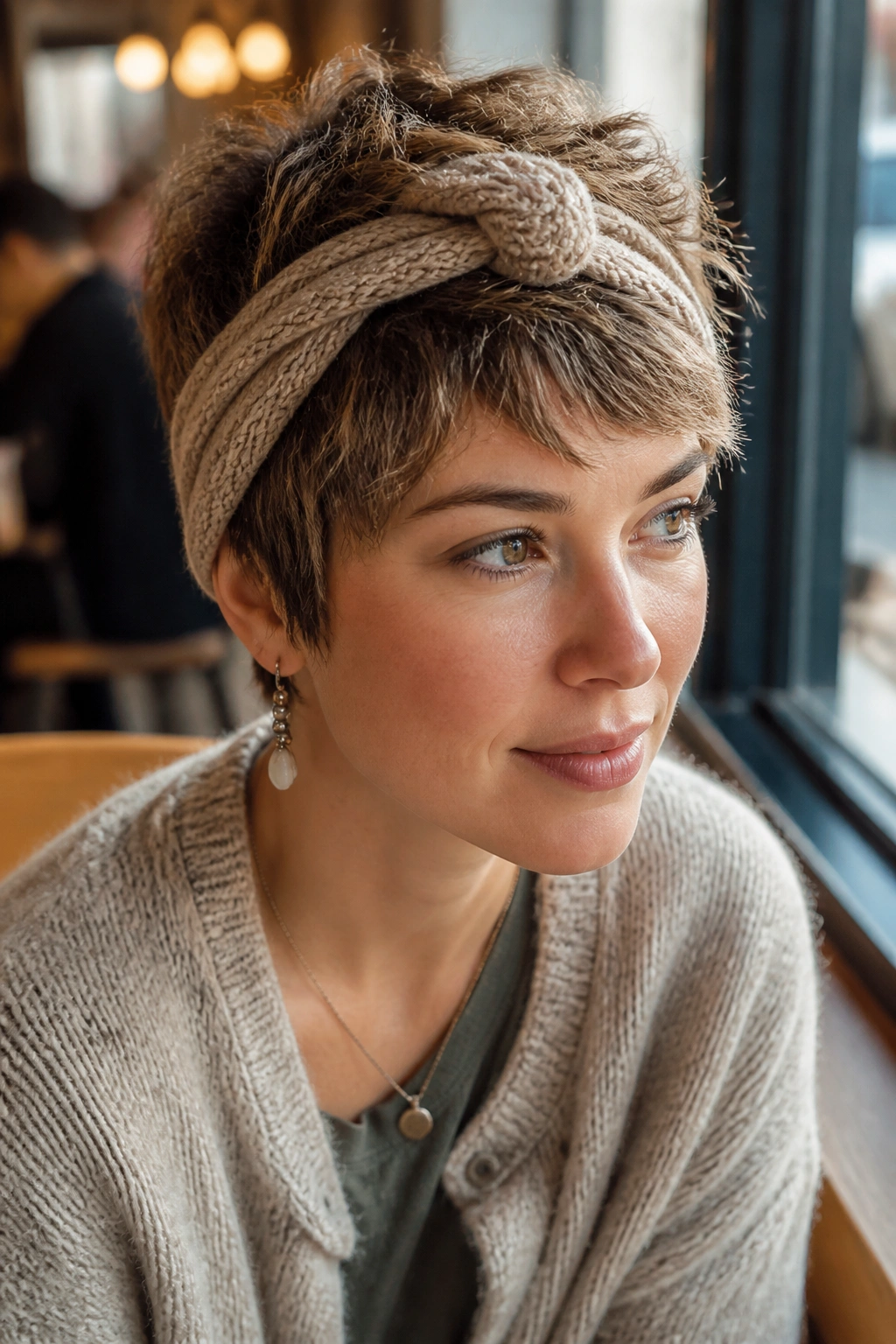
Why does a choppy pixie suddenly look more put-together when you add a knotted knit band? Because the knot echoes the cut’s texture instead of fighting it. The jagged layers, broken ends, and uneven pieces suddenly feel like part of the design.
This is the version I reach for when hair has been rough-dried and the ends are doing their own thing. A knit headband gives those pieces a home. It also works well with dry shampoo, which adds a little grit near the roots and keeps the top from collapsing by noon.
How to keep the knot from fighting the cut
The trick is size. A huge knot can swallow a tiny pixie. A medium knot, set slightly off-center, usually looks better because it pulls the eye upward without making the forehead look crowded. If your face is narrow, wear the knot a touch higher. If your face is round, sit it closer to the hairline.
I like knit bands in soft neutral colors—heather gray, cream, muted olive—because they make choppy texture look purposeful instead of messy. That said, a deep rust or dusty blue can be excellent when the outfit is plain and the haircut needs the contrast.
One small thing. Keep the knit band snug enough to stay put, but not so tight that it leaves a ridge across the crown. You do not want the style to look pressed into place.
3. Curly Pixie With a Wide Stretch Headband
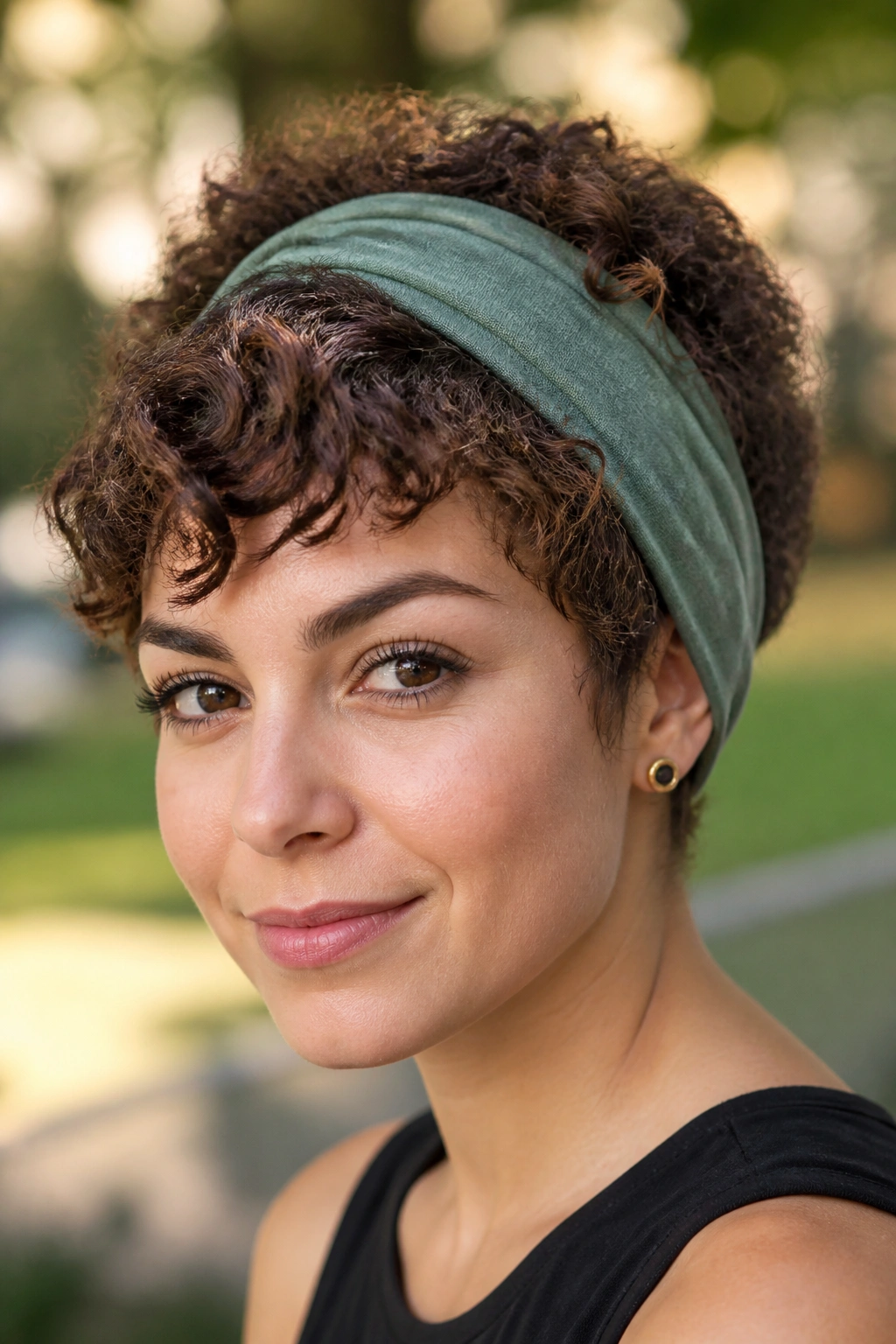
A curly pixie and a wide stretch headband are a good pair when the goal is control without flattening the curl pattern. Wide bands hold the front back, but they leave the curl mound on top alone, which is where the shape lives.
Curly hair needs room. A too-narrow band can slice awkwardly through curls and make the front look pinched. A band that’s roughly 2 to 3 inches wide tends to sit better because it gathers the hairline softly and gives the curls above it space to spring.
Where to place it for the cleanest shape
Set the band just behind the line where the curls start to fan forward. Not on the forehead. Not halfway up the crown. Right at that seam. If the curls are loose and springy, let a few curls fall over the edge of the band instead of forcing every strand back. That keeps the style from looking stiff.
This is a strong choice for humid days because the band can hold the front while the rest of the cut keeps its natural bend. A satin-lined stretch band helps even more. It reduces friction, which means less halo frizz around the temples and ears.
A quick warning: if the band is too tight, curls flatten at the sides and puff at the crown. That shape looks like a helmet. Nobody needs that.
4. Slicked-Back Pixie With a Thin Metal Headband
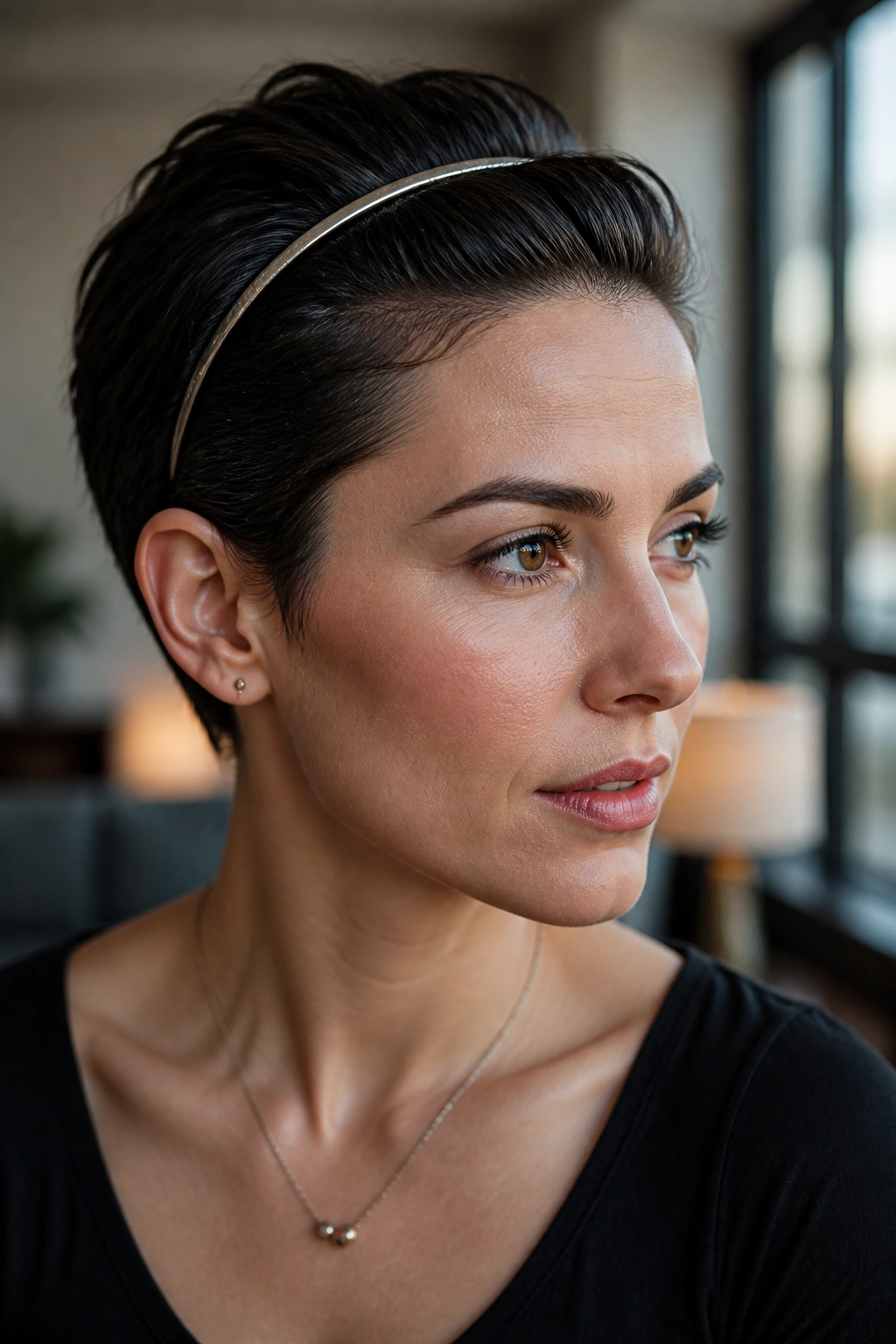
A slicked-back pixie does not need more hair. It needs better structure. That is why a thin metal headband makes so much sense here: it adds a crisp line while the rest of the cut stays sleek and close to the head.
This style works best when the hair has been combed back with a small amount of gel or pomade and the top has been smoothed with the fingers, not brushed into submission. The metal band then becomes a clean frame, almost like a line drawn on purpose. It looks sharp. Plain sharp.
What to look for
- Smooth inner finish: no teeth, no rough seam
- Narrow width: about ⅛ to ¼ inch
- Placement: just behind the hairline, where it can anchor slicked sides
- Finish: matte metal for a softer look, polished metal for a dressier one
This is the pixie for evenings, black jackets, and strong earrings. It also helps if the haircut has a faded side or undercut, because the contrast between shaved sides and a slim band gives the whole shape more bite. I like this combination on short hair that already has a little attitude. It does not need extra decoration. It needs a line that says the style is done.
5. Asymmetrical Pixie With a Pearl Headband
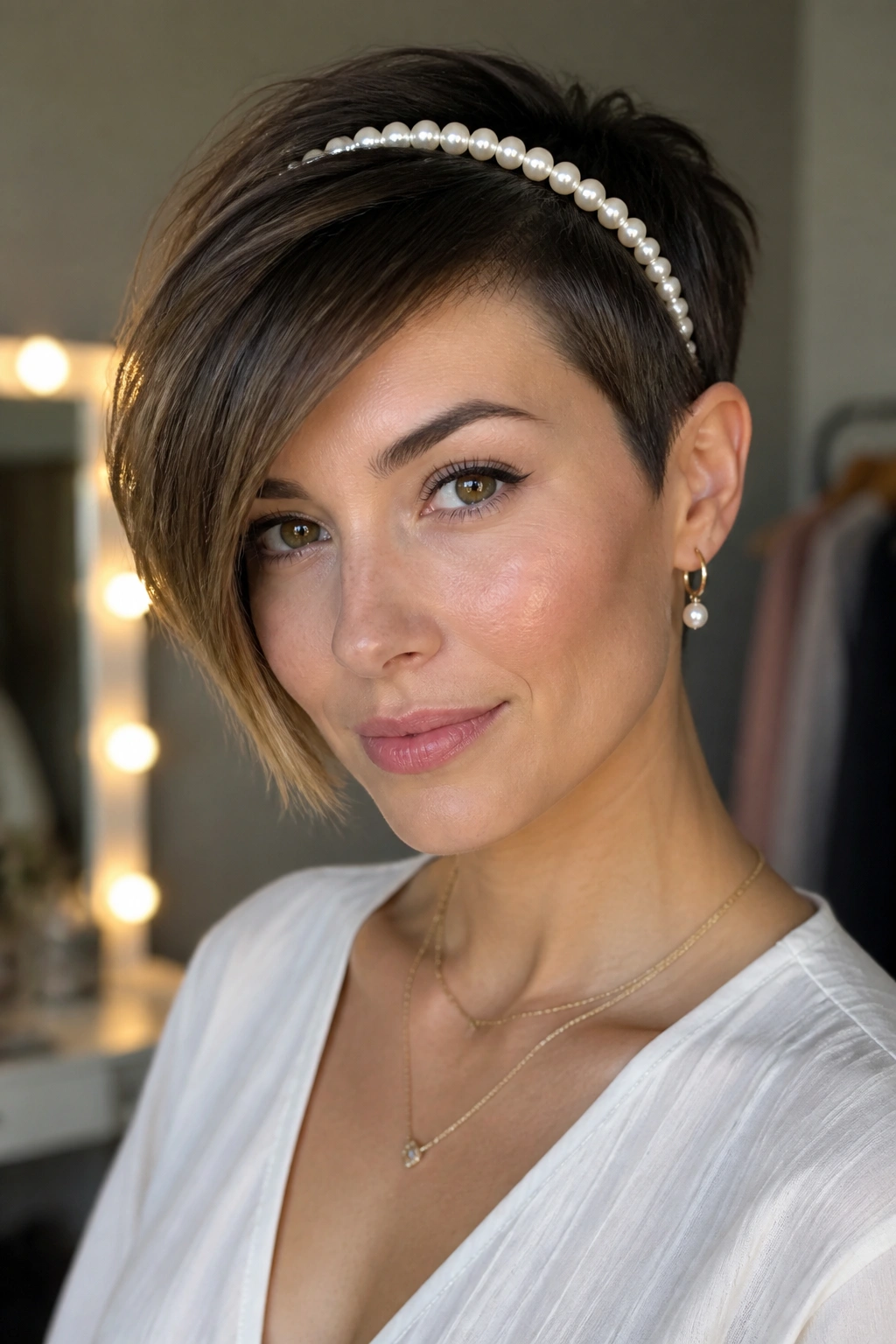
Pearls against cropped hair look crisp and a little old-school in the good way. An asymmetrical pixie gives you one side that is slightly longer or heavier, and a pearl headband helps balance that imbalance without flattening it.
The nice thing about pearls is that they soften a sharp cut. If the pixie has one side sweeping toward the cheek and the other side clipped closer, the headband pulls the eye upward and keeps the face from feeling too directional. It also makes the haircut read more dressed up without needing a lot else.
This style is especially good when you want the pixie to work with a structured outfit: a blazer, a high-neck top, a dress with clean seams. The pearls echo those crisp lines, but they also add a little old glamour. Not too much. Just enough.
A useful detail: let one side of the pixie fall partly behind the ear and leave the longer side free. That asymmetry gives the pearls a reason to be there. If everything is tucked too neatly, the shape loses its edge and starts to look generic.
6. Feathered Pixie With a Braided Headband
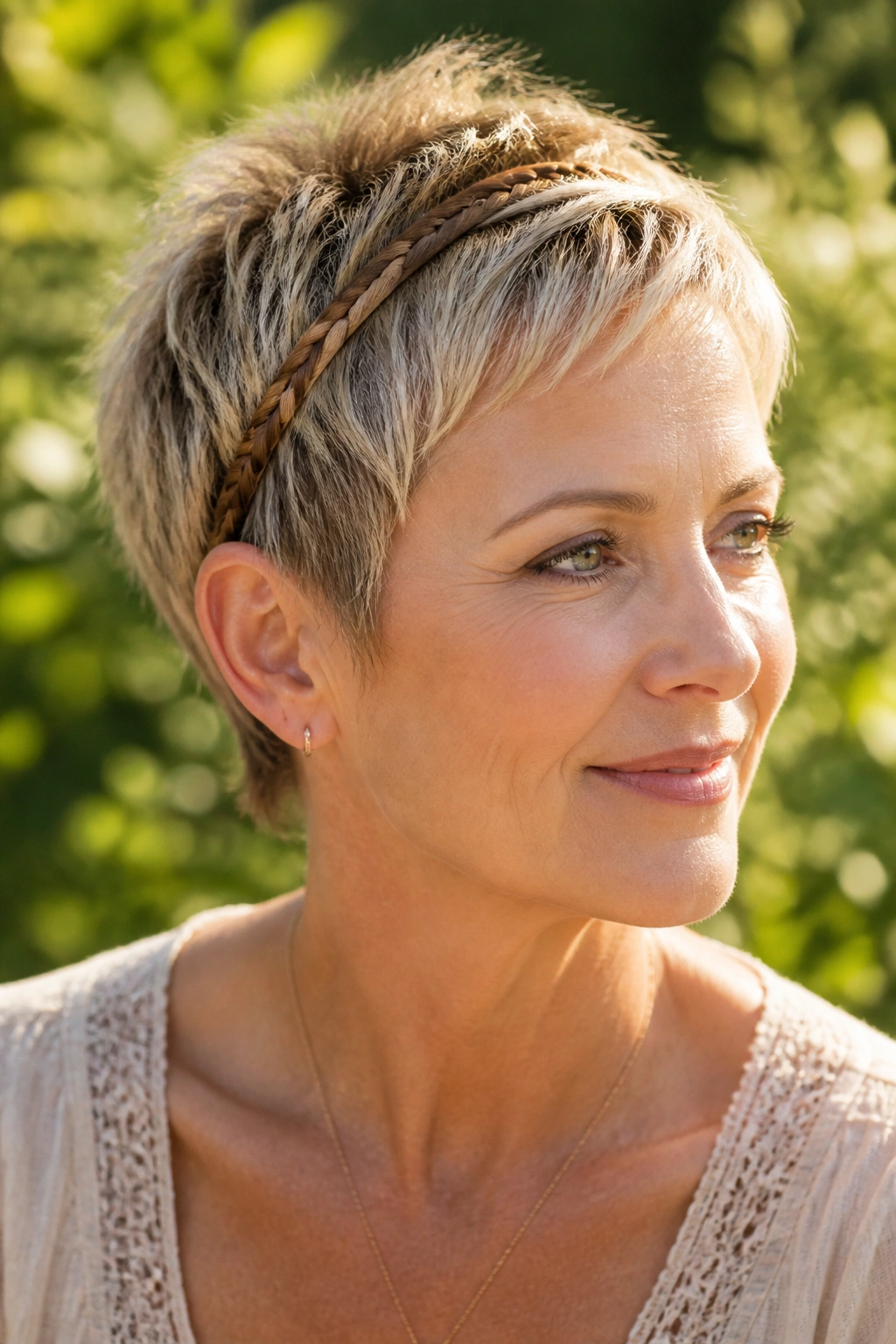
A feathered pixie already has movement, so a braided headband makes sense in a way a sleek band sometimes doesn’t. The braid adds texture near the hairline while the feathered layers keep lifting around the crown and ears.
Unlike satin, which calms everything down, a braided band can live in the same textural family as the haircut. That makes the whole look feel more relaxed. It is especially good when the ends are cut in light, wispy layers that flick outward instead of sitting flat.
How to get the most from it
Choose a braid that matches the root color or the darker pieces in the haircut. If the band is too close to the hair color, the braid disappears. If it is too far off, it can look pasted on. A little contrast is enough. A lot is usually too much.
This is one of those styles that works on second-day hair because the texture in the band and the texture in the cut support each other. A touch of dry shampoo at the roots and a tiny bit of cream at the ends are usually enough. You do not need a heavy styling routine here.
Feathered pixies can start to fray at the edges if they are too soft, and that is where the braid helps. It gives the haircut a border. A calm border, but still a border.
7. Undercut Pixie With a Structured Padded Band
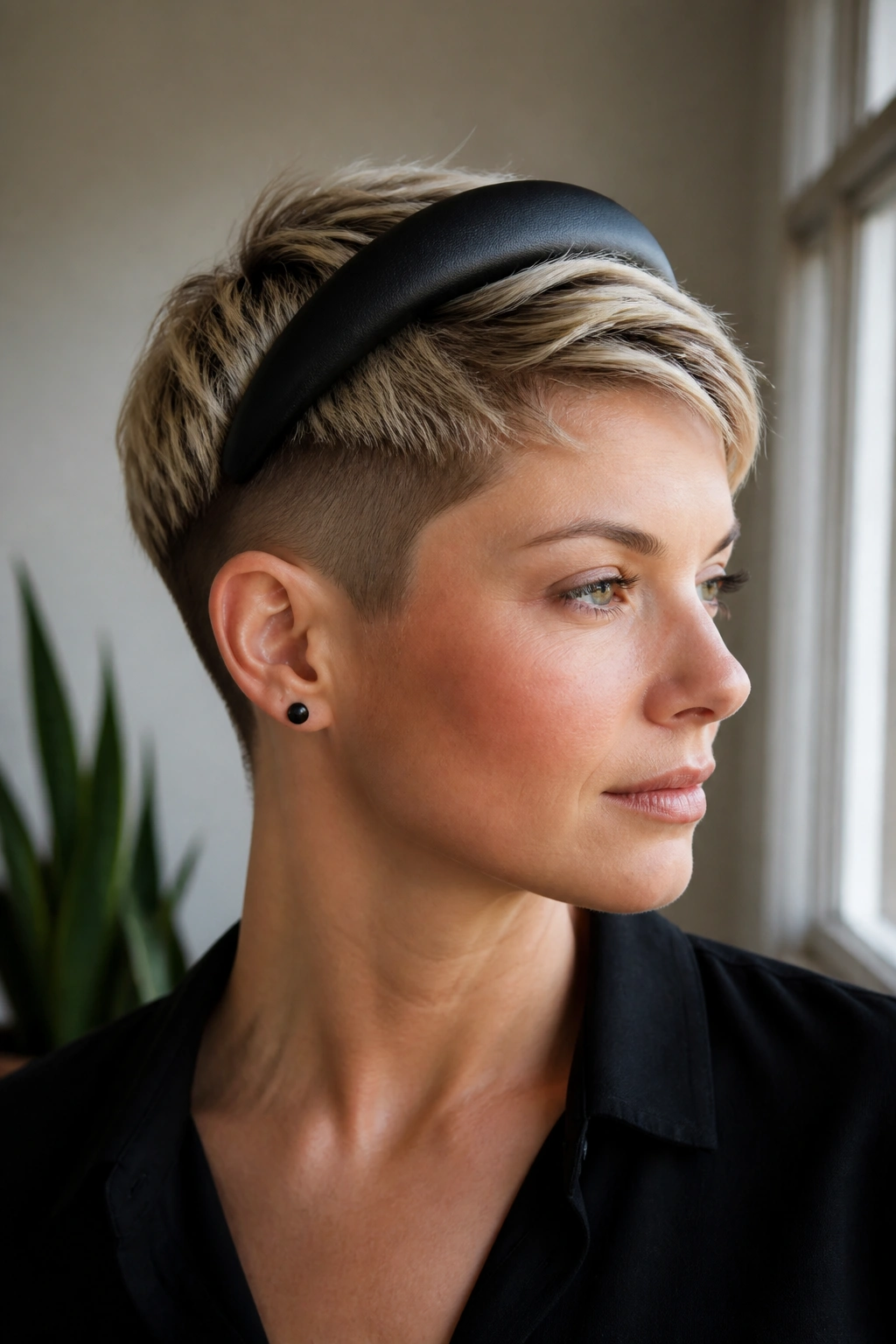
Can a padded headband work on an undercut pixie without making the whole thing look fussy? Yes, if the band has a clean shape and the fit is right. The shaved or closely cropped sides give the band room to show off, which is half the point.
A padded band adds a little architectural weight near the face. That suits an undercut because the cut already has contrast built in. Short sides. Longer top. Sharp edges. The band can echo that geometry if it sits high enough to show the undercut line rather than bury it.
What to watch for
A padded band that’s around 1 to 1.5 inches wide usually works better than a big, pillow-like one. Too much padding turns the style into costume territory. The cleaner version feels modern and a bit editorial.
- Best placement: just above the temples
- Best hair texture: straight, smoothed, or lightly waved
- Good add-ons: a single earring, a strong lip color, a tailored jacket
- Skip: extra volume at the crown; the undercut already gives enough shape
I like this version when the outfit is plain and the haircut needs to do more work. The band becomes the detail, and the undercut handles the drama.
8. Long-Top Pixie With a Scarf-Wrapped Headband
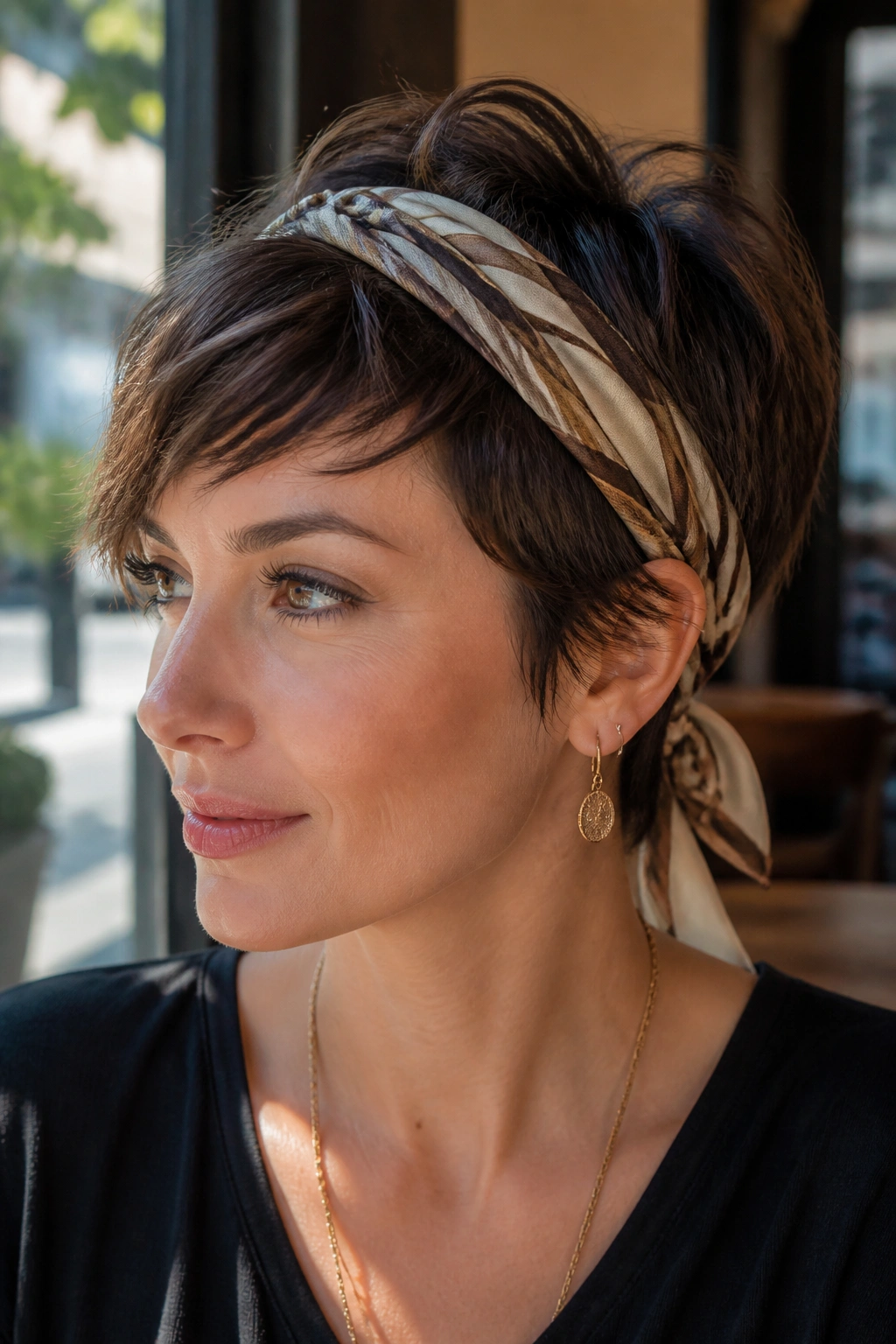
If the top of your pixie brushes your eyebrows, a scarf-wrapped headband can control the length without hiding it. That’s the sweet spot. You still get movement, but the front stops falling into your eyes every ten minutes.
A silk or lightweight satin scarf folded into a band about 2 inches wide sits comfortably and slides less than stiff cotton. Tie it at the nape for a cleaner look, or knot it slightly off-center if you want the style to feel a little looser. Both work. The fabric changes the mood more than the knot does.
This is one of the easiest styles to use when a pixie is growing out. The scarf takes care of awkward bangs, uneven side pieces, and that one section near the temple that never behaves. It also softens the transition between the haircut and whatever you’re wearing, which sounds small until you see it in the mirror and realize the whole outfit makes more sense.
A printed scarf can be fun, but I usually prefer a solid or a tiny pattern when the hair is already busy. Big prints can take over the face. Small ones just add lift.
9. Soft Fringe Pixie With a Velvet Headband
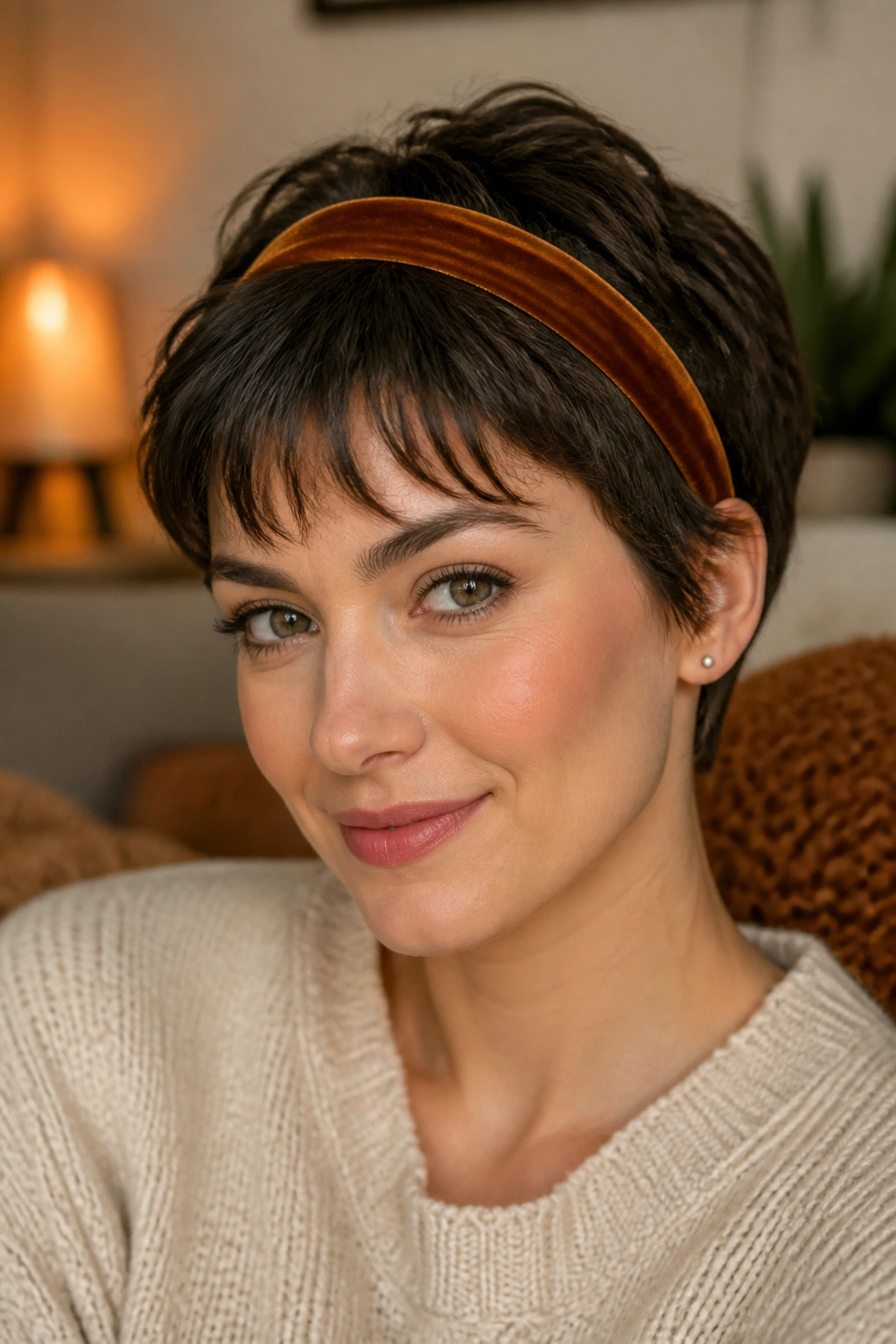
Velvet is not only for evening clothes and winter coats. On a soft fringe pixie, it gives the haircut a plush edge that feels warm and deliberate, especially when the fringe is brushed lightly across the forehead instead of cut blunt.
The texture matters here. Velvet has a little visual depth, so it works well when the pixie itself is soft rather than sharply spiked. If the haircut has rounded layers and a gentle side fringe, the headband adds weight where the hair may otherwise look too airy.
Why it feels different from satin
Satin glides. Velvet holds. That difference changes the whole silhouette. A velvet band can anchor wispy pieces around the temples and keep the front from drifting apart during the day. It also looks good with matte makeup and soft knitwear, which is probably why this pairing shows up so often in cooler weather.
One small caution: if your forehead is short, keep the band narrower. Velvet gets bulky fast, and a wide band can eat up too much space between the brow and the hairline. If the face is longer, a wider band can look balanced and add some needed width.
I’d use this for daytime events, dinners, or any situation where the hair should feel a touch richer without looking overdone. It has presence. Quietly, but still.
10. Micro Pixie With a Sporty Elastic Band
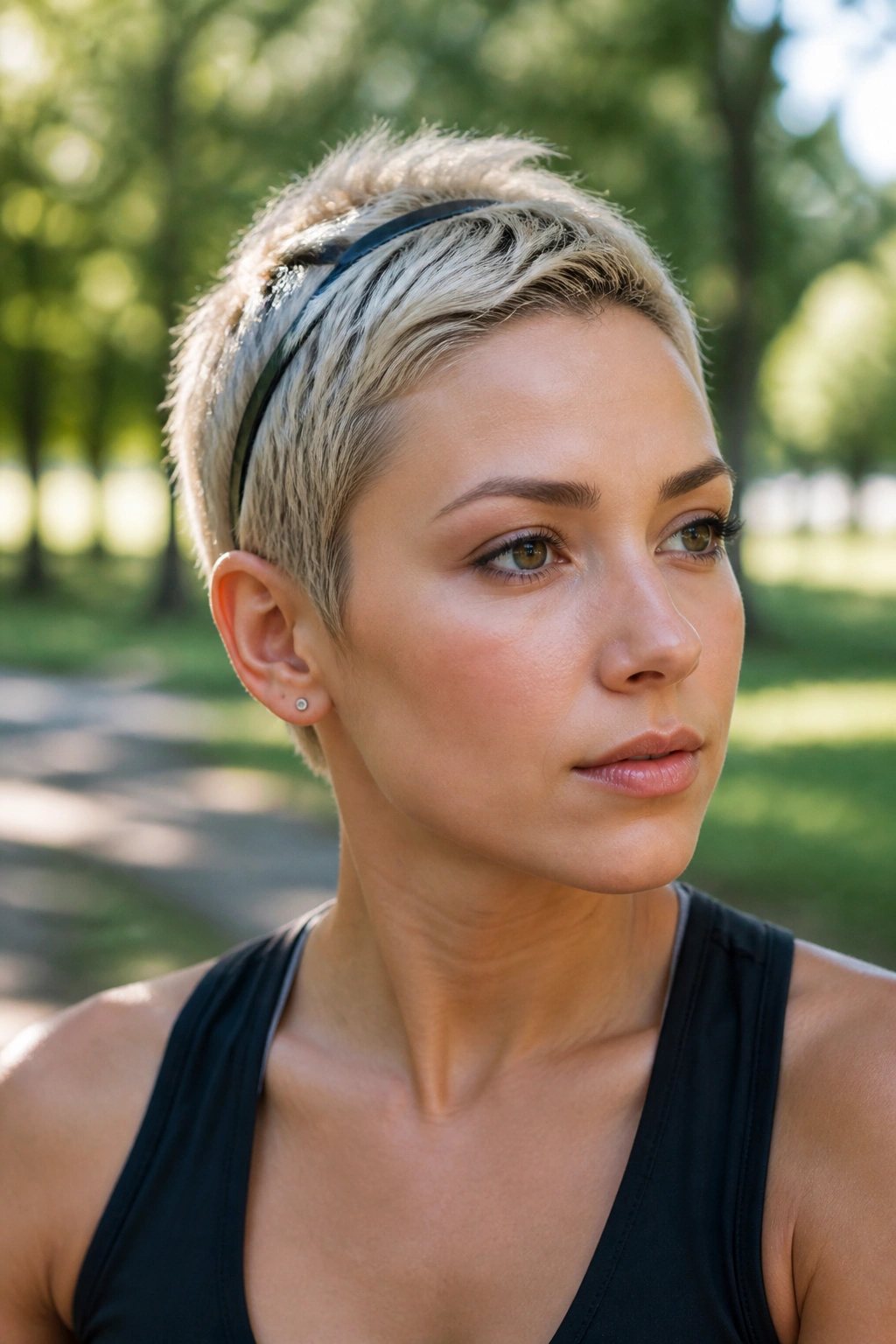
How do you style hair that’s barely long enough to tuck? You use a sporty elastic band and stop pretending the cut needs more than it has. A micro pixie is tiny by nature. The band should respect that.
This kind of headband is especially useful when the cut is close at the sides and short at the crown, because there isn’t much surface area for a decorative band to sit on. A narrow elastic, usually around ½ to 1 inch wide, keeps the look clean. It also stays in place better during walks, workouts, or windy days when fancier bands start to slip.
A micro pixie looks strongest when the band sits just behind the hairline and the rest of the hair is brushed forward a little at the top. That tiny bit of lift keeps the style from looking too flat. If the hair is very short, a whisper of pomade or edge control at the temples can help the finish look smooth rather than patchy.
This is not the place for big ornaments. The appeal is the spare, athletic line. Clean. Fast. No fuss.
11. Tousled Platinum Pixie With a Jewel-Tone Headband
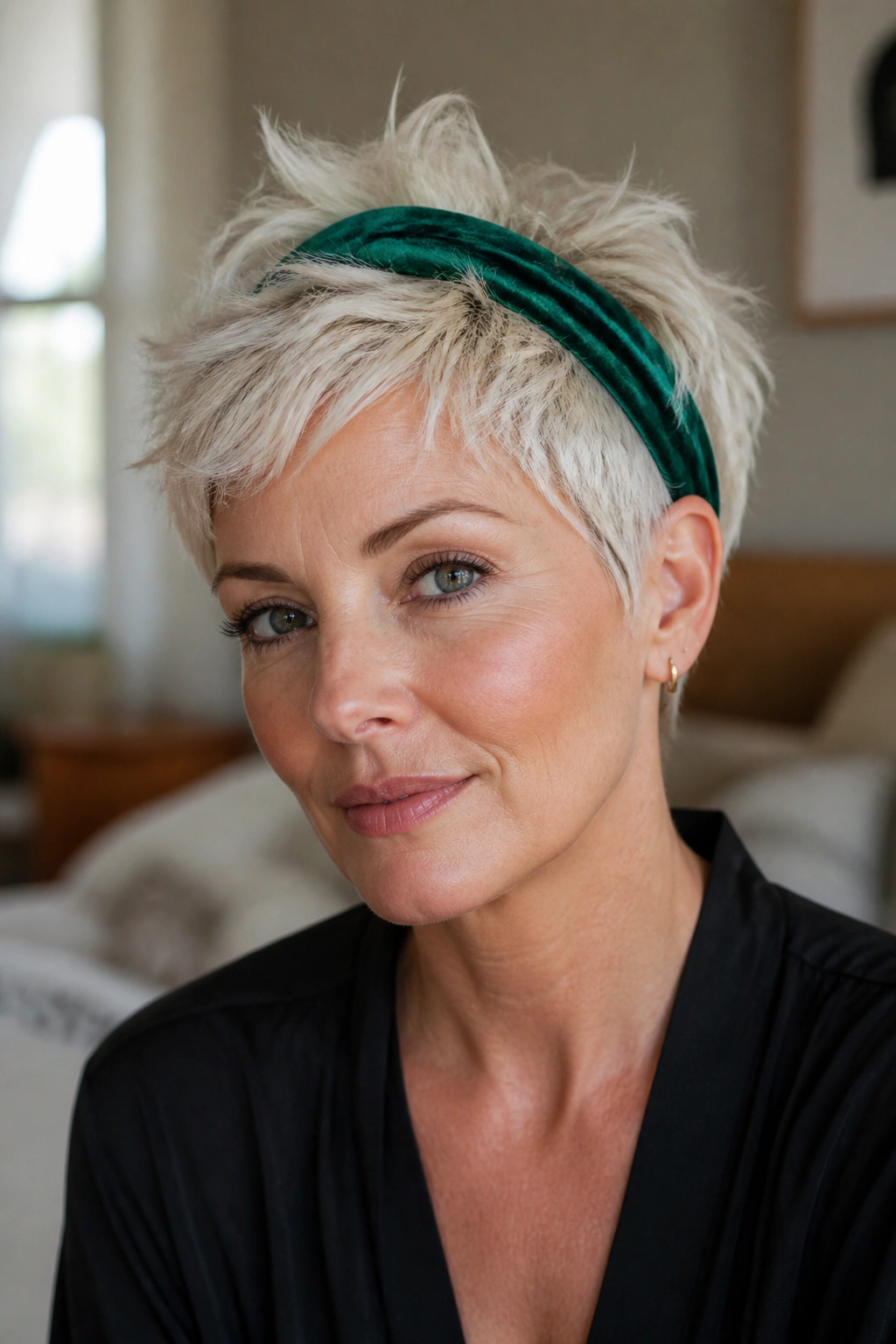
Platinum hair can get washed out if everything around it is pale too. A jewel-tone headband solves that fast. Emerald, cobalt, burgundy, deep amethyst—those shades give a tousled platinum pixie some depth and keep the cut from reading flat.
The contrast does most of the work. Platinum hair already reflects light, so a rich-colored band creates a clean break at the hairline. That break is what makes the style feel intentional. Without it, the haircut can blur into the face, especially when the texture is soft and airy.
This is a strong choice for loose, piecey styling. The top can be roughened with a texturizing spray and separated with fingertips, while the band keeps the front area tidy. The result has movement up top and control around the face. Nice balance. Not precious.
I prefer jewel tones with cool platinum, and deeper greens or wine shades with warmer skin tones. A black band can work too, but a color band gives you more personality without needing any extra effort from the haircut.
12. Grow-Out Pixie With a Turban Wrap
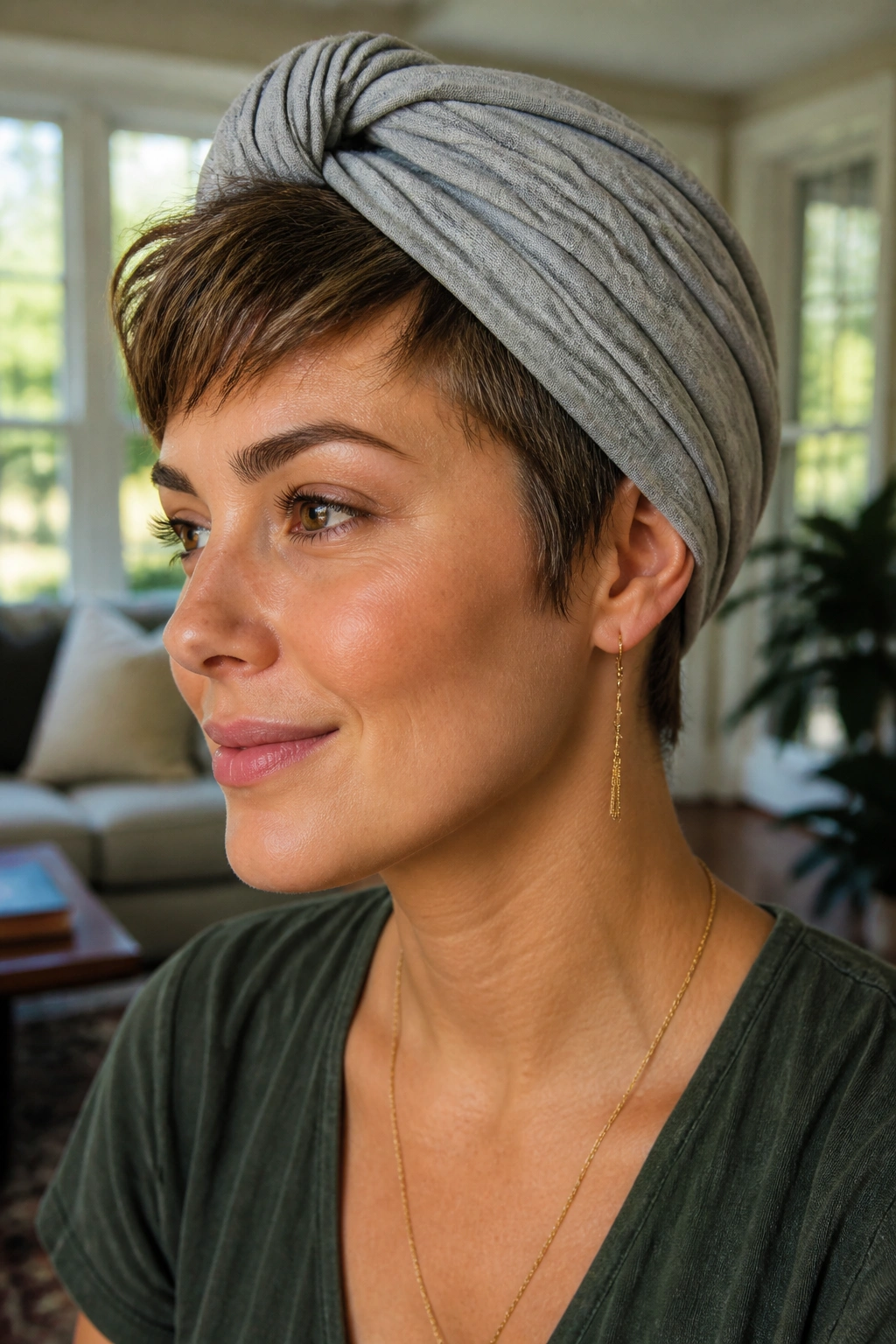
When the sides start puffing out and the fringe falls into your eyes, a turban wrap turns that awkward stage into a choice. That is why it earns a spot here. A grow-out pixie can feel like a compromise if you fight it. A wrap makes it look planned.
The best wraps are soft and slightly stretchy, not stiff and bulky. Jersey, rayon blends, and lightweight knits usually sit better than heavy cotton. They drape instead of sitting up on the head, which matters a lot when the hair underneath has uneven lengths.
A small practical note
If the back is longer than the front, tuck the nape pieces neatly before wrapping. If the front is the problem, let the band sit just over the shortest fringe so it catches the stray ends and holds them down. Do not pull it so tight that it flattens the crown; a little lift near the top keeps the head shape from looking compressed.
This style is also useful on days when you do not want to deal with styling tools. It hides a lot, but not in a lazy way. More like a reset button. The haircut still reads as short and chic, only now it has a softer edge.
13. Retro Pixie With a Wide Alice Band
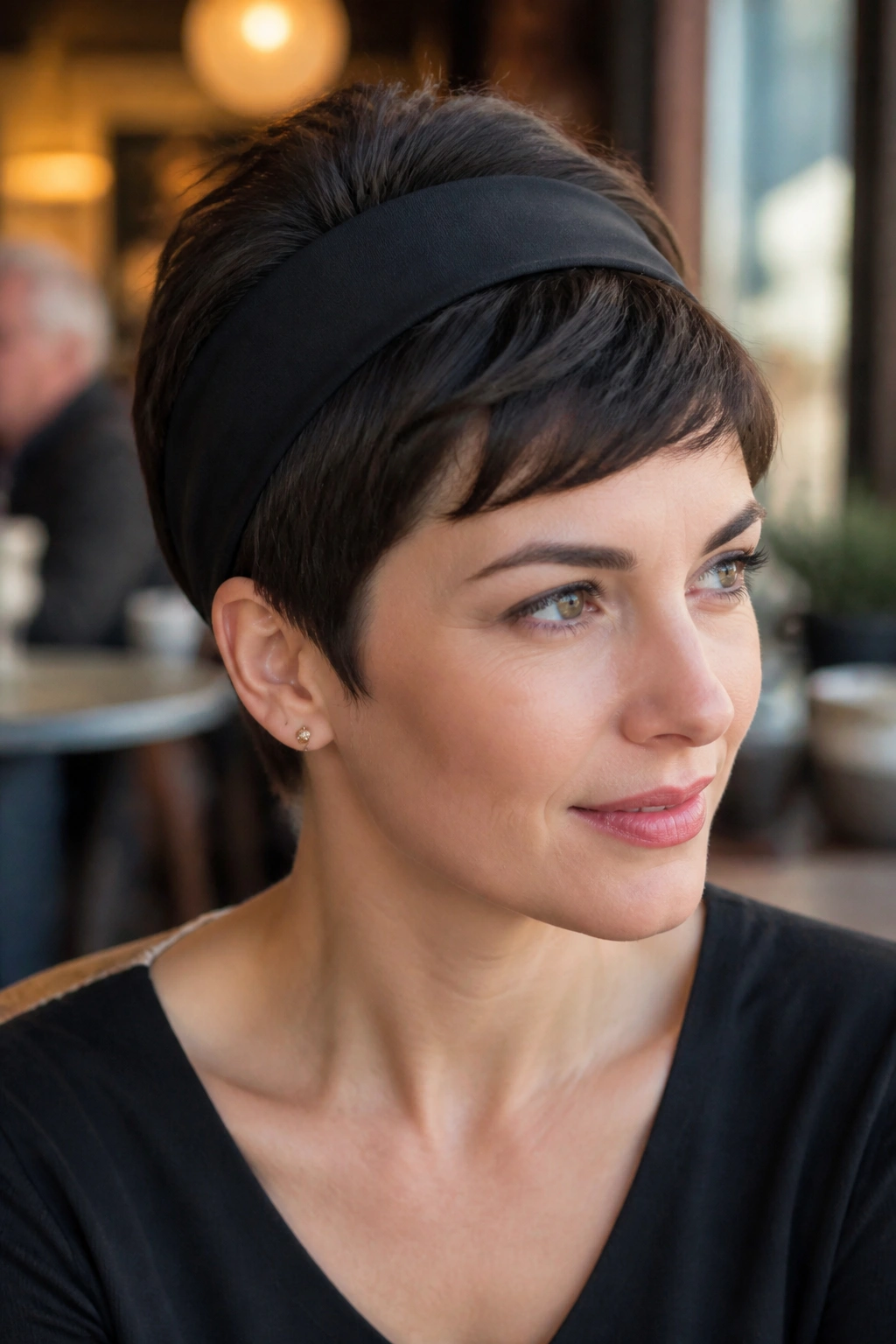
What gives a pixie that little 1960s tilt without turning it into costume hair? A wide Alice band and a small lift at the crown. That combination brings back a retro shape without asking the haircut to become a full throwback look.
A wide Alice band usually sits farther back on the head than a thin band, which is part of the charm. It pushes the hair slightly up and away from the face, creating a rounded line near the crown. On a pixie, that little lift can make the silhouette feel more elegant and less flat.
How to keep it from slipping
- Tease the crown lightly at the roots before placing the band
- Smooth the sides with a small brush or your fingers
- Choose a band with a grippy inner lining if your hair is fine
- Keep the front soft, not stiff, so the shape still moves
I like this pairing with a tucked collar, a simple dress, or even a plain T-shirt when you want the hair to carry the look. It has a polished feel, but not the cold kind. The band does most of the styling work, which is honestly a relief on busy mornings.
14. Wavy Pixie With a Printed Silk Headband

A print can look cleaner than a plain band when the haircut already has a lot of movement. That’s especially true on a wavy pixie, where the hair bends, flips, and changes shape all day long. A printed silk headband gives the eye one clear place to land.
The trick is scale. Big, loud prints can fight with the waves. Smaller prints—tiny dots, narrow stripes, a soft paisley, even a blocky geometric with only two or three colors—sit better because they add detail without becoming noisy. Silk helps too. It keeps the waves from snagging and gives the front a smoother finish.
This style is good when the hair has a bit of natural body and the outfit is simple. The print becomes the accent. Not the whole outfit. If the print includes one color that echoes your hair shade or your lipstick, the result looks more pulled together than random.
I would not overstyle the waves here. A little bend, a little lift at the roots, and a clean band are enough. Too much polish kills the relaxed feel that makes this pairing work in the first place.
15. Edgy Pixie With a Low-Profile Black Band
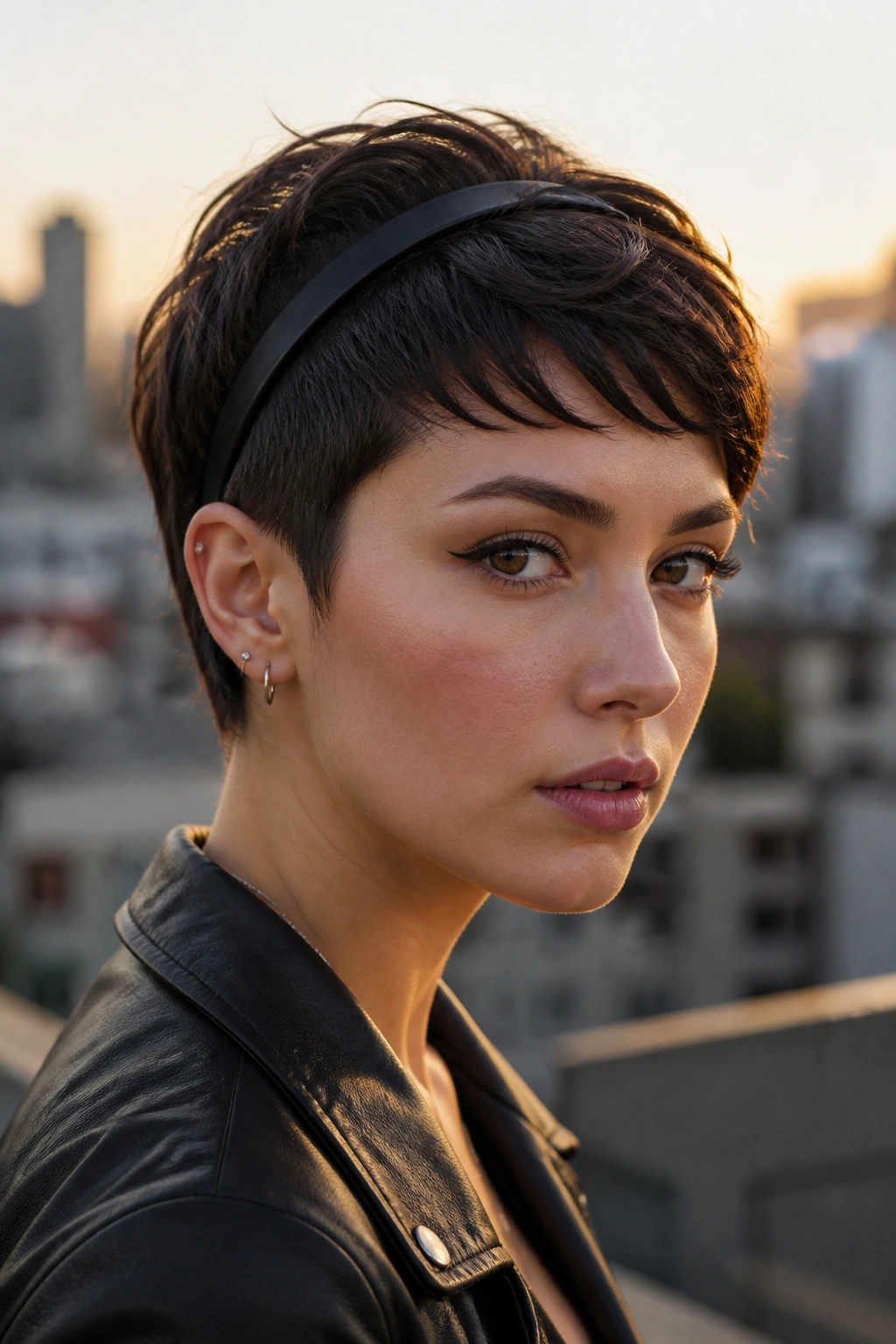
A black band is boring only if you let it be. On an edgy pixie, a low-profile black headband creates the cleanest possible line, which is often exactly what the haircut needs when the sides are sharp or the fringe is cut in fragments.
This is the most stripped-back option in the bunch, and that is why it works. No shine. No fluff. No extra texture fighting for attention. The band simply frames the face and lets the cut stay in charge. If the pixie has an undercut, a shaved temple, or a jagged fringe, the black band gives those lines a place to land.
The finish matters more than the ornament. A matte black band feels modern and a little severe, which can be lovely with a strong brow or graphic eyeliner. A slightly glossy one can look better when the hair is dry or has a lot of texture. The wrong move is choosing something too bulky. That kills the edge and makes the style look cautious.
If I had to leave you with one practical rule, it would be this: pick the headband to match the haircut’s shape, not just the outfit. A pixie wants structure somewhere, even when the rest of the look feels loose. The band can be sleek, soft, rich, sporty, or plain. What it should not be is random. A good band turns a short cut into a finished one, and that little shift changes everything.
