



Fine hair does not need more layers. It needs a shape that holds.
French bobs with curtain bangs for fine hair work when the cut keeps a clean edge and leaves the fringe soft enough to move. That balance is the whole trick. A blunt outline can make the ends look denser, while curtain bangs bring shape to the front without eating up too much weight.
I’m suspicious of any bob that only looks good after twenty minutes with hot tools. Fine strands can collapse fast, and the wrong haircut will show that weakness in a heartbeat. The better versions keep the perimeter tidy, let the bangs fall in two soft panes, and avoid the over-thinned, airy look that sounds romantic in a salon chair and then behaves badly at home.
The differences between a good French bob and a forgettable one are small. A half inch here, a little bevel there, a fringe that starts at the cheekbones instead of the nose, and suddenly the cut reads fuller, sharper, and easier to wear. Some versions below are crisp and polished. Others live in the messy, lived-in zone. A few are for people who want to air-dry and move on with their day.
1. Jaw-Skimming French Bob with Curtain Bangs for Fine Hair

This is the safest starting point if your strands are fine and a little flat. A jaw-skimming length gives the cut a hard line, and that line does a lot of work for you. Hair looks thicker when the eye sees a strong edge, not a wispy finish that disappears into the neck.
The curtain bangs should open around the cheekbones, not hover too high on the forehead. That keeps the front soft while still holding enough weight to sit neatly. If the fringe is too short, it starts acting like a broken bang. If it’s too long, it blends into the sides and loses the whole point.
Why it works on fine hair
A French bob at the jaw gives the ends a place to land. Fine hair often looks best when the haircut creates the illusion of a fuller hemline, and the jaw is a smart place for that because the shape is easy to see from the front and side.
- Length: aim for right at the jaw or a hair below it.
- Bangs: part them in the center, then let them taper to the cheekbones.
- Finish: ask for a tiny bevel under the ends, not a stacked back.
- Styling: a light mousse at the roots gives more lift than heavy cream ever will.
Pro tip: keep one side of the fringe a touch longer if your face is asymmetrical or one eyebrow sits higher. Tiny imbalance can make the cut look softer, not messier.
2. Chin-Length Blunt French Bob with Long Curtain Fringe

Blunt ends beat airy ends almost every time when the hair is fine. That’s the blunt truth. A chin-length bob creates a thick-looking line across the bottom, and that solid perimeter keeps the style from looking sparse when the weather turns damp or the roots lose their lift.
Long curtain bangs change the mood. Instead of a heavy fringe that steals too much density from the front, the split bangs frame the face and leave the rest of the bob to do its job. They also give you room to tuck, pin, or blow them back depending on how cooperative your hair feels that day.
I like this version for people who want something neat but not severe. It has shape. It has polish. It doesn’t need to be overworked. If you blow-dry the bangs away from the face and let them cool in that lifted position, they fall into a softer bend that looks done without looking stiff.
No wispy perimeter. That’s the rule here.
The chin length also helps if your neck is short or you want the cut to graze the face a little more than a jawline bob. It can make the whole silhouette feel lighter, even though the actual shape is stronger. That’s the funny thing about good haircuts: the ones that look the least fussy usually need the most careful planning.
3. Cheekbone-Grazing French Bob with Piecey Curtain Bangs

Why does this length work so well on fine hair? Because it puts the visual action right where the face already has structure. Cheekbone-grazing bobs lift the eye upward, and that matters when the strands themselves do not have much bulk to give.
The fringe should be soft enough to split, but not so soft that it loses presence. Think of it as a curtain, not a veil. A little separation at the ends keeps the bangs from reading as one flat sheet, and a small amount of texture through the front keeps the cut from feeling too precious.
How to wear it
- Blow-dry the fringe with a small round brush, wrapping each side away from the center part.
- Finish with a pea-sized amount of light styling cream on the fingertips.
- Push a few front pieces forward once the hair cools, so the bangs land in a loose curve.
- Keep the bob one to two inches below the cheekbone if your hair has a soft wave; go closer to the cheekbone if it lies straight.
This cut has a nice side effect: it makes the forehead feel framed without making the hairline look crowded. That matters more than people admit. Fine hair can get swallowed by too much fringe, and then the cut loses the open, airy feel that makes a French bob work in the first place.
A tiny bit piecey. That’s enough.
4. Rounded French Bob with Airy Curtain Bangs

If your hair flips out at the ends or falls in awkward corners, a rounded French bob can clean that up fast. The shape curves inward a touch, so the outline looks controlled even when the strands are doing their own thing underneath. It is a nice fix for hair that feels too straight to be sleek and too flat to be textured.
The rounded shape also helps the bob look fuller from every angle. Straight-across lines can be sharp, but they can also expose thin spots if the density changes from crown to nape. A soft curve hides that problem better. The curtain bangs should echo the same idea: airy, bent, and not over-pruned.
What to ask your stylist for
- A rounded outline that curves slightly under the jaw.
- Curtain bangs that begin around the pupil and open near the cheekbones.
- Minimal thinning through the ends.
- Soft internal weight, not choppy layers through the crown.
I would choose this for hair that needs a little discipline. Not stiffness. Discipline. Those are different things. A rounded bob has enough shape to keep fine hair from drifting apart, but it still feels casual enough for everyday wear.
One warning: if the styling tool is too big, the curve can disappear. A medium brush, around 1 to 1.5 inches, usually gives a better bend than a giant one that leaves the ends too loose.
5. Feathered French Bob with Barely-There Curtain Bangs

Feathering can be a gift or a disaster on fine hair, and the difference comes down to restraint. When the ends are feathered lightly, the bob moves. When the cut is over-textured, it starts looking thirsty and thin. Nobody needs that.
This version works best when the stylist uses soft point cutting at the perimeter and leaves the crown mostly alone. The bangs should be long enough to part easily, then feathered only at the tips so they don’t sit in one heavy block. The result is a cut that feels light in the hand but still holds a visible line around the face.
I like this on hair that has a little bend already. It catches a wave without fighting it. Straight fine hair can wear it too, but then the styling has to be cleaner: root lift, smooth ends, and a touch of separation around the fringe.
A simple routine goes a long way here.
Use a nickel-sized amount of mousse at the roots on damp hair. Then rough-dry until the hair is about 80% dry before bringing in a brush. That keeps the feathered ends from puffing out in weird directions. Once dry, twist the bangs around two fingers for a few seconds and let them drop. It sounds small. It matters.
6. Wavy French Bob with Long, Loose Curtain Bangs
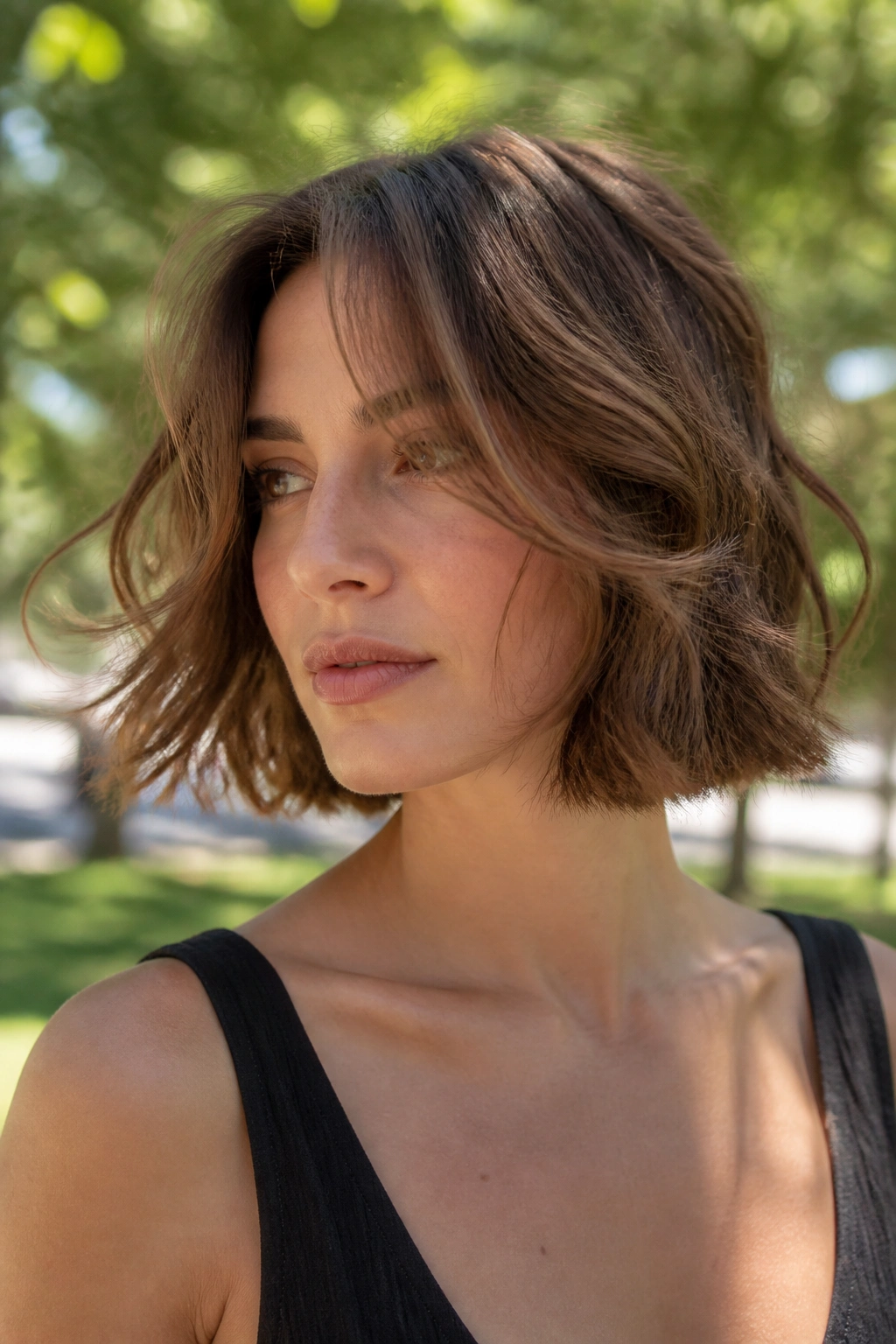
Unlike the polished versions, this one leans into movement. If your fine hair has a natural bend — even a lazy one — a wavy French bob can look richer than a perfectly straight cut because the waves break up the outline and make the hair seem fuller at the sides.
The long curtain bangs are doing a different job here. They don’t need to be crisp. They need to slide into the rest of the shape. A few loose bends around the face soften the whole cut, especially if your cheekbones are prominent or your jaw feels a little narrow. The bob becomes more about texture than line, and that can be a relief if you hate spending much time styling.
The catch is product control. Too much cream and the wave drops. Too much spray and the fringe starts feeling crunchy. I’d keep it light: a small dab of wave cream through the mid-lengths, then a diffuser on low heat or an air-dry with a little scrunching at the ends.
This one is best for hair that already bends on its own. If your strands are pin-straight, you can still wear it, but you’ll be borrowing texture from a curling iron or a flat iron wave. Without that bend, the cut can lose its shape and drift toward plain.
7. Shattered French Bob with Lightly Razored Curtain Bangs

A razor cut can help fine hair, but only at the edges. That’s the line I’d hold. Used carefully, a razor gives the bob a soft, broken perimeter that moves when you turn your head. Used too heavily, it eats the density you were trying to save.
This version suits people who want a little edge in the finish. The bob still sits in that French zone — chin to jaw, easy fringe, slightly undone feel — but the ends are more broken up than blunt. The curtain bangs follow suit with a lighter, pieceier split. They should separate into two soft panels rather than one solid curtain.
What to watch for
- The razor should touch the very ends, not travel through the crown.
- The fringe should keep enough weight to part without collapsing.
- The cut needs a bit of styling paste or spray wax to show the texture.
- If your hair is very fragile, blunt scissors may be better than a razor.
This cut has energy. That’s the appeal. It can make flat hair feel more alive, especially if you dislike a tidy salon finish. But it does demand a careful hand. A heavy razor pass can leave fine hair looking see-through at the perimeter, and once that density is gone, there’s no easy fix except waiting for it to grow out.
8. Side-Weighted French Bob with a Soft Curtain Part

Not every face wants a dead-center part, and fine hair does not always behave nicely when you force one. A side-weighted French bob gives the fringe a softer direction while still keeping the curtain-bang shape. It’s a smart move if one side of your hair falls flatter, if you have a cowlick at the hairline, or if a center part makes the front split too widely.
The cut itself stays short and neat. The change comes from where the bangs split and how the front drapes across the forehead. Instead of opening evenly, the fringe leans a little to one side first, then spills into the other. That tiny shift adds motion without turning the style into a side-swept bang situation.
This is also one of the easiest ways to make a French bob feel less symmetrical. A lot of fine hair looks best with a slight bias. I know that sounds minor. It is minor. But minor changes are what make short hair look expensive and intentional rather than accidental.
If your face is long, side-weighted curtain bangs can shorten the vertical line a bit. If your face is round, they can break up the width. The cut is doing quiet work, not shouting about itself. That’s usually a good sign.
9. Polished French Bob with a Soft Bevel
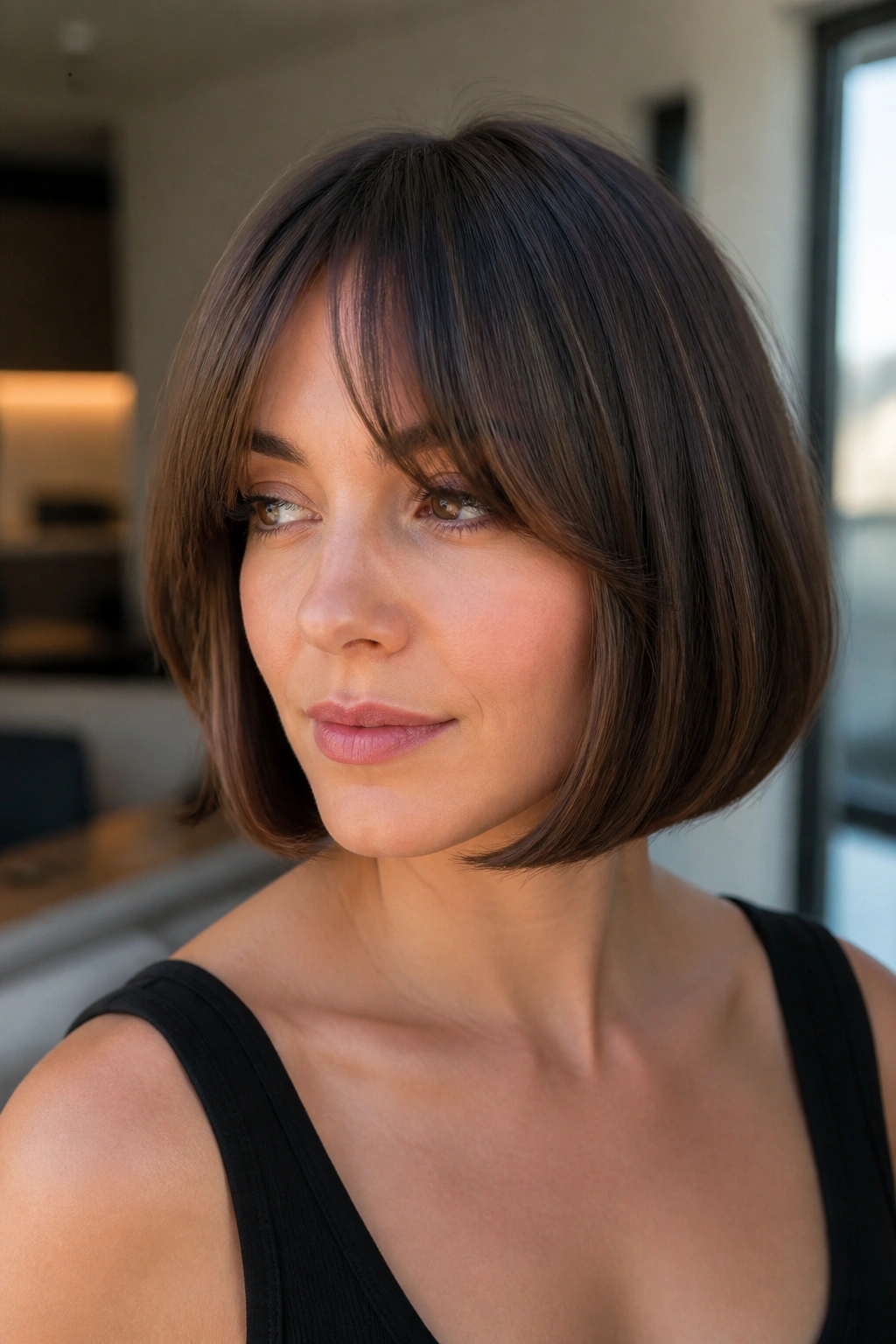
Want the neatest version of the bunch? Keep the line soft, not shaggy. A polished French bob with a bevel under the ends makes fine hair look controlled and dense, which is a better look than trying to fake volume with a lot of random texture.
The bevel is the secret. It’s that inward curve you get from a round brush and a careful blow-dry, or from a cut that already has a slight underbend in the shape. The goal is for the ends to tuck under by a fraction of an inch, enough to show a finish but not enough to look helmet-like. The curtain bangs should match that mood — smooth at the root, light at the cheekbones, and softly separated at the tips.
How to keep it polished without making it stiff
- Start with a root-lift mousse on damp hair.
- Blow-dry with a small round brush and a nozzle attachment.
- Direct the ends under for the last 30 seconds of heat.
- Finish with a drop of serum on the very tips, not the roots.
This style is good when you want the haircut to look groomed even on a plain day. It’s also the easiest one to dress up for dinner or a meeting because the shape already has clean lines. A blunt bob can look sharp; a beveled bob looks finished.
That distinction matters more than people think.
10. Lived-In French Bob with Dry Texture and Fringe Separation

This is the one I’d hand to someone who styles hair in five minutes or less. A lived-in French bob is built to look a little undone, which means you do not have to fight every small bend or flyaway. Fine hair can get punished by too much brushing. Sometimes the better move is to let the texture speak first.
The curtain bangs here are separated, not smooth. They fall into two loose panes, maybe with one or two face-framing pieces breaking free. That separation keeps the fringe from sitting like a flat curtain across the forehead. It also helps the bob feel less rigid around the cheeks.
A tiny amount of texture spray at the roots is enough. Too much product, and the hair starts clumping into little cords that show off the lack of density instead of disguising it. That’s the line you want to avoid. Give the roots grip, then leave the mids mostly alone.
One sentence says it all. Too much product kills fine hair.
The best part of this version is the way it ages through the day. It can look fresher by lunch than it did in the mirror at 8 a.m., which is rare and welcome. If your hair likes to collapse on clean, slippery days, this is a good place to land.
11. Mini French Bob with Extra-Long Curtain Bangs

A shorter bob can feel scary if you have fine hair, but the long fringe makes it friendlier. The mini French bob sits a touch above the jaw or right at it, and the extra-long curtain bangs soften the line so the haircut does not feel too exposed around the face.
This is a good choice if you want short hair without losing the option to tuck, pin, or redirect the front. The longer fringe gives you range. On days when the hair feels flat, you can blow it away from the face and let it fall in a long bend. On days when you want a bit more drama, you can curve the bangs inward and let the rest of the bob stay clean.
Who it suits best
- People who like short hair but want more forehead coverage.
- Fine hair that lies close to the head and needs a strong perimeter.
- Faces that look good with a little extra length around the eyes or cheekbones.
- Anyone who tucks one side behind the ear and wants that habit to still work.
I would skip this if your hairline is very uneven and you hate styling bangs. Longer curtain fringe needs some cooperation. It doesn’t have to be fussy, though. A dry shampoo mist at the roots and a quick round-brush pass through the front are usually enough to keep it in line.
12. French Bob with Invisible Layers and a Floating Fringe
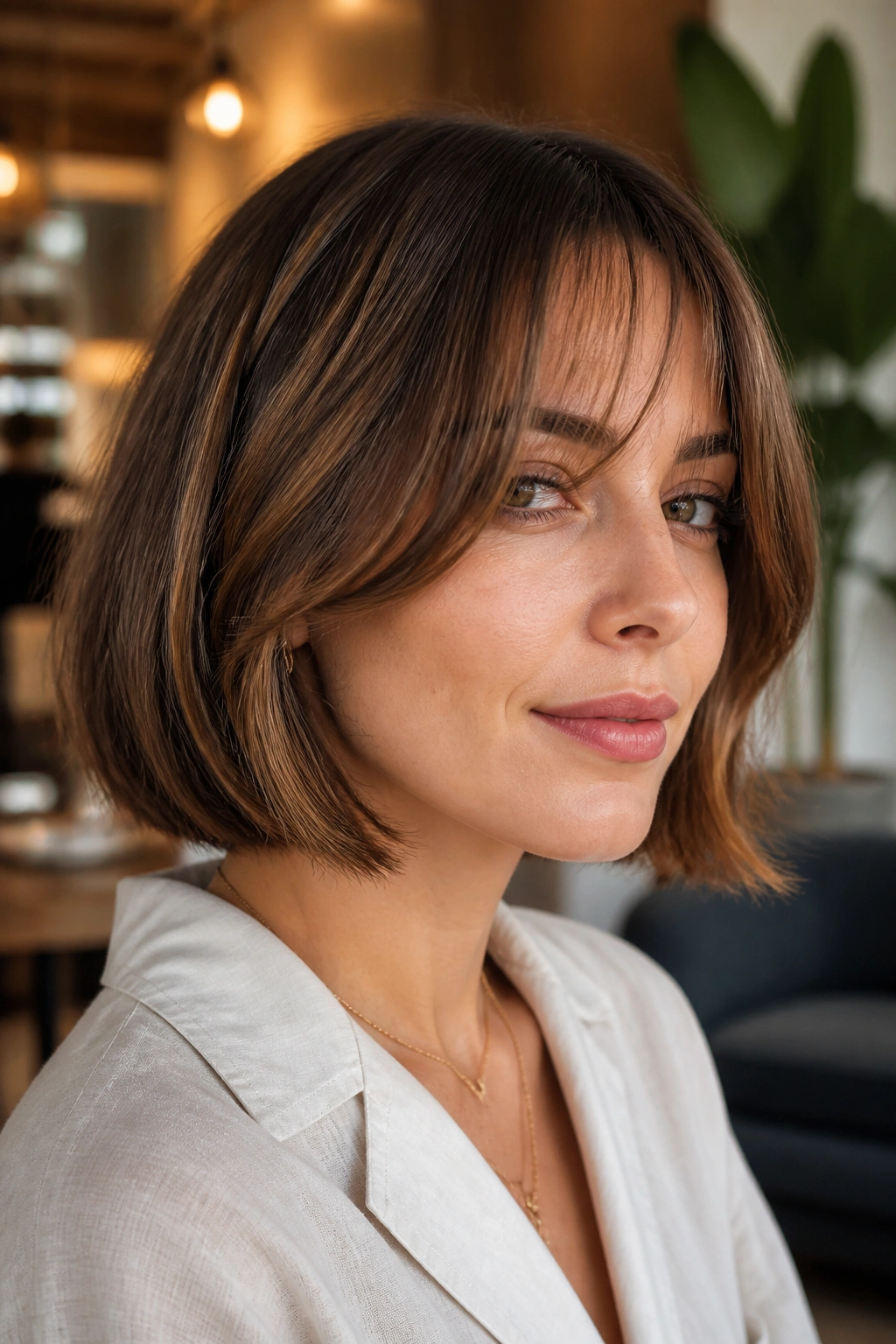
Unlike a choppy bob, this version keeps the outer line clean and hides most of the movement inside the shape. That makes it a good option for fine hair that loses density fast when layers are cut too high. The layers are there, but they are tucked low and soft, so the haircut still reads full from the outside.
The floating fringe is the other half of the idea. It’s a curtain bang, yes, but a light one — long enough to part, short enough to hover around the cheekbones, and soft enough not to sit as one heavy wall. Think of it as fringe with breathing room. The hair moves, but the outline stays calm.
This is the version I’d choose if you like the French bob look but don’t want the cut to feel too obvious. It’s subtle. That’s the charm. The shape can sit neatly with a tucked ear or fall loose without getting boxy. A few hidden layers at the bottom help the bob curve in, while the top stays dense.
If you have fine hair and a lot of cowlicks at the crown, keep the internal layers low. High layers can make the top collapse and leave the ends hungry. That’s the trade-off. Clean outside, careful inside.
13. Velcro-Roller French Bob with a Rounded Blowout
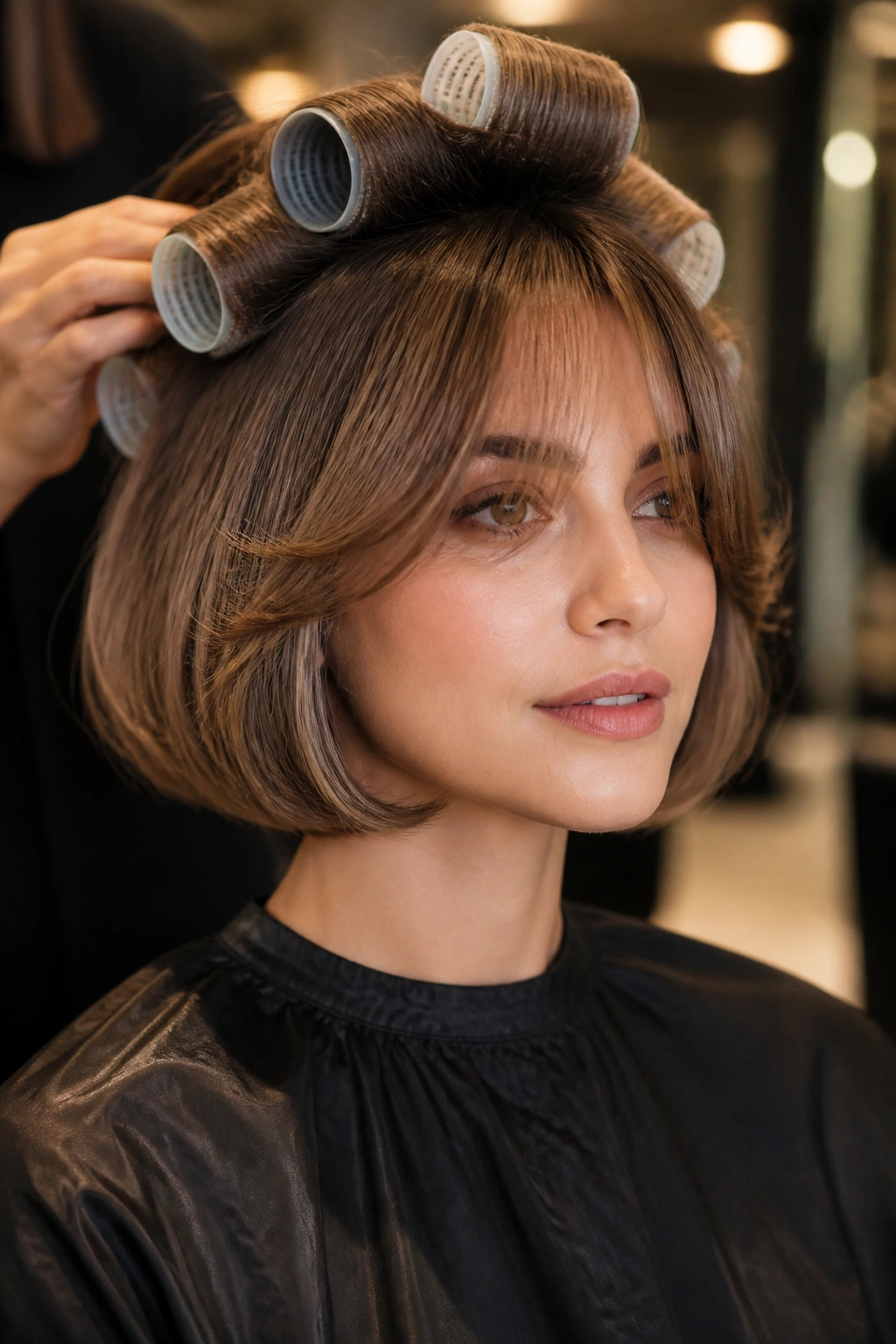
If your hair falls flat the moment it cools, the styling matters as much as the cut. A velcro-roller French bob gets a little lift back into the roots and keeps the curtain bangs from sinking into the forehead before you reach the door.
The shape starts with a rounded blow-dry. Use a round brush to build bend through the bob, then set the top and the fringe in two to four medium velcro rollers while the hair is still warm. Let them cool fully before removing them. Ten minutes is enough if the hair is fine and short; longer if the room is humid or the strands are stubborn.
The setup that actually helps
- Apply mousse to damp roots.
- Blow-dry the bob until it’s about 90% dry.
- Roll the top sections away from the face.
- Let the bangs cool open, not clipped flat to the head.
The rollers do something a flat iron cannot. They preserve a soft curve without pressing the life out of the hair. That matters with fine strands because fine hair often looks best when it still has air around it.
A little old-school? Sure. But it works.
14. Curly French Bob with Extended Curtain Bangs

Can fine hair be curly and still wear a French bob? Absolutely. The main thing is not to cut the bangs too short. Curls spring up, and a fringe that looks long enough wet can end up sitting well above the cheekbones once it dries. Extended curtain bangs give the curl room to settle.
This version works best when the bob is cut with the curl pattern in mind. The perimeter should follow the natural bend of the hair instead of fighting it. If the curl is loose, the bob can sit around the chin. If it is tighter, the line may need to land a little longer so the shape doesn’t rise too much.
The fringe should part with the curl, not against it. That sounds obvious, but it’s where a lot of short curly cuts go sideways. Curtain bangs that are left too short on curly fine hair tend to split awkwardly and expose too much forehead. Longer pieces at the front keep the shape soft and give the cut a calmer finish.
A diffuser helps, but use low airflow. High heat can make the curl frizz out and reveal every sparse spot in the cut. Gentle drying, a light cream, and a patient hand are enough.
15. Asymmetrical French Bob with Curtain Bangs and a Longer Front
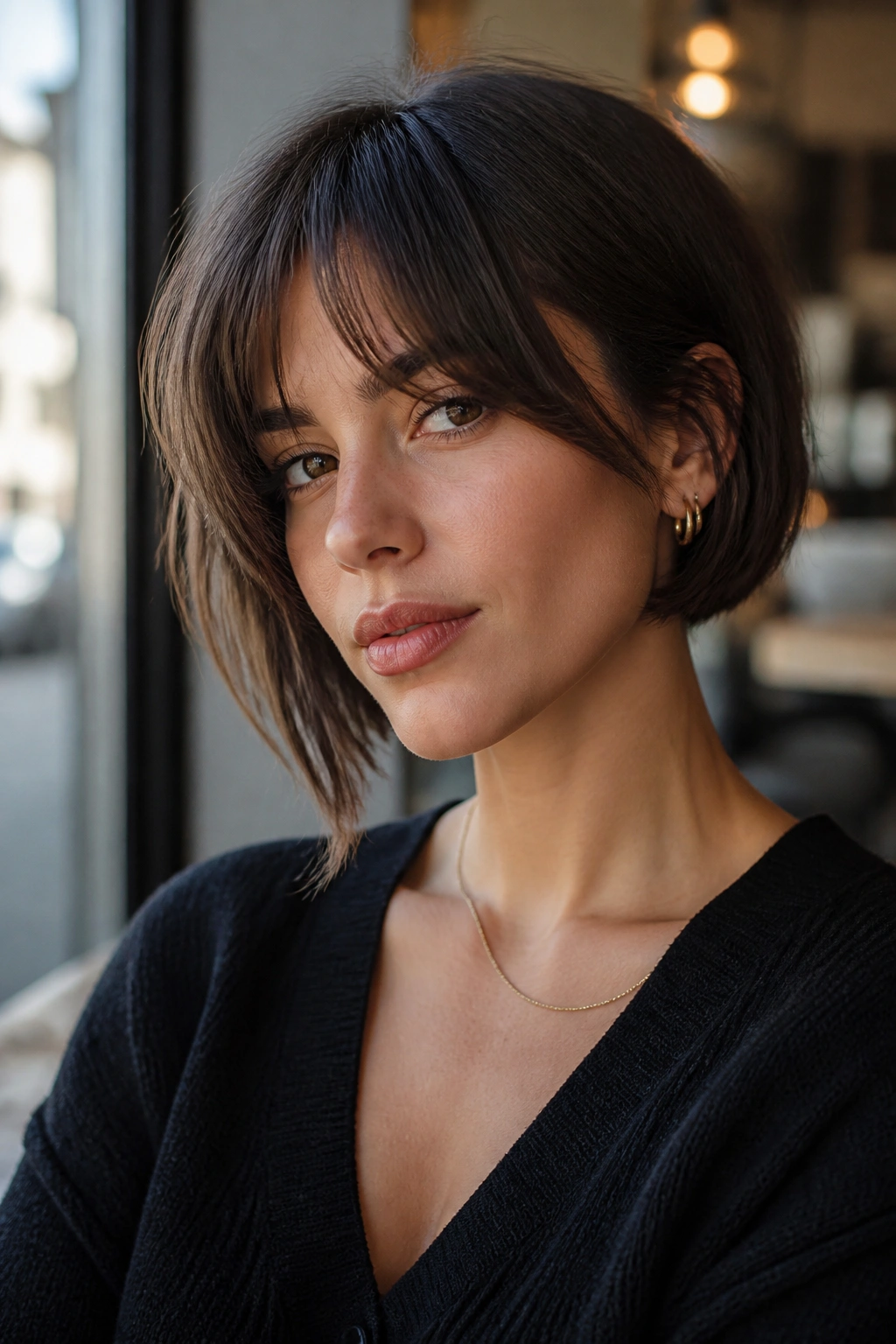
A tiny bit of unevenness can look sharper than perfect symmetry. That is especially true on fine hair, where a perfectly balanced cut can sometimes feel too neat and therefore a little flat. An asymmetrical French bob gives one side a slight edge — maybe a quarter inch, maybe half an inch — while the curtain bangs blur the change so it doesn’t look blunt or accidental.
The longer front can help if one side of your hair grows faster, if your part naturally shifts, or if you want the style to feel a touch more modern without leaving French-bob territory. It also gives the cut movement when you tuck one side behind the ear. The shorter side stays close to the jaw, the longer side skims the cheek, and the bangs connect the two.
I would keep the asymmetry small. Big differences can make fine hair look stringy, especially if the longer side drags down the whole shape. Small differences look deliberate. That’s the sweet spot.
This version suits someone who likes a little attitude in the haircut but not much maintenance. It does not need to be dramatic to work. It needs confidence in the outline and enough fringe to keep the face soft. Clean lines, a slight tilt, and a good blow-dry. That’s plenty.
Final Thoughts
The best French bob for fine hair is usually the one that protects the outline first. Everything else — the fringe, the texture, the little bend under the ends — sits on top of that decision. If the perimeter is too shredded, the whole cut starts to feel thin no matter how cute it looked in the chair.
I’d put the blunt jaw-skimming version at the top of the list for most people. It has the strongest shape, the cleanest grow-out, and the easiest styling routine. If you already know your hair likes movement, the feathered or lived-in versions are worth a look. If you want the cut to hold its own with minimal fuss, keep the line tidy and the curtain bangs soft.
Bring a photo, sure. Bring a note about how you part your hair, too. That part gets ignored all the time, and it changes the haircut more than a lot of people expect. A French bob only looks effortless when the details are doing their job behind the scenes.
