



Layered haircuts for women over 60 can do something a blunt cut rarely does: they put motion back into hair that has started to feel heavy, flat, or oddly stuck in place. That matters even more with gray hair, because silver strands often have a coarser feel, a little less bend, and a habit of showing every hard line in a cut.
A good layered shape softens all of that. It can lift the crown, brighten the face, and make fine hair look fuller without turning it into a helmet. It can also keep thick hair from swallowing your neck and shoulders. The trick is not “more layers” in the abstract. The trick is the right layers in the right place.
I’ve always thought the best cuts for this stage of life are the ones that make styling easier, not fussier. A smart haircut should work with your natural growth pattern, your cowlicks, your glasses, your neck length, your jawline, and the amount of time you actually want to spend with a brush. Otherwise, you end up with a beautiful photo and a miserable morning.
Some of these cuts lean soft and feathered. Some are tidy and polished. A few are sharper and more modern. All of them have one thing in common: they make layered haircuts for women over 60 look current, wearable, and genuinely flattering without asking you to fight your own hair every day.
1. Feathered Bob That Brushes the Jawline
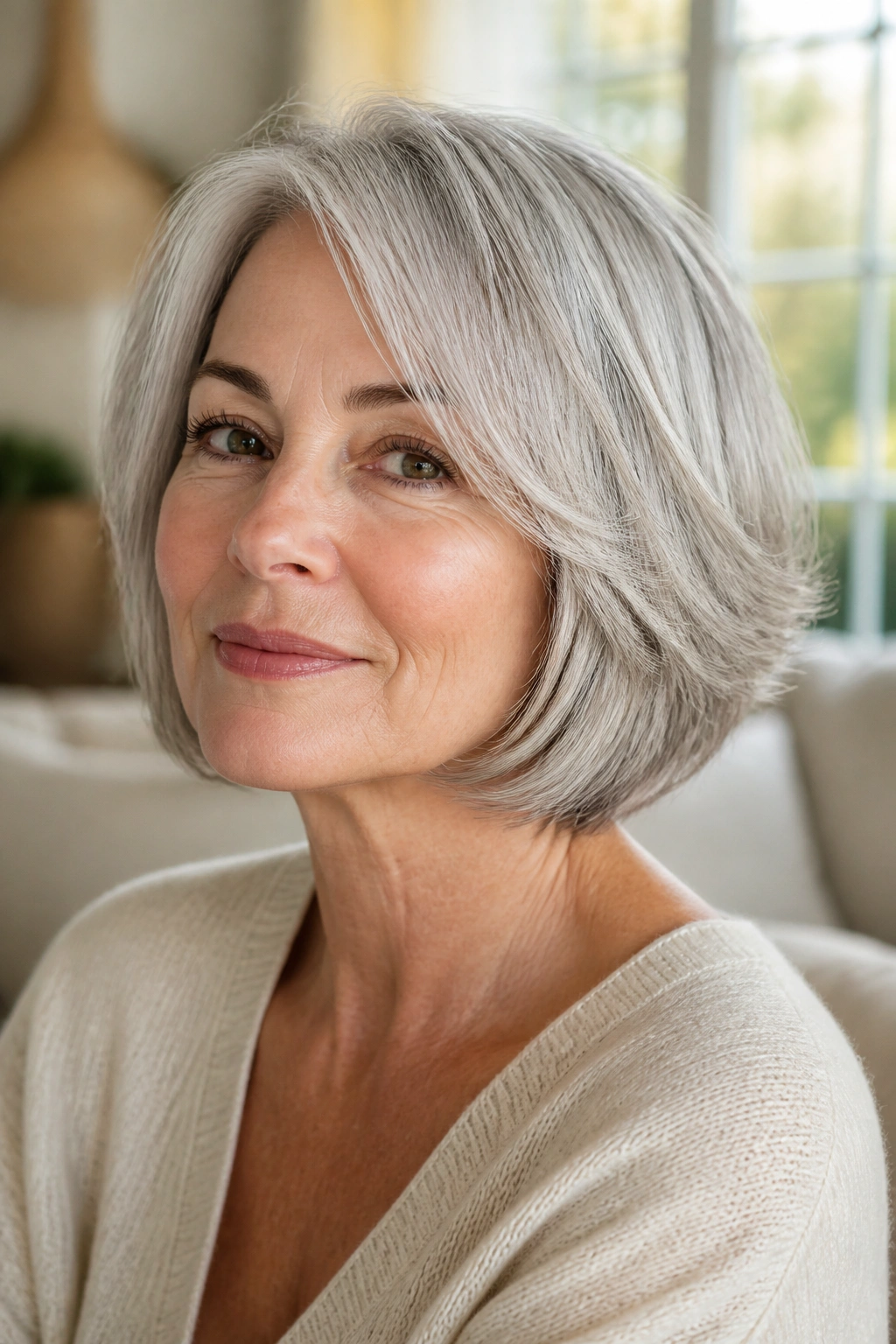
This is one of those cuts that just makes sense on real heads, not just in salon photos. The bob sits around the jaw or a touch below it, and the layers are sliced in a feathered way so the ends move instead of sitting there like a shelf. On gray hair, that soft edge matters a lot. Hard lines can look stern. Feathering keeps the whole shape lighter.
It works especially well if your hair has gone a little finer at the temples or around the crown. Ask for soft internal layers rather than choppy chunks, because the goal is lift, not holes. A side part helps if you want a little more height on one side, and a round brush at the ends gives the cut a neat swing.
Best for: fine to medium hair, oval faces, and anyone who likes a tidy shape.
Styling note: a pea-sized amount of mousse at the roots is enough.
2. Shoulder-Length Layers With a Side Sweep

Shoulder-length hair is underrated after 60. It gives you enough length for a ponytail, a clip, or a quick bend with a brush, but the layers stop it from hanging like a curtain. A side sweep across the forehead or temple can soften lines around the eyes without looking like you tried too hard. That’s the sweet spot.
This cut is especially kind to hair that’s become a little uneven in texture. The longer layers help blend wiry silver strands with softer pieces underneath, so the whole head looks more intentional. If you wear glasses, the side sweep keeps the hair from crowding the frames. Small thing. Big difference.
I like this one because it doesn’t shout. It just makes hair look healthier and more awake.
What to ask for at the salon
- Layers that start below the chin and blend down through the shoulders
- A soft side fringe or face sweep, not heavy bangs
- Ends that are dusted rather than blunt-cut straight across
3. Pixie With Tapered Layers
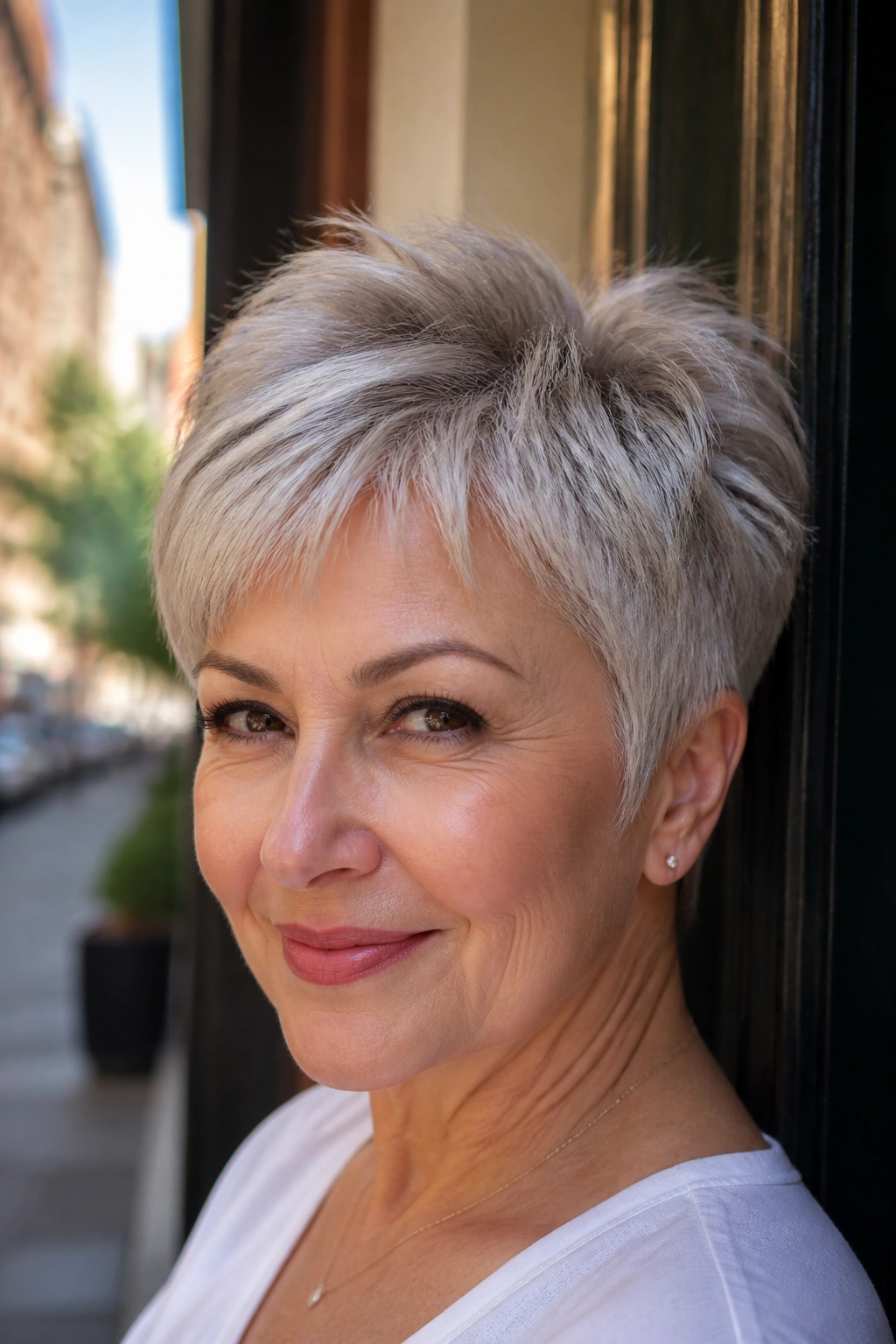
A pixie with tapered layers is one of the cleanest ways to get lift at the crown without dealing with length at the neck. The shorter top pieces create movement, while the tapered sides keep the shape close to the head. That sounds simple, but it’s exactly why it works so well on hair that’s thinning a little or losing bounce.
The key is balance. Too much bulk on top and the cut starts to look puffy. Too little, and it turns flat fast. The best version has a soft top, a neat nape, and just enough texture around the ears to keep it from looking severe. Gray hair can look gorgeous in this cut because the layers catch the light in different ways.
If you’re tired of blow-drying for 20 minutes, this is a smart reset.
Style it with: a dab of pomade rubbed between the palms, then pressed lightly through the top.
4. Long Layers That Let Gray Hair Shine

Long gray hair can look elegant, but only if it has shape. Without layers, it tends to drag downward and flatten the face. With the right long layers, though, it turns airy and dimensional. The movement shows off silver and white strands instead of hiding them, which is exactly the point.
This cut is best when the layers are blended from about the collarbone down, with a few face-framing pieces that start lower than the cheekbones. That keeps the front soft without creating a sudden step. If your hair is thick, the stylist can remove weight from the inside. If it’s fine, the layers should stay light and sparse so the ends don’t look wispy.
Long hair after 60 does not need to be hidden. It needs shape. That’s all.
Styling tip
Use a large round brush or a wide curling iron on just the front sections for bend, not ringlets.
5. Chin-Length Bob With Soft Interior Layers
A chin-length bob can be a little unforgiving if it’s cut too blunt. Add soft interior layers, though, and the shape suddenly behaves. It keeps the line near the face, which is flattering, but the inside layers stop it from feeling blocky or helmet-like. On gray hair, that softness matters because shine tends to show every edge.
This cut is a good match for women who want structure without a lot of styling. It’s polished enough for a neat everyday look, but it still has movement when you tuck one side behind the ear. If your hair flips out at the ends, that can actually work here. A slight bend gives the whole style some life.
I’d choose this for someone who likes order, but not stiffness.
Works well with: straight to slightly wavy hair and a clean side part.
6. Soft Shag With Wispy Fringe
The shag has stayed around for a reason: it gives flat hair a second chance. For women over 60, a softer version works better than anything too wild or chopped-up. The layers should move from the crown through the sides in a way that feels broken-in, not trendy for the sake of it. A wispy fringe keeps the forehead area light.
This is a strong choice if your hair has texture, especially if it forms a loose wave or curl after washing. The layers encourage that natural bend instead of fighting it. A little texture spray is usually enough. No hard styling. No sticky finish. No giant barrel brush unless you enjoy that sort of thing.
Gray hair often looks especially pretty in a shag because the different lengths create depth. It reads relaxed, not messy.
How to style it
- Scrunch in a light mousse
- Air-dry about 70 percent, then rough-dry the roots
- Finish with a few finger-shaped bends around the face
7. Collarbone Cut With Face-Framing Layers
The collarbone cut is a quiet workhorse. It gives you enough length to feel feminine and versatile, but it still moves easily when layered well. The face-framing pieces should start around the chin or cheekbone, then drift down to the collarbone so the shape opens the face instead of closing it in.
This is one of the most forgiving layered haircuts for women over 60 because it works with a lot of hair types. Fine hair gets lift. Thick hair gets shape. Wavy hair gets a place to go. It also sits nicely under sweaters, scarves, and jackets, which sounds trivial until you actually live with hair.
The best version has soft ends, not razor-thin tips. That keeps the style from looking tired.
Good if you want: length without heaviness, movement without a lot of upkeep.
8. Stacked Bob With Lift at the Crown
A stacked bob can be a small miracle for hair that has lost volume at the back of the head. The shorter pieces in the nape create a built-in lift, and the layers stack upward so the crown looks fuller. It’s a smart shape for straight or slightly wavy hair, especially when the back tends to collapse by lunchtime.
The front can stay a little longer to keep the cut from feeling too boxy. That balance matters. Too much stacking and the cut gets old-fashioned fast. Too little and you lose the point. A few longer pieces around the cheekbones keep the style soft and help it grow out more gracefully.
This is one of my favorite options for women who like a neat silhouette but still want a bit of swing.
Styling note
Blow-dry the back first, lifting at the roots with a small round brush. That’s where the shape lives.
9. Textured Lob With Loose Waves
A lob, or long bob, lands somewhere between chin and shoulder length. Add texture through the mid-lengths and ends, and you get a cut that looks casual without falling apart. Loose waves suit this shape because they make the layers visible, which is where the movement comes from.
This cut is great if you want flexibility. You can wear it smooth, tuck it behind one ear, clip one side back, or add a bend with a flat iron. The layers should be soft enough that the hair still feels like hair, not a stack of separate pieces. That’s especially important on gray hair, which can already have a wiry texture.
It’s a good “busy but not fussy” cut. Clean, wearable, and easy to grow into.
Try this: a 1-inch curling iron, wrapped away from the face, then brushed out with fingers.
10. Short Crop With Piecey Layers
A short crop with piecey layers is for the woman who wants energy around the face and no nonsense at the neck. The top stays textured, the sides stay tidy, and the ends are broken up just enough to keep the shape from turning stiff. Gray and white hair can look especially sharp here because the cut shows off the color variation.
This style likes a little product. Not much. A matte paste or a light cream lets you push the pieces where you want them without making the hair look wet. The beauty of the crop is that it can be polished or a little messy, and both versions still read as deliberate.
If your hairline has changed or your hair grows differently on each side, this cut can hide a lot of that.
What to watch for
Don’t let the top get too long. Once it starts flopping, the whole shape loses its edge.
11. Soft Curly Layers That Keep the Shape Round
Curly hair after 60 often needs one thing more than anything else: room. Soft layers give curls that room so they can spring instead of clumping into a triangle. The shape should be rounded and lifted, with layers placed where the curls naturally stack. That keeps the cut from looking bulky at the bottom.
A good curly cut is done dry or close to dry, because curl patterns lie when they’re wet. The stylist should respect the natural spring of the curl rather than carve it into a shape that only works for one wash day. Gray curls can be beautiful when the layers are right, since silver tones show depth very clearly.
This is not a cut for someone who wants pin-straight control. It is for someone who wants curls that look alive.
Best styling approach: leave-in conditioner, a curl cream, and a diffuser on low heat.
12. Blended Silver Layers Past the Shoulders
Longer silver hair looks elegant when the layers are blended so carefully you almost don’t notice them at first glance. That’s the point. You’re not aiming for obvious steps. You’re aiming for movement through the mid-lengths and softness at the ends, which keeps long gray hair from looking heavy or stringy.
This cut is flattering if your hair has enough density to support the length. It also works well when you like to wear it in a low twist, a loose bun, or a half-up clip. The layers should support those styles, not fight them. If you have a little frizz, the movement helps hide it. If your hair is too thin, though, long layers can look sparse fast.
The answer is not “never wear it long.” The answer is “keep the ends healthy and the layers blended.”
Small detail that helps
A trimming schedule matters here more than people admit. Dry ends ruin the shape fast.
13. Rounded Bob With Underlayers
A rounded bob gives the head a softer outline, which is flattering when hair has started to thin around the crown or temples. Underlayers keep the body underneath while reducing weight on the surface. That lets the top curve instead of falling in a flat sheet.
This cut is especially kind to women who want fullness without obvious stacking. It has a smoother profile than a stacked bob, so it feels a little gentler. Gray hair looks polished in this shape because the curve around the face catches the light and keeps the style from looking hard.
If you like a refined cut that still has life, this one sits in a nice middle ground.
Style tip: dry the ends under with a round brush, then flip the brush inward for the last 2 inches.
14. Bixie Cut With Soft Layering
The bixie sits between a bob and a pixie, and that in-between space is where it gets interesting. It has enough length to feel feminine and versatile, but enough layering to keep the crown lifted and the sides light. The best version has a soft fringe or side sweep rather than a blunt line across the forehead.
This cut works on women who want short hair but are not ready for a super cropped shape. It also grows out in a decent way, which matters more than people think. A bixie that can survive six to eight weeks without looking ragged is a better haircut than one that looks perfect for five days and then turns into a problem.
Gray hair shows the layers well here, especially when the top is textured and the sides taper in.
Ask for this
- A longer top with piecey layers
- Shorter, neater sides
- A nape that stays clean but not shaved close
15. Inverted Bob That Lifts the Back
An inverted bob is shorter in the back and longer in the front, and that shape does a lot of work without asking much from you. It builds a sense of lift at the back of the head while leaving enough length in front to soften the jaw. If your hair has started to fall flat behind the ears, this cut fixes that quickly.
The angle should be gentle, not dramatic. A steep inversion can look sharp in a way that feels dated or hard to wear. A softer version gives you movement and a clean neck line. On gray hair, the shape reads crisp in the best possible way.
It’s a good choice for straight hair that needs a little attitude and for wavy hair that likes structure.
Pro tip: a little root spray at the crown makes the back look fuller without teasing.
16. Side-Swept Layers With a Soft Fringe
A side-swept fringe can change a face fast. It softens the forehead, breaks up strong lines, and keeps the haircut from feeling too open in front. Add layered sides and you get a cut that moves around the cheekbones instead of sitting on them. That’s a nice thing if your face has become a little more angular over time.
This cut works across a lot of lengths, from chin-length bobs to shoulder-length styles. The fringe should be soft enough to blend, not heavy enough to need daily battle. If you wear glasses, it’s especially useful because the hair can sweep away from the frames instead of crowding them.
I like this one for anyone who wants a small change that makes a big visual difference.
Styling note
Use a small round brush or just your fingers and a dryer set on medium heat. Over-directing the fringe makes it stiff.
17. Layered Cut That Frames Glasses Cleanly
Glasses change everything. Hair that looks lovely on its own can suddenly feel busy once frames are in the picture. A layered cut with clean face framing solves that by keeping the hair off the lenses and leaving breathing room around the eyes. The layers should start where the frames end or just below them, depending on the shape.
The goal is not to hide the glasses. It’s to make them part of the look. Soft layers around the temples, a little lift at the crown, and controlled ends near the jaw help the whole face look balanced. Gray hair works beautifully here because the contrast between silver strands and dark frames can look sharp without being harsh.
This is one of those cuts that saves time every morning. Less adjusting. Less pushing hair back. More actual wearing.
Good if you want: a cut that looks neat with prescription glasses, reading glasses, or oversized frames.
18. Fine-Hair Layers That Build Fullness
Fine hair needs a careful hand. Too many layers and it starts to look thin at the ends. Too few and it falls flat by lunch. The right cut uses soft, strategic layering to build the illusion of body while keeping enough weight in the perimeter so the shape still reads full.
This is one of the places where a lot of stylists go wrong. They take too much off. What you want instead is a blunt-ish outline with subtle movement inside it. A side part helps, and so does a little root lift at the crown. Gray fine hair can be tricky because it often looks fuller than it feels, but the right layers give it life without making the ends see-through.
Keep the finish light. A heavy cream can drag this cut down fast.
Best styling products
- Volumizing mousse at the roots
- Dry texture spray at the crown
- A lightweight serum only on the ends
19. Thick-Hair Layers That Remove Weight
Thick hair is lucky until it isn’t. Once it gets too heavy, the shape becomes puffy, triangular, or plain exhausting to style. Layers help by taking weight out of the right places while keeping enough fullness to look rich and healthy. The trick is to thin strategically, not aggressively.
A thick-haired woman over 60 often needs movement around the face and neck more than she needs more length. That’s where the cut earns its keep. A few long internal layers can stop the sides from ballooning. If the hair is gray, those layers also stop the color from looking like one flat block.
This is not about making thick hair “manageable” in some vague sense. It’s about making it sit where you want it.
Watch for: over-thinning at the bottom. That makes the ends fray and the whole cut age faster.
20. Razored Shag With Soft Ends
A razored shag has edge, but the soft version is what works best for many women over 60. The razor removes bulk and creates a feathery finish, which can be lovely on hair that feels heavy or stiff. The ends should still look healthy, though. You want texture, not raggedness.
This cut looks especially good when air-dried with a little cream or diffuse-dried for extra bend. It gives gray hair a lived-in feel that doesn’t read sloppy. If your hair has a natural wave, the layers will show it off. If it’s straighter, the cut still creates movement through the ends.
I’d skip this if you hate texture or want a very sleek finish every day. Otherwise, it’s a strong, modern choice.
A small caution
A razored finish needs regular trims. Once the ends get scruffy, the whole style loses shape.
21. Modern Pageboy With Layered Movement
The old pageboy had a reputation for being stiff, but a modern version with layers is a different animal. The shape stays rounded and smooth, with a little inward bend at the ends, while the layers keep it from feeling like a cap. It’s neat, tidy, and surprisingly flattering on strong jawlines.
This cut works well if you like a controlled silhouette and don’t want pieces flying around your face. It also behaves nicely with gray hair, which often shines well in a clean, shaped cut. The modern version should have a little softness at the fringe or cheek area so it doesn’t read too severe.
It’s a good option for women who like structure but not fuss.
Styling detail: a flat brush and a medium heat setting are usually enough. Push the ends under, then stop.
22. Soft Asymmetrical Bob
An asymmetrical bob gives the face a little energy without making the haircut loud. One side sits a touch longer than the other, which pulls the eye downward and can lengthen the look of the neck and jaw. Keep the layers soft, and the whole shape feels fresh rather than sharp.
This is a nice cut if you want something with personality but still wearable at the grocery store, the office, or a dinner out. Gray hair can look especially striking in this shape because the uneven line catches attention without needing extra styling. Just don’t overdo the contrast. A subtle difference between sides is enough.
The cut works best when the shorter side still has a little movement. If one side is too blunt, the whole thing starts to feel hard.
What to ask for
- A gentle angle, not a steep diagonal
- Soft layers through the body
- A finish that moves when you turn your head
23. Shoulder-Length Flip Layers
Flip layers bring a little lift and a little attitude to shoulder-length hair. The ends turn outward instead of under, which can be flattering when hair tends to collapse toward the collarbone. The look has a touch of retro charm, but when the layers are soft, it does not feel costume-like.
This cut is useful if your hair has lost some bounce and you want a shape that feels lighter around the shoulders. It also works well on gray hair because the flipped ends show off the variation in silver tones. Use a round brush or a flat iron just at the ends, and the whole style wakes up.
I’d call this one cheerful without being cute.
Best for: straight or slightly wavy hair that needs a little lift at the bottom.
24. Curtain Bangs With Long Layers
Curtain bangs can be a smart move after 60 if you want to soften the forehead without committing to full bangs. They part in the center or just off-center and blend into long layers on each side. That makes the cut feel airy, which is useful if you don’t want a heavy fringe sitting on your face all day.
The trick is to keep the bangs long enough to sweep back on lazy days. Short curtain bangs can be annoying when they’re growing out. Longer ones blend more easily with the rest of the haircut and work nicely with glasses. Gray hair often looks lovely with this shape because the face is framed in a soft, open way.
It’s one of the easiest ways to change a haircut without changing the whole length.
Styling note
A quick blow-dry with a round brush at the front is enough. Don’t overwork the fringe or it turns too curved.
25. Invisible Layers for a Mid-Length Cut
Invisible layers are exactly what they sound like: layers that shape the hair without shouting about themselves. They’re cut into the interior of the hair, so the outline still looks smooth while the movement sits underneath. That’s useful for women who want a polished look but do not want obvious steps.
This is a smart choice if your hair is medium-density and you want it to fall naturally. It helps the ends move, keeps the top from collapsing, and makes air-drying less risky. Gray hair benefits because the shine stays clean across the surface while the shape still has some life.
A lot of women think they need more obvious layers. Often they need smarter ones.
Ask for: a soft internal shape, not choppy layers through the perimeter.
26. Curly Bob With Rounded Layers
A curly bob with rounded layers gives curls a place to sit. The shape follows the curve of the head, then lets the curls spring just past the jaw or neck. It keeps the style from turning into a pyramid, which is one of the fastest ways to make curly hair feel heavy.
This cut should be tailored to your curl pattern, not forced into a standard length. Some curls spring higher and need more room at the crown. Others drop more and need stronger shaping at the bottom. Gray curls can be gorgeous here because the silver tones catch inside the curl cluster and make the texture look deeper.
This is one of the most honest cuts in the bunch. It either respects your curl pattern or it doesn’t.
Styling note
Use a leave-in conditioner first, then a gel or cream, and do not brush it dry. That’s how frizz moves in.
27. Layered Taper Cut With a Soft Neckline
A tapered cut with layers gives a clean shape around the nape while keeping enough softness on top to avoid looking too severe. The taper is especially nice if you want hair off the neck but still want some body around the crown and sides. It feels neat, cool, and easy to wear.
This works well for straight hair, but it can also suit loose waves. The neckline should be gently tapered, not buzzed close, unless that is the look you want. Gray hair shines in a tapered shape because the contrast between the clean sides and the softer top gives the cut a crisp outline.
I like this for active women who want hair that stays out of the way without feeling too short.
Good detail to mention at the salon: ask for a soft finish at the ears so the cut grows out cleanly.
28. Layered Lob With a Deep Side Part
A deep side part can completely change a layered lob. It adds instant lift on the heavier side and creates a little drape across the forehead on the other. That asymmetry is useful when hair has gone flatter over time. It also helps the face look less long and more open.
The lob itself should sit around the collarbone, with layers that move through the mid-lengths. This is a strong choice for gray hair because the side part gives the color dimension without needing much styling. If you have a strong cowlick at the front, a deep part can either tame it or make it obvious, so test it before you commit.
This cut feels easy, but it still has shape. That combination is why it hangs around.
Styling tip
Flip the part while your hair is still damp, then dry at the roots in the opposite direction first. It builds volume fast.
29. Soft Mullet With Layered Shape
A soft mullet is not the punky, spiky version people picture from old photos. The newer take keeps the top and sides blended, then leaves a little extra length in the back for movement. On the right face, it looks modern and lively. On the wrong face, it can feel too committed, so this one needs a little honesty.
What makes it work after 60 is the softness. The layers should stay feathered and wearable, with a fringe that can be brushed aside or worn loose. Gray hair often makes this cut look more refined than expected because the tonal shift in silver strands helps the layers read as texture instead of noise.
If you like a little attitude in your haircut, this is the wild card.
Best for: women who like texture, side pieces, and a cut that does not sit quietly.
30. Long Feathered Layers With a Polished Finish
Long feathered layers are the grown-up answer to hair that feels too heavy but still needs length. The feathering lightens the shape from the cheekbones down, while the polished finish keeps it from slipping into “just long hair” territory. That distinction matters. A good feathered cut has movement all through it, not only at the ends.
This style works especially well on gray hair with good density, because the layers show the tonal changes in silver, white, and charcoal strands. It also photographs well in real life, which is not the same thing as being too styled. A blow-dry with a paddle brush or a large round brush can keep the finish smooth without making it stiff.
If you want length, softness, and a little shine, this is the one to keep in mind.
Final styling note
Use heat sparingly. Feathered layers look better with bend than with tight curls or heavy smoothing.
Final Thoughts
The best layered haircuts for women over 60 do more than shave off weight. They give hair shape where it has gone flat, lift where it has gone tired, and softness where harsh lines start to feel unforgiving.
Gray hair is especially good at showing the truth of a haircut. If the layers are right, the silver looks richer and the whole style feels lighter. If they’re wrong, every blunt edge shows. That is why the small details matter so much: where the layers start, how the fringe sits, and whether the ends still look healthy.
If you’re bringing one of these ideas to a stylist, take a photo of the shape you like and be honest about your routine. That part saves more bad haircuts than any trend ever could.
