



A bridal ponytail is not a fallback. Done well, it can look sharper than a bun, lighter than a full updo, and a whole lot more comfortable when the day stretches long and the dance floor fills up.
The best wedding ponytail hairstyles for brides do more than pull the hair back. They show off a neckline, leave room for earrings, and hold their shape through hugs, heat, and a veil that gets lifted and lowered more than once.
The trick is almost always at the crown and the base. Too flat, and the style looks rushed. Too tight, and it starts to feel severe. But give it a clean part, a little lift, and a wrapped elastic, and suddenly the whole thing reads as intentional.
I keep coming back to ponytails for one simple reason: they move nicely. That swing matters in photos, but it matters even more in real life, when you turn your head to greet people, lean in for a kiss, or step into a gust of wind that would ruin a softer style in minutes.
1. The Bridal High Ponytail With a Wrapped Base

A high ponytail is the fastest way to make a gown feel modern. It lifts the face, shows the shoulders, and gives a bride a clean line from crown to tail that looks strong in profile.
The version that works best for weddings is smooth at the scalp and soft through the length. A stylist usually wraps a 1-inch section of hair around the elastic, pins it underneath, and keeps the tail glossy but not stiff. If the hair is fine, a little teasing at the crown helps the whole shape stay up without sliding flat by cocktail hour.
A few details make this one feel bridal instead of sporty:
- Best with strapless, square-neck, or halter gowns
- Looks sharp with statement earrings
- Can be worn straight, curled, or with a slight bend at the ends
- Needs a heat-protectant spray if the tail is blown out or curled
My take: if you like a dress with structure, this ponytail is one of the easiest ways to match it without piling on extra hair.
2. The Low Center-Part Ponytail With Soft Waves

Why does this style keep showing up on brides with romantic dresses? Because it softens everything. A low center-part ponytail sits calm at the nape, and that calmness gives lace, tulle, and delicate straps a little breathing room.
Why the Center Part Works
A center part pulls the eye straight down, which makes the face look longer and the neckline look cleaner. It also keeps the style balanced, which matters if your dress has a lot going on at the bodice.
For the tail itself, soft waves are better than tight curls. A 1.25-inch curling iron, brushed out while the hair is still warm, gives that easy bend that feels polished without looking overworked. The ends should move. They should not freeze.
How to Wear It Well
- Keep the part crisp, then mist the roots with light-hold spray
- Place the ponytail exactly at the nape, not higher
- Leave the tail loose enough to swing
- Add a single jeweled pin on one side if the gown is very plain
This is a quietly elegant choice, and I mean that in the useful sense. It won’t fight the dress.
3. The Bubble Ponytail With Pearl Ties

If the ceremony is outdoors and the weather has opinions, a bubble ponytail is one of the few styles that still looks deliberate after a breeze. It has shape built into it, so it doesn’t collapse into a sad rope halfway through the evening.
The trick is spacing. Clear elastics every 2 to 3 inches create the bubbles, and then you gently pull each section outward until it looks rounded but not puffed beyond control. A few pearl ties or pearl pins at the joins make it feel bridal fast.
The style works especially well when the dress is simple and the bride wants the hair to do the talking. It also photographs with nice texture from the side, which is useful because bubble ponytails can flatten if you only look at them from the front.
A small warning: don’t overpull the bubbles. You want dimension, not a row of inflated circles that look like costume hair.
4. The Voluminous Curly Ponytail With Crown Lift
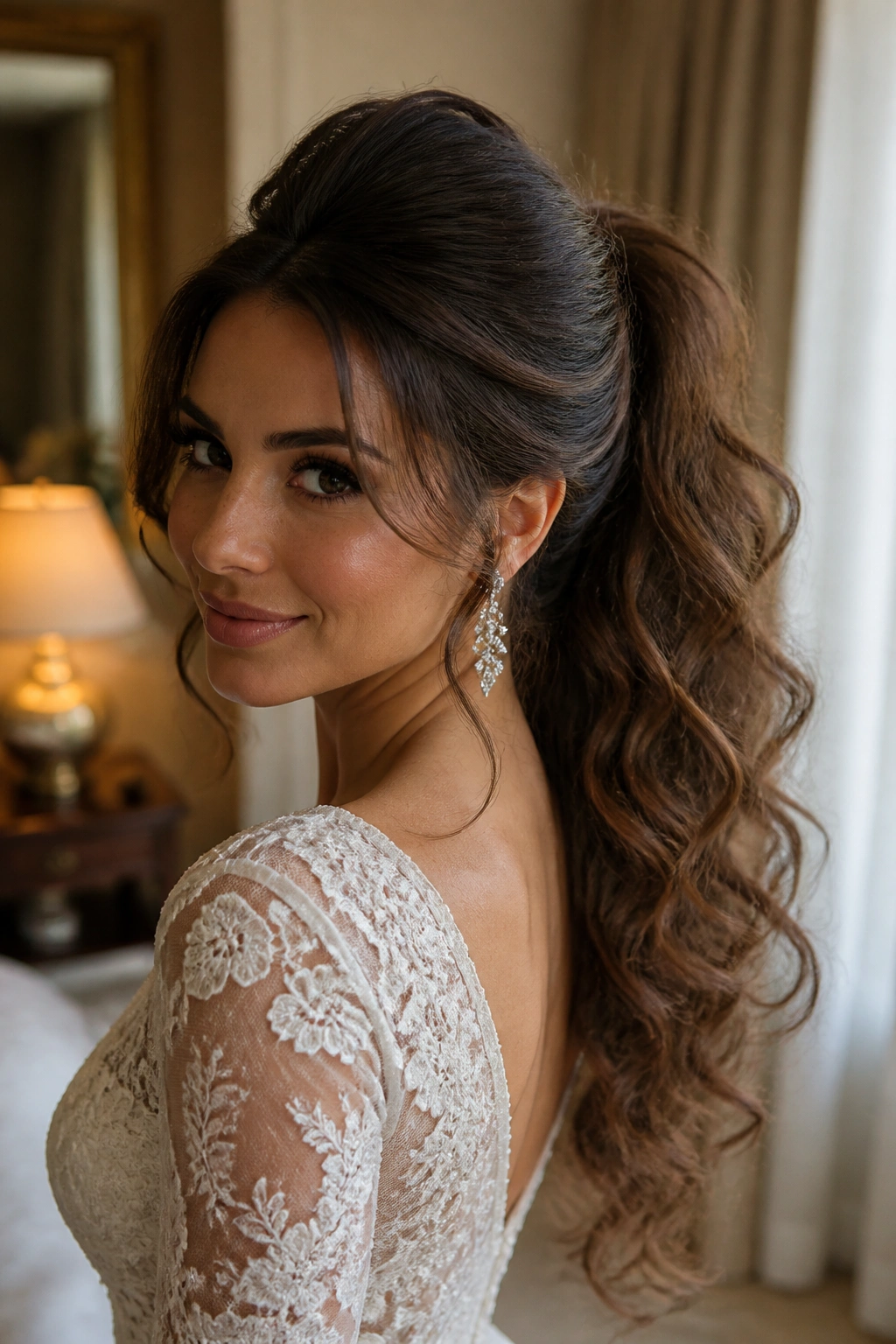
A curly ponytail does not have to be loose to feel romantic. In fact, the strongest ones usually have a little control at the crown and a lot of movement in the tail.
That balance matters. If the top is too soft, the style can look unfinished. If the curls are too tight, it starts to feel dated. A good stylist will smooth the front, lift the crown just enough to create height, and let the curls stack in a way that looks full from every angle.
What helps most is leaving a few face-framing pieces out and shaping them with a smaller iron so they bend, not just sit there. The result is not fussy. It looks alive.
Best for: brides with natural waves or curls, fuller gowns, and veils that sit below the crown.
Skip the heavy oil: a light gloss spray works better here. Too much product breaks up the curl pattern and makes the tail look weighed down.
5. The Braided Ponytail With a Hidden Base

Unlike a bun, a braided ponytail gives you texture without closing off the neck. That matters if your dress has a pretty back or if you want the hairstyle to feel a little more tactile under close-up photos.
The braid usually starts at the crown or just behind it, then feeds into the ponytail. The base stays hidden under a wrap of hair, so the elastic disappears. That small move is what keeps the look from slipping into schoolgirl territory.
I like this style for brides who want detail without sparkle. It has enough pattern to feel dressed up, but it does not need pins, pearls, or flowers to hold attention.
You can wear the tail as a loose three-strand braid, a fishtail, or a gently pulled-apart plait. Each version gives a different mood. The first feels classic. The second feels more relaxed. The third has a bit more texture for photos.
6. The Hollywood Wave Ponytail
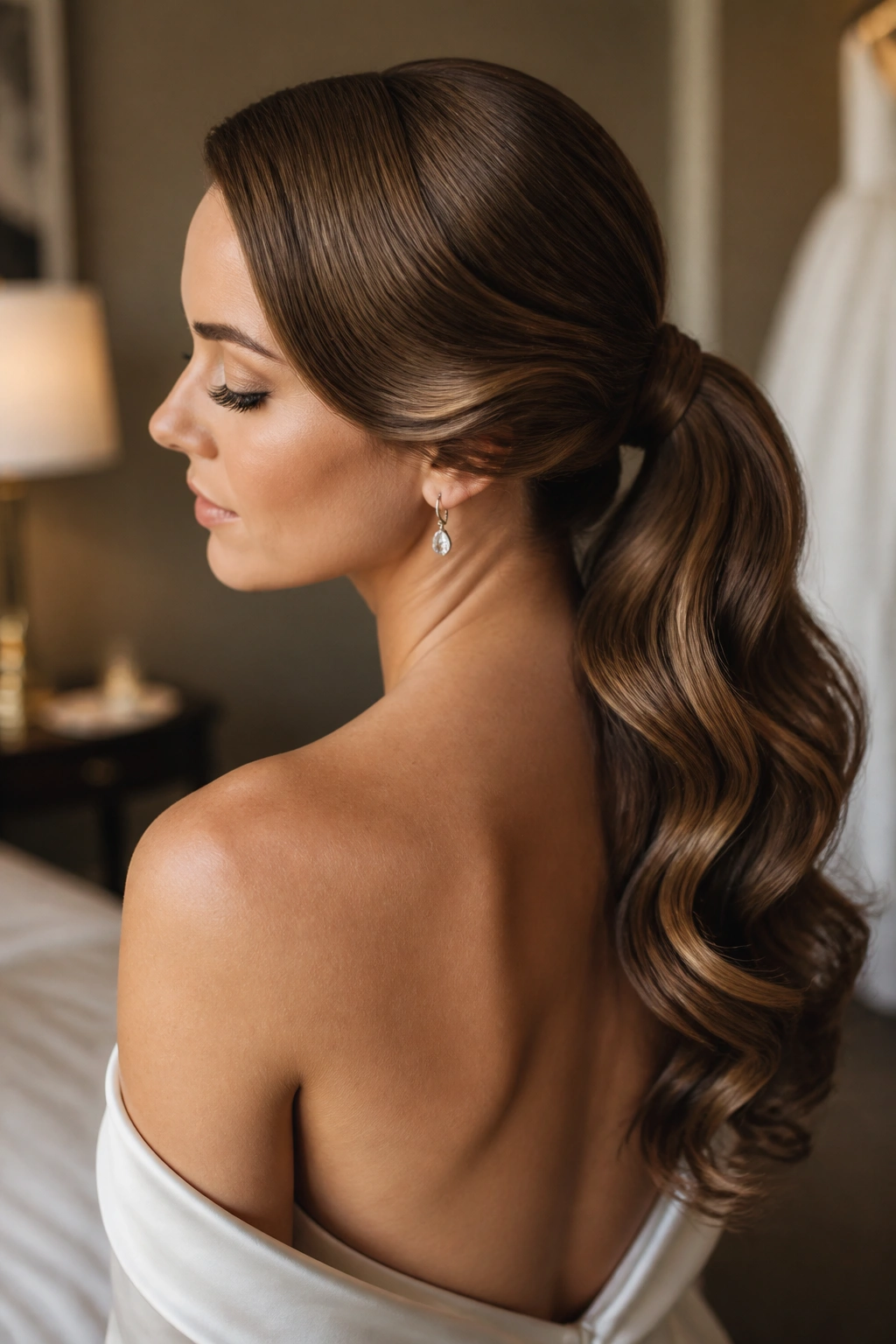
A Hollywood wave ponytail is what happens when a red-carpet curl meets wedding hair and behaves itself. The hair is usually side-parted, smoothed near the scalp, and then shaped into broad, glossy waves through the tail.
I’ve always liked this one for brides who want glamour but do not want their hair pinned to their head. There is movement here, which is the whole point. The curls should look brushed, not crunchy, and the overall shape should fall in one smooth line instead of a pile of separate sections.
This style is especially good with asymmetrical necklines and draped gowns. The side part adds a little drama, and the wave pattern keeps the look from becoming too strict.
The only thing I’d watch is volume at the base. If the ponytail sits too low, the waves can drag the face down. Keep it at mid-height and let the hair do the rest.
7. The Side-Swept Ponytail With a Deep Part

A side-swept ponytail has a little old-fashioned charm, but it still feels easy to wear. One side of the hair gets tucked close to the head, the part dives deep, and the ponytail lands low over one shoulder.
Why It Works for Certain Dresses
This style is smart with one-shoulder gowns, off-the-shoulder sleeves, or dresses that already have a strong line across the neckline. It keeps the exposed side clean and lets the shape of the dress stay visible.
The ponytail itself can be smooth, waved, or loosely curled, but the placement is what makes it matter. If it sits too far forward, it starts looking like hair that fell by accident. If it sits too far back, the whole point of the side sweep disappears.
What to Ask For
- A deep side part with a clean root line
- Hidden pins along the tucked side
- A ponytail placed just behind the shoulder blade
- A soft curve at the ends so the hair doesn’t hang straight like a cord
This one has a lot of visual payoff for a style that is, under the hood, pretty simple.
8. The Textured Ponytail With Face-Framing Pieces
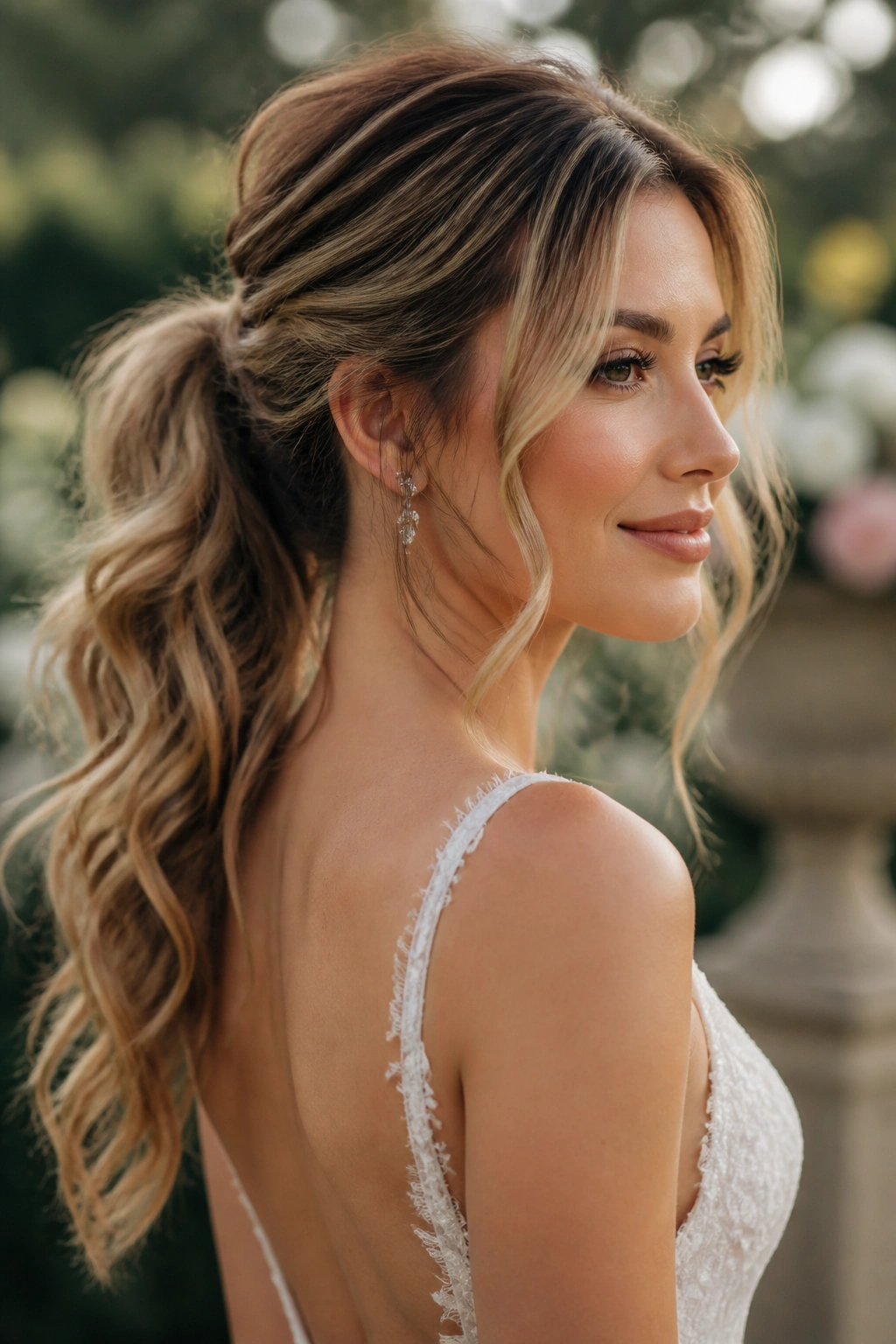
Textured ponytails are the ones that look the least forced. They’re not trying to be sleek, and that is exactly why they work so well for brides who want a little softness around the face.
The texture should be built on purpose. A stylist might rough-dry the hair, use a medium curling wand, and then break the waves apart with fingers rather than a brush. The result is airy, touchable, and a little undone in a way that feels expensive without shouting about it.
Face-framing pieces matter here. A pair of loose pieces at the cheeks can soften a stronger jawline and keep the style from looking too severe from the front. Keep them short enough to matter, but long enough to sit with the rest of the shape.
This is a strong choice for outdoor weddings, garden settings, and dresses made from lighter fabrics. It has movement, and movement always helps.
9. The Bow-Back Ponytail
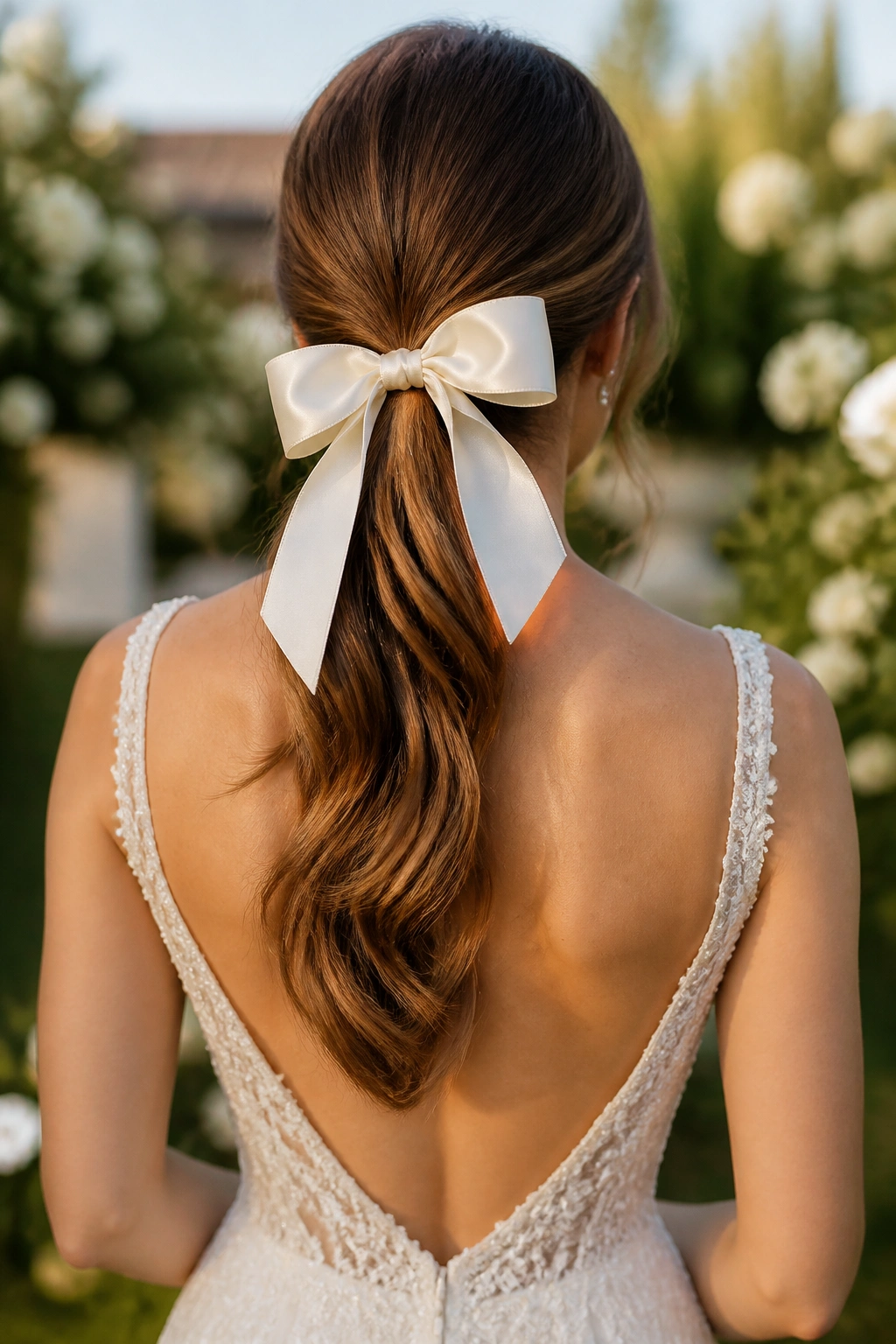
Can a ponytail look playful and bridal at the same time? Absolutely, if you put the bow in the right place and keep the rest of the hair clean.
A bow-back ponytail uses ribbon or fabric at the base or slightly below it, so the bow reads as part of the style rather than a random add-on. Satin is the classic pick because it echoes formalwear, but matte ribbon can work if the dress has a softer texture.
The size matters more than people think. A bow that is too large starts to fight the neckline. A bow that is too tiny looks like an afterthought. The sweet spot is usually wide enough to be seen from the back in photos, but not so wide that it overpowers the ponytail.
I’d choose this for a bride who wants a little charm and a little personality. It’s polished, but it doesn’t take itself too seriously. That is a nice balance, honestly.
10. The Pearl-Dotted Ponytail for Minimal Jewelry
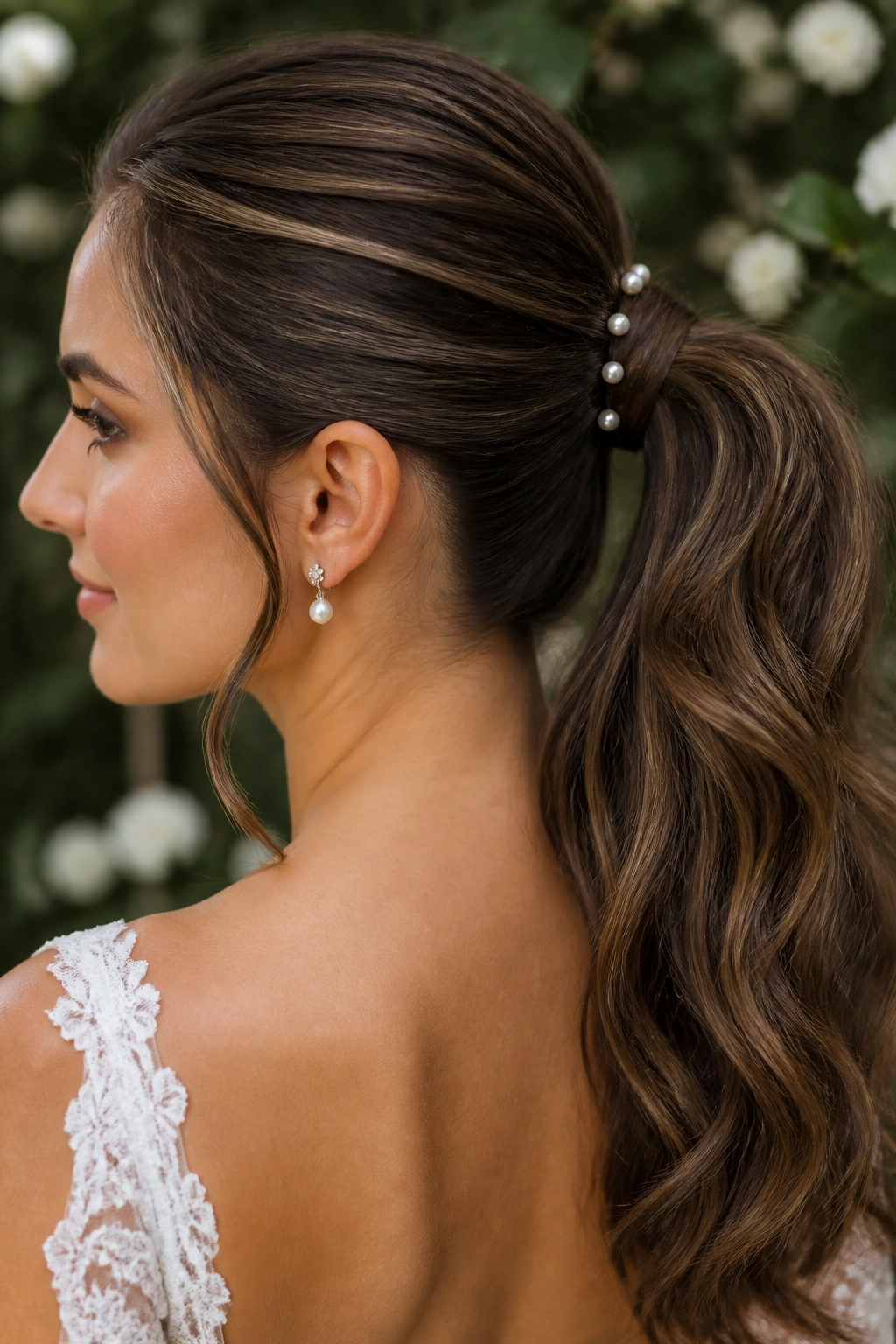
Three or four small pearl pins can change the whole mood of a ponytail. You do not need a full head of adornment. A few well-placed pieces are enough.
Where the Pearls Belong
Pearls work best when they trace one side of the ponytail or sit at the wrap around the base. If they’re scattered everywhere, the look gets busy fast. If they’re placed in a line or a small cluster, they act like jewelry for the hair.
The ponytail itself can be smooth or softly waved. I prefer a cleaner base here because the pearl detail needs some negative space around it. That contrast is what makes the accent noticeable.
- Use flat-back pearl pins if the hair is fine
- Space larger pins about 1 inch apart
- Keep the dress jewelry simple if the hair is already decorated
- Match the pearl tone to the gown’s white or ivory shade
This is one of those styles that looks more expensive than it sounds. Small details do a lot of work.
11. The Fishtail Ponytail

A fishtail ponytail is not just a braid with a fancier name. It has a tighter, more intricate pattern that creates a woven look through the tail, and that texture is lovely on a bride who wants detail without sparkle.
It works especially well when the gown has lace, embroidery, or a softer bohemian shape. The braid feels handcrafted, which suits dresses with visible texture. And because the braid tapers as it goes, the tail gets this neat, pointed finish that photographs well from the back.
The key is not making the braid too tight. A tight fishtail can look stiff and shrink the length of the hair. Pull it apart gently after braiding, and keep the crown smooth so the texture stays where it belongs — in the tail, not everywhere.
This is a good style if you like the idea of romance but don’t want curls falling in your face all night.
12. The Half-Up Ponytail With Loose Length
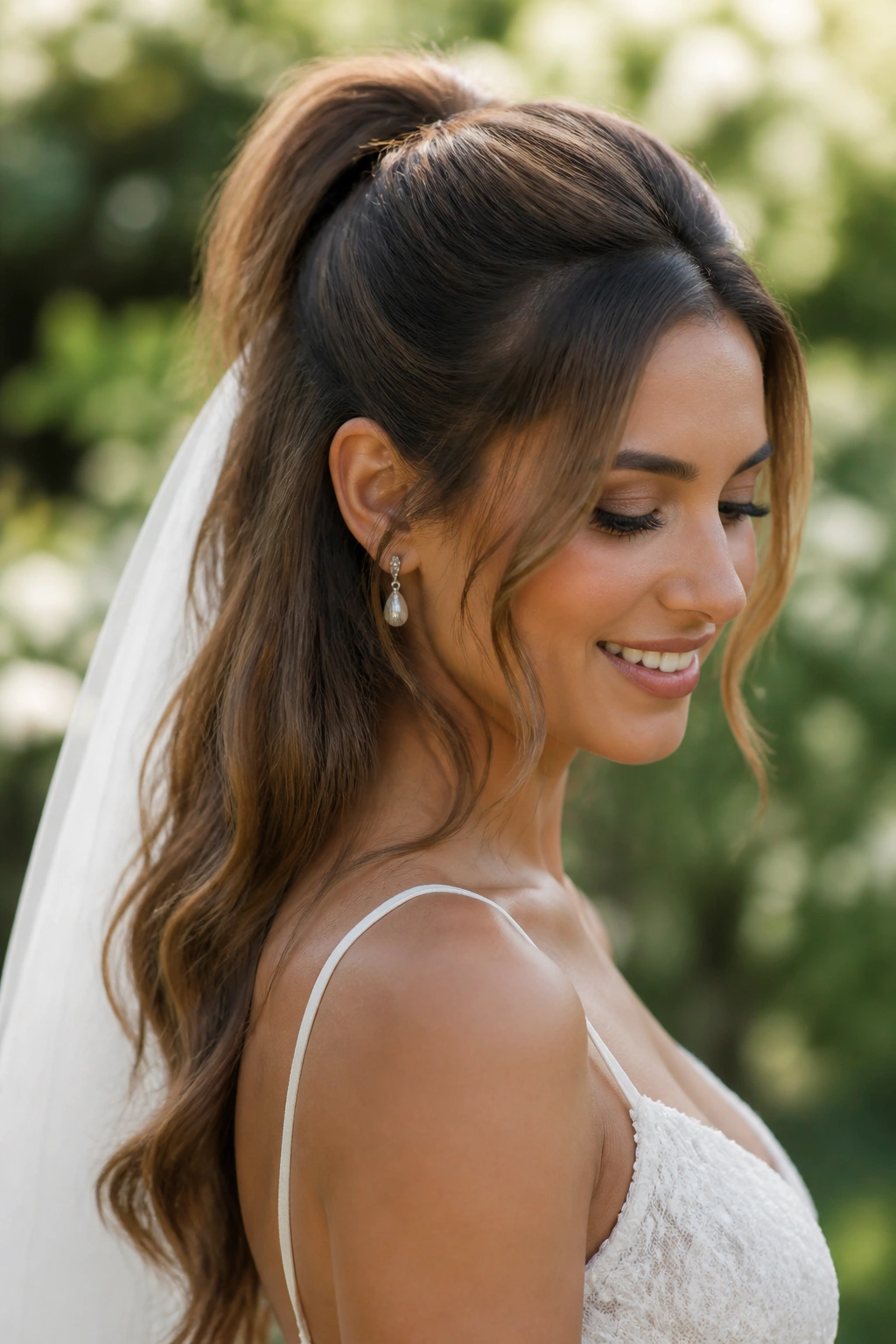
Half-up ponytails are for brides who want the security of hair pulled back without giving up the feeling of length. I like them because they split the difference without looking indecisive.
The top section is gathered into a ponytail, usually at the crown or slightly lower, and the rest of the hair falls freely underneath. That makes the style feel softer than a full ponytail and lighter than a fully pinned half-up look.
The best version has a clear shape at the top. If the crown is too flat, the style can look like you changed your mind halfway through styling. A bit of height, a smooth part, and curled ends underneath give it more purpose.
It also works nicely with veils that sit farther back on the head. The veil can live over the top section without taking over the whole style. For brides who want movement and a bit of face opening, this one is hard to beat.
13. The Rope-Braid Ponytail

A rope-braid ponytail looks fussy in theory and clean in real life. That is part of its appeal. Two twisted sections create the braid effect, and the result feels neat without becoming formal in the stiff sense.
How to Keep the Twist Even
The biggest mistake is twisting one side tighter than the other. Once that happens, the braid starts leaning and the whole shape loses balance. Work with smooth sections, twist them in the same direction, then wrap them around each other in the opposite direction.
The end should be secured with a clear elastic, then softened a little so the twist does not look hard-edged. If the hair is long, you can let the rope braid continue all the way down. If it’s medium-length, stop after a few inches and leave the rest loose.
This style works well with dresses that have clean seams or strong lines. It brings texture without clutter.
And it lasts. That’s the practical part brides appreciate after a long day of sitting, standing, hugging, and dancing.
14. The Extra-Long Ponytail With Extensions

Need more drama than your own hair can give you? Add length the smart way. A long bridal ponytail built with extensions can look lush, balanced, and a bit dramatic without feeling fake.
The real trick is blending. Clip-in or wrap-around extensions should be matched to the crown and hidden at the base so the ponytail looks like one piece, not a stack of parts. A second hidden anchor elastic helps if the length is heavy, because a single tie can slip under the weight.
I like this look for brides who want the tail to be seen in motion. Long hair swinging behind a dress has a kind of clean drama to it, especially when the rest of the styling stays simple.
A couple of things matter here:
- The extension color should match the mid-lengths, not just the ends
- The wrap at the base should be wide enough to hide every clip
- The tail should be curled or blown out so the added length blends
- Heavy jewelry can compete with the scale of the hair, so keep it in check
This is one of the few times where more length really does change the silhouette.
15. The Sculpted Ponytail for Curly and Coily Hair
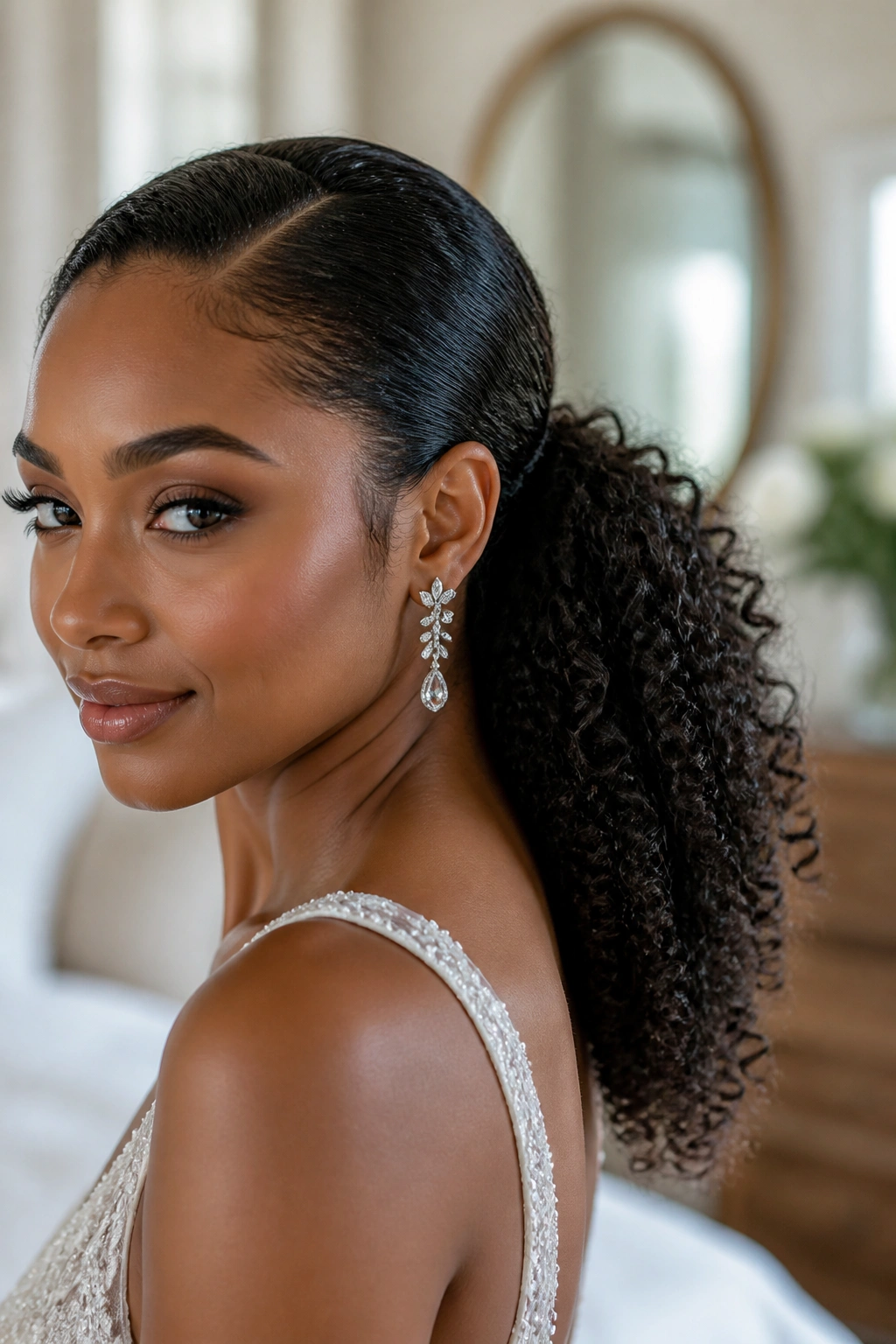
Curly and coily hair can make a bridal ponytail look richer than pin-straight lengths ever will. The shape has built-in personality, which means the style does not need to fake volume or texture.
The smartest version keeps the crown sleek enough to show control, then lets the curls bloom in the tail. That contrast is beautiful. It tells the eye where to look, and it keeps the hairstyle from becoming a mass of shape with no center.
I would not flatten the texture just to chase a glossy finish. That usually backfires. Let the curl pattern stay recognizable, and shape the ponytail so it feels intentional around the edges. A soft side part can help, but a center part can look stunning too if the dress is symmetrical.
If you want control without stiffness, use a light cream or gel at the root and a stronger hold only where needed. The hair should move, but not frizz out by the second toast.
16. The Twisted Low Ponytail With a Soft Knot

A twisted low ponytail often saves the day when a bride wants detail but not volume. Two side sections are twisted back, pinned or knotted near the nape, and then the tail drops from there.
The Small Detail That Changes It
That twist at the back is what keeps the style from looking plain. It gives the eye a place to land before the hair falls into the ponytail, which is why this style feels more finished than a simple tie.
It’s also one of the most forgiving bridal ponytails. If the hair is fine, the twist adds texture. If the hair is thick, it gives shape without forcing the whole style upward. Either way, the nape stays clean.
This is a good fit for brides who want their veil comb to sit neatly and disappear after the ceremony. It also works with dresses that have a lot of detail in the front and need a quieter hairstyle in back.
I like this one when a bride says she wants her hair to look “done” but not “styled within an inch of its life.” That’s the sweet spot.
17. The Sleek Mid Ponytail With Statement Earrings

A mid-height ponytail is the middle child of bridal hair, and that is exactly why I like it. It does a little bit of everything without stealing the whole show.
The placement sits between high and low, which keeps the neck open and leaves room for big earrings, a dramatic neckline, or a back detail that deserves a clean view. If the ponytail is too high, the face can feel crowded. If it’s too low, the style can start to feel sleepy. Mid-height solves both problems.
Keep the crown smooth, but not lacquered. A bit of movement near the roots keeps the whole thing from looking too rigid. The tail can be straight, waved, or curled under at the end, depending on the dress.
This is the hairstyle I’d hand to a bride who wants one less decision on a long wedding day. It holds up. It looks balanced. And it does not need to be rescued every hour.
18. The Brushed-Out Ponytail With Old-Hollywood Volume

When brushed-out waves move through a ponytail, the whole style feels softer. The ends should swing a little, not stick out in separate chunks. That is the difference between formal and stiff.
This look starts with larger curls or rollers, then gets brushed into smooth, wide waves after cooling. The ponytail itself can sit at the nape or slightly higher, but the shape should stay full at the crown and fluid through the tail. No crunchy texture. No hard spirals.
It suits brides who love a bit of glamour but want hair that still feels touchable. I especially like it with satin gowns, draped bodices, and anything with a classic silhouette. The volume gives the dress a worthy partner.
A small side part can sharpen the shape, but a center part makes it feel calmer. Either way, the brushed finish is what makes this one special. The hair should look like it wants to move.
19. The Veil-Friendly Low Bridal Ponytail

A veil-friendly ponytail is all about where the comb lands. If the placement is wrong, the whole style gets pinched, flattened, or tugged out of shape before the ceremony even starts.
The safest setup is a low ponytail anchored at the nape, with the veil comb tucked just above the base or just beneath it, depending on the weight of the veil and the shape of the dress. A stylist usually tests both placements before finishing the tail. That little rehearsal matters.
Good Veil Placement Rules
- Above the base if you want the ponytail to stay visible after the veil comes off
- Below the base if the veil is heavy and needs extra support
- Use enough pins to lock the comb in place, but not so many that the hair dents
- Keep the crown smooth so the veil doesn’t snag on raised texture
This style is not flashy, and I mean that as praise. It gives the veil room to do its job, then leaves behind a clean, flattering ponytail for the reception.
20. The Knotted Ponytail With Satin Ribbon
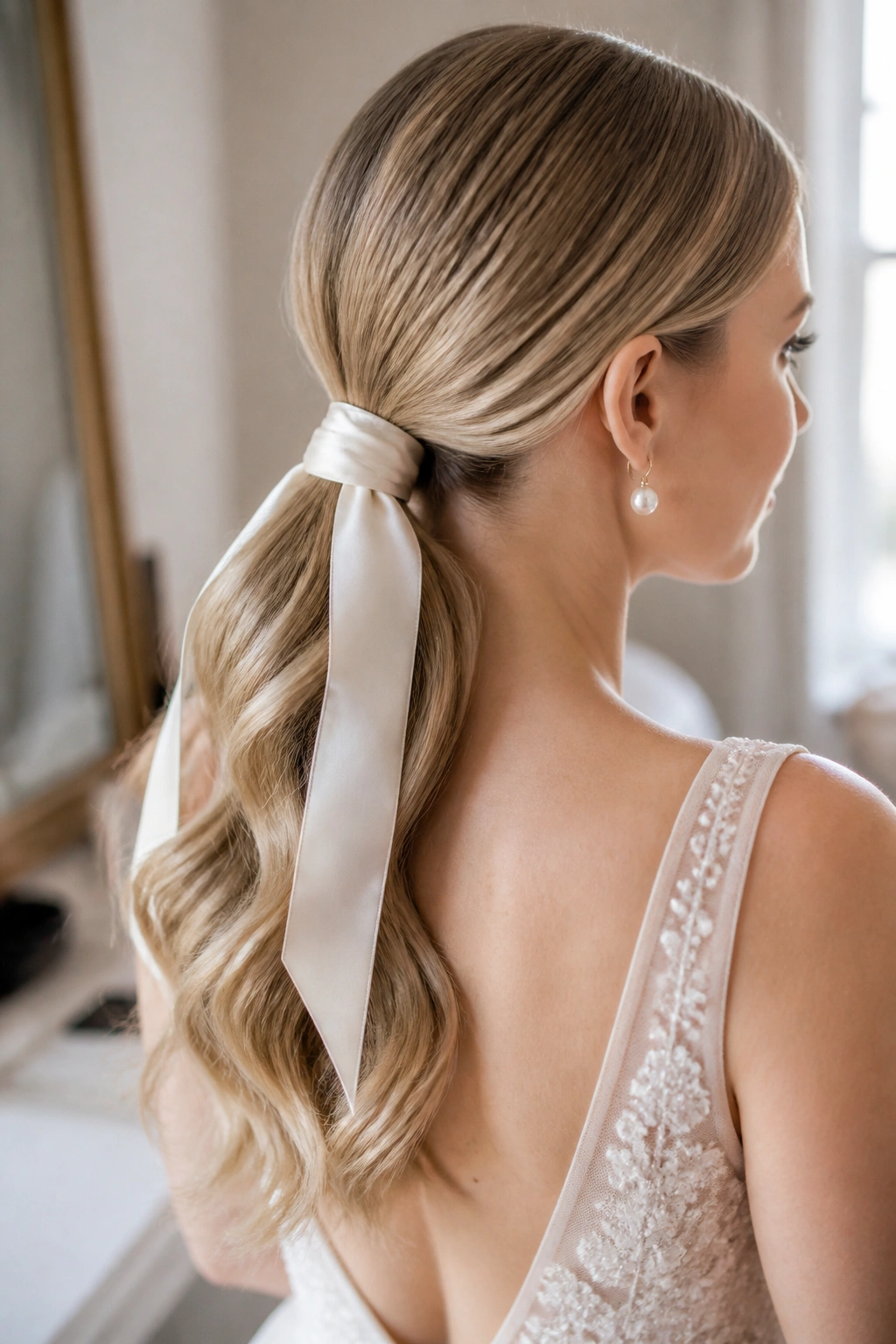
What happens when satin ribbon meets a ponytail? The whole thing softens. It feels a little more romantic, a little less severe, and much easier to coordinate with a formal dress.
The knot can sit at the base, or the ribbon can wind through a few sections of the tail. I prefer the first approach for most brides because it reads cleanly from a distance. The ribbon should be wide enough to show, usually around 1 to 2 inches, unless the dress already has a lot of texture and calls for something thinner.
Best Ribbon Choices
- Satin for smooth, classic gowns
- Grossgrain if you want a bit more texture
- Ivory or soft white for traditional looks
- A muted color if the bouquet or shoes carry the same tone
The rest of the ponytail can stay sleek or softly waved. The ribbon is the point here, so don’t crowd it with too many pins or extra flourishes.
21. The Puffed Ponytail With Natural Texture

Natural texture does not need to be tamed into something unrecognizable for a wedding. A puffed ponytail can be elegant, polished, and full of shape when it’s built with care.
The goal is a smooth base and a rounded, lifted ponytail that respects the hair’s natural body. A stylist might stretch the hair lightly, shape the crown, and let the puff sit high or low depending on the neckline. The result feels confident, not forced.
I like this style when the bride wants her own texture to stay visible. That matters more than people say it does. Hair that still looks like the bride’s hair tends to feel more comfortable on the day, and comfort shows up on camera.
A few details help a lot:
- Moisture and hold have to work together
- The base should be secured cleanly so the puff doesn’t sag
- Edges can be styled softly or neatly, depending on taste
- A simple earring or comb often works better than a crowded accessory set
This is one of the most dignified ponytail choices on the list, and I don’t use that word lightly.
22. The Minimalist Bridal Ponytail With Curtain Pieces
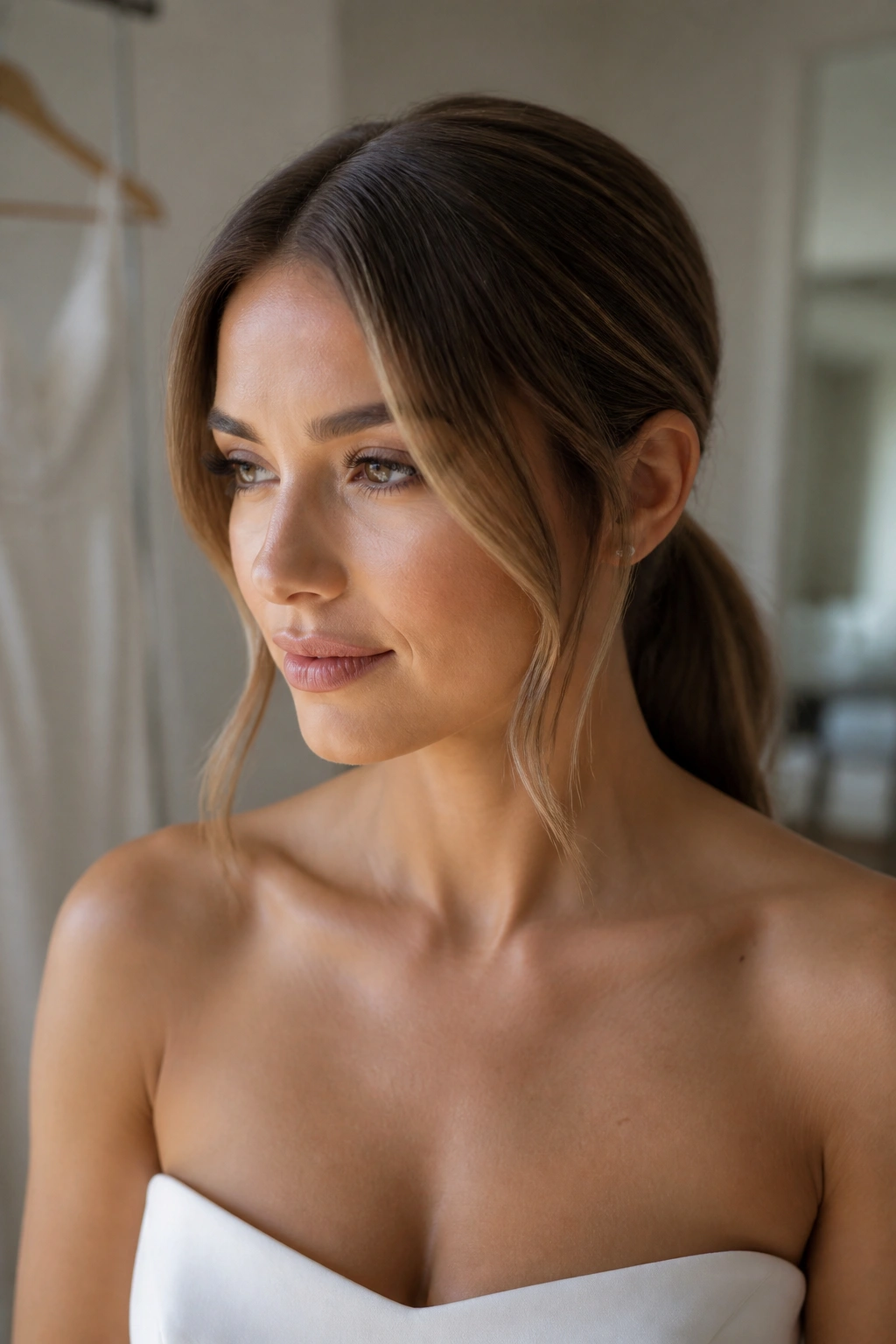
If the dress is the star, the minimalist low ponytail is the quietest smart choice. It lets the neckline stay clean, gives the face a frame, and keeps the overall look calm in a way that never feels boring.
The style usually sits low at the nape, with a center part or a soft middle part and two curtain pieces left to skim the cheeks. Those pieces are not there to hide the face. They’re there to soften it. Keep them long enough to move, and shape them with a bend rather than a curl that feels too styled.
I’d choose this for brides who want the dress, the veil, or the jewelry to do most of the talking. The ponytail should support the look, not compete with it. That restraint can be very pretty.
And if you’re standing in front of the mirror deciding whether to add one more pin, one more curl, or one more sparkly thing, that’s usually the moment to stop. A clean bridal ponytail is often strongest when it looks like the easiest thing in the room.
