



Cruise wedding hairstyles for brides have one job that ballroom hair never really has to think about: they need to look lovely when the wind picks up, when the air feels damp, and when you’ve been smiling for photos longer than your neck would like to admit. A style that survives a ceremony on deck, a walk to dinner, and a long night of dancing is doing real work. A pretty shape that collapses into frizz by cocktail hour is not.
That’s why shipboard bridal hair usually leans lower, cleaner, or better anchored than a standard wedding style. The best looks have a built-in grip point, a shape that won’t wobble, and enough texture to keep pins from sliding around. Even loose styles can work, but they need more thought than “curl it and hope.”
Most brides end up wanting one of two things. They want romance that holds together, or they want polish that doesn’t fight the dress, veil, or earrings. Both are possible. The trick is choosing a style that respects the setting instead of pretending the setting won’t matter.
Some of the best looks on a cruise are the ones that might seem a little too practical on land. Out at sea, practical can be gorgeous. And the first style earns its spot for exactly that reason.
1. Cruise Wedding Hairstyles for Brides: Textured Low Chignon with Face-Framing Pieces

If I had to pick one cruise-friendly bridal style that rarely looks out of place, it would be this one. A textured low chignon sits close to the neck, which keeps the whole shape steady when the breeze starts doing its thing.
Why It Stays Put
The magic is in the low center of gravity. Hair gathered near the nape has less to fight against than a high bun, and the texture gives pins something to grip. A little softness around the face keeps it from feeling too stern.
You also get a nice bonus: this style works with both a veil and a statement earring. If your dress has detail at the neckline, the chignon does the sensible thing and gets out of the way.
- Best for medium to long hair, especially if you want a clean back view.
- Works well with a fingertip-length veil or a comb placed just above the bun.
- Holds up better when the hair is lightly texturized first, not freshly conditioned and slippery.
- Looks balanced in photos from every angle, which matters more than people admit.
- Easy to refresh with 2 or 3 extra pins if the ship’s air gets humid.
My favorite detail: leave two thin pieces near the cheekbones, not bulky front sections. That little touch softens the look without giving the wind extra material to play with.
2. Glossy Mid Bun with a Deep Side Part

A mid bun can look more formal than a low bun when the dress is sharp and the makeup is clean. The height is still modest, but it brings the eye up a little, which is useful if your gown has a high neckline or detailed shoulders.
The deep side part is doing some quiet heavy lifting here. It adds shape before the bun even starts, so the whole look feels intentional instead of like hair was just swept back and pinned. On a cruise, that matters because a style with a clear line reads well in bright daylight and under evening lights.
This is one of those looks that needs neat prep, not endless product. I’d start with a smoothing cream on damp hair, blow it dry with a round brush, then go over the top layer with a flat iron if your hair frizzes easily. Too much spray makes it stiff, and stiff hair can show every pin. Soft hold, not shellac.
The bun itself should sit around the middle of the back of the head, not up at the crown. That placement gives you enough elegance for the ceremony and enough comfort for a long dinner. If your hair is silky, a small hair net under the bun is worth the extra minute. No one sees it. Everyone sees the result.
3. One-Sided Hollywood Waves Pinned Behind the Ear

Why does pinning one side matter so much on a moving ship? Because it changes the way the whole style behaves. One shoulder of hair stays controlled, which means the waves are less likely to whip across your face the second the breeze gets cheeky.
The other side can stay soft and glossy, which is where the romance lives. You get movement without chaos. That balance is the reason this style keeps showing up for brides who want glam hair but don’t want a full updo.
How to Wear It on a Cruise
Keep the wave pattern broad, not tiny. Wider bends survive wind better than tight curls, which can puff up fast if the air is damp.
Use one or two discreet pins just behind the ear, then hide them under a small section of hair or a jeweled clip. The goal is to stop the front from migrating, not to freeze the whole style.
- Best for one-shoulder or off-the-shoulder dresses.
- Works well with side-swept veils or no veil at all.
- Looks strongest on medium to long hair with a decent amount of shine.
- Needs a setting spray that still leaves touchable movement.
- Not the smartest choice if you know your ceremony will be outdoors in strong wind.
A style like this says “I want glamour,” but it does not shout. That is probably why it photographs so well in low deck light and at sunset without needing a lot of fuss.
4. Braided Crown into a Low Knot
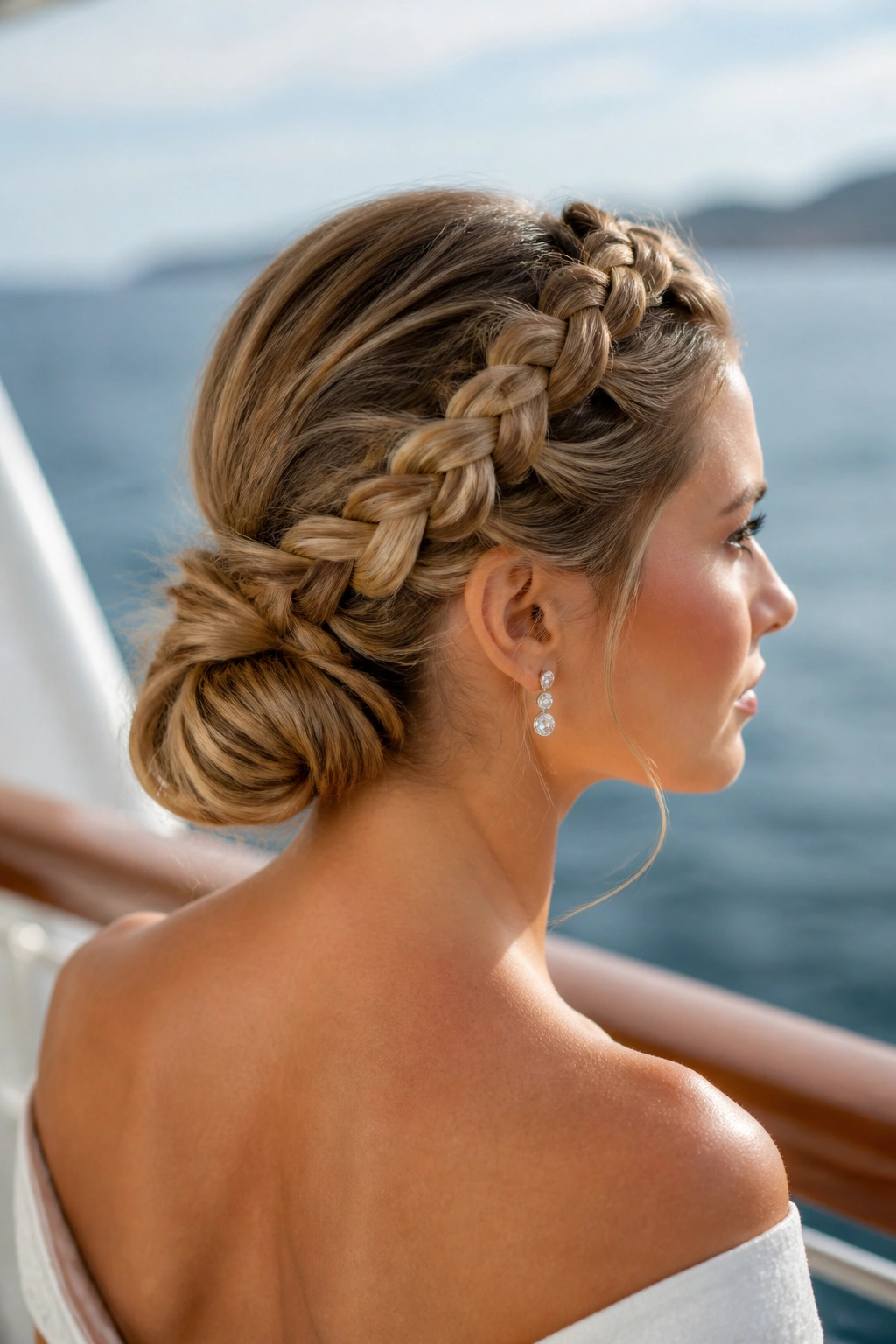
Picture a bride who wants her hair off her neck but still wants texture from the front all the way around. This is the answer that keeps showing up for that exact person.
The braid acts like a rail. Once it’s woven around the crown or along one side and tucked into a low knot, the whole style gains structure that plain twists don’t always have. It also gives you built-in frizz control, since the braided sections already look finished even if a few tiny hairs escape.
What to Ask Your Stylist
- Keep the braid medium-sized so it reads clearly in photos.
- Ask for the knot to sit low and slightly off-center if your dress has detail on one side.
- Leave the braid a touch soft, not tight and shiny like a school style.
- Add 4 to 6 hidden pins at the tuck point, since that’s where the weight sits.
- Consider a few tiny flowers or pearl pins if you want the braid to feel softer.
This style is especially good if your hair is thick or tends to swell in humidity. The braid gives it somewhere to go. A plain knot can get bulky fast. A braided crown gives the shape a reason to exist.
5. Sleek Low Ponytail with a Wrapped Base

A low ponytail is not the casual choice here. Done well, it looks sharp, modern, and expensive without trying too hard. Done badly, it looks like you ran out of time. There is no middle ground.
The difference lives in the finish. The crown should be smooth, the ponytail should hang cleanly, and the base should be wrapped with a strip of hair so the elastic disappears. That wrapped base matters more than people think. It’s the detail that turns a ponytail into bridal hair instead of workout hair.
This style works best when the hair is prepped in sections. Blow-dry with a brush, smooth the top with a light serum, and secure the ponytail low and centered or just behind one ear if your dress has an asymmetrical cut. If your hair slips a lot, use two elastics stacked together instead of one. It’s a small thing. It helps.
I also like this look for brides who want earrings to do some of the talking. A sleek ponytail gives the face open space, which makes bold drops or long bars stand out in a way loose hair can’t always manage. It’s clean. It’s calm. And it survives movement better than most styles people think of first.
6. Soft French Twist with Airy Crown

Unlike a stiff, formal updo, a soft French twist gives you height without putting all the weight at the top of the head. That makes it a smart choice when you want the profile to look elegant but not fussy.
The best versions have a little lift at the crown and a looser twist through the back. You should see shape, not a hard shell. On a cruise, that looseness helps the style feel lighter in warm air, which is one of those tiny comfort details brides only notice after they’ve been in hair and makeup for an hour.
This is a strong pick for a more classic gown. Satin, lace, and structured bodices all sit nicely with it. If the dress already carries drama, the twist gives balance instead of competing. If the dress is simple, the twist becomes the dressy part. That’s a good trade.
I’d ask for hidden pins rather than a giant decorative comb unless you really want a statement piece. Too much ornament can make the twist look top-heavy. The whole point is a controlled shape with a bit of air around it.
7. Half-Up Twist with Loose Curls

Half-up bridal hair often holds better than a full down style because the top section is pinned where the movement starts. That’s the part that usually fails first on a cruise. Lock it down, and the rest has a fighting chance.
The style also gives you two moods at once. You get the romance of loose curls through the ends, but the top stays tidy enough for a veil, comb, or floral pin. It works especially well if you want to show off length without letting all of it swing in the wind.
Where to Pin It
Place the twist or small braid at the back of the head, around the upper midpoint between crown and ears. Any higher, and it can feel too formal. Any lower, and you lose the lift that makes the style work.
Curl the lower section in large, soft pieces with a 1-inch iron or a larger wand. Smaller curls can puff too much if the air is damp. Bigger curls relax into something prettier. They also move better in photos.
I like this style for brides who want to keep some shoulder softness with a square neckline or a gown with thin straps. It’s less rigid than a full updo, but it still behaves. That’s the whole point.
8. Bubble Ponytail with Pearl Pins

If you want a little playfulness without giving up control, this is a fun one. A bubble ponytail keeps the hair segmented, which means the shape stays defined even when the day gets long.
The bubbles are made with small elastics spaced down the ponytail, then gently pulled apart to create soft rounded sections. Each section acts like a checkpoint. If one part shifts, the rest still holds. That’s a nice thing to have on a ship where you may be walking, dancing, or leaning into a breeze for photos.
Pearl pins or tiny crystal accents work well here because the style already has a rhythm. You do not need a giant hairpiece. A few small points of shine are enough.
- Best for longer hair or clip-in extensions.
- Strong with strapless gowns and clean necklines.
- Looks fresher if the bubbles are kept even, around 2 to 3 inches apart.
- Holds better when the ponytail is slightly textured first.
- Easy to restyle if a bubble loosens before the reception.
This is not the most traditional wedding look, and that’s the charm. It feels lighter and a little modern, which suits a bride who wants something different without crossing into edgy territory.
9. Side-Swept Bun with Vintage Waves

What happens when you want softness near the face and almost no movement in the back? You end up here. The side-swept bun gives you one shoulder line of wave, then tucks the rest away neatly.
The shape is especially nice with gowns that have an asymmetrical neckline or a dramatic earring moment. It also does a good job of framing the face in photos because the swept front section creates a diagonal line. Diagonals are flattering. They just are.
I like this style when the dress has old-Hollywood energy. The waves can be deep and polished, then rolled into a bun that sits low and slightly to one side. That little offset keeps the whole thing from feeling too rigid. If everything is perfectly centered, the look can start to feel stiff fast.
This is a style that rewards careful pinning. The wave at the front should feel deliberate, almost sculpted, while the back stays secure and calm. Use enough spray to hold the pattern, but not so much that the hair looks crunchy in close-up shots. Nobody wants that.
10. Sculpted Waves for Short Hair with Jewelled Clips
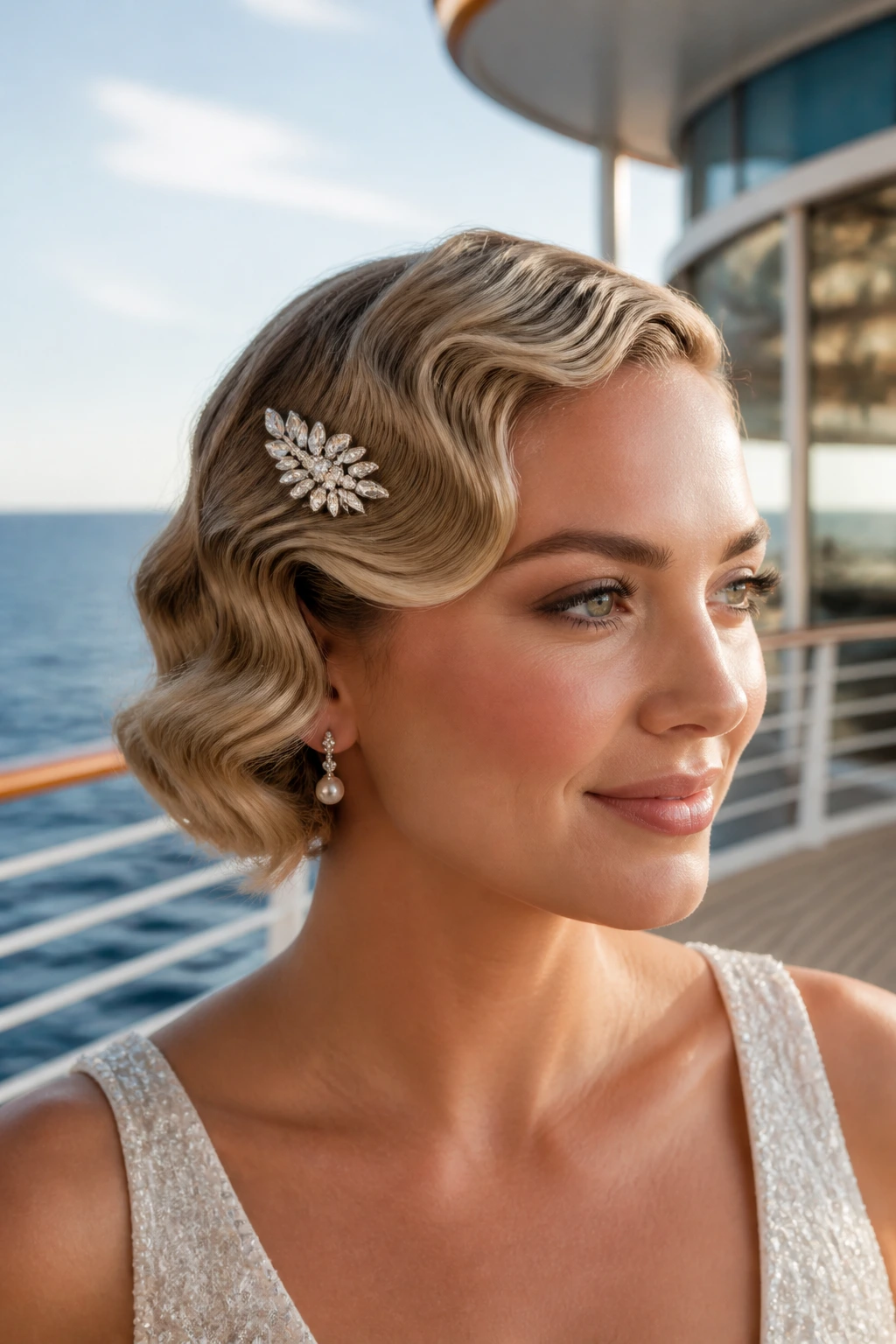
Short hair does not need fake volume to look bridal. It needs shape, shine, and one or two details that make the cut feel finished instead of everyday.
A bob or lob can look beautiful on a cruise because the length moves less in the wind. That gives you an advantage right away. The trick is to sculpt the wave pattern so it reads clearly, then choose clips that sit where the eye naturally lands — usually near the temple, above the ear, or just at the side part.
If the hair is chin-length, soft finger waves can look especially polished. If it’s a little longer, loose S-waves feel less severe and easier to wear. Either way, the key is to keep the edges neat around the hairline so the style doesn’t puff out when the humidity shifts.
Best Clip Placements
- One jeweled clip above the ear for a cleaner line.
- Two smaller pins stacked vertically if you want a quieter look.
- A side part with the clip placed on the heavier side for balance.
- A tucked-back section on one side if your veil is short and simple.
Short hair sometimes gets ignored in wedding hair discussions, which is a shame. It can be one of the smartest choices on a ship. Less length means less weather to manage.
11. Braided Low Bun with Tiny Flowers or Pins

A braided low bun feels calmer than a plain bun because the braid builds texture before the bun even starts. That extra texture is useful on a cruise, where sleek hair can slide and frizz at the same time, which is an annoying combination.
This style works best when the braid starts from one side or from a low center part and then folds into the bun. The braid doesn’t have to be huge. In fact, a smaller braid often looks more refined. It gives the bun a handcrafted look without turning the whole thing into a festival style.
Tiny flowers, pearl pins, or a narrow comb can sit right at the braid tuck or along the outer edge of the bun. Keep the decoration small. The braid is already doing the visual work. If you pile on too many extras, the style loses its clean shape.
I like this for brides who want something romantic but not too soft. It has a bit of structure. It has a bit of charm. And it handles a little wind better than styles that depend on loose curls near the shoulders.
12. Cruise Wedding Hairstyles for Brides: Polished Top Knot with Veil Anchor

A polished top knot works best when the ceremony and reception call for a quicker style shift. You get the clean, lifted look for vows, and you can keep it for dinner without needing a fresh start halfway through the day.
The important part is not making the knot too high. Too high and it starts feeling like a ballet bun. A little lower, sitting near the upper back of the head, keeps it bridal. The crown should be smooth, but not so tight that it pulls the face. Brides sometimes go too far there. Don’t.
If you want to wear a veil, this style needs a real anchor point. A comb pinned into the bun or just above it works better than something floating loosely over the top. The structure underneath matters more than the decorative piece itself. If the base is solid, the veil sits where it should. If the base is sloppy, the veil shows it.
A top knot is a strong choice for structured gowns, back detail, or a dress with a strong neckline. It opens the face, shows the shoulders, and keeps the neck cool. That last part sounds small until you’re standing in warm air with a full face of makeup on.
13. Twisted Halo with Soft Ends

The halo style has a neat trick: it looks soft from a distance and carefully built up close. That makes it a lovely match for a cruise wedding, where the wind can make soft styles look even prettier if they’re anchored well.
A twisted halo runs around the head like a crown, but it doesn’t have to be tight or overly perfect. The best versions leave a few wisps near the temples and tuck the ends low at the back instead of hiding every strand. That little softness keeps the style from feeling stiff.
This is one of the best looks for brides who want a boho feel without wearing their hair fully down. It gives you the lifted, secure shape of an updo while still leaving the edges relaxed. If you’re using fresh flowers, keep them clustered on one side rather than scattered everywhere. Too many tiny pieces can get lost in the texture.
What Makes It Work
- The twist should be loose enough to look modern, not costume-like.
- A bit of texture spray helps the braid or twist hold its shape.
- The ends need to be pinned flat so they don’t peek out in photos.
- Works nicely with soft, fluttery dresses and outdoor deck ceremonies.
- Good for brides who want to keep the face open without looking too sleek.
It’s one of those styles that quietly does a lot.
14. Curly Pinned-Up Style with Natural Volume

You do not have to flatten your curls to make them wedding-ready. That idea gets repeated far too often, and it leads to hair that looks unfamiliar on the very day you want to feel most like yourself.
A curly pinned-up style respects the curl pattern instead of fighting it. Sections are lifted and pinned where they already want to fall, which keeps the texture alive while still controlling the shape. On a cruise, that’s a gift, because curls tend to respond better to humidity when they’re allowed to stay themselves.
The best approach is usually to define the curls first, then pin the upper and side sections in a way that preserves volume around the crown and toward the back. You want soft height, not a flattened shell. A little volume gives the style room to breathe.
If your curls are tight, ask for enough pins to hold each section without crushing it. If your curls are looser, a bit of cream and a stronger hold spray can keep the shape from falling apart by the time dinner starts. Either way, the goal is control without erasing texture. That’s the real win.
15. Low Knot with Silk Ribbon and Minimal Pins
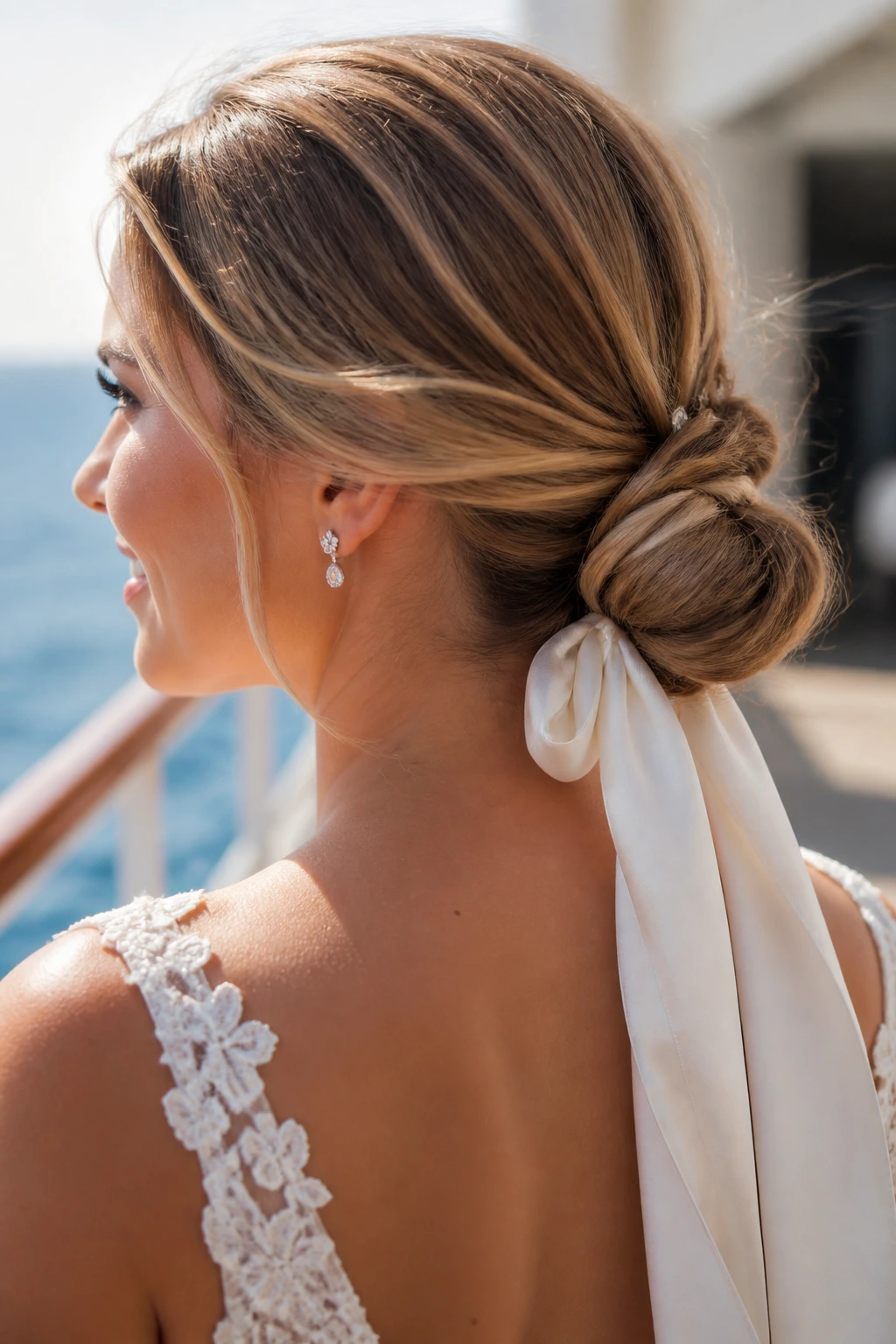
Sometimes the smartest answer is the quietest one. A low knot wrapped with a silk ribbon feels graceful, easy to wear, and far less likely to fight the weather than a style that’s trying to do too much.
The ribbon matters more than it sounds like it should. A 12- to 18-inch length of silk or satin, tied with the ends tucked or left to trail a little, adds softness without making the hair heavy. It also gives the back of the hairstyle a gentle finish, which looks lovely against a simple gown or a dress with a clean open back.
Keep the knot compact and the pinning minimal, but not careless. The trick is to secure the knot first, then wrap the ribbon so it hides the base and softens the silhouette. If the ribbon is too wide, the look can get bulky. If it is too thin, it disappears. Somewhere in the middle feels right.
I like this for brides who want their hair to feel calm from ceremony to last dance. No hard edges. No extra fuss. Just a low shape that sits well, moves a little, and still looks like it belonged there all day. That kind of ease is hard to fake, and on a cruise, it tends to be the thing that holds up best when everything else starts shifting around.
A cruise wedding gives you a reason to choose hair that behaves in real life, not only in a still photo. That usually means a lower placement, smarter pinning, and enough texture or structure to resist the wind without looking stiff.
If you’re torn between romance and control, lean toward the style that can be touched up with two or three extra pins and still look intentional afterward. That’s the kind of bridal hair that makes sense on the water.
