



Half up half down hairstyles for short hair work best when you stop pretending short hair wants to behave like waist-length hair. A bob, lob, or grown-out pixie needs smaller sections, lighter hold, and a little cheating with pins — nothing dramatic, just smart placement.
That is why so many half-up styles fall flat on shorter cuts: people gather too much hair, use an elastic that leaves a lump, then wonder why the back collapses by lunch. The better move is to work with the haircut’s shape, not against it.
I’ve always liked half-up styles on short lengths because they show off the neck and cheekbones while keeping the front controlled. They also save you from that awkward in-between stage where your hair is long enough to bother you but not long enough to tuck behind both ears cleanly.
Some of the best versions use barely a quarter of the hair. Others borrow from braids, clips, tiny buns, or a quick twist behind each ear. The good ones look clean from the front and hold up from the side, which is where short hair tells the truth.
1. Mini Half-Up Top Knot for Short Hair
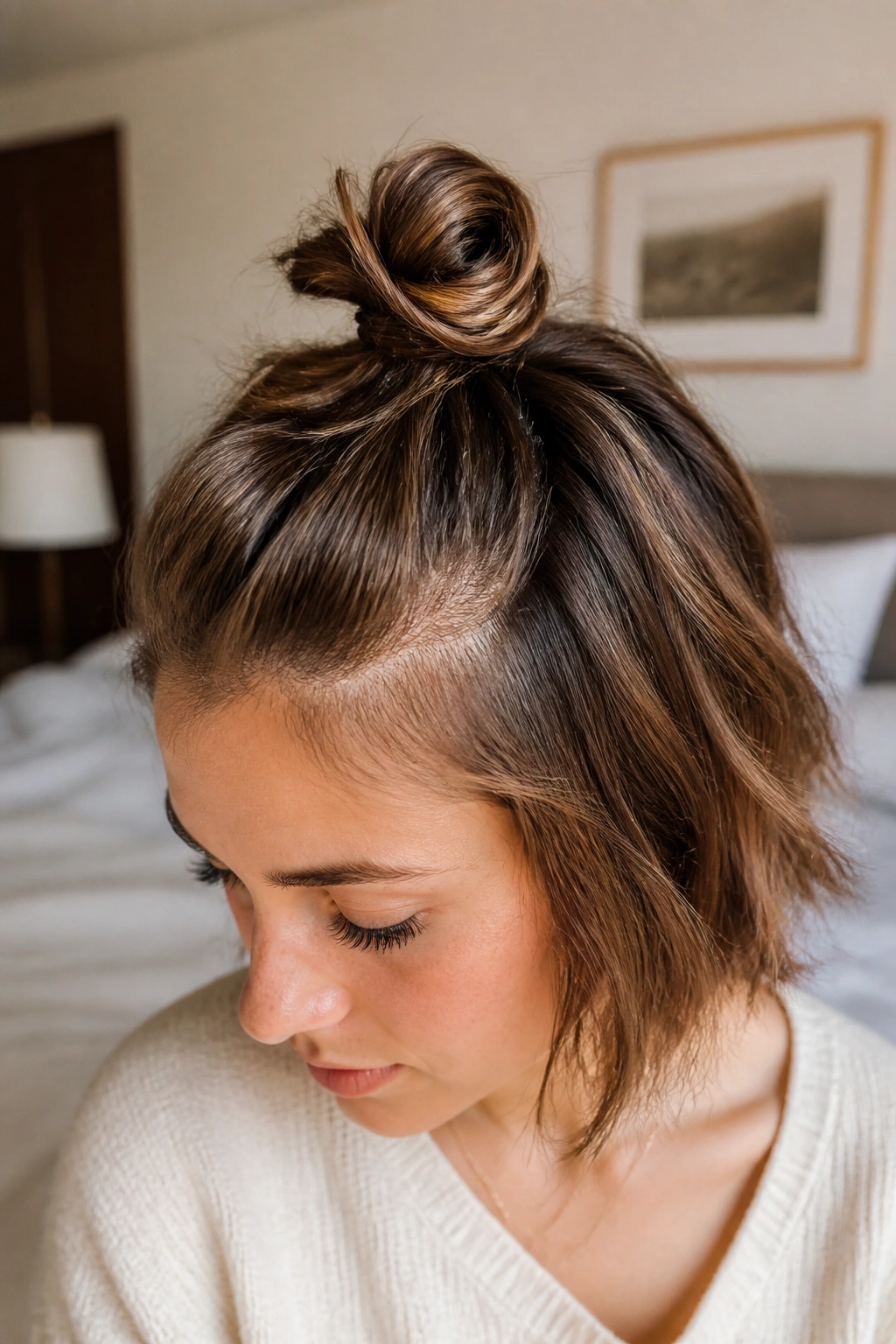
A mini top knot is the first style I’d reach for if your hair is chin-length to lob-length and you want something that feels tidy without looking stiff. The whole point is proportion. If the knot gets too big, it starts fighting the haircut, and that’s where the style turns lumpy.
Why it holds so well
Take a small section from temple to temple, then gather only the top third of that hair. Twist it once or twice, coil it into a tiny bun, and pin it from underneath with 2 to 4 bobby pins. A mini clear elastic helps if your layers slip fast. I like to mist the roots with dry shampoo or texturizing spray first; the grip matters more than volume.
- Use a 1-inch elastic if the hair is slippery.
- Keep the bun no wider than 2 to 3 inches on fine hair.
- Pull the crown up slightly before pinning so it doesn’t sit flat.
Best trick: leave the ends of the bun a little uneven. A too-perfect knot on short hair can look like you borrowed it from a different head.
2. Twisted Crown with Hidden Pins
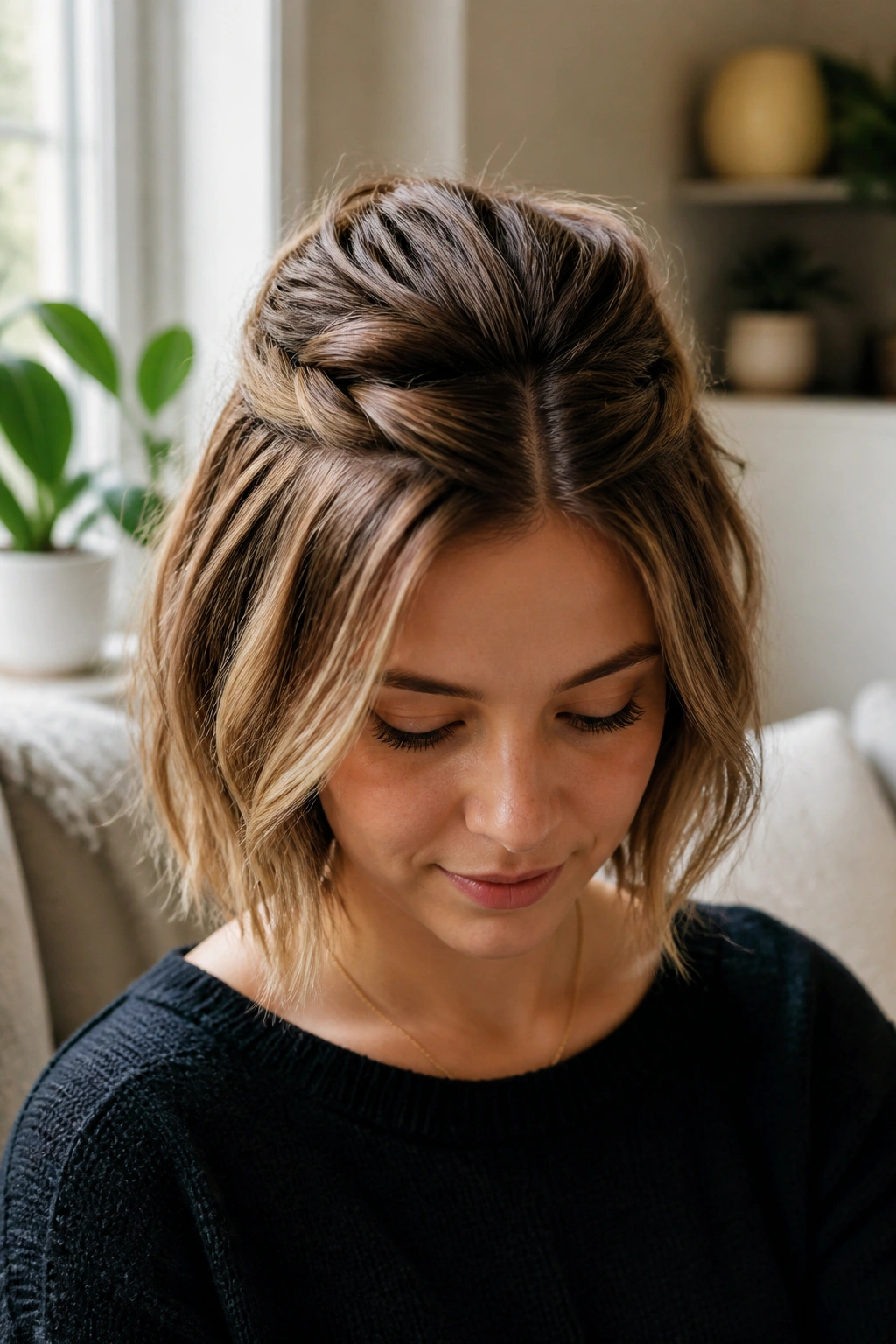
This is the easiest way to make short hair look finished without making it look “done.” A twisted crown uses the sides of the hair, not the whole head, so even a blunt bob can handle it.
Split the front into two side sections, twist each one back toward the center, and pin them just under the crown. Cross the bobby pins in an X if the hair is fine. That one move keeps everything from sliding out after an hour of moving around, talking, and touching your hair without meaning to.
What I like here is the softness. The twists frame the face, but they do not pull the style into formal territory. If your hair has a little bend from the day before, even better. The texture helps the twists hold, and the back can stay loose and natural.
A tiny bit of matte pomade on your fingertips tames the fuzz near the hairline. Don’t coat the whole section. That’s too much. You want grip, not shine-heavy grease.
3. Tiny Side Braids Pulled Back
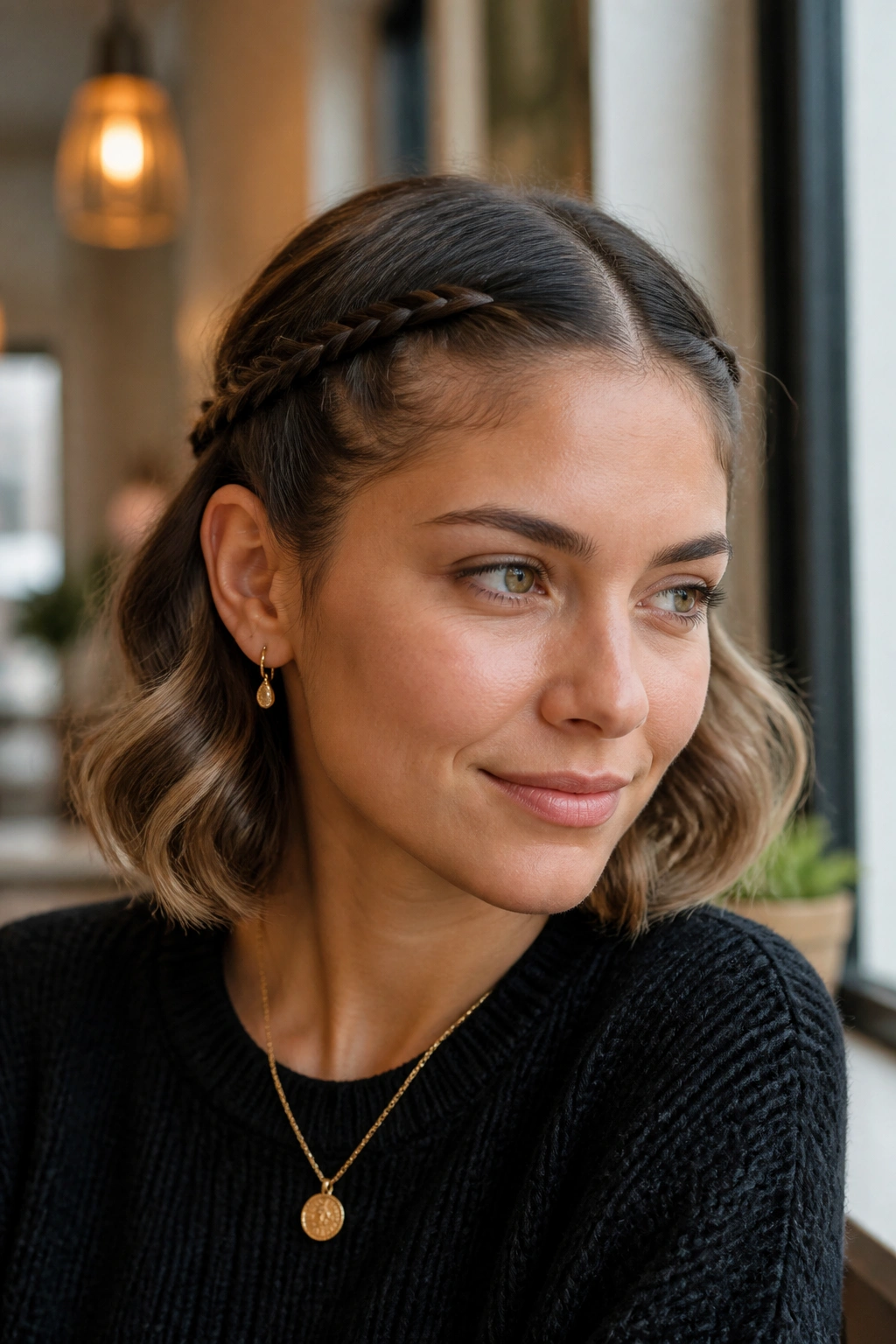
Why does a small braid work so well on short hair? Because it gives you a clear shape without asking for long lengths. A braid at the temple can do more for a lob than a giant updo ever could.
Start with a side part, take a 1 to 1.5-inch section from each temple, and braid each piece back just three or four stitches. Tie the ends with tiny clear elastics or pin them flat behind the ear. If your hair is too short for a full braid, do a simple three-strand braid only on the top inch, then pin the loose tail under the rest of the section.
How to use it
- Keep the braid close to the scalp so it doesn’t puff out.
- Use a light mist of spray before braiding for grip.
- Leave the rest of the hair soft or lightly waved.
- Add a small barrette where the braids meet if you want a cleaner finish.
This style is one of those quiet ones that looks more detailed than it is. Good news. It only takes a few minutes.
4. Half-Up Claw Clip Twist
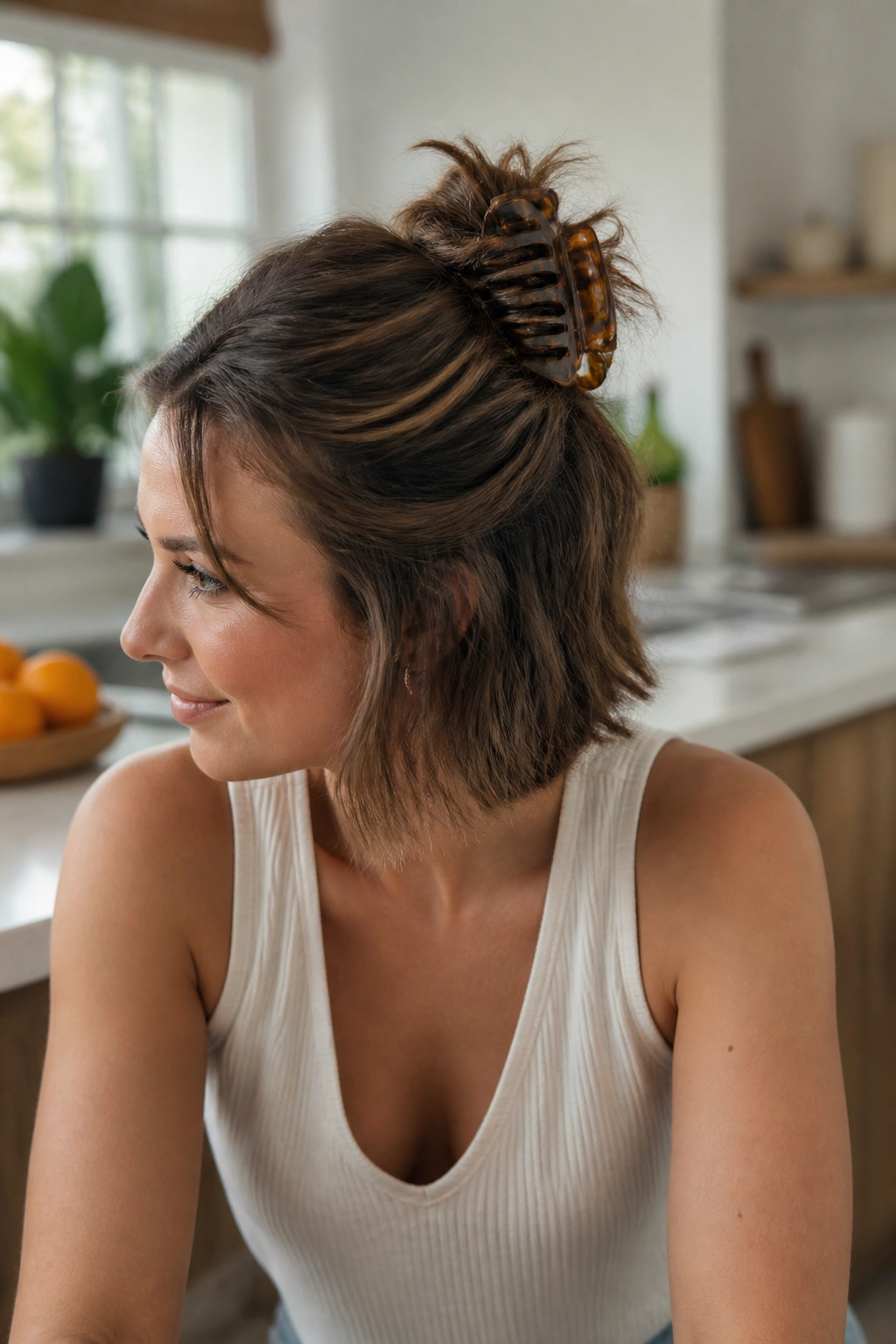
A small claw clip can save a morning. Seriously. If your short layers refuse to stay in a tie, a clip gives you shape without the little elastic dents that show up in every mirror.
Gather the top half of the hair, twist it upward once, then fold the twist back on itself and catch it with a 1.5- to 2.5-inch clip. The clip should sit vertically, not sideways, so it grips the folded part of the twist. If the ends poke out, let them. That’s part of the look, and fighting them usually makes the shape worse.
Quick details that matter:
- Best on hair with a little grit, like day-two hair.
- Works especially well on layered bobs.
- Use a clip with teeth that are close together.
- Avoid huge clips; they overpower short hair fast.
This style reads as casual, but not sloppy. It’s the sort of thing that looks like you meant to leave the house with a neat twist and still have your hair do its own thing.
5. Bubble Half Ponytail
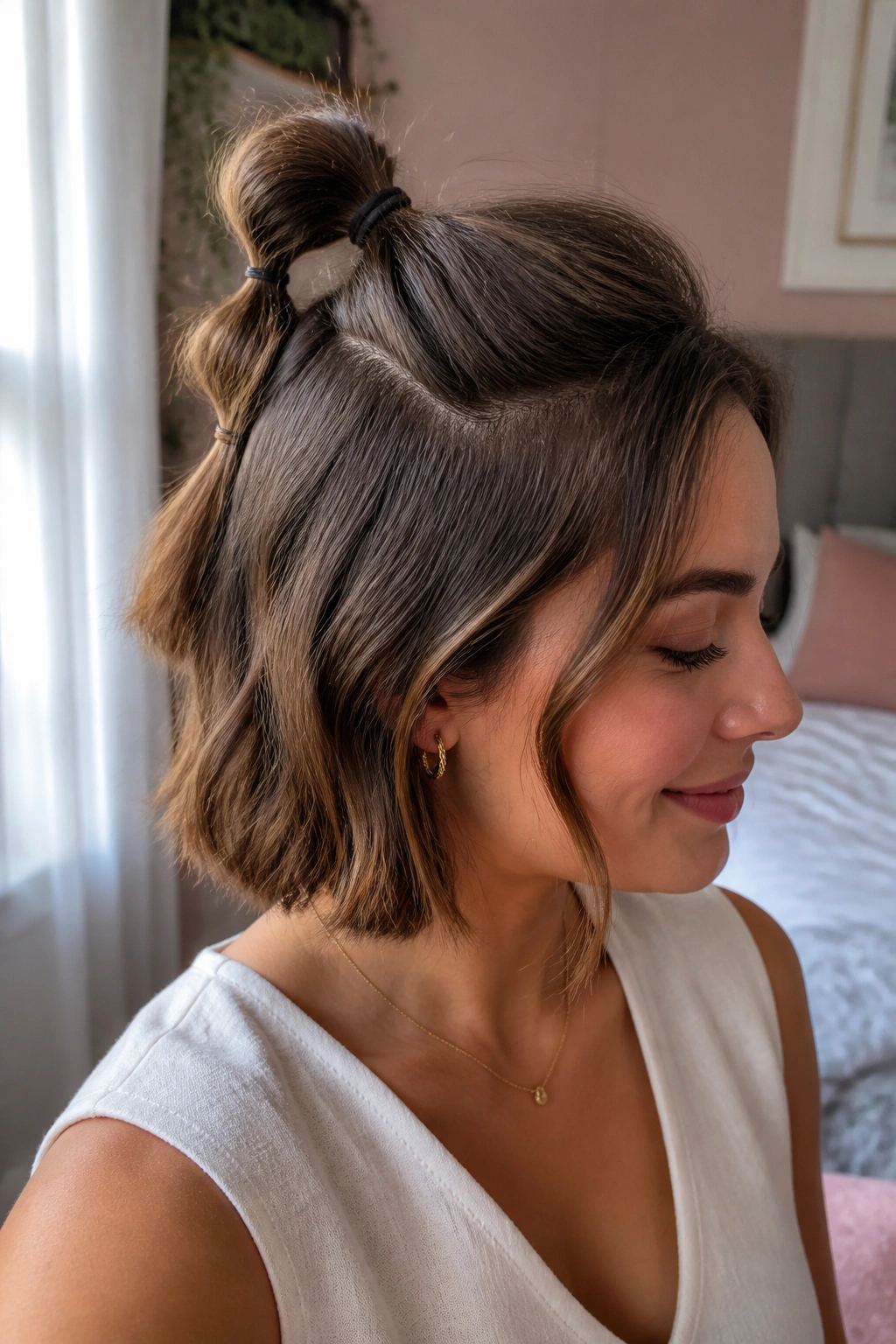
Bubble ponytails look playful, but on short hair they’re also practical. The bubbles help fill out the top section, which is useful when the ends are too short to hang in a long, smooth tail.
Pull the top half into a small ponytail and secure it with a clear elastic. Then add another elastic 1.5 to 2 inches down the tail, gently tug the hair between the elastics to puff out each section. On short hair, you may only get two bubbles. That’s fine. You do not need five. You need the right shape for the length you have.
A bubble half pony works especially well on fine hair because it creates the illusion of more volume without teasing the crown into a nest. Keep the bubbles loose and round, not stretched so hard that the tail looks tense. If your hair is thick, use tiny elastics that match your color so the sections stay clean.
I like this one for blunt cuts. The contrast between the polished crown and the textured tail feels fresh in a way a plain half pony often doesn’t.
6. Mini Space Buns with Loose Ends
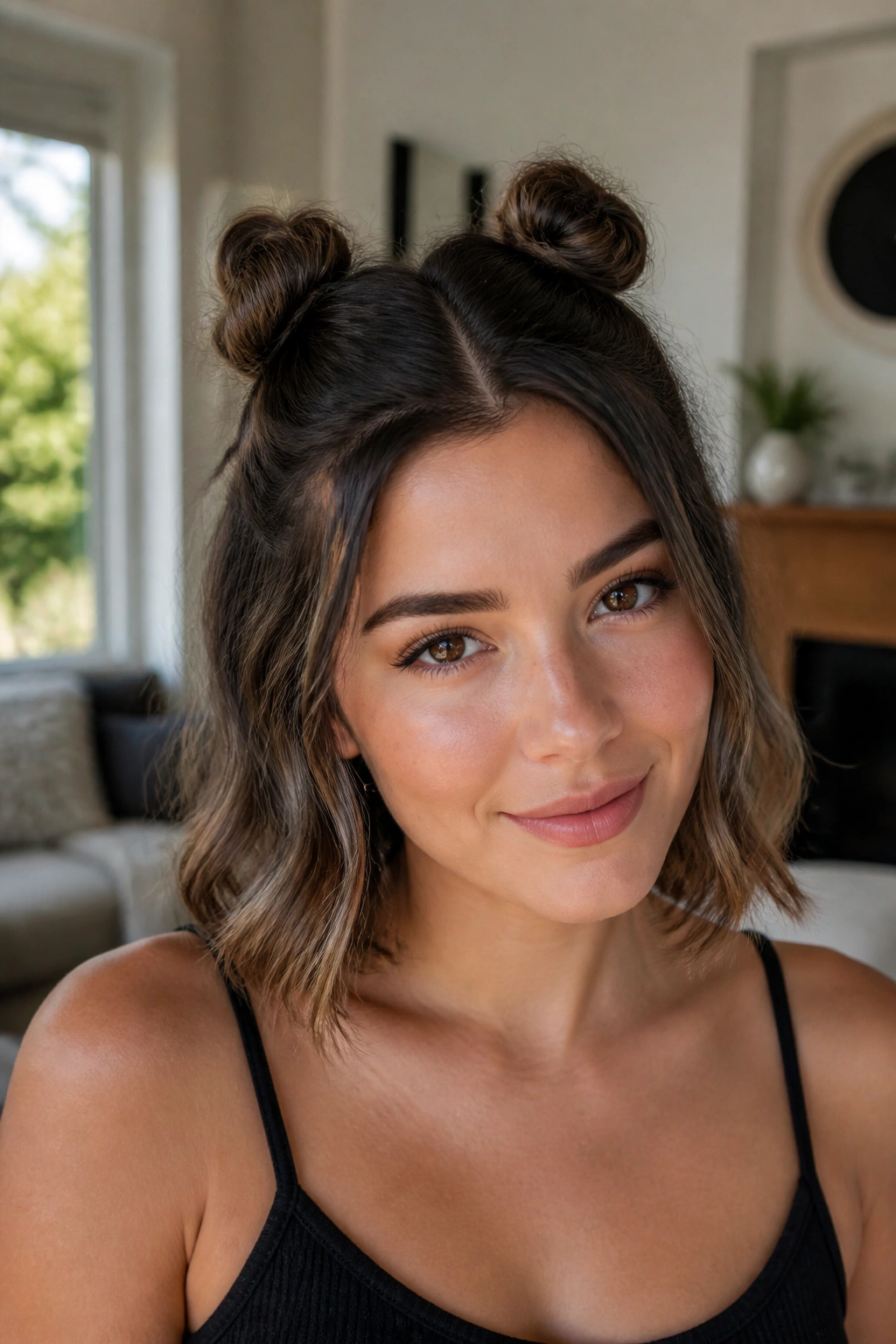
Mini space buns are the bolder answer to half up half down hairstyles for short hair. They are also more forgiving than people think. The buns can be tiny, uneven, and a little messy, which is half the charm.
Take two top sections, one on each side of the part, and secure them with clear elastics. Twist each section into a small bun near the crown or slightly higher toward the temples. Pin the ends under the buns with two bobby pins each, or let the shorter pieces stick out a little for texture. The rest of the hair should stay down and soft.
Unlike full space buns, this version does not need much length. In fact, too much hair makes the buns sit too low and too heavy. Short hair keeps the shape playful. If your ends are straight, add a quick bend with a 1-inch curling iron before you start; the bottom half looks better with some movement.
This style is a good pick when you want something fun but not costume-like. That line is easy to cross. Keep the buns small, and you’ll stay on the right side of it.
7. Sleek Half-Up Ponytail with a Glass Finish
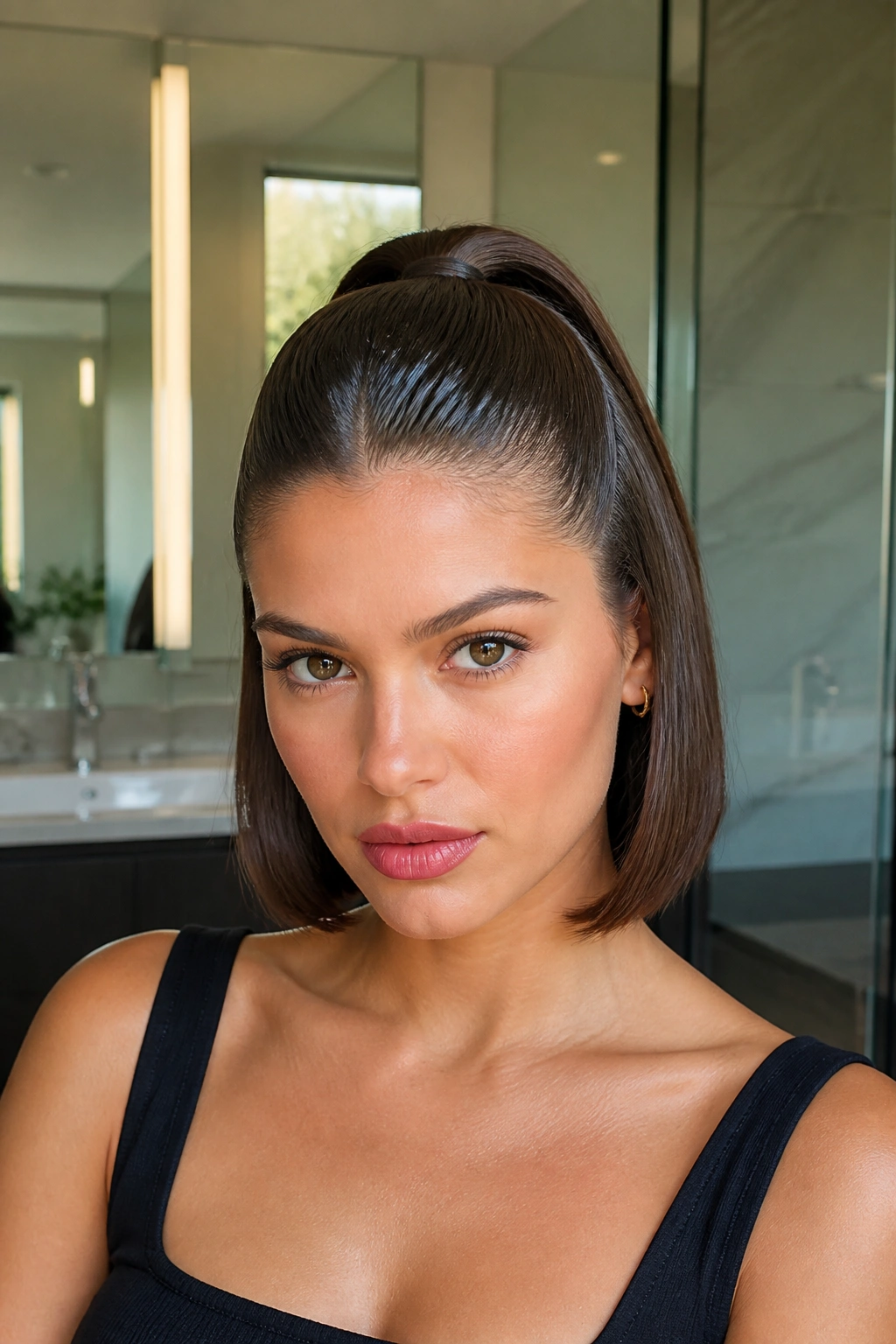
If your hair is blunt, straight, or just refuses to hold curl, a sleek half-up ponytail is probably the sharpest move. There’s nowhere to hide with this one, which is exactly why it looks so clean when it’s done well.
Brush the top section straight back from the temples and secure it at the crown with a small elastic. Before you gather it, smooth a pea-sized amount of lightweight cream or serum over the top layer only. Use a boar bristle brush or a fine-tooth comb to keep the surface flat. Then wrap a thin strand of hair around the elastic and pin it underneath.
The main thing here is restraint. Too much product makes the top greasy. Too little leaves frizz at the hairline. You want a surface that looks controlled, not wet. The ends below can stay straight, curled under, or lightly flipped out, depending on the cut.
This is one of those styles that looks best on hair with a blunt edge or a smooth bob line. It has a sharpness to it that feels deliberate. And yes, it can be a little unforgiving if your cut is uneven — but that is also what gives it personality.
8. Soft Waves and Face-Framing Pieces
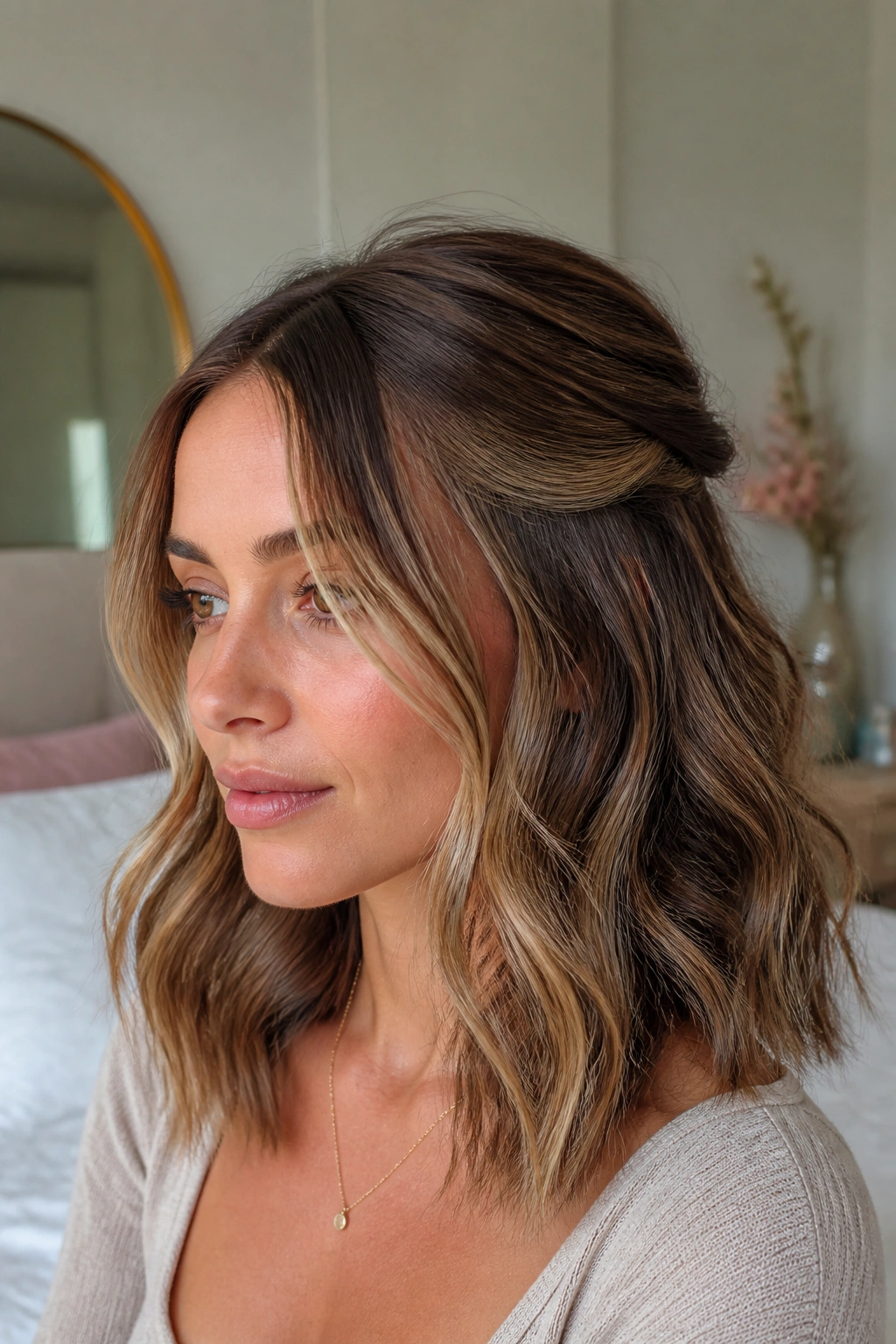
Can short hair still look soft and romantic? Absolutely. It just needs the wave placed in the right spots, not all over the head like you’re trying to fight the cut.
Use a 1-inch curling iron or a flat iron bend to add loose waves through the mid-lengths and ends. Leave the very front pieces a little straighter if you want the face to stay open. Then take a small section from each side of the head, pull it back loosely, and pin it at the back of the crown with two hidden bobby pins or a small neutral clip.
How to keep it from collapsing
The wave should be loose enough to move, but not so soft that it disappears in fifteen minutes. A touch of texturizing spray at the roots helps. So does pinning the section while the hair is still warm from styling. If you want a more relaxed finish, let a few strands fall forward around the cheeks.
This look is one of the easiest half up half down hairstyles for short hair when you want something pretty without going formal. It works on bobs, lobs, and even shaggy crops if the layers are behaving.
9. Braided Halo with Loose Ends
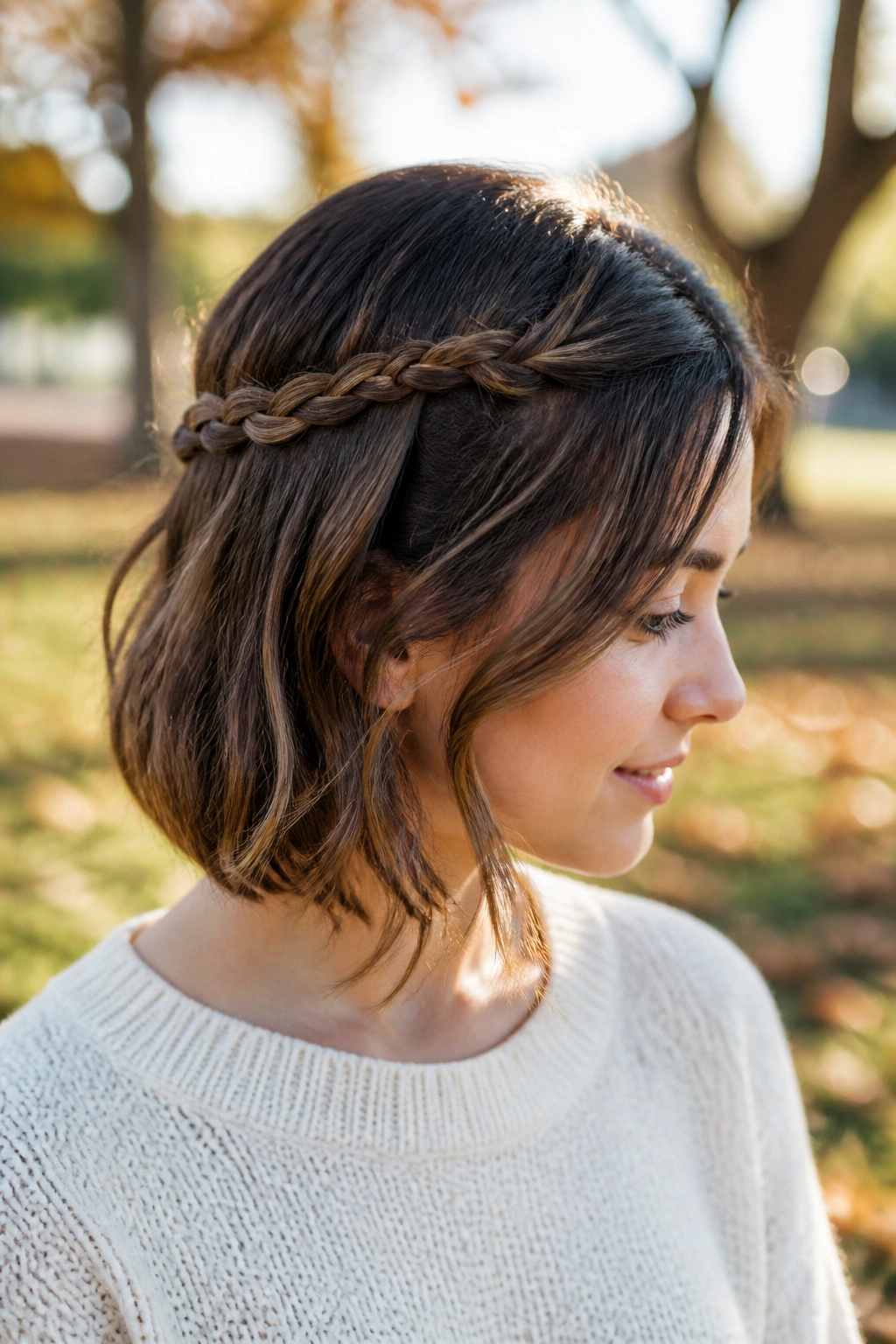
A full halo braid is too much for a lot of short cuts. A partial halo, though, can be gorgeous. It gives you the braid detail at the top and keeps the rest free.
Start a braid at one temple and work it along the hairline toward the opposite side, but stop when you reach the back of the head. Pin the braid flat so it follows the curve of the crown. If your hair is layered, keep the braid tight and shallow; that stops the shorter pieces from breaking out. Leave the back loose and either straight or softly waved.
This style has a little old-world feel without becoming fussy. It’s especially good if you have a side part, because the braid can tuck into the natural direction of your cut. A small amount of hairspray on the fingertips helps smooth the top while you braid, and a couple of flat pins under the braid keep the shape from rolling.
Short hair doesn’t need a giant braid to look styled. A small arc across the crown is often enough.
10. Ribbon-Tied Half-Up Style
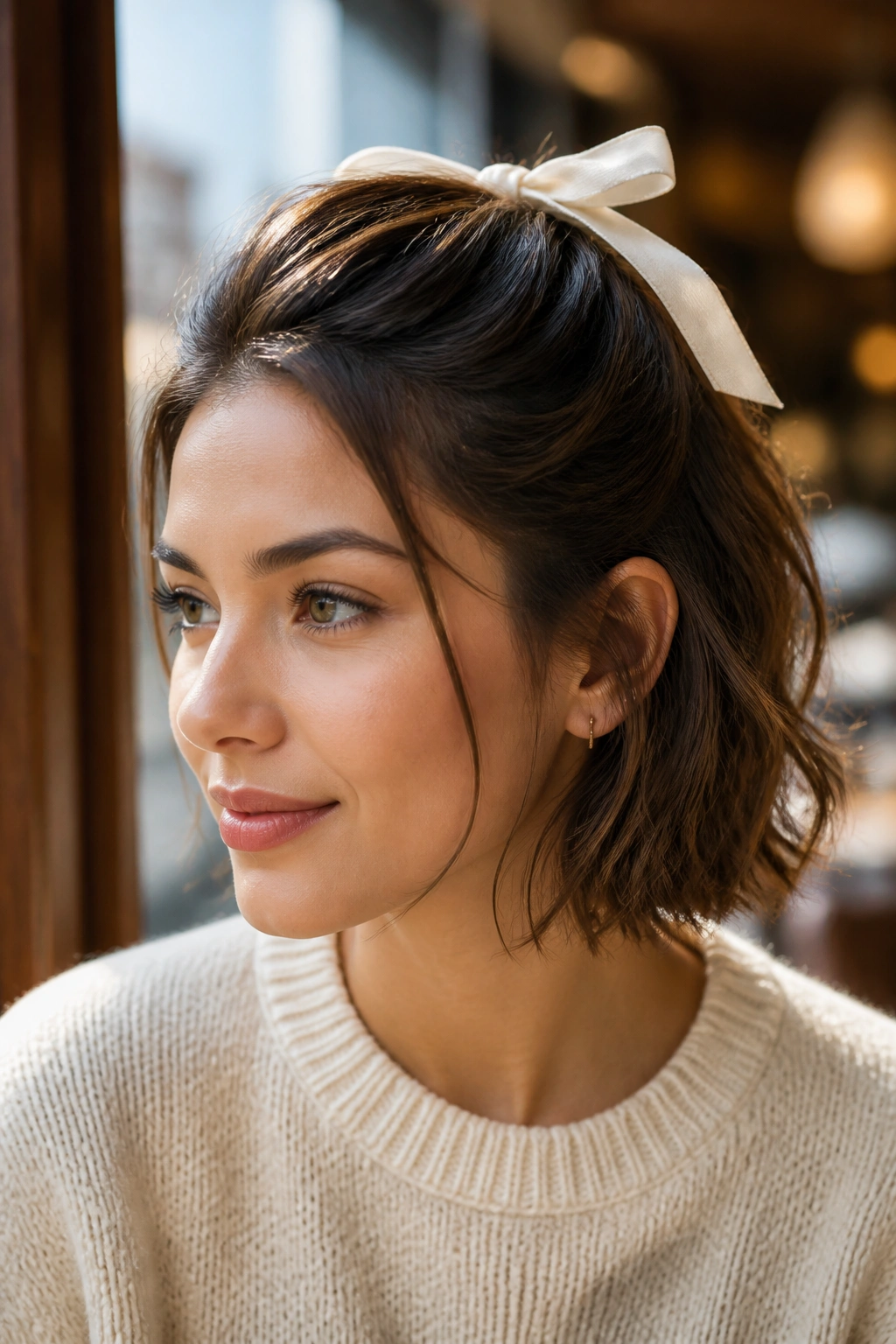
Sometimes the best fix is not another tool. It’s a ribbon.
Gather the top half into a small ponytail or twist and tie it with a 1/2-inch to 1-inch ribbon, depending on how much hair you have. Satin looks softer, grosgrain holds its shape better, and velvet gives the style a little weight for colder weather or thicker hair. If your hair is fine, keep the bow small. A giant bow on a tiny section can swallow the whole style.
What makes this work on short hair is that the ribbon becomes part of the shape. You are not asking the hair to do all the work. That matters when the back is too short for a full tail. I like this best with a lightly wavy bob or a straight cut that needs a bit of color near the crown.
A ribbon also saves you from over-styling. No teasing. No complicated pinning. Just a neat tie and a little adjustment so the bow sits a touch off-center, which tends to look more natural than dead center on short lengths.
11. Crisscross Bobby Pin Section
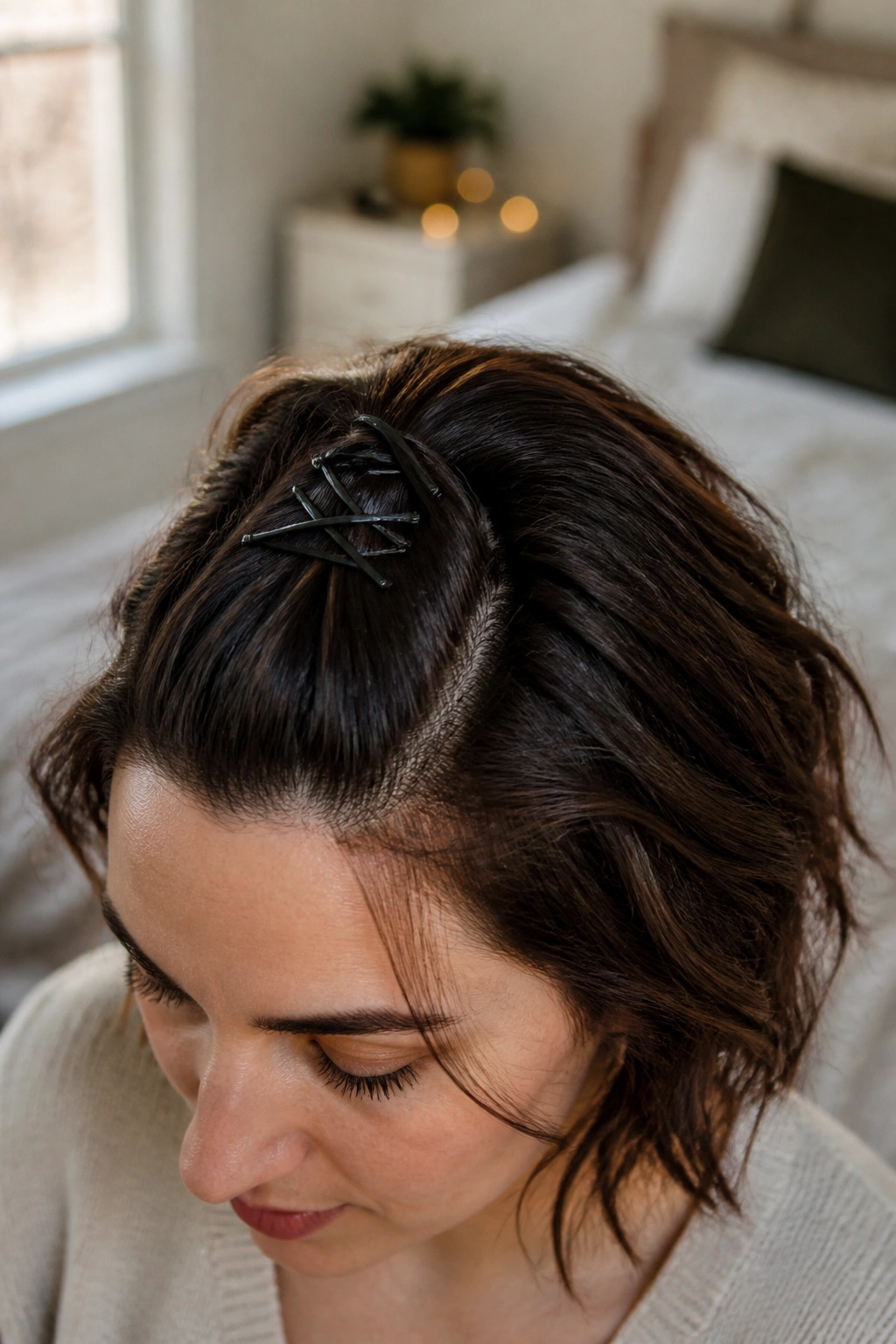
A row of bobby pins can be the hairstyle. That sounds too simple until you try it on a short cut that refuses to hold a real braid.
Take a small top section from one side of the head, pull it back toward the crown, and secure it with 4 to 6 bobby pins in a crisscross or ladder pattern. Use matte pins if you want them to disappear, or use gold or silver if you want the pins to show. The section can be twisted first, or left smooth. Either way, the pins create the visual line.
What makes it different
- It works on hair that is too short for a ponytail.
- It adds detail without adding bulk.
- It holds better on second-day hair than on freshly washed hair.
- It looks neat on blunt bobs and more undone on shag cuts.
I like this style because it solves a real short-hair problem: some pieces are long enough to pin back, but not long enough to tie. The crisscross pattern makes that awkward middle zone look intentional.
12. Half-Up Fishtail Accent
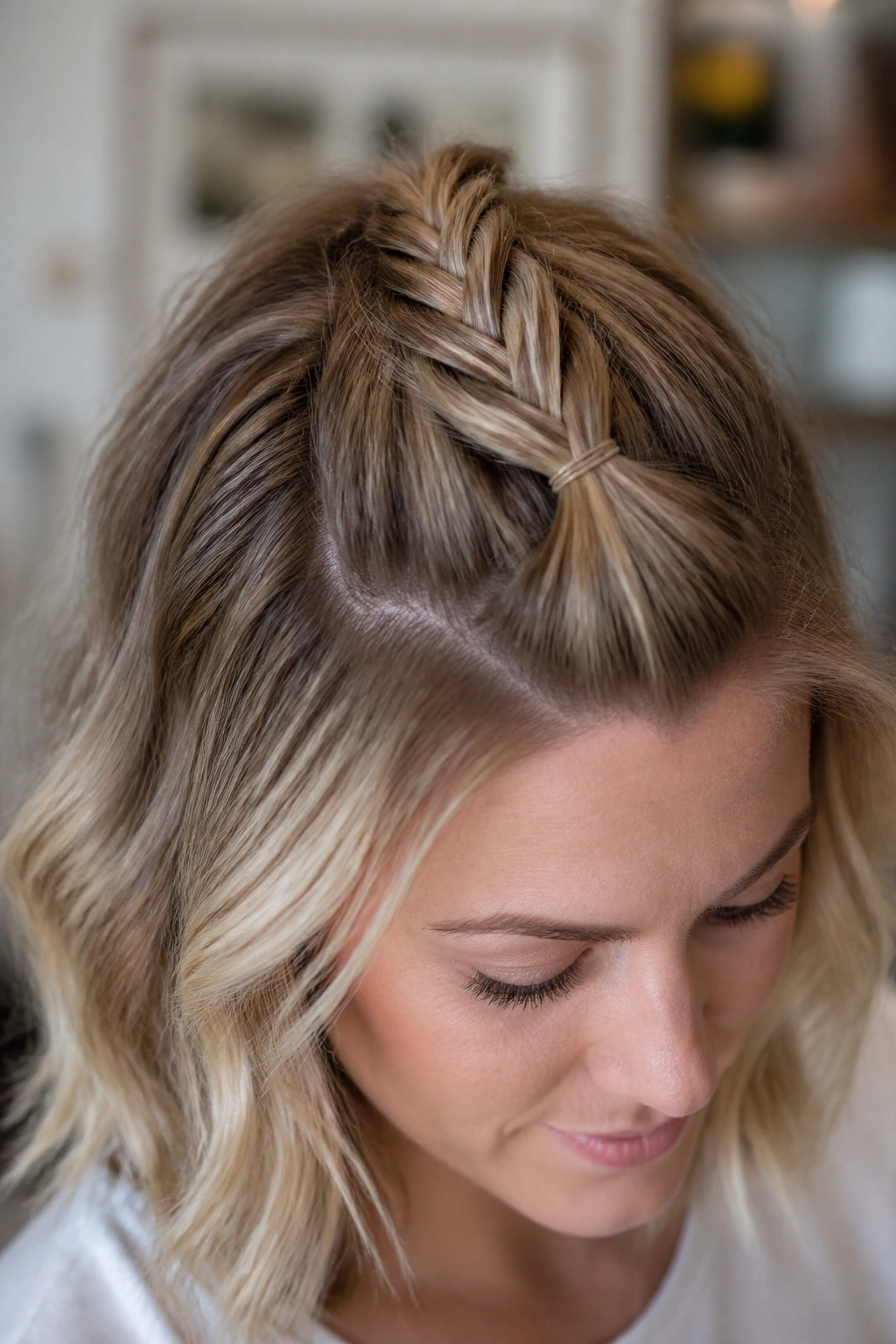
A fishtail braid looks more intricate than a plain braid, but the move is the same: compact sections and a firm grip. On short hair, that matters a lot.
Take a small top section, split it into two pieces, and cross a tiny outer strand from one side to the other until you have a short fishtail that reaches the back of the head. Stop early. You do not need to keep braiding until the end of time. A fishtail that ends just past the crown is often the right length for a bob or shoulder-grazing cut.
This style has a dressier feel than a regular braid, mostly because the weave is tighter and more detailed. It works best if your hair has a little texture already. If the strands are silky, mist them lightly before braiding so they don’t slide apart. A tiny elastic at the end keeps the braid from unraveling, and you can hide that band with a wrap of hair if you want the finish to look cleaner.
Unlike a chunky braid, this one stays slim. That makes it a good choice when your haircut is already carrying a lot of shape.
13. Statement Barrette Half-Up
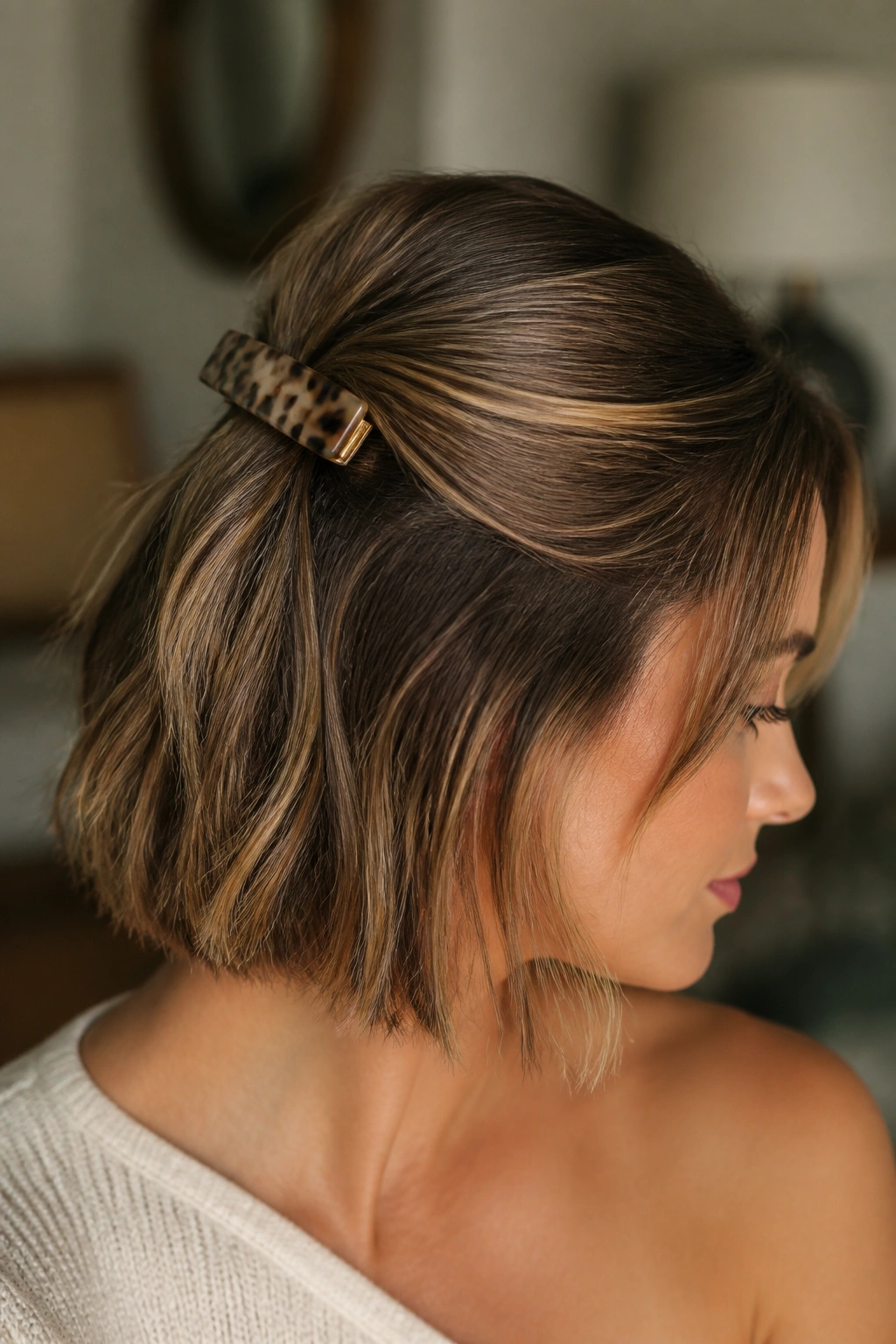
If you have one good barrette, you already have a style. That’s the whole point here.
Pull back one side of the top section, or both sides if your hair is longer, and clip it with a 2- to 3-inch barrette that can hold the hair flat without sliding. A barrette with a flat back tends to sit better on short hair than a heavy curved clip. If your hair is fine, give the crown a tiny lift first so the clip has something to grip.
Best details to watch for
- Use a side part for a softer shape.
- Curl the loose ends slightly if you want the clip to stand out more.
- Keep the pinned section small so the barrette does not strain.
- Choose a clip with teeth if your hair is slippery.
This is the style I’d call the least fussy and the most useful. It can rescue a grow-out stage, cover a weird front layer, and still look polished enough for dinner. Not bad for one piece of hardware.
14. Half-Up Dutch Braid Mohawk
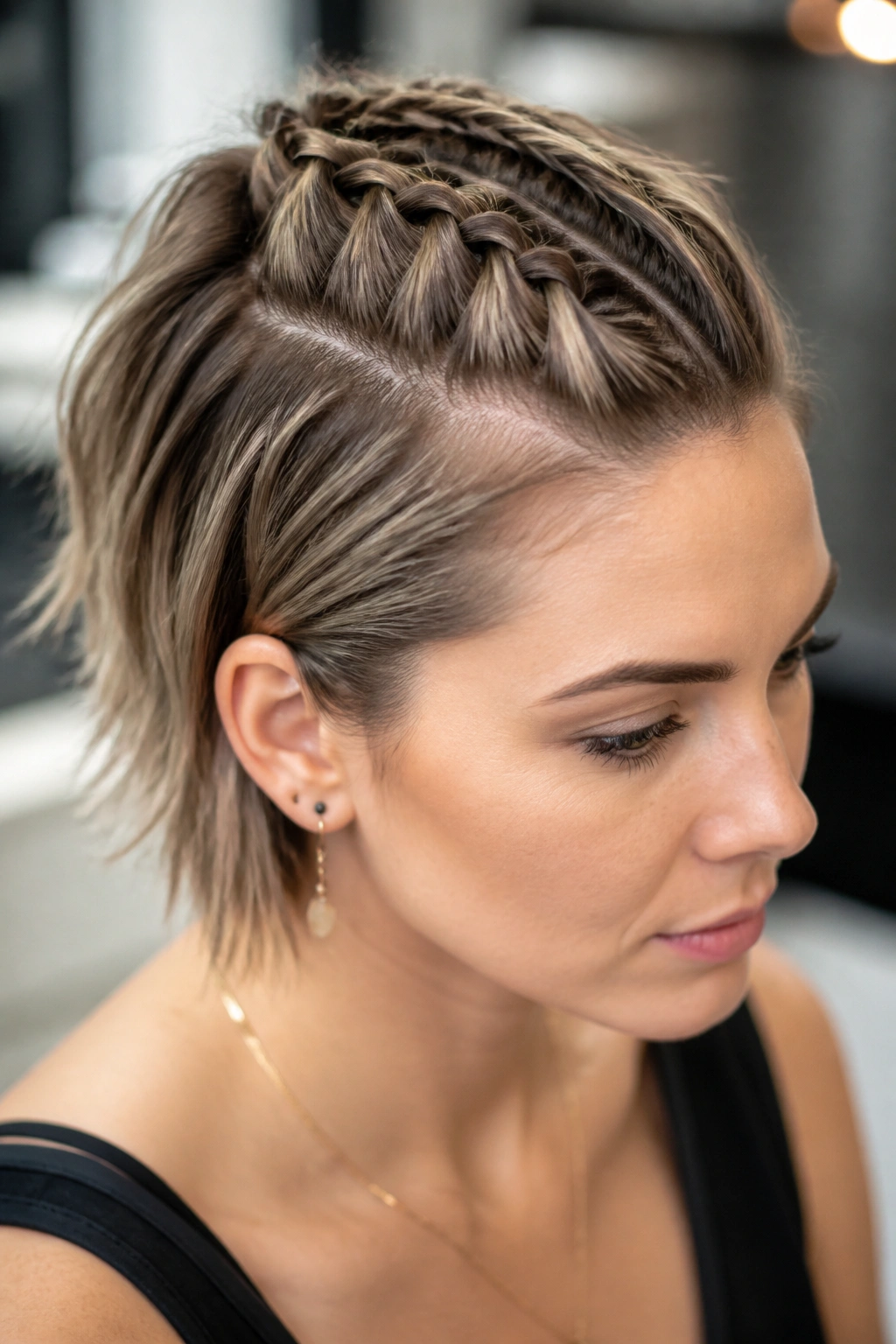
A Dutch braid through the center gives short hair more grip than almost any other half-up style. It also gives the cut a sharper line, which is nice if your hair has layers that like to escape.
Start at the front hairline with a narrow center section and braid backward, adding small pieces as you go. Keep the braid tight and low against the scalp for the first few stitches. Once it reaches the crown, stop and tie it off or pin the end under the rest of the top section. The sides stay down, which keeps the look from turning into a full updo.
This is a strong option for blunt bobs and shorter shags because the braid visually stretches the head shape a little. The braid itself becomes the focus. The rest of the hair can stay smooth or textured, but I’d avoid too much curl underneath. The contrast gets muddy fast.
A Dutch braid like this does take a steadier hand than a twist. Still, if your short hair keeps falling out of everything else, this is usually the one that stays put.
15. Half-Up Pony with Curled Ends
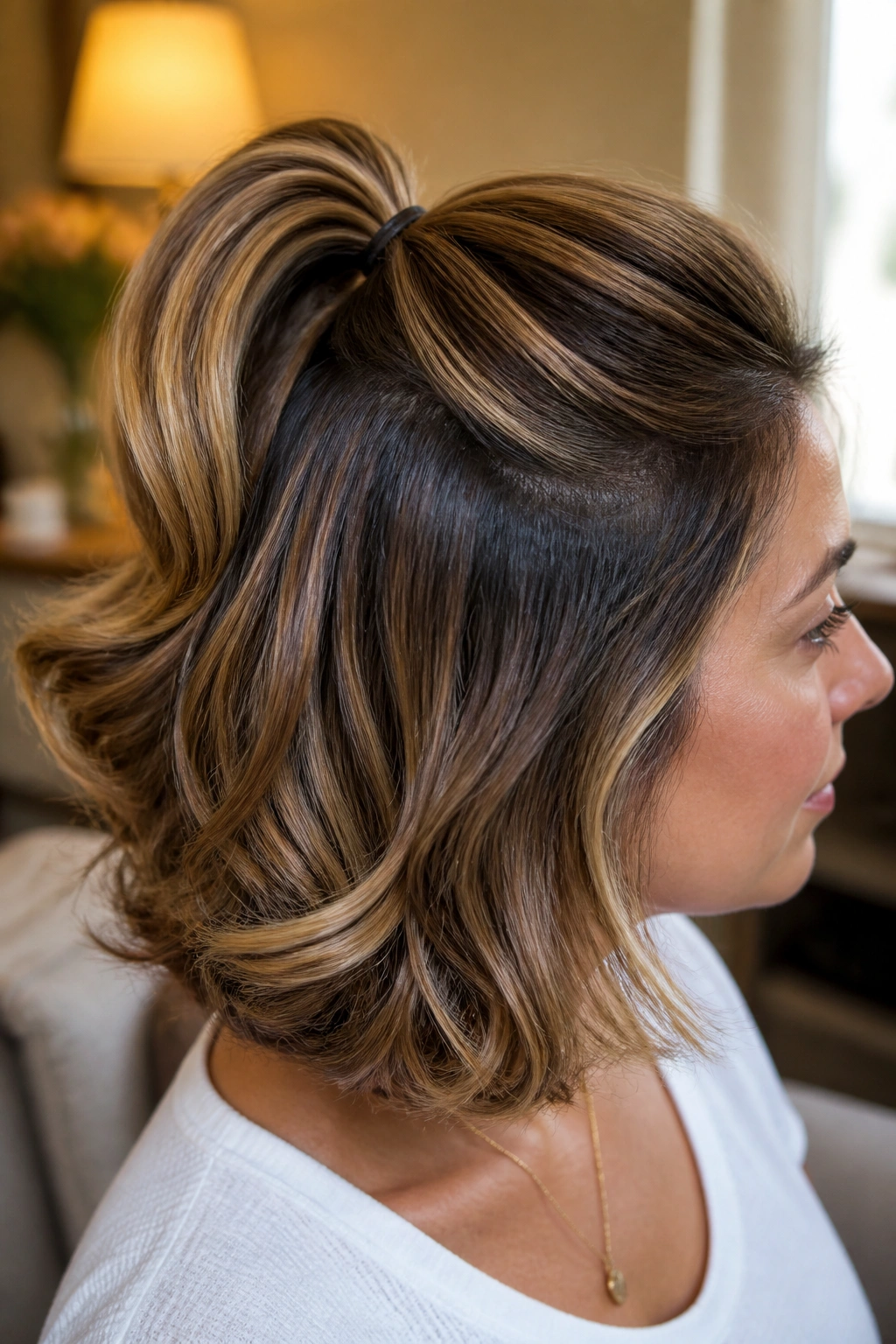
Why curl only the lower half? Because the top needs control and the bottom needs movement. That split keeps the style from feeling overworked.
Gather the top section into a small ponytail and secure it with a clear elastic. Leave the bottom hair down, then curl only the ends or mid-lengths with a 1-inch barrel. If your hair is blunt, curl the ends under on some pieces and away from the face on others. That little mix keeps the shape from looking too stiff.
This style works especially well on thick hair because it cuts down on bulk at the crown while still giving the back some shape. It also suits short hair that tends to flip in odd directions. The ponytail creates order up top, and the curls below soften the edges.
Use a light spray on the curled sections, not the roots. Short hair can get heavy fast if you coat everything. The finish should move when you turn your head, not stick to your neck like it was sprayed into place.
16. Messy Knot with Textured Ends
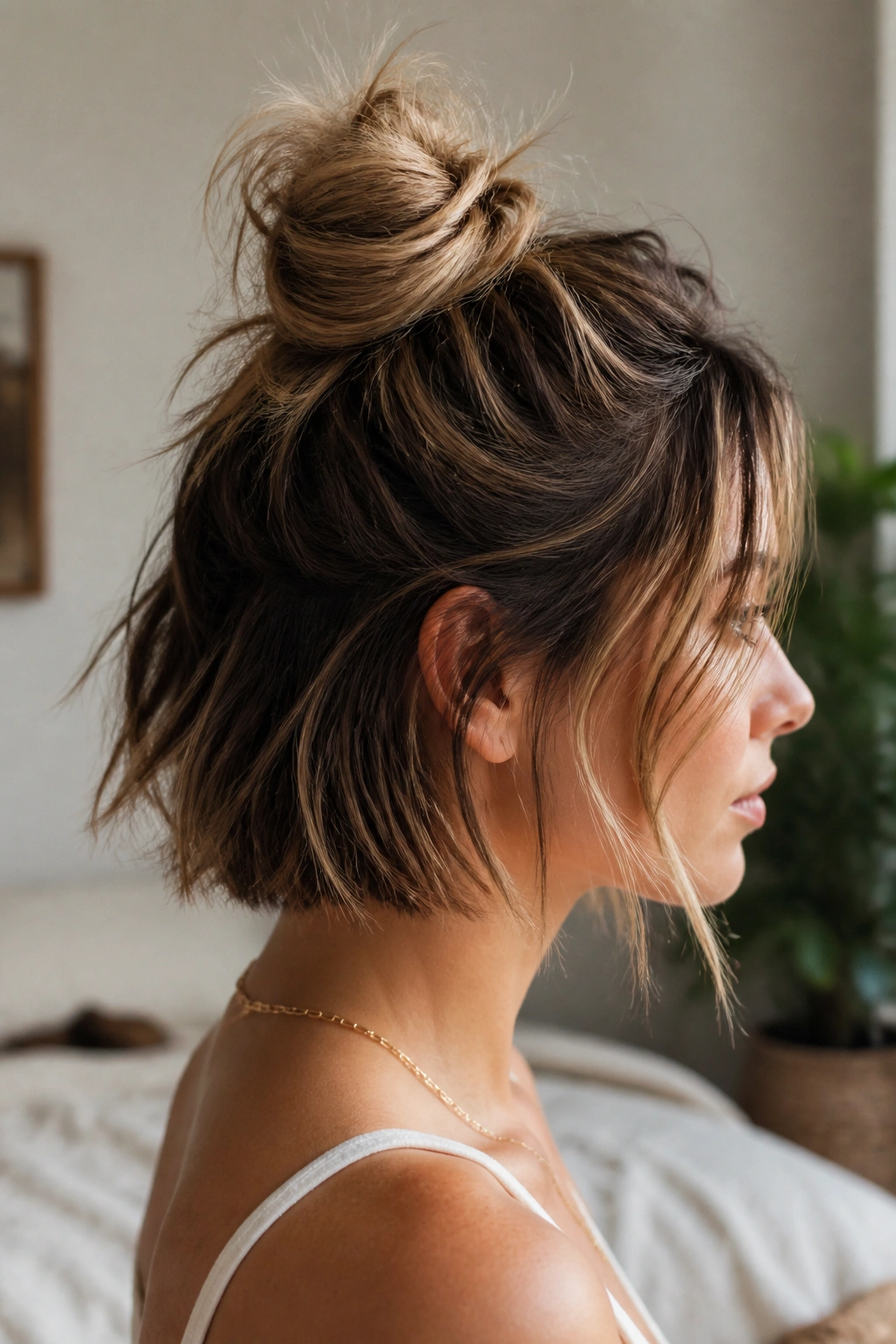
Second-day hair and a few rogue layers are not a problem here. They are the style.
Rough-dry the hair, add a bit of sea salt spray or dry texture spray, and gather the top half into a loose knot. Don’t smooth it too much. Pin it in two or three directions so the knot sits a little undone, then tug a few small pieces free around the temples. The bottom half stays loose and can be straight, wavy, or a little bent at the ends.
This is the least precious of the bunch, which is why it works. If your hair is short enough that some strands poke out of every style, this one accepts them instead of fighting them. The texture reads as part of the shape. That saves a lot of time, honestly.
Do not overpin this one. If the knot feels too secure, it loses the loose, airy shape that makes it work in the first place. A messy knot on short hair should look like it was tied, adjusted once, and left alone.
17. Rope-Twist Half-Up
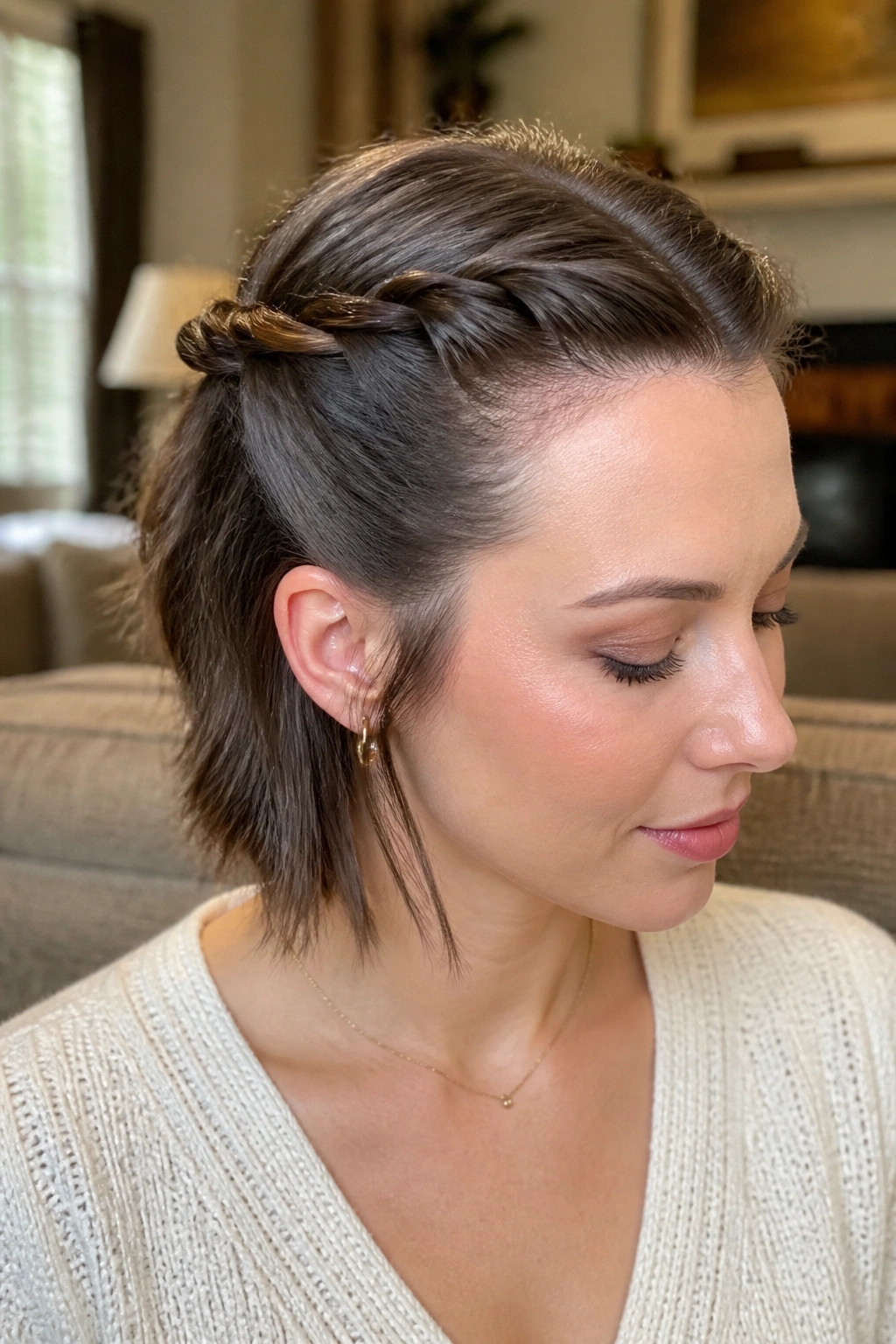
Rope twists are underrated on short hair because they stay compact. Braids can spread out and get bulky fast. Twists keep the section narrow, which is exactly what a shorter cut needs.
Why the rope twist works
Take a small front section on each side, divide each piece into two, twist the pieces in the same direction, then wrap them around each other in the opposite direction. Pin both twists together at the back of the crown. If you want a softer finish, gently pull the outer edge of each twist after it’s pinned. That little loosen-up gives the hair more shape without making the twist fall apart.
- Best on hair with a little grit or bend.
- Good for short layers that slip out of braids.
- Easier to keep neat than a fishtail.
- Looks clean with a side or middle part.
This is one of those styles that looks more complicated than it is. It also works well when the front pieces are too short for a real braid but too long to leave hanging in your eyes.
18. Side-Swept Half-Up with Bang Twist
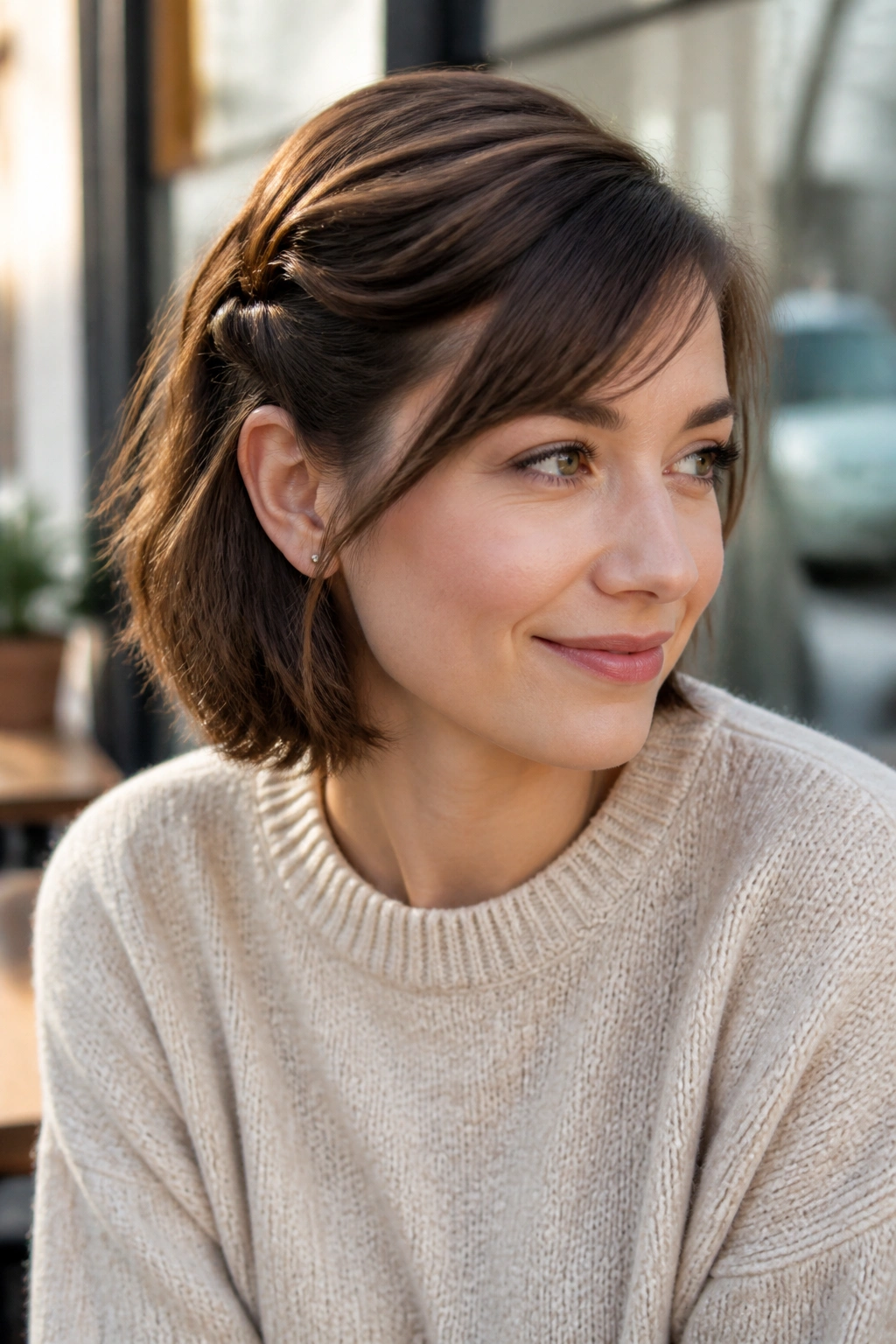
A short haircut with bangs or face-framing fringe often needs one simple move: get the front out of the way without killing the shape. A side-swept half-up does that nicely.
Sweep the front section to one side, twist it back along the hairline, and pin it just behind the ear. You only need 2 pins if the hair has some texture. If the fringe is stubborn, use a tiny bit of pomade on the fingertips before twisting. The rest of the hair stays loose, which keeps the style from feeling too stiff around the face.
This one is especially useful during grow-out stages. Bangs that are almost at the eye tend to behave better when they are redirected into the style instead of fought. You still get softness around the cheekbones, but not that constant hair-in-the-eyelash problem.
It’s also a good option if you don’t want volume at the crown. Everything sits low and close to the head, which can be more flattering on shorter cuts than a taller half-up shape.
19. Retro Pouf Half-Up
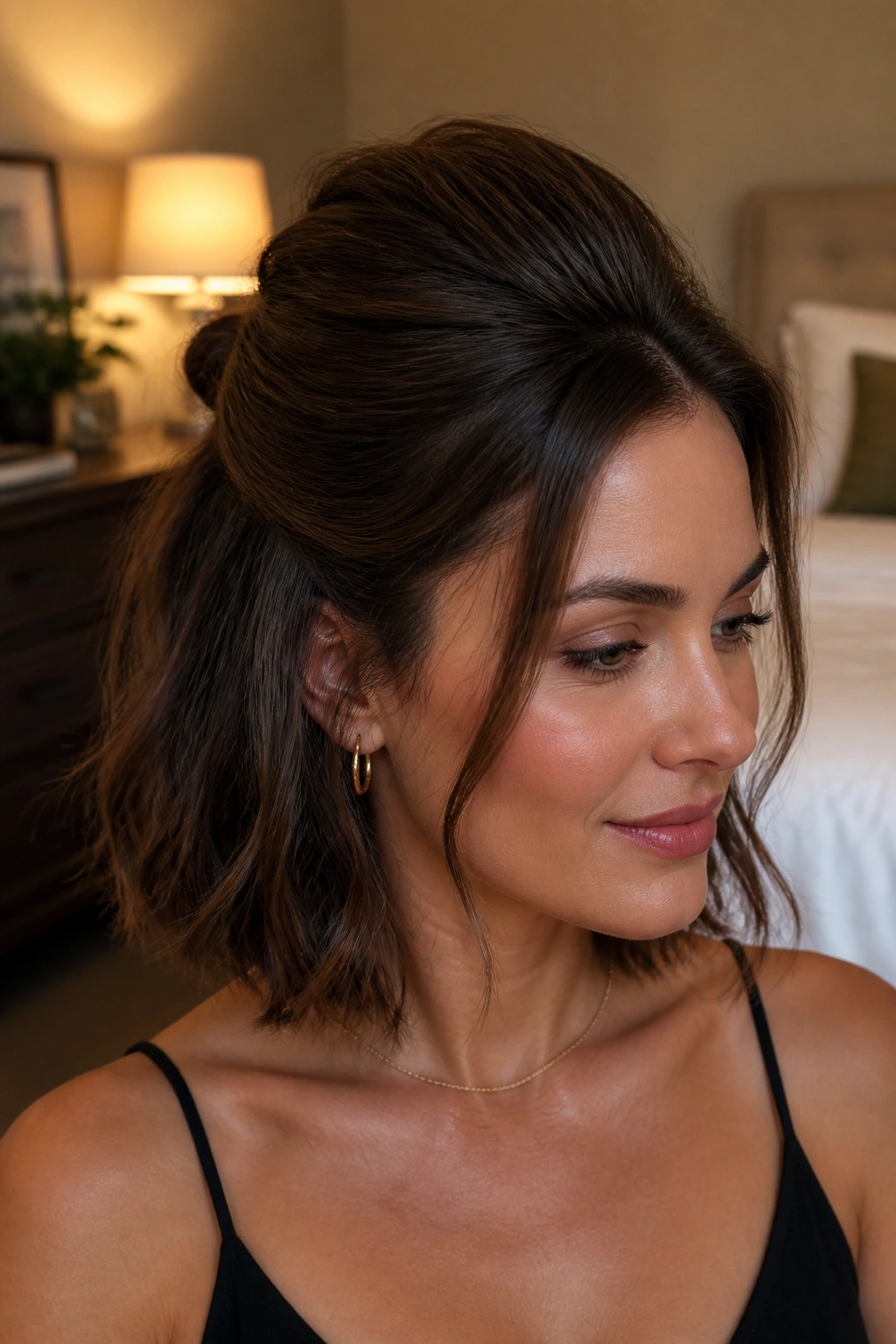
A little pouf is enough. No need to go full vintage television. Just enough lift at the crown gives short hair a cleaner profile and helps the front section stand away from the head.
Backcomb a 1-inch section at the crown, smooth the top layer over it, then pin the rest of the top half back. The trick is not to tease the whole section. Tease the hidden part only. That gives you height without turning the hair rough. A light mist of flexible hairspray keeps the shape in place while the rest of the hair stays soft.
This style likes blunt bobs and softly curled ends, but it can work on layered cuts too if the top section has enough length to cover the pouf. I’d keep the lift modest. A small bump at the crown changes the shape more than people expect.
Small is the point. Short hair with a little height looks intentional. Short hair with too much tease just looks like it has ideas.
20. The Tiny Half-Up That Still Feels Finished
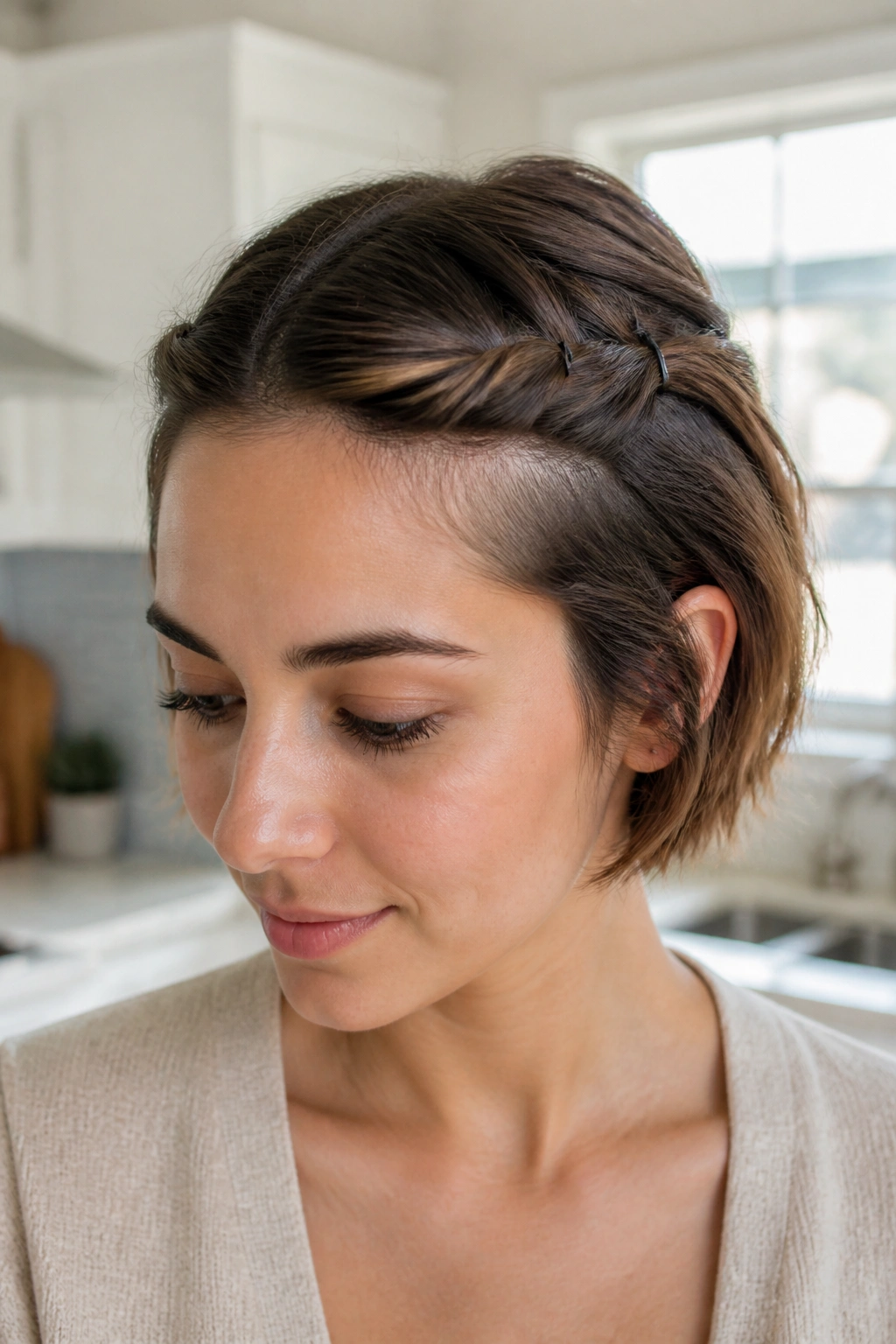
This is the style for the shortest cuts — the ones that make people say there is “not enough hair” for anything interesting. There is. You just need a smaller plan.
Take only the front 2 to 3 inches from each side of the crown, twist them back, and fasten them with two bobby pins or a mini snap clip. If the cut is very short, you may only be pinning a few inches of hair on each side. That still counts as half-up if the front is controlled and the crown has shape. The goal is not volume. The goal is a visible decision.
I like this one because it respects the haircut. It doesn’t pretend a pixie or cropped bob can become a long half-up style. It just gives the front a little lift, keeps the eyes clear, and lets the rest of the cut do the talking. Use a touch of texture spray first if the hair is too silky, and keep the pinned area slightly loose so the style doesn’t look stiff against the scalp.
Short hair doesn’t need more hair to look styled. It needs the right anchor points, a calm hand, and enough room for the cut to stay itself.
