



A round face can wear more haircut than people give it credit for. The trick is not to hide it; the trick is to steer the eye.
When people talk about haircuts for round faces, they often get stuck on the wrong question. It is not “How do I make my face disappear?” It is “How do I build length, angle, and movement so the shape feels balanced?” That shift matters. A cut that ends at the widest part of the cheek can make the face read fuller, while a cut that drops below the jaw or breaks up the curve can make everything look cleaner.
Length alone is not the answer.
A good stylist looks at more than face shape, too. Hair density changes the result. Fine hair can collapse into the cheeks if it is cut too bluntly. Thick hair can puff out if the layers start too high. Curly hair behaves differently again — the dry shape matters more than the wet one, and the weight has to be removed in the right places or the sides can balloon.
The best cuts do one of three things: they create a vertical line, they add a diagonal line, or they open space around the face without adding width. That is the sweet spot. And the cuts below live there in slightly different ways, depending on how much length you want, how much time you want to spend styling, and how much edge you can live with in the mirror.
1. Long Layers That Start Below the Cheekbones

Long layers below the cheekbones pull the eye down, and that matters more than most people think. If the first layer lands too high, the face can look wider through the middle. If it starts lower, the cut keeps the softness but stops the sides from ballooning.
Why It Works on Round Faces
The key is placement. Ask for the shortest layer to begin about 2 to 3 inches below the cheekbone, not right at it. That gives the hair room to move around the jaw instead of sitting on top of it. It also keeps the layers from opening up too much width across the face.
This cut is a smart pick if your hair has some body already. Medium and thick textures hold the shape well. Fine hair can wear it too, but the layers need to stay long and soft so the ends do not look thin.
- Best for straight, wavy, or loose-curly hair
- Ask for face-framing pieces that hit below the jawline
- Works well with air-drying or a loose blowout
- Avoid short crown layers if your hair already puffs out at the sides
Tip: Keep the crown light, not poofy. A little lift at the roots is enough.
2. Angled Lob With a Longer Front

A good angled lob is one of those cuts that looks simple until you study the line. Shorter in back, longer in front — that small shift does a lot of work for a round face.
The front pieces drag the eye diagonally instead of straight across. That diagonal is what softens the width. If you want a cut that still feels polished in a work setting but does not look stiff, this is a very safe bet. It sits right in that middle zone between tidy and modern.
I like this cut especially on hair that likes to bend a little at the ends. Straight hair shows off the angle cleanly. Wavy hair gives it a softer edge. Either way, the front should graze the collarbone or fall just below it. Too short, and the shape can creep back toward the cheek.
Sharp does not have to mean harsh.
3. Collarbone Cut With Soft Ends

Why does collarbone length show up so often in good haircuts for round faces? Because it lands in a useful place: below the cheek, above the chest, and long enough to create a vertical line without feeling heavy. It is one of the least fussy lengths in the whole category.
The ends matter here. Keep them soft, not chopped bluntly like a box. Point-cutting or a gentle razor finish can stop the hair from sitting like a shelf at the bottom. That shelf effect is what makes some shoulder cuts widen the face instead of flattering it.
How to Ask for It
Tell your stylist you want the length to rest at the collarbone or a touch below, with soft perimeter ends and light movement around the face. If you have thick hair, ask for internal weight removal through the mid-lengths. If your hair is fine, keep the outline fuller and leave the layers long.
This cut is one of those rare shapes that works with a middle part or a side part, which is handy if you like to change things up. Not many cuts do both well.
4. Curtain Bangs With Mid-Length Layers

If your forehead feels wide and your cheeks are full, curtain bangs can change the whole balance. They split the top half of the face into softer sections and draw the eye down into the rest of the cut. Done well, they do not trap the face. They frame it.
The best version on a round face is not a short, choppy fringe. It is a longer curtain bang that starts around the brow and opens toward the cheekbone. That opening is the point. It creates a slight V shape in the center, which helps the face feel less circular. Mid-length layers under the bangs keep the rest of the cut from turning puffy.
A small warning. If the bangs are cut too short or too blunt, they can make the face read broader. The longest pieces should blend into the sides, not stop suddenly at the temple.
- Ask for bangs that part softly from the center
- Keep the shortest point around brow level
- Let the side pieces hit the cheekbone or just below
- Style with a round brush or a quick bend from a flat iron
The grow-out is forgiving, too, which I always count as a win.
5. Deep Side-Parted Blunt Bob

A blunt bob is not the enemy. A dead-center part is.
That may sound a little rude, but it is true. A blunt bob with a deep side part creates a line that cuts across the face instead of echoing its roundness. The deep part gives one side lift and lets the other side fall longer, which breaks up the symmetry in a useful way. On round faces, that asymmetry matters.
The cut itself should sit somewhere between the chin and the jaw, with the ends kept clean. If you add too much texturing at the perimeter, the bob can lose its shape. What you want is a crisp edge with movement at the roots and the part. That is enough.
This works best if you like a neat finish and do not mind using a round brush or a blow dryer with a nozzle. A little root lift on the heavier side helps a lot. And if one side tucks behind the ear? Even better. That tiny move can open the face more than people expect.
6. Textured Shag With Crown Volume

The shag can be a mess, or it can be excellent. The difference is control at the crown.
A round face usually benefits from a little height on top and less bulk at the sides, and that is exactly where a well-cut shag earns its keep. The layers should build upward, not outward. Think crown lift, cheekbone softness, and ends that move instead of hanging like a curtain. When the shape is right, the face feels longer without looking forced.
The Pieces That Matter Most
- The shortest layers should stay near the crown, not the cheeks
- The sides need soft tapering so the width does not balloon
- A wispy fringe can help, but only if it blends
- Best on wavy hair, though straight hair can wear it with styling
The big mistake with a shag on a round face is too much volume at ear level. That is a hard no. If your stylist cuts the layers to flip out around the cheeks, the face gets wider. If the texture stays mostly on top and through the ends, the cut works the way it should.
It looks casual, but it is not careless. There is a difference.
7. Pixie Cut With Height on Top

Short hair can be better than long hair on a round face. Really.
A pixie with height on top and tapered sides makes the face look longer by moving the visual weight upward. The sides stay close to the head, while the top carries the shape. That contrast is what creates balance. Without it, a short cut can become all width and no lift. Nobody wants that.
The best pixie for a round face usually has 2 to 4 inches of length on top, enough to sweep to the side or push upward with a little mousse. A side-swept fringe helps, too, especially if it falls diagonally across the forehead. The line should feel light and sharp, not helmet-like.
Use a matte paste or a light styling cream. Skip heavy products that flatten the top. Once the top collapses, the face reads wider again. Not ideal.
8. Bixie With a Tapered Nape

What is a bixie? It is the midpoint between a bob and a pixie, and on a round face that middle ground can be very useful. You get more shape than a pixie, but less weight than a bob.
The tapered nape is the secret. It keeps the back close and clean, while the top and sides stay a little longer for movement. That taper helps the cut sit neatly against the neck, which is one of the fastest ways to make a round face feel more vertical. The front can be worn soft and side-swept, or pushed forward with texture if you want a little edge.
What to Ask For
Ask your stylist for a shorter, tapered back, a soft side fringe, and enough length on top to style into a bend. If your hair is thick, ask for internal removal near the crown. If it is fine, keep the ends full so the cut does not disappear.
This cut is a good choice if you want short hair but do not want the maintenance of a strict pixie. It grows out more gently, which matters more than people admit.
9. A-Line Bob With a Clean Angle

If you want something neat enough for work but not stiff, an A-line bob does the job. The back sits a little shorter, the front drops longer, and that line gives the face a stronger frame.
On a round face, the clean angle breaks the circle in a way a one-length bob sometimes cannot. The front pieces should skim the jaw or sit just below it. If they end right on the jaw, the face can look boxed in. If they fall a little longer, the shape relaxes.
This cut is especially useful if you like straight hair or a polished bend at the ends. It keeps its shape with less effort than people expect. A blow-dry with a paddle brush can be enough. If your hair is wavy, a quick pass with a large brush or a 1.25-inch iron gives the angle a bit more definition.
The line is the whole point. Protect it.
10. U-Shaped Long Cut

One-length long hair can look heavy on a round face. A U-shape fixes that without chopping off the length you want to keep.
The reason it works is simple. The perimeter curves down a little in the back, while the front stays slightly shorter. That soft U gives the hair a shape that follows the body instead of hanging in one flat sheet. It also keeps the sides from ending at the widest part of the face, which is where a lot of long cuts go wrong.
Blunt long hair is not bad by default. It just needs a reason to move. A U-shape gives it one.
This cut is good if you like long hair but hate the triangle effect that can happen when the lower half grows thick. It also plays well with light face-framing pieces around the chin and collarbone. Those pieces do not need to be dramatic. A few inches are enough to make the whole cut breathe.
11. Asymmetrical Bob For a Sharper Line

An asymmetrical bob brings attitude, but it also brings structure. One side is longer than the other, and that uneven line breaks up the roundness of the face in a direct way.
Unlike a standard bob, this cut does not sit evenly around the jaw. It creates a visual pull to one side, which is useful if your face feels widest right through the cheeks. The difference between the two sides does not have to be huge. Even a half-inch to an inch can change the read of the cut.
Who It Suits Best
- People who like a cleaner, fashion-forward shape
- Straight or slightly wavy hair
- Anyone who wants a bob but needs more angle
- Folks willing to keep the line trimmed every few weeks
If you want the cut to feel softer, keep the ends lightly textured rather than razor-sharp. If you want it to feel bolder, make the side length difference more obvious. Either way, the asymmetry does the heavy lifting.
12. Invisible Layers on Long Hair

Not every layer needs to shout.
Invisible layers are built inside the haircut instead of sitting loudly on the surface, and that makes them a smart choice when you want movement without losing length. On a round face, they help the hair fall in a slimmer shape because the bulk gets removed from inside the structure, not from the outer line.
This is a strong option for thick hair that tends to spread out at the sides. The outer length stays long and clean, while the hidden layers stop the bottom from turning heavy. The result feels lighter, but not choppy. That distinction matters. Choppy long hair can look wide if the layers are too aggressive.
Ask your stylist to keep the perimeter full and remove weight in the interior from around the mid-lengths down. If you wear your hair curled, this cut keeps the curl pattern from exploding sideways. If you wear it straight, it stays sleek.
13. Wolf Cut With Softer Edges

Can a wolf cut work on a round face? Yes — if the top is softer than the internet photos suggest.
The harshest versions of the wolf cut can add too much width at the cheek level. The version that flatters a round face keeps the shortest layers higher on the head and lets the sides stay airy rather than puffy. You want a little lift, a little mess, and a shape that moves away from the face instead of sitting on it.
What to leave out matters here. Skip heavy side bulk. Skip a fringe that stops dead at the brow. Skip oversized layers that kick out right by the ears. Those details can make the face look fuller in the wrong places. The better version keeps the shaggy energy, but trims the silhouette tighter.
This cut is a good match for wavy and dense hair, especially if you like texture that dries with some shape on its own. If you need a cut that looks better a little imperfect, this is one of the strongest options.
14. Blunt Mid-Length Cut With Lifted Roots

Straight lines can flatter a round face when the root area has a bit of lift. Without that lift, the cut can sit flat and widen the face. With it, the whole thing looks cleaner.
A blunt mid-length cut usually lands between the chin and the shoulders. On a round face, the safest version sits closer to the collarbone than the jaw. The blunt end gives the hair a strong edge, while the lifted roots stop the line from feeling heavy. A side part can help too, especially if your hair is fine and tends to flatten quickly.
The styling part is not complicated. Blow-dry the roots upward with a round brush or clip the top section up while it cools. Even 10 minutes of root lift makes a difference. Keep the ends smooth, not flipped in every direction. The shape should feel controlled.
If you want a clean, modern cut that does not ask for a lot of layering, this one deserves a look.
15. Shoulder-Length Cut With Flipped-Out Ends

A shoulder cut can sink into the face if the ends just hang there. A small flip at the bottom changes the whole read.
That outward turn creates movement away from the cheeks and jaw instead of toward them. It is a small visual trick, but a useful one. If the hair hits the shoulders and turns out by an inch or so, the face feels less enclosed. This is especially nice on round faces that do not love heavy inward bends.
A round brush works well here, and so does a 1.25-inch curling iron if you want a softer finish. The flip does not need to be shiny or tight. In fact, a relaxed bend looks better. Too much curl can fight the softness of the shape.
- Best with medium-density hair
- Works well on layered or one-length shoulder cuts
- Needs only a light styling cream or heat protectant
- Grow-out stays neat for a while
It is an easy way to make a plain shoulder cut feel intentional.
16. Sleek Lob With a Side Tuck

Why does a sleek lob work when it is tucked behind one ear? Because the side tuck breaks the symmetry and shows off the neck and jaw on one side. That one change can make a round face feel much leaner.
The cut itself should sit at the collarbone or just above it. Keep the ends smooth and the line sharp. Then tuck one side back and let the other side fall forward a little. The contrast between exposed and covered areas is the whole point. It gives the face shape without adding fluff.
This is a good haircut if you like low-effort styling. You do not need waves, curls, or a lot of product. A smooth blowout, a side part, and a tuck are enough. If your hair is very straight, a touch of bend at the front pieces can keep the cut from looking severe.
Some days you wear it tucked. Some days you don’t. That small choice changes the whole mood.
17. Side-Swept Fringe and Medium Layers
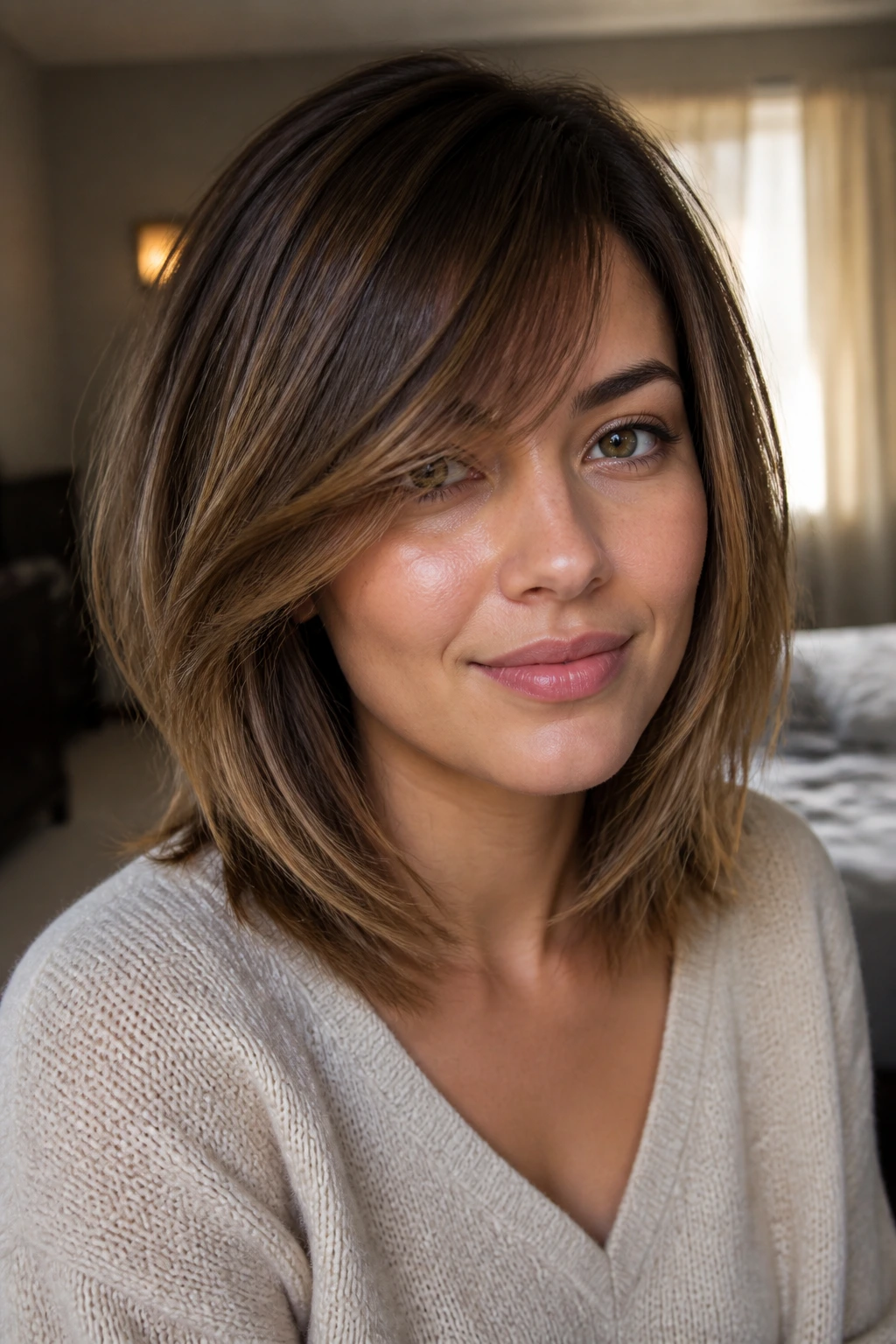
Straight-across bangs are not always the easiest choice. Side-swept fringe usually gives a round face more room.
The angle matters. Instead of drawing a hard horizontal line across the forehead, the fringe moves diagonally and blends into medium layers around the cheekbone and jaw. That diagonal softens the face without cutting it in half. It is also more forgiving when your hair grows out, which is a practical plus.
Good Signs to Look For
- The shortest piece starts near the eyebrow, not mid-forehead
- The longest fringe piece blends into the cheekbone
- The layers below stay light and mobile
- The overall shape keeps a little length below the chin
This cut suits people who want fringe but do not want a heavy commitment. It works especially well on fine to medium hair because the side sweep adds movement without requiring a lot of bulk. On thicker hair, the bangs need enough thinning to lie properly, or they can take over the whole face.
It is a quieter cut than a dramatic fringe, which is exactly why it works.
18. Curly Cut Shaped for Length
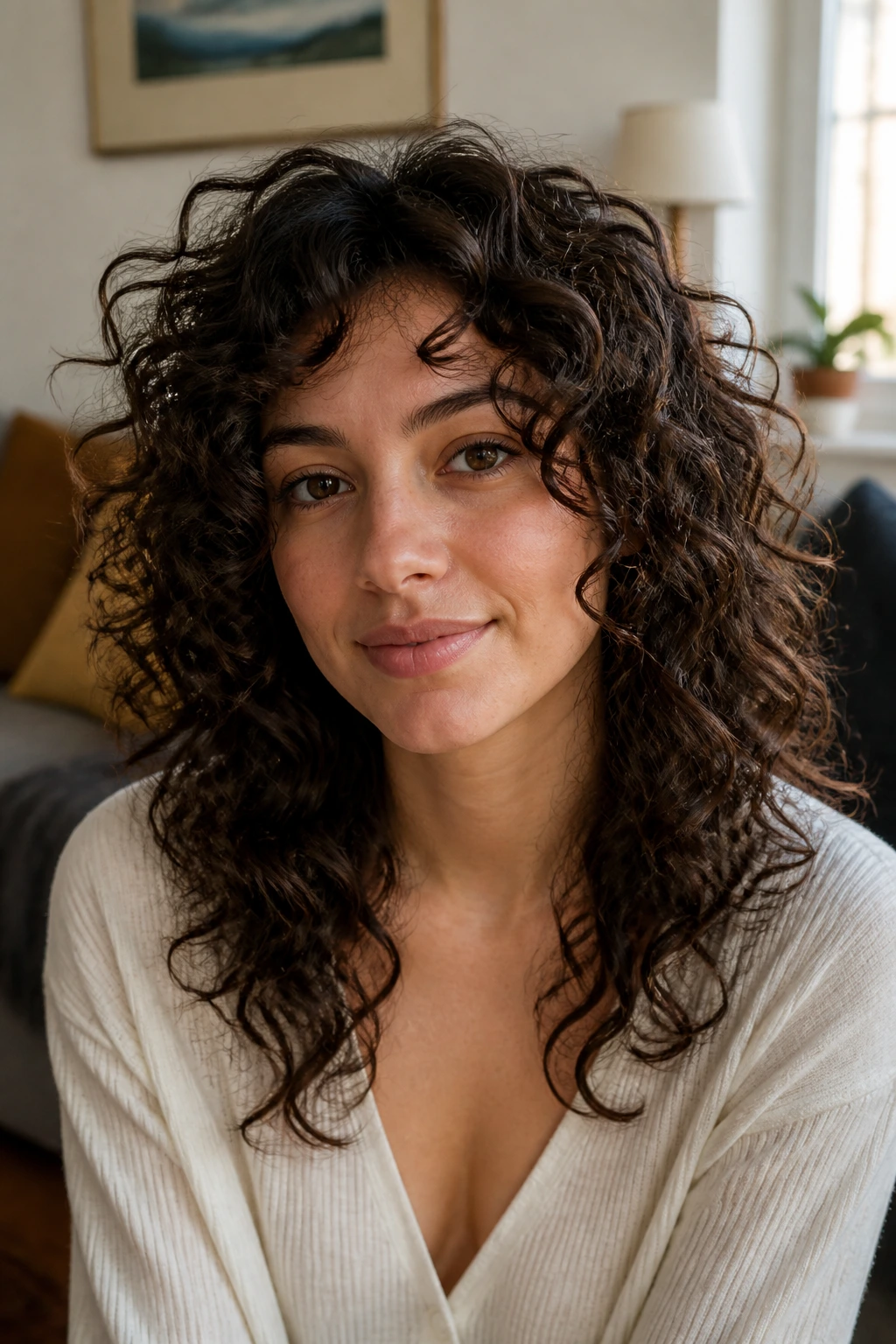
Curly hair and round faces need a different map.
The curl pattern changes where the hair sits, so a cut that looks balanced when wet can look very different once it dries. A good curly cut for a round face keeps the widest part of the curl away from the cheek area and lets the crown carry a little more height. That pushes the shape upward and downward instead of outward.
A dry cut is worth asking for here. Curly hair shrinks, and shrinkage changes everything. If the stylist cuts it wet without checking the dry shape, the layers can land in the wrong place. Ask for longer face-framing pieces that drop past the jaw and for side volume to be reduced only where needed, not everywhere.
Ask For a Dry-Cut Approach
- Let the stylist see your curl pattern in its natural state
- Keep the shortest face-framing pieces below the cheek
- Avoid over-thinning the ends
- Preserve a strong shape at the crown
This cut is not about forcing curls to behave. It is about placing them where they help the face instead of crowding it.
19. Grown-Out Shag With Wispy Pieces

Unlike a heavier shag, this version keeps the outline loose and the ends light. That makes it easier to live with, especially if you do not want to trim your hair every few weeks.
The grown-out shag uses wispy layers around the face and a softer perimeter through the rest of the cut. On a round face, the looseness matters because it avoids that full, cloud-like width at the sides. The hair still has texture, but it does not look chopped up or overworked.
This is one of my favorite shapes for people who like some mess in their hair but do not want a full rock-and-roll look. It is softer, more relaxed, and easier to air-dry. A little mousse at the roots and a bend through the mid-lengths is often enough. If your hair is thick, keep the internal layers controlled. If it is fine, leave the ends fuller so the cut does not disappear.
It also grows out cleanly. That alone saves a headache.
20. Long Layers With a Face-Framing Sweep

If you want one cut that plays well with almost every version of a round face, this is the one I’d put near the top of the list. Long layers with a face-framing sweep give you length, movement, and a soft diagonal line all at once.
The front pieces should start around the cheekbone or just below it, then fall toward the collarbone. That sweep does a subtle job of slimming the middle of the face without making the cut look carved up. The rest of the layers can stay long and quiet. No need to overdo it. In fact, the best version is often the simplest one.
This shape is forgiving. It works air-dried, blown out, curled, or pulled into a low clip with the front left out. It also suits a lot of hair types, which is why it earns a place at the end of this list. When a cut can look good with minimal effort and still keep the face in balance, that is not a small thing.
And that is the part people miss. The right haircut is not the one that fights your features. It is the one that makes them read the way you like, on ordinary days, with ordinary styling, when the mirror is not being kind and you still want your hair to do its job.
