



Gray hair gets better when the cut is doing some of the work for you. The best modern grey hairstyles for women over 50 are not stiff, overly neat, or trying too hard to look “young”; they move, they catch light, and they make the face look rested without hiding it.
Gray hair has its own personality. It can feel coarser, drier, or wirier in one section and soft in another, and a style that looked fine years ago can start hanging in the wrong places if the cut is too blunt or too heavy. That’s why the smartest cuts for silver hair lean on shape, not fuss.
A good haircut fixes a bad hair day before it starts.
The styles below are built around that idea. Some are short and sharp, some keep length, and some do their best work when the hair’s natural wave or curl is left alone instead of being flattened into submission. If your gray is salt-and-pepper, silver, white, or somewhere in the long transition between dye and natural color, these cuts give it a cleaner, fresher outline.
1. A Soft Layered Bob That Moves Instead of Sitting Still

A soft layered bob is one of those haircuts that looks easy because it is doing a lot of quiet work. The shape keeps the ends from hanging like a curtain, while the layers stop gray hair from turning bulky around the jaw.
That matters more than people think. Silver strands often reflect light well, but they can lose shape fast if the cut is too heavy. A bob with layers cut through the interior — not chopped into random pieces — gives the hair a little swing when you turn your head.
Why it works on gray hair
The sweet spot is usually between chin length and the top of the collarbone. Shorter than that, and it can get a little severe. Longer than that, and the weight starts pulling the shape down unless the layering is done with care.
Ask for soft internal layers and a perimeter that stays clean. You want movement, not thin ends.
- Best for fine to medium hair that needs lift at the crown
- Works well with a side part or a loose off-center part
- Easy to air-dry with a dab of styling cream
- Needs a trim every 6 to 8 weeks to keep the outline tidy
Tip: Keep the layers soft around the front. Harsh face-framing chops can look dated fast on gray hair.
2. A Side-Swept Pixie That Softens the Face

Want short hair without the hard edges? A side-swept pixie does that better than almost anything else. The top stays long enough to brush forward or across the forehead, and the sides can be kept neat without looking clipper-sharp.
The side sweep changes the whole mood. It pulls attention away from the hairline and gives the face a softer angle, which is handy if your gray hair has more texture than it used to.
How to ask for it
Ask for 2 to 3 inches on top, shorter sides, and a fringe that can be pushed across the forehead without sticking out. If your hair grows straight up at the crown, the top needs a touch more length so it can lie in the direction you want.
A pea-sized amount of styling paste is usually enough. Warm it in your hands, work it through damp hair, then blow-dry the front first so it sits where you want it. If you let the crown dry flat, you’ll spend the rest of the morning fighting it.
This cut is neat, quick, and not fussy. That’s the appeal.
3. A Shoulder-Length Shag for Silver Hair With Natural Texture

If your gray hair has any wave at all, the shoulder-length shag can be a gift. It keeps the length people often want, but it removes enough weight that the shape doesn’t fall flat by noon.
I’ve always thought this cut looks best when it’s a little imperfect. Not messy. Just alive. The layers sit in different places, the fringe is soft rather than blunt, and the whole thing moves when you turn your head or tuck hair behind one ear.
What the shag is actually doing
The crown gets a little lift, the sides get a little swing, and the ends are never all trying to land in the same spot. That’s why it works so well on gray hair that has become dry or puffy on the surface but still has body underneath.
- Ask for layers that start around the cheekbone or just below it
- Keep the ends grazing the shoulders, not sitting on top of them
- Use a diffuser on low heat if your wave frizzes easily
- Scrunch in a light curl cream or foam while the hair is damp
Practical note: A shag looks best when you stop overhandling it. Finger-comb, scrunch, air-dry a bit, and let the hair do the rest.
4. A Chin-Length Blunt Bob That Makes Gray Shine
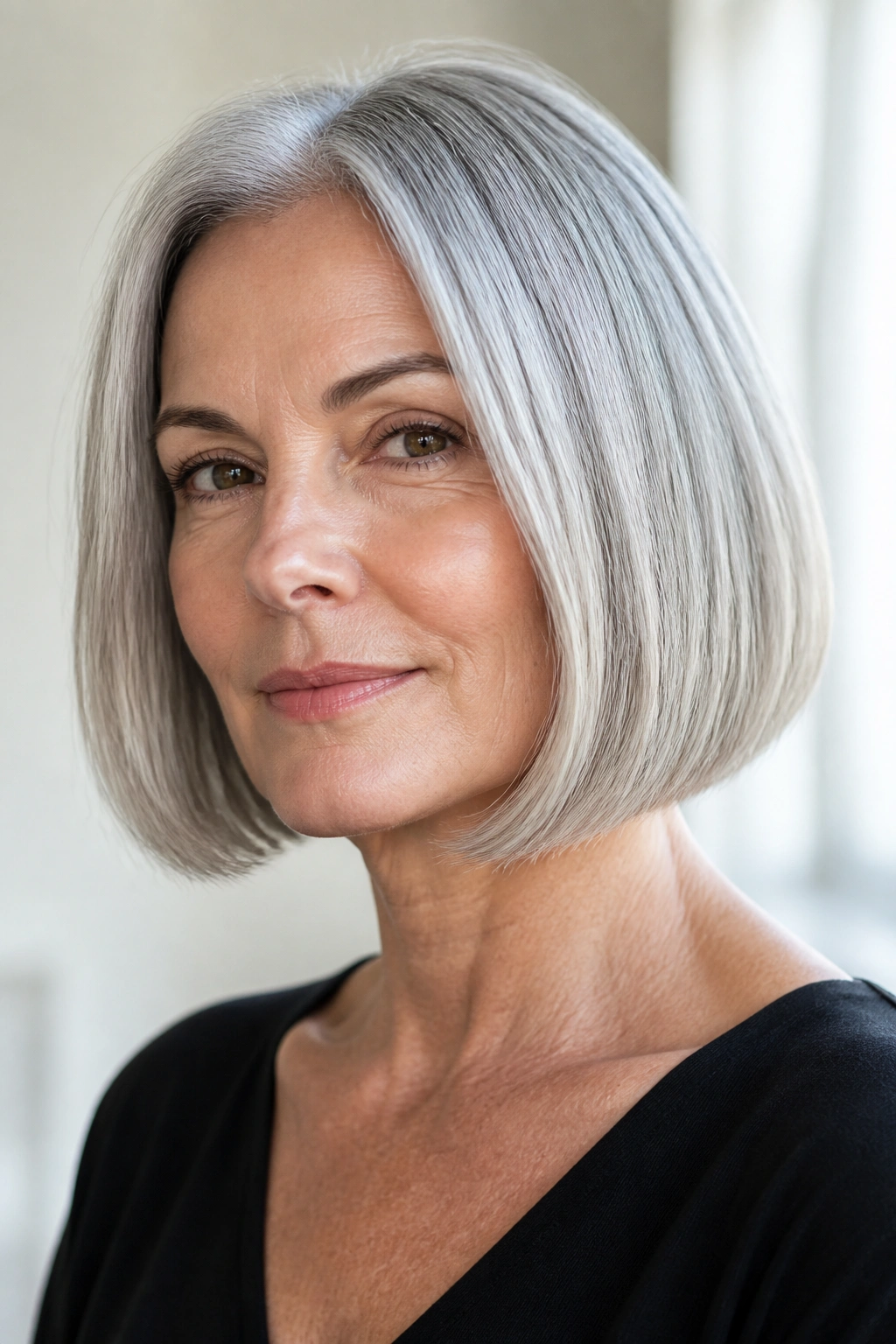
A clean blunt bob can be gorgeous on gray hair. The straight edge gives silver strands a crisp line, and that line makes the color look brighter because the eye isn’t getting distracted by too many layers.
This cut has a reputation for being severe. It can be, if it’s too hard around the face or too stiff at the ends. Done well, though, it feels modern in the simplest possible way. The shape is tidy, the neckline looks intentional, and the whole cut sits close enough to the head that it doesn’t puff out at the wrong places.
The best version usually lands at the chin or slightly below it. That length gives the jaw some definition without turning the face boxy. If your hair is very dense, ask for a tiny bit of soft debulking underneath so the bob doesn’t kick out.
Straight or slightly wavy hair tends to handle this best. If your hair is very curly, you can still wear a blunt bob, but it needs thoughtful shaping so the perimeter doesn’t become a triangle. Nobody wants that.
The styling is simple. Blow-dry with a paddle brush, keep the ends smooth, and finish with a light serum on the last inch. That last inch matters. It’s where the haircut either looks polished or starts to fray.
5. Feathered Crops That Keep Short Hair Light

A feathered crop is not the same thing as the old short cuts that made a lot of women feel older than they were. The feathering is the difference. Instead of creating a stiff cap of hair, it softens the perimeter and lets the top move.
That’s the real reason this cut still works. Gray hair often needs shape around the temples and ears, but it doesn’t need to be pinned into place like a helmet. Feathering around those areas keeps the haircut airy, which is a better look on almost everyone.
What makes it different from a plain short cut
A plain crop can feel blunt and boxy if the hair is thick. Feathering takes out some of that bulk. It also helps short gray hair catch light in small shifts, which is more flattering than a hard block of color.
- Top length: usually 2 to 3 inches
- Sides: tapered but not shaved
- Fringe: optional, but a soft fringe helps if the forehead feels a little dominant
- Product: a light cream or cream-wax, never a sticky gel
Who it’s best for? Women who want short hair that still has softness. If you like quick styling and hate the feeling of hair brushing your neck, this one earns its keep fast.
6. A Curly Lob That Lets Silver Curls Breathe
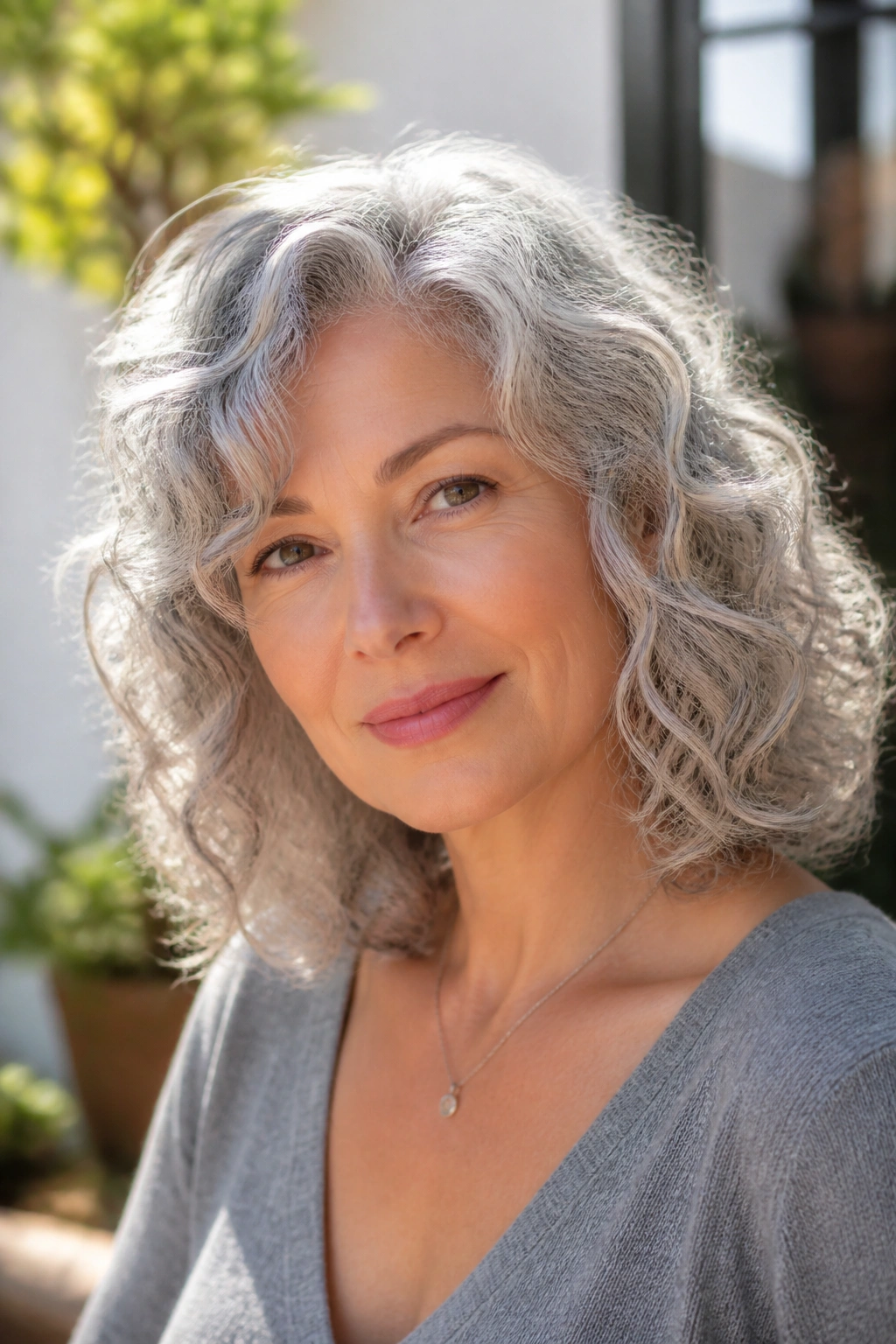
Gray curls can look fantastic at lob length. The longer shape gives the curls enough room to spring, and the length keeps them from shrinking into a round puff at the ears.
The big mistake is cutting curly gray hair too wet and too aggressively. Curls lie. They always lie a little. A strand that looks long when it’s wet may spring up two inches when it dries, and silver curls often do that with even more attitude because they’re drier and lighter.
A good curly lob is usually cut with the curl pattern in mind, sometimes dry or partly dry, so the shape is visible before the scissors close in. The ends should feel light, not wispy. That’s a fine line, but it matters.
You don’t need a heavy routine here. A leave-in conditioner, a small amount of curl cream, and a diffuser on low heat can be enough. If you comb curls after they’ve started to dry, they’ll frizz and spread out in the wrong direction. Fingers only, or a wide-tooth comb in the shower. That’s it.
This cut shines when the curls have room to settle just below the shoulders. Shorter can work too, but the lob gives a bit more grace if your curls are inconsistent from one side to the other.
7. A Tapered Pixie With Lift at the Crown

Why do some pixies look lively and others look flat by 10 a.m.? Usually the answer is the crown. If the top has no height, the whole cut collapses.
A tapered pixie fixes that by keeping the sides and back shorter while leaving enough length on top for movement. The lift at the crown gives the face a small stretch upward, which is useful if the hairline has softened or the hair has started lying closer to the scalp.
How to get the lift
Ask for more length at the crown than at the nape, and make sure the stylist keeps enough weight on top to brush upward with a round brush or fingers. A little root mousse goes a long way here.
- Crown length: around 3 to 4 inches
- Nape: short and neat, but not tight
- Sides: tapered around the ears for a clean outline
- Styling: blow-dry upward at the roots, then shape with a matte paste
This is one of those cuts that looks especially good with silver or white hair because the shape does the showing off. You don’t need much product. Too much and it starts looking sticky, which ruins the lightness that makes it good.
8. Collarbone Layers That Frame the Jaw Without Hiding Length

Longer gray hair gets a bad reputation when it goes limp at the ends. That’s not really a length problem; it’s a shape problem. Collarbone layers solve it by keeping the length while stopping the whole head of hair from hanging straight down.
The cut is flattering because it lets the front pieces sit near the cheekbones and jaw, where they soften the face, while the back stays long enough to pull into a low ponytail or clip back. There’s a nice practical side to that. Hair past 50 often needs styles that can do two jobs at once.
What to ask for
- The longest point should sit around the collarbone
- Face-framing pieces can start at the cheekbone
- Layers should be blended, not cut into obvious steps
- Keep the ends blunt enough to look full
This is a good choice if you like your length but hate the stale look that can happen when the ends get too thin. It also plays well with subtle waves, since the layers help the bend show up instead of hiding under one heavy curtain.
A quick blowout with a large round brush makes the shape come alive. So does a loose bend made with a 1.25-inch curling iron, especially if you only wrap the mid-lengths and leave the ends straight.
9. A Sleek Center-Part Bob for Straight Gray Hair
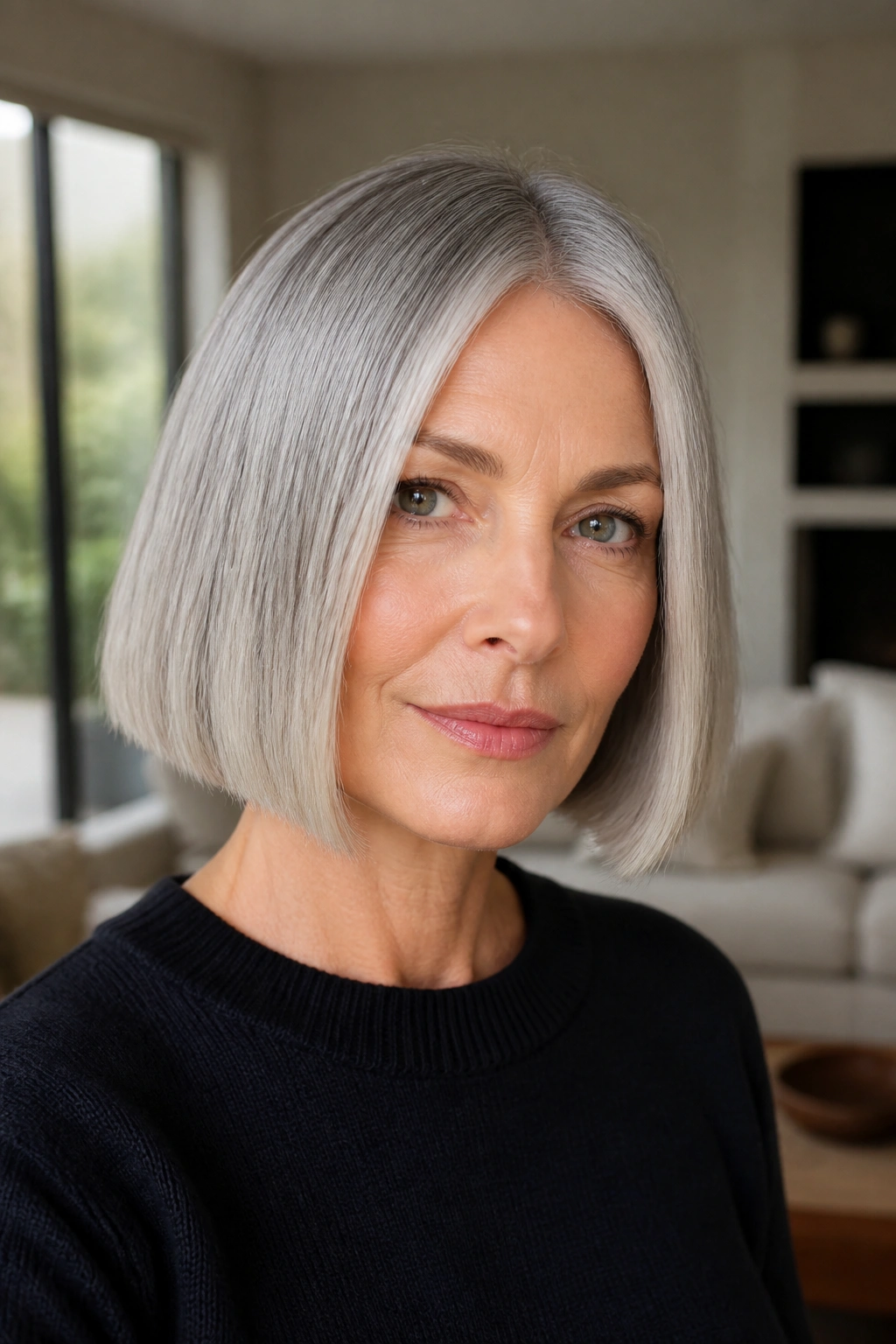
A center part can be unforgiving on the wrong haircut. On the right one, it looks crisp and calm.
That’s why a sleek center-part bob works so well on straight gray hair. The part creates symmetry, the bob gives the shape a clean frame, and the silver or white color reflects light along the edges instead of getting lost in a pile of texture. The result is sharp without being flashy.
The best version usually sits right at the jaw or just below it. Any shorter, and the look can turn boxy fast. Any longer, and the point of the bob gets diluted. If the ends flip out, ask for a slight bevel under the line so the finish sits smooth against the neck.
Heat styling should stay modest. A flat iron set around 300 to 340°F is enough for most gray hair, especially if you’ve already blown it dry with a concentrator nozzle. Use a heat protectant first. Dry gray hair does not forgive overuse of hot tools.
One small drop of serum through the last inch gives the finish a polished look. Too much serum, and the hair can get oily at the roots, which defeats the whole point.
10. Wavy Mid-Length Hair With Curtain Bangs
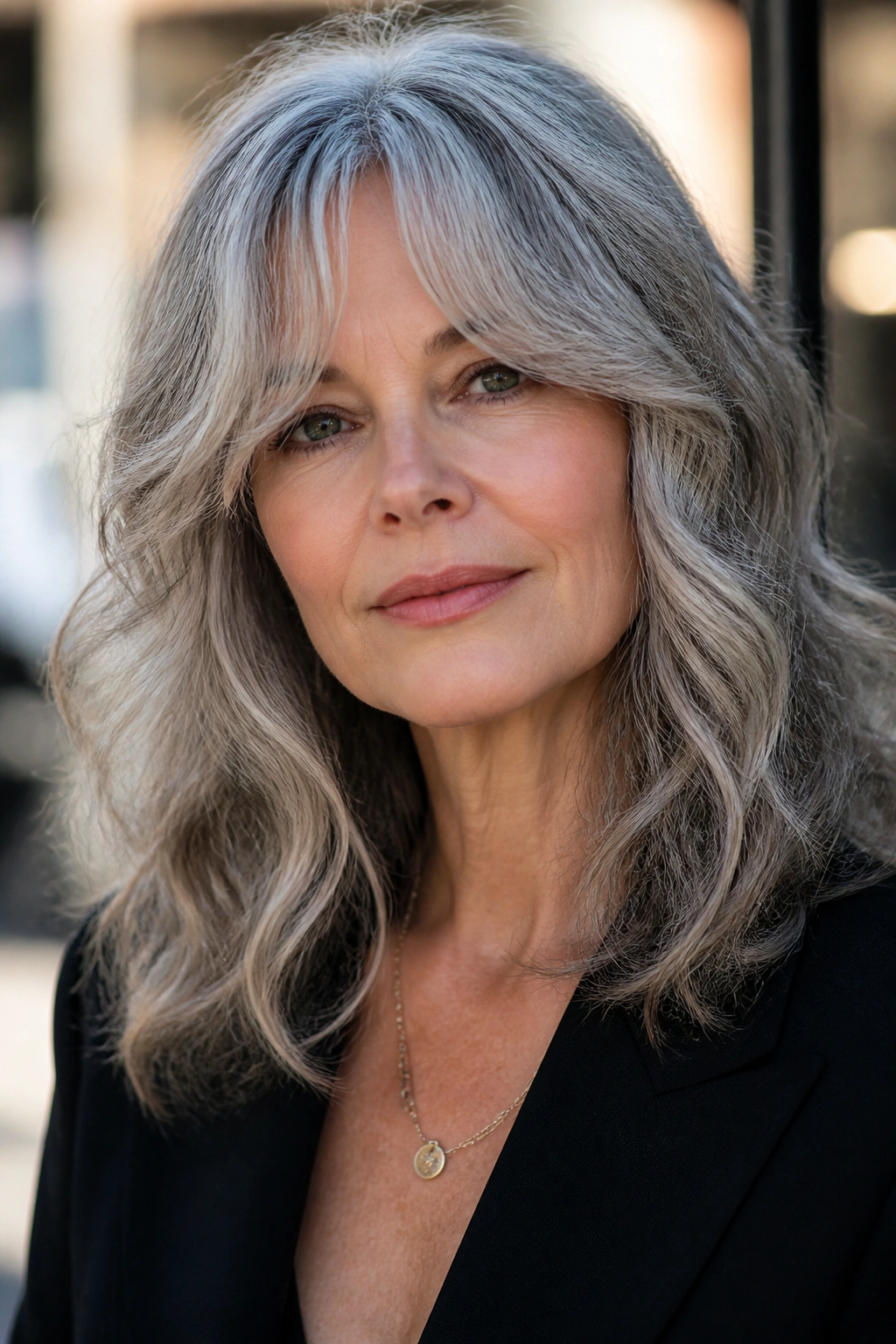
Curtain bangs do a lot of quiet work around the eyes and cheekbones. They break up the forehead, soften the top of the face, and let wavy gray hair keep its movement instead of forcing it into one flat shape.
The trick is length. Curtain bangs that are too short can look choppy and spend all day flipping in odd directions. Bangs that graze the cheekbone or lip line are easier to live with. They can be tucked back on lazy days and styled forward when you want the cut to look more finished.
How to style the bend
A small round brush or a 1-inch curling iron is usually enough. You’re not trying to curl the bangs into ringlets. Just give them a bend away from the face, then let them fall open in the middle.
- Bang length: cheekbone to lip line
- Best for: wavy or soft-textured hair
- Styling product: light mousse or blow-dry cream
- Trim cycle: every 3 to 5 weeks so the shape does not collapse
The rest of the hair can sit at the shoulders or just below them. That length gives the bangs room to matter. If the rest of the cut is too short, the fringe starts competing with the whole head. And that gets annoying fast.
11. A Cut That Respects Natural Curls Instead of Fighting Them

A lot of gray curl cuts go wrong because the hair was shaped like straight hair and expected to behave the same way. It won’t. Curls need space, and silver curls often need moisture even more.
The best curl-friendly cut keeps the curl pattern in mind from the start. That usually means removing weight where the curls pile up and leaving enough length where the curls need support. A dry or nearly dry cut is often smarter than a wet one, because you can see how each curl sits once it springs back.
Unlike a standard layered cut, this approach does not try to flatten the top and bulk out the bottom. It works with the curl families already there. That means fewer triangle shapes, fewer strange poofs at the sides, and less daily arguing with a diffuser.
What to ask the stylist for
- A curl-by-curl or dry-shape approach if possible
- Length that keeps the curl spring from shrinking too far
- Minimal razor thinning unless the hair is extremely dense
- Layers that follow the way your curls naturally fall
If your gray hair is curly and dry at the ends, a leave-in conditioner and a gel-cream mix can help more than heavy oil. Oil alone often sits on top of the strand and doesn’t fix the frizz underneath.
12. An Asymmetrical Bob With a Slight Edge
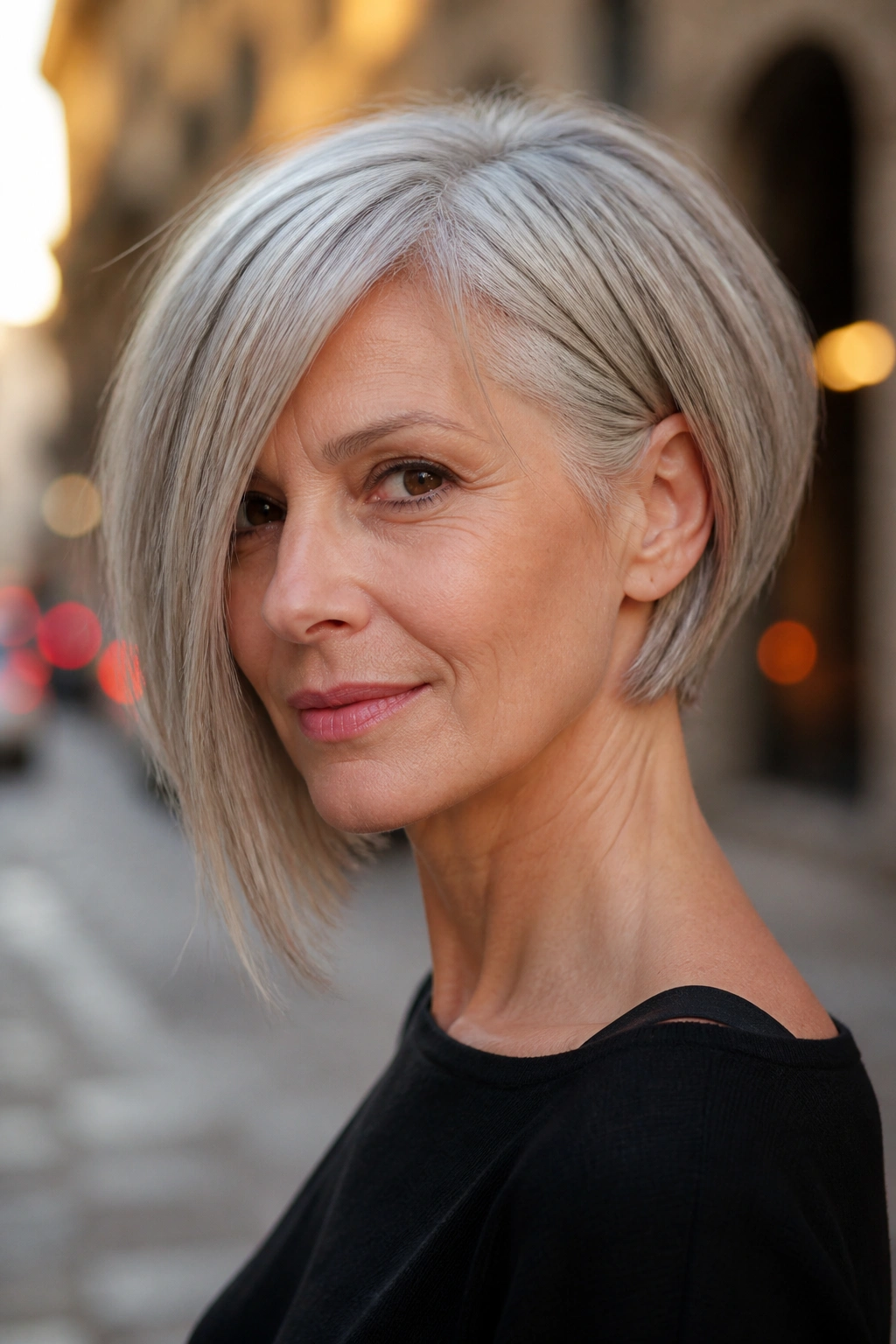
A small asymmetry changes the whole mood of a bob. One side sits a little longer — often by just 1 to 2 inches — and suddenly the cut feels more current without looking fussy.
That tiny difference matters. It pulls the eye diagonally, which can slim a wider jaw or soften a face that feels very square. It also keeps the bob from feeling too perfect, and perfection is not always flattering on gray hair. A little irregularity usually reads better.
This style works best when the longer side is the side you naturally part your hair toward. That lets the length fall in a way that feels easy instead of forced. If you tuck one side behind the ear, the contrast gets even cleaner.
The catch is maintenance. An asymmetrical bob loses its shape faster than a simple one-length bob if you let it grow too long. Every 5 to 7 weeks is a safe trim rhythm if you want the angle to stay obvious.
It’s a neat choice for women who want a little edge but not a haircut that screams for attention.
13. Rounded Layers for Thick Gray Hair

Thick gray hair can look lush, but it can also turn into a wide block if nobody shapes it properly. Rounded layers fix that by keeping fullness where it belongs and taking weight out of the places that make the cut puff out.
The shape is softer than a hard layered shag and less severe than a blunt bob. Think of it as a curved outline with movement built into the inside. The top stays light, the sides bend inward a bit, and the ends don’t pile up into a heavy shelf.
On thick hair, the difference shows fast. The haircut no longer sits on the head like a helmet. It follows the head shape better, which is the whole trick.
This style usually lands from the chin to the shoulders, depending on how much volume you want to keep. A round brush during blow-drying helps set the curve, especially if the hair tends to flare outward at the ends. Keep the brush tension gentle. If you pull too hard, the hair can go flat at the roots and frizzy at the tips.
A soft cream or smoothing lotion on damp hair helps the strands lie together without getting greasy. Gray hair loves to look shiny, but it hates being weighed down. There’s a difference, and it’s a big one.
14. The Mixie for Women Who Want Something Bolder

A little edge is sometimes the kindest thing you can do for hair that’s getting thinner or flatter. The mixie — part pixie, part mullet, part shag — sounds odd on paper and often looks smarter in person than people expect.
What makes it work is the shape. The front and sides stay shorter and sharper, while the back keeps a little more length and texture. That gives the haircut a modern swing, and it can make gray hair feel deliberate instead of apologetic.
Who it suits best
Women who like short hair but want something less classic tend to enjoy this cut. It works on straight, wavy, and lightly curly hair, though the styling changes a bit from one texture to another. If your daily routine is “wash, scrunch, go,” this can fit well.
The part people worry about is the nape. If it’s too long or too uneven, the cut can look like it’s in between styles. If it’s too short, the whole thing loses its shape. That’s why the back needs careful balancing.
Ask for texture, not randomness. A good mixie has intention in the layers and soft edges around the ears. A tiny bit of matte paste is usually enough to keep the shape alive.
It is not for someone who wants a very neat, quiet haircut. That’s fine. Not every head of hair needs to be polite.
15. The French Bob With a Soft Fringe
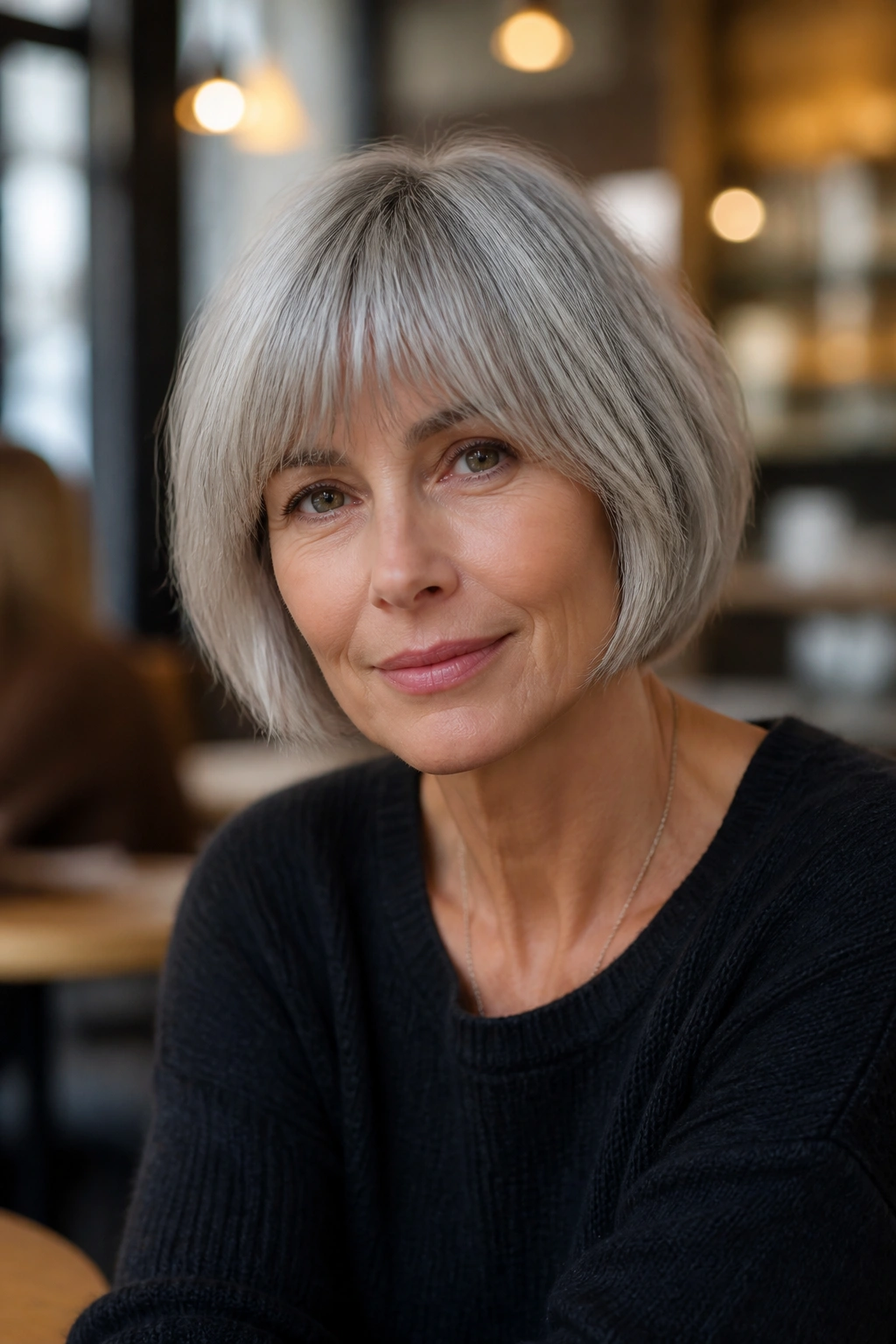
Why do some short bobs look fresh while others look plain? The French bob gets the answer right by keeping the line short, the fringe soft, and the overall shape relaxed enough to move.
The classic length lands around the jaw or a touch above it. The fringe can be full, but on gray hair I usually like it softer — a brow-grazing fringe or a feathered edge around the forehead keeps the style from feeling too hard. When the line is too blunt, the face can get boxed in.
This cut suits women with straight to wavy hair who want a clean shape without the weight of longer lengths. It also works well if your gray hair has a fine texture, because the shorter length makes the strands look denser.
Styling is mercifully simple. A round brush, a quick bend under at the ends, and a touch of lightweight cream are often enough. If you let the fringe air-dry wild, it can split in the middle or stick in odd places, so I’d usually dry that section first.
This is one of the few cuts that can look both sharp and easy at the same time. That balance is the reason it keeps showing up.
16. Long Gray Layers That Keep Length from Looking Heavy
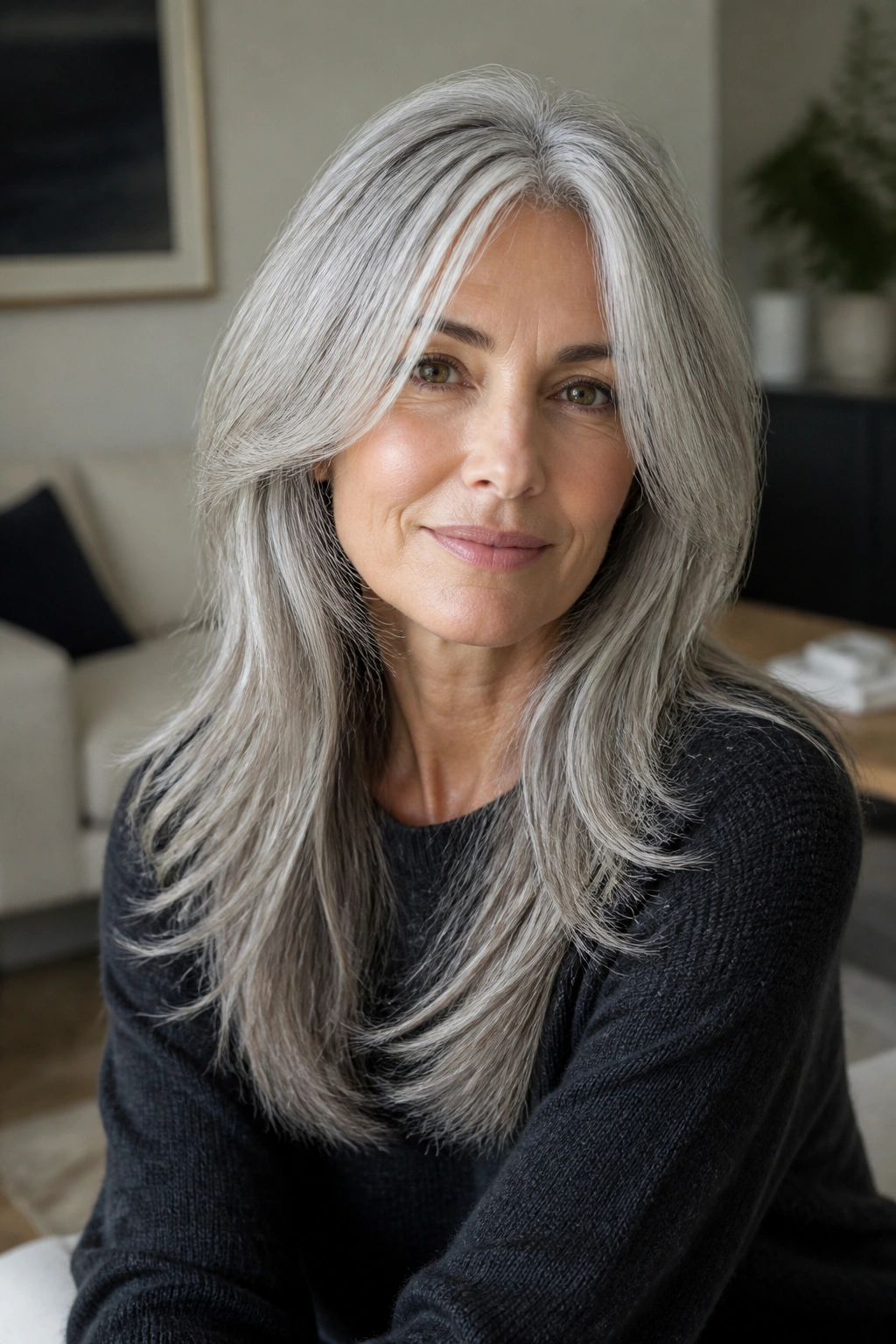
Long gray hair can be beautiful, but only when the shape keeps it from sagging. Heavy, one-length lengths tend to drag the face down and make the ends look thin, especially if the hair has become drier over time.
Long layers solve that by keeping the body near the face and the movement through the middle of the length. The longest pieces can still reach past the shoulders or toward the chest, but the layers stop the hair from sitting like a single sheet.
The parts that matter most
- Ask for layers that start below the cheekbone if you want to keep length
- Keep the ends blunt enough to look full
- Trim every 8 to 10 weeks so the shape does not fray
- Use a light mask, not a heavy butter, if your hair gets dry
This style works especially well if you like low buns, clips, or loose waves. The layers give the hair enough shape when it’s down, and enough flexibility when it’s pulled back. Gray strands also show shine nicely at longer lengths if the cut is healthy at the ends.
A gloss treatment can help if the color has turned dull or yellowed. So can a gentle purple shampoo used sparingly — not every wash, because that can leave silver hair looking flat or slightly dull.
17. A Textured Crop With a Hidden Nape Undercut

There’s a specific moment when this haircut wins people over: the hair at the neck stops puffing out.
That happens because the nape has been narrowed a little underneath, while the top stays textured and full. The undercut is usually hidden, which keeps the style from looking extreme. You get the clean line at the back without advertising it from across the room.
Gray hair that grows thick through the crown and fluffy at the neckline benefits a lot from this. The shape stays light where hair usually gets bulky, and the top keeps enough length to brush forward, lift, or separate with fingers.
The texture is the star here. A small amount of paste or clay rubbed into dry hair gives piece and direction. If you use too much, it turns stiff fast, and stiff short hair is never flattering.
This cut suits women who like a bit of polish with their practicality. It’s quick in the morning, but it still has personality. That’s a hard combo to beat.
18. The Stacked Volume Bob That Lifts Everything Up
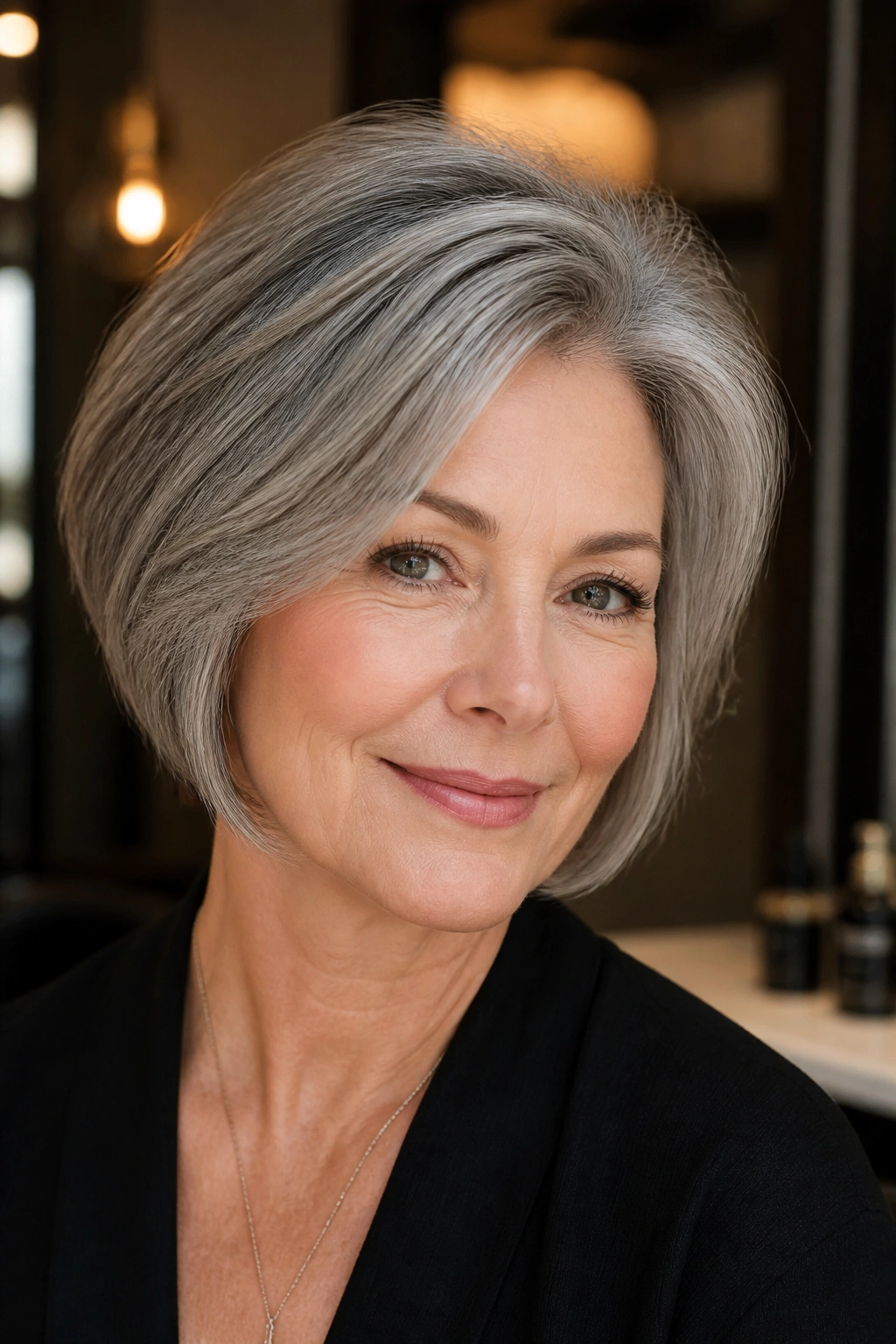
If your hair collapses by lunchtime, a stacked volume bob can change the whole game. The shorter graduation in the back builds lift into the shape, while the front stays longer and softer so the cut doesn’t feel boxy.
The stacked back is doing the heavy lifting. It creates height at the crown and keeps the neckline neat, which matters a lot on gray hair that has started to lose some spring. Done well, the cut makes the head shape look cleaner and the face look more open.
This style is strongest on medium to thick hair, but fine hair can wear it too if the layering is handled gently. Ask for a softer stack if your hair is thin. Too much graduation can make the back look airy in the wrong way, and that is not the goal.
A blow-dry with a round brush or a small vent brush helps set the lift. Aim the airflow up at the roots for a few seconds, then smooth the top and tuck the ends under a little. That small bend under the edge is what keeps the bob from looking dated.
If you want one haircut that makes gray hair look shaped, bright, and awake without a lot of daily effort, this is one of the strongest choices on the list. It’s neat. It has lift. And it doesn’t make you fight your own hair every morning.
Gray hair after 50 does not need to be hidden, and it does not need to be forced into a style that belongs to someone else. The best cuts respect the texture you actually have, keep the outline clean, and leave enough movement for the color to do its work.
A good stylist will look at your density, your face shape, and how much time you want to spend in front of a mirror. That part matters more than the trendiest name on a salon menu. If the haircut suits your hair as it grows, you’ll notice the difference every day.
