



Feathered bangs are the rare fringe that can look soft without looking unfinished. The best versions skim the brows, break into tiny pieces at the temples, and leave enough air over the forehead that the cut feels light instead of heavy. That’s why they’ve stuck around for so long: they don’t fight the rest of the haircut.
The part most people miss is this: feathering is about controlled movement, not random thinning. A good feathered fringe has shape. The ends taper, the center opens up, and the sides melt into the hair around the face. A bad one just looks frayed. There’s a difference, and it shows up fast in daylight.
Not all foreheads want the same fringe. Not all hairlines behave the same way either.
Cowlicks have opinions. So does fine hair. So does thick hair that refuses to lie flat no matter how politely you ask it. That’s why the smartest way to choose feathered bangs is by looking at the cut’s behavior, not just the photo on your phone.
1. Brow-Grazing Feathered Bangs That Skim the Brows
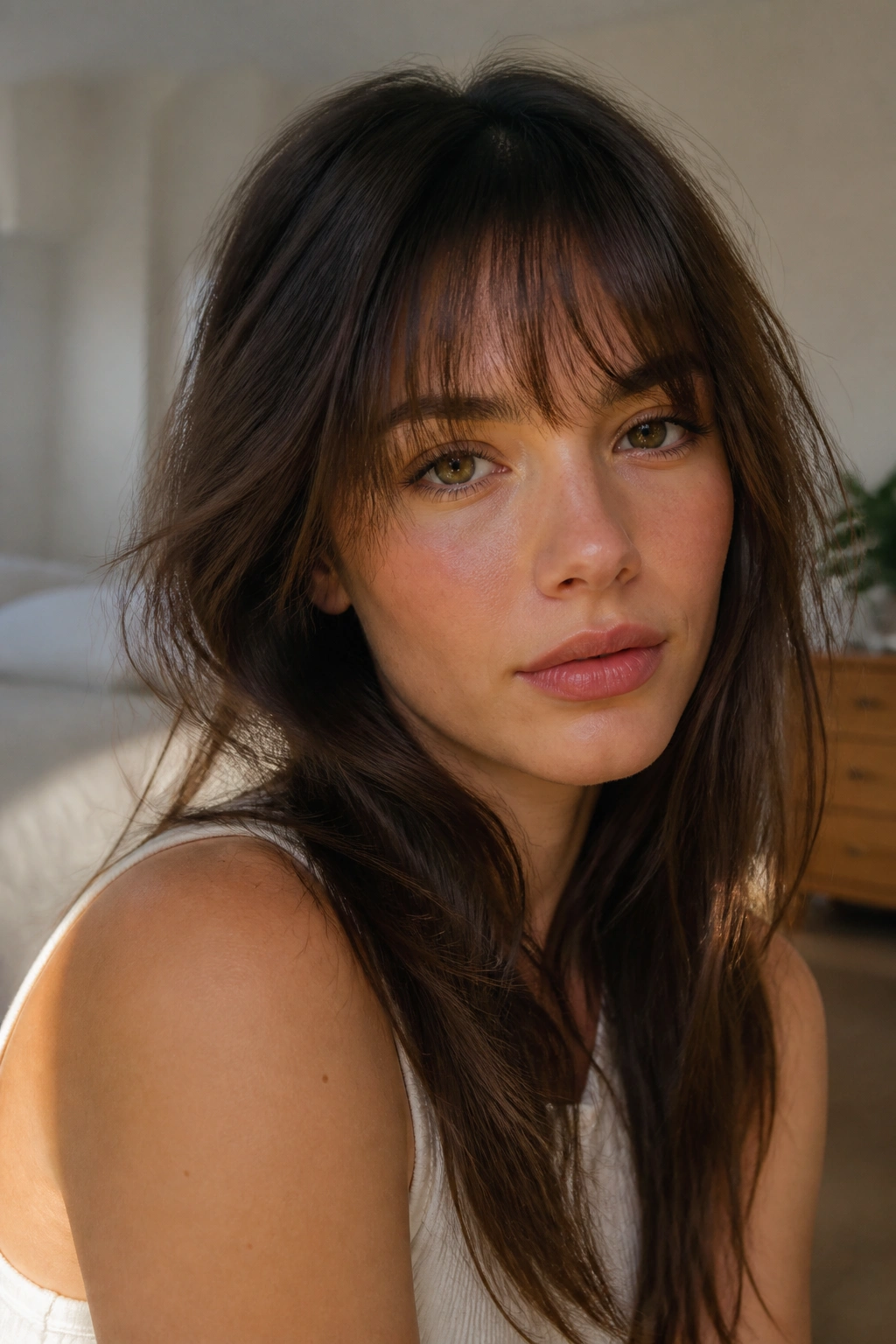
These are the feathered bangs I reach for when someone wants change without drama. They sit right at the brow line, but the ends are softened so they don’t read as a hard shelf across the forehead. The whole point is to keep the eye area open while still getting that little bit of fringe movement.
Why the Brow Line Matters
A brow-grazing cut works because it lands in a place your eye already expects hair to stop. That makes the fringe feel neat even when it’s loose and airy. If it’s cut too short, the feathering can start to look accidental. Too long, and it slips into curtain territory.
- Keep the center pieces just above the brows when dry.
- Leave the outer corners about 1/2 inch longer so the fringe can melt into the sides.
- Ask for point cutting at the ends, not a blunt straight line.
- A 1-inch round brush gives enough bend without turning the bang into a curl.
What I like about this shape is how little work it needs on a normal day. A quick blow-dry with a small brush, a few passes from side to side, and it’s done. The cut does the heavy lifting if the length is right.
Pro tip: If your hairline grows forward or you have a cowlick near one temple, keep the fringe a touch longer on the problem side. That tiny adjustment saves a lot of fighting in the mirror.
2. Curtain Feathered Bangs with a Soft Center Split
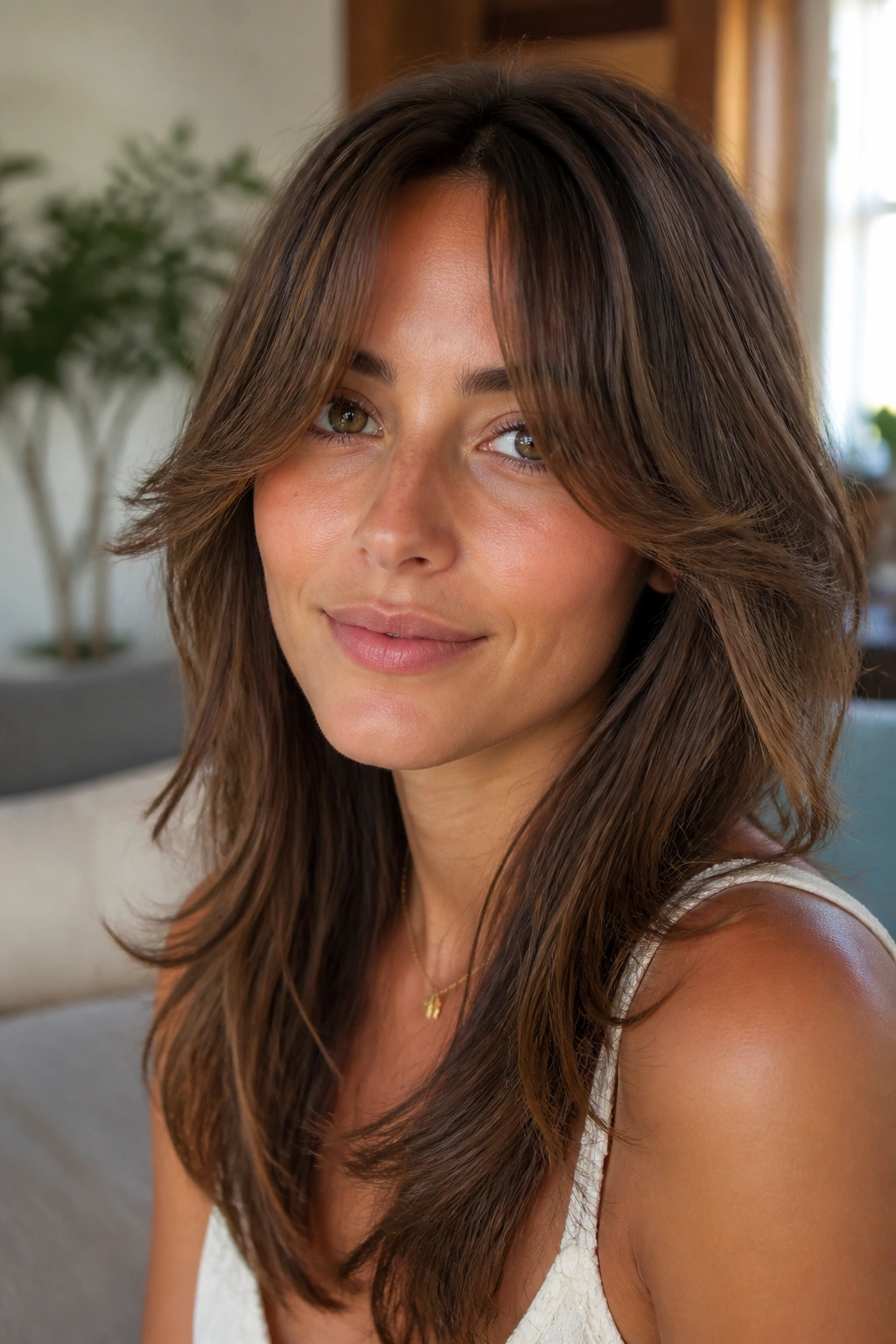
Curtain bangs get better when the ends are feathered, not when they’re over-thinned. A soft center split lets the hair fall away from the face in two loose wings, which keeps the forehead from feeling boxed in. The result is easy, but not lazy. There’s a difference.
This version works especially well if you like a little shape around the cheekbones. The center can start just below the bridge of the nose, then drift longer toward the outer edges. That longer perimeter matters because it keeps the cut from puffing out around the temples. The longest pieces should blend into the face, not hang like separate curtains.
When I style this shape, I dry the center forward first, then push each side away from the face with a round brush. A cool shot at the end helps the bend hold. If you skip that last bit, the hair can collapse back into the middle and lose the split.
Keep a light hand with product. A drop of styling cream through the ends is enough. Too much, and the feathering goes slick instead of soft.
3. Side-Swept Feathered Bangs That Bend Off the Face
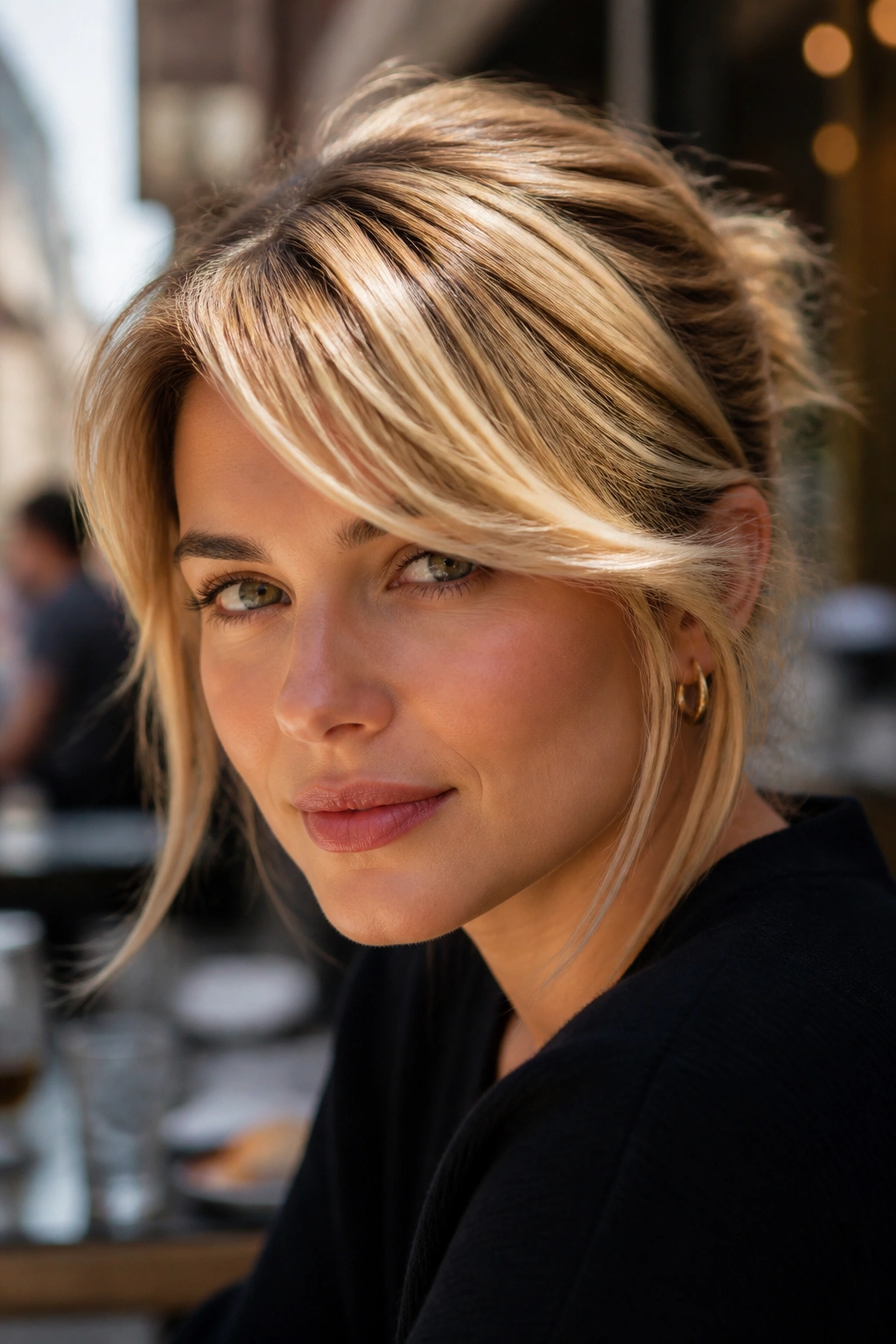
What if you want fringe, but you hate hair landing in your eyes? Side-swept feathered bangs solve that problem without looking stiff. They move in one direction, usually from a deep or medium side part, and they keep the forehead open while still adding a little front weight.
How to Wear It
The shape works best when the longest pieces sweep toward the cheekbone instead of stopping high on the temple. That gives the bang a softer line and keeps it from feeling abrupt. A small root lift spray at the front helps, especially if the hair naturally falls flat.
- Start the part about 1 to 1 1/2 inches off center if you want a strong sweep.
- Blow-dry the fringe across the forehead first, then guide it sideways with your fingers.
- Keep one corner slightly longer so the shape has somewhere to land.
- Use a light mist of texture spray at the end, not enough to make the hair gritty.
One thing I like here: a stubborn front cowlick can actually help. It pushes the fringe into the sweep instead of fighting against it. That sounds annoying, and sometimes it is, but on this cut it can be useful.
4. Bottleneck Feathered Bangs with a Narrow Center
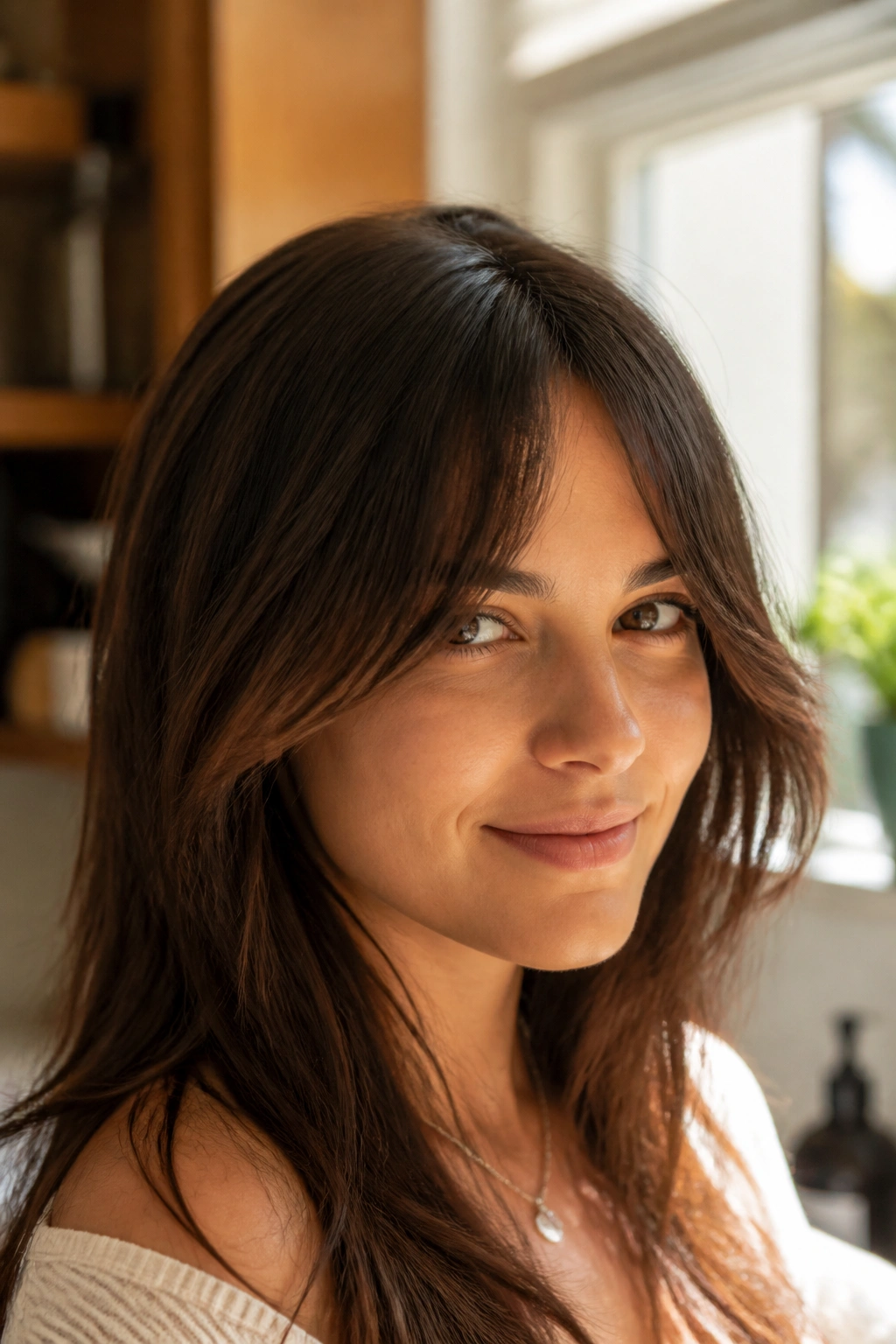
Picture a fringe that starts narrow in the middle and opens wider near the temples. That’s the bottleneck shape, and feathering makes it feel much softer. The center is the shortest part, then the hair gradually lengthens out on both sides like the neck of a bottle widening at the base.
This shape flatters people who want a little frame without a full curtain split. It gives the forehead a break at the center, then leads the eye outward toward the cheekbones. The whole cut feels gentle, but it still has a point of view.
What the Shape Needs
- A shorter center section that sits near the brow line when dry.
- Longer side pieces that can reach the outer cheek area.
- A clean transition, which usually means careful point cutting rather than heavy texturizing.
- Enough length to clear glasses frames if you wear them.
That last point matters more than people think. If the center lands right on top of your frames, the fringe starts to compete with your glasses. Keep it a little higher or a little lower so the line stays clean.
The bottleneck shape is one of my favorites for anyone who wants movement but not a lot of face coverage. It looks deliberate. It behaves.
5. Razor-Cut Piecey Feathered Bangs
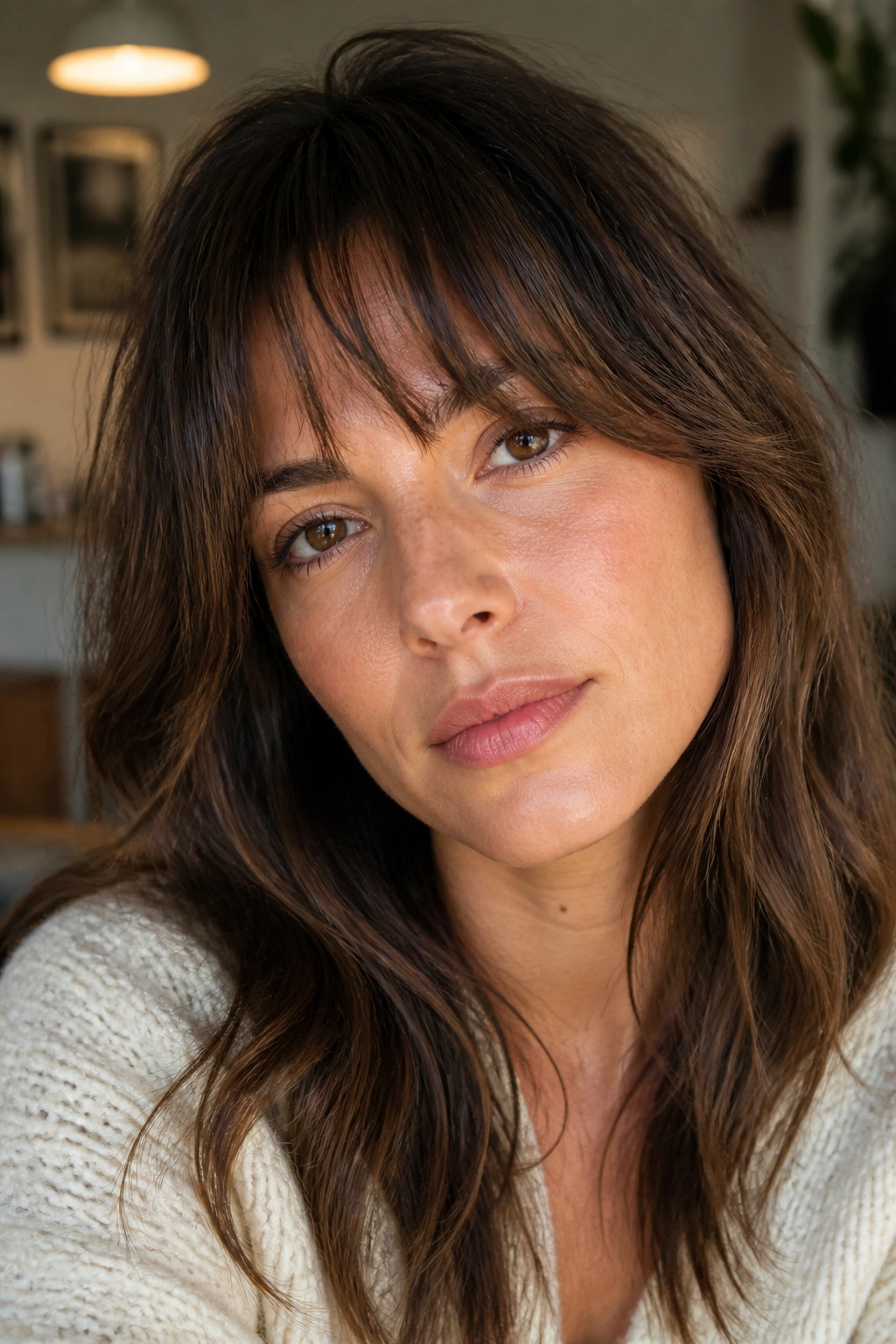
A razor can give feathered bangs a broken edge that scissors can’t fake. The hair falls in slimmer ribbons, so the fringe reads light from a distance and still has a little texture up close. It’s sharp, but not harsh when it’s done well.
But it is not forgiving.
I like this cut on hair that already has some bend or natural separation. On very fine hair, a razor can make the ends look too wispy if the stylist gets heavy-handed. On coarse hair, it can help remove bulk, but only if the person cutting knows when to stop. Overdoing it is how you get fuzz instead of shape.
The best way to wear razor-cut feathered bangs is with a small amount of air and movement. Rough-dry them first. Then use your fingers, not a brush, to push the strands where they want to sit. A tiny bit of dry texture spray can help the pieces stay visible without turning the fringe stiff.
I reach for this look when someone wants bangs that feel a little undone on purpose. It has edge. It also has rules, which is why it can look expensive or chaotic depending on the cut.
6. Shag-Blended Feathered Bangs with Built-In Texture
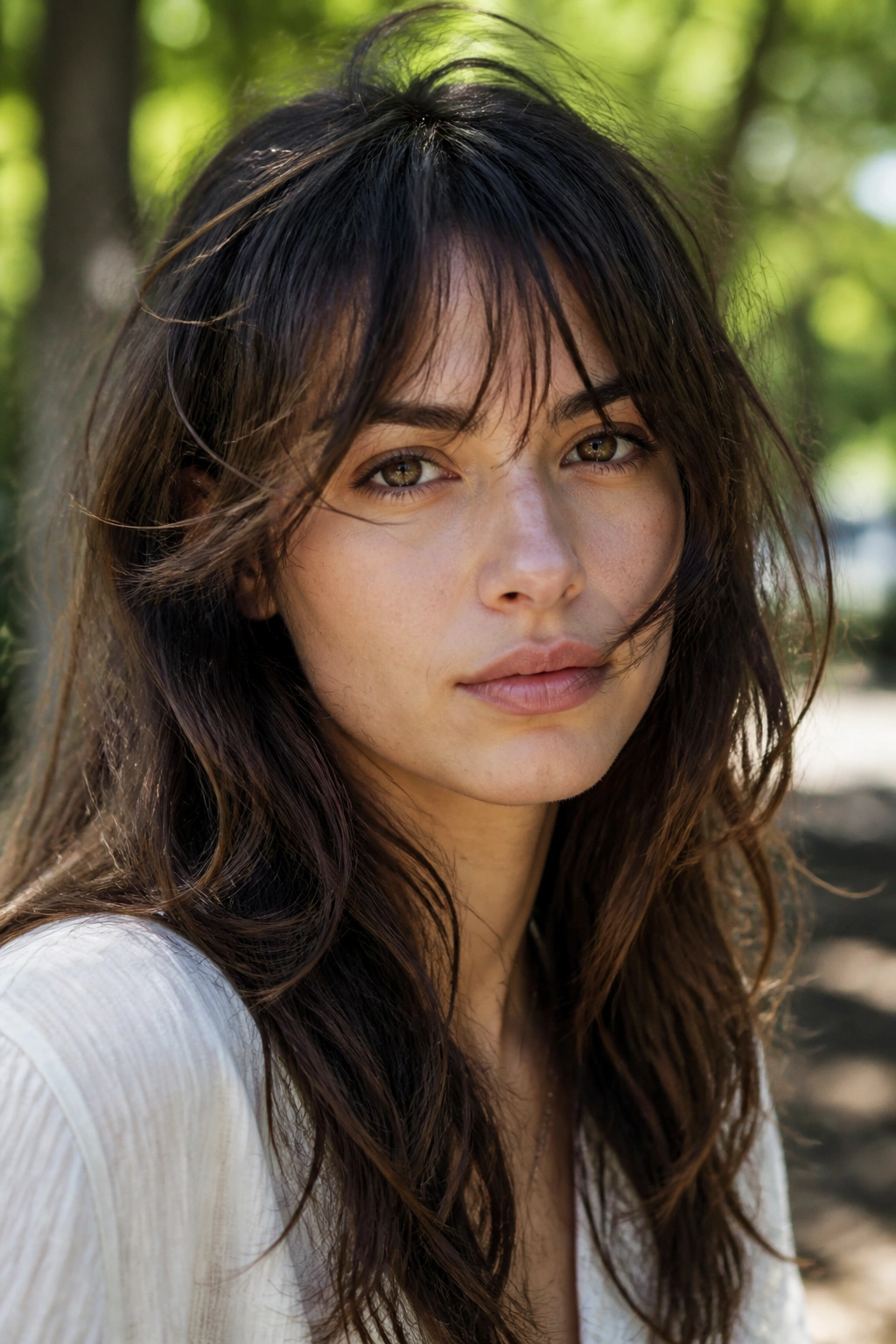
Unlike a stand-alone fringe, this version lives inside the haircut. The bangs don’t stop at the forehead; they roll straight into the front layers of a shag, so the whole top section feels connected. If you already wear a shag, this is the bang shape that makes the haircut make sense.
The real advantage is how little separation you need to style. The fringe can be broken up, swept, or left a little messy because the rest of the cut already has movement. That means less time with a round brush and fewer moments of trying to force hair into place it never wanted.
This is a strong choice for medium to thick hair with a natural wave. On very straight hair, the shape can still work, but it may need a touch of bend from a blow-dryer or flat iron. On very fine hair, too much layering can make the top go flat, so keep the feathering controlled.
If you want one sentence to bring to a stylist, make it this: keep the bang connected to the temple layers so it grows out in the same direction as the haircut. That’s the part people skip, and then the fringe looks disconnected two weeks later.
7. Cheekbone-Skimming Feathered Bangs That Frame the Eyes
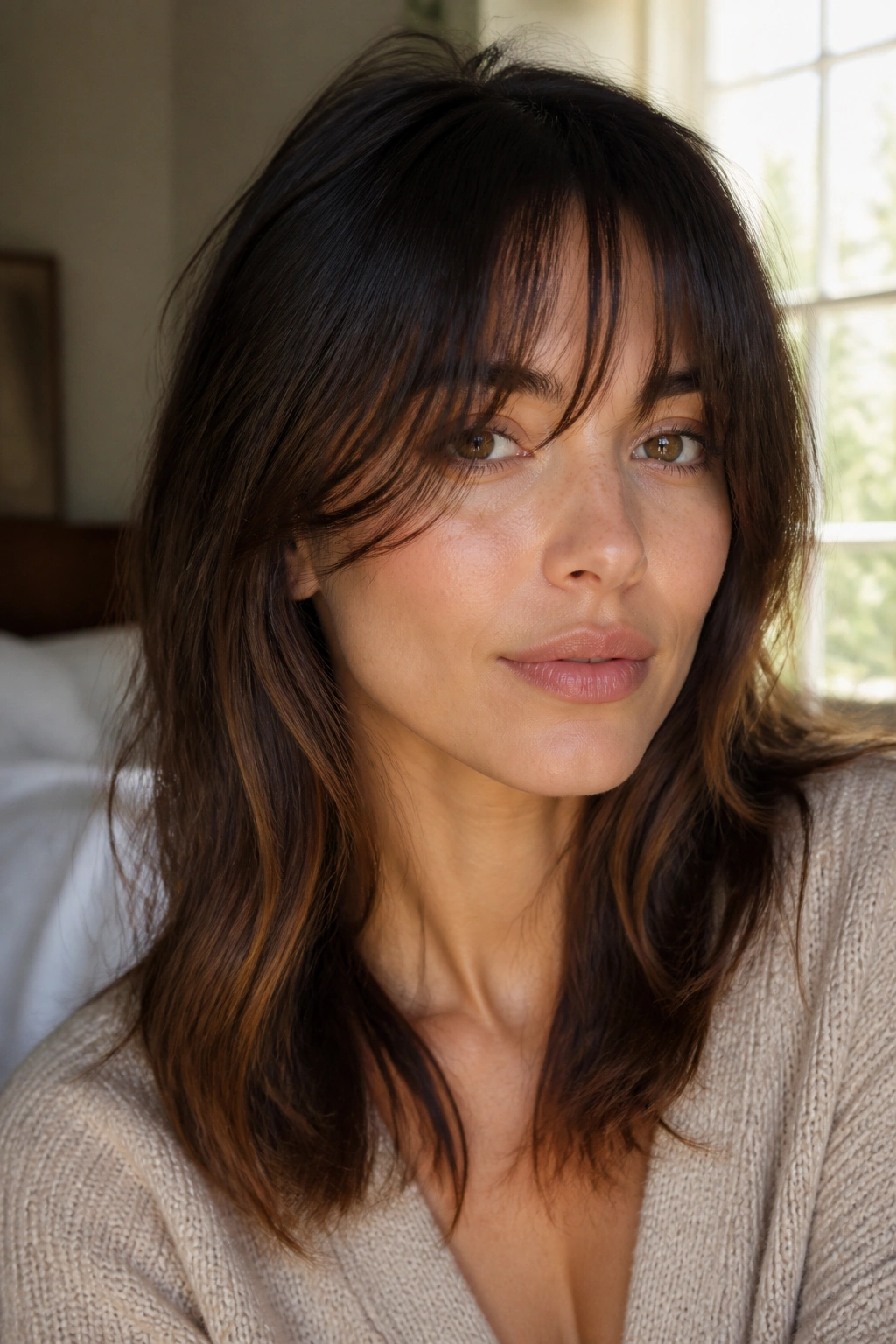
These bangs are all about where they stop. The shortest pieces hover near the brow, but the real action happens lower, around the upper cheekbone. That long diagonal gives the face a little lift without covering the eyes.
Why the Eye Area Looks Softer Here
When the fringe opens at the cheekbone, it creates a frame instead of a block. The eye area stays visible, and the hair around the temples softens the edges of the face. It’s one of the easiest ways to make bangs feel light without making them short.
- Keep the center just long enough to brush the lashes when dry.
- Let the outer corners fall toward the cheekbone, not the jaw.
- Use a small round brush to create a soft bend away from the face.
- Trim every 5 to 7 weeks if you want the shape to stay crisp.
I like this style most on people who want the fringe to do the flattering work without shouting. It gives structure, but not in a blunt, heavy way. The hair moves when you move. That matters.
The biggest mistake is cutting the sides too short. Once the corners lose their length, the whole thing can pop out awkwardly instead of folding into the haircut.
8. Airy French Fringe with Light, Separated Ends
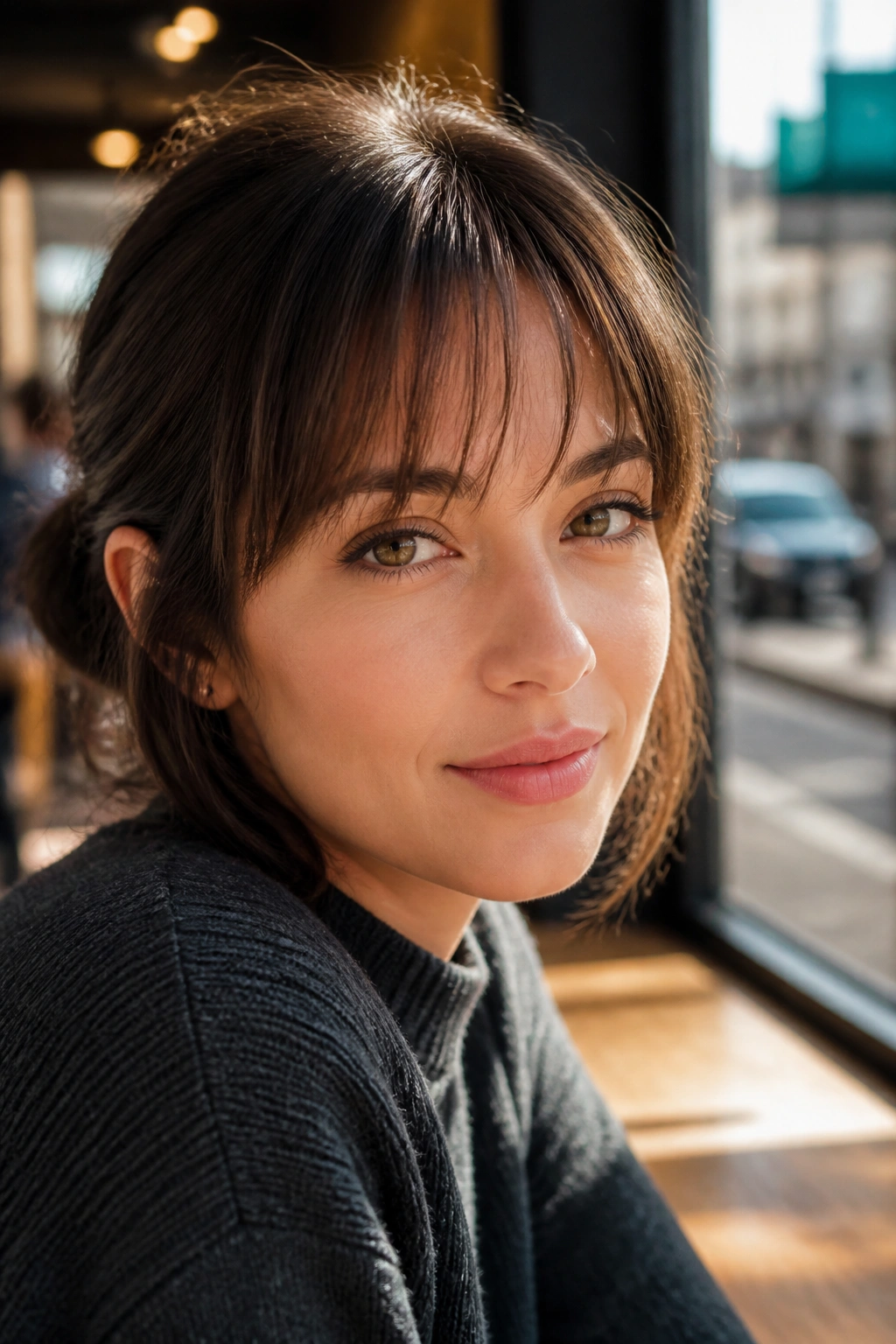
French fringe gets heavy fast when it sits in a block. Feathering fixes that. It breaks up the line so the bangs feel airy and a little imperfect, which is exactly why the style has such easy charm when it’s done right.
The key is to keep the ends separated enough that you can see skin between the pieces. Not a lot. Just enough. That negative space stops the fringe from acting like a solid curtain and gives the hair a lived-in look. Soft separation is the whole game here.
I’d keep this one for hair that doesn’t need a lot of correction across the forehead. If the fringe is too dense, the French shape loses its lightness. If it’s too sparse, it can look like you forgot to finish the cut. The middle ground is where it shines.
A little styling cream on dry fingers is usually enough. Push the hair forward, then split the ends with your fingertips. If you want more bend, a quick pass with a flat iron on the outer corners can help, but keep the iron moving. Holding it too long makes the fringe look too set, and that kills the whole point.
9. Arched Feathered Bangs with a Soft Curve
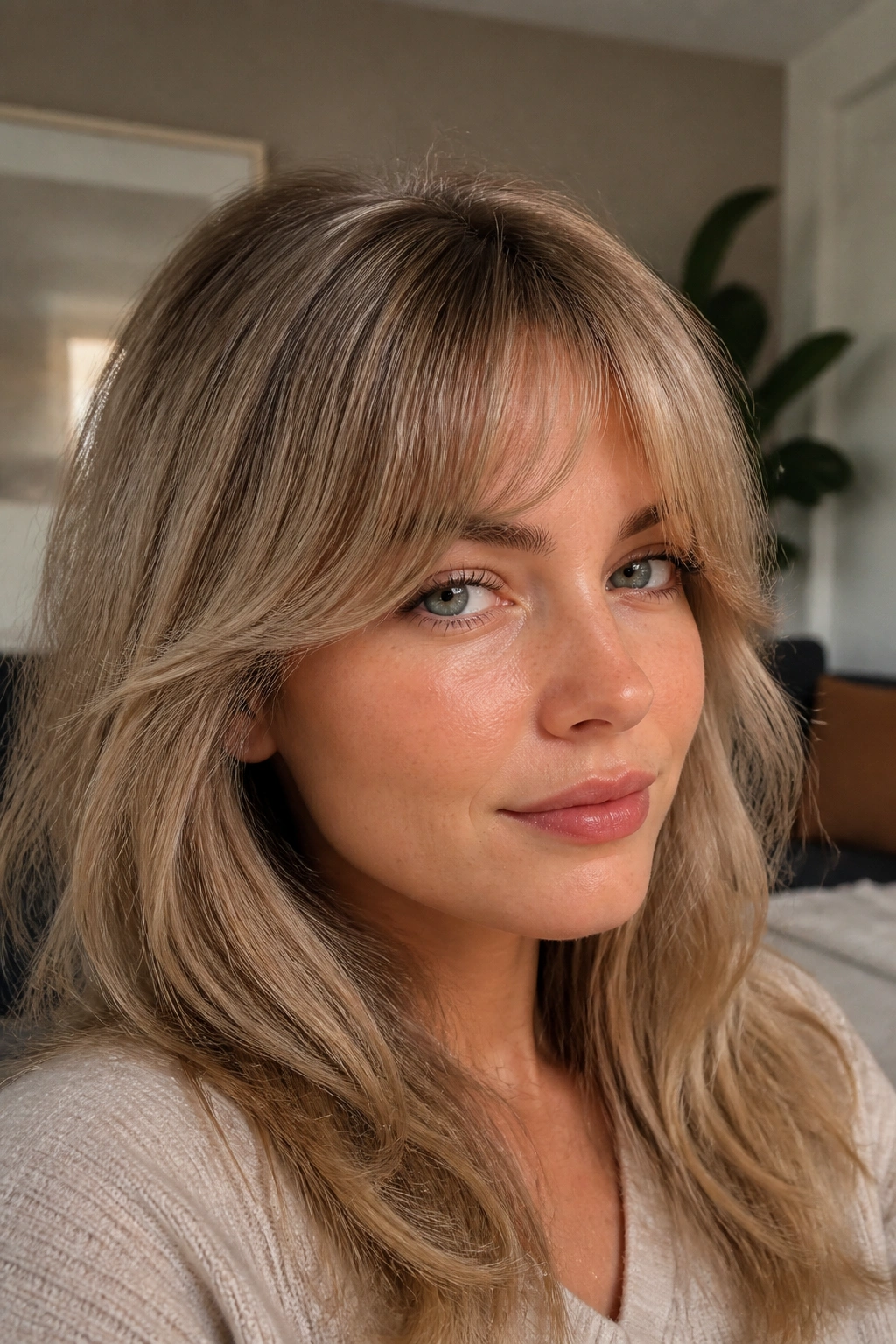
Why do arched bangs work so well on some faces and not others? Because the curve changes the whole mood of the fringe. A soft arch lifts the center a bit higher and lets the sides sit lower, which makes the bangs feel shaped instead of square.
This style is especially useful if you want a little structure around a longer forehead. The curve pulls the eye inward and downward, which can make the front of the haircut feel more balanced. On a round face, keep the arch subtle. Too much curve can shorten the face more than you want.
How to Ask for the Curve
Ask for the center to sit slightly shorter than the corners, with the length dropping slowly as it moves outward. The feathering should be fine enough that the edge looks soft, not scalloped. That detail matters. A scalloped fringe looks dated fast.
A good arched feathered bang should still move. It should not sit like a little helmet. If it does, the curve is too rigid or the hair has been cut too bluntly at the bottom.
I like this style with a blow-dry brush and a cool finish, because the curve holds better when the roots are set early. Once the shape is in place, the rest is easy.
10. Feathered Bangs for Fine Hair That Need Lift
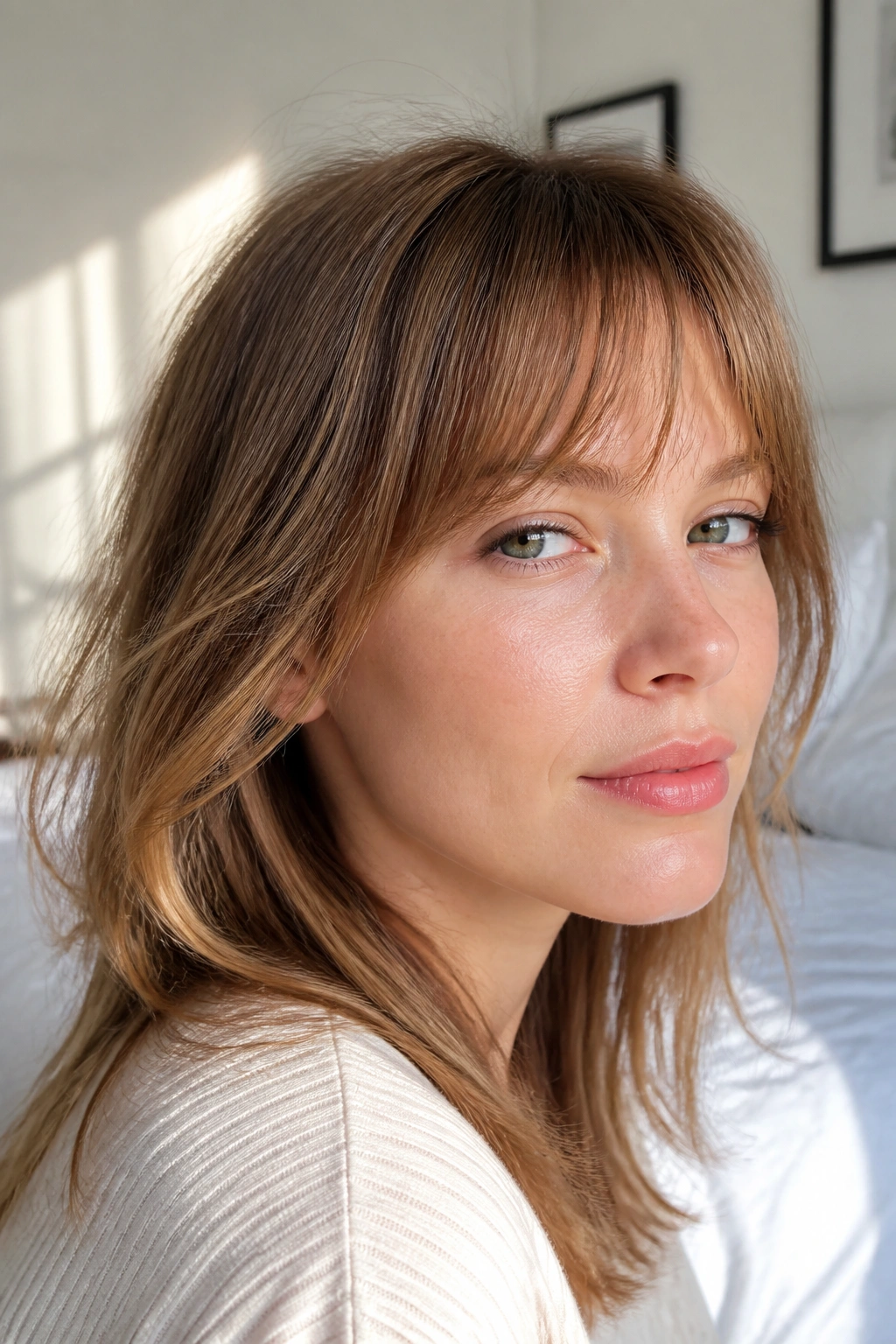
Fine hair needs a different kind of feathering. Too much thinning and the bangs start to vanish. Too little and they collapse into a flat strip across the forehead. The sweet spot is controlled lightness with enough density left behind to keep the fringe visible.
What Fine Hair Needs Most
- Keep the fringe slightly longer than you think, because fine hair can shrink when it dries.
- Ask for internal removal, not aggressive thinning at the surface.
- Use a root-lift mousse at the base, then blow-dry the bangs from side to side.
- Avoid heavy oils near the front. They make the hair separate in a limp way.
What I prefer here is a cut that looks fuller at the roots and softer at the tips. That gives the fringe a little body without turning it thick. If the ends are too sparse, the front reads stringy. If the roots are too flat, the whole thing disappears against the forehead.
Fine hair also gets overworked easily, so this is not the fringe for piling on product. A little goes a long way. Seriously.
The best version of feathered bangs for fine hair should still have a visible edge when you look straight on, but it should move when you tilt your head. That little swing is the sign the cut has enough life.
11. Feathered Bangs for Thick Hair That Need Removal
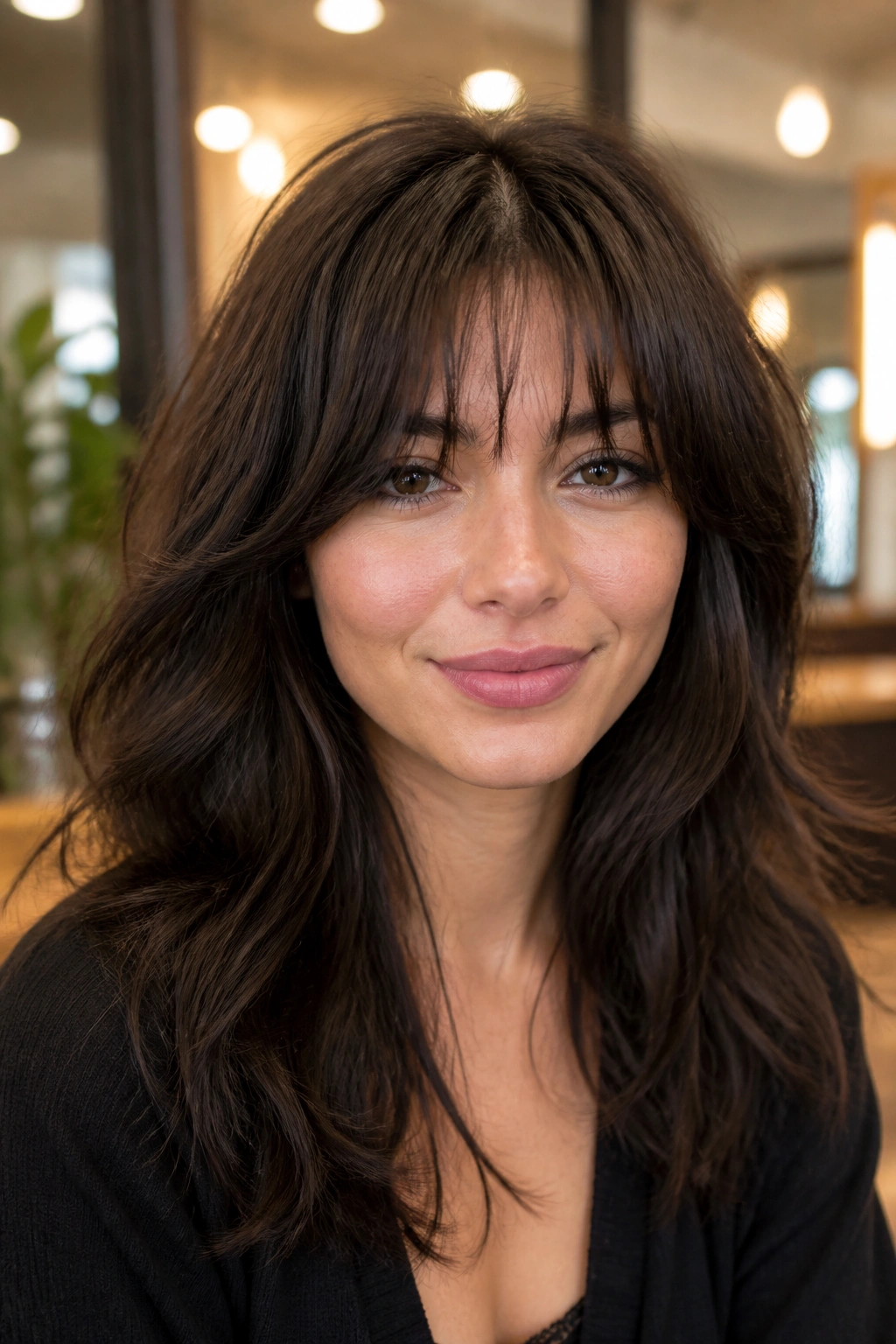
Thick hair is where feathered bangs can either look gorgeous or turn into a puffball with opinions. The cut has to remove weight without wiping out the shape. That means thoughtful layering near the front, not a wild thinning session that leaves the ends dry and see-through.
Less hair is not the goal.
The real job is to make the bangs sit flatter at the root and lighter at the edge. For thick hair, I like a stylist to work in small sections and keep the perimeter of the fringe a little stronger than they might on fine hair. That perimeter helps the bangs hold their line instead of exploding outward in humidity.
A dry cut helps here because thick hair often shows its true shape only when it’s not wet and clinging together. You can see the bulk spots, the cowlicks, and the places that need more removal. It’s not glamorous work, but it saves a lot of mistakes.
The downside is maintenance. Thick hair can push bangs around faster than most people expect, so a trim every 4 to 6 weeks keeps the fringe from swallowing the face. Let it grow too long, and the feathering gets buried.
12. Feathered Bangs for Wavy Hair with Loose Bend
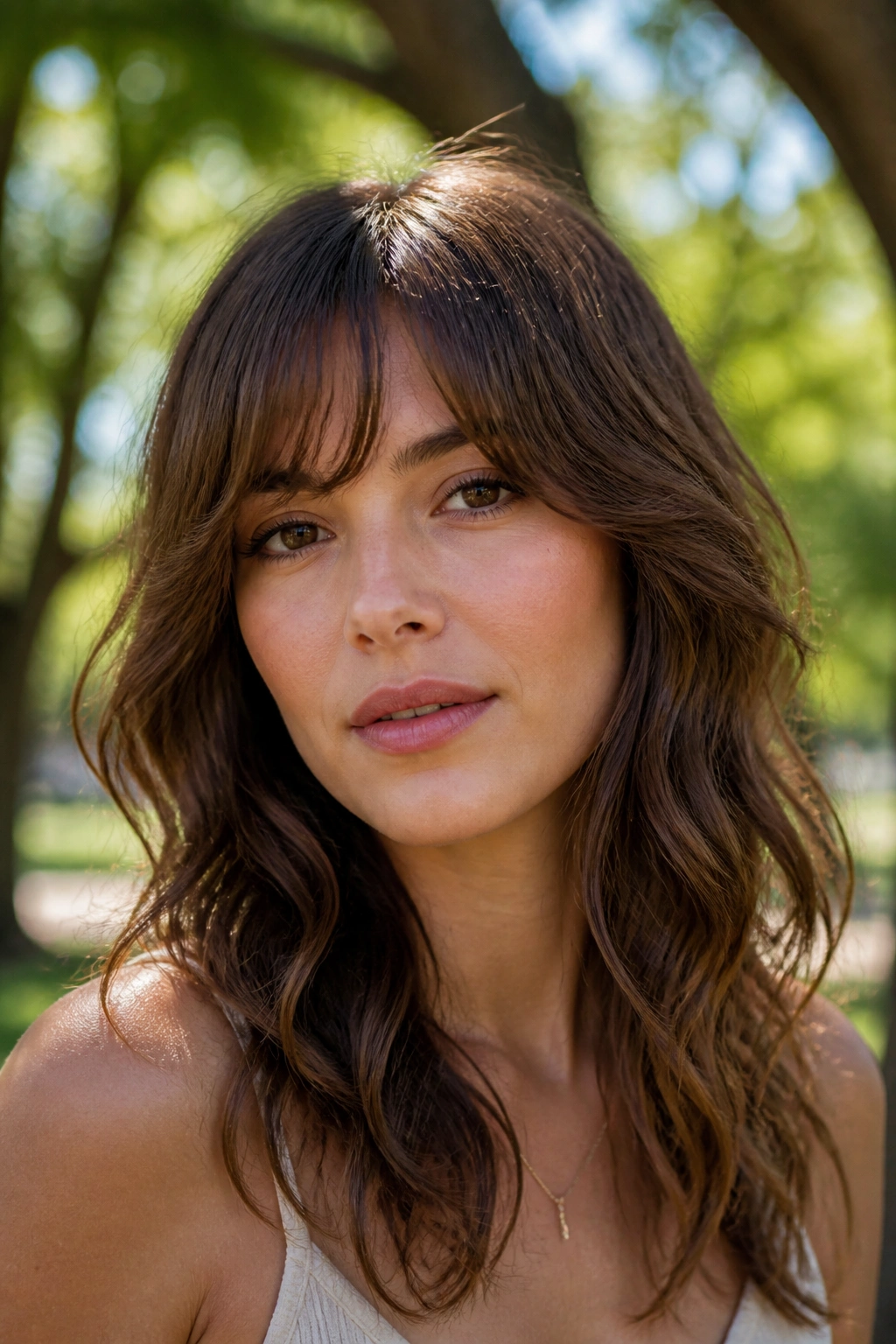
Wavy hair already wants to do half the work for you. That’s why feathered bangs on a loose wave tend to look natural without a lot of heat. The bend gives the fringe shape, and the feathering keeps it from getting too bulky at the center.
Unlike straight hair, wavy hair doesn’t need a hard curve forced into it. It wants room. Leave the bangs a touch longer than a straight-hair version so the wave doesn’t spring up too high once it dries. A half-inch of extra length can make the difference between soft and too short.
This is a good place to use a light mousse or cream on damp bangs, then either air-dry with a clip at the roots or diffuse on low. I like to scrunch the ends once, then leave them alone. Too much handling can separate the wave in a choppy way.
If your waves fall unevenly, that’s fine. Feathered bangs can handle a little irregularity. In fact, they often look better when they don’t try too hard.
13. Feathered Bangs for Curly Hair That Stay Soft
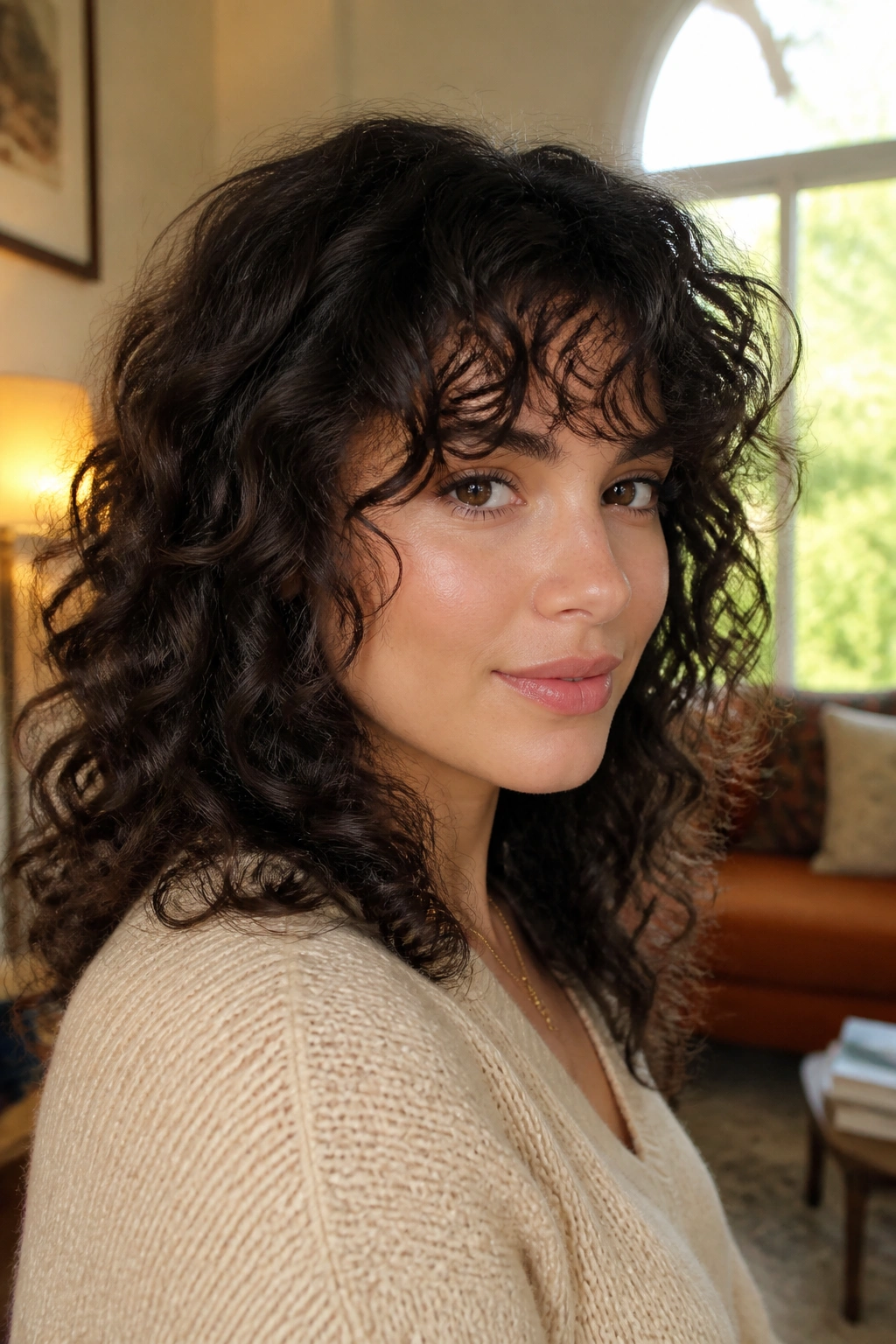
Curly bangs need to be cut like curly bangs, not like straight hair pretending to be curly later. That means dry cutting or cutting in a curl pattern the stylist can actually see. The feathering should follow the curl, not fight it.
How Curl Changes the Cut
Curly hair shrinks more than people expect, especially near the front where the curl pattern can be tighter than it is at the sides. I’d rather see a fringe cut a little long and refined after drying than one that lands too high and has nowhere to go. The shortest curl usually springs higher than the eye thinks it will.
- Cut the fringe in its natural curl state whenever possible.
- Leave the length a little below the intended finished point so shrinkage doesn’t bite.
- Use a light cream, not a heavy butter, to keep the shape soft.
- Refresh with water and fingers, not a brush that stretches the curl flat.
What I love here is the softness. Curly feathered bangs don’t need to look perfectly separated to work. They just need enough structure that the front doesn’t puff into a helmet. That’s the line to watch.
A curly fringe should move like curls, not sit like bangs that are trying too hard. When it does, the feathering feels effortless in the best way.
14. Feathered Bangs for Straight Hair with a Dry Texture Finish
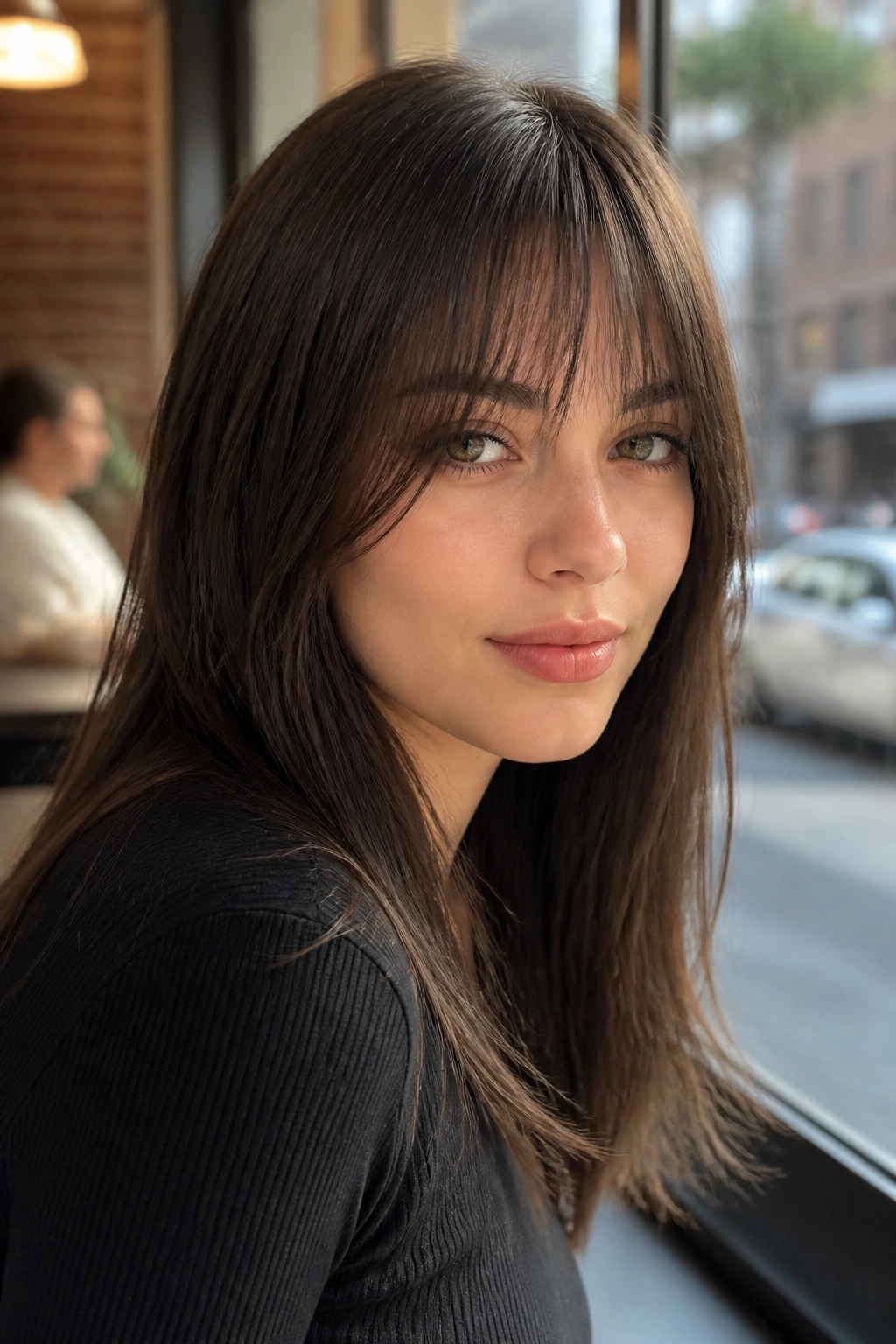
Straight hair can make feathered bangs look too neat if you stop at the cut. The fringe needs a little grit and a little bend, or it can fall into a flat strip that feels more school picture than soft texture. That’s why a dry finish matters so much.
The easiest fix is to rough-dry the bangs first, then bend only the ends with a flat iron. Use small sections, about 1 inch wide, and turn the iron just enough to break the line. Don’t curl them. A tiny bend is enough. The goal is separation, not polish.
A texture spray sprayed from mid-length to ends can help the fringe hold its piecey look. Keep it light. Too much product on straight hair makes the bangs sticky, and then they stop moving. That dead, coated look is the enemy here.
Straight hair is also the most honest hair. If the cut is uneven, you’ll see it. If the feathering is too aggressive, you’ll see that too. That’s useful, even if it’s a little unforgiving. It tells you exactly what needs fixing.
15. Feathered Bangs on a Pixie Cut for a Soft Edge
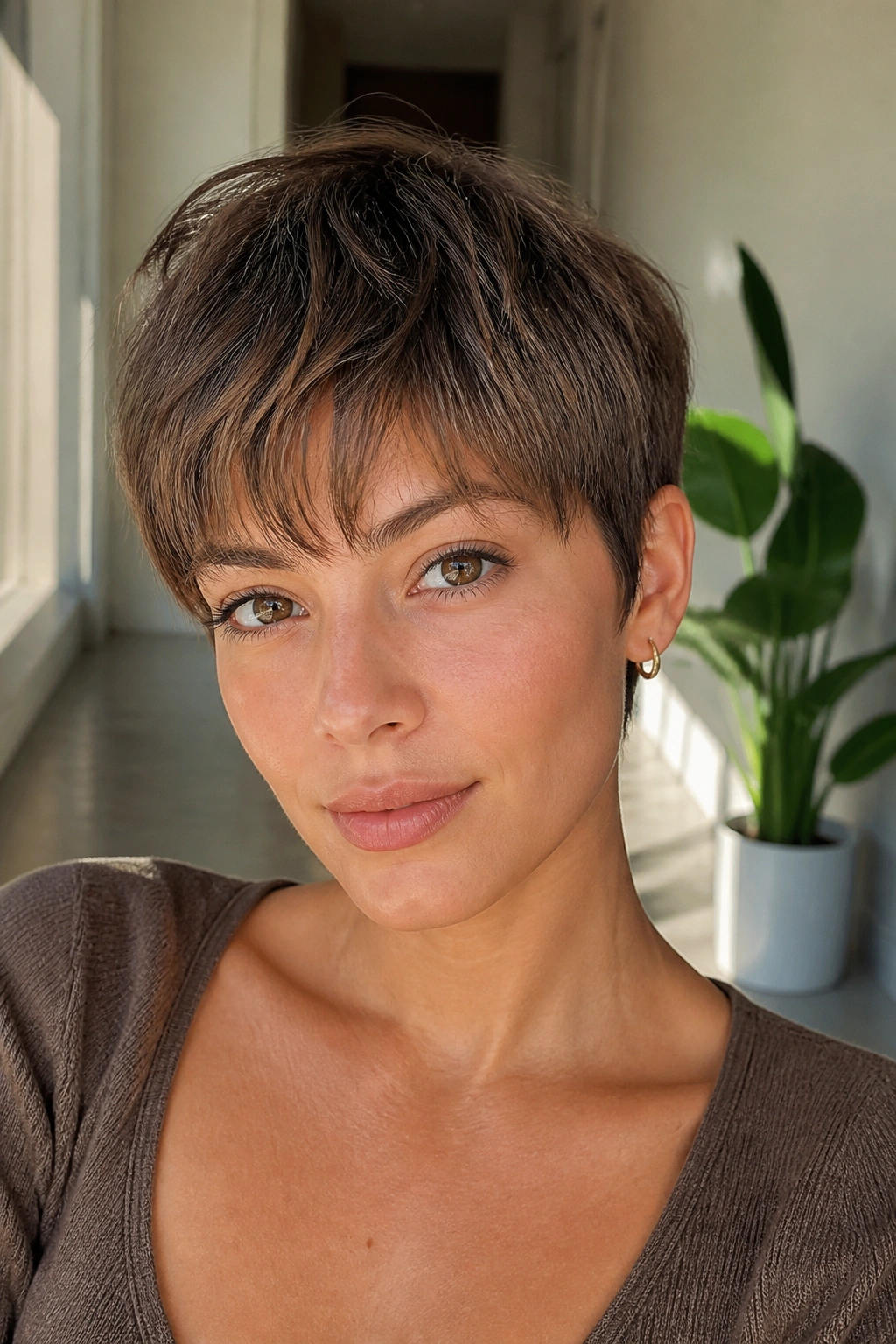
Can a pixie cut carry bangs without looking severe? Absolutely. A feathered fringe softens the front edge of a pixie and keeps the haircut from turning into a hard cap shape. The bangs don’t have to be long; they just need enough movement to break the line at the forehead.
The best pixie fringe usually lands somewhere between the brow and the top of the eyes, then tapers at the sides so it melts into the short layers around the ears. That taper matters more than length. Without it, the front can feel chopped off.
How to Ask for It
- Keep the center a little longer than the temples.
- Ask for soft point cutting, not blunt scissor cuts.
- Leave enough length for the fringe to sweep sideways if you want flexibility.
- Pair the bangs with a slight texture on top so the whole pixie feels connected.
A pixie with feathered bangs works because it gives the haircut a front edge that feels human. Sharp pixies can look amazing, but they can also feel severe fast. A feathered fringe fixes that in one move.
I like this version most when the person wants short hair but not a stern look. It has a little softness, and that softness goes a long way.
16. Face-Framing Feathered Bangs That Blend into Layers
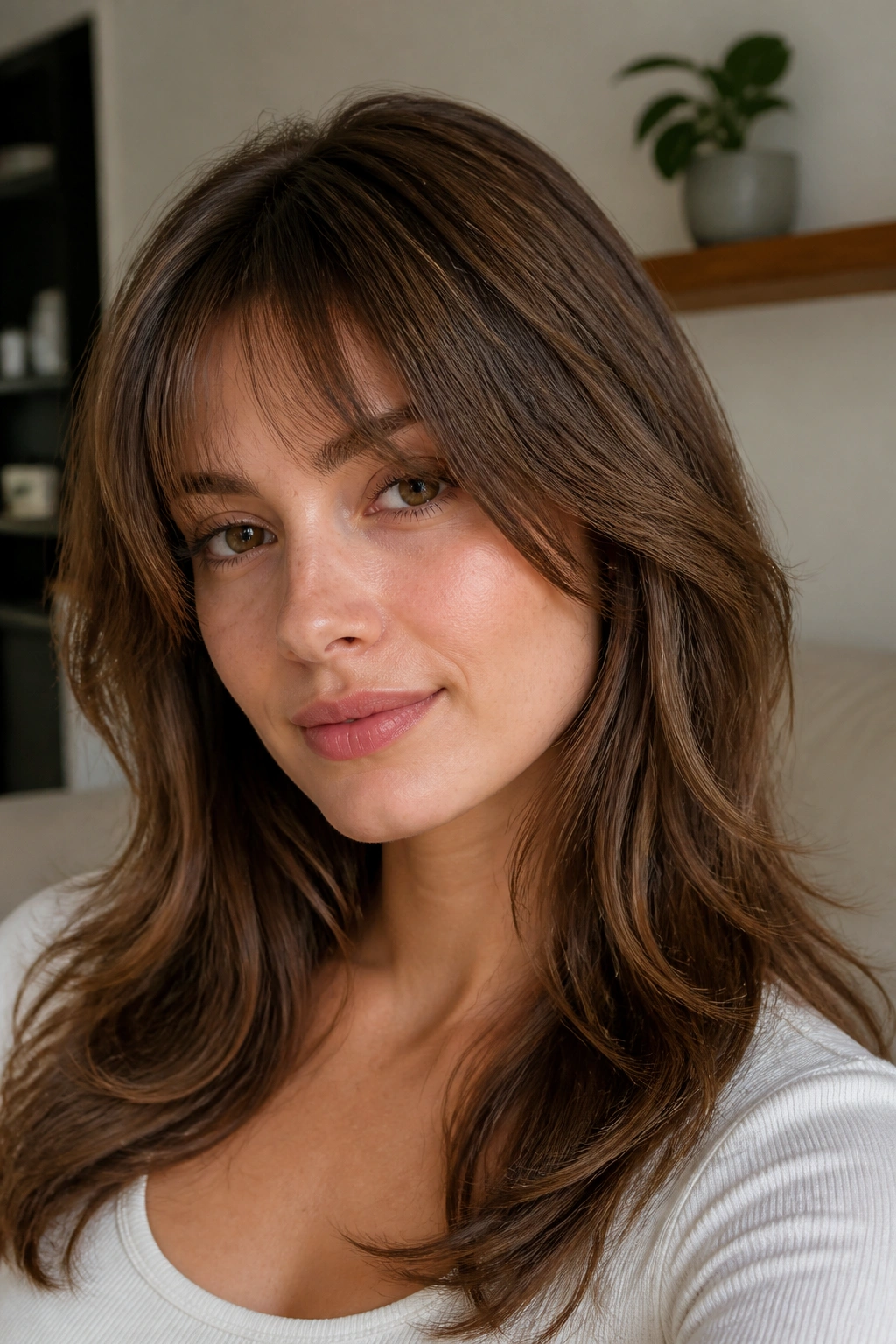
This is the version for anyone who wants bangs but doesn’t want a clear line of demarcation on the forehead. The fringe starts near the temples and then blends into face-framing layers that carry the shape down toward the cheeks and jaw. It’s bangs, but in a quieter register.
You can think of it as a soft transition rather than a separate feature. The front still gets movement, but the eye doesn’t stop at the bang line. Instead, the hair leads into the rest of the cut. That’s what makes it feel easy as it grows.
Key Details to Ask For
- Start the shortest pieces around the outer edge of the eyebrow or temple.
- Let the longest front pieces drop toward the cheekbone or jawline.
- Keep the ends feathered so the fringe doesn’t sit like a chunk.
- Blend the sides with the rest of the haircut, not on top of it.
This style is handy if you like changing your part often. Since the bangs are already tied into the layers, they can swing center, side, or slightly off-center without looking broken. That flexibility is the real win.
17. Grown-Out Feathered Bangs That Still Look Intentional
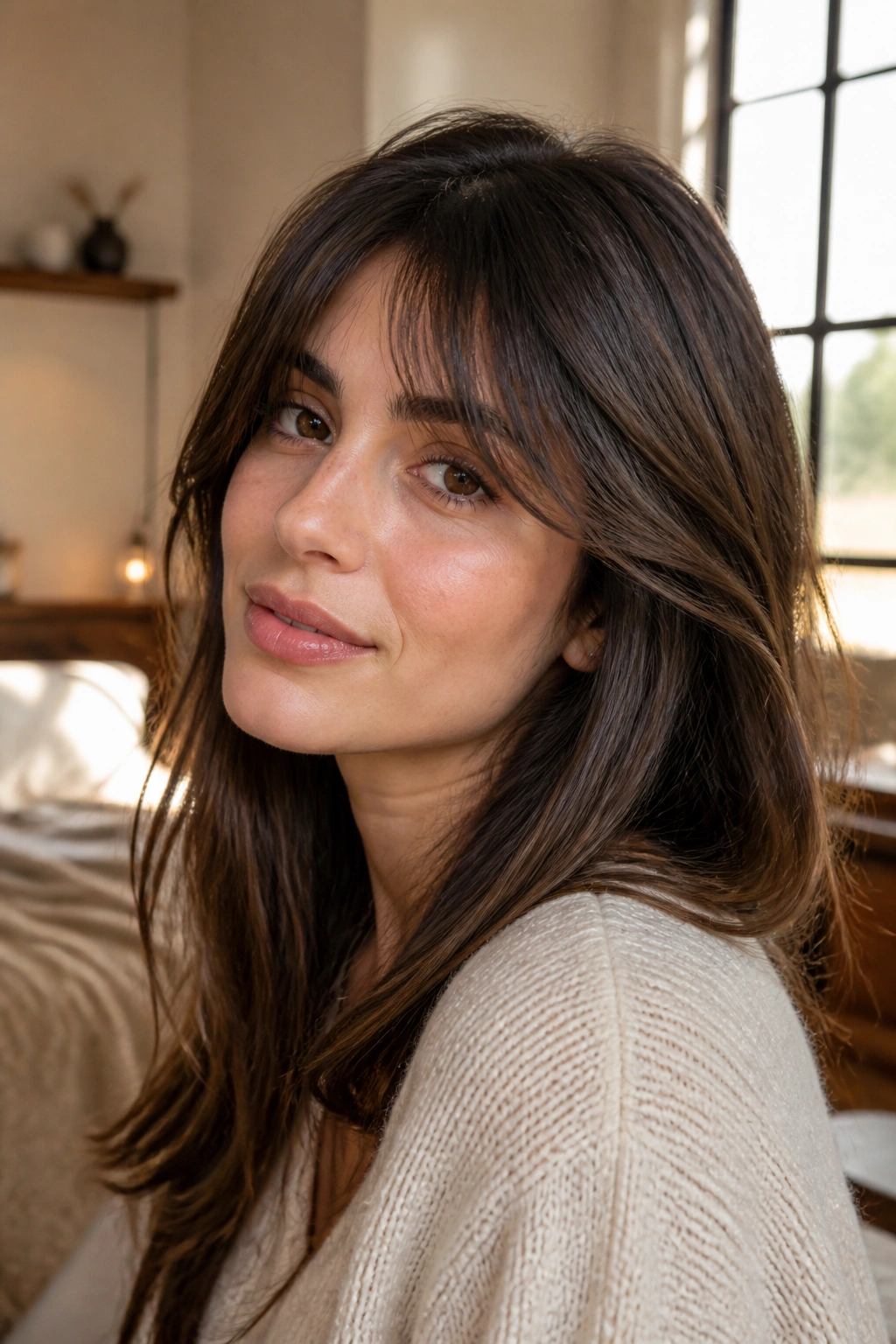
Grown-out bangs are usually where people panic. They hit the awkward middle, the shape feels fuzzy, and everyone starts pinning hair back like it’s a temporary problem. Feathering changes that. A grown-out feathered fringe can look intentional if the corners are kept long and the center stays light.
Messy is not the same as grown-out.
The trick is to keep the outer pieces long enough to blend into the front layers while trimming the center just enough to keep it off the eyes. A soft side part or a loose center part can make the whole shape feel on purpose. You don’t need the fringe to disappear. You need it to shift from obvious to easy.
I also like a very light texturizing mist on this version, but only at the ends. That helps the bangs separate without turning dry and frayed. If the shape starts looking stringy, the spray is probably too heavy or too close to the root.
This is the fringe for people who are tired of fighting their grow-out and want to make peace with it. It works because it accepts the in-between stage instead of pretending it isn’t there.
18. Soft Feathered Bangs with a Round-Brush Finish
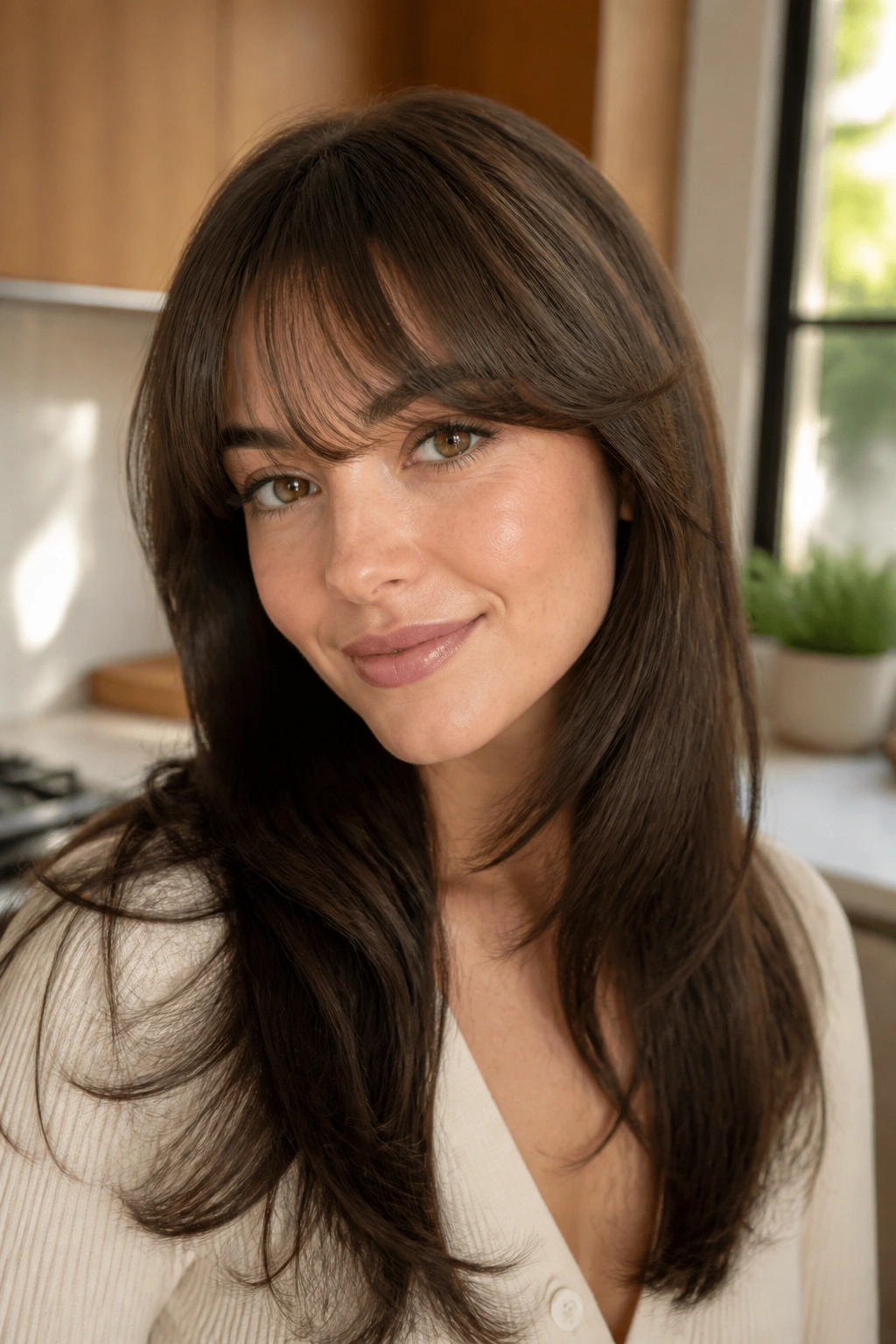
Air-dried feathered bangs have charm. Round-brush feathered bangs have polish. The difference is small on paper and obvious in real life: one looks relaxed, the other looks finished. If you like your fringe to sit neatly but still move, this is the version to keep close.
The round brush gives the front a slight bend, not a curl, and that tiny curve helps the feathered ends tuck into the haircut. I like a 1 to 1.25-inch brush for most lengths. Smaller brushes create too much roll. Larger ones can flatten the fringe before the roots set.
This style is especially good for people who want a front section that behaves on a normal morning. Dry the bangs from side to side, roll the ends under just a touch, then hit them with a cool shot. If you skip the cool air, the shape falls faster. That part annoys people, but it’s true.
What I’d recommend, after all these versions, is this: choose the feathered bang that matches how you actually live. If you want something quick, keep the cut longer and looser. If you want a cleaner line, keep the center shaped and the edges soft. The best feathered bangs move with your head, not against it.
