



A wedding updo has a brutal job. It has to sit through hours of movement, survive hugs from people who lean in from odd angles, hold up under lights, and still look calm in close-up. If the hair slips, puffs, or starts fraying at the crown, the whole look can feel off in a way that photographs notice fast.
Classic wedding updos keep coming back because they solve that problem without making a fuss. They give the face shape, keep the neckline clean, and make room for veils, combs, pins, and earrings without turning the whole head into a crowded little stage. That balance is the trick.
Messy ends don’t belong here.
The best bridal styles have structure first and softness second. A good bridal bun, chignon, French twist, or tucked roll should look deliberate from the front and secure from the back, even when the camera catches the side of the head or the nape of the neck. That means paying attention to pin placement, weight distribution, and where the volume sits.
And yes, the dress matters. So does the neckline. So does the hair texture. A sleek satin gown usually wants a cleaner silhouette, while lace, tulle, and beaded necklines can handle a softer finish with a few loose pieces around the face. The styles below cover the classics that actually earn their place.
1. French Twist
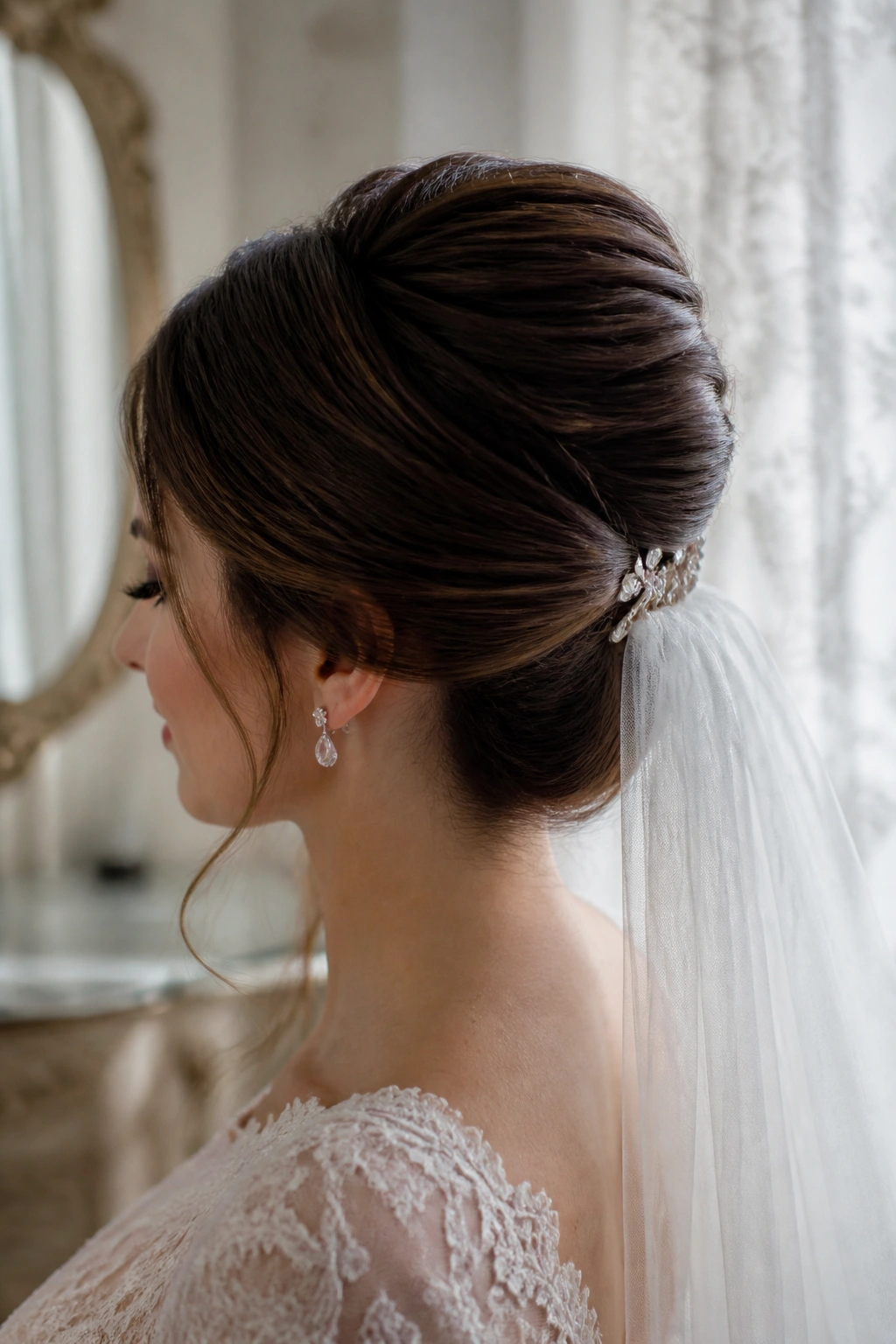
The French twist is one of those wedding hairstyles that never looks try-hard. It pulls the hair upward, folds it inward, and leaves you with a long, elegant line that feels refined without being stiff. There’s a reason stylists keep returning to it for formal weddings: it frames the head beautifully from the side, and it gives a veil comb a very stable place to sit.
Why it works so well
A French twist creates vertical lift, which is useful if the bride wants to lengthen the neck and sharpen the profile. It also keeps the hair compact, so the style won’t fight with earrings or a high collar. The shape is clean enough for a black-tie gown, but it can soften easily with a few tucked tendrils or a little texture at the crown.
- Best on medium to long hair.
- Holds especially well when the hair has a bit of grit from setting spray or light texturizing spray.
- Works with a veil that attaches low or just above the twist.
- Looks best when the twist is narrow and the surface is smooth, not shellacked.
Tip: Ask for a twist that sits slightly off the center of the head if your face is very long. A tiny shift makes the style feel less severe.
2. Low Chignon
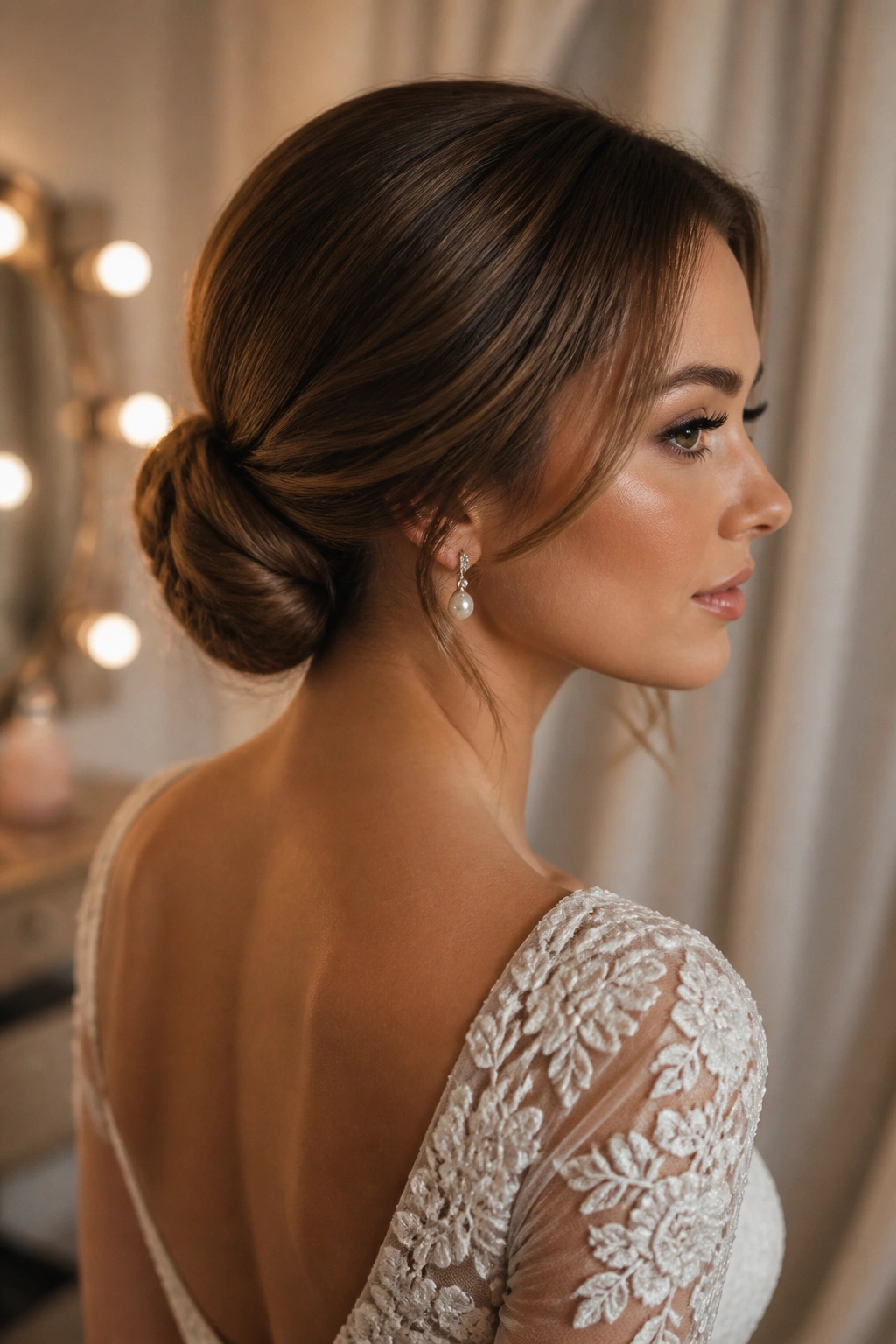
A low chignon is the safe bet that never feels lazy. It sits at the nape, usually in a neat coil or folded knot, and gives the whole look a grounded, polished shape. If the French twist is the sleek one with a little drama, the chignon is its softer cousin.
The reason brides love it is simple: it plays well with almost every dress neckline. Bare shoulders, boat necks, illusion lace, square necks — the chignon doesn’t argue with any of them. It also handles hair accessories without getting crowded, especially pearl pins or a comb placed just above the bun.
What I like about a good chignon is how calm it feels. Not flat. Calm. There’s a difference. If the texture is too smooth, it can look a bit severe, so a little movement through the top and sides helps. If the hair is very thick, the bun can get bulky fast, so the goal is a compact shape with enough pinning to hold the curve at the back.
This is the style for someone who wants to look finished, not fussy.
3. Sleek Ballet Bun
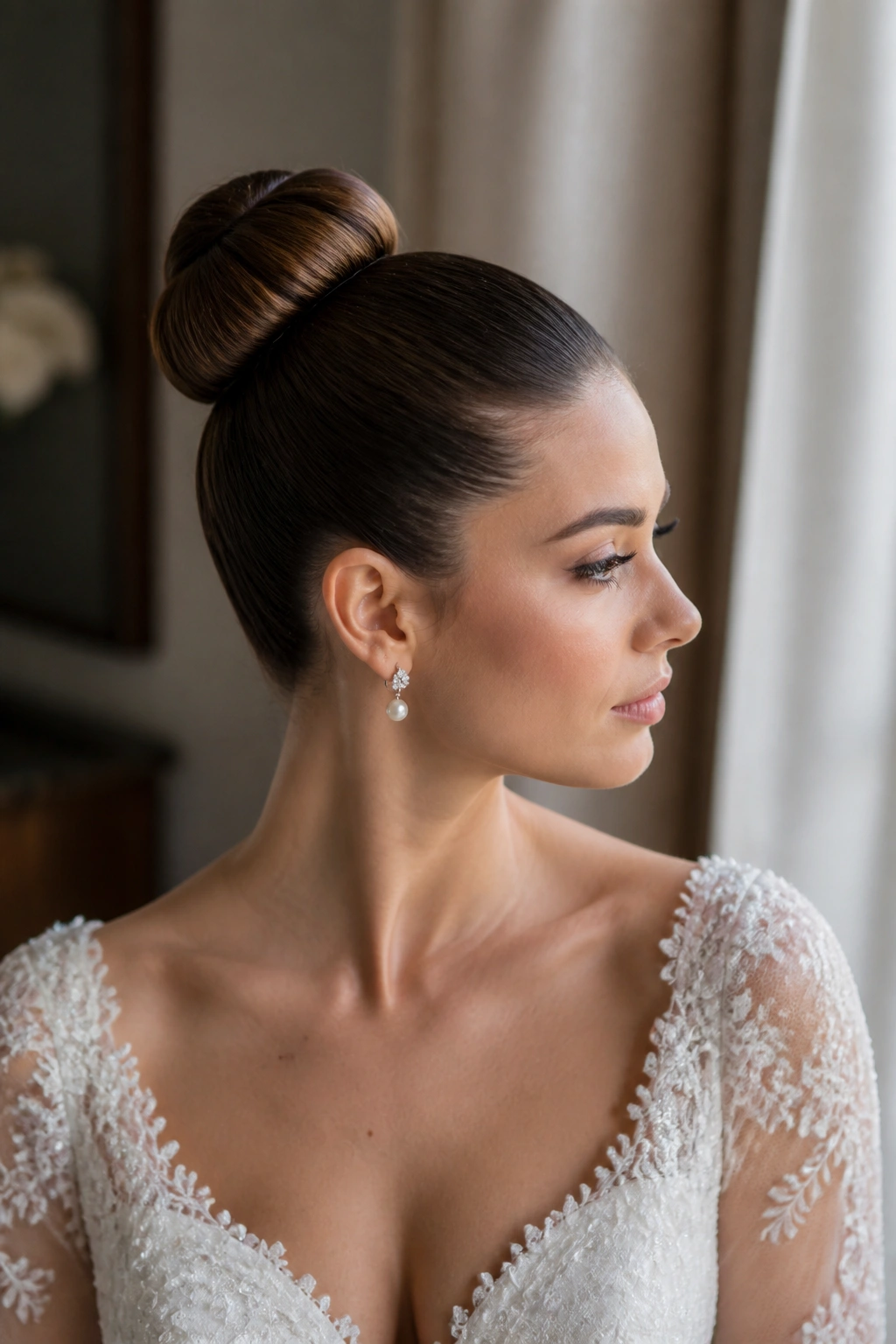
Why do brides keep coming back to the ballerina bun? Because it makes everything else easier. The face becomes the focus, the neckline stays open, and the dress gets to do its job without hair competing for attention. A centered bun also gives strong symmetry, which reads as crisp in photos.
What makes it different
A ballet bun sits higher than a chignon and usually looks tighter, cleaner, and more architectural. It can be wrapped with the bride’s own hair or shaped with a padding donut if more fullness is needed. On fine hair, that padding matters more than people expect. Without it, the bun can look thin from the side.
A few things help this style stay wedding-ready:
- Smooth the surface with a boar-bristle brush before securing.
- Anchor the bun with cross-pinned bobby pins, not just one or two pins shoved in.
- Keep the hairline neat, but not wet-looking.
- Add a narrow satin ribbon, a crystal comb, or a single pearl pin if the dress is very plain.
The sleek bun is a strong choice for modern brides who still want something traditional. It feels disciplined. Clean. A little formal, in the best way.
4. Braided Crown Updo
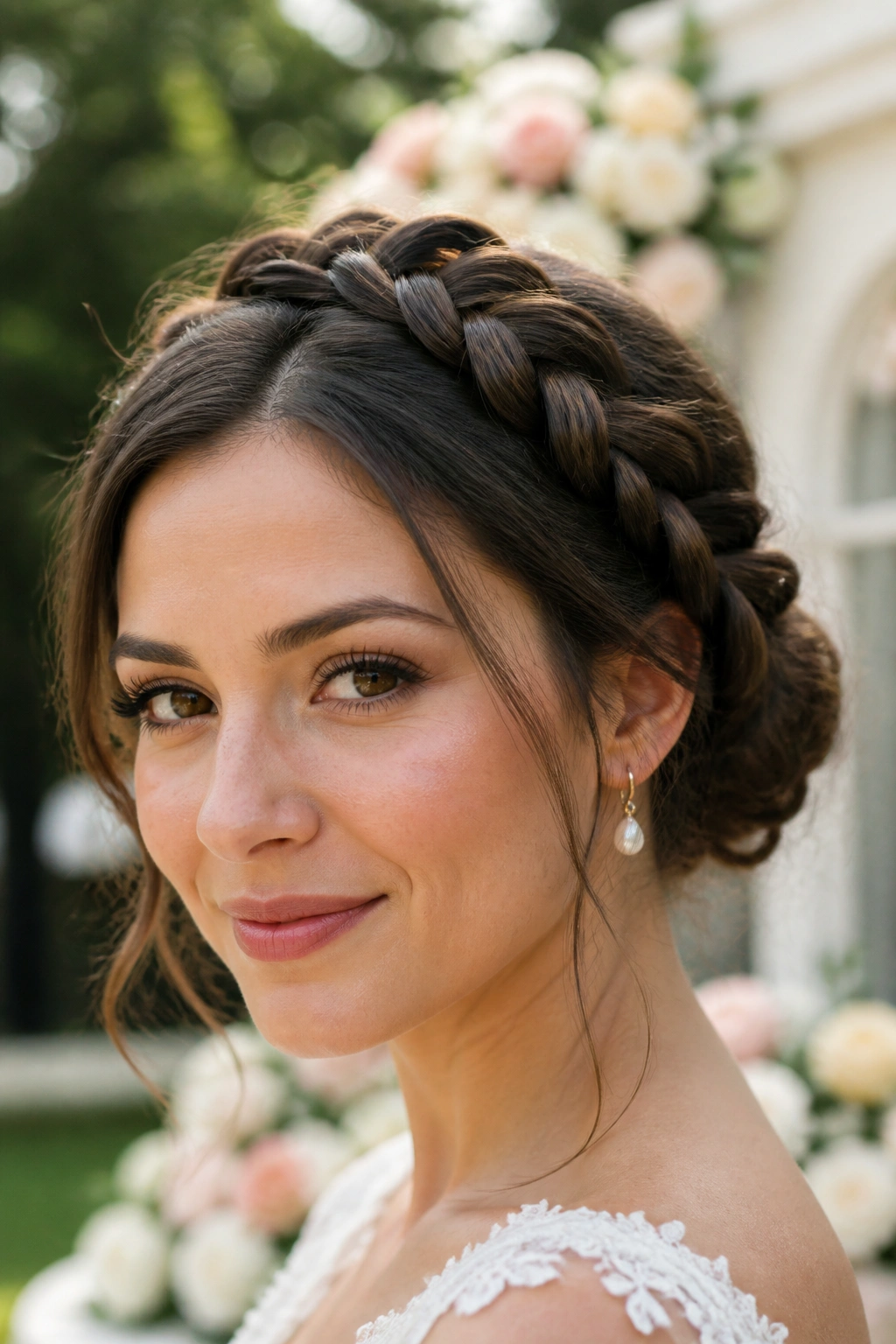
A braided crown updo has a built-in sense of ceremony. The braid wraps around the head like a frame, then tucks into a bun, twist, or pinned base at the back. It gives the whole style a feeling of movement even when everything is locked down and secure.
This is the one I reach for when a bride wants detail from every angle. From the front, the braid softens the hairline. From the side, it gives texture. From the back, it creates that lovely layered finish that looks expensive without actually needing extra decorations. The braid does some of the visual work for you.
There’s one catch. If the braid is too loose, the style can lose shape by the second hour. If it’s too tight, the hairline starts to look harsh. The sweet spot is a braid that feels firm in the hand but still has a little give. That balance matters on finer hair and on hair that has been freshly washed.
Good pairing ideas:
- Garden weddings with floral pins
- Dresses with open backs
- Medium to long hair that needs extra grip
- Brides who want a romantic look without soft curls everywhere
A braided crown can look sweet. It can also look regal. The difference is in the finish.
5. Gibson Tuck
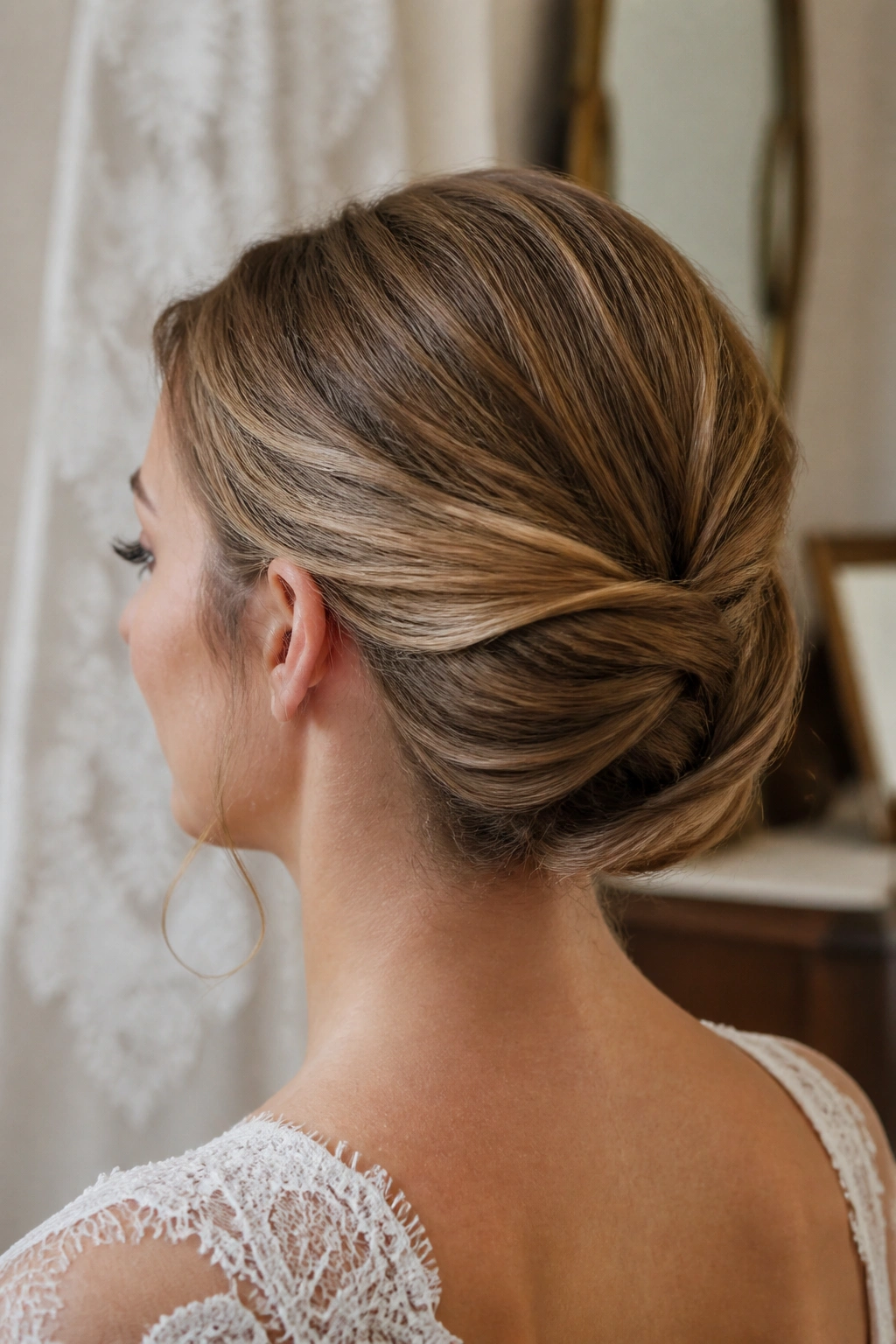
The Gibson tuck has old-school charm, and I mean that in the nicest possible way. It folds the hair upward and inward at the back, creating a soft roll that feels tidy but not severe. It has a gentle vintage mood without sliding into costume.
What makes it useful for weddings is the way it handles medium-length hair. A lot of updos assume the hair is very long, which leaves brides with shoulder-length hair hunting for extensions or falling back on curls. The Gibson tuck solves that quietly. It gives shape where length might not be there.
The style also sits well under veils because the base is usually low and compact. That makes it easier to place a comb or a few pins without the accessory fighting the hairstyle. I also like it for dresses with lace detail at the back, since the tuck leaves room to show off the fabric.
No rough edges. No giant bun. Just a smooth fold and a clean finish.
6. Side-Swept Chignon
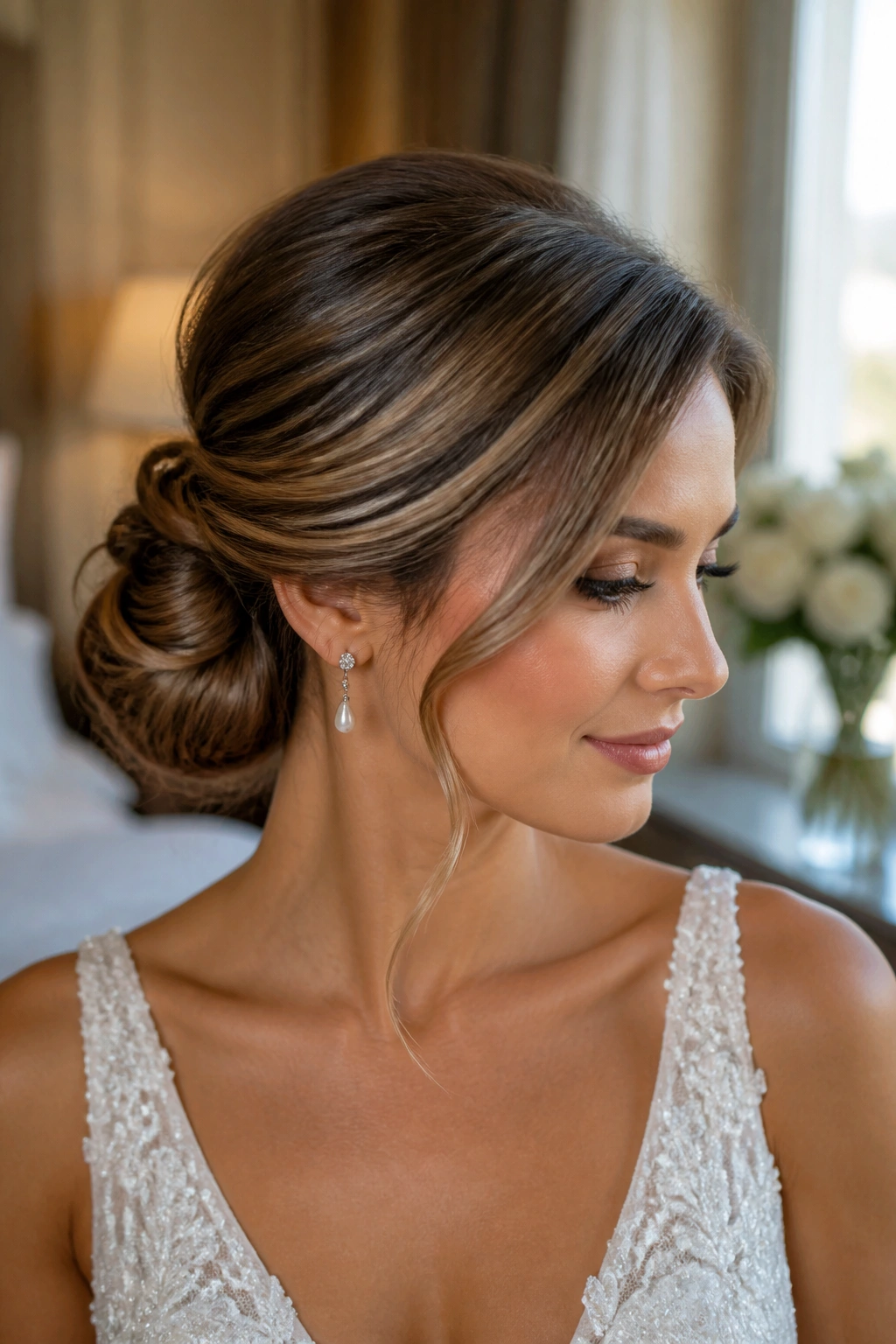
A side-swept chignon has a little more personality than a center-set bun. It shifts the weight to one side, which softens the face and gives the style a more relaxed line. That asymmetry can be lovely on brides who don’t want the hair sitting straight down the middle like a portrait from a formal registry office.
Compared with a centered chignon, this version feels more fluid. The neck stays open, but the eye is led toward one shoulder, one earring, or one side of the gown. That works especially well with off-the-shoulder dresses and one-shoulder gowns, where the hairstyle should echo the shape of the clothing instead of competing with it.
What to ask for
A side chignon should still be anchored low and tight underneath. The “soft” part belongs in the surface and the sweep, not in the security. Ask for one or two soft face-framing pieces if you want movement, but do not let the whole structure loosen at once.
It’s a lovely choice for brides who want the romance of a chignon with a little more motion in the silhouette.
7. Rolled Updo
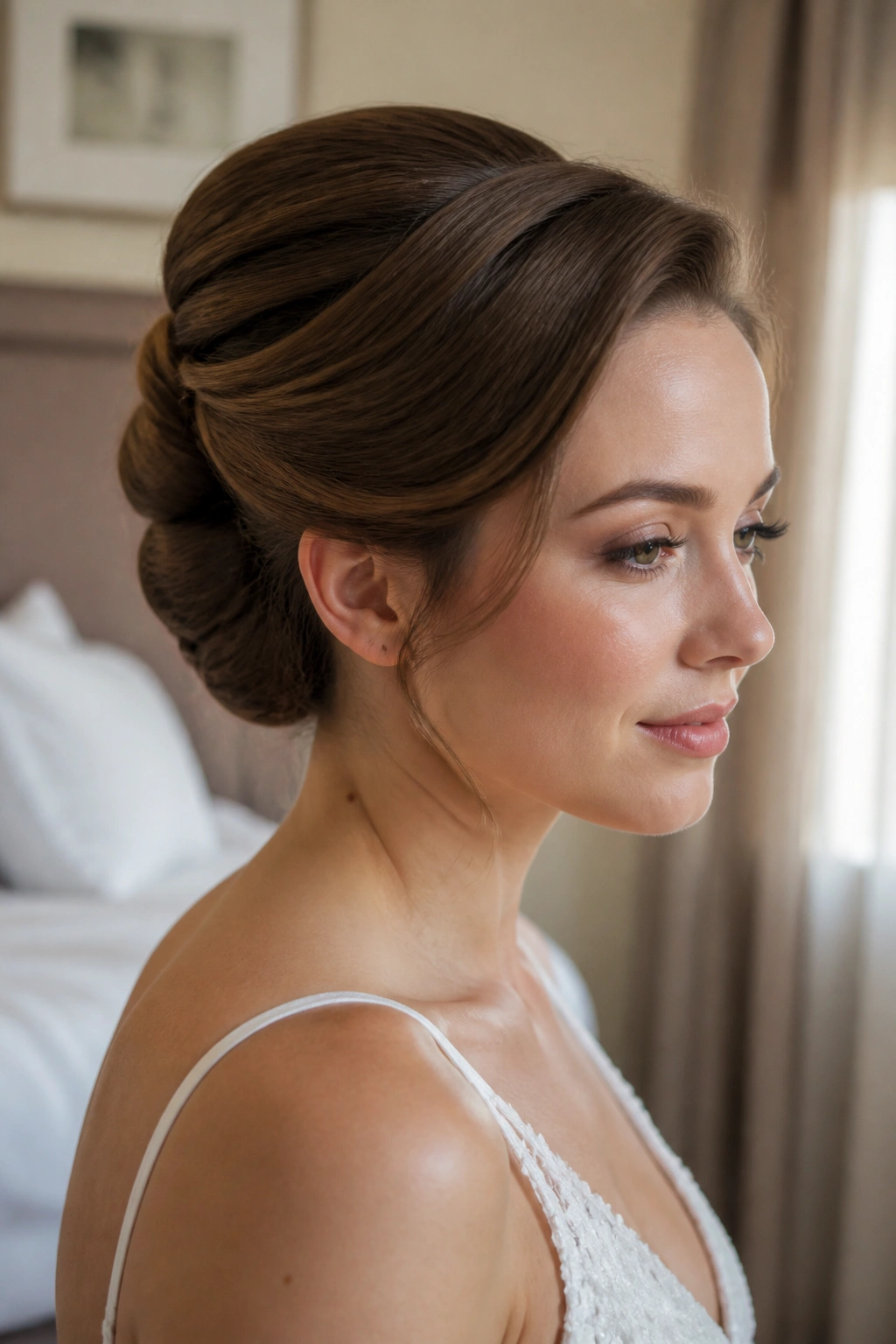
The rolled updo has a satisfying old-fashioned elegance that never really goes out of style. Hair is rolled inward in sections, then pinned so the shape stacks into a smooth, curved finish. It often ends up looking like a softer cousin of the French twist, though it can sit lower and feel a bit more delicate.
How the roll creates structure
The magic is in the sections. If each roll is clean, the style holds its shape and creates a nice rhythm across the back of the head. If the sections are uneven, the whole thing starts to sag or bunch in odd places. That’s why this style works best when someone knows how to place pins in layers rather than all at once.
A rolled updo is great for brides who want texture without curls everywhere. It also looks good with a side part, which gives the front a touch of vintage character. On thick hair, the rolls can become dense and heavy, so the stylist usually has to flatten the base and keep the outer surface controlled.
This is not a loose, casual style. It is tidy in the old meaning of the word. Careful. Intentional. Very pretty from the back.
8. Knot Bun
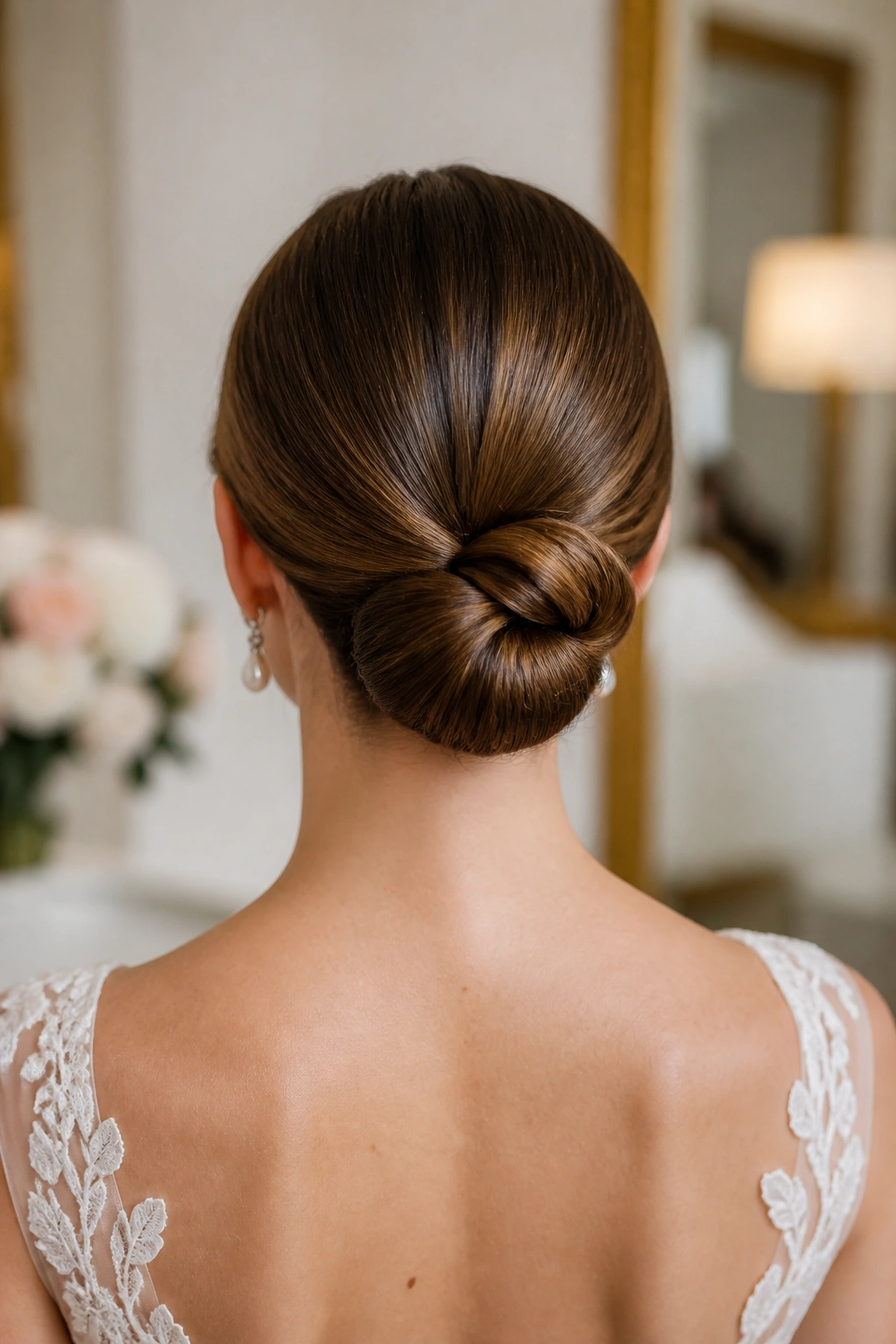
Can a knot bun look formal enough for a wedding? Absolutely, if the shape is clean and the finish is handled with restraint. The knot gives the style a sculpted center, and the bun effect grows from that shape instead of sitting like a separate ball of hair.
The best versions look almost architectural. Hair is wrapped, crossed, and tucked so the knot sits at the back or slightly off to one side. That makes the style interesting without making it busy. Brides who want a modern bridal updo usually like this one because it has structure, but it doesn’t feel stiff.
It also works with a lot of hair textures. Fine hair gets a more compact knot, while thicker hair can be twisted into a fuller one. The key is to keep the edges polished and the base secure. A knot bun that starts loosening after the first dance is a headache no one needs.
This style looks especially good with clean necklines and simple jewelry. It lets the dress and the face do the talking.
9. Voluminous Top Bun
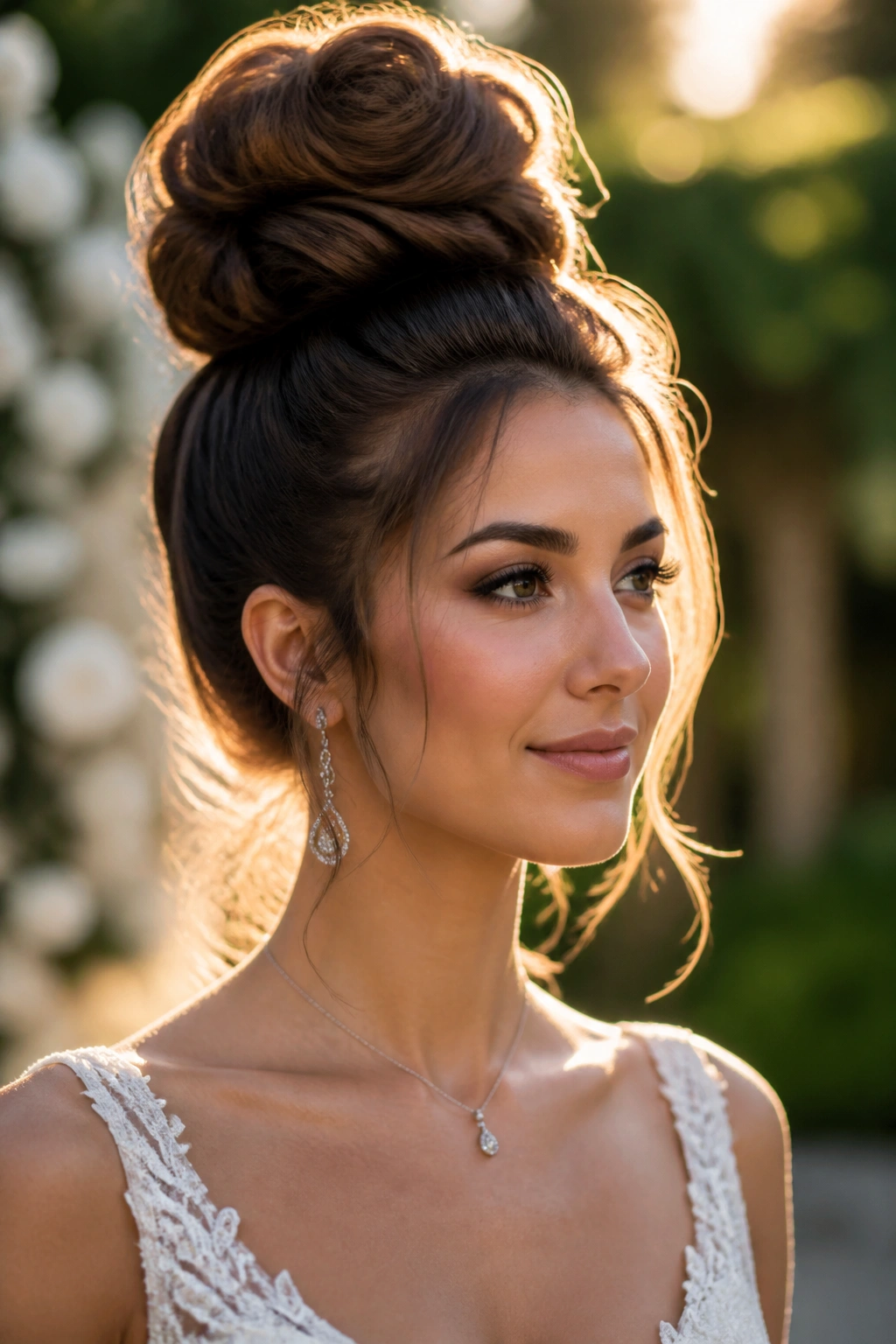
Height changes the whole room. A voluminous top bun draws the eye upward, adds lift to the face, and gives a bride a little more presence without needing a complicated shape. It’s a strong choice for women who want their updo to feel elegant and noticeable from across the aisle.
This bun works best when the volume is built on purpose, not teased into a puff. There’s a difference between full and fluffy. Full means the bun has shape, balance, and enough hair to read beautifully from the side. Fluffy can look unfinished if the surface isn’t controlled.
A high bun also helps if the dress has a lower back or a detailed neckline, because it keeps the visual weight away from the shoulders. The face opens up. The earrings show. The whole outfit breathes a little more.
Best for:
- Taller brides who want to add even more length
- Dresses with clean, simple bodices
- Hair that holds teasing and pinning without collapsing
- Veils that attach below the bun
It is a more assertive choice than a low chignon. That’s the point.
10. Halo Braid Bun
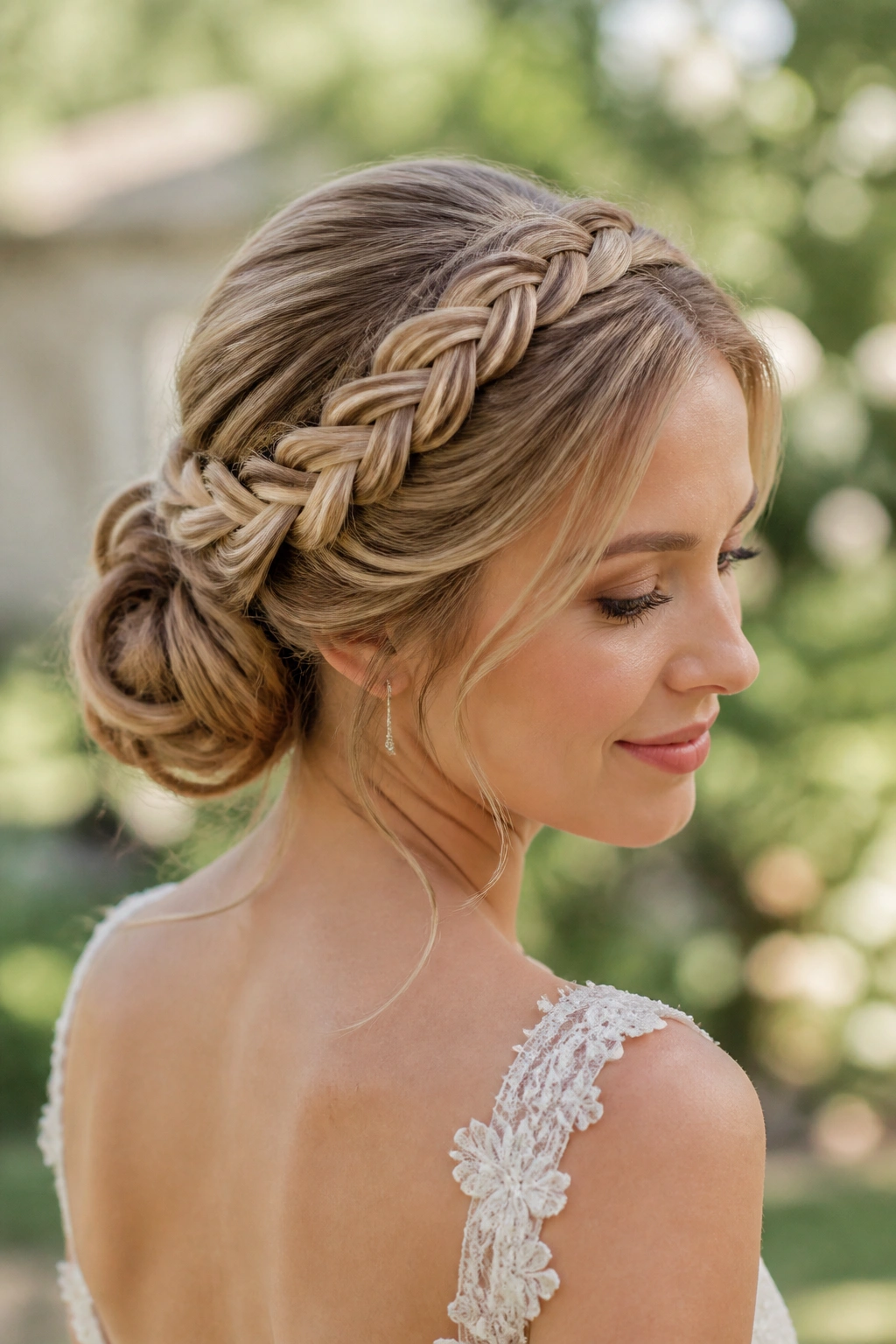
A halo braid bun gives you two classic shapes in one: the braid around the head and the bun tucked underneath or at the back. It feels romantic without going fuzzy, and it has that nice sense of enclosure that photographs well from a 360-degree angle.
The texture of the braid matters here. If it’s too tight, the style can look hard. If it’s too soft, the halo loses its outline. I like a braid that’s gently expanded after braiding, so the plaits feel a little fuller and less rope-like. That makes the whole style read better in person.
Where it shines
This updo is a good fit for outdoor weddings, especially when the dress has simple lines and the bride wants the hair to carry more of the visual detail. It also works with floral pins tucked along the braid, though I’d keep the flowers small. Big blooms can overpower the shape.
A halo braid bun does take time. Not the kind of style you rush through in ten minutes and hope for the best. It rewards patience, clean parting, and a stylist who knows how to balance the braid so it doesn’t pull too hard on the scalp.
11. Pin-Curled Updo
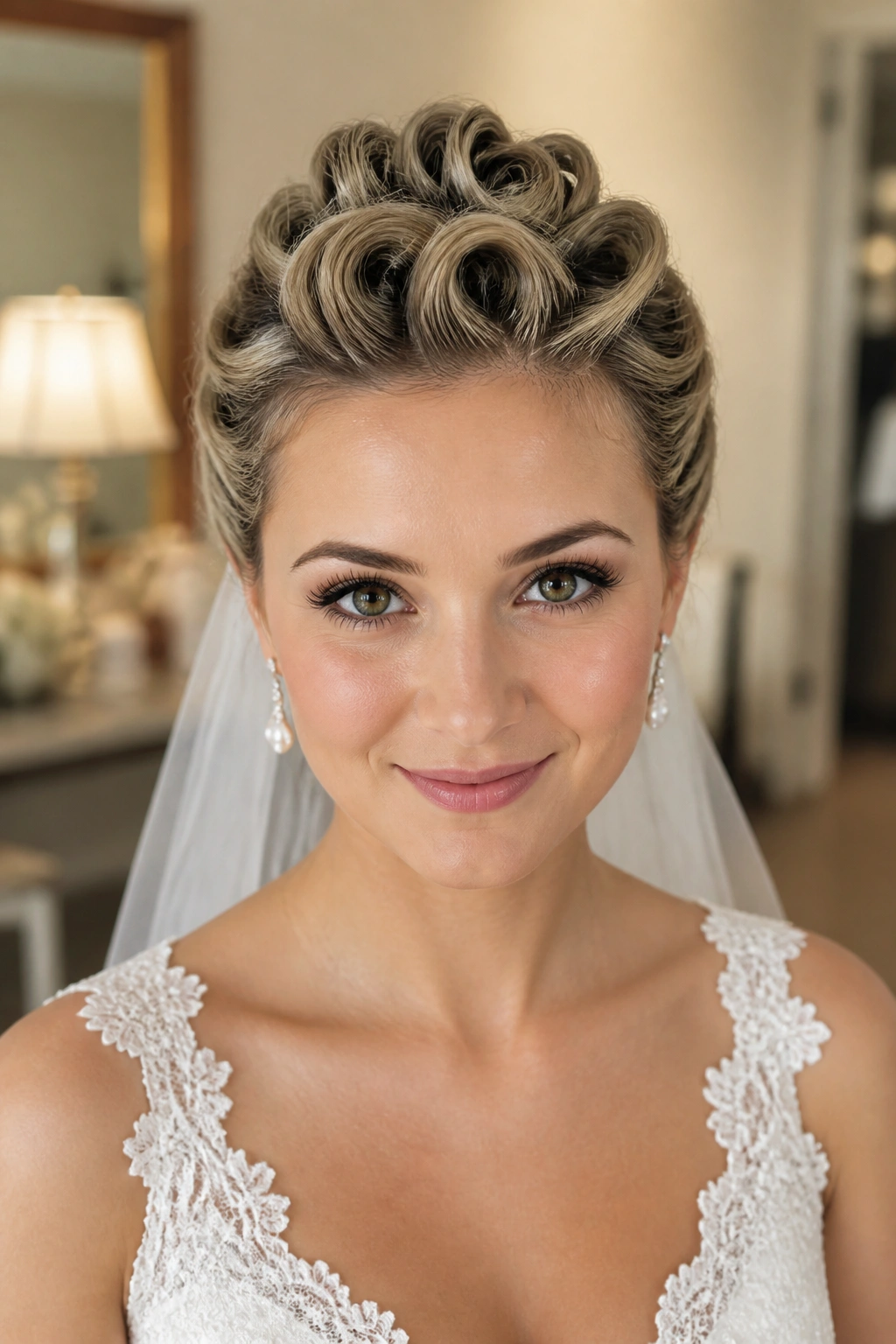
Pin curls have a way of making a bride look polished and soft at the same time. Each curl is shaped, pinned, and arranged so the final style has a scalloped, vintage feel that reads beautifully under soft light. There’s a reason pin-curled wedding hair shows up again and again in formal settings. It has real texture, not just sprayed-on texture.
This style is especially kind to shorter long hair and medium hair because it builds shape without demanding a huge amount of length. The curls can be placed in a cluster, tucked into a low roll, or stacked into a fuller back shape. That gives the stylist room to adjust the silhouette to the dress and the face.
It does take a careful hand. Pin curls need to cool and set before they’re brushed or placed, and that part matters more than people think. If they’re handled too early, they flatten. If they’re brushed too much, the pretty ridges disappear.
The result is feminine without being sugary. I like that.
12. Twisted Low Bun
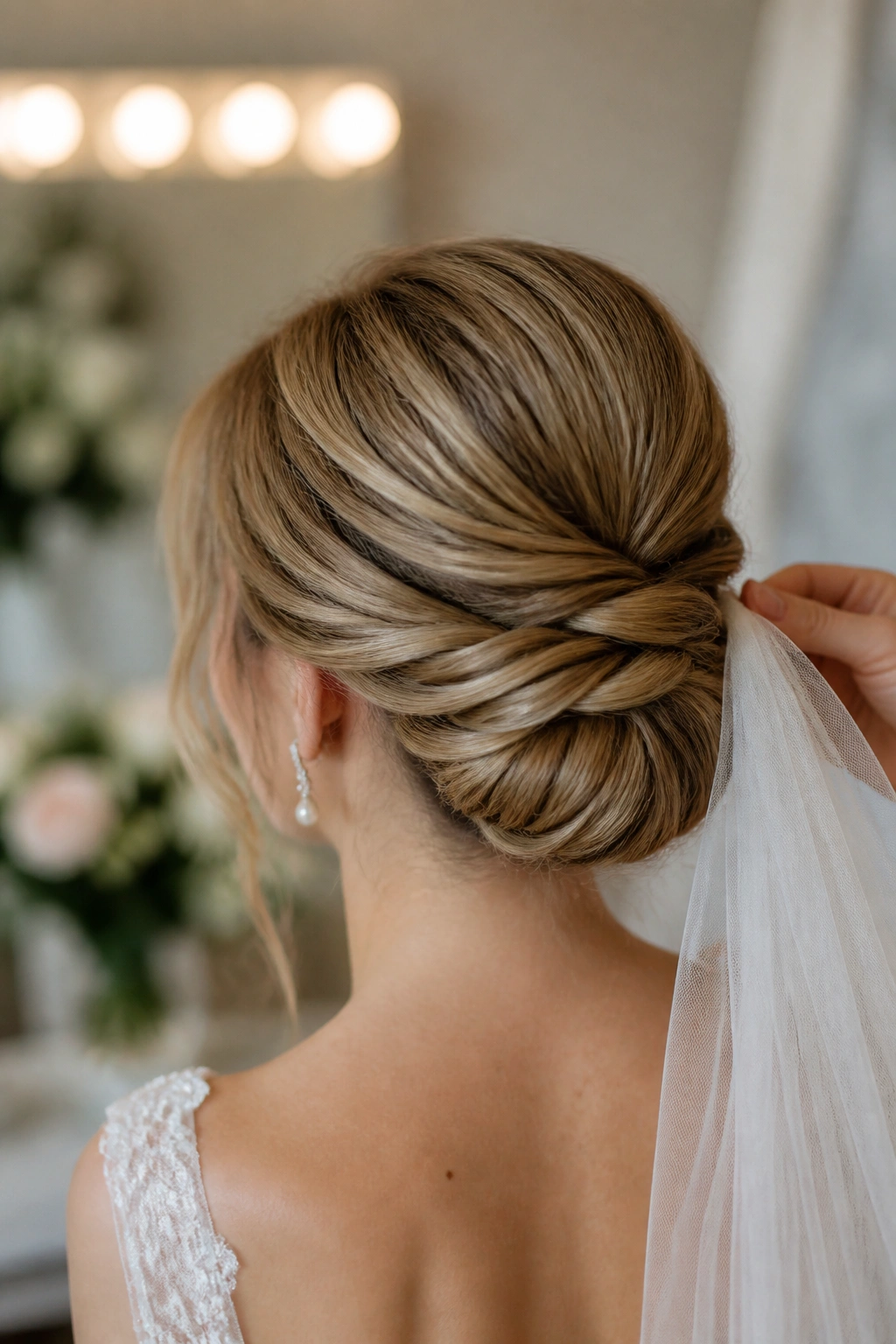
A twisted low bun is one of the easiest classic wedding styles to underestimate. It looks simple at first glance, but the twist pattern gives it movement and keeps the bun from feeling like a plain loop of hair. When it’s done well, the surface has little ridges and folds that catch the eye without becoming fussy.
Key details that matter
- Keep the bun low, just above the nape.
- Twist each section in the same direction before wrapping.
- Use pins inside the twist, not just around the outside.
- Leave the crown smooth so the texture stays focused at the bun.
That last point matters. If the whole head is teased or roughed up, the style can lose its calm feel. The best twisted buns are controlled at the top and interesting at the base. It’s a neat little contrast.
This style is smart for brides who want something secure and classic but don’t want a flat, rigid finish. It also works well with veil placement because the low position gives the comb a stable anchor without crowding the crown. Clean. Practical. Still pretty.
13. Wrapped Ponytail Updo
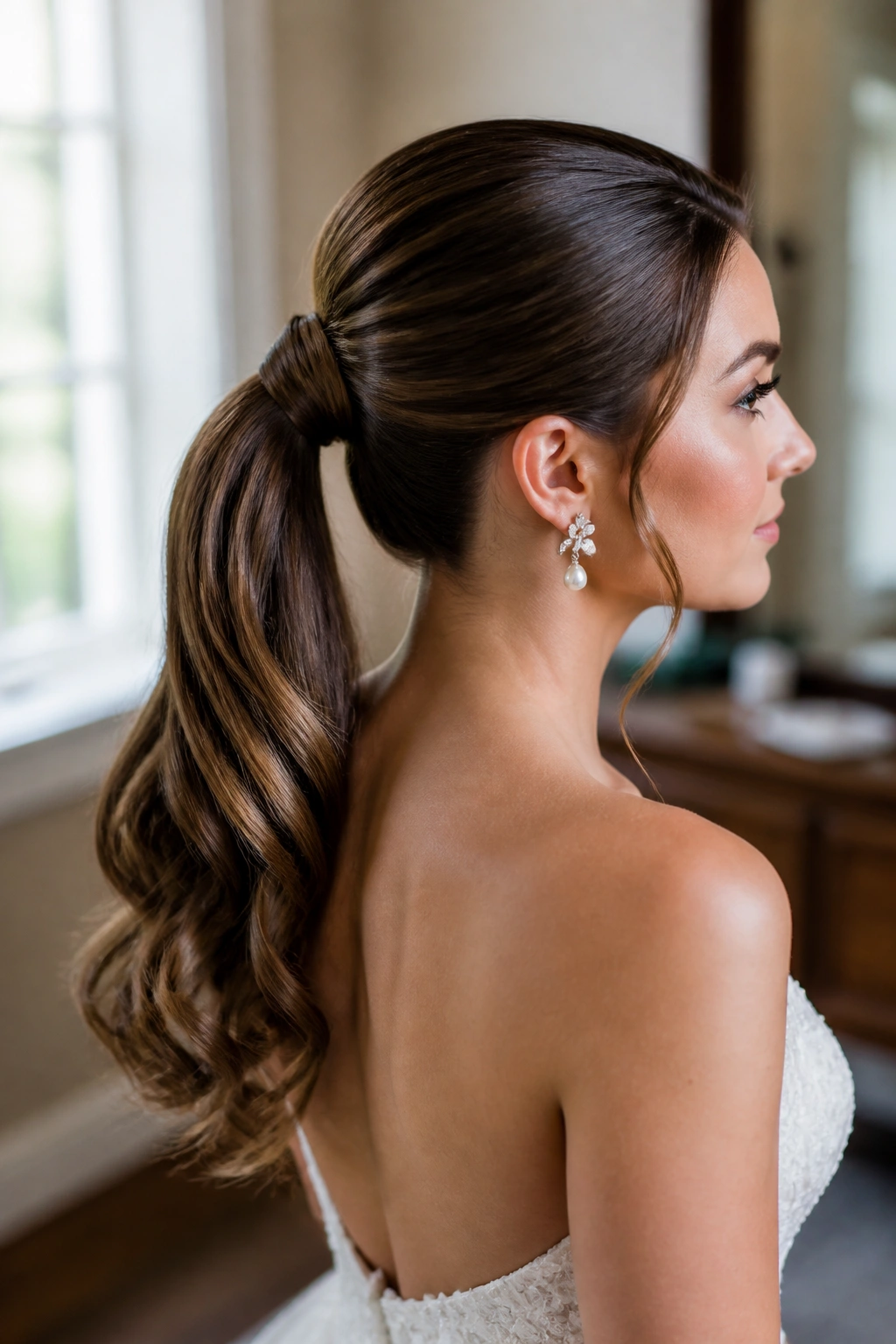
A wrapped ponytail updo is for the bride who wants the line of a ponytail but the polish of a formal style. Hair is drawn back, wrapped around the base, and shaped so the tail itself becomes part of the design. If you’re tired of buns that feel too expected, this is a strong alternative.
Compared with a true bun, a wrapped ponytail shows more length and movement. That can be a gift if the hair is thick and long, because the style uses that length instead of hiding it. It also gives the dress a more open, airy feel, especially when the gown has layers or a flowing skirt.
The danger is that it can drift into “just a ponytail” if the base isn’t tight enough. The hair around the crown has to be smooth, and the wrap around the elastic should be neat and firm. A loose base makes the whole thing look unfinished.
I like this style for brides who want something a touch less traditional but still elegant enough for a formal ceremony.
14. Tucked-Under Chignon
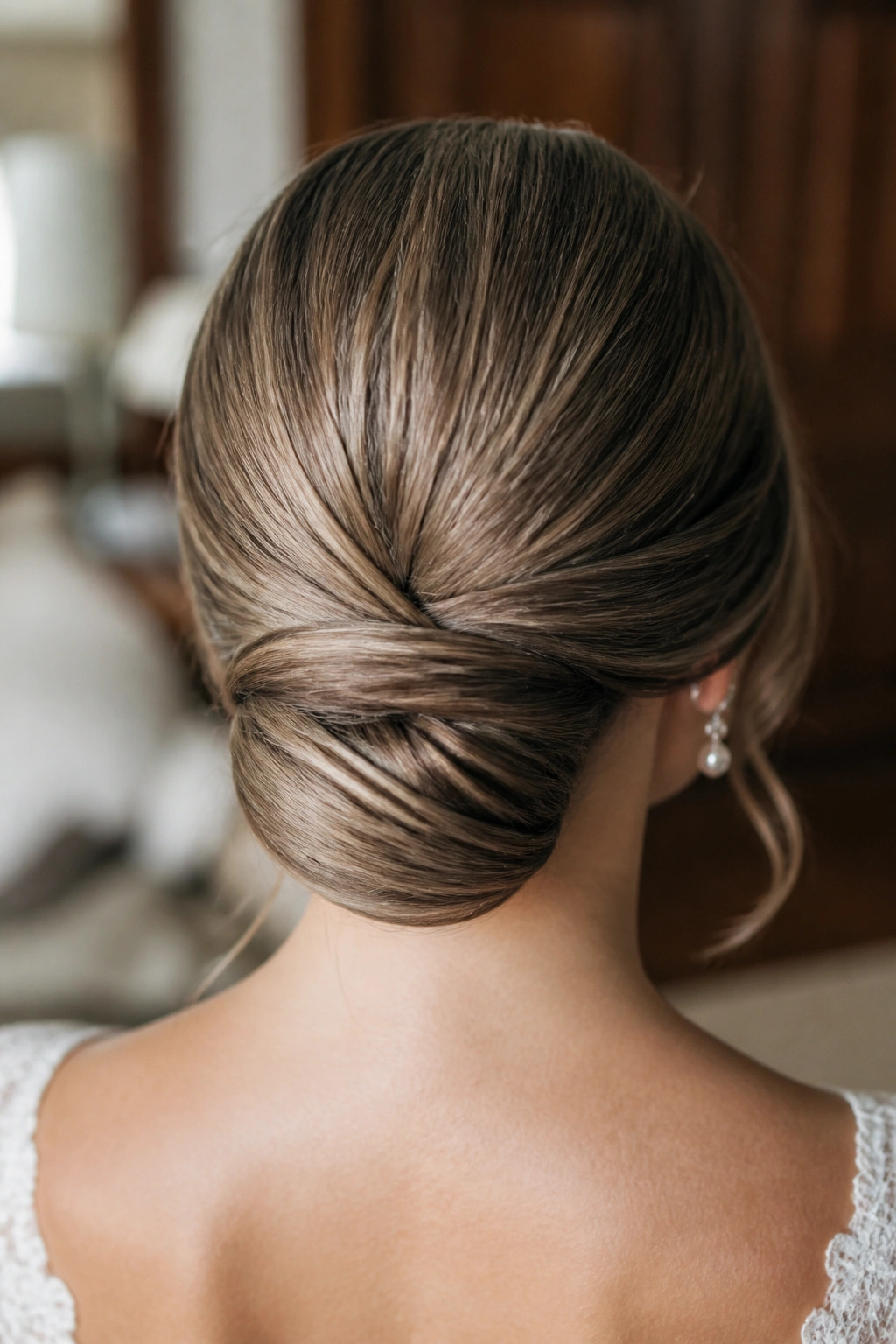
Picture a chignon that looks as if the hair was folded under itself and pinned into a soft shell at the nape. That is the tucked-under version, and it has a quiet charm that works far better than people expect. It sits low, reads cleanly in photos, and keeps the profile smooth from every angle.
This is one of those styles that looks easy because it avoids obvious drama. But the shape depends on careful folding. The ends need to disappear neatly, and the surface has to stay smooth enough to look intentional. If the tuck is uneven, the style loses its grace fast.
It suits brides who want their hair to support the dress rather than compete with it. A back-detail gown, a refined satin neckline, or a set of statement earrings all fit nicely here. The bun doesn’t take over. It steps back and does its job.
A veil also sits well with this style, especially when the comb is placed just above the tuck. Very tidy. Very dependable.
15. Double Twist Updo
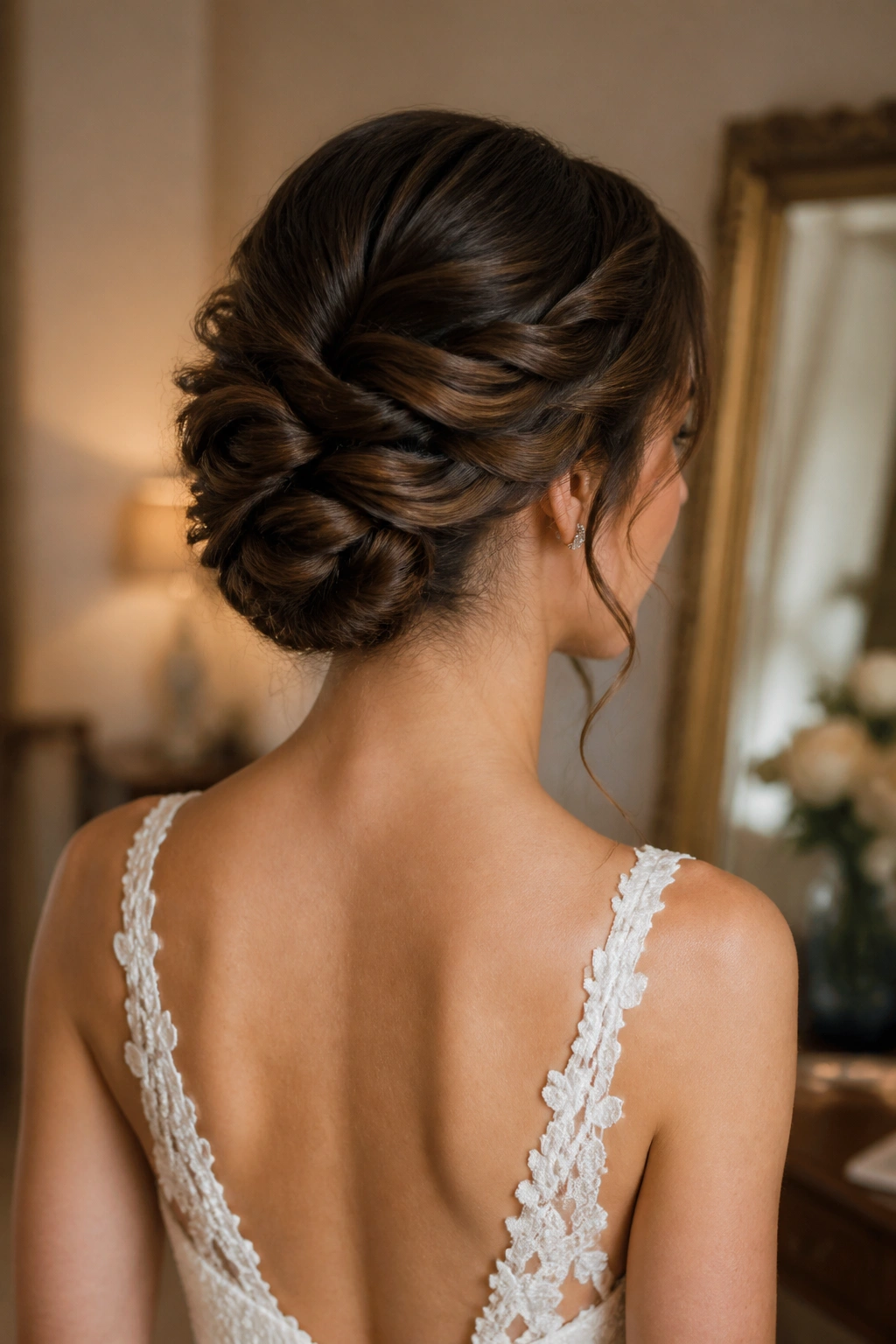
Can you get more visual interest from twists than from a single bun? Yes, and that’s exactly why the double twist updo keeps showing up in wedding hair. Two twisted sections wrap into one another, then pin into a low or mid-height shape that has movement from every side.
How to build it
Start with a clean section on each side of the head. Twist each one back toward the center, keeping the turns even and firm. Then cross or layer them so the finished shape looks woven rather than stacked. The goal is a soft sculptural effect, not a tangled knot.
This style is especially nice for brides with medium-thick hair because the twist pattern creates fullness without needing a lot of extra padding. It also gives the back of the head texture, which is useful if the dress has a plain bodice and needs one more point of interest.
I’d avoid making the twists too perfect. A tiny bit of looseness at the surface keeps the style from looking hard. The pins should hold the shape, not announce themselves.
16. Vintage Victory Roll Updo
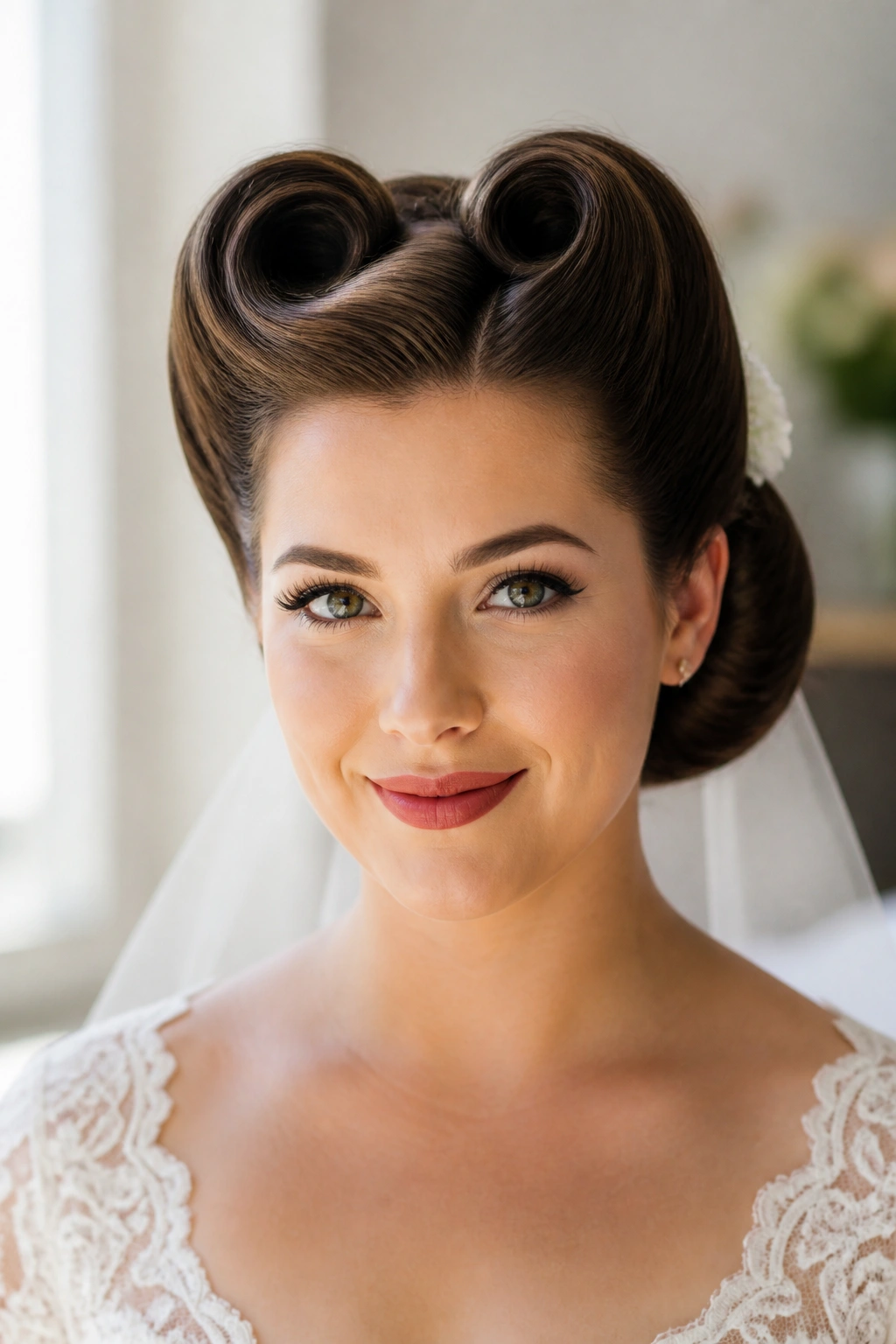
Victory rolls bring a specific kind of glamour to wedding hair. They sit high at the front, shaped into rounded rolls that push the style into vintage territory before the rest of the hair is pinned up or tucked low. If the dress has a nod to old Hollywood, this one is hard to beat.
The rolls need space, and that is part of the appeal. They create a clear front view, which means the bride’s face is framed by shape rather than by loose curls. That can look striking on strong brows, a sharp lip, or a gown with a simple neckline. The style does not ask for much decoration because the rolls already do the talking.
It does ask for skill. Victory rolls rely on clean sectioning and strong base support. If one side is taller than the other, the asymmetry can feel accidental instead of glamorous. A little height is lovely. A lopsided roll is not.
This is a choice for brides who want personality in the hair, not just prettiness. It has character.
17. Asymmetrical Bun
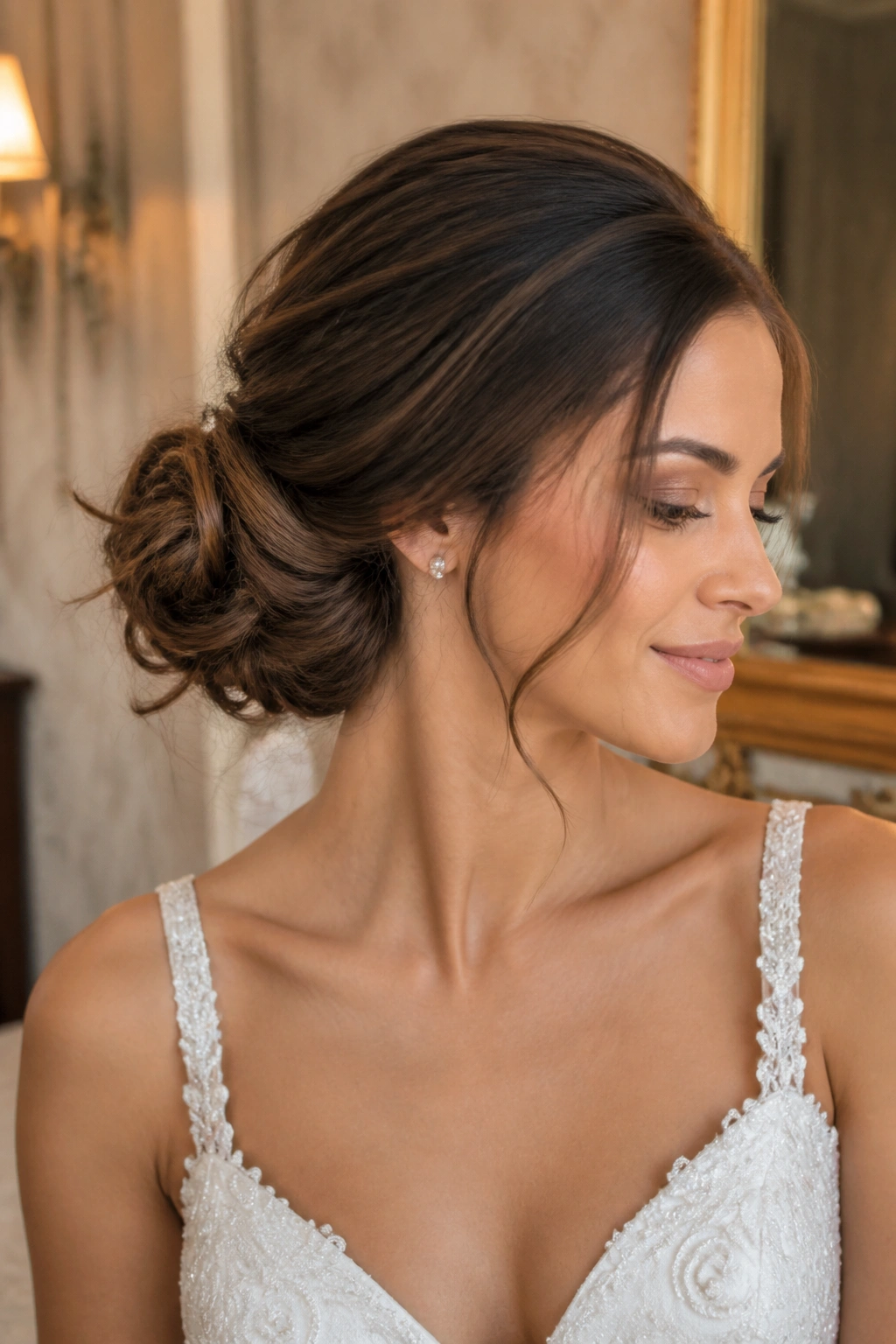
A slightly off-center bun has more life than a centered one, and I’ll happily say that out loud. The asymmetrical bun lets the eye move across the head instead of stopping dead in the middle, which makes the whole style feel softer and less rigid. It’s especially flattering when the dress has one detailed shoulder, a deep side part, or a neckline that already leans to one side.
The bun itself can be low, mid-height, compact, or a little fuller. The real point is the placement. Once the bun shifts just a few inches, the whole face changes. The profile becomes gentler, and the hairstyle feels a little less formal without losing polish.
This is also a smart move for brides who don’t love symmetry on themselves. Some people look great in a centered bun and feel boxed in by it. Others need just a small offset to feel more natural. That isn’t vanity. It’s design.
Keep the front smooth enough that the asymmetry reads as deliberate. If the shift is too subtle, nobody notices. If it’s too extreme, the style can look like it wandered off by mistake. The sweet spot is somewhere in the middle.
18. Soft Romantic Updo
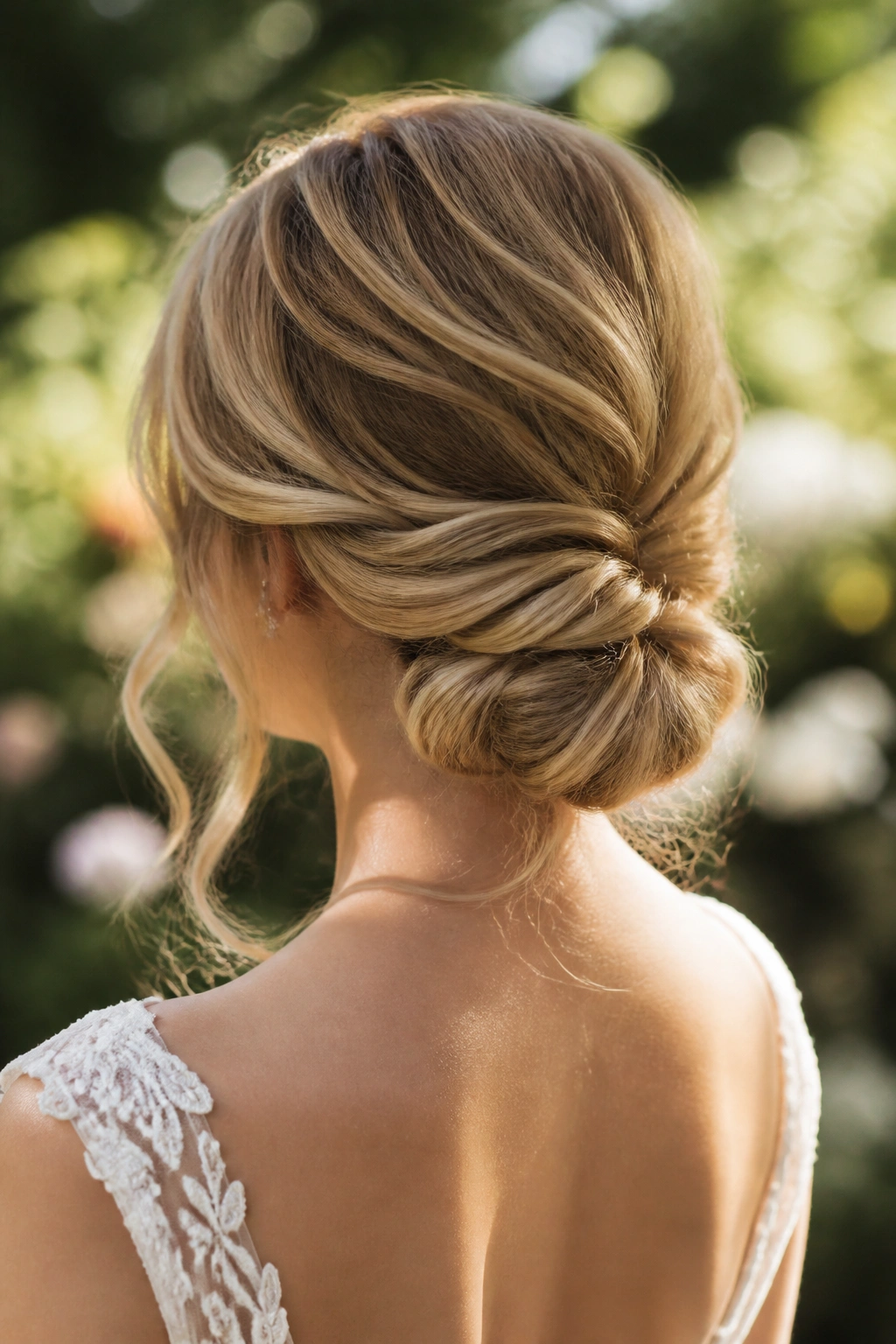
A soft romantic updo is what happens when classic wedding hair learns to breathe a little. The structure is still there — pinned sections, a defined base, enough support to hold under movement — but the finish is gentler. A few loose pieces around the face, a slightly touched-up crown, and a low bundle of hair at the back can turn a formal style into something more tender.
This is the updo for brides who want motion without mess. It pairs well with lace, chiffon, and dresses that have a bit of softness in the fabric. It also handles flowers well, especially small ones tucked near the bun or along one side. Big accessories can swamp the shape, so I’d keep the additions light.
The biggest mistake here is over-loosening the style in the name of romance. That gets slippery fast. You want softness, not collapse. The hair should still hold its line when you step back and look at it from across the room.
A good soft updo feels finished but not rigid, and that is often the hardest balance to hit. When it works, though, it gives a bride that rare mix of poise and ease that makes the whole look feel human instead of overbuilt. That’s the kind of finish people remember.
