



Bangs can make an updo look finished instead of fussy. They also make a bad pin job easier to spot, which is why the best classic updos with bangs pay attention to the fringe first, not last. If the front section sits well, the whole style feels calmer, cleaner, and a lot more intentional.
That is the part people miss. They think the bun, twist, or ponytail is the main event, but the bangs are usually what decide whether the style looks polished or a little improvised. A blunt fringe changes the whole shape of the face. Curtain bangs soften a high knot. Side bangs can save a severe chignon that would otherwise feel too tight around the jaw.
The good news is that classic updos are forgiving when you match the bang type to the shape of the style. A smooth French twist likes a bit of sweep at the front. A low bun can take a heavier fringe. A ponytail can handle almost anything if the crown has enough control and the ends are tucked with purpose.
The real trick is balance. Not symmetry. Balance.
1. French Twist with Side-Swept Bangs
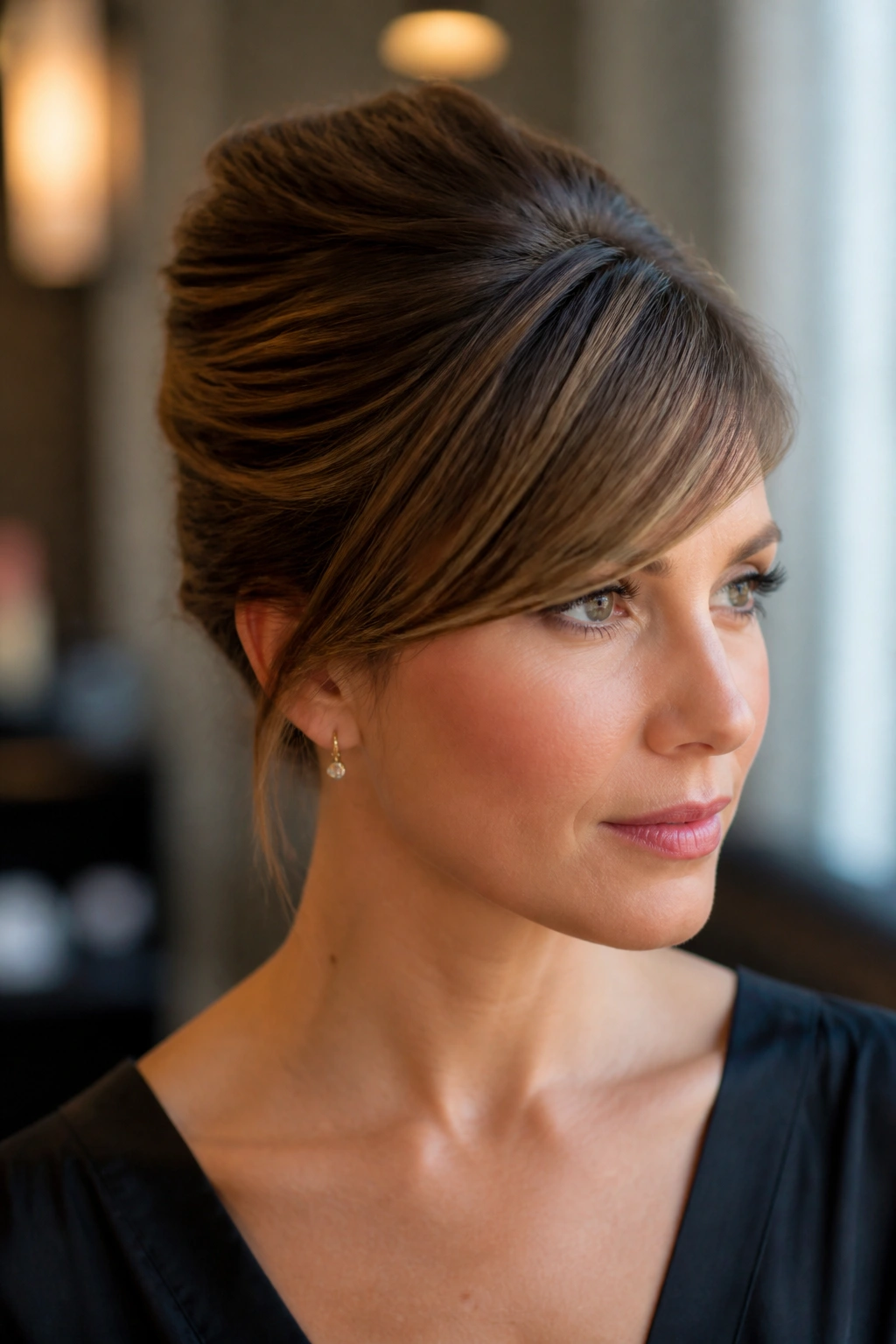
A French twist and side-swept bangs have the kind of relationship that makes sense the second you see it. The twist pulls the hair upward and inward, which gives the style height and structure, while the bangs soften the front so the whole thing does not feel stiff.
Why it works
The French twist is one of those updos that can look severe if every strand is slicked back too tightly. Side-swept bangs break that line in a useful way. They add movement across the forehead and keep the style from looking like it belongs in a very formal ballroom with no air conditioning.
Styling notes
- Keep the crown smooth, but not flat.
- Leave the bangs with a slight bend, not a hard curl.
- Use 2 to 4 hidden pins inside the twist, depending on hair thickness.
- A light mist of flexible hairspray is usually enough unless your hair slips easily.
If your hair is fine, a little root-lifting spray at the crown helps the twist hold its shape. Thick hair, on the other hand, needs a neater sectioning job before you start twisting or the back gets bulky fast. The bangs should look like they belong to the same haircut, not like they were pinned on as an afterthought.
2. Low Chignon with Blunt Bangs
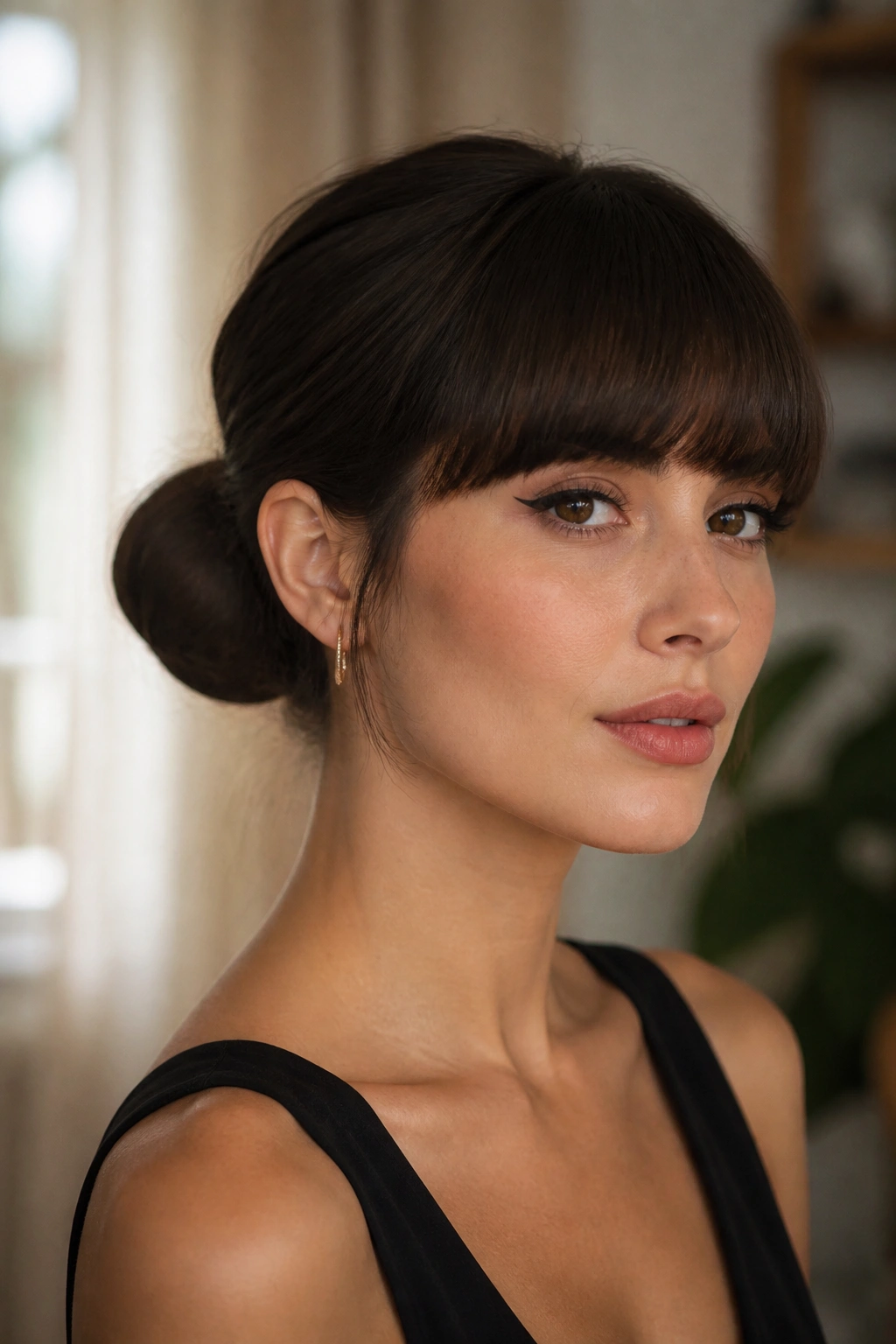
A low chignon with blunt bangs has a strong, clean shape that feels older than the trend cycle and better for it. The bun sits near the nape, usually tucked or coiled close to the head, while the fringe gives the whole style a blunt, graphic edge.
Blunt bangs do the heavy lifting here. They draw attention straight to the eyes, which keeps the low bun from disappearing into the back of the head. That contrast is the point. The chignon stays quiet; the bangs do the talking.
This style is especially good when you want something neat but not severe. If the bun is too sleek, the bangs stop it from reading cold. If the bangs are a little dense, the low chignon keeps the face from feeling boxed in. It is a strong pair, not a soft one.
A fine-tooth comb, a small elastic, and 6 to 10 bobby pins will usually do the job. Smooth the top first, then coil the bun low and tuck every loose end under. If the fringe wants to split, a tiny round brush and a quick pass of the blow-dryer usually settle it better than more product.
3. Sleek Ballerina Bun with Curtain Bangs
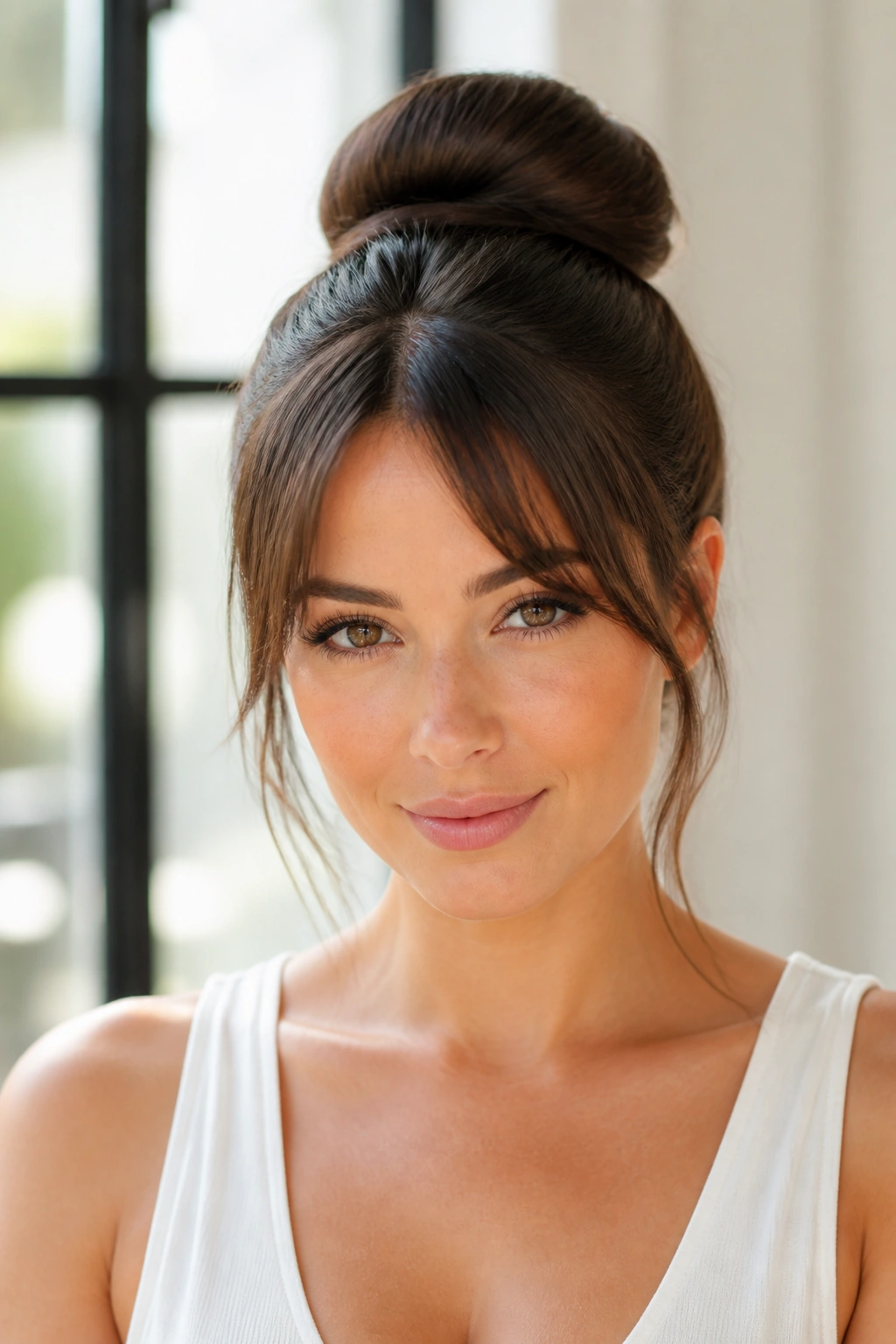
Curtain bangs and a ballerina bun solve each other’s problems. The bun is precise, centered, and high enough to lift the face, while the bangs fall away from the middle and ease the severity of the whole look.
What makes the contrast work
A ballerina bun can look a little bare if the front is pulled completely away from the face. Curtain bangs fix that by creating a soft frame that still keeps the hair off the cheeks. They also make the bun feel more wearable for everyday life, which matters if you are tired of updos that look nice in photos but feel too strict at a table or desk.
A few things to watch
- Part the bangs cleanly down the center before you gather the rest of the hair.
- Keep the bun tight enough to stay clean, but not so tight that the crown flattens.
- If the bangs are short, bend only the ends under with a medium round brush.
- If they are longer, let them skim the cheekbone for a softer line.
This is a strong option for medium and long hair. It also works well when you need a style that can survive a long day without needing constant fixing. A little shine serum on the ends helps the bun look intentional rather than dry.
4. Messy Top Knot with Wispy Bangs
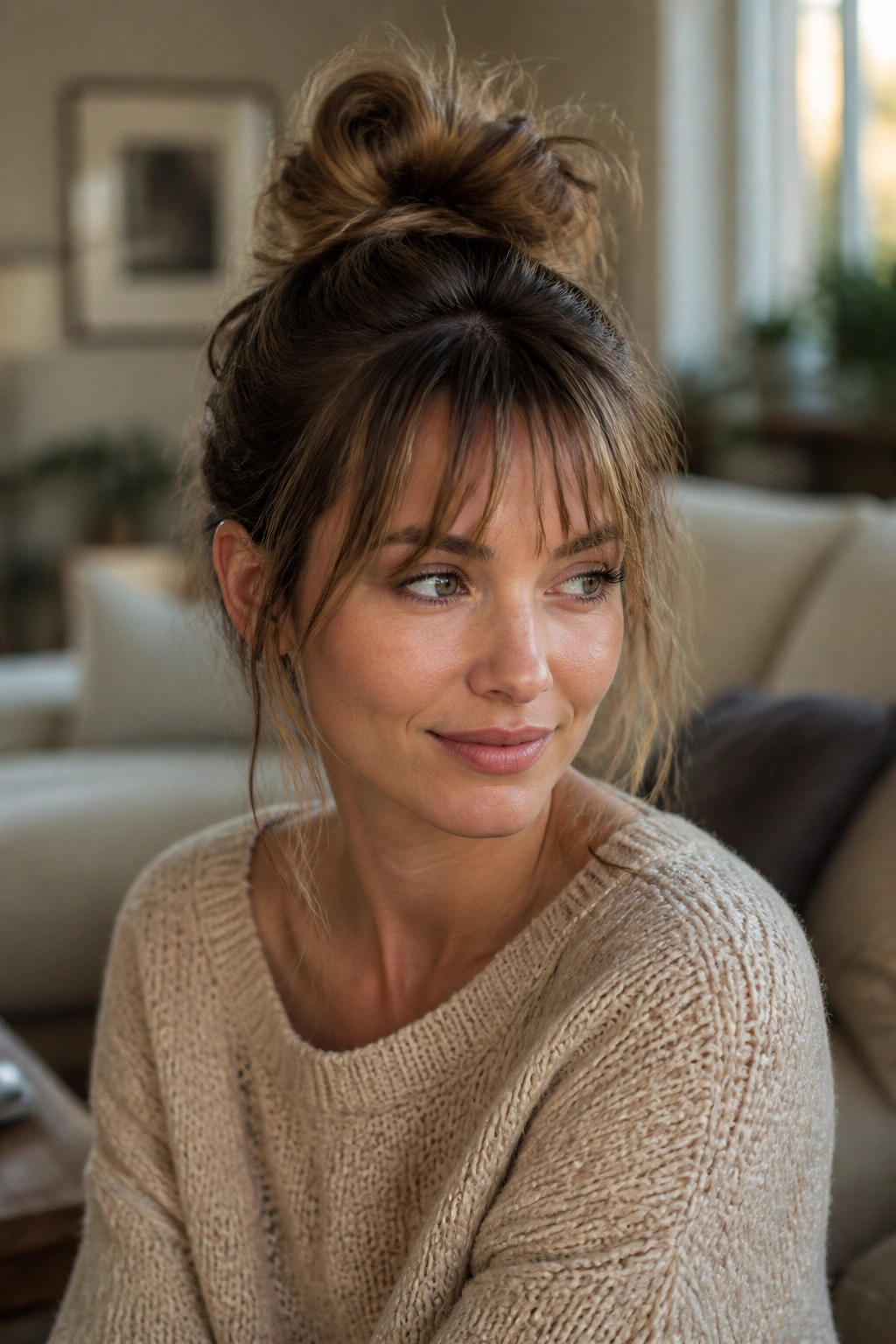
A messy top knot sounds casual because it is casual, but wispy bangs keep it from sliding into “I gave up.” That is the useful middle ground: relaxed, but still shaped.
The top knot sits high and loose, often with a few pieces left out around the hairline. Wispy bangs make that looseness feel deliberate. They add air to the front of the face and stop the style from feeling too heavy at the top. If your hair is naturally fine, this combo gives you volume without needing a giant teased crown.
A messy bun can go wrong fast when the bangs are too thick. The front and top start competing. Wispy fringe solves that by staying light. It is the easiest way to make a casual bun look styled rather than rushed.
A quick spray of dry shampoo at the roots helps here, especially if your hair is freshly washed and slippery. Twist the knot loosely, pin it in two or three places, and then touch the bangs last. Don’t overthink the stray pieces. The charm is in the slight mess.
5. Gibson Tuck with Soft Fringe
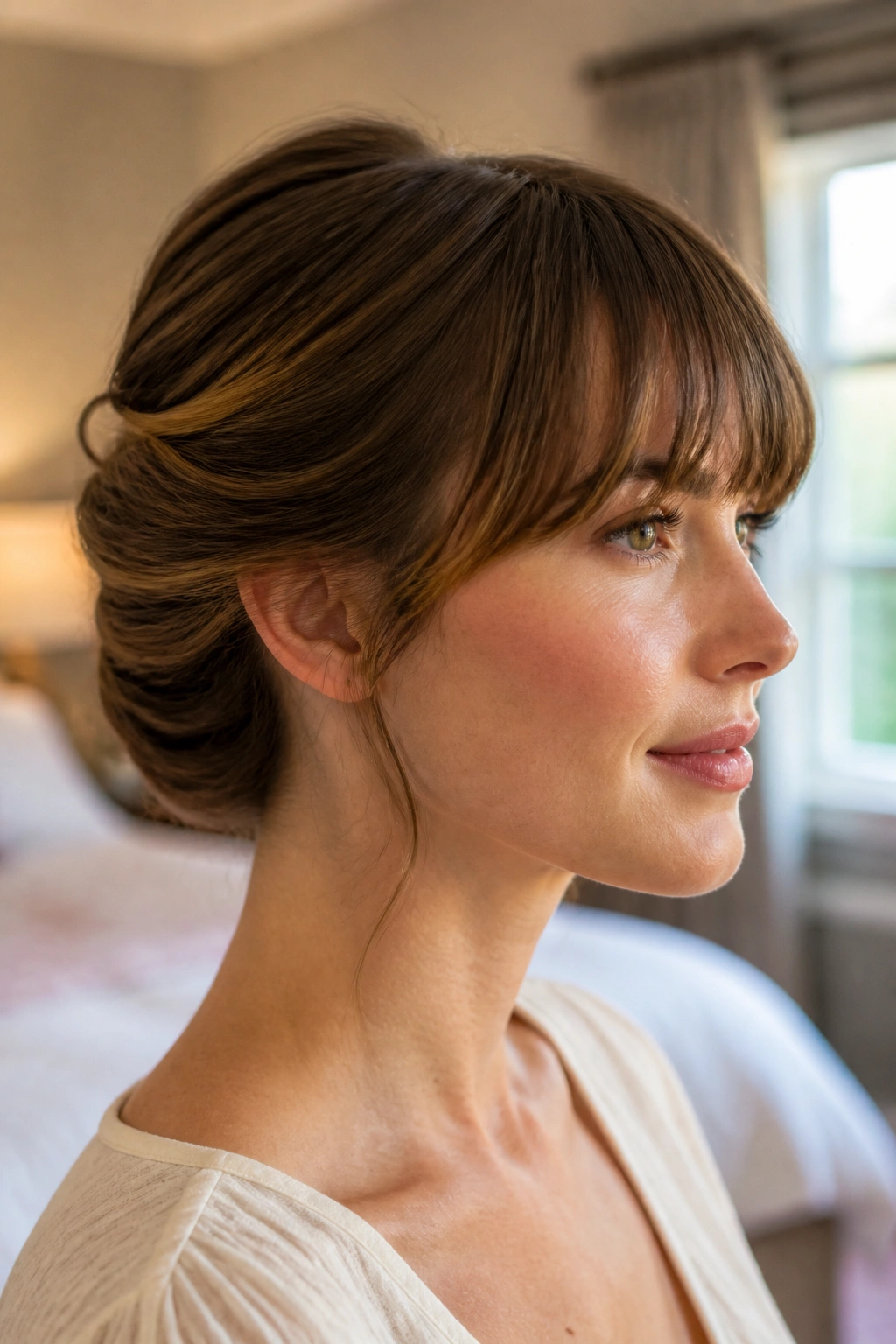
The Gibson tuck has a quiet elegance to it, and soft fringe keeps that softness going instead of turning the style severe. The hair rolls under itself near the nape, creating a neat tucked shape that sits flat against the head.
Soft fringe works here because the tuck already has enough structure. You do not need a hard line across the forehead. What you want is a little movement, maybe a gentle sweep or a broken, airy edge that keeps the face open.
A lot of people skip this style because they think it looks complicated. It really does not. You roll the length upward, pin as you go, and fold the ends into the tuck. The fringe is the part that changes the mood. With a feathered front, the whole look becomes less formal and easier to wear with a simple blouse or knit top.
If your hair tends to slip, use small, flat pins tucked into the roll rather than larger ones that poke out. A little texture spray at the mid-lengths can give the tuck something to grip. The front should feel soft, not fussy.
6. Crown Braid Updo with Face-Framing Bangs
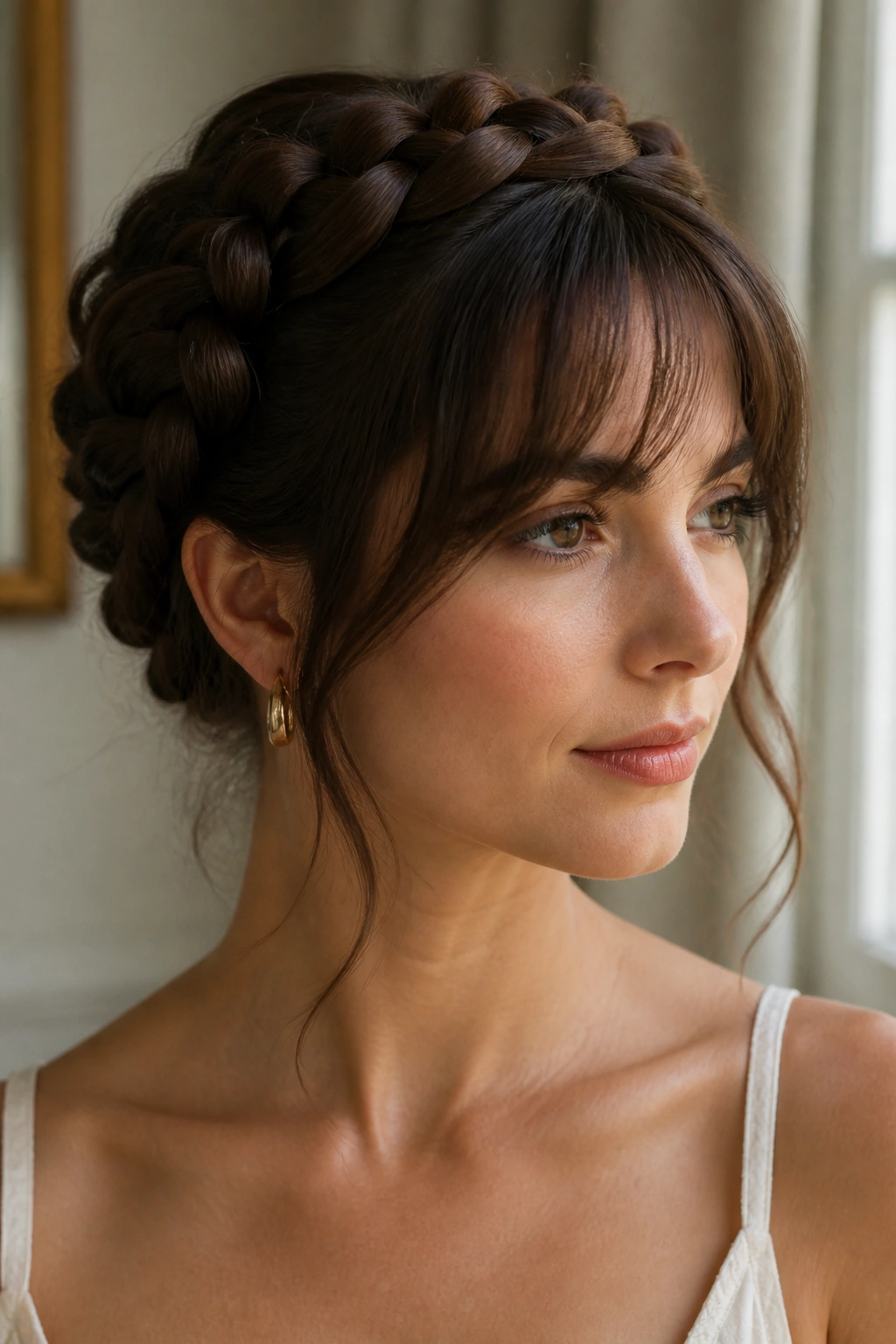
A crown braid with face-framing bangs is one of those styles that looks more complicated than it is. The braid wraps around the head like a built-in headband, and the bangs keep the look from feeling too locked in.
Why this one stays flattering
The braid adds structure around the perimeter of the head, which is useful if you want something that holds up well without relying on a lot of teasing. Face-framing bangs make sure the front does not disappear. They also soften the braid’s shape, especially if the braid is a bit thick or the hair is very dense.
Quick setup
- Start with lightly textured hair so the braid has grip.
- Leave enough bang length to skim the temples.
- Pin the braid close to the scalp in 2-inch sections.
- Tuck the tail under the braid or coil it low at the back.
This is a smart choice for weddings, dinners, or any day you want your hair to stay put. It also suits hair that is slightly grown out around the fringe, because those softer bits can blend right into the framing pieces. The charm is in the contrast: woven texture at the back, loose movement at the front.
7. Braided Low Bun with Side Bangs
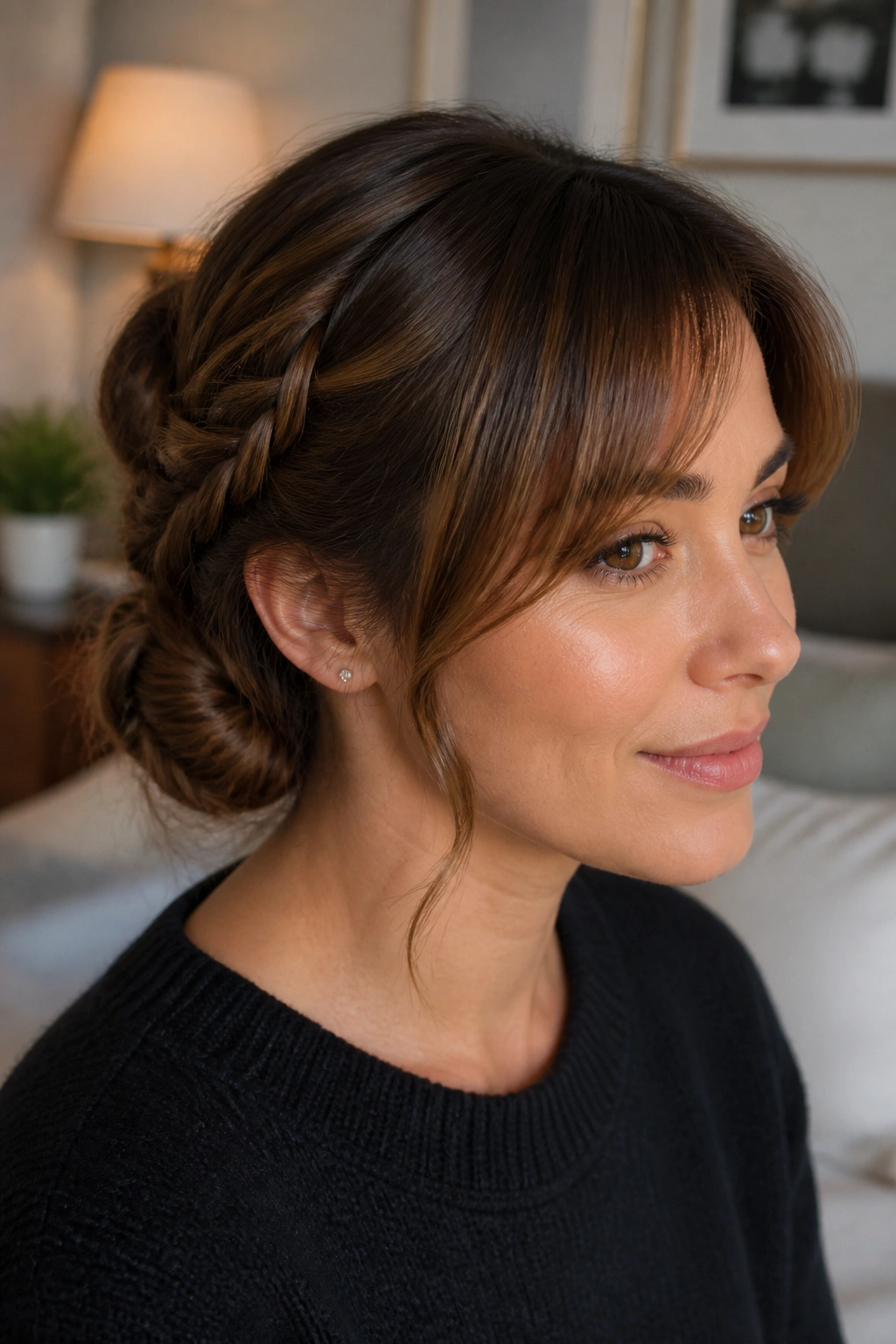
A braided low bun gives you texture where a plain bun might feel too plain. Side bangs keep the front easy and relaxed, which matters because the braid already brings enough detail on its own.
This is one of the better classic updos with bangs for hair that needs a little help staying in place. The braid gives the bun a firmer base, and the low placement keeps the whole style grounded. Side bangs prevent the result from feeling too locked up around the face.
If your hair has layers, this style is forgiving. The braid does not have to be perfect. In fact, a braid that is slightly loose often looks better because it gives the bun more body. A little shine spray on the finished braid can help the texture show without making it greasy.
Use an elastic close to your hair color, then wrap the braid into a bun and pin around the edges rather than through the center. That keeps the bun flatter. The bangs should fall just enough to break the line of the braid, not cover it completely.
8. Victory Roll Updo with Micro Bangs
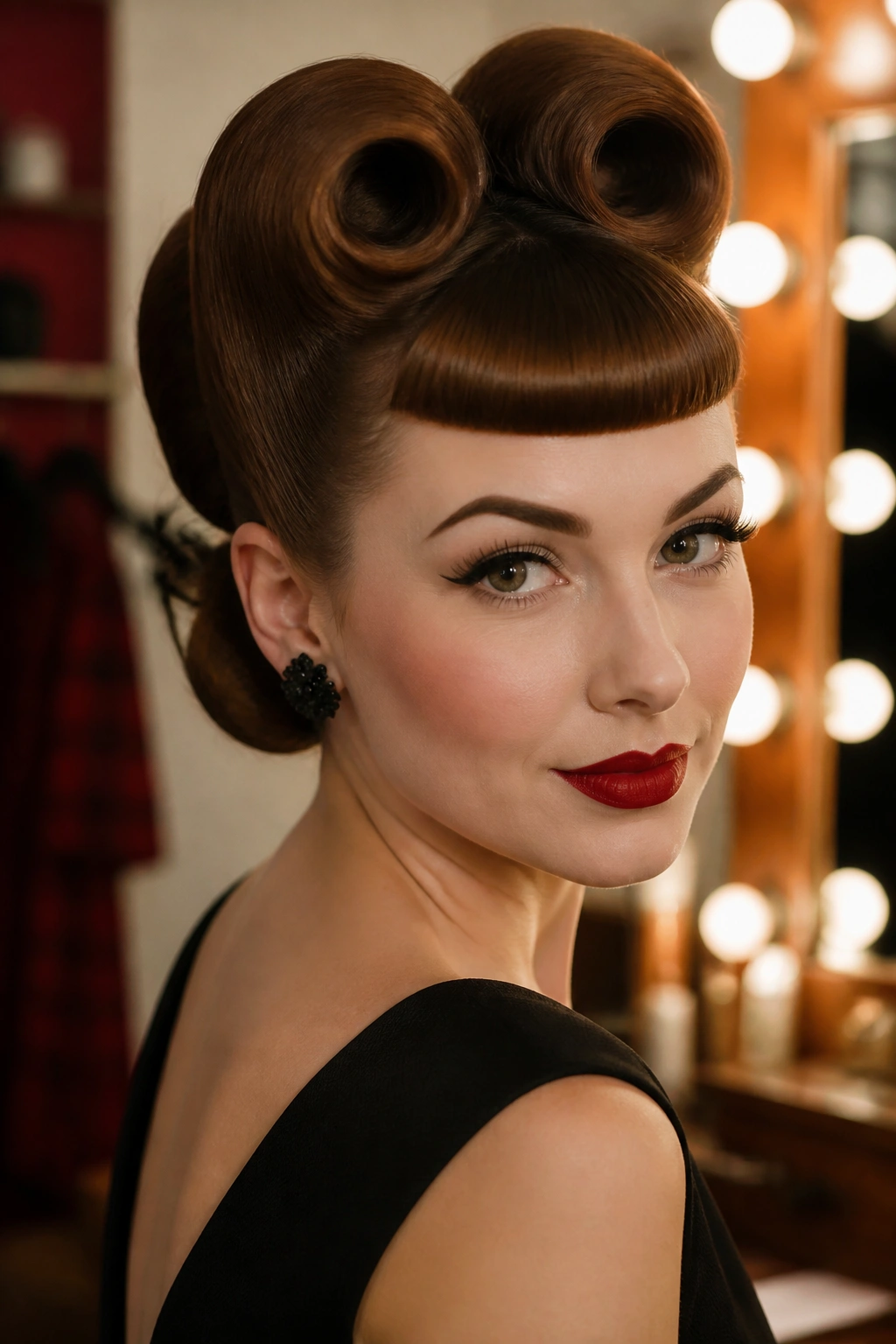
Can micro bangs work with a vintage updo? Absolutely, if you let the shape stay strong. Victory rolls bring all the drama to the top and sides, so the short fringe becomes part of the design instead of a separate detail.
How to keep it balanced
Victory rolls need structure, and micro bangs add a crisp front edge that suits that structure. The style is bold, but not busy. If you have ever seen a retro set where the bangs and rolls fight each other, the problem is usually scale. The rolls were too soft or the fringe was too heavy. Here, you want a clean ratio.
How to wear it well
- Keep the rolls smooth and symmetrical or slightly offset.
- Use setting spray or a light pomade to control flyaways.
- Curl the remaining hair under into a low tucked shape or pin it flat.
- Keep the fringe dry and defined so it does not collapse into the rolls.
This one is not shy. It works best when the outfit and makeup carry the same vintage energy. A cat-eye, a red lip, or a fitted neckline helps. But the real point is the shape. Short bangs sharpen the whole silhouette.
9. Bouffant Updo with Full Fringe
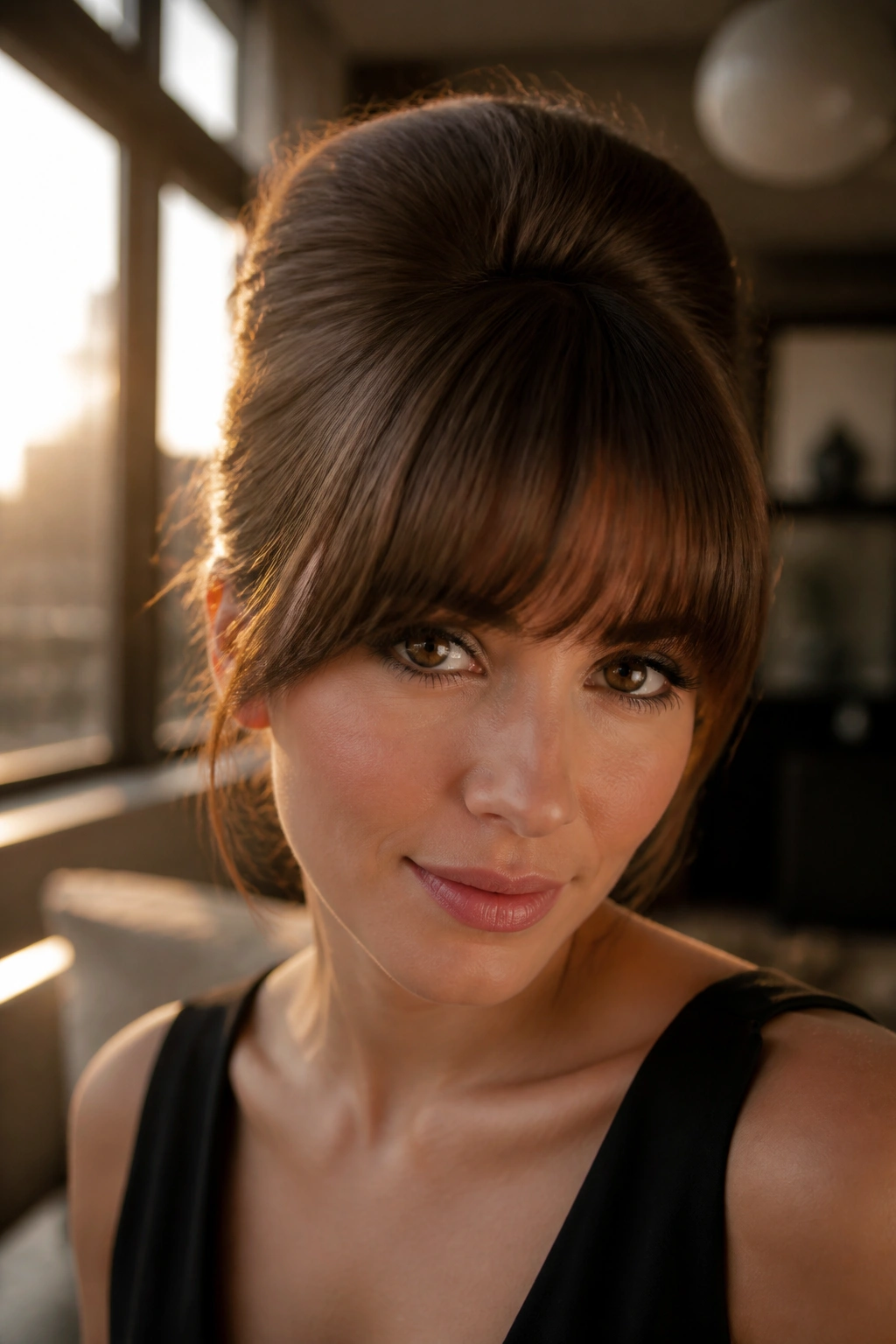
A bouffant updo with full fringe is the answer when you want height at the crown but do not want to expose the forehead completely. The bouffant gives lift, while the fringe grounds the style and keeps it from going too far back in time.
This pairing has a classic, slightly dramatic feel. Full bangs stop the bouffant from looking too airy or overdone. They also hide a little crown teasing, which is handy if you want volume without showing every tease mark.
The key is to keep the bangs smooth and the crown controlled. If both areas are too big, the style starts to look puffy. If both are too flat, you lose the whole point. That balance takes a hand that is a little patient with the brush. A round brush and a cool blast at the end help the fringe sit properly.
This style is excellent for long faces and for anyone who likes a bit of old-school structure. It can feel dressy, but not stiff, especially if a few fine pieces are left near the ears.
10. Twisted Low Knot with Curtain Bangs
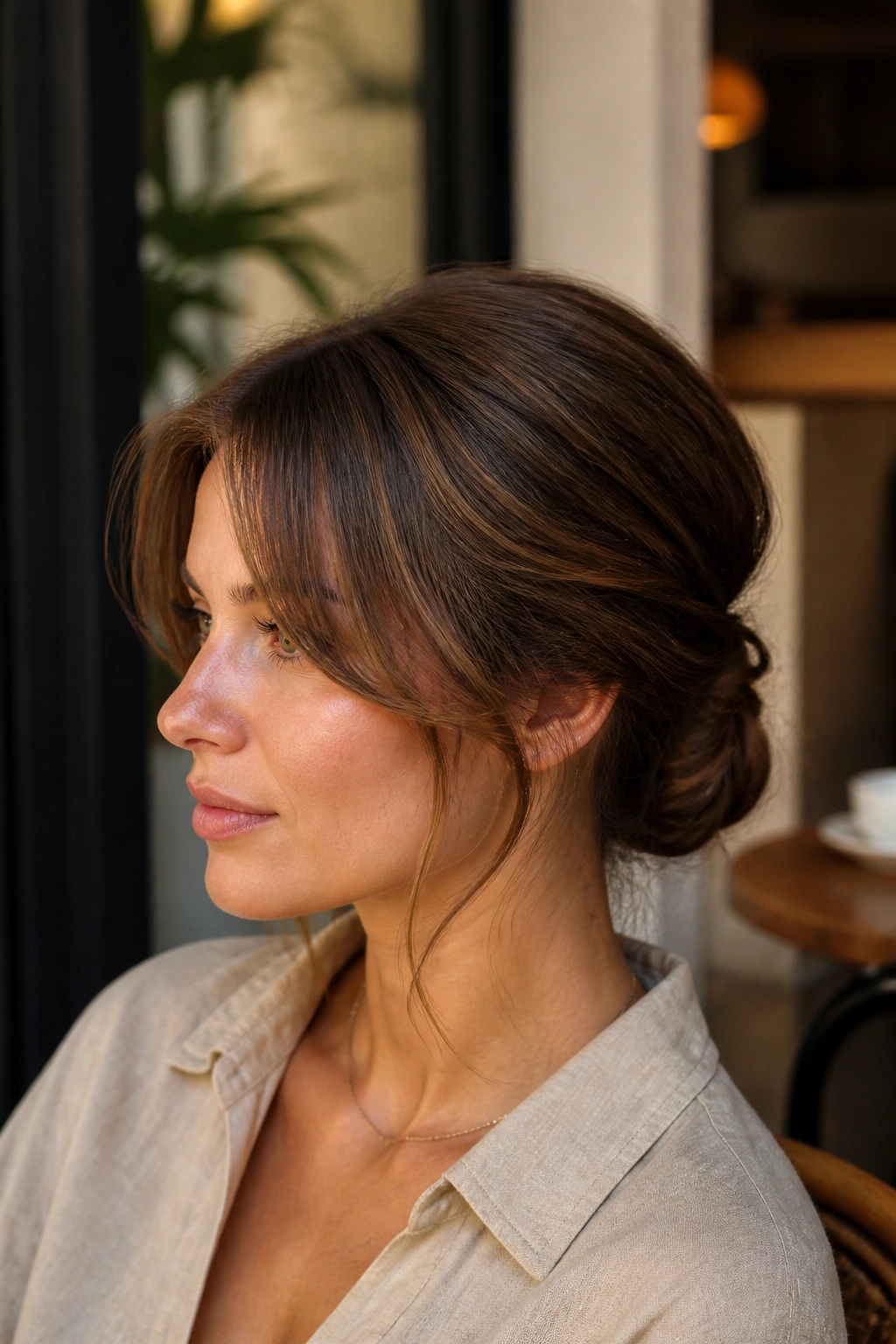
A twisted low knot feels cleaner than a messy bun and less formal than a chignon. Curtain bangs are the easiest way to keep that middle lane comfortable.
What makes it different
Instead of folding the hair into a tight coil, you twist sections back and anchor them low. The result has movement, but it does not look loose. Curtain bangs echo that same feel at the front: parted, soft, and slightly undone in a controlled way.
How to style it
- Divide the hair into two back sections before twisting.
- Twist each side toward the center and pin them where they meet.
- Leave the knot low and slightly oval rather than round.
- Blow-dry the bangs away from the face, then let them settle naturally.
This is one of those styles that looks good on a normal day, not only at special events. It works with sweaters, blazers, and plain tees. It also survives a little wind better than styles that depend on perfect smoothness. If you want classic without looking formal, this is a solid choice.
11. French Roll with Swept Fringe
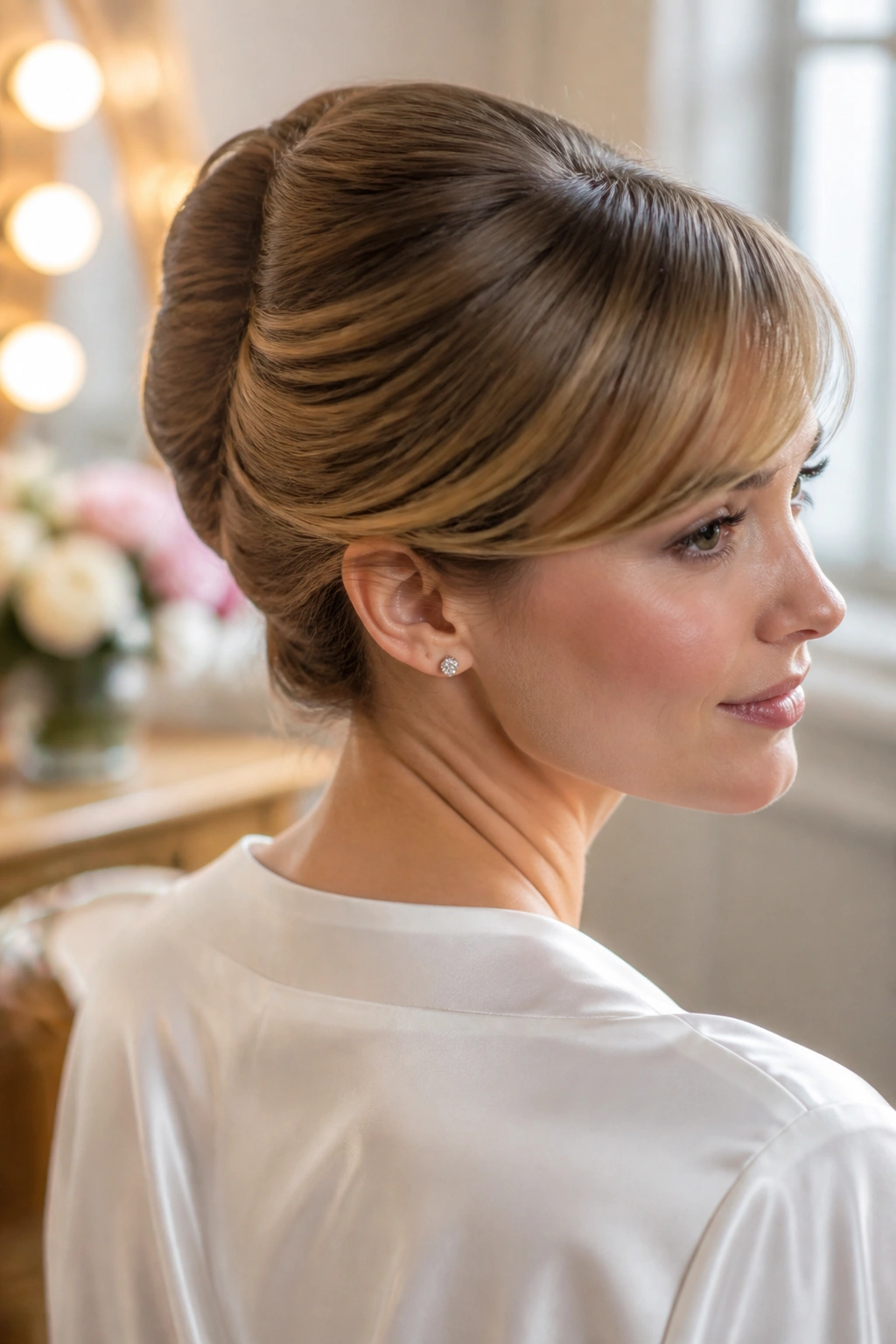
A French roll has a slimmer profile than a French twist, and swept fringe gives it a softer front edge. The style runs vertically along the back of the head, which creates a neat line that feels tidy without being severe.
Swept fringe helps because the roll already has a strong shape. A straight-across bang would make it feel boxy. A side sweep opens the face and keeps the top from looking too helmet-like, which is a real risk with polished rolls if the hair is dense or coarse.
This is a style that rewards careful pinning. The roll should sit close to the head and feel anchored from the middle all the way down. The fringe can stay loose, but not floppy. A little bend from a flat iron or round brush is enough.
If your hair is layered, pin the shorter pieces into the roll first and then smooth the surface. That keeps the front and back from separating. The line should look continuous from fringe to nape.
12. Side Bun with Angled Bangs
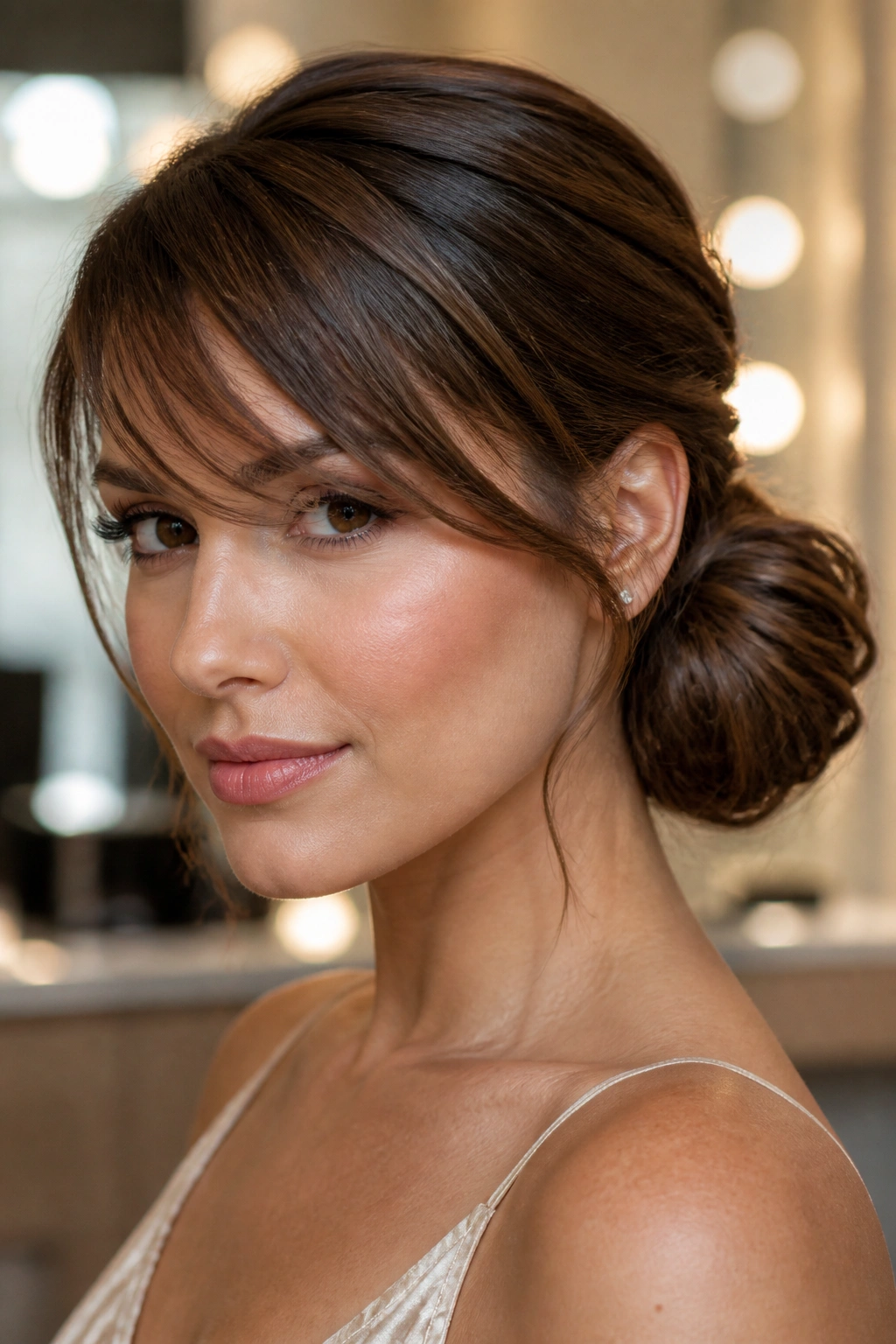
A side bun has built-in personality because it breaks the centered shape people expect from formal hair. Angled bangs push that effect further by directing the eye diagonally across the face.
This is a good style when you want something a little softer than a strict low bun. The bun can sit behind one ear or just below it, and the bangs help carry that off-balance feel so it does not seem accidental. Angled bangs are especially useful if your face feels widest at the cheeks, because the diagonal line changes the visual weight.
You can keep the bun smooth or give it a little texture. Both work. What matters more is that the bangs do not fight the placement of the bun. If the bun is low and left-heavy, the bangs should sweep in the opposite direction with enough movement to connect the two halves of the style.
A few loose pins are fine here. A tiny bit of separation makes the bun look touched rather than trapped. The shape should look like it was chosen, not corrected.
13. Sleek High Ponytail with Bangs
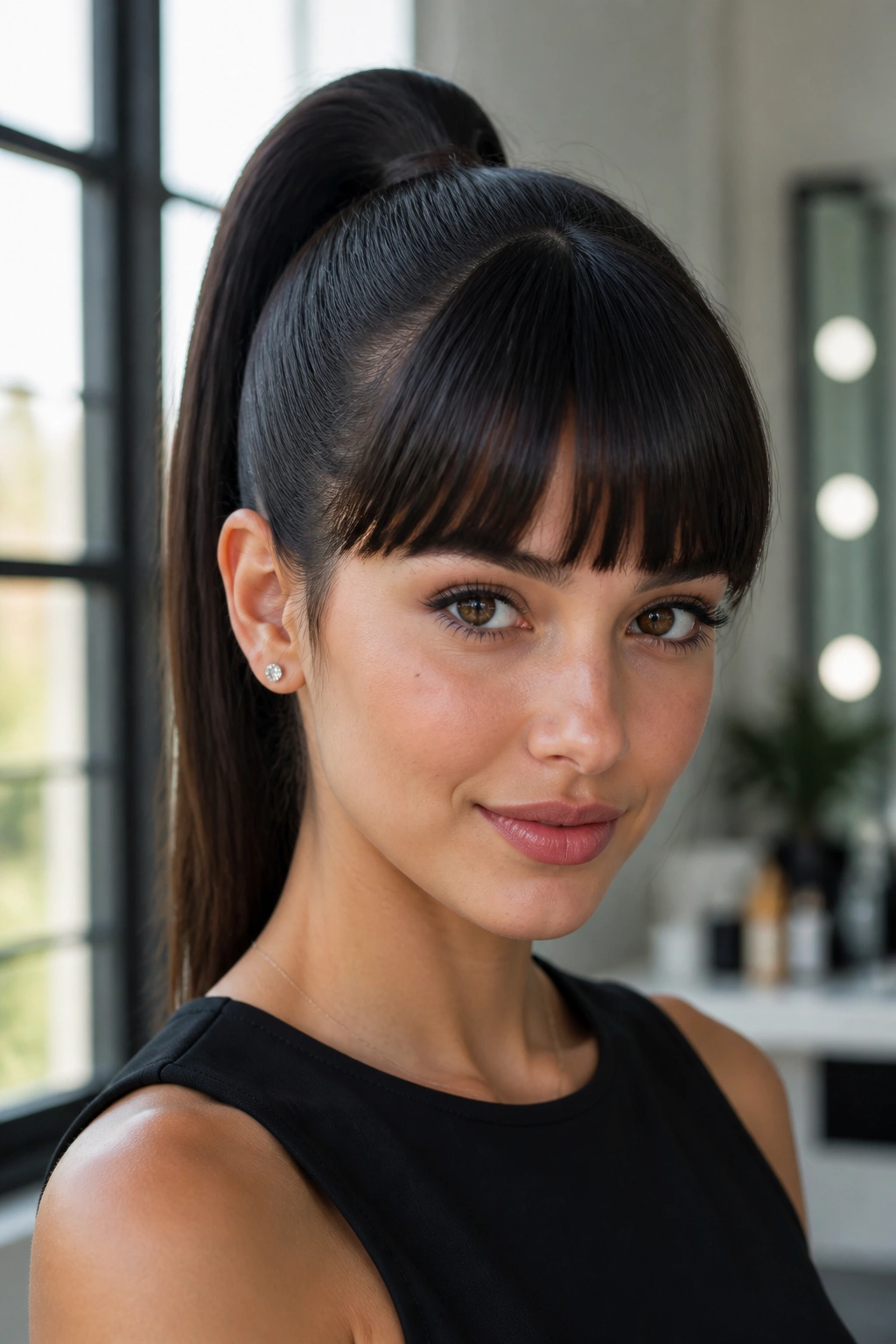
A high ponytail counts as a classic updo for a reason. It lifts the face, exposes the neck, and looks good on a day when you want your hair out of the way but still styled. Add bangs, and the look shifts from sporty to polished.
Why bangs matter here
A high ponytail pulls everything back sharply, which can make the front feel bare. Bangs fix that immediately. Full bangs give the ponytail more attitude. Curtain bangs soften it. Side bangs make it easier to wear with tailored clothes or a sharper neckline.
Getting the finish right
- Brush the crown up before tying the elastic.
- Wrap a small section of hair around the base to hide the band.
- Smooth the bangs separately so they do not get caught in the pull.
- Use a flat brush for straight bangs and a round brush for softer fringe.
If your hair is thick, secure the ponytail in two elastic layers so it does not sag. If it is fine, a spritz of texturizing spray at the base helps the ponytail hold its height. The bangs should feel deliberate, not like a leftover section from the rest of the style.
14. Wrapped Low Ponytail with Soft Layers
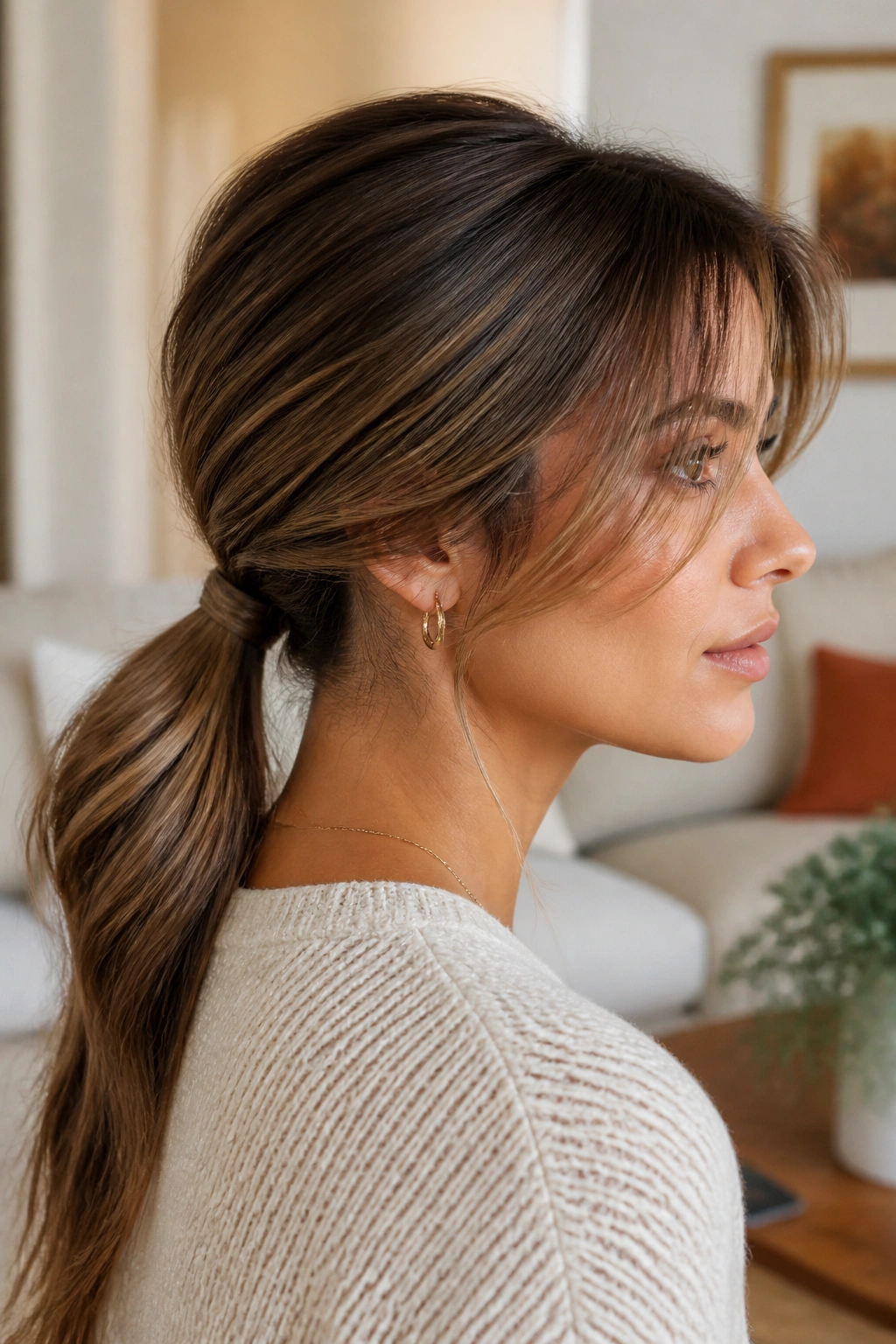
A wrapped low ponytail has a calm, almost restrained feel, which is exactly why soft layers work so well with it. The elastic gets hidden with a strand of hair, and the low placement keeps the style graceful instead of sporty.
Soft layers around the front stop the ponytail from feeling too severe. They also help if your bangs are growing out, because the front can blend into the rest of the shape instead of sticking out as a separate element. This is a useful style for hair that is medium to long and has some natural movement.
You do not need much volume at the crown. In fact, too much lift can make the ponytail look disconnected from the face. Keep the top smooth, tie the ponytail low, then wrap a small strand around the elastic and pin it underneath. The front pieces can stay loose around the temples or be tucked behind the ears depending on your face shape.
It is a quiet style, and that is the point. Not every updo needs a dramatic finish to work.
15. Double-Twist Chignon with Side Bangs
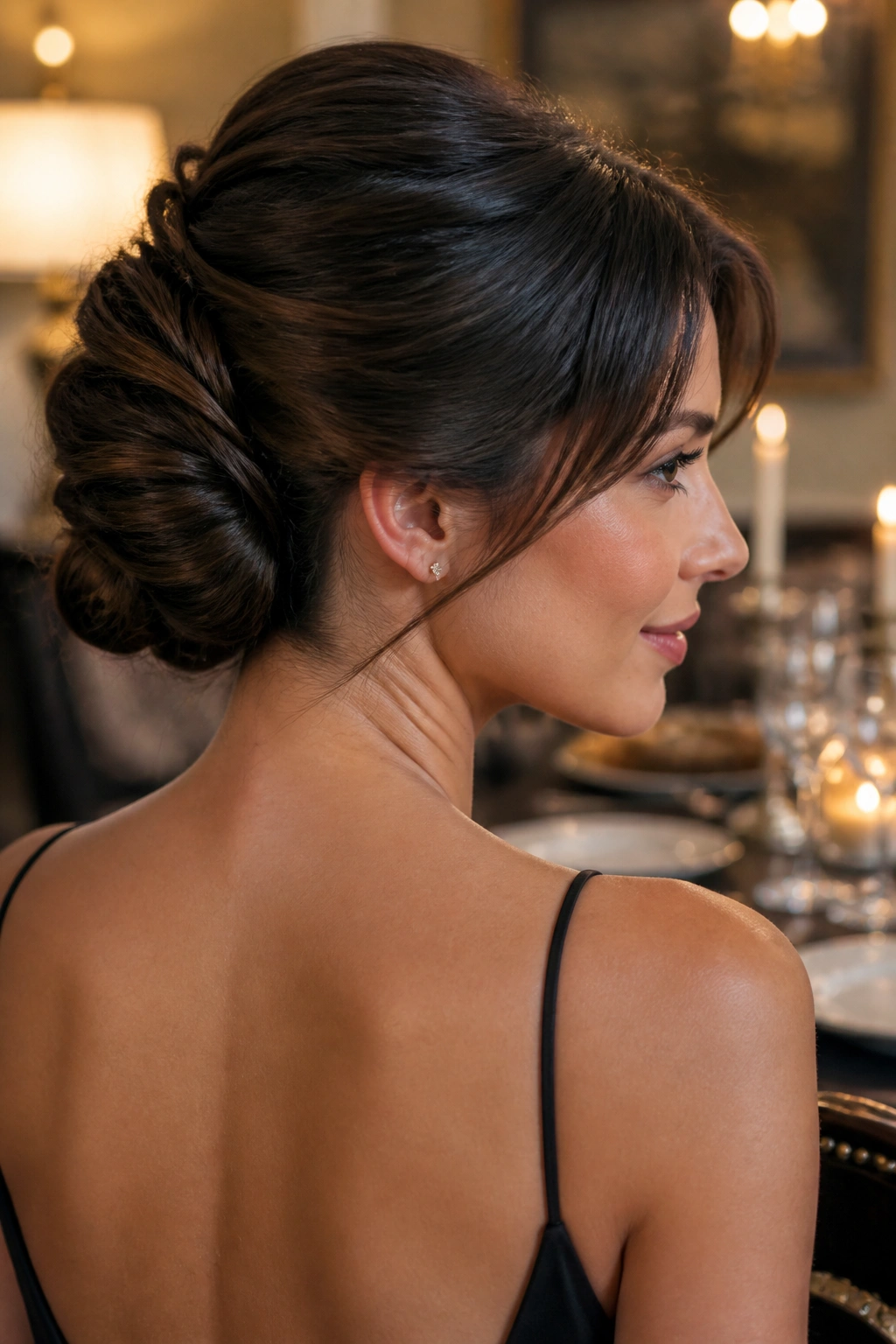
The double-twist chignon gives you a little more texture than a single coil, which is useful when the hair is layered or when you want the back to look fuller. Side bangs keep the front approachable and stop the style from feeling too formal.
Think of it as two soft twists meeting at the nape and folding into one bun. That extra twist creates depth without making the style bulky. Side bangs sit nicely against that shape because they balance the visual weight. If the bun leans left or right a touch, the bangs can mirror that movement.
This is a strong choice for hair that needs control but not stiffness. It also wears well with earrings, since the bun stays low and the front is open enough to show the face. A light mist of hairspray and a couple of hidden U-pins are often enough.
If one side looks too flat, tug a little at the twist rather than adding more product. Product can make the whole thing greasy fast. Shape first, hold second.
16. Braided Crown Bun with Baby Bangs
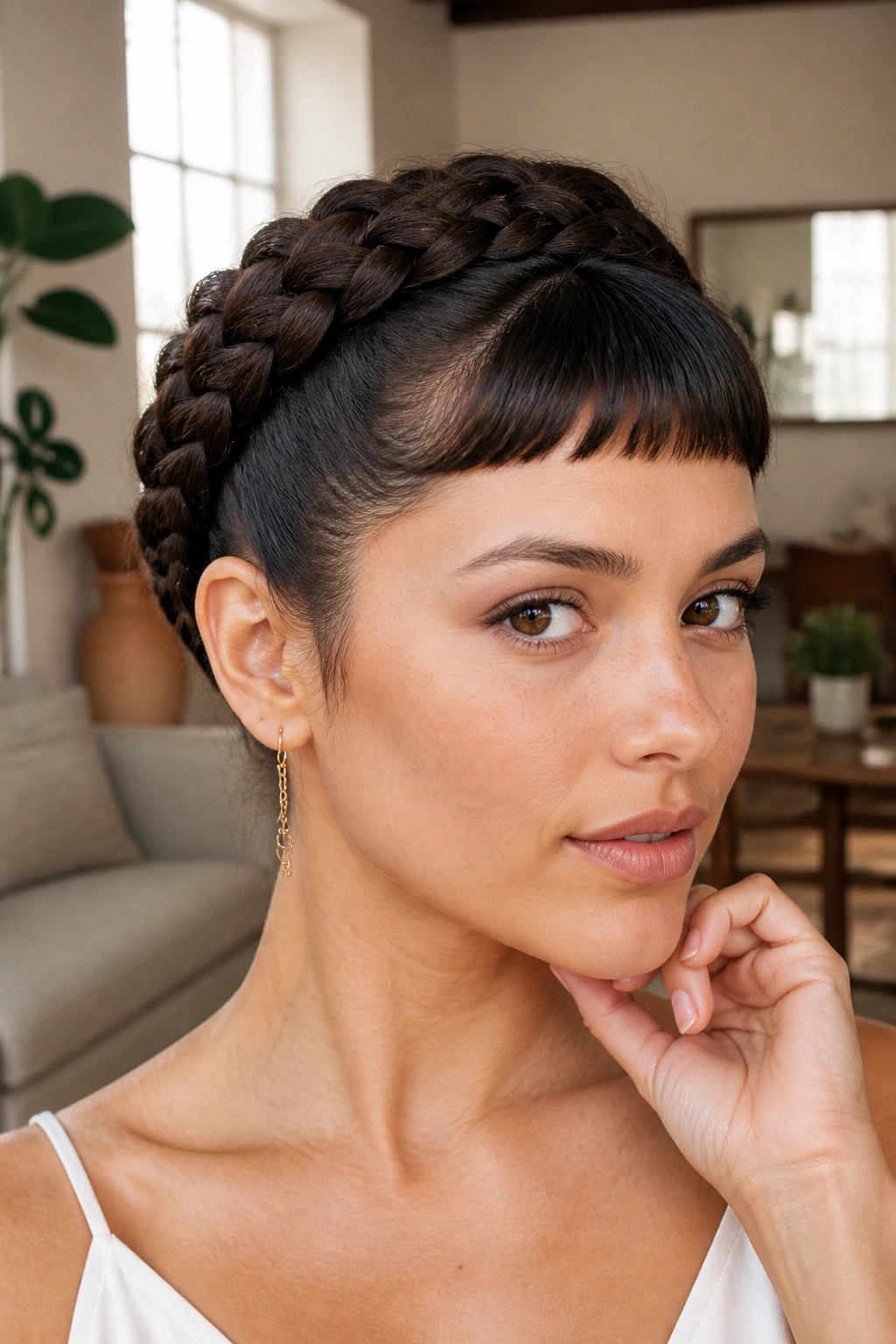
Baby bangs and a braided crown bun are a bold pair, and that is exactly why they work. The braid wraps the head in a decorative line, while the short fringe keeps the front sharp and modern-looking even though the base shape is old-school.
Best way to wear it
This is not a soft, blended look. It is architectural. The crown braid creates a visible path around the head, and the baby bangs create a hard stop above the eyes. If you like styles with a little edge, this one has it built in.
Small details that matter
- Keep the braid tight enough to stay close to the scalp.
- Pin the bun low or at the crown, depending on how much height you want.
- Smooth the baby bangs with minimal product so they stay piecey instead of greasy.
- Leave the rest of the hair tucked neatly so the front remains the focus.
The style works best when the bangs are cut on purpose, not grown out by accident. It can be striking with simple clothes because the hair carries the whole look. The contrast is the reason it holds your attention.
17. Classic Knot at the Nape with Wispy Bangs
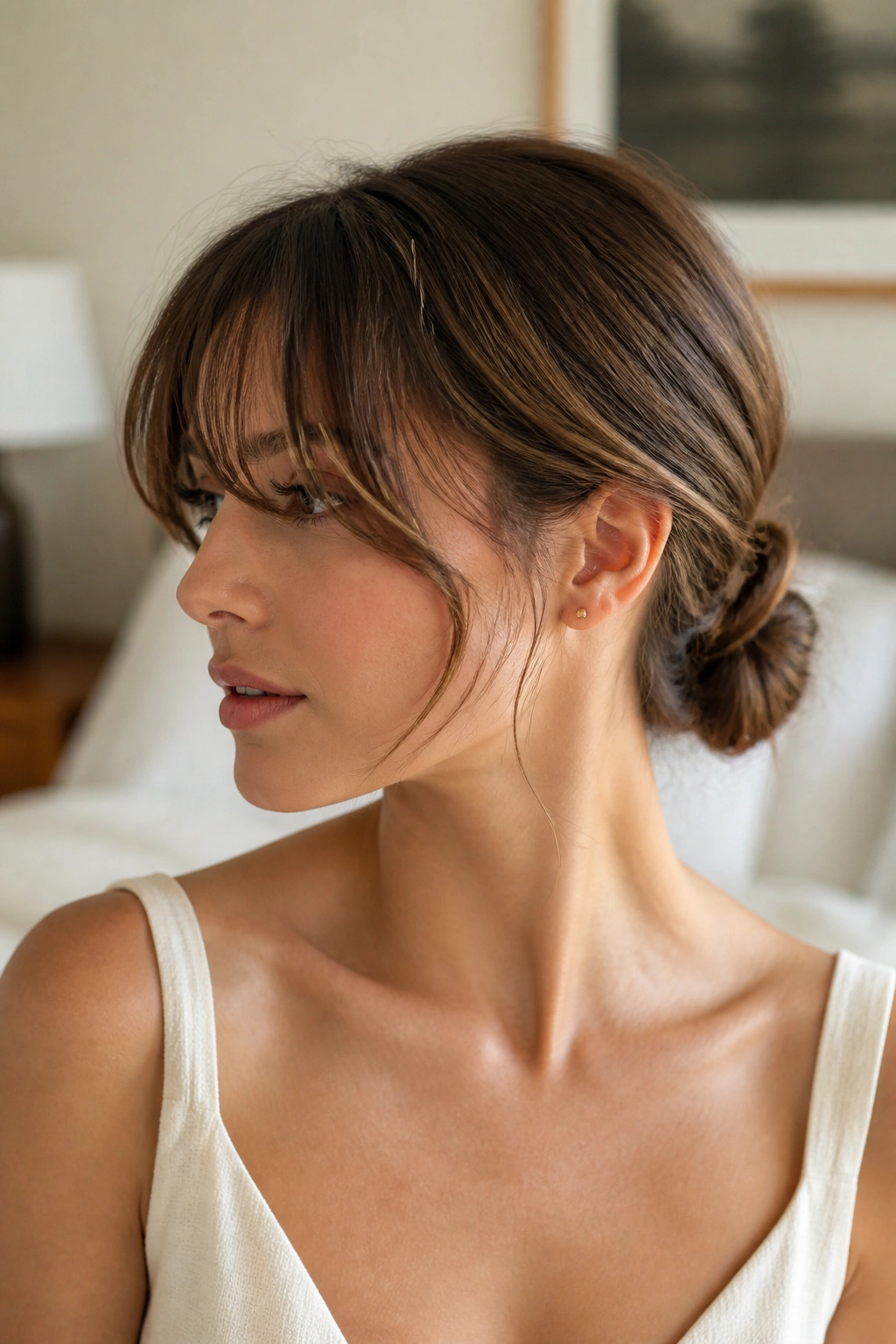
A knot at the nape is one of the easiest classic updos to wear, and wispy bangs make it feel lighter around the face. The knot sits low and neat, usually with the hair wrapped into itself or tucked under a small coil.
Wispy bangs are useful because they stop the style from looking too tidy. A low knot already has restraint; the fringe adds breath and movement. If your hair is fine, this combo is especially friendly because the wispy bangs do not demand thick density. They can be feathered, broken, or slightly see-through and still look right.
This style is also nice when you want to keep your neckline open. It works with necklaces, collars, and earrings without competing with them. A smoothing cream can help the knot stay clean, but use a small amount. Too much and the bangs lose their soft edge.
Simple wins here. A clean knot and a light fringe can carry more style than a complicated updo with too many pieces fighting for attention.
18. Polished Low Roll with Long Curtain Bangs
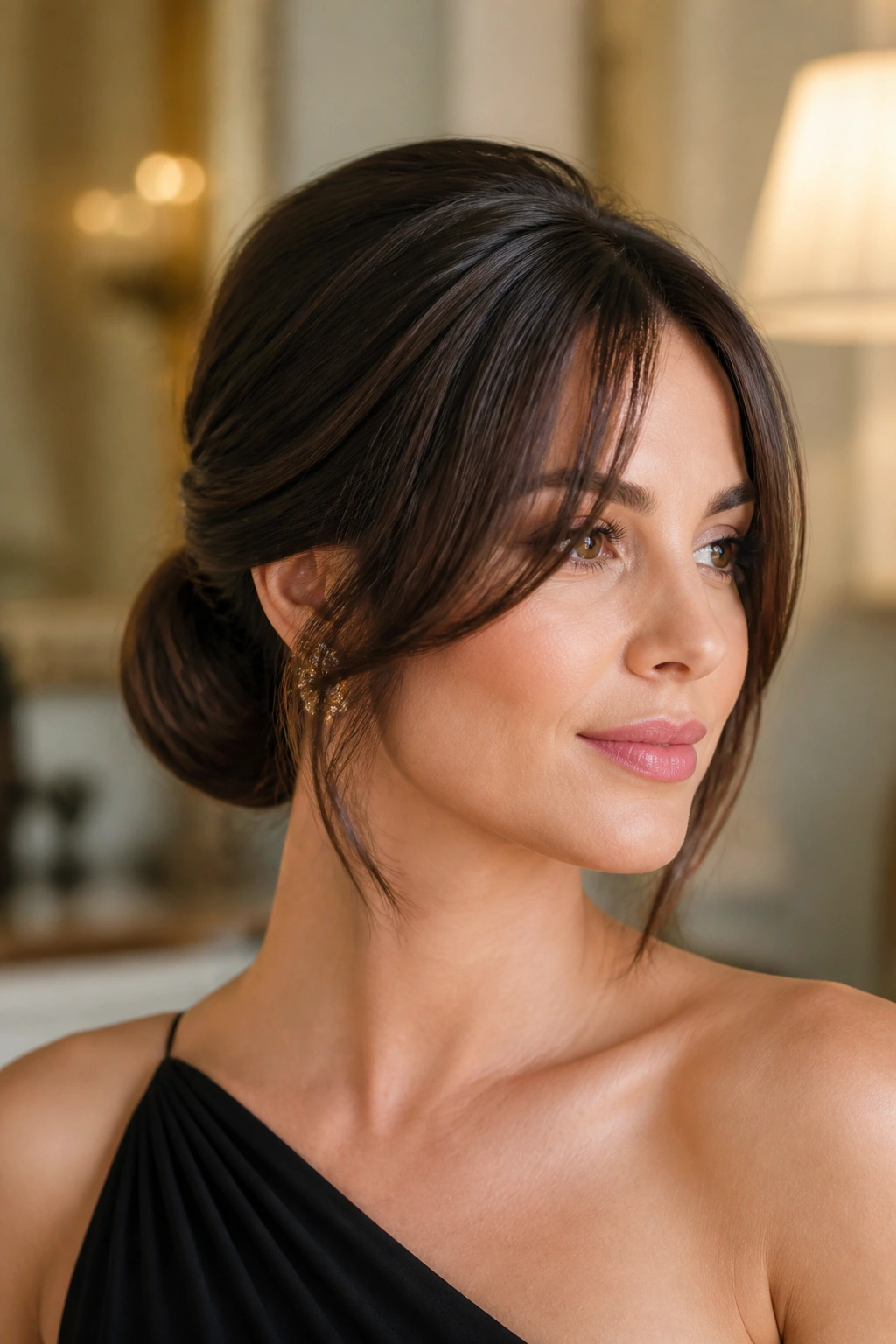
A polished low roll is the sort of style that never feels out of place. It sits low, close to the head, and has enough structure to look deliberate without turning rigid. Long curtain bangs finish it with a softer frame that keeps the face open.
This pairing is smart because the roll brings order while the bangs bring movement. Long curtain bangs are especially helpful when the hair is past the shoulders and the front needs a bit of shape. They can blend into the sides or fall along the cheekbones, depending on how much face you want to show.
The roll itself should be smooth, but not pressed flat. A little curve through the middle gives the style life. Pin it from underneath so the outside stays clean. If the bangs want to split in the center, let them. That bit of space is part of the charm.
It is the kind of updo that works for a formal event, a dinner, or a workday when you want your hair controlled without looking overdone. If you keep one classic style in your back pocket, this is an excellent one.
Long curtain bangs make the whole thing feel less rigid. The roll carries the polish. The fringe keeps it human.
