



A blunt bob can look polished in the chair and boxy by dinner. That’s the problem most people run into when they ask for “just a bob” and leave with a clean line that sits there like a helmet until the next wash.
A feathered bob fixes that by taking weight out in the right places. Not everywhere. Not with random thinning shears gone wild. The good versions are carved with intention: soft internal layers, lighter ends, and enough movement to keep the shape from feeling stiff.
That’s why this cut works across so many hair types. Fine hair gets lift. Thick hair gets air. Straight hair stops looking like one solid block. Wavy hair gets a little help without losing its natural bend.
The trick is matching the feathering to the hair you actually have — and the way you live with it — because a feathered bob that looks effortless on one person can turn puffy, limp, or over-shredded on another. The right version matters.
1. Feathered French Bob with Airy Ends

The French bob already has attitude. Add feathering, and it softens into something a little less rigid, a little more lived-in, and a lot easier to wear if you hate hair that looks too “done.”
This version usually sits around the jawline or just below it, with the ends cut to move instead of sit flat. The feathering is subtle, which is the point. You want the perimeter to stay clean enough to hold shape, but the interior should be light enough that the bob bends instead of dropping into a shelf.
Why It Works on Shorter Hair
A short bob can go boxy fast. Feathered ends break that blocky outline and make the cut feel lighter around the face. That matters if your hair is dense or if your jawline is sharp and you want something softer near the cheeks.
- Best for straight to slightly wavy hair
- Sits well with a center part or a loose side part
- Looks especially good when the ends curve under with a small round brush
- Needs trimming about every 6 to 8 weeks if you want the shape to stay crisp
Pro tip: Ask for soft point cutting at the ends, not aggressive texturizing through the whole head. Too much slicing turns this into frizz bait.
2. Collarbone Feathered Lob

A lob earns its keep when you want movement without giving up the option to tie your hair back. This feathered version keeps the line long enough to feel easy, but the layers stop it from hanging like a curtain.
The best collarbone feathered lob usually has the longest pieces brushing the top of the shoulders and shorter internal layers that start around the cheekbone or below it. That placement matters. If the feathering begins too high, the shape can get floppy. If it starts too low, you lose the lift that makes the cut worth getting in the first place.
The result is a haircut that moves when you walk. Not in a fussy way. In a believable way.
This is the one I’d point to for anyone who wants a bob haircut that can survive a workday, a gym bag, and second-day styling without looking tired. A quick blow-dry with a medium round brush gives the ends a soft flip, and a mist of light texture spray keeps the layers from collapsing. Simple. Smart. No drama.
3. Feathered Bob with Curtain Bangs
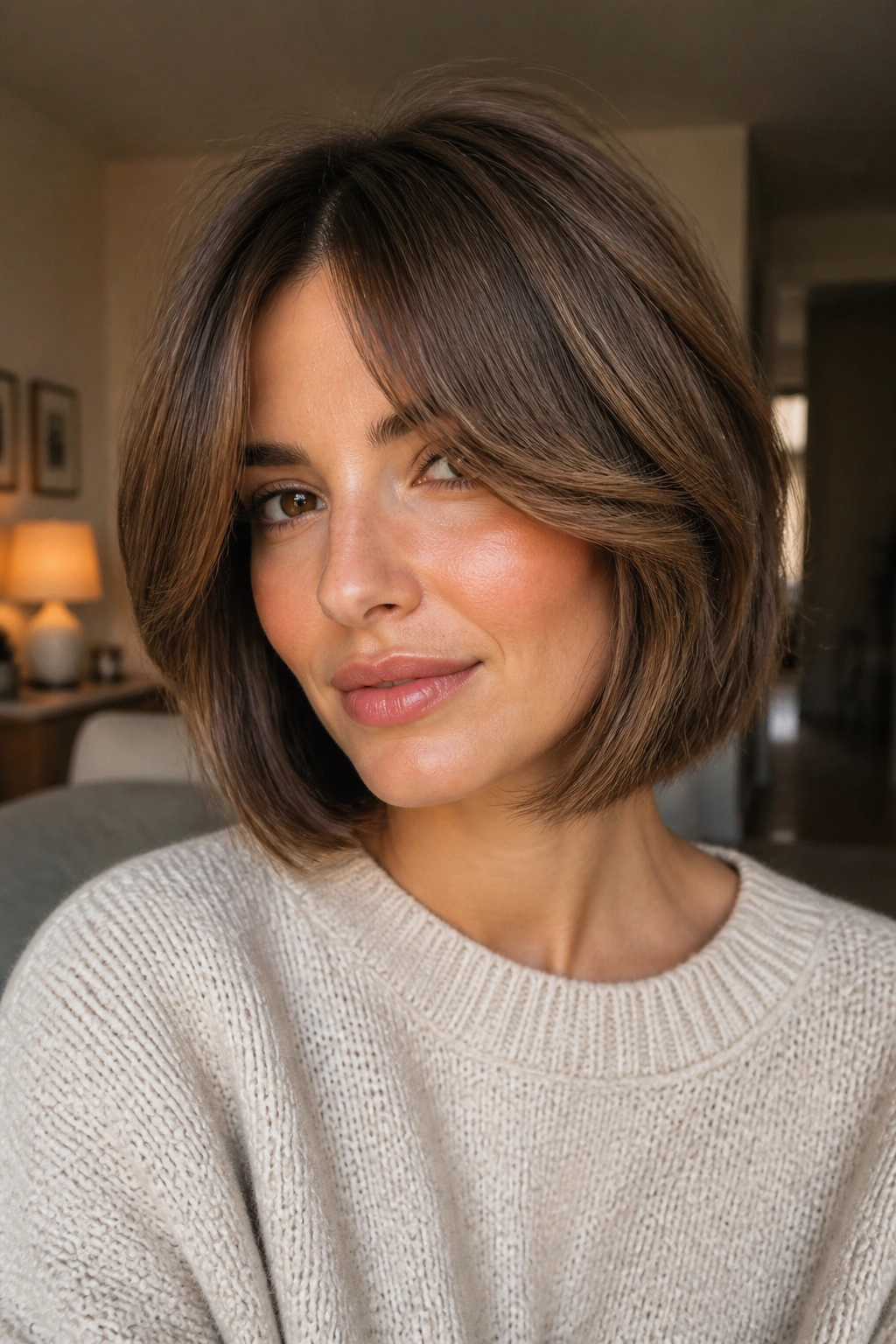
Why does this pairing work so well? Because curtain bangs and feathering are doing the same job in two different places: they blur hard lines. One opens the forehead; the other loosens the shape through the sides and ends.
This cut works best when the bangs are blended, not chopped bluntly across the face. The shortest part usually sits around the bridge of the nose or just below it, then the fringe sweeps open into the cheekbones. The bob underneath should echo that motion with layers that curve away from the face rather than straight down.
How to Ask for It
Tell your stylist you want bangs that merge into the front layers, not a separate fringe sitting on top of the haircut. That phrase saves a lot of confusion.
A small round brush or a velcro roller can help the bangs fall in that soft split shape. If you leave them to air-dry without guidance, they can part strangely and stick out in the wrong direction. Bangs are needy like that.
This version suits round and oval faces especially well, because the layers create vertical movement without making the face look too long. It also plays nicely with second-day hair. A little dry shampoo at the roots, a finger through the fringe, and you’re back in business.
4. Rounded Feathered Bob for Fine Hair
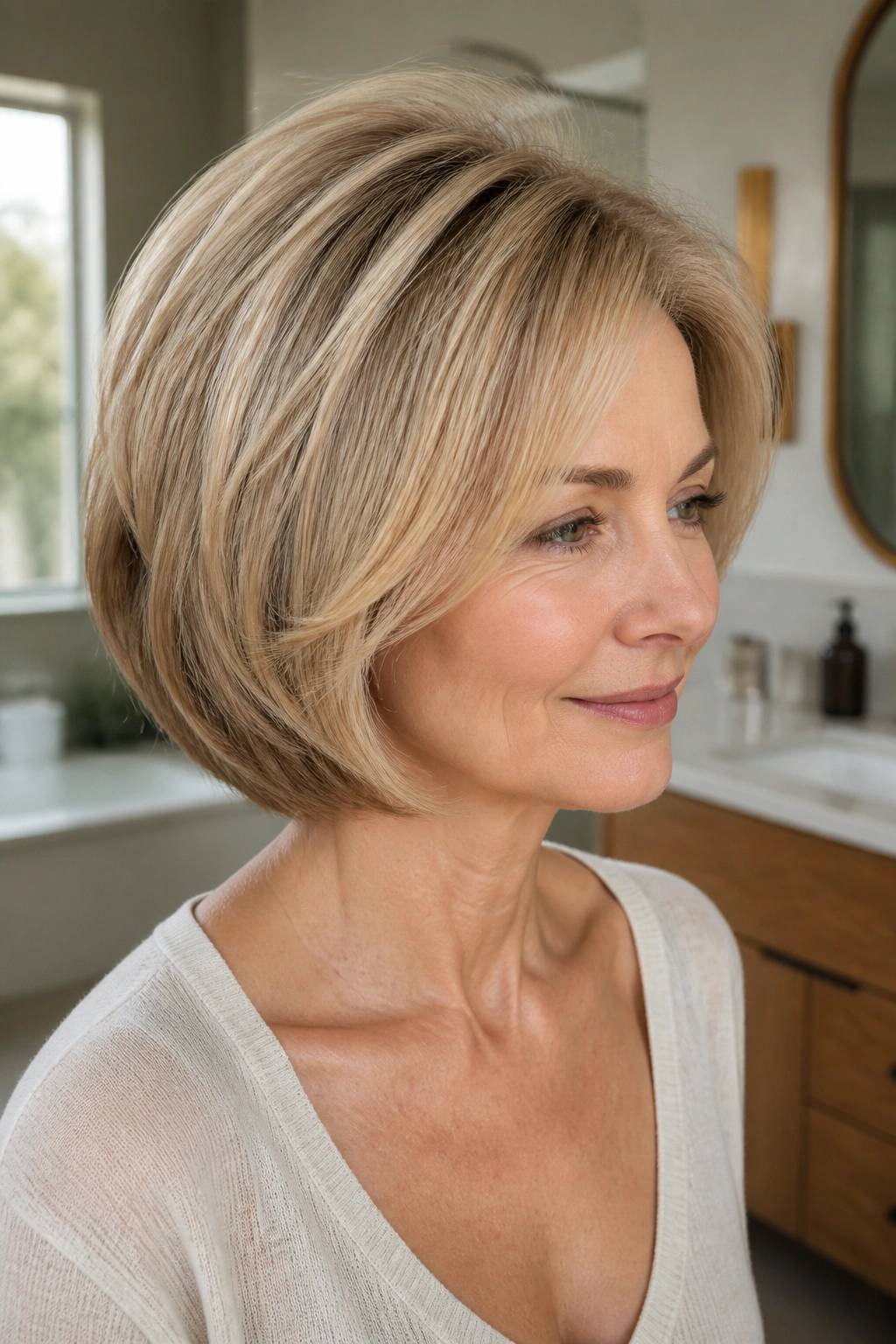
Fine hair needs a haircut that knows how to fake fullness. A rounded feathered bob does that by building shape through the crown and keeping the ends soft enough to avoid a thin, stringy finish.
I’ve seen too many fine-haired people get talked into heavy one-length bobs that look slick for about five minutes. Then gravity wins. The rounded feathered version is different. It keeps a slight curve around the head, with discreet internal layers that support lift without turning the style into a shag.
What to Ask For
- A rounded outline through the back and sides
- Light internal layers at the crown
- Soft feathering at the ends, not heavy thinning
- A length that clears the jawline if you want more movement
The styling part matters here. Use a volumizing mousse at the roots on damp hair, then blow-dry with a round brush, lifting the crown straight up before turning the ends under. That one motion makes a bigger difference than people expect.
Do not overdo serum on the ends. Fine hair gets weighed down fast, and a feathered bob only looks full if the layers can move.
5. Side-Part Feathered Bob with Swept Fringe
A side part changes everything. Seriously. It gives a feathered bob a bit of lift at the root, which is why this version feels fuller and less symmetrical than a center-parted cut.
The swept fringe is the part that makes it work. Instead of falling straight across the forehead, the front pieces arc diagonally and merge into the sides. That diagonal line is flattering on square faces because it softens the angles. It also helps if one side of your hair naturally grows flatter than the other — which, annoyingly, happens to a lot of people.
The cut itself should still have a clean perimeter. The feathering lives inside the shape, not all over it. That balance keeps the style from looking messy in a bad way.
What I like about this version is that it looks intentional even when it’s slightly undone. A little bend at the ends, a little lift at the roots, and the side part does half the work for you. If you want a layered bob that feels polished but not stiff, this is a strong place to start.
6. Tousled Feathered Lob with Broken Waves
Unlike a sleek lob, this one is built to look a little irregular. That’s not a flaw. It’s the whole point. The soft layers and broken waves give the haircut a loose, airier feel that doesn’t depend on perfect blow-drying.
The trick is restraint. You do not want ringlets, and you definitely do not want every piece curled in the same direction. A 1-inch iron, alternating curl directions, and brushing the waves out while they’re still warm will give you that soft, separated look. A light mist of texture spray at the mid-lengths helps the layers sit apart instead of clumping together.
This version is best for medium-density hair that tends to fall flat if it’s cut too bluntly. The feathering lets the lob move, while the waves hide any tiny imperfections in the line. That’s useful because most people do not want to spend 40 minutes making their lob behave every morning.
If your idea of good hair is “I ran a brush through it and it still looked decent,” this cut makes a lot of sense. It’s relaxed, but not lazy.
7. Inverted Feathered Bob with a Soft Nape
An inverted bob does not have to look severe. That’s the part a lot of people miss. Once you soften the stacked back with feathering, the haircut keeps its shape but loses the sharp, angled drama that can read a little too hard.
The signature feature is still there: shorter in the back, longer in the front. But the transition is gentler. The nape sits close to the neck, the crown has a bit of lift, and the front pieces taper downward in a way that frames the jaw instead of cutting right across it.
This cut is especially useful for thick hair. The stacked back removes bulk where it tends to puff out, and the feathered top stops the crown from looking bulky. You still get a clear silhouette. You just don’t get that rigid wedge shape some inverted bobs fall into.
It’s a good choice if you like structure and softness in the same haircut. Not everyone does, but the people who do tend to love this one for a long time.
8. Wavy Feathered Bob with Diffused Texture
The texture should look touched by air, not styled within an inch of its life. That’s the appeal of a wavy feathered bob: it respects the wave pattern instead of fighting it, then trims the ends so the shape doesn’t swell into a triangle.
The Right Way to Style It
Start with a curl cream or light mousse on damp hair. Scrunch it upward once or twice, then diffuse on low heat until the roots are dry and the mids are about 80 percent set. Letting the hair finish air-drying helps keep the wave pattern loose.
A few practical details matter here:
- Ask for layers that follow the wave, not chop across it
- Avoid too much thinning near the ends
- Keep the length near chin to collarbone for the cleanest shape
- Use a diffuser instead of rough towel-drying, which frays the cuticle
The whole point is balance. Too little layering and the wave makes the bob look wide. Too much layering and it starts to resemble a mini shag that won’t hold its outline. A good feathered bob for wavy hair sits in the middle, and that middle is where the good stuff happens.
9. Blunt-Base Feathered Bob Hybrid
This one is a little sneaky. From a distance, it looks like a strong blunt bob. Up close, you see the feathered layers hidden inside it, giving the shape more movement than a truly one-length cut would ever have.
That combination works well for fine to medium hair that needs a fuller edge. The blunt base makes the hair look denser at the perimeter, while the internal feathering keeps the body from feeling heavy. It’s a smart compromise, and I wish more people asked for it.
The danger is overtexturizing. If your stylist removes too much weight from the ends, the whole point of the blunt base disappears. You want the line to stay solid. The feathering should be subtle enough that the haircut only reveals itself when you move.
This is one of those cuts that looks especially good on straight hair because the line stays visible, but it can still be styled with a quick bend at the ends for softness. Clean. Controlled. A little more interesting than it first appears.
10. Feathered Bob with Bottleneck Bangs
What makes bottleneck bangs different from curtain bangs? They start narrower in the center and widen as they sweep out, which gives the front of a feathered bob a softer, more tailored look around the eyes and cheekbones.
The shape flatters longer faces because it shortens the forehead visually without cutting the face in half. It also works for people who want fringe but do not want to commit to a heavy bang that needs constant trimming. Bottleneck bangs grow out better than a blunt fringe, and that is a practical benefit, not a glamorous one.
Styling the Fringe
Use a small round brush or a flat brush with a slight lift at the roots. Dry the center forward first, then direct the side pieces away from the face. If you skip that shaping step, the bangs can split in awkward places and lose the bottleneck effect.
The bob underneath should stay soft and layered, not overbuilt. Feathering around the sides helps the fringe blend into the rest of the haircut instead of sitting on top like an afterthought. That blend is what makes the style feel cohesive.
11. Graduated Feathered Bob for Thick Hair
Thick hair can swallow a bob whole if the cut is too blunt. Heavy hair wants to sit where it wants to sit, which is usually wider and fuller than most people planned. A graduated feathered bob fixes that by building the shape through the back and removing weight in a controlled way.
The graduation gives the bob lift at the nape and a cleaner curve through the crown. Feathering then softens the top layers so the cut doesn’t feel bulky. The result is neat, but not helmet-like.
A few things matter more than most salon descriptions admit:
- Bulk should come out from the interior, not only the ends
- The top layer needs movement so it does not puff
- Feathering should be precise; too much texturizing makes thick hair frizzy
- The bob should be cut with the wearer’s natural head shape in mind
This is a cut that rewards a stylist who knows how thick hair behaves when it dries. Wet hair can lie and pretend to be tame. Dry hair tells the truth. A good graduation respects that.
12. Soft A-Line Feathered Bob
A-line bobs have a built-in shape story: shorter in the back, longer toward the front. That diagonal line is clean and flattering, but without feathering it can feel too sharp or too polished for everyday wear.
Feathering softens the angle. The front still drops a little lower than the back, which gives the haircut a slim, face-framing line, but the internal layers keep the cut from reading as stiff. It’s the difference between a bob that looks sculpted and one that looks wearable.
Straight hair is where this version shines. The line stays visible, and the lighter layers prevent the front from hanging too heavily near the jaw. If your hair has a tendency to flip out at the ends, a soft A-line feathered bob can tame that better than a blunt shape because the movement has already been built into the cut.
This is not the loudest version in the room. That’s fine. Some haircuts earn their keep by looking elegant from every angle and not asking for much in return.
13. Face-Framing Feathered Bob with Longer Front Pieces
A lot of people want their bob to slim the face without making the haircut look overdesigned. Longer front pieces do that job well. They give the haircut a subtle frame near the cheekbones and jaw while the feathered interior keeps everything from feeling dense.
The length of the front matters. If it stops too high, the effect can look abrupt. If it falls too low, you lose the lift that makes the bob feel fresh. The sweet spot is usually somewhere between the chin and the top of the shoulder, depending on face shape and neck length.
A face-framing bob like this is especially useful if you like tucking one side behind the ear. That little move shows off the layers and gives the cut a softer shape around the face. It’s a small styling habit, but it changes the whole mood of the haircut.
Good for: round faces, fuller cheeks, and anyone who wants a little movement without fringe. Less good for: people who dislike having hair near the jawline, because the framing pieces are the point here.
14. Shaggy Feathered Lob with Piecey Ends
This one lives closer to the shag than the classic bob, but the lob length keeps it grounded. The layers are more visible, the ends are more separated, and the overall look is looser than a refined feathered bob.
That doesn’t mean messy. It means the cut is built for texture. A razor or careful point cutting can create those piecey ends, but the barber or stylist has to know when to stop. Overdo it and the haircut starts looking thin at the bottom, which is the opposite of what most people want.
The shaggy feathered lob is best for hair that has some natural wave or enough density to hold shape. It gives movement without needing perfect styling. A little salt spray, a quick scrunch, and you’re close.
I like this cut for people who hate the feeling of “finished” hair. It has edge, but not in a try-hard way. It moves around. It softens the jawline. It looks better the second day, which is often the only reason a haircut becomes a favorite.
15. Classic Soft Feathered Bob for Everyday Wear
Not every feathered bob needs a trick. The classic version wins because it’s easy to live with, and that matters more than people admit when they’re standing in front of a mirror at 7:30 a.m. with one coffee in hand.
This cut usually lands somewhere between the chin and just above the shoulders, with soft layering through the mid-lengths and lightly feathered ends. The outline stays clean. The movement comes from the inside. That’s the whole point, really. You get softness without losing the bob’s shape, and you get shape without the stiff edges that make some bobs feel too formal.
It works across a wide range of hair types, which is why stylists keep coming back to it. Fine hair gets lift. Dense hair gets relief. Straight hair gets some bend. Wavy hair gets definition without losing its own texture. Nothing about it is flashy, and that’s why it lasts.
If you want a haircut that looks calm in a windstorm, this is the one I’d keep in the chair a little longer for. Ask for a soft perimeter, light internal layers, and ends that are feathered rather than shredded. Then keep the styling simple: root lift, a round brush, and a touch of movement at the ends. That’s enough.
