



A good chin length bob with bangs for over 50 does one thing most haircuts miss: it makes the face look rested without trying too hard. The length sits where the jaw still has shape, the neck still shows, and the hair has enough weight to lie neatly instead of puffing out like a triangle.
That matters more than people admit. Once hair gets a little finer, a little drier, or a little more stubborn around the crown and temples, the wrong bob can turn fussy fast. The right one keeps its line, gives the forehead some softness, and works with glasses instead of fighting them.
I’ve always had a soft spot for chin-length cuts because they do not demand perfection. A slight bend, a loose wave, a tidy blow-dry, even a little natural frizz at the ends — all of it can look intentional when the shape is right. Bangs are the part that scare people off, but they’re also the part that can make the haircut feel fresh instead of severe.
1. Soft blunt chin-length bob with wispy bangs
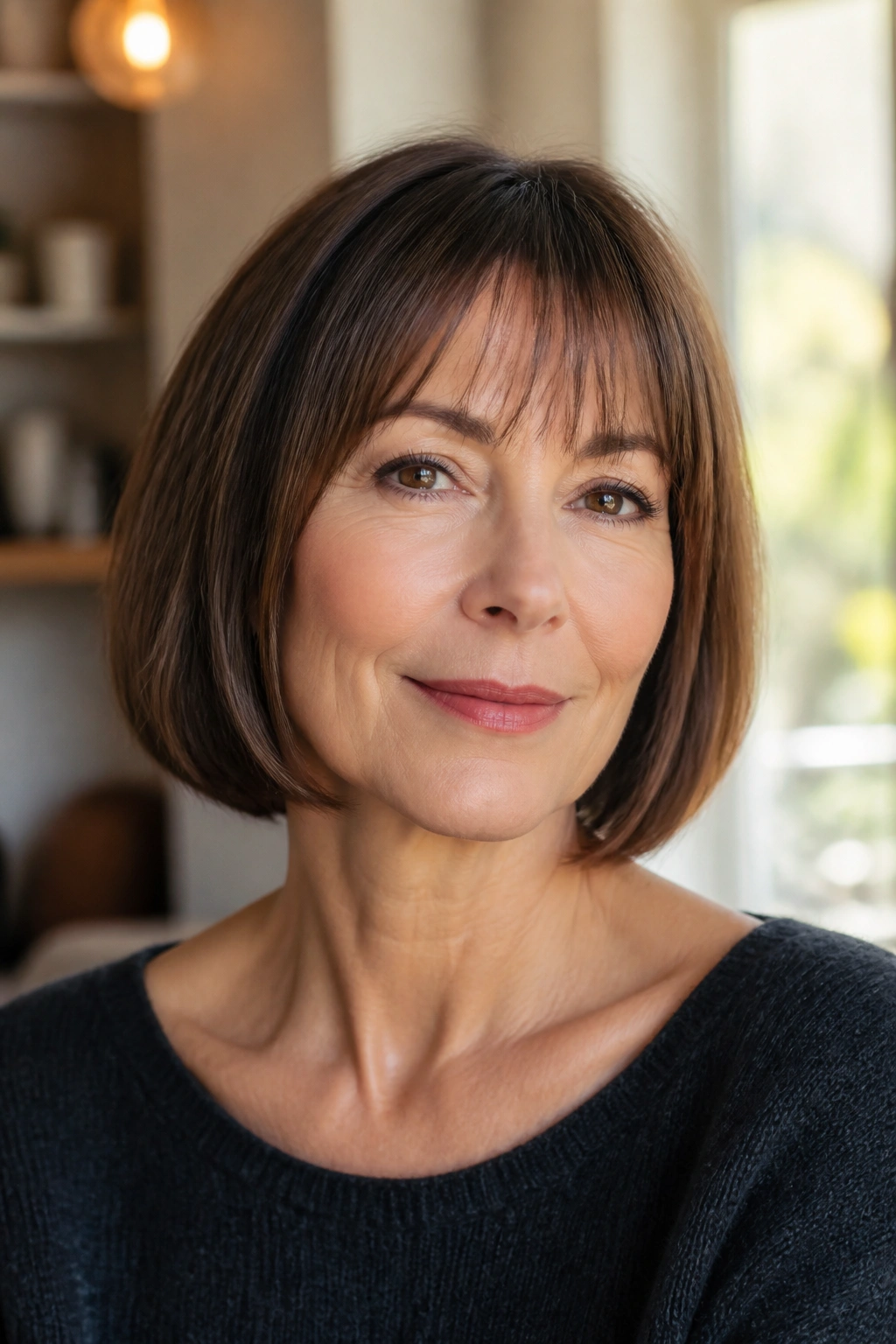
A soft blunt bob is the cut I reach for when someone wants fullness without a heavy helmet shape. The ends sit straight at the chin, but the line is not carved like a ruler; it’s softened with light point-cutting so the edge moves a little when you turn your head. Pair that with wispy bangs and the whole look gets easier to wear, especially if your hair has thinned at the front.
Why it flatters fine or aging hair
The blunt perimeter gives the illusion of density. Fine hair loves that trick.
Wispy bangs keep the forehead covered without taking over the face. If your hairline has changed a bit, or the front pieces separate in awkward ways, this fringe hides the chaos and still looks light.
Ask your stylist to keep the bangs narrow at first. You can always widen them later. That small choice makes a huge difference when you wear glasses or have a cowlick near the front.
- Best for straight to slightly wavy hair
- Works well with a round brush and a 1.5-inch curling brush
- Keeps the chin area neat without looking stiff
- Easy to tuck behind one ear for a softer finish
A tiny amount of smoothing cream is enough. Too much and the ends go flat.
2. Rounded bob with side-swept bangs
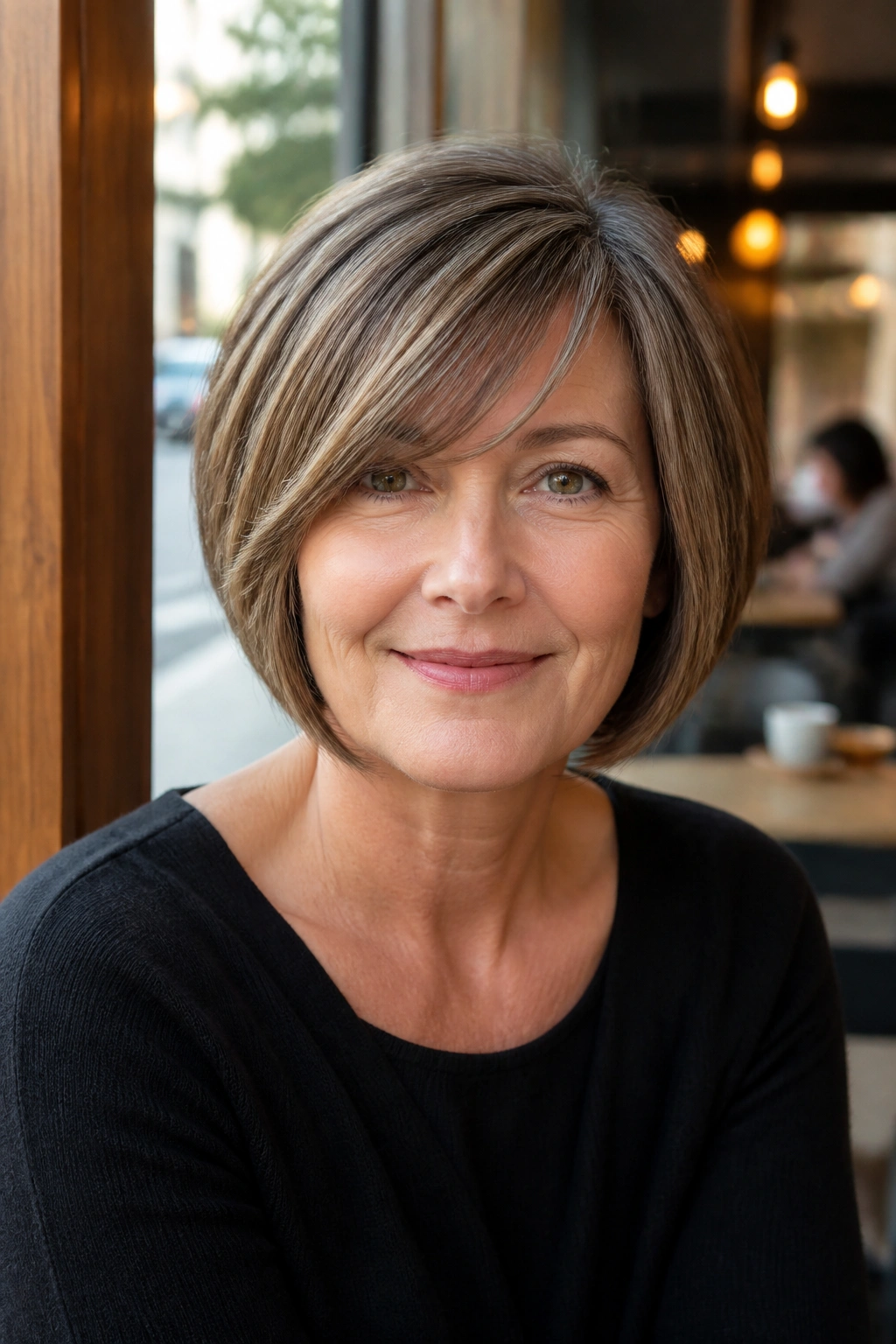
Side-swept bangs are useful because they don’t demand a perfect forehead line. They slide across the face, soften the brow, and make the whole cut feel a little more relaxed. On a rounded bob, that sideways motion keeps the shape from looking boxy at the jaw.
This is one of those cuts that looks good on a plain Tuesday and still works when you put on earrings. The curve in the body of the bob draws the eye inward, while the fringe gives the face a diagonal line. That diagonal matters. It breaks up width across the cheeks and brings focus back to the eyes.
If your hair tends to puff at the sides, ask for a gentle bevel under the chin instead of a sharp round brush flip. The bevel should be subtle, not dated. Too much curl under and the cut starts to look like it came from a salon menu that nobody updates.
A side part makes this style even kinder. It lets the bangs fall in a softer arc, and that arc is what keeps the look from feeling too formal. Simple. Useful. Easy to live with.
3. French bob with eyebrow-skimming bangs

The French bob has attitude, but not the annoying kind. It usually sits a touch shorter through the nape, with a clean line at or just under the chin, and the bangs land right around the brows. That little bit of coverage makes the haircut feel sharp without looking hard.
Why does this cut keep showing up in flattering haircut conversations? Because it gives structure to the face without dragging everything downward. The brow-skimming fringe creates a frame, and the shorter shape opens the neck. For a lot of women, that balance is the whole point. You want definition, not drag.
What to ask for
Ask for a bob that hits the chin when dry, not just when wet. Hair shrinks and swings. That tiny detail saves you from ending up with a cut that sits too high.
The bangs should graze the brow, not sit thick on top of it. A little softness at the ends keeps the fringe from looking blunt in a way that can feel severe.
- Works especially well with straight or softly waved hair
- Looks best when the ends are lightly textured, not razor-thinned
- Needs a quick bang trim every 3 to 4 weeks if you want the shape to stay crisp
A French bob can be a little cheeky. That’s part of the appeal.
4. Layered chin-length bob with curtain bangs
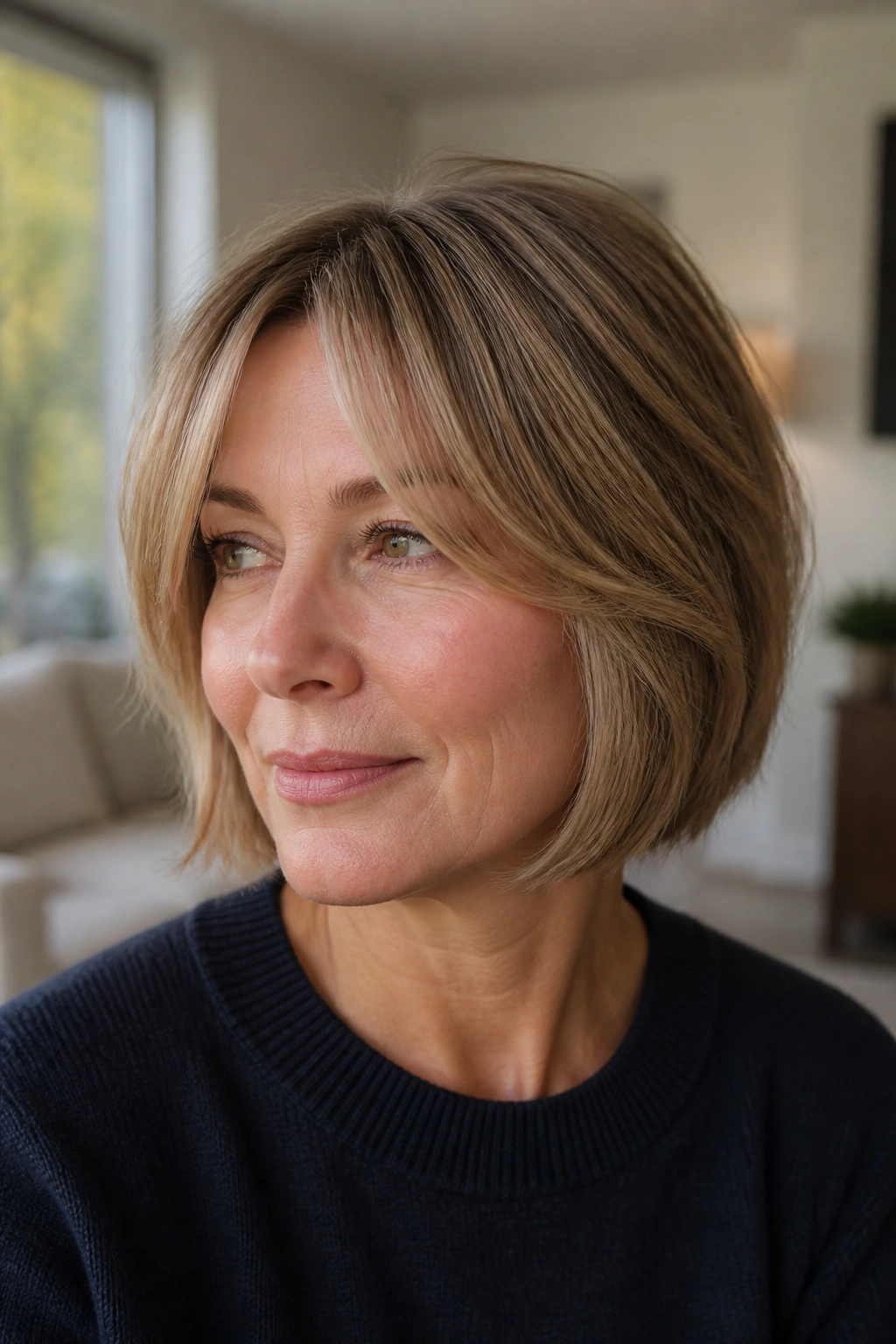
Curtain bangs are the easiest way to ease into fringe if you’re nervous about committing. They part in the middle or slightly off-center, fall along the cheekbones, and blend into a layered bob instead of sitting on top of it like a separate piece. On chin-length hair, that softness keeps the cut from feeling boxy.
I like this version for anyone whose hair has changed texture over time. Maybe it used to be straighter, maybe it’s a little wavier now, maybe the top has less body than the ends. Curtain bangs help bridge those shifts because they can be dried forward and then swept open with your fingers.
Where the layers should sit
The first layer should start around the cheekbone or just below it. That gives the fringe room to blend. If the layers begin too high, the bob can start looking wispy in the wrong places.
The ends around the chin should still carry weight. You do not want every strand thinned out. You want movement, not weakness.
Styling note
Blow-dry the bangs first, using a medium round brush or even a vent brush, then let the rest of the bob fall into place. If you wait until the hair is half-dry and then try to fix the fringe, you’ll chase it around for ten minutes.
5. Inverted bob with piecey fringe
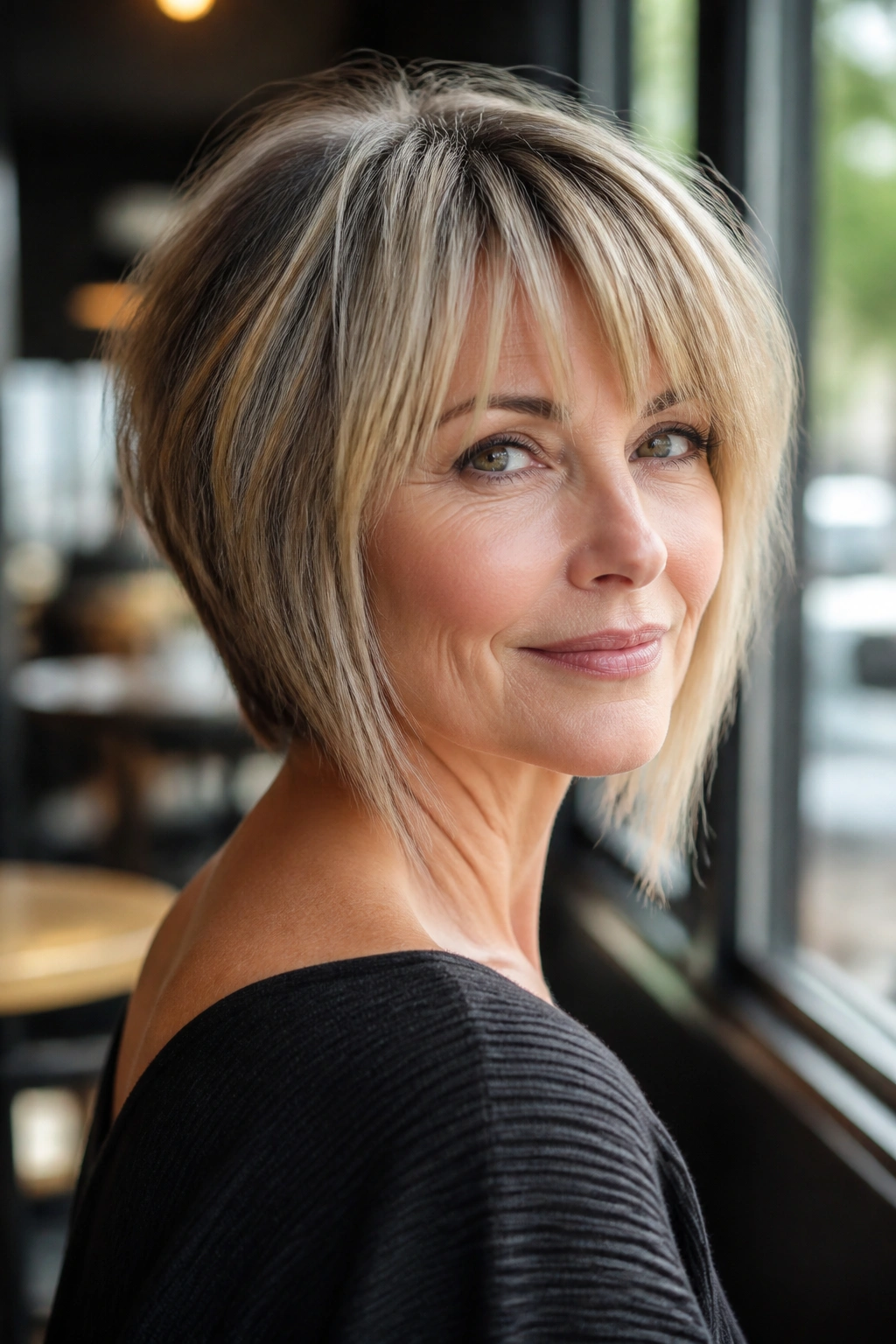
An inverted bob earns its keep by building lift in the back and keeping the front a little longer. That slope makes the chin area look sharper without making the whole haircut feel angular. Add piecey fringe and you get a cut that feels modern without shouting about it.
This one is a smart choice if your hair lies flat at the crown. The shorter back creates a bit of natural rise, and the longer front pieces slide toward the jaw. It’s one of the best chin-length bobs with bangs for over 50 when you want a cleaner neckline and a little more shape near the face.
Piecey bangs are the trick here. Not thick bangs. Not a hard wall across the forehead. Little separated sections that move when you do. That kind of fringe is kinder on cowlicks, and it also plays well with a few silver streaks because the light catches those gaps instead of making the fringe look solid and heavy.
If you like a dryer finish with a touch of texture spray, this is your cut. If you hate styling, skip it. An inverted bob looks best when it has a little lift, even if that lift is only from a five-minute blow-dry.
6. Sleek bob with full bangs
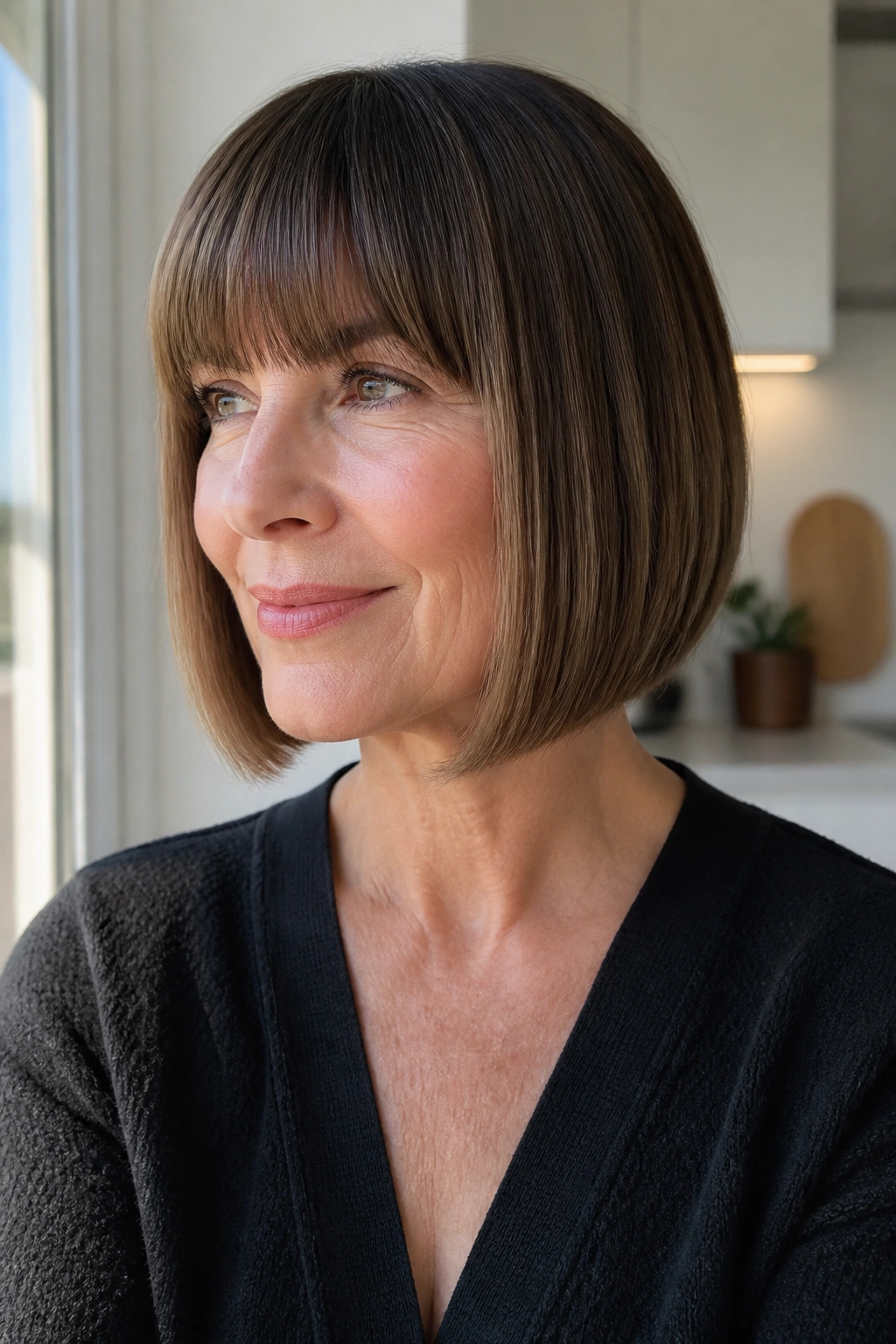
A sleek bob with full bangs is the haircut equivalent of a crisp white shirt. Clean lines. No nonsense. It works because the geometry is clear: straight across at the chin, enough weight to lie flat, and bangs that cover the forehead in one smooth panel.
That sounds strict, but it doesn’t have to feel severe. The trick is in the edges. If the ends are beveled slightly inward and the bangs are softened at the tips, the cut stays elegant instead of stiff. For thicker hair, this shape can be especially good because the density helps the bob hold its line all day.
Best if your hair has natural smoothness
If your hair already dries with a bit of shine and not too much puff, full bangs are worth considering. They frame the eyes fast and make glasses sit more intentionally on the face.
If your hair is coarse, the fringe needs careful thinning near the ends — not in the middle, where it can split in ugly ways. That’s the part people often get wrong. Too much texturizing turns a good fringe into little wisps that refuse to stay together.
I’d style this one with a 1-inch flat iron or a smooth blow-dry and a paddle brush. Keep the movement simple. Overworking it makes the cut lose its point.
7. Textured bob with choppy bangs
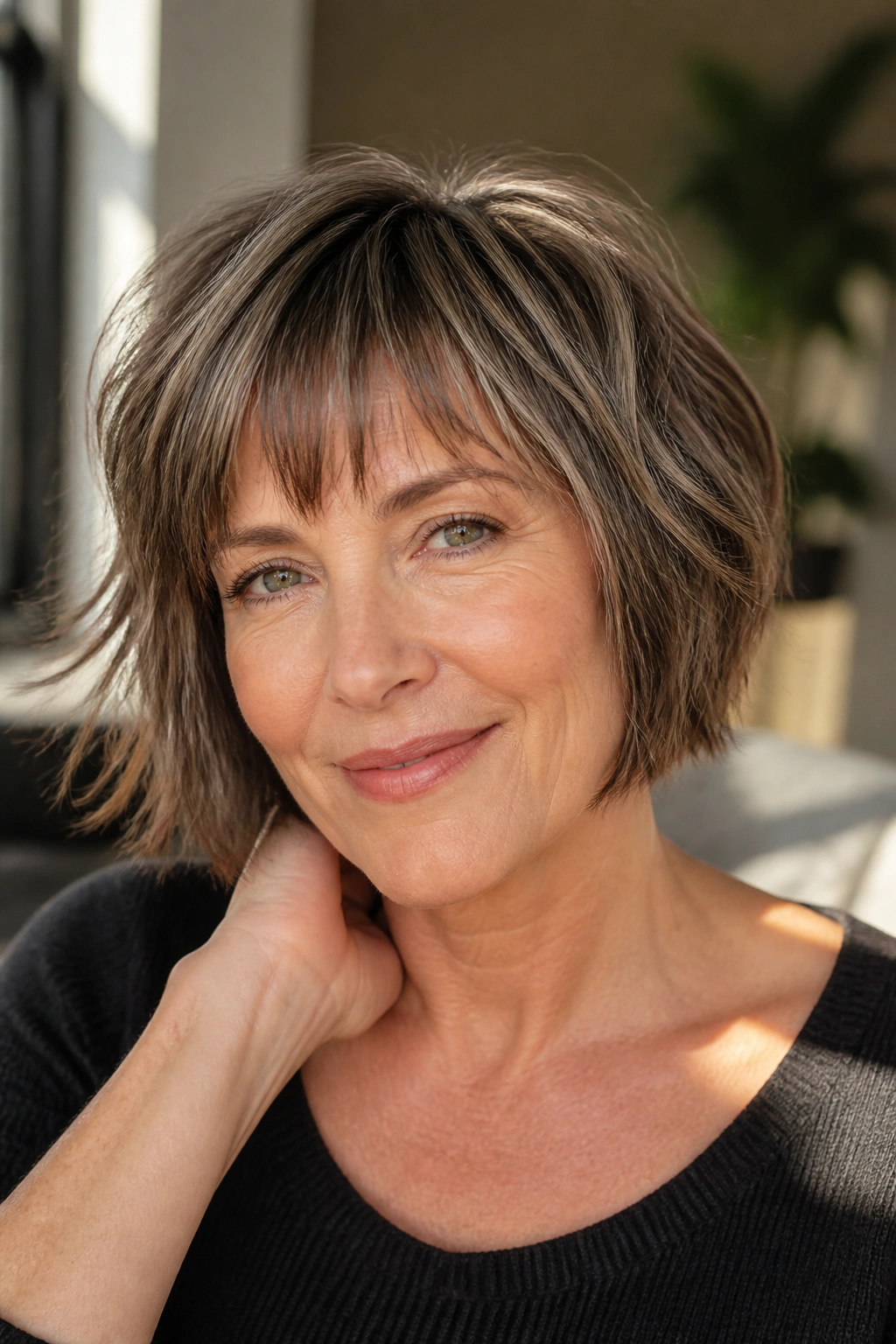
Choppy bangs are not for someone who wants polished and perfect. They’re for someone who wants a bob that looks like hair, not architecture. The texture around the fringe breaks up a heavy forehead, and the chin-length shape keeps the cut grounded.
Here’s why I like this on women over 50: it hides the tiny things that bother people most. A little recession at the hairline. A cowlick that splits the bangs in the center. A crown that refuses to cooperate. Choppy bangs don’t ask for symmetry, which is refreshing.
What to tell your stylist
Ask for soft interior texture through the bob, not shredded ends. There’s a difference. The bob should still have enough weight to frame the jaw.
The bangs can be cut into uneven pieces, but they should still sit together as a group. If they’re too broken up, the front starts looking thin instead of lived-in.
- Good for wavy hair that wants to move
- Best styled with mousse at the roots and a dab of paste on the fringe
- Works with a side part or a loose middle part
- Needs only a quick finger-tousle on most days
Choppy does not mean messy. It means the cut has enough internal shape to move without collapsing.
8. Wavy chin-length bob with bottleneck bangs

Bottleneck bangs are one of those clever fringe shapes that look softer than a full blunt bang but more finished than curtain bangs. They start a little narrower at the top and widen as they fall, which makes them a nice match for wavy chin-length bobs. The shape follows the face instead of sitting on it like a lid.
This style is especially good if you wear glasses. The fringe can curve around the frame without crowding it, and the waves in the bob stop the haircut from looking too precise. I like the slight contradiction in it. The bangs are controlled; the rest is loose.
The wave should not be curled into ringlets. A loose bend is enough. If you want the shape to stay soft, use a 1-inch curling iron only on the mid-lengths, then brush it out with your fingers. That keeps the ends from bunching.
And yes, this works well with salt-and-pepper hair. The waves show the contrast in tone, which gives the cut more shape than you’d get from a flat, single-color bob.
9. A-line bob with long side bangs
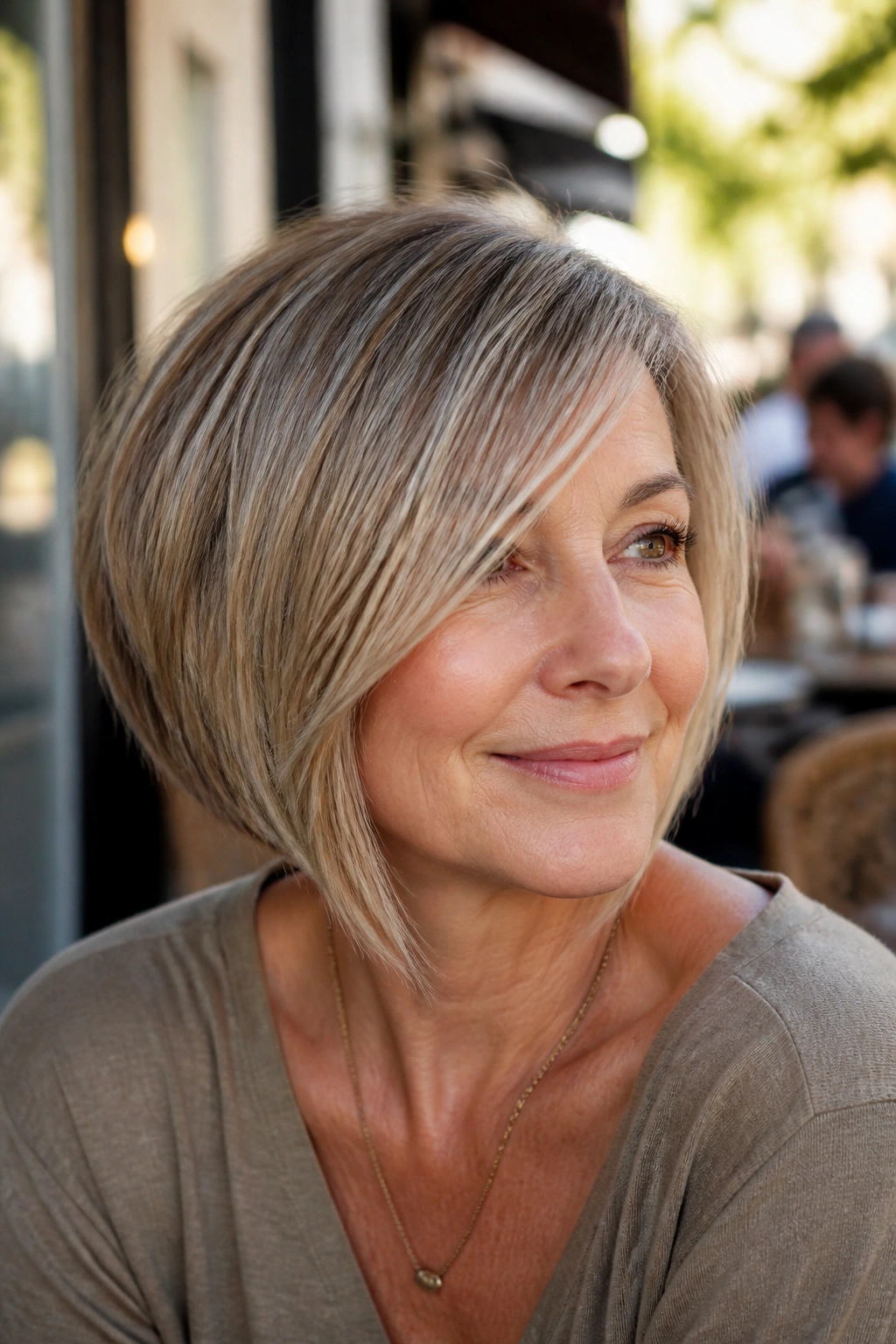
Unlike a straight bob, the A-line version gives you that quiet forward angle — shorter at the back, longer toward the chin. That slant does a lot of work. It lengthens the neck, sharpens the jaw, and keeps the haircut from spreading out at the sides.
Long side bangs are the right partner for it because they continue the same diagonal line. Nothing feels chopped off. Nothing feels heavy. The fringe moves across the face and can be tucked behind the ear when you want the eyes open.
This is a strong choice for rounder faces or softer jawlines. The length in front draws the eye downward, which changes the whole balance of the cut. It also helps if your hair is thick through the bottom and needs a shape that removes bulk without making the ends look thin.
A slight bevel at the front usually helps. Too much stacking in the back can feel dated, and too much angle in the front can look severe. You want the middle ground. That sounds boring, but it’s the sweet spot here.
10. Feathered bob with soft fringe

Feathering is one of the few old salon ideas that still makes perfect sense. Done well, it removes weight without making the haircut look shredded. On a chin-length bob, feathering lets the ends flick instead of sit like a block, which is especially useful if your hair is dense or coarse.
Soft fringe keeps the front from getting too busy. The bangs should skim the forehead and blend into the sides with almost no hard line. That softness matters more than people think. If the fringe is too blunt, the whole cut can feel boxy. If it’s too thin, the face disappears behind it.
I’d recommend this style for anyone who wants movement but not obvious layers. It’s one of those haircuts that looks better after a few hours of living in it. A little bend, a little tuck, a little wind — it can handle all of that.
And if you’re not into daily heat styling, even better. Feathered ends usually dry with enough shape to look finished on their own, especially with a light mousse or a touch of leave-in cream.
11. Curly chin-length bob with curly bangs
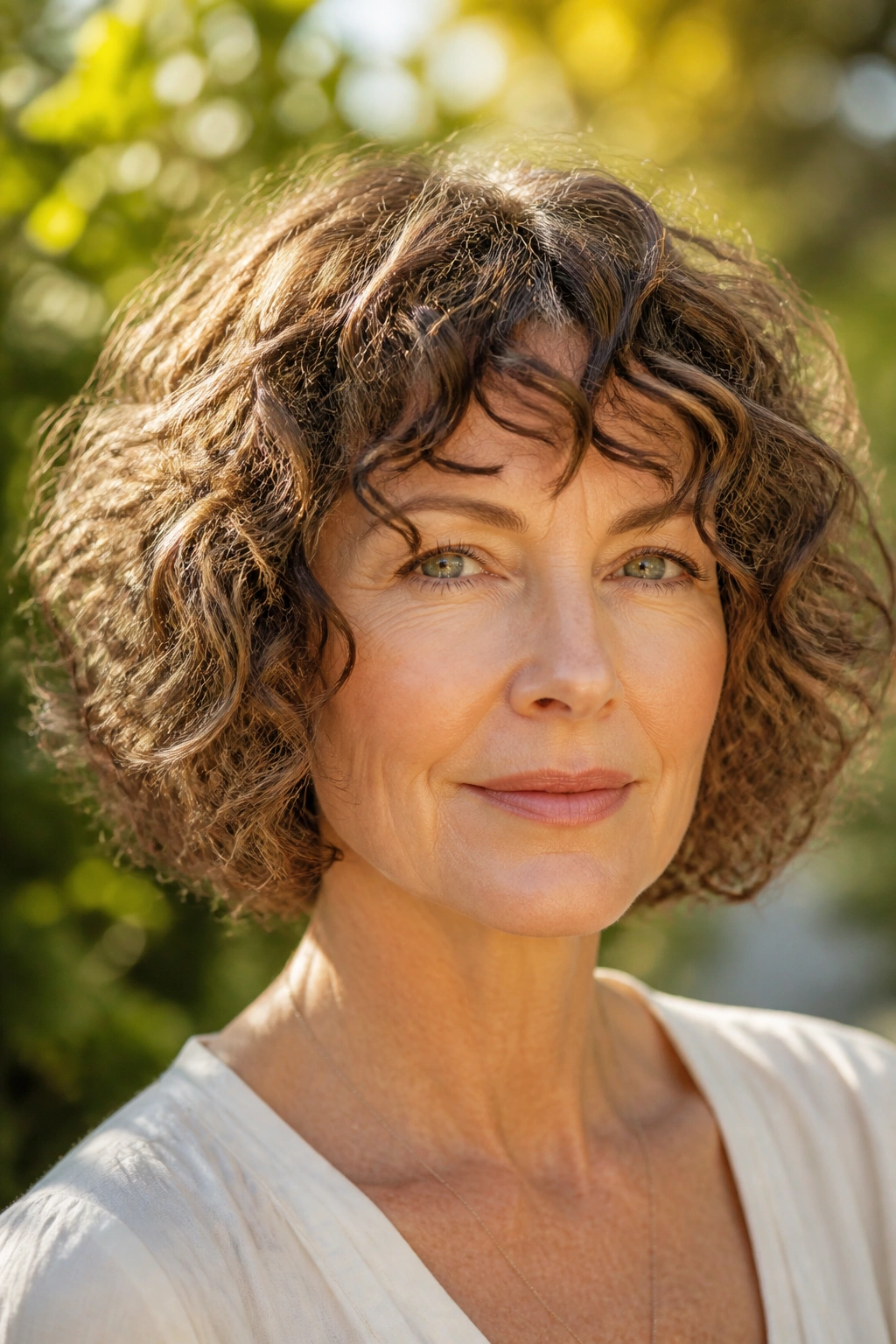
Curly hair needs a different kind of honesty. If you cut it like straight hair, you’ll lose the shape once it dries. A curly chin-length bob with curly bangs works because the cut respects shrinkage, volume, and the way curls spring at the forehead.
The bangs should be cut dry or nearly dry. That sounds fussy, but it saves you from fringe that lands two inches shorter than planned. Curly bangs can sit softly on the brow, open in the center, or skim one side depending on the curl pattern. The key is to let the curl choose its path.
How to ask for it
Tell the stylist you want the bob to sit at the chin when the curls are dry, not stretched. That line matters.
Ask for bangs that follow the natural curl rather than forcing a blunt edge. If the curl clumps into little spirals, the fringe should be shaped to match that.
- Best for 2B through 3C curls
- Diffuse on low heat until the roots are dry and the curls are set
- Use a cream with enough slip to keep the bangs from frizzing apart
- Avoid over-thinning the ends; curls need weight
This cut is lively. That’s the point.
12. Tucked-under bob with featherlight bangs
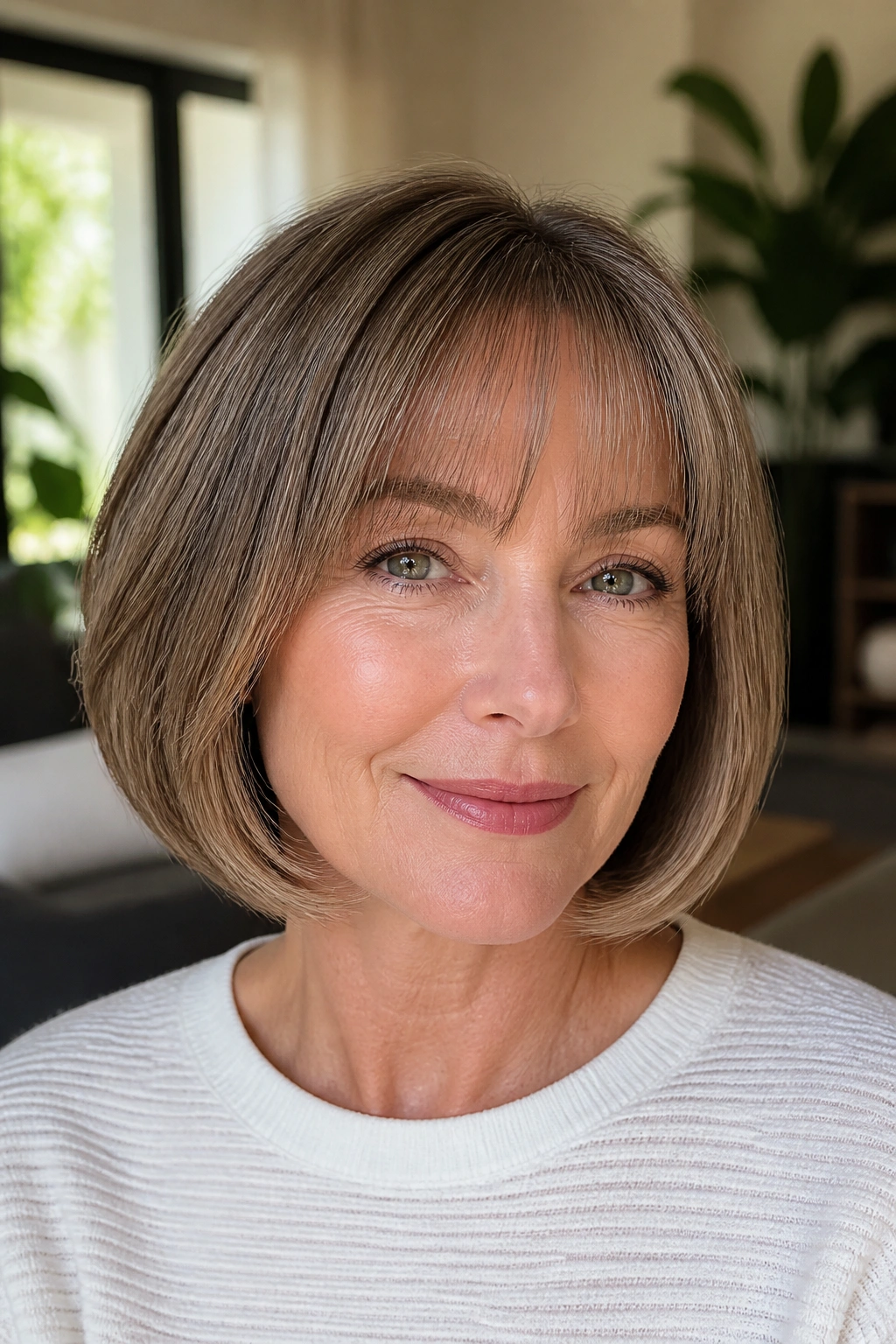
A tucked-under bob can look polished in a way that feels easy, not stiff. The ends curl slightly inward at the chin, creating a smooth curve around the jaw. Pair that with featherlight bangs and you get a haircut that frames the face gently instead of boxing it in.
This is a smart option if you like a neat finish but don’t want a full heavy fringe. Featherlight bangs sit somewhere between a bang and a face-framing veil. They’re thin enough to keep the forehead from feeling crowded, but they still change the expression of the cut. That’s often enough.
The tucked-under shape works especially well on hair that tends to swing outward at the ends. The inward bend gives it direction. If your hair sticks out after air-drying, a quick round-brush pass or a 15-second hit from a flat iron at the tips can fix it.
One caution. If your hair is extremely thin, too much tuck can make the bottom edge look sparse. In that case, keep the line straighter and let the bangs do more of the softening.
13. Silver bob with side fringe

Silver hair has a way of exposing bad haircut choices fast. It also rewards good ones. A chin-length silver bob with side fringe can look crisp and rich because the shorter length lets the color read as a feature instead of just a change in shade.
Side fringe is kinder than a harsh full bang when the hair is naturally lighter at the front. It gives a soft diagonal line and avoids that flat, blocked look that can happen when gray hair loses a bit of density. The bob itself should hold enough weight through the perimeter to keep the ends clean.
I like this cut with a little shine product, not a greasy one — a pea-size amount of serum through the ends is enough. Silver hair shows every bit of product build-up, so restraint matters here. Keep the layers minimal, keep the line clean, and let the color do the talking.
If your silver has white sections and darker lowlights, the side fringe makes those tones move across the forehead instead of sitting in one spot. That gives the whole haircut a more expensive look, if I can use that word without getting silly about it.
14. Wash-and-go bob with long sweeping bangs

Some haircuts ask for a blow-dryer. This one doesn’t ask for much at all. A wash-and-go chin-length bob with long sweeping bangs is built for people who want shape without a morning ritual that drags on forever.
Long bangs matter here because they give you options. You can wear them across the forehead, split them in the middle, or sweep them to one side and let them blend into the bob. That flexibility is useful when your hair behaves differently on humid days, windy days, or the days you simply cannot be bothered.
What makes it low-maintenance
The cut keeps enough length at the front to sit neatly on its own. That means fewer awkward flips and fewer mornings spent fighting the crown.
The bangs should be cut with a soft edge so they fall in a natural curve. Too much bluntness makes them need constant styling.
- Good for hair that air-dries with a slight bend
- Works with a light leave-in conditioner and a small dab of styling cream
- Can be refreshed with a water mist and fingers, no hot tools required
- Easy to grow out if you decide you want less fringe later
This is the haircut for people who want a decent-looking finish before coffee.
15. Angled chin-length bob with layered bangs
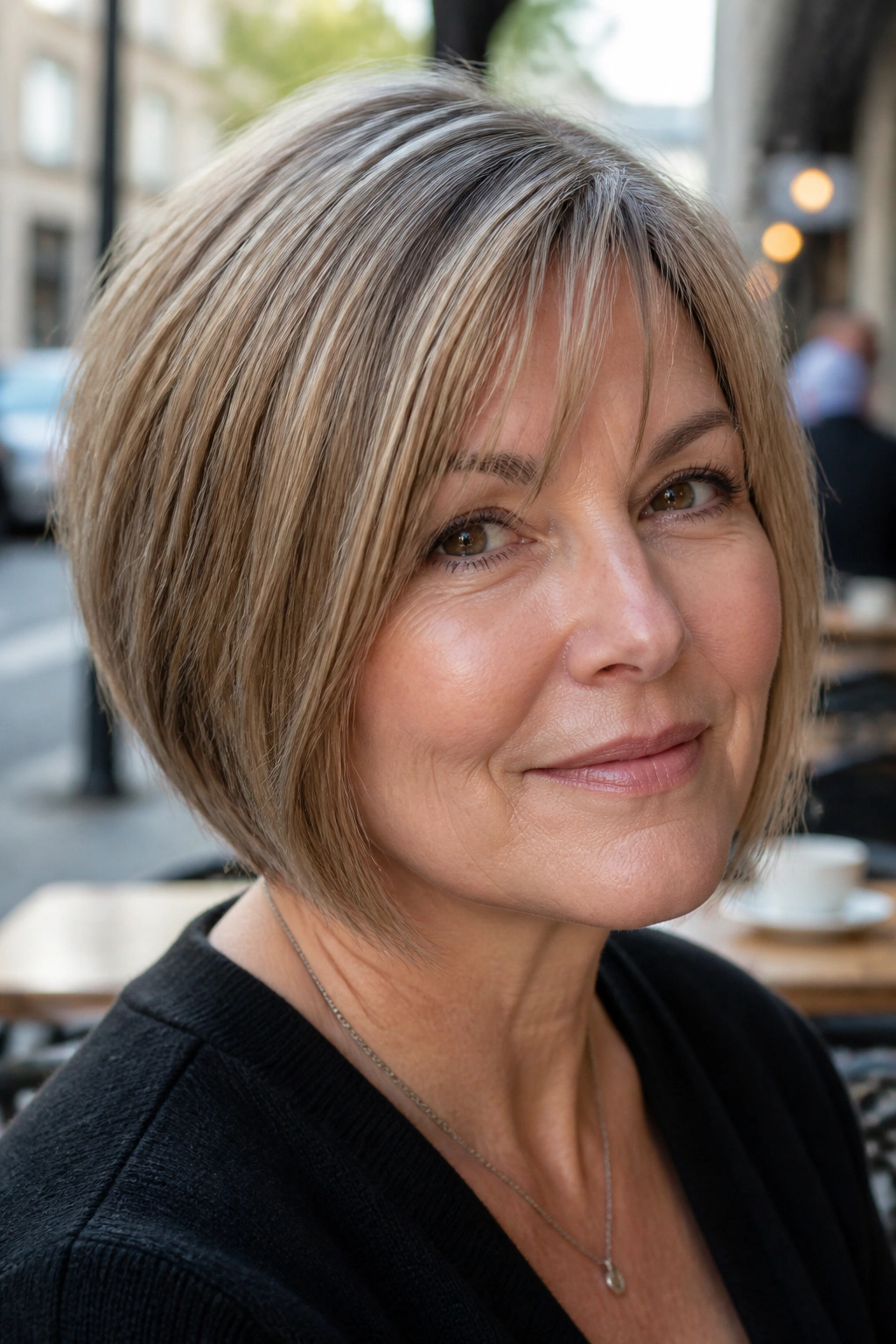
An angled chin-length bob with layered bangs is probably the most adaptable shape in this whole group. The angle sharpens the profile, the layers soften the front, and the bangs keep the forehead from taking over the face. It’s a balanced cut, which sounds plain until you realize how hard balance is to find in a bob.
I like this one for women who want movement but still want a defined edge. The front can be slightly longer than the chin, or it can meet the jaw exactly, depending on how strong you want the line to feel. Layered bangs keep the top from looking heavy, which helps if your hair has some lift at the crown but not much at the temples.
This cut also handles glasses well because the layered fringe can part around the frames instead of crashing into them. That small detail saves a lot of annoyance. And if you have a neck you like showing, the angle keeps it visible.
Bring photos that show the side view, not just the front. That’s the part a lot of people skip, and it’s where the success of this haircut really lives.
