



Short bangs can go wrong fast. Cut them too blunt, and the face hardens. Cut them too short, and they start looking bossy in the least flattering way.
Bardot bangs avoid that problem when they’re cut with air, bend, and a little room around the eyes. The shape comes from a split fringe that opens near the center, then sweeps out toward the cheekbones instead of stopping in a hard line across the forehead. That softness is the whole point. It makes the hair feel a touch romantic, a touch undone, and a lot less severe than a blunt fringe.
The trick is that Bardot bangs are not one single haircut. They can be wispy, thick, shaggy, curled, blown out, or grown out on purpose. A good version works with your hairline, not against it. A bad version fights cowlicks, sits too high on the forehead, and needs a round brush every morning just to behave.
That’s why the details matter. The best Bardot bangs ideas are the ones that match your texture, your face shape, and your tolerance for styling. Get those three things aligned, and the fringe stops feeling like a separate project. It becomes part of the cut.
1. Feathered Bardot Bangs That Sit at the Cheekbones

This is the classic Bardot bangs shape for a soft look. The center pieces stay long enough to skim the brow line, then the outer edges feather out toward the cheekbones instead of dropping in a blunt curtain. That little bit of taper makes the whole face read lighter.
The reason this version works so well is that it creates movement without swallowing the forehead. You still see skin. You still see the brows. The fringe frames the face instead of boxing it in.
Why It Stays Soft
The cut should look airy at the ends, not sliced into a hard edge. Ask for point cutting or slide cutting through the last inch or two so the fringe breaks up instead of sitting as one heavy strip.
A round brush helps, but not in a stiff, pageant-hair way. Pull the center section forward, then bend it away from the face so the split opens naturally. The outer pieces should feel like they’re drifting, not glued into place.
- Best for: oval, heart, and long faces
- Length cue: center pieces around the brow bone, outer pieces at cheekbone level
- Texture cue: medium to thick hair holds this shape best
- Styling cue: a 1.25- to 1.5-inch round brush gives a soft curve
If the fringe ends above the brow, the whole look turns sharp fast.
2. Long Bardot Bangs with a Center Part That Barely Shows
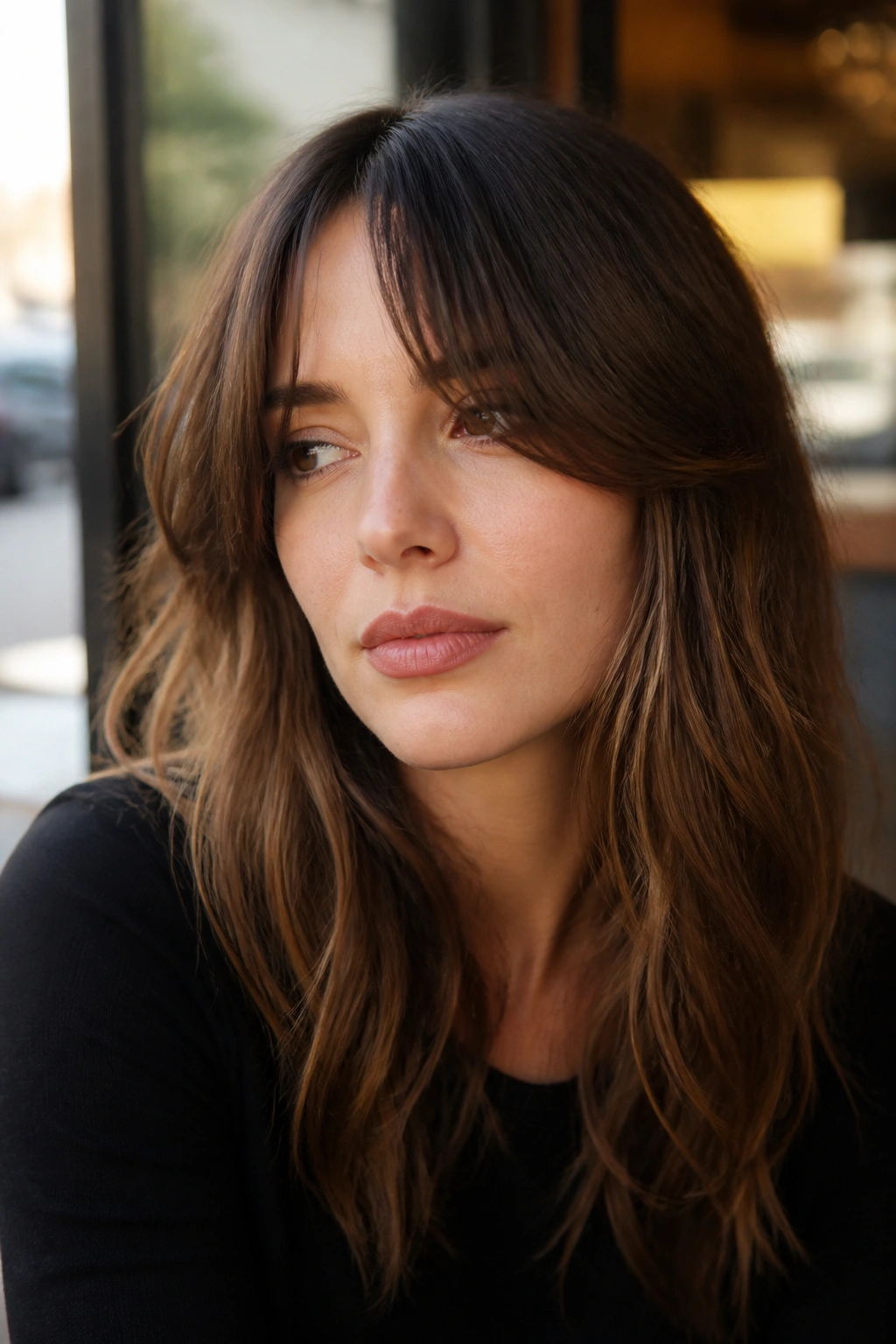
Why does this version feel softer than a shorter fringe? Because it gives the eye space to breathe. Long Bardot bangs usually start around the eyebrow and taper all the way down toward the mouth corners or chin, which makes the split part look relaxed rather than precise.
That extra length matters on first-time fringe wearers. You can tuck the pieces behind the ears, let them fall forward, or push them off the face on a busy day. They behave like bangs, but they do not lock you into one look.
How to Wear It
The easiest way to style long Bardot bangs is to dry them forward first, then brush each side away from the center while the hair is still warm. Clip the front pieces back from the face for a few minutes while they cool. That sets the bend without turning the fringe into a helmet.
Keep the part a touch off-center if your hairline has a strong middle cowlick. A perfectly straight split can fight back all day. A slightly softer part often sits better and looks more natural.
- Best for: people who want fringe without losing length
- Works well with: shoulder-length cuts, long layers, and blunt ends
- Avoid if: you want a tidy, tucked-away fringe
- Styling note: use a light cream, not a heavy balm
The long version has one nice habit. It grows out gracefully.
3. Wispy Bardot Bangs for Fine Hair
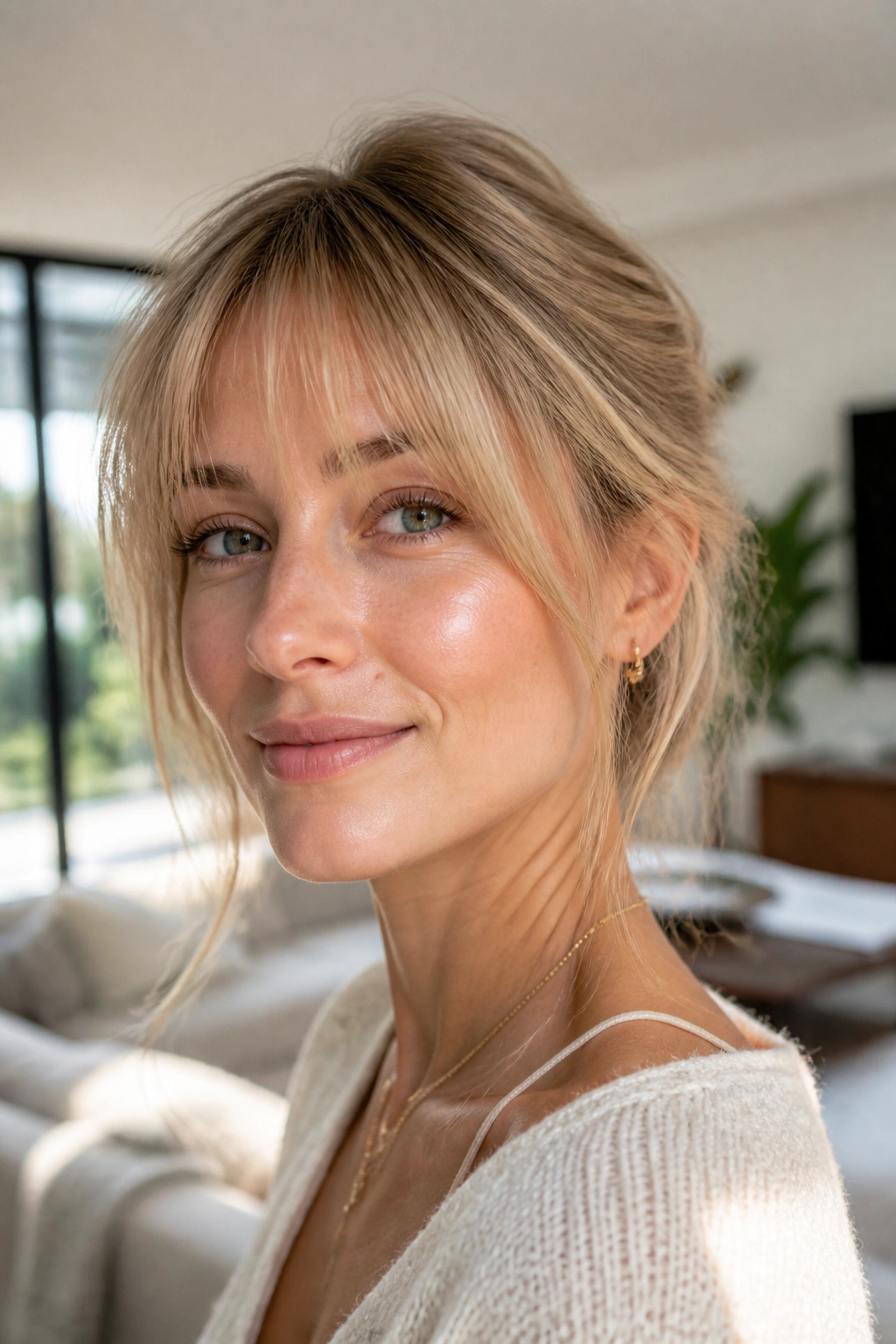
Fine hair can wear Bardot bangs beautifully when the fringe is light enough to move. Heavy bangs flatten fine strands in a hurry, and then the face starts looking crowded. Wispy Bardot bangs do the opposite. They let air through.
The feeling should be almost translucent at the ends. You want enough hair to frame the eyes, but not so much that the fringe becomes a solid block. A stylist will usually cut this with soft internal texture so the front pieces fall in separated little ribbons rather than one thick sheet.
What to Ask For at the Chair
A dry or mostly dry cut helps here, because fine hair can collapse when wet and then surprise you once it shrinks up. Ask for a lighter center and more softness through the outer corners. The goal is movement, not density.
A tiny bit of texture powder at the roots can help the fringe sit off the forehead instead of sticking flat. That matters more than people think. Fine hair often looks best when the roots have a bit of grit.
Heavy bangs swallow fine hair.
- Best for: straight to slightly wavy fine hair
- Good length: shorter in the center, longer at the sides
- Best tools: soft-hold spray, texture powder, small round brush
- Skip: thick oils near the fringe
A wispy Bardot fringe should feel feather-light when you touch it.
4. Bottleneck Bardot Bangs with a Narrow Center and Wide Sides

Bottleneck bangs are not a gimmick. They’re one of the smartest versions of Bardot bangs if you want softness with a little shape discipline. The center starts narrower, then opens out like the neck of a bottle before falling wider along the sides.
That shape does a useful job. It keeps the middle from looking too thick while still giving the face a framed, lifted look. The result feels a bit sculpted, but never hard.
Where the Shortest Piece Should Land
The shortest part usually sits somewhere between the center of the brow and just above it, depending on your forehead length. The outer sections should slide down toward the cheekbones or even a little below, especially if you want a face-softening effect.
This style works well when you want something more defined than loose curtain bangs but less heavy than a full fringe. It also suits people whose features look better when the center of the forehead stays open.
- Best for: broader foreheads, oval faces, and medium hair density
- Cut detail: a tight center with long, swooping sides
- Styling cue: bend the outer corners away from the cheek, not straight down
- Maintenance: shape trims matter here, because the balance can drift
The thing I like about bottleneck Bardot bangs is how intentional they look without feeling stiff. That’s a rare mix.
5. Side-Swept Bardot Bangs When You Don’t Love a Dead-Center Part
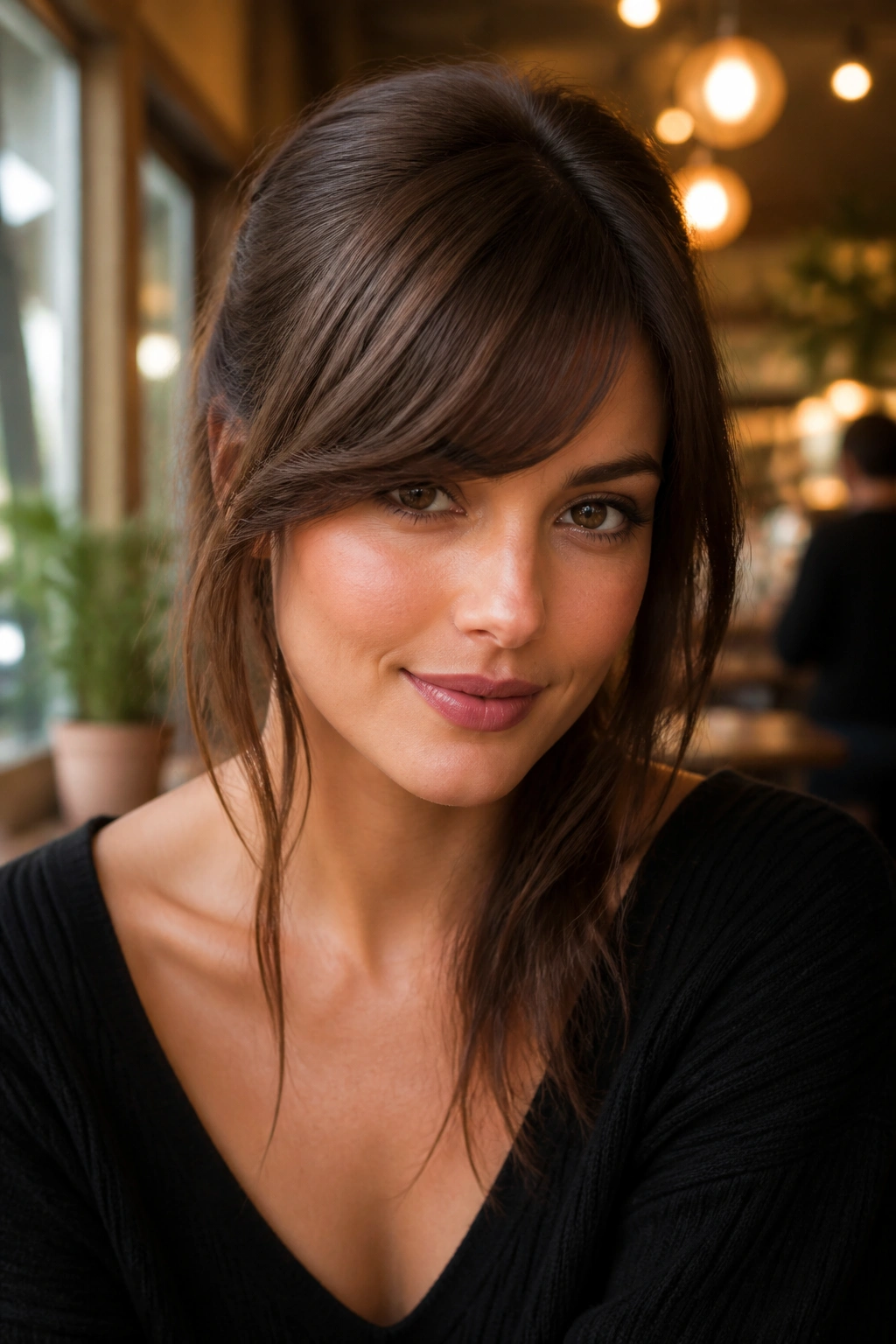
A dead-center split is not mandatory. Good riddance, honestly, if your hairline refuses to cooperate. Side-swept Bardot bangs keep the softness of the style but move the break line just enough to flatter cowlicks, uneven growth, or a forehead that looks better with a little asymmetry.
Picture the fringe starting near the eyebrow, then drifting across the face in a long diagonal curve. One side opens the forehead. The other side skims the eye and cheek. It feels less formal than a strict curtain part.
Why It Works Better on Some Hairlines
A side part can hide a stubborn front cowlick that would otherwise force the fringe to split in the wrong place. It also gives the style a softer fall when the hair is thick at the front and likes to puff upward.
The key is not to sweep everything in one heavy curve. Leave a bit of air at the root, then guide the bangs over with your fingers or a flat brush. If the part sits too deep, the whole thing starts looking like a side fringe from a different era. Keep it loose.
- Best for: cowlicks, asymmetrical faces, and strong hairlines
- Good pairing: layered lobs and shoulder-length cuts
- Styling note: dry the root first, then shape the ends
- Look to avoid: a stiff comb-over effect
Side-swept Bardot bangs have a quiet advantage. They look intentional even on imperfect hair days.
6. Curly Bardot Bangs That Follow Your Curl Pattern

Curly hair and Bardot bangs can work together beautifully when the cut respects shrinkage. That part matters. Cut curls too short in the front, and the fringe springs upward into a line that feels abrupt. Leave them too long, and the bangs hide your face instead of framing it.
The best curly Bardot bangs are cut dry or nearly dry so the stylist can see where the curls sit in real life. The center pieces usually land longer than you expect, because curls bounce up and tighten as they dry. The sides should melt into the rest of the haircut instead of sitting as a separate chunk.
The Shape That Keeps It Soft
Softness comes from rounded edges and a little asymmetry. A few curls can land over the brow, a few can swing toward the temple, and a few can hang closer to the cheekbone. That unevenness is the charm.
Use a diffuser on low heat, then stop fiddling. Curly bangs go frizzy fast when they’re overhandled. A pea-sized amount of curl cream is often enough; too much product makes the front limp and sticky.
- Best for: loose curls through tighter ringlets
- Ask for: dry cutting and curl-by-curl shaping
- Avoid: blunt horizontal lines
- Helpful finish: a touch of gel cast broken with dry hands
Curly Bardot bangs look best when they feel a little alive. Too neat, and they lose the point.
7. Shaggy Bardot Bangs with a Broken-Up Edge
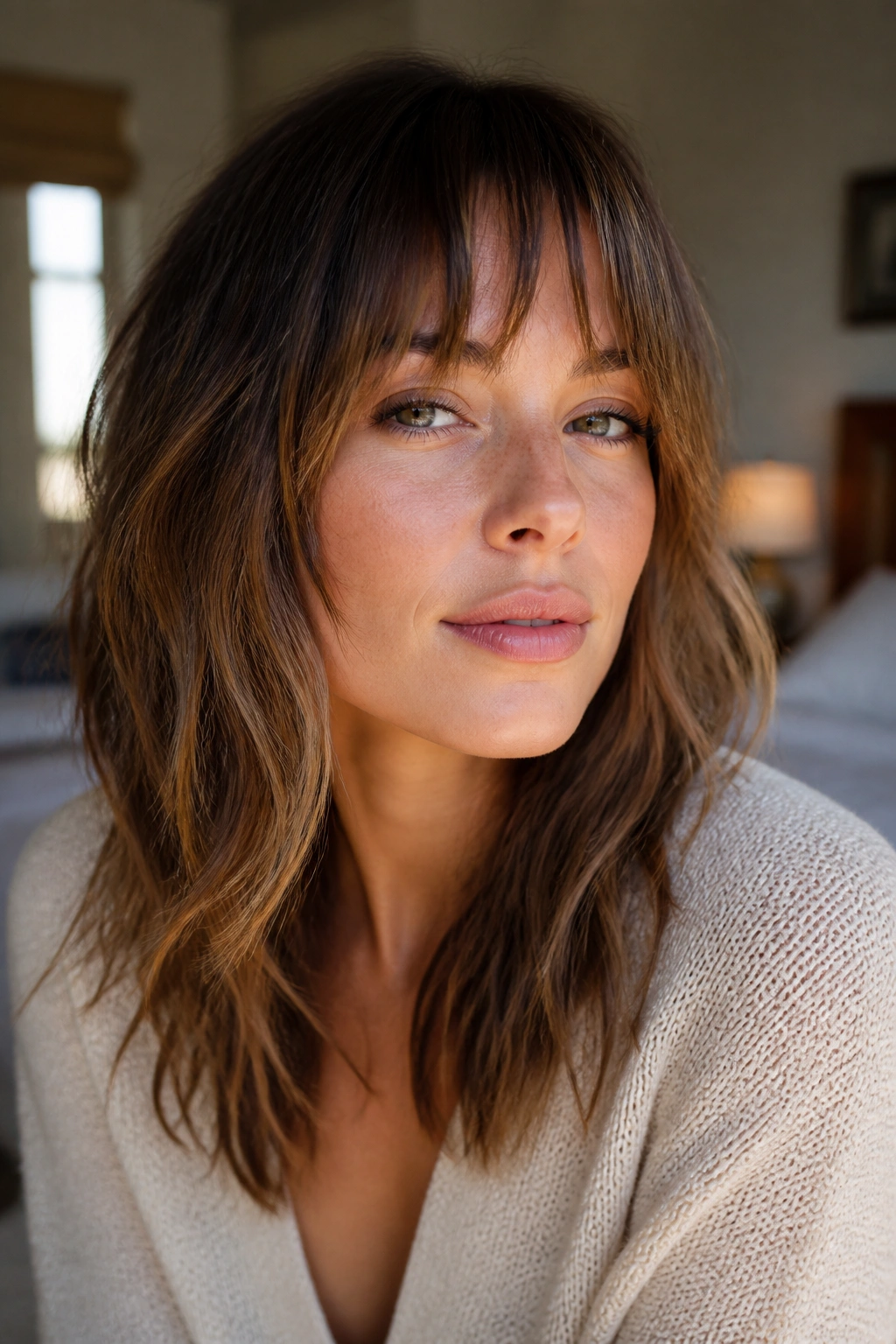
If you want softness with a little grit, this is the one. Shaggy Bardot bangs sit inside a layered cut, so the fringe does not behave like a separate object pasted onto the front of the head. It blends, bends, and breaks apart in a way that feels easy.
The shag gives the fringe a lived-in edge. Not messy. Just not overworked. The center can be shorter, the sides can fall unevenly, and the ends can be sliced into little bits so the whole thing moves when you turn your head.
What Makes It Different
A shaggy Bardot fringe usually looks better with a bit of natural wave. Straight hair can wear it too, but the cut really wakes up when there’s some bend in it. The layers around the face help the bangs fall into the rest of the haircut instead of sitting on top of it.
This is the version I’d point to if you like hair that looks better after a little time in it. A clean blowout is fine, but the shape does not depend on one. That makes it less precious.
- Best for: wavy hair, textured hair, and layered cuts
- Good detail: piecey ends rather than smooth edges
- Works with: shags, wolf cuts, and airy mids
- Style cue: scrunch with a light cream and stop before it gets polished
The shaggy version has attitude, but the softness is still there under it.
8. Thick Bardot Bangs That Use Weight Instead of Fighting It
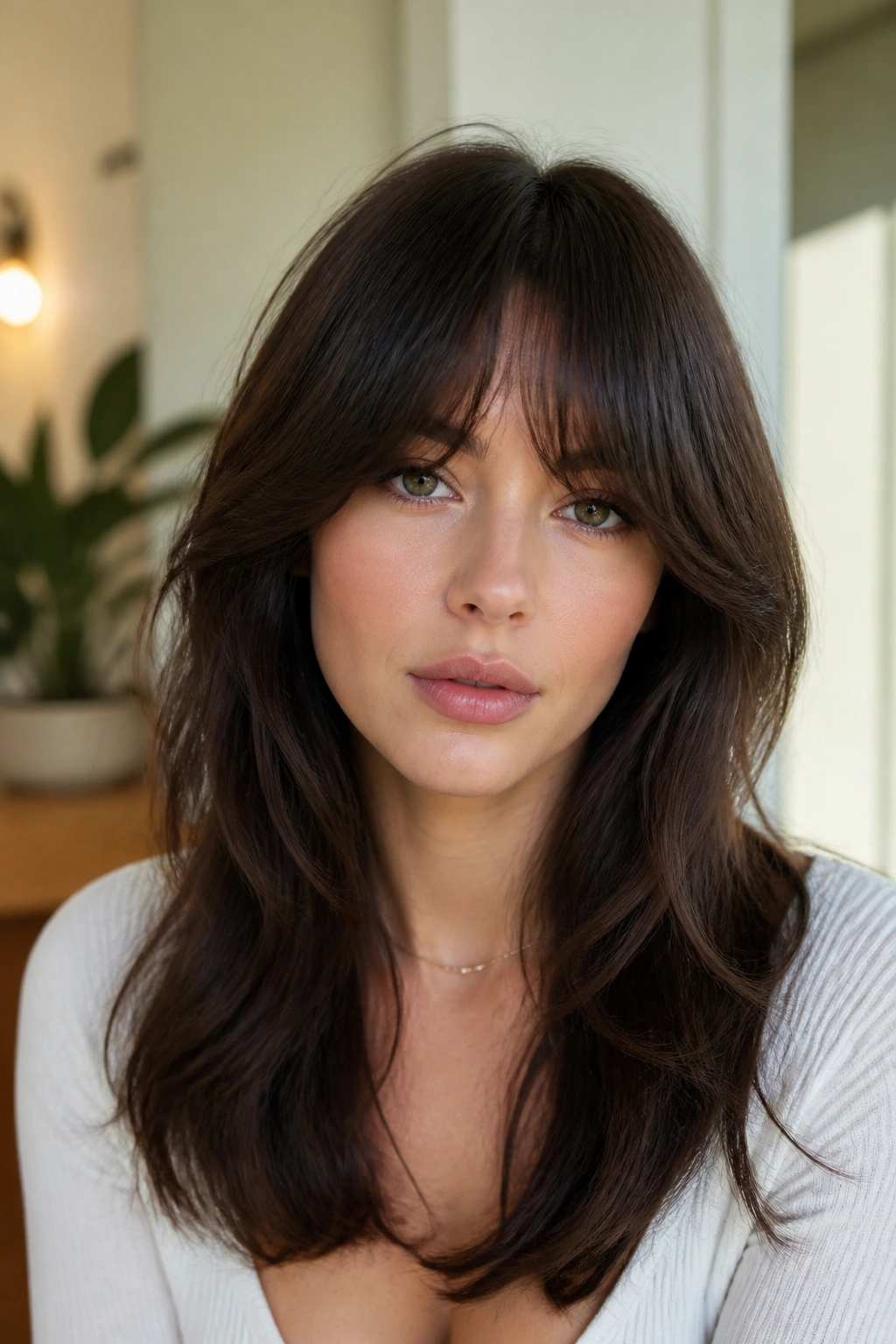
Dense hair gets blamed for being “too much” when the real problem is often a bad cut. Thick Bardot bangs can look gorgeous because the fringe has enough body to hold shape, keep its split, and frame the face without disappearing by noon.
The trick is weight removal in the right places. You do not want a big blunt panel across the forehead. You want a controlled thickness at the root, then soft release at the ends. That usually means some internal layering and careful point cutting through the outer pieces.
What to Ask Your Stylist For
Ask for density through the center, then a feathered drop toward the temples. That prevents the sides from flaring like curtains. If your hair is coarse, a little thinning through the bulk near the forehead can help, but too much thinning can leave the ends fuzzy. There’s a line there.
These bangs are especially useful if your hair tends to puff in humidity. The extra weight helps the fringe stay put, while the softness around the edges keeps it from looking severe.
- Best for: thick straight hair, coarse hair, and strong growth patterns
- Avoid: over-thinning the whole section
- Good length: longer sides to balance the mass
- Style cue: dry the center first so it doesn’t lift too high
Thick Bardot bangs feel expensive in the practical sense. They hold their shape.
9. Bardot Bangs That Skim a Square Jaw Without Hardening the Face
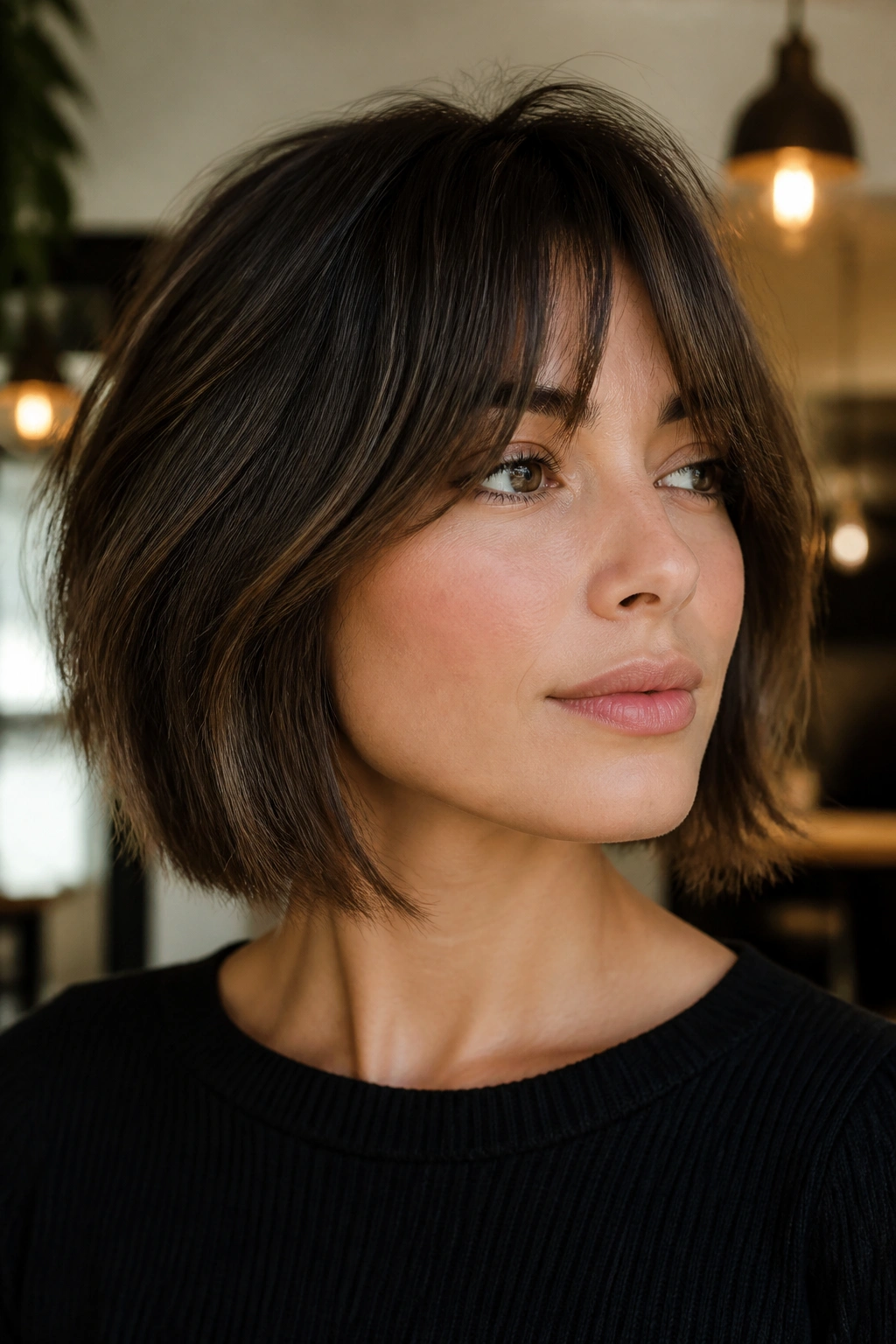
Square faces do not need bangs that stop abruptly at the wrong place. That’s the mistake. Bardot bangs work here because the longest pieces can start softening the face above the jaw, then follow the line down with a bend instead of a block.
The outer corners should be long enough to miss the jawline by a bit, or at least graze it with a curve. If they end exactly at the jaw, the eye notices the edge first. If they sweep past it, the face feels longer and gentler.
The center should stay open enough to show the brows. That keeps the style from becoming a curtain. A square face usually looks best when the bangs soften the upper face and let the stronger jaw stay visible in a flattering way.
I like this shape with a side part that isn’t too deep. A dead center can make the frontal area feel too symmetrical. A slight offset brings more softness.
A square face does not need to hide. It needs a frame that bends.
10. A Lob with Bardot Bangs for a Clean, Soft Outline
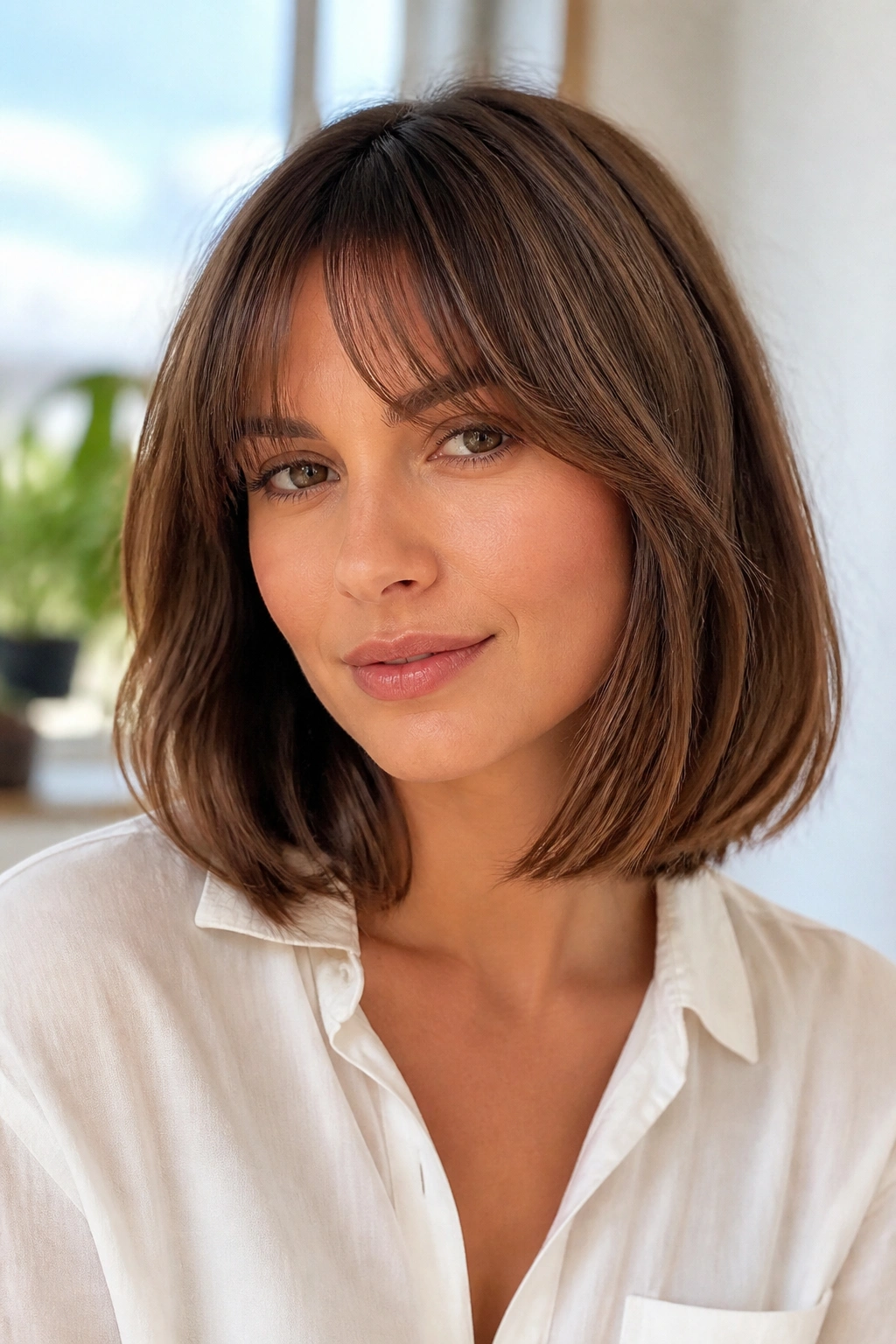
A blunt lob can look sharp in a good way, but sometimes it reads a little strict. Bardot bangs soften that line fast. The fringe adds movement near the eyes while the lob keeps the ends tidy, and the combination feels balanced rather than fussy.
This pairing works because the hair below the face stays simple. No heavy layers everywhere. No overbuilt shape. The bangs carry the softness, which means the rest of the cut can stay clean and easy to manage.
Best Length Pairings
The sweet spot is usually a lob that lands between the chin and collarbone. Shorter than that, and the fringe can start competing with the length. Longer than that, and the whole cut can lose its crisp outline.
A one-length lob with Bardot bangs gives a polished frame. A lightly layered lob feels more casual. Both work. The bigger question is whether you want the fringe to be the soft feature or part of a bigger sweep.
- Best for: people who want shape without long-hair maintenance
- Good cut pairings: blunt lob, soft layers, slightly angled lob
- Style cue: keep the ends sleek and the fringe loose
- Avoid: too many face-framing layers at once
This is one of my favorite pairings because it looks put-together without feeling loud. That’s hard to beat.
11. Air-Dried Bardot Bangs for Lazy Mornings That Still Look Intentional

Heat is optional. Really. If your hair has enough wave or bend on its own, Bardot bangs can be cut so they fall softly with almost no styling at all.
The trick is in the dry pattern. After washing, comb the bangs into the rough split you want, then let them dry away from the face instead of plastering them straight down. A tiny clip at each side can help the front pieces keep a gentle bend while the rest of your hair dries.
The shape should not rely on perfection. It should rely on a good cut.
What Makes Air-Dried Bangs Work
A soft cream or light mousse can stop the fringe from frizzing at the roots. Too much product kills the movement, so keep it light. Finger-comb the bangs once or twice while they dry, then leave them alone.
This version is especially nice for hair with a natural bend or for people who wear a bit of wave in the rest of the cut. If your hair dries pin-straight at the front, you may need a touch more help. Still less than a full blowout, though.
- Best for: wavy hair, slightly textured hair, humid climates
- Helpful tool: a couple of duckbill clips
- Product note: light mousse or soft cream, not heavy serum
- Look goal: loose, face-skimming, never stiff
Air-dried Bardot bangs are the lazy-girl version, but that makes them sound less thoughtful than they are. They’re not.
12. Bardot Bangs with a Rounded Blowout and a Soft Bend

A blowout changes everything. The same Bardot bangs that look casual air-dried can turn fuller and more glamorous with a round brush and a little root lift. The point is not volume for volume’s sake. It’s the bend.
The Shape the Brush Creates
Use a medium round brush and direct the fringe forward at the root first, then roll the ends away from the face. The center should open in a loose split, and the outer corners should curve back without looking curled under too tightly. That little return bend is what keeps the softness.
A cool shot at the end matters more than people think. Hair sets while it cools. If you skip that part, the fringe falls flat faster than it should. A few clips at the sides can also train the bangs to stay open while you finish the rest of your hair.
- Best for: special occasions, fuller hair, and straight to wavy textures
- Tool cue: medium round brush or velcro rollers
- Finish cue: light hairspray from a distance, not a wet shell
- Avoid: over-rolling the ends into a curl
This is the version that makes Bardot bangs look soft but deliberate. A little old-Hollywood, but not costume-y.
13. Razor-Cut Bardot Bangs for Piecey Movement

Razor-cut bangs are for people who like a fringe with a broken edge. Not ragged. Broken-up. That matters. A razor removes weight in tiny strokes, so the bangs fall in thinner, more separated pieces that move easily across the forehead.
This approach can make Bardot bangs look especially soft because there’s no hard finish line. The fringe melts into the rest of the haircut. It also works well when you want the bangs to feel light without looking sparse.
The downside is real. Razor cutting is not kind to dry, damaged, or very frizzy hair. If the ends are already rough, a razor can make them look worse. A good stylist will judge that before picking up the tool.
Who This Cut Suits
- Best for: straight hair, fine-to-medium hair, soft waves
- Not ideal for: brittle ends or very tight curl patterns
- Style cue: use a tiny bit of styling cream and separate the pieces with fingers
- Maintenance cue: shape trims keep the edge from getting fuzzy
Razor-cut Bardot bangs have a more relaxed finish than scissor-cut versions. If you like hair that looks a little wind-touched even when it’s clean, this is a smart choice.
14. Balayage-Framed Bardot Bangs That Brighten the Face
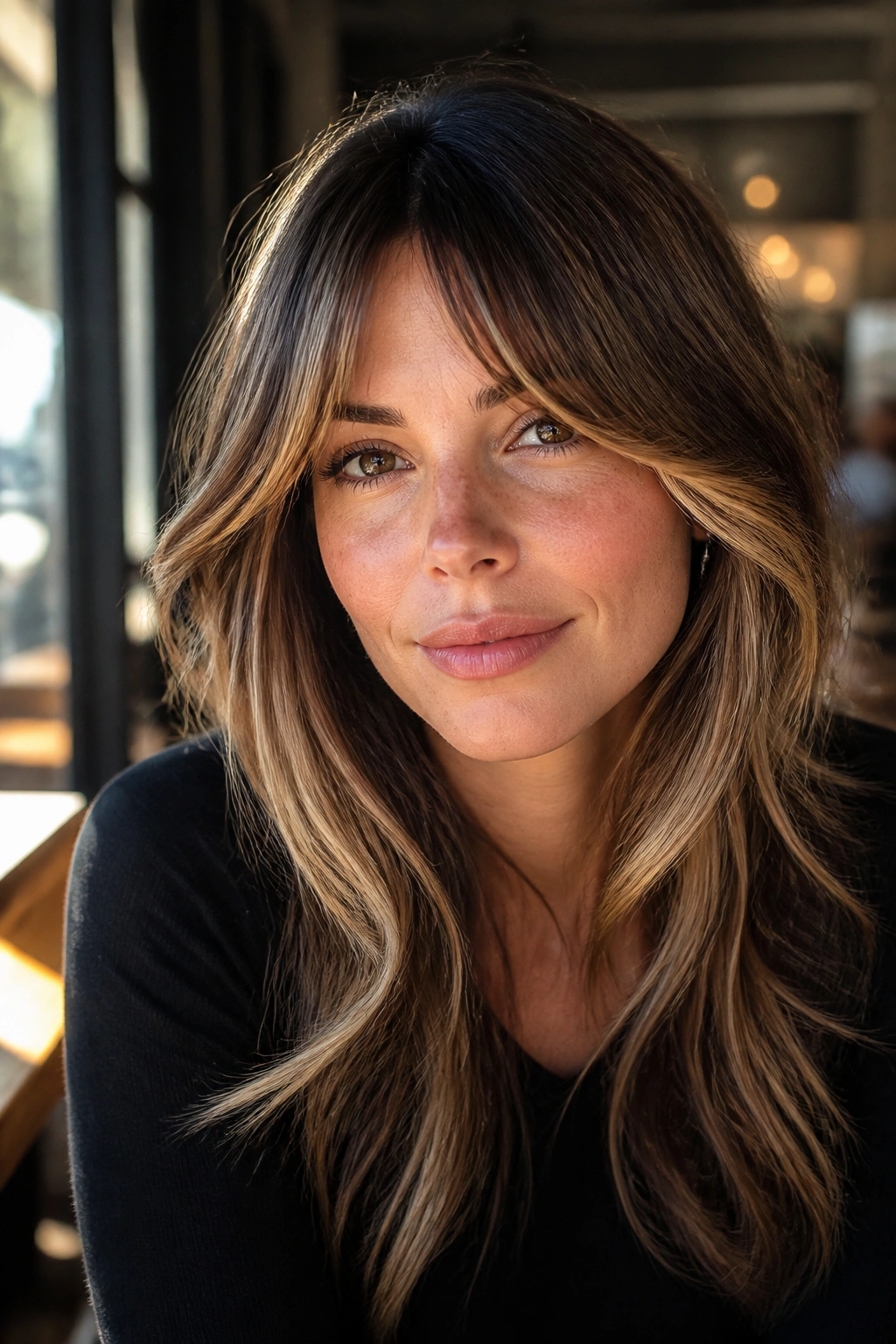
Color changes the whole read of Bardot bangs. A soft face frame can look flatter without it, especially on darker hair. Add a few lighter pieces around the fringe, and the bangs suddenly look airier because the eye can see the shape better.
The smartest version is not chunky streaks. It’s subtle brightness placed where the bangs part and where the outer pieces sweep toward the cheekbones. That breaks up a heavy block of hair and brings the focus to the eyes.
Why the Color Matters
A one- or two-shade lift around the front can make a fringe look softer even if the cut stays the same. You do not need streaks all over the head. You need a few carefully placed lighter strands where the light would naturally hit when the hair moves.
This pairing works well with long Bardot bangs, bottleneck bangs, and shaggy fringes. The color adds a little lift, and the cut keeps the shape from feeling too flat.
- Best for: brunettes, dark blondes, and any hair that reads heavy near the face
- Placement cue: brightest near the part and cheekbone sweep
- Avoid: harsh blocks of contrast at the center
- Best effect: soft framing, not stripey contrast
Color and fringe have a funny relationship. Get them wrong, and both feel louder than they should. Get them right, and the face opens up.
15. Grown-Out Bardot Bangs That Look Good Between Salon Visits
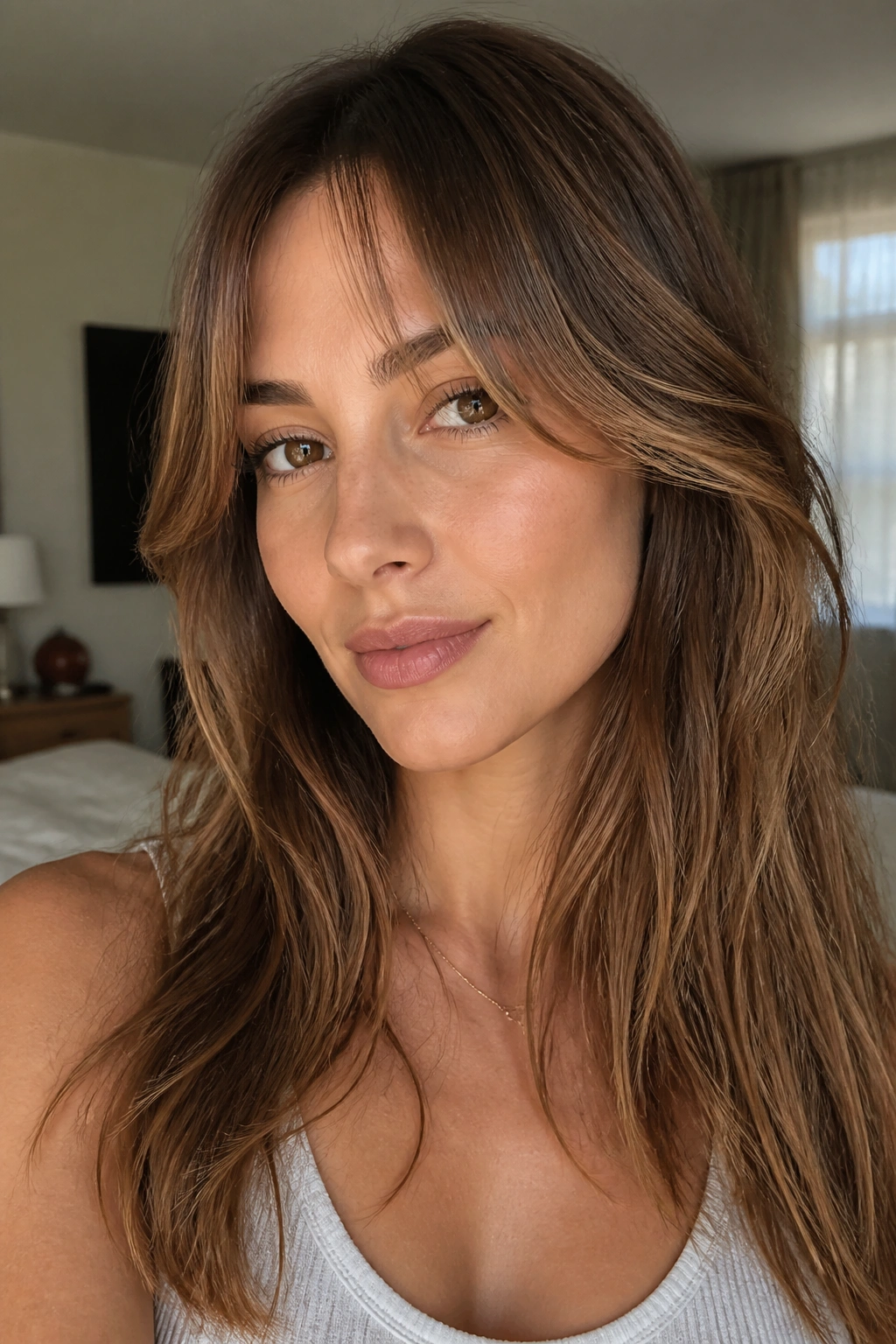
Grown-out bangs can be their own hairstyle if the shape is planned well. That’s the whole appeal of Bardot bangs for a lot of people: they can start as a fringe, then drift into face-framing layers without looking awkward halfway through.
The best grown-out version keeps the shortest pieces somewhere around the nose bridge or upper cheekbone while the outer sections stay long enough to blend into the rest of the cut. That gives you room to pin them back, part them differently, or let them fall forward on their own.
This is the version I recommend to people who want softness but not a high-maintenance relationship with their hair. The cut does not need to look perfect every day. It only needs to keep its shape when it gets a little longer.
A trim around the eyes before the fringe starts poking them is worth doing. Once the pieces hit the lashes and start flipping inward, the softness disappears and the bangs begin to feel annoying. Earlier is better there.
Grown-out Bardot bangs are the practical ending to the whole idea. They still look romantic, still frame the face, and still leave you enough flexibility to change your mind later. That’s the kind of fringe that earns its keep.
