



A tiara can make a hairstyle look finished in two seconds, or it can make the front of the head look crowded and unstable. The difference usually isn’t the tiara itself. It’s the shape beneath it.
Bridal tiara hairstyles for weddings work best when the hair gives the piece something solid to sit on: a lifted crown, a clean part, a braid line, or a bun with enough anchor points for pins. A flat top and a heavy headpiece fight each other. A little structure changes everything.
Weight matters more than most people expect. A slim crystal band can sit in loose waves with two hidden pins; a tall, beaded tiara needs a stronger base, a cleaner center section, and sometimes a bit of backcombing at the crown so it doesn’t slide forward every time someone hugs you.
The styles below cover the full spread: polished updos, soft waves, short hair, curls, braids, locs, and the veil question that always comes up at the trial appointment. The first one starts with the easiest combination to wear, and the rest get more specific from there.
1. Soft Hollywood Waves with a Center Tiara
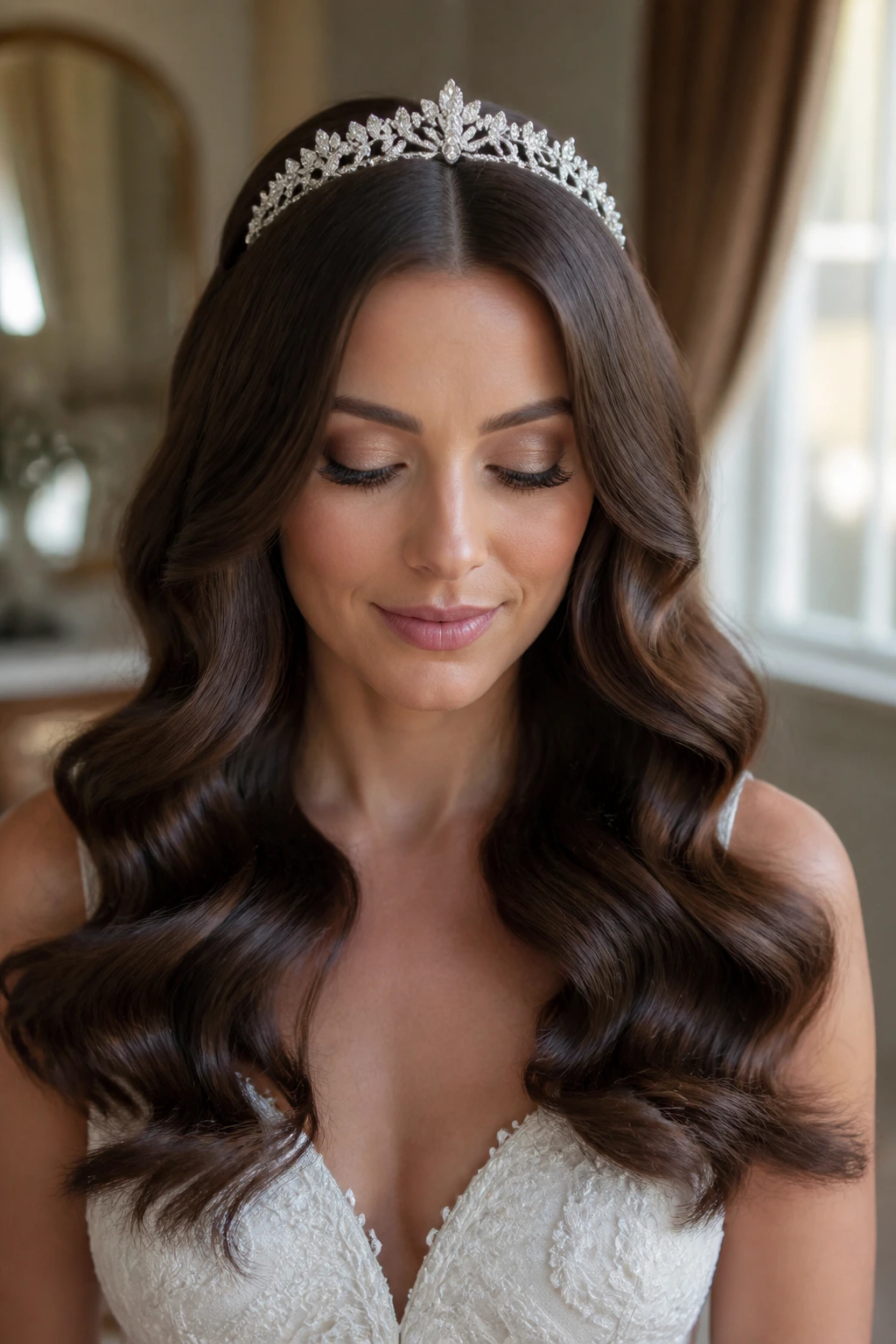
Soft Hollywood waves are the safest place to start if you want bridal tiara hairstyles for weddings that feel romantic without getting stiff. The shape is familiar, flattering, and easy to adjust for different tiara widths.
Why It Works
A center part gives the tiara a clear landing strip, and the waves keep the sides from looking flat. I like this pairing for medium to long hair because the motion starts below the crown, which keeps the headpiece from competing with the curls.
Use a 1-inch or 1¼-inch iron, curl away from the face, and let the curls cool completely before brushing them out. That cooling time matters. Warm curls collapse fast, and the tiara will suddenly look heavier than it did in the chair.
- Best with a thin crystal band or a medium-height comb tiara
- Works well when the hair is shoulder-length or longer
- Looks cleanest when the crown gets a little lift, not a full tease
- Holds up better if you mist the brush, not the finished wave, with flexible spray
Pro tip: Place the tiara about half an inch behind the hairline if it has comb teeth. Too far forward, and it starts to look pasted on.
2. Sleek Low Chignon with a Pearl Tiara
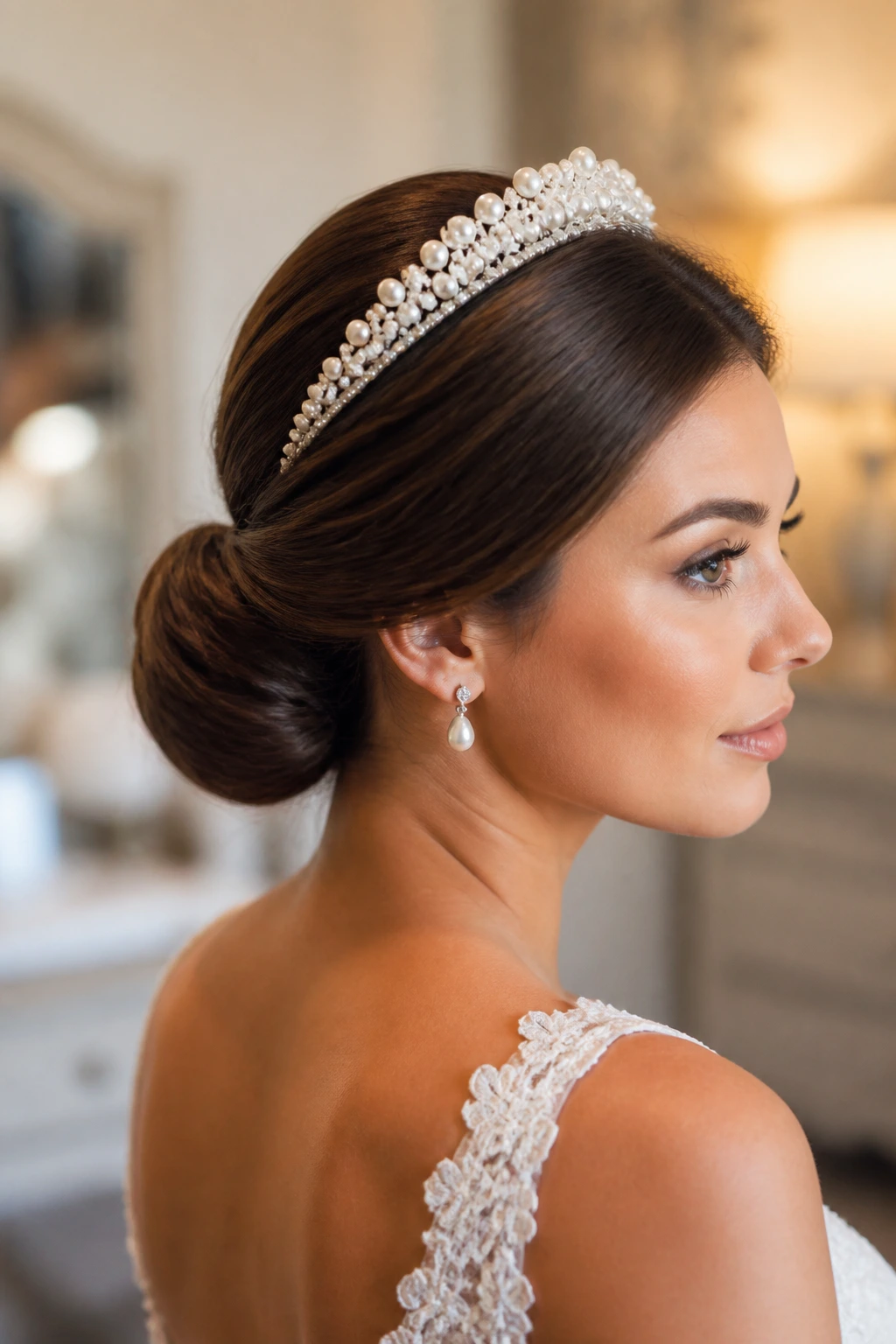
A low chignon gives a tiara the calmest possible base. That sounds plain, and it is — but plain hair is often what makes the headpiece look intentional instead of crowded.
A smooth chignon keeps the eye moving upward to the tiara, especially when the dress has beadwork, lace, or a high neckline. Pearls suit this shape because they echo the clean finish of the bun. Crystal tiaras can work too, but pearl settings feel softer against satin and matte fabrics.
The trick is placement. Set the tiara slightly above the bun, not buried into it. If the bun sits low at the nape, leave a small pocket of visible hair between the top of the bun and the headpiece so the shape reads clearly from the side.
Fine hair needs a little help here. A mesh bun form, a few hidden pins, and a light spray of shine mist keep the style from flattening before the ceremony is over. No drama. No puff. Just control.
3. Half-Up Cascading Curls with a Crystal Tiara
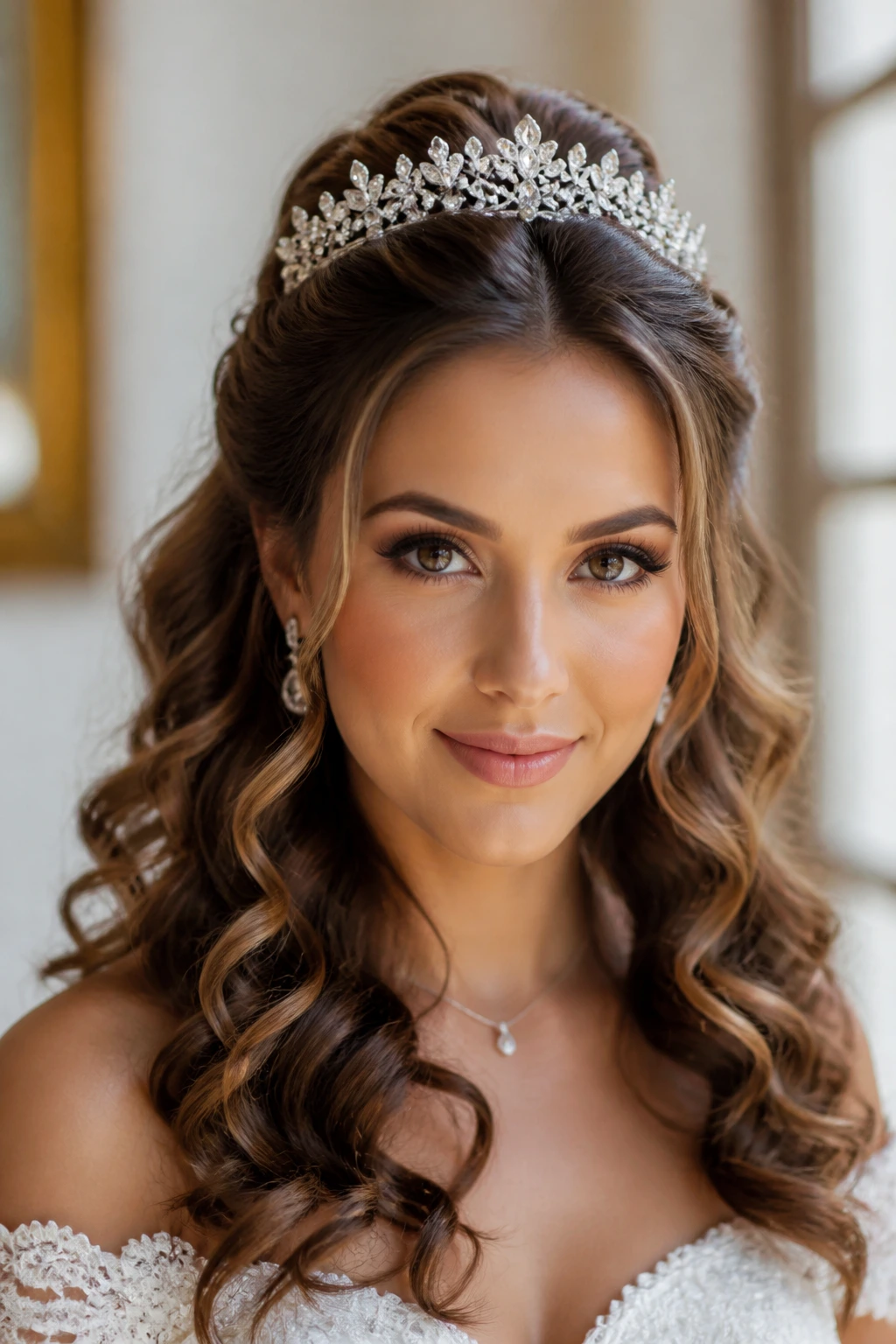
Why do half-up styles keep showing up in bridal folders? Because they solve two problems at once. You get volume at the crown for the tiara, and you keep enough length loose to soften the face and shoulders.
How to Style It
Start by curling the lower half of the hair in uniform sections, then pin the top back just above the occipital bone. That spot gives the tiara a stable shelf without hiding it in the hair. If you pin too high, the crown gets crowded. Too low, and the piece sinks into the back section.
A crystal tiara works especially well here because the loose curls catch the sparkle without looking fussy. Keep the top section smooth, though. If the crown gets too bulky, the tiara loses its line and starts to wobble visually even if it’s pinned down well.
This style is a smart pick for brides who want movement in photos. It reads polished from the front and softer from behind. That matters more than people think, because the back of the head shows up in almost every hug shot and veil shot.
4. Braided Crown with a Narrow Tiara
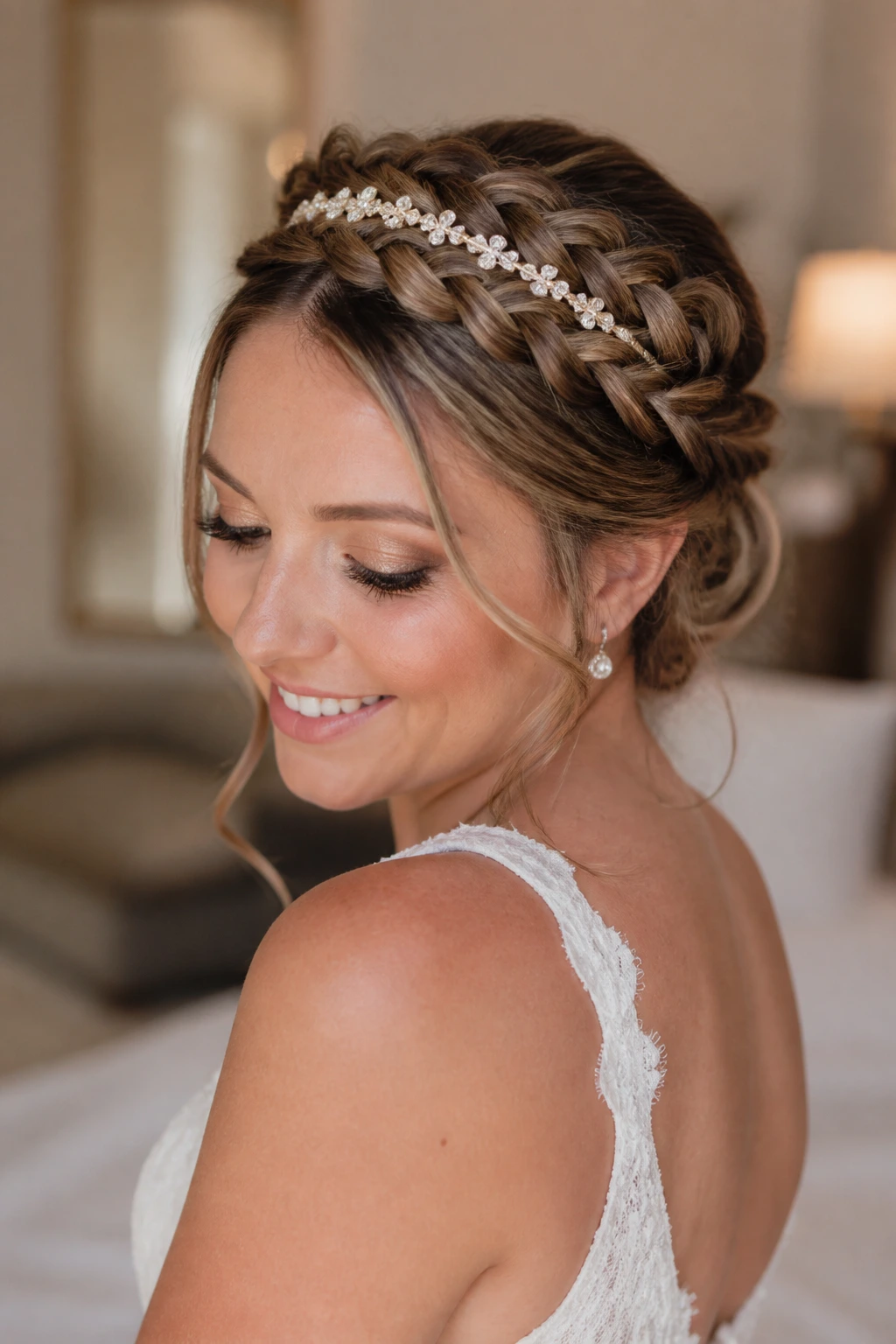
A bride who wants her hair off her face but still wants a little softness usually ends up here. The braided crown gives shape. The tiara adds the shine.
The braid acts like a built-in frame, which is why this look stays neat for long ceremonies and even longer receptions. A narrow tiara works best because it follows the curve of the braid instead of fighting it. If the tiara is too tall, the style starts to feel crowded at the top.
Quick Details That Matter
- Use a Dutch braid or a loose French braid around the crown
- Keep the braid slightly soft so it doesn’t look severe
- Pin the tiara just in front of the braid line, not on top of it
- Choose a smaller piece if the braid already sits high on the head
The best version of this style never looks overworked. That’s the whole point. The braid does the heavy lifting, and the tiara just finishes the shape.
5. Side-Swept Waves with a Deep Part Tiara
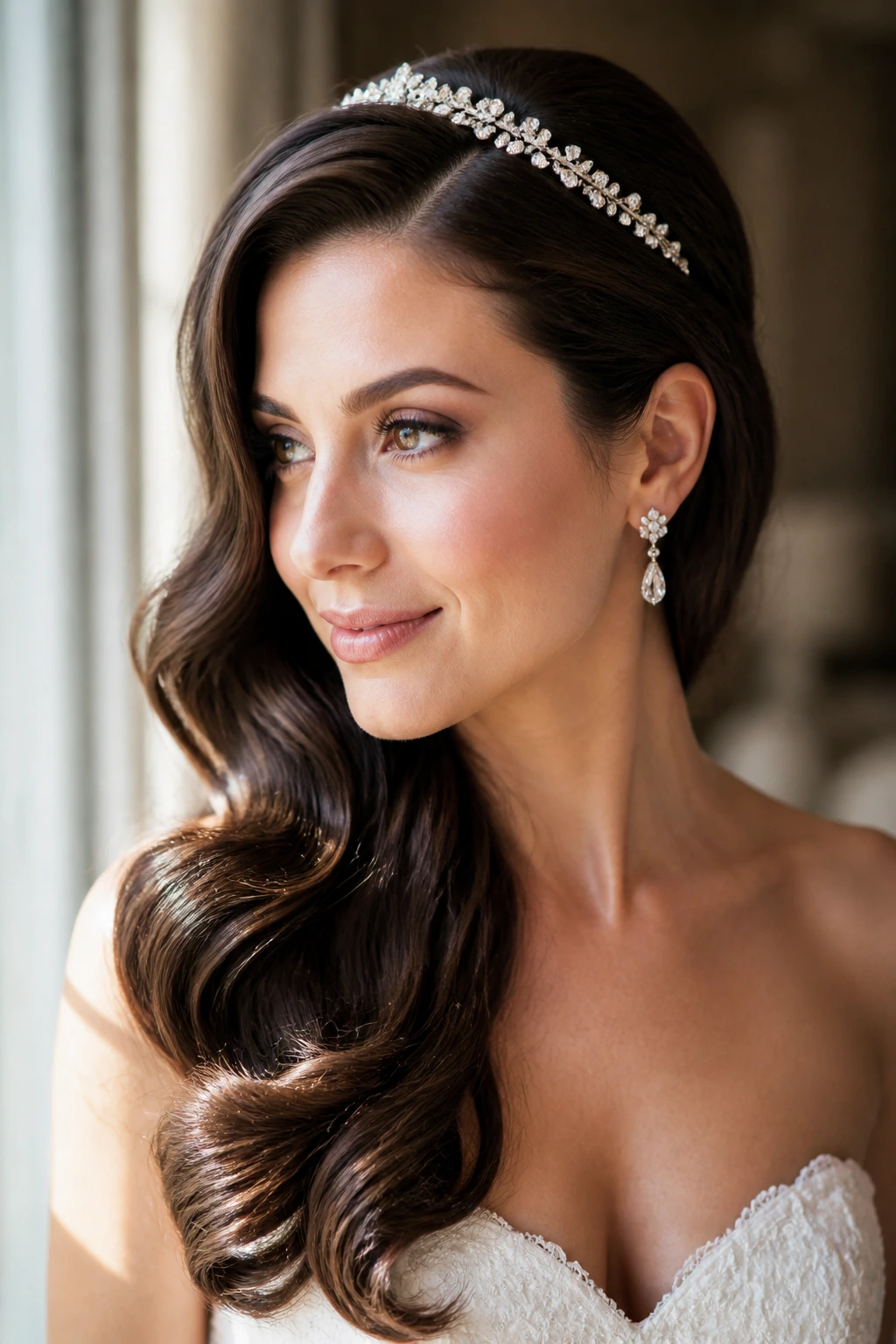
A deep side part changes the mood fast. It gives the face a little drama, and it gives the tiara a place to lean without sitting dead center like a pageant crown.
This style works especially well for one-shoulder dresses, asymmetric necklines, or gowns with a lot of detail on one side. Pull the larger wave section toward the tiara side and tuck the opposite side behind the ear or smooth it close to the cheekbone. That contrast is what makes the whole thing feel dressed up.
The key is balance. If the tiara is placed over the heavy side of the part, it can look lopsided. If it sits too far back, the side sweep loses its shape. A good stylist will use the part line, the wave direction, and the headpiece all at once, which sounds fussy but usually looks effortless in photos.
A narrow-to-medium tiara is the safest choice here. Wide pieces can flatten the line of the part. Small pieces disappear. This middle ground gets used a lot for a reason.
6. Textured Low Twist with a Veil-Friendly Tiara
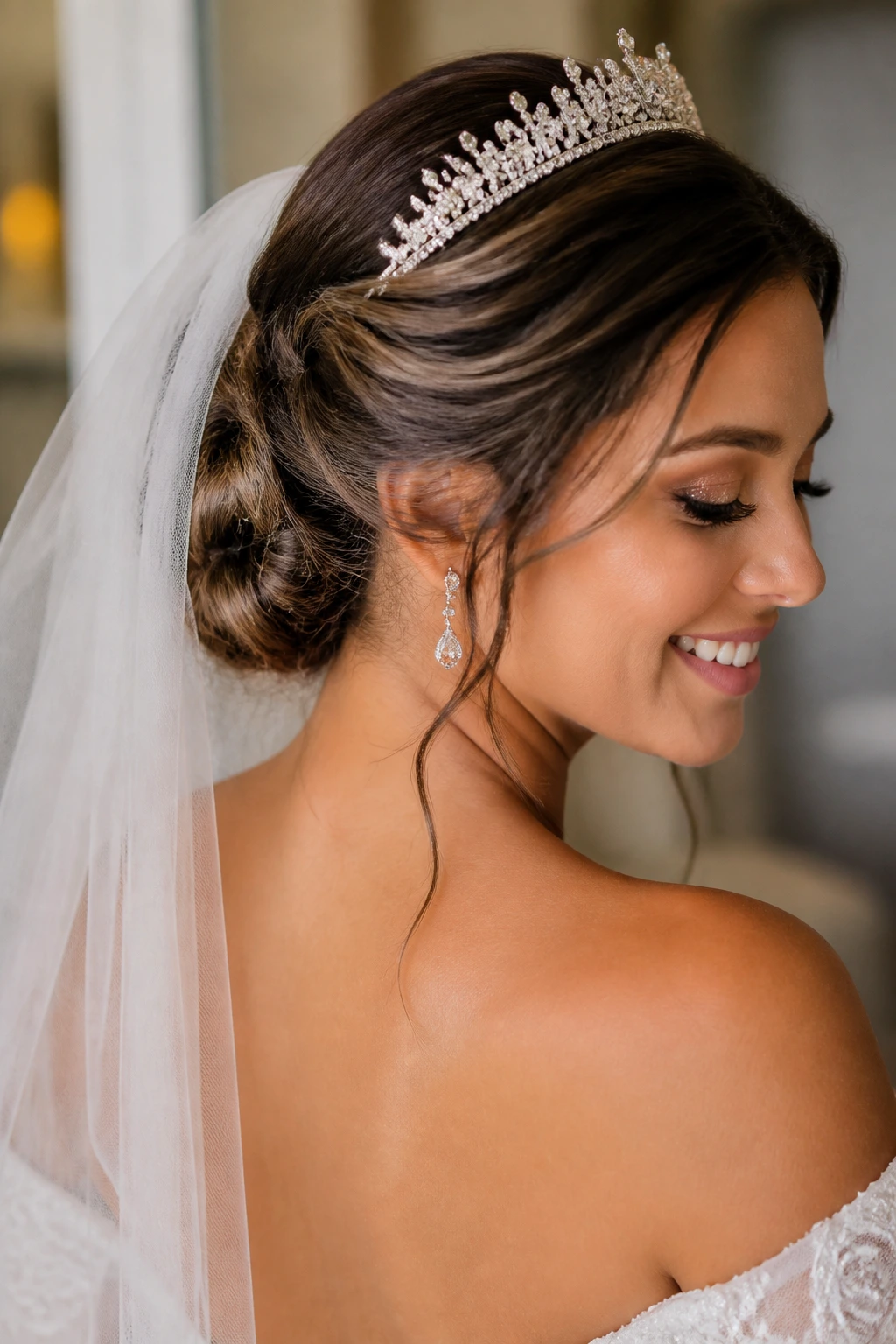
Unlike a solid bun, a low twist leaves a little movement in the hair. That matters if you want the style to feel soft but still need something strong enough to support a veil or a heavier tiara.
The twist should start with a bit of grip at the roots. Not crunch. Grip. A touch of texturizing spray on dry hair gives pins something to hold onto, and that keeps the style from slipping during a long day of wear. I’d choose this for a bride who wants an updo that doesn’t look too rigid.
What Makes It Easy to Wear All Day
The shape is compact at the nape, so it doesn’t bump the veil. It also leaves room for the tiara to sit just above the twist without getting buried in the folds. That small gap is worth paying attention to. Too much overlap makes the headpiece look like an afterthought.
This is one of those styles that behaves well in real life. It’s not flashy. It doesn’t need to be. It just stays put, and that counts for a lot when there’s dancing later.
7. Voluminous High Bun with a Statement Tiara
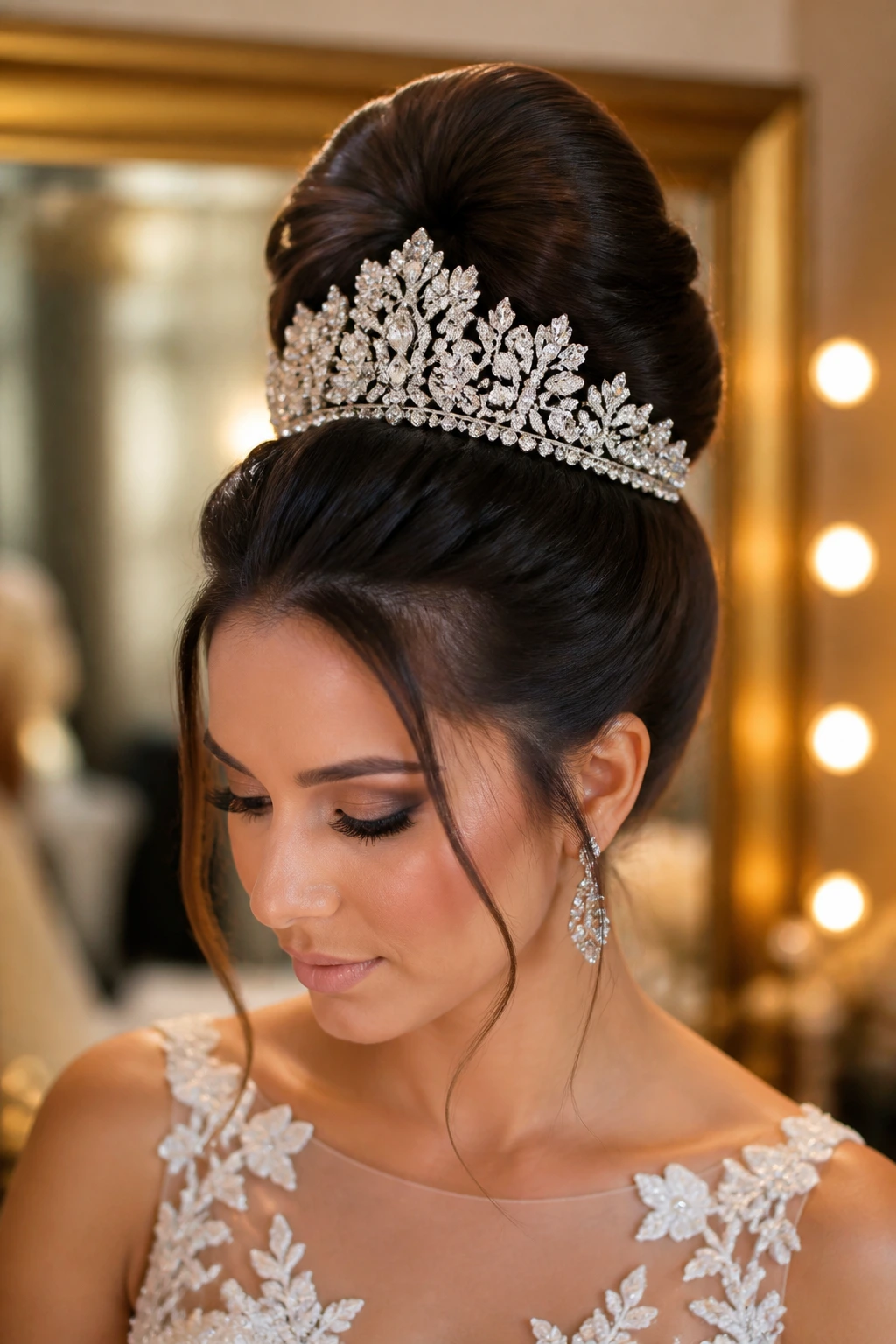
A high bun is the easiest place to hide anchors, which is why statement tiaras stay put here better than almost anywhere else. The bun creates a natural pedestal, and the tiara gets to look tall without sliding into the hair.
The trick is not to let the bun get puffy in a random way. You want height, yes, but you also want a clean shape. A donut form, a pinned sock base, or a carefully wrapped knot can all work. Fine hair usually needs padding. Thick hair usually needs sculpting. Both need pins from more than one angle.
What to Watch For
A heavy tiara can flatten a weak bun within an hour if the base is loose. Press gently at the crown before you leave the chair. If the bun shifts, it will shift more later.
I like this combo for structured gowns, especially dresses with full skirts or strong necklines. The shape holds the same visual weight as the dress, which keeps the whole look from feeling bottom-heavy.
8. Loose Waterfall Braid with a Romantic Tiara
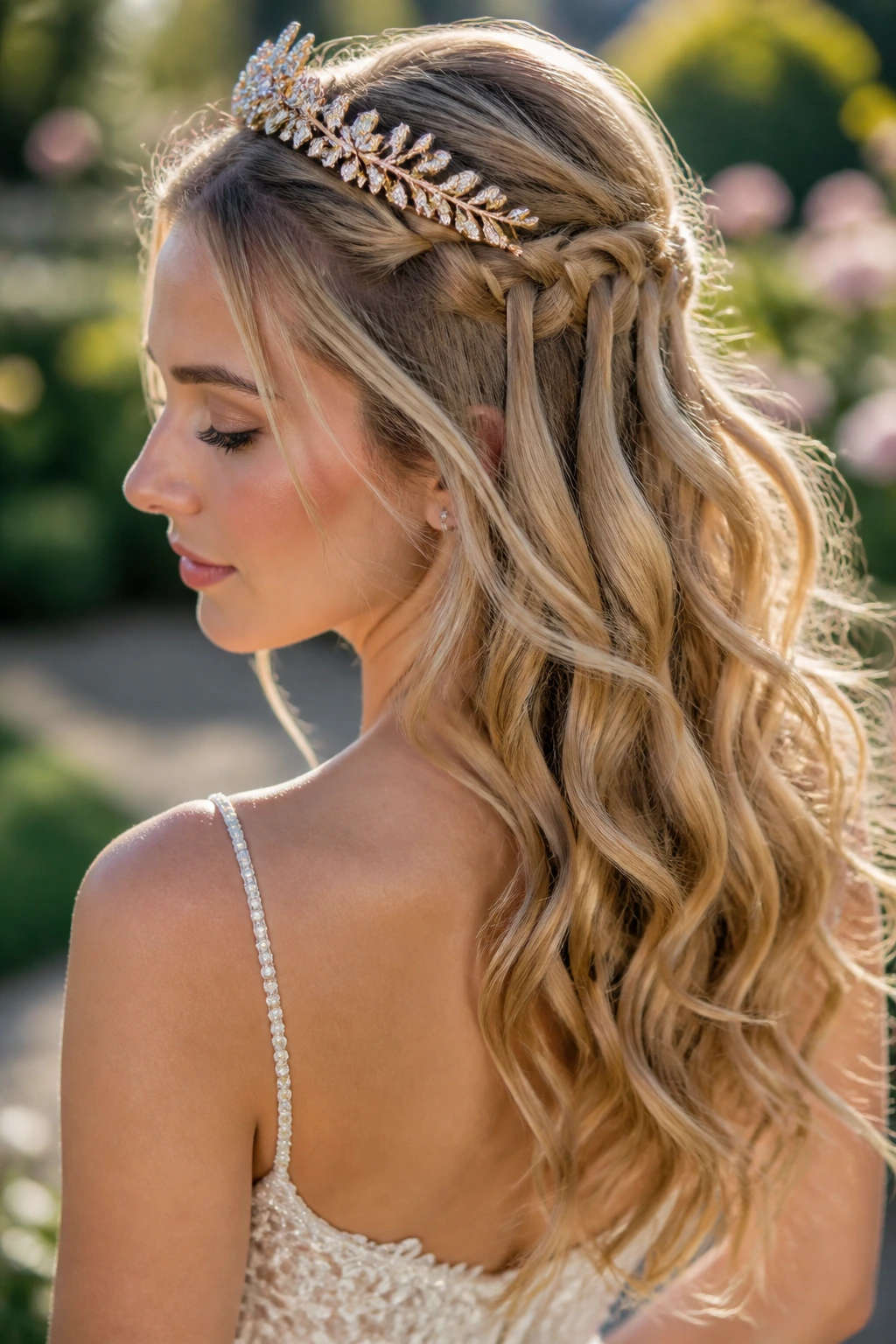
Why does a waterfall braid feel so soft under a tiara? Because it breaks up the hair in little pieces while still leaving enough length flowing through the back. That balance is what makes the style feel airy instead of stiff.
The braid line gives the tiara a bit of structure, and the loose lengths keep the look from turning severe. It’s a smart choice for medium and long hair, especially if the ceremony will be outdoors and the bride wants something that moves a little in the wind.
How to Keep It from Slipping
Start the braid high enough that the tiara doesn’t sit on top of the braid’s largest loops. That’s the part people miss. If the braid is too low, the headpiece disappears into the pattern.
Keep the loose strands curled, not straight. Straight ends make the braid look accidental. Curling the ends gives the whole style a finished edge, and the tiara reads as part of the design instead of a separate object sitting on top.
9. Long Blowout with a Delicate Tiara
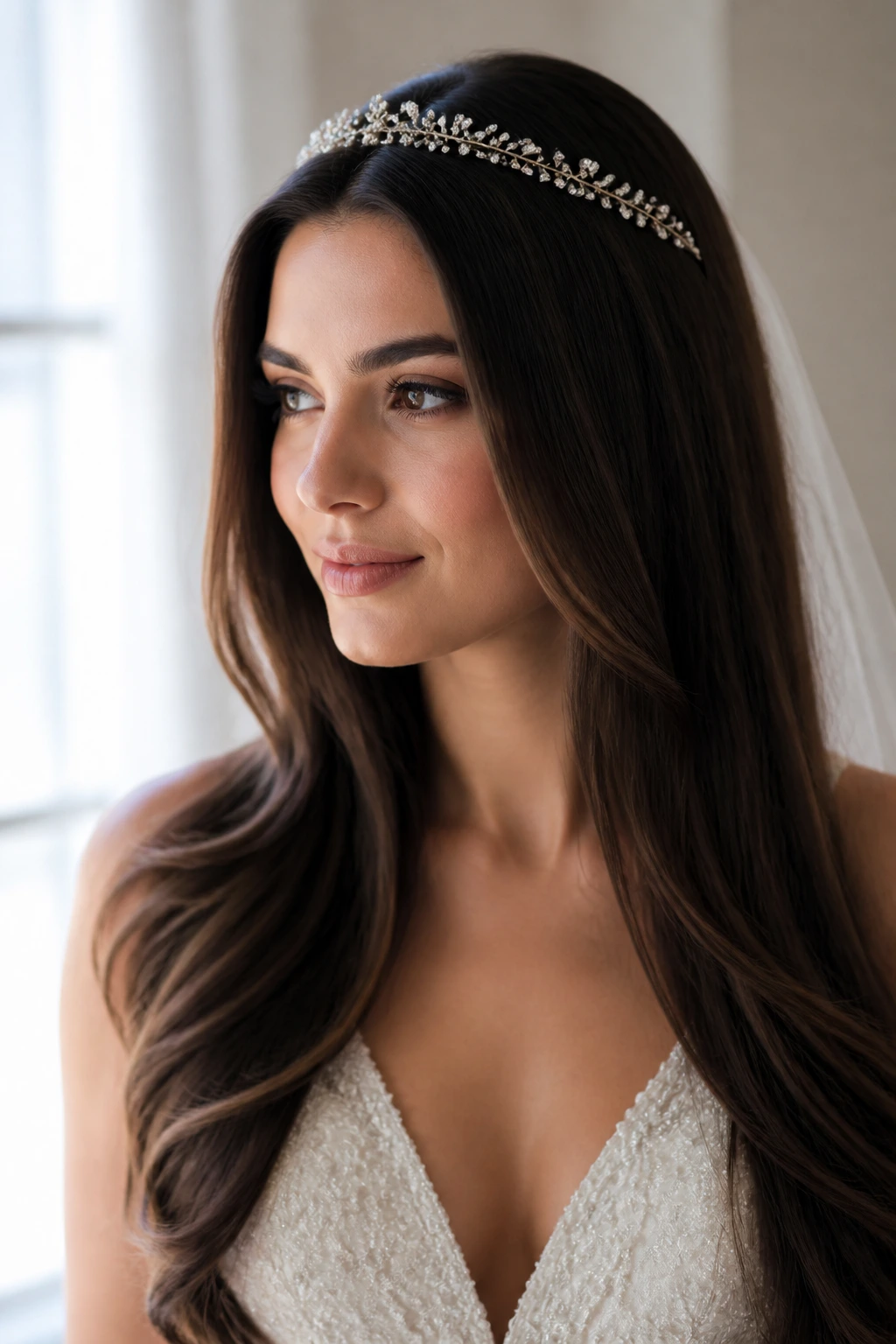
Straight, glossy lengths give a delicate tiara room to breathe. There’s no braid, no bun, no heavy twist competing for attention. Just clean hair and a small line of sparkle.
A wedding blowout should still have shape. I’m not talking about poker-straight hair that hangs like a curtain. The roots need lift, the mid-lengths need a smooth bend, and the ends should turn under slightly or curve away from the face. That little bit of shape keeps the tiara from looking like an afterthought.
This style is strongest when the tiara is slim and low-profile. Think fine crystals, tiny pearls, or a vine-like band. A thick crown can look too large against straight lengths because the eye has nowhere to rest between the hair and the headpiece.
The one thing to avoid is overloading the hair with oil or gloss spray. Shine is good. Grease is not. You want the hair to move when you turn your head, not stick together in heavy sections.
10. Messy Bun with Face-Framing Pieces and Tiara
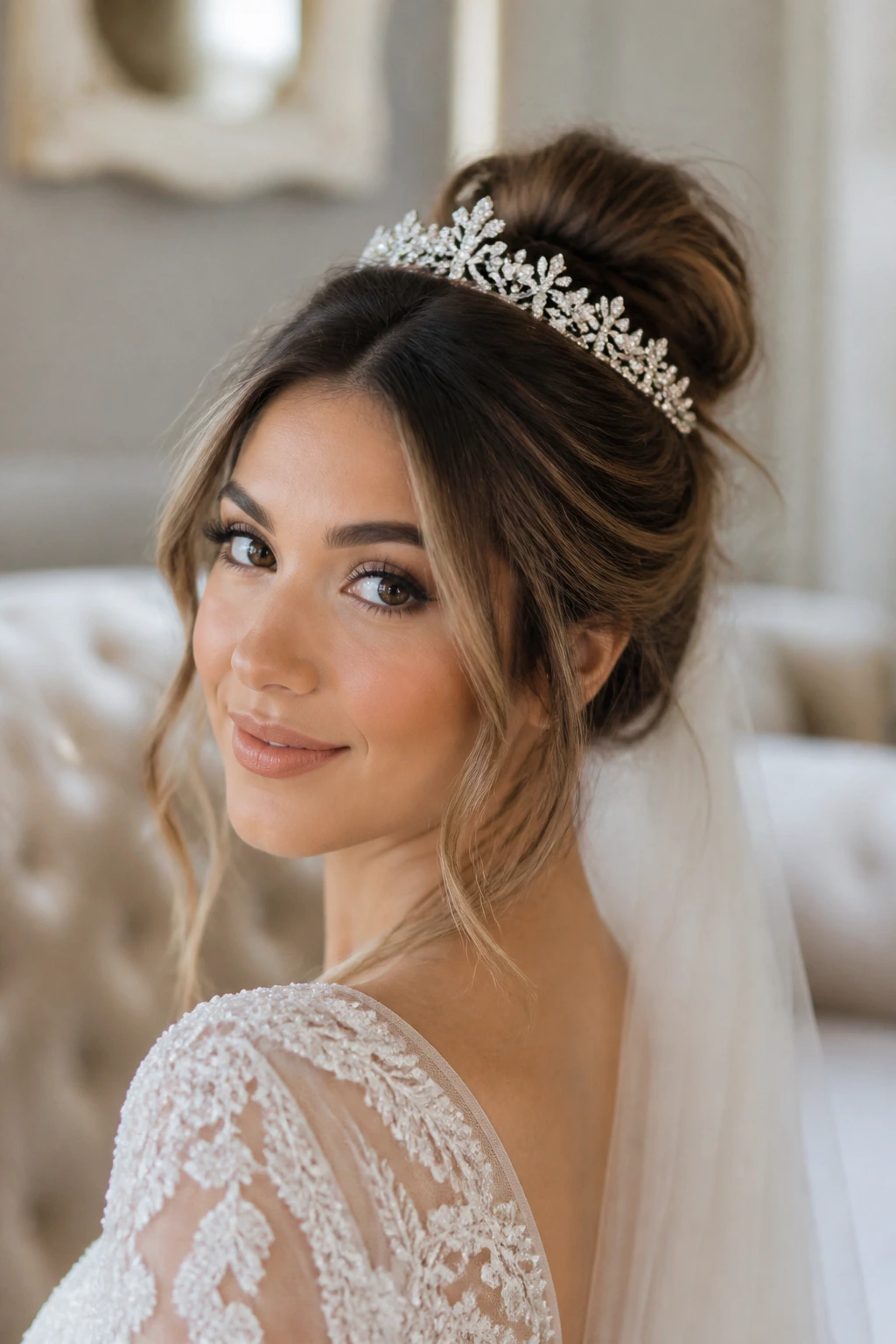
A messy bun sounds forgiving. In bridal hair, it still needs a plan.
The bun should be loose in shape, not loose in structure. There’s a difference. Good messy buns have a clear center, a few controlled flyaways, and face-framing pieces that are cut or curled on purpose. Bad ones just sag. A tiara saves the style from looking too casual, especially if the bun sits low and the crown area has some lift.
- Leave two to four pieces out around the face, and curl them away from the cheeks
- Tease the crown lightly so the tiara has a flatter surface to sit on
- Keep the bun off-center if the dress neckline already feels symmetrical
- Use hidden pins in a crisscross pattern so the bun doesn’t loosen after the first hour
The charm here is the contrast. The bun says relaxed. The tiara says formal. Put them together carefully and the result feels lived-in, not sloppy.
11. Fishtail Braid and Tiara Combo
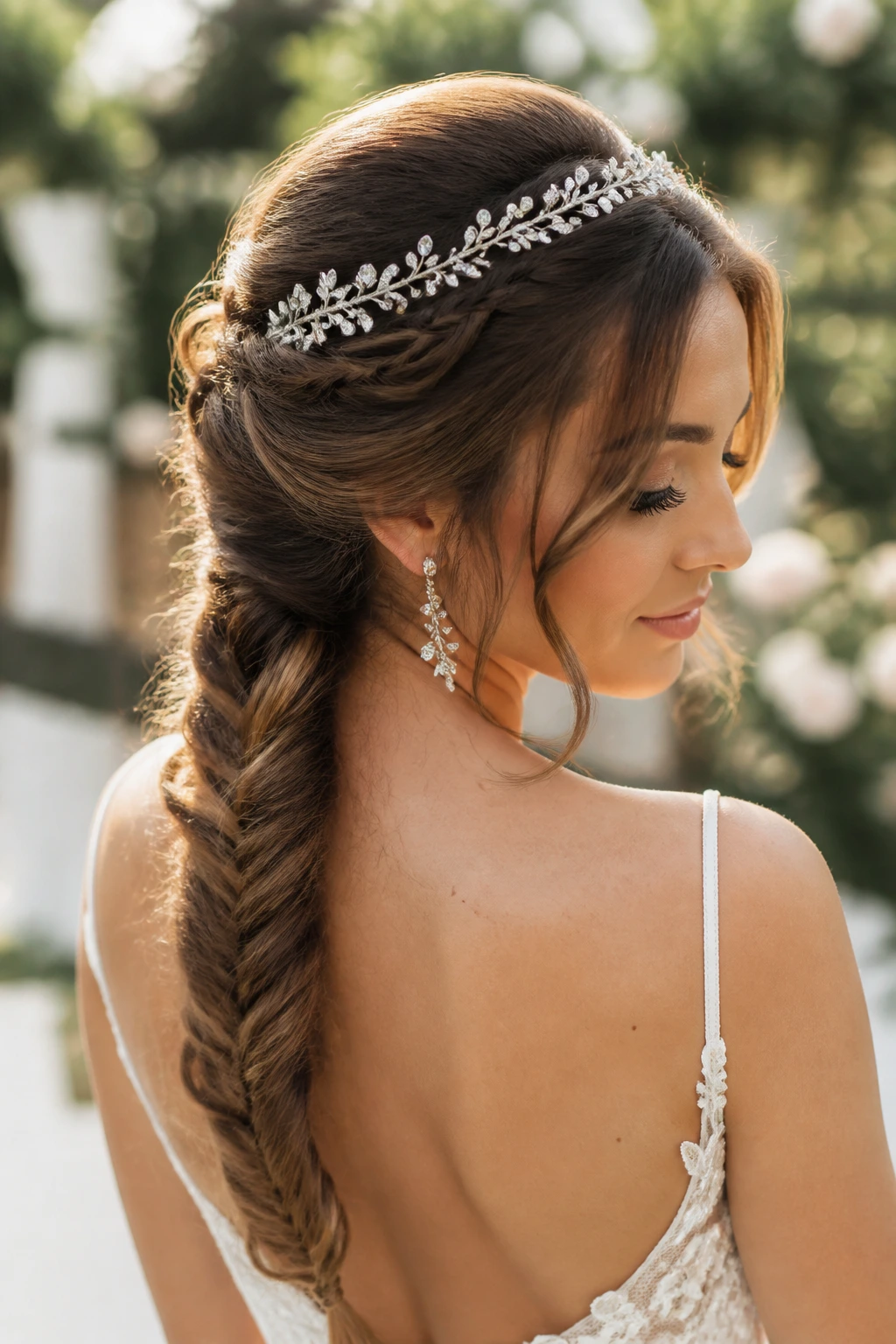
Unlike a classic three-strand braid, a fishtail braid holds texture even after hours of hugging, dancing, and moving around in a dress that weighs more than expected. That’s why it shows up so often in bridal hair with a tiara.
The braid itself has a fine, woven look, which gives the tiara a slightly more detailed backdrop. A narrow band or vine-style piece tends to fit best here because the braid already carries a lot of visual pattern. A giant tiara on top of a fishtail braid can look like two different ideas fighting for the same space.
This style suits brides who want their hair down the back but still need it under control. It also works well with outdoor ceremonies because the braid keeps the length tidy. If the braid is slightly pancaked — gently pulled apart for width — the tiara sits more clearly in front of it.
One note: keep the braid starting point high enough that the crown doesn’t collapse. The tiara needs a small shelf, not a slope.
12. Old-Hollywood Side Part with a Vintage Tiara
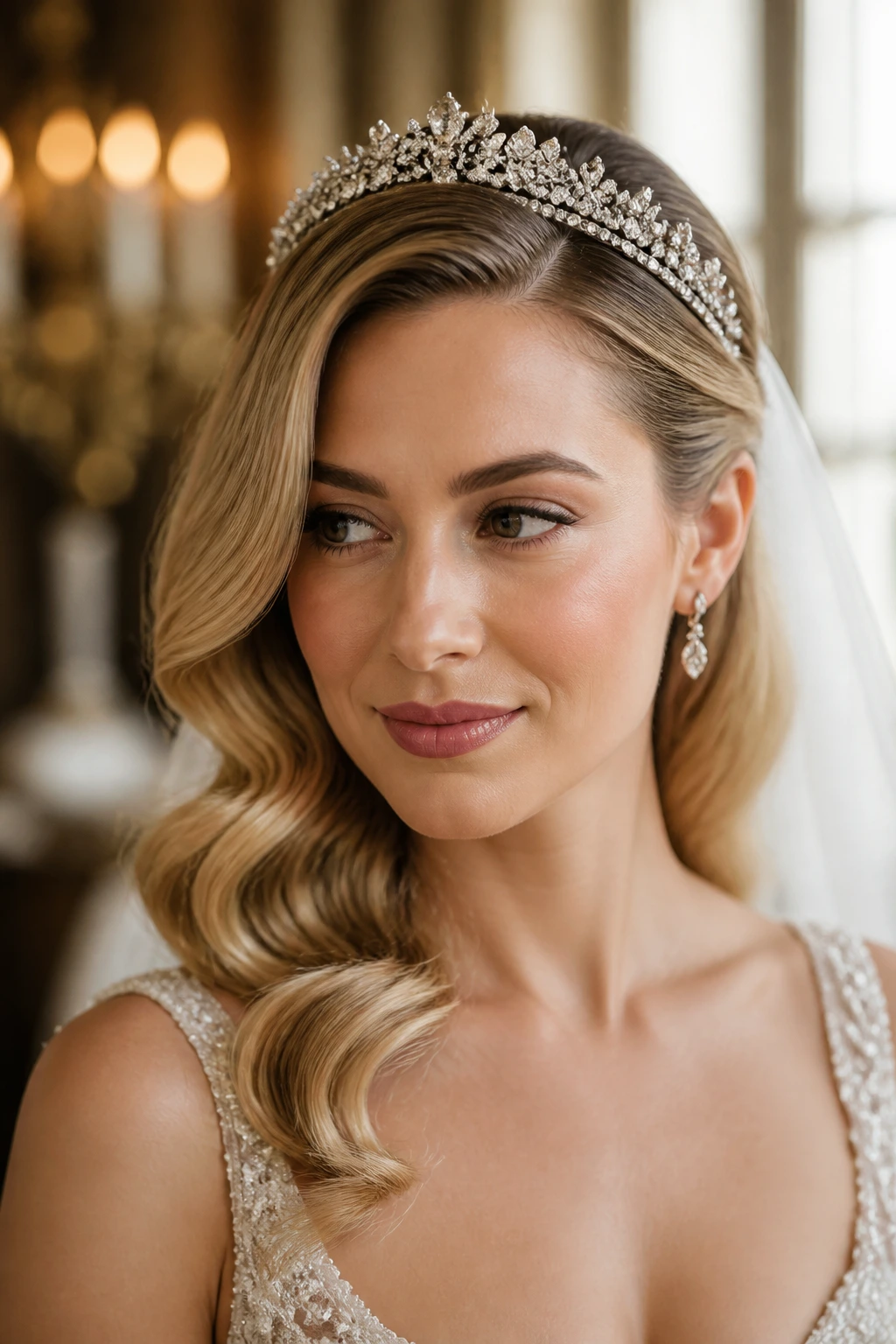
Old-Hollywood side parts love a tiara that sits a touch off center. The whole look depends on that sweep — one side smooth, the other side rolling into soft waves that skim the jaw and shoulder.
This is one of the most polished bridal tiara hairstyles for weddings because it uses restraint instead of volume. The hair is glossy, the part is strong, and the tiara feels like part of the styling instead of a separate accessory. Vintage-inspired pieces with milgrain edges or pearl clusters fit especially well here.
A strong side part also helps lengthen the face. That matters if the tiara has height. You don’t want the top of the head to feel crowded, so keep the wave pattern controlled and let the tiara sit just above the highest point of the wave on the chosen side.
This look pairs nicely with satin dresses, long gloves, or anything that has a little old-world structure. It’s calm, but not plain. There’s a difference.
13. Short Bob with a Mini Tiara
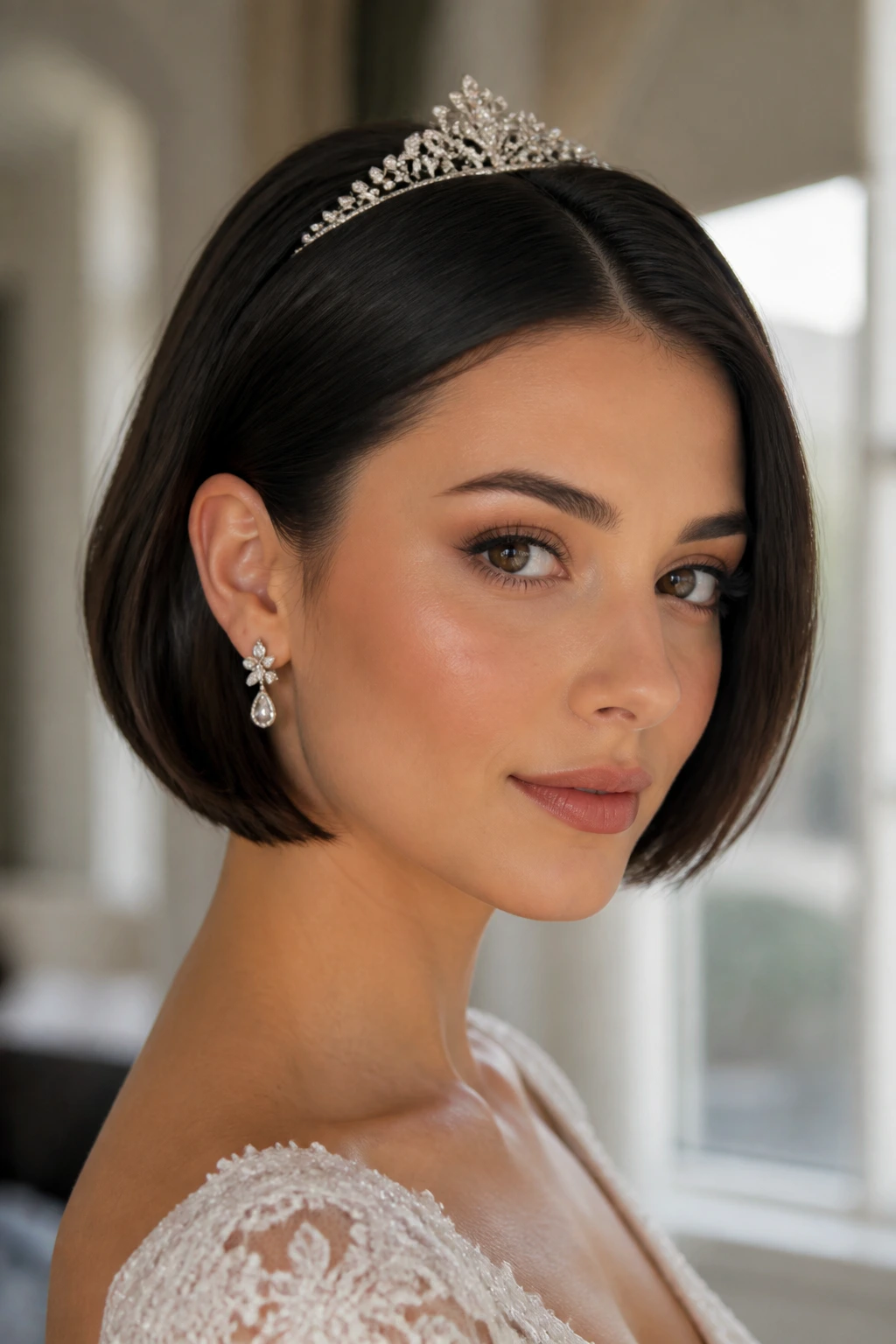
Short hair does not need to fake a long updo to wear a tiara. That’s the first thing I’d tell any bride with a bob who thinks she has to add extensions just to make the headpiece work.
A mini tiara or a slim comb piece is enough for a bob, especially when the haircut has a clean line and a little bend at the ends. If the bob is blunt, tuck one side behind the ear and keep the top soft. If it’s textured, a tiny bit of lift at the roots gives the tiara a place to rest without looking oversized.
What Makes It Work
The headpiece should be scaled to the haircut. A full crown can swallow a chin-length bob. A small, detailed piece looks deliberate.
I also like a side part with this length because it gives the tiara a more natural anchor point. A center part can work too, but only if the hair is very smooth and the piece is light. Short hair needs precision, not volume for volume’s sake.
14. Pixie Cut with a Headband-Style Tiara
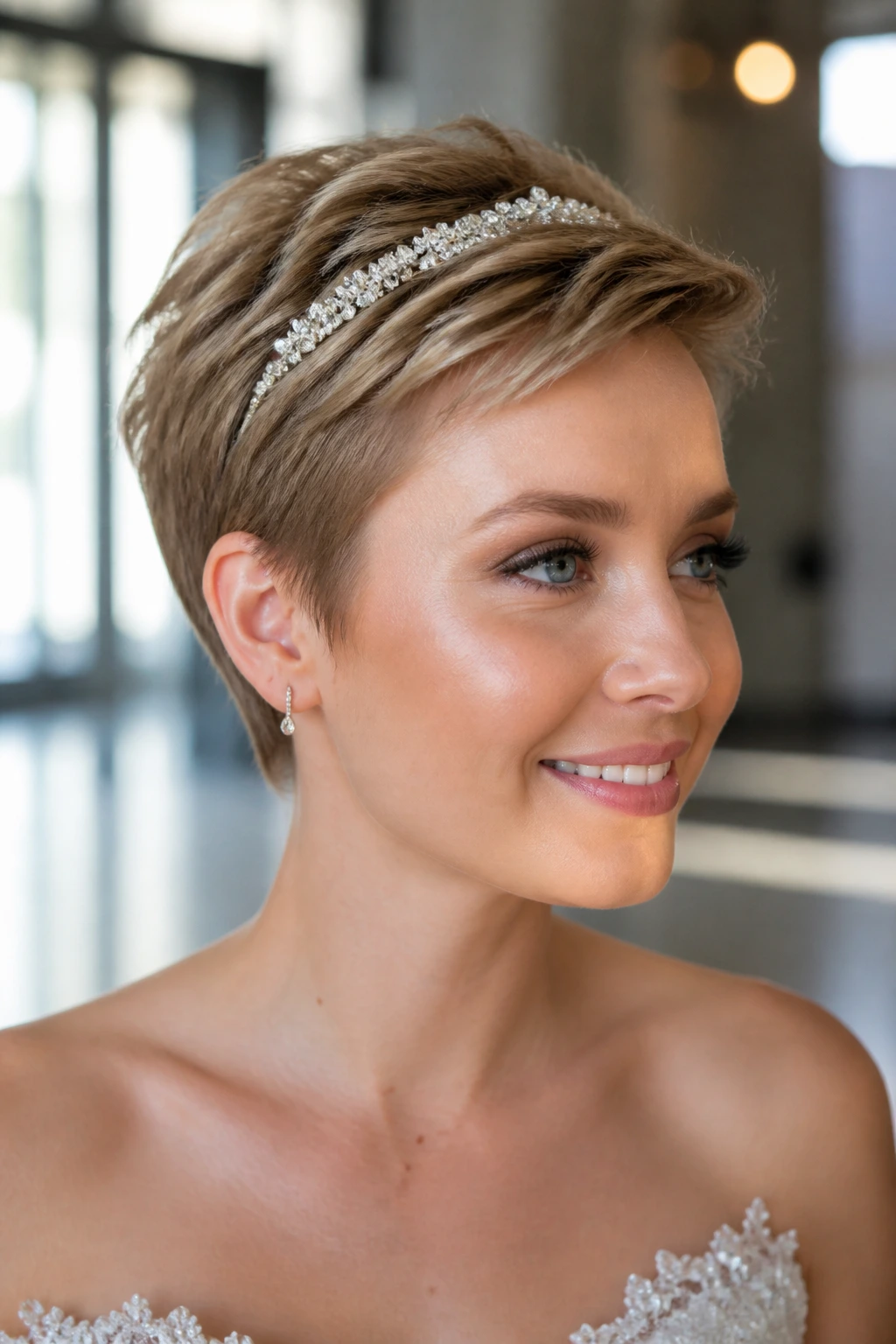
Can a pixie cut handle a tiara without looking crowded? Yes, if the piece is shaped like a headband instead of a towering crown.
A pixie looks best with a lower-profile tiara that follows the head’s curve. Headband-style designs sit more naturally on short hair because they don’t need much lift behind them. If the pixie has longer fringe or a side-swept top, that extra length can be tucked, waved, or pinned to frame the piece.
The main job here is security. Short hair gives pins less to grab, so the tiara usually needs hidden anchors near the temples and behind the ears. A little texture spray at the roots helps too. Too much product makes the hair slick, and slick hair is a headache with a headpiece.
This look has a neat, modern feel when it’s done well. It’s clean. It’s spare. And it lets the face do the talking, which is often exactly the point.
15. Natural Curls with a Center Tiara
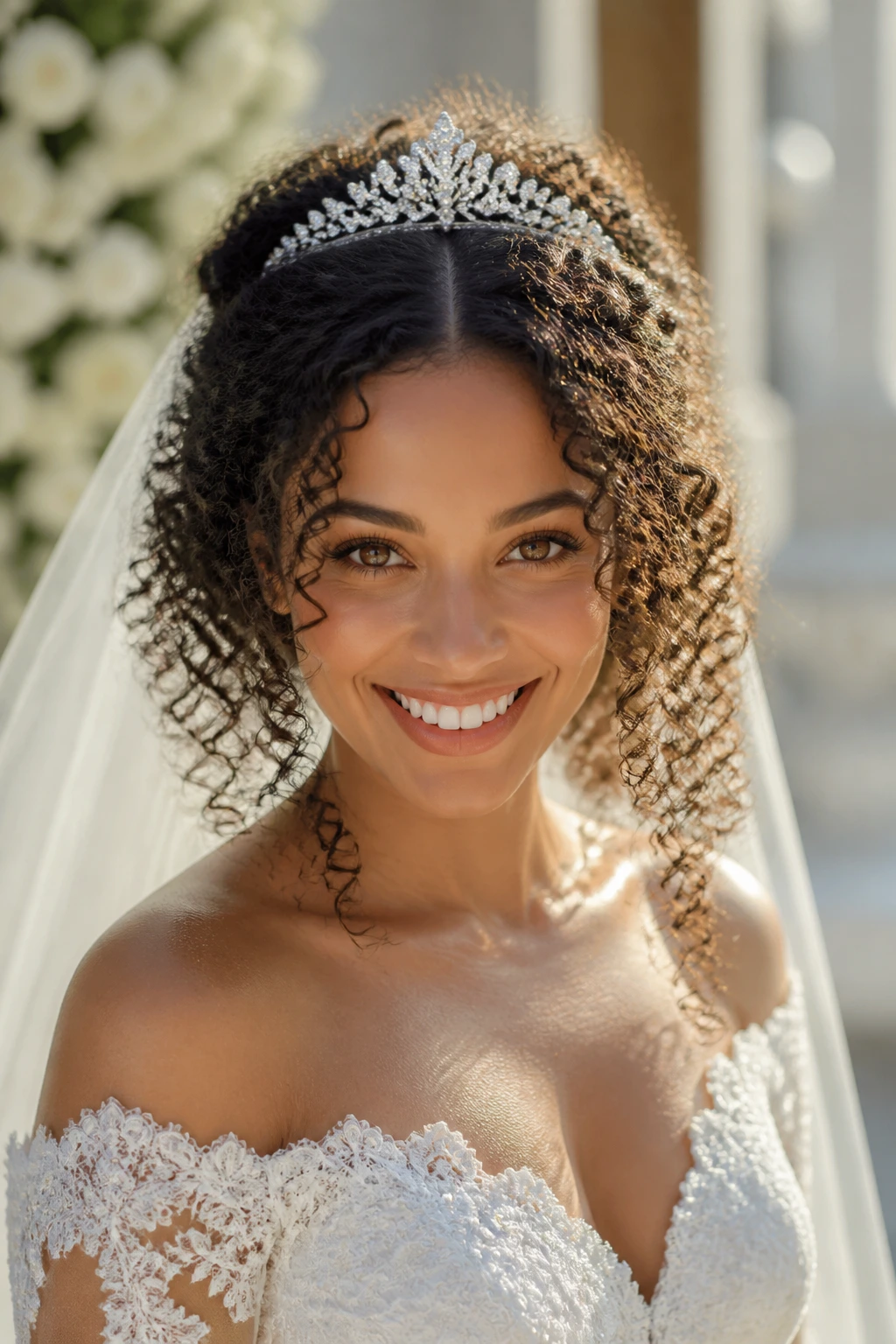
Natural curls look best when the tiara meets them halfway. Don’t flatten the curls into obedience. Don’t let the tiara sink into the halo either.
The shape should start with healthy definition at the crown. Diffuse the hair or set it in a curl pattern that keeps the root lifted a little, then choose a tiara with enough presence to show above the curl cloud. A center placement usually works best because it keeps the style balanced and lets the curls fall evenly on both sides.
- Keep the curl pattern intact near the face
- Use a light cream or gel only where the curl needs control
- Place the tiara on a shaped crown, not on a flat root area
- Secure the piece with pins that match the curl direction so they disappear
I love this combination when the bride wants her texture to stay visible. The curls bring softness. The tiara brings structure. Neither one has to surrender.
16. Locs with a Sculpted Tiara
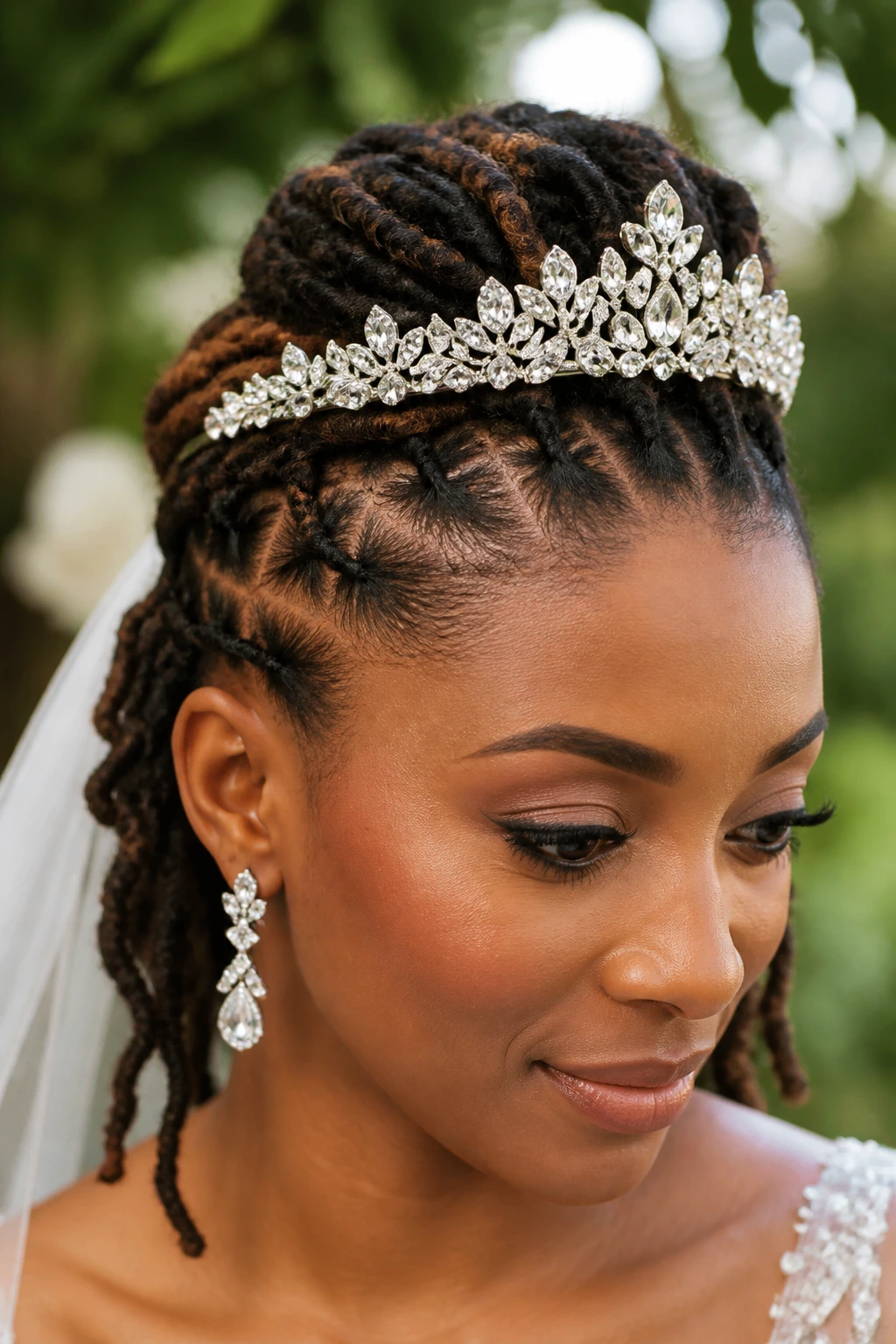
Locs can carry a tiara with more ease than people expect, but the placement has to respect the density and shape of the hair. The headpiece should sit where the locs have been shaped flat enough to support it, often slightly behind the hairline rather than right on top of it.
A sculpted updo, half-up set, or pulled-back front section usually gives the best base. The goal is to create a line across the front that the tiara can follow without sliding into the locs. If the piece has comb teeth, check that they do not snag. Some stylists line the contact points with a little satin ribbon or smooth wrap so the teeth rest more gently.
This is one of those looks where balance matters more than sparkle. A heavy tiara can overpower the beauty of locs if the rest of the styling stays too tight. Keep the finish clean, but not crushed.
The result is strong and graceful. No part of it needs to be timid.
17. Mermaid Waves with a Tall Tiara
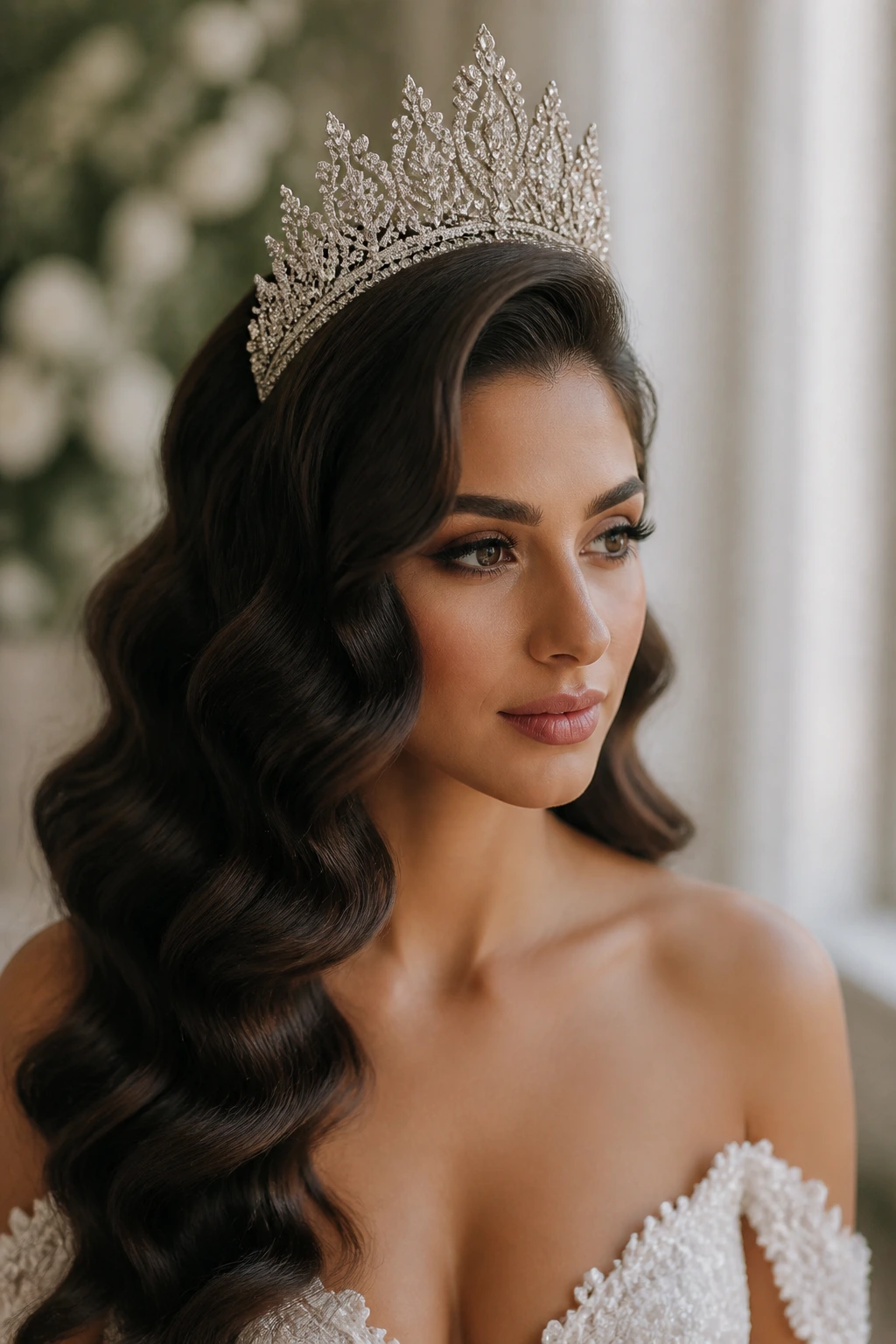
Unlike soft waves, mermaid waves rely on deeper bends and a little more hold, which gives a taller tiara something to sit against without vanishing into the hair. The texture is larger, richer, and a bit more dramatic.
That makes this pair especially good for brides who want a fuller silhouette. The tiara adds height at the top while the waves carry bulk through the length. If the dress is clean and simple, this can be a smart way to add presence without piling on extra accessories.
A tall tiara needs the crown to be steady. Backcombing at the roots, plus a light mist of flexible spray, usually gives enough grip. Don’t overdo the spray. If the waves turn stiff, the whole style loses that soft movement that makes it work in the first place.
This look can lean glamorous fast, so it suits brides who want a little drama without turning the whole outfit into costume territory. The line between the two is thinner than people think.
18. Low Ponytail with a Wrapped Base and Tiara
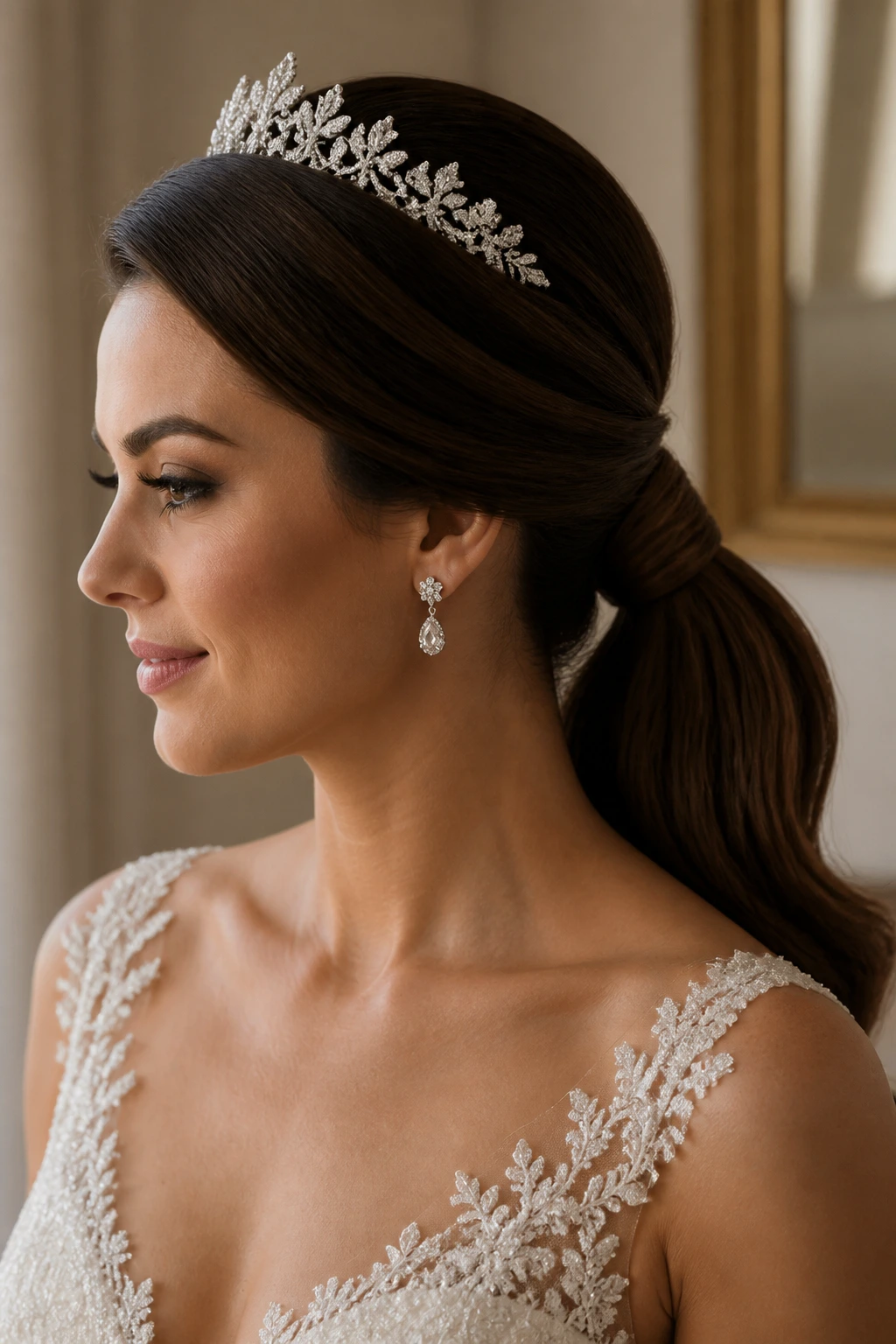
A low ponytail can look more formal than a bun if the base is wrapped cleanly and the crown is smooth. That’s the secret most people miss.
The hair at the top should be polished and close to the head, with the tiara sitting just above the ponytail’s start. Wrap a small section of hair around the elastic so the base disappears. If the ponytail is straight, keep the ends lightly beveled. If it’s curled, let the shape stay soft through the tail so the style doesn’t feel too sharp.
This works especially well when the dress has a strong back detail. A ponytail keeps the neck open and shows the gown off. It also gives the tiara a tidy frame, since the eye goes from the headpiece down the smooth crown to the ponytail’s flow.
A little lift at the front helps, but not too much. The whole charm is the clean line.
19. Bubble Ponytail with a Slim Tiara
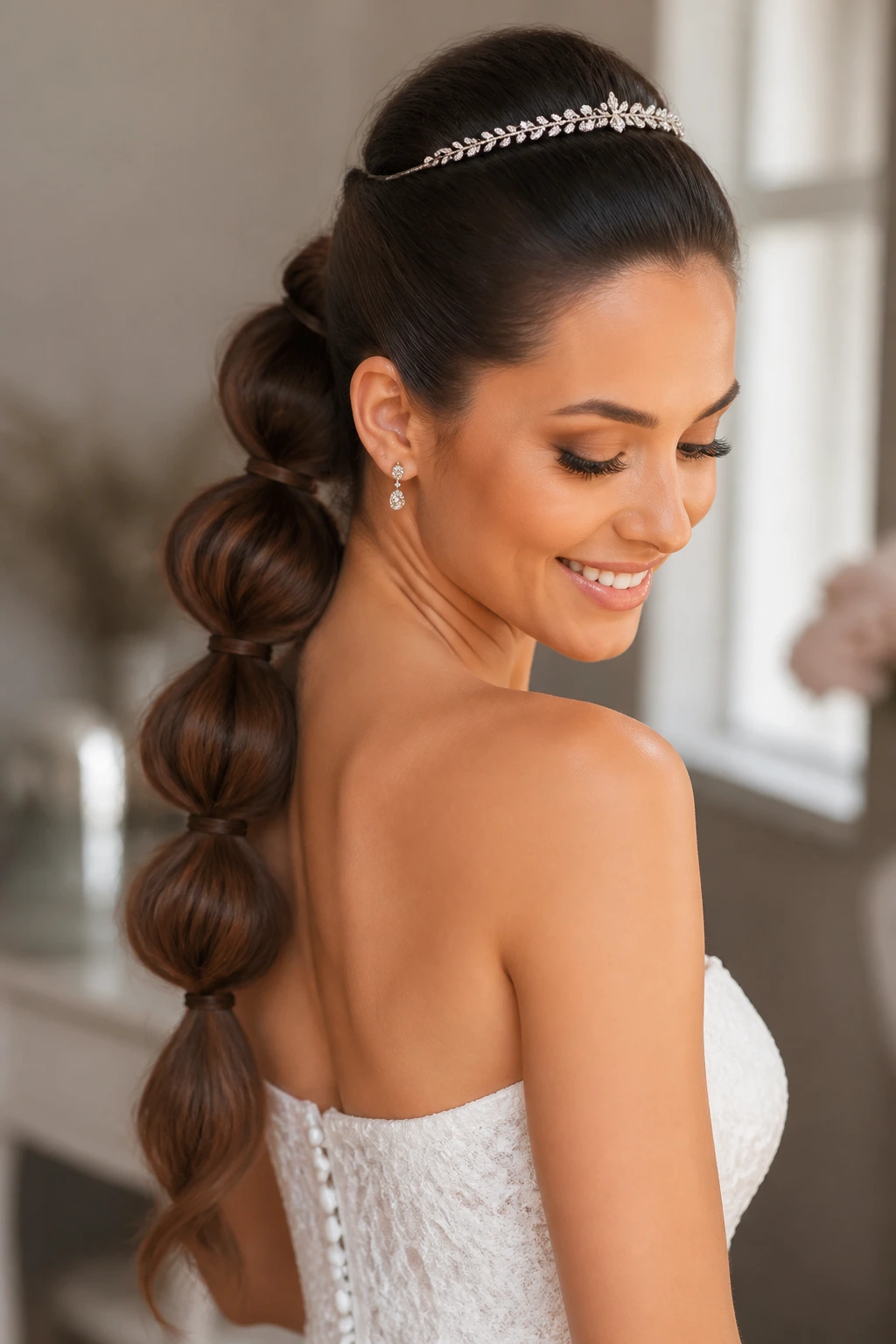
What makes a bubble ponytail feel bridal instead of playful? The answer is in the crown and the spacing.
Keep the top sleek, then create bubbles with small elastics placed about 1½ to 2 inches apart, depending on the length of the ponytail. A slim tiara works best because the ponytail already creates enough shape. A large crown can make the style feel busy. A fine band keeps the eye moving downward through the bubbles instead of stopping at the top.
This is a good option for brides who want something different but still polished. It holds texture well, and it looks strong in profile. The bubbles catch light in a neat way, especially if the hair has been smoothed with a shine serum before styling.
Don’t skip the wrap at the base. A visible elastic at the crown will cheapen the whole look fast. Tiny detail. Big difference.
20. French Twist with a Side Tiara
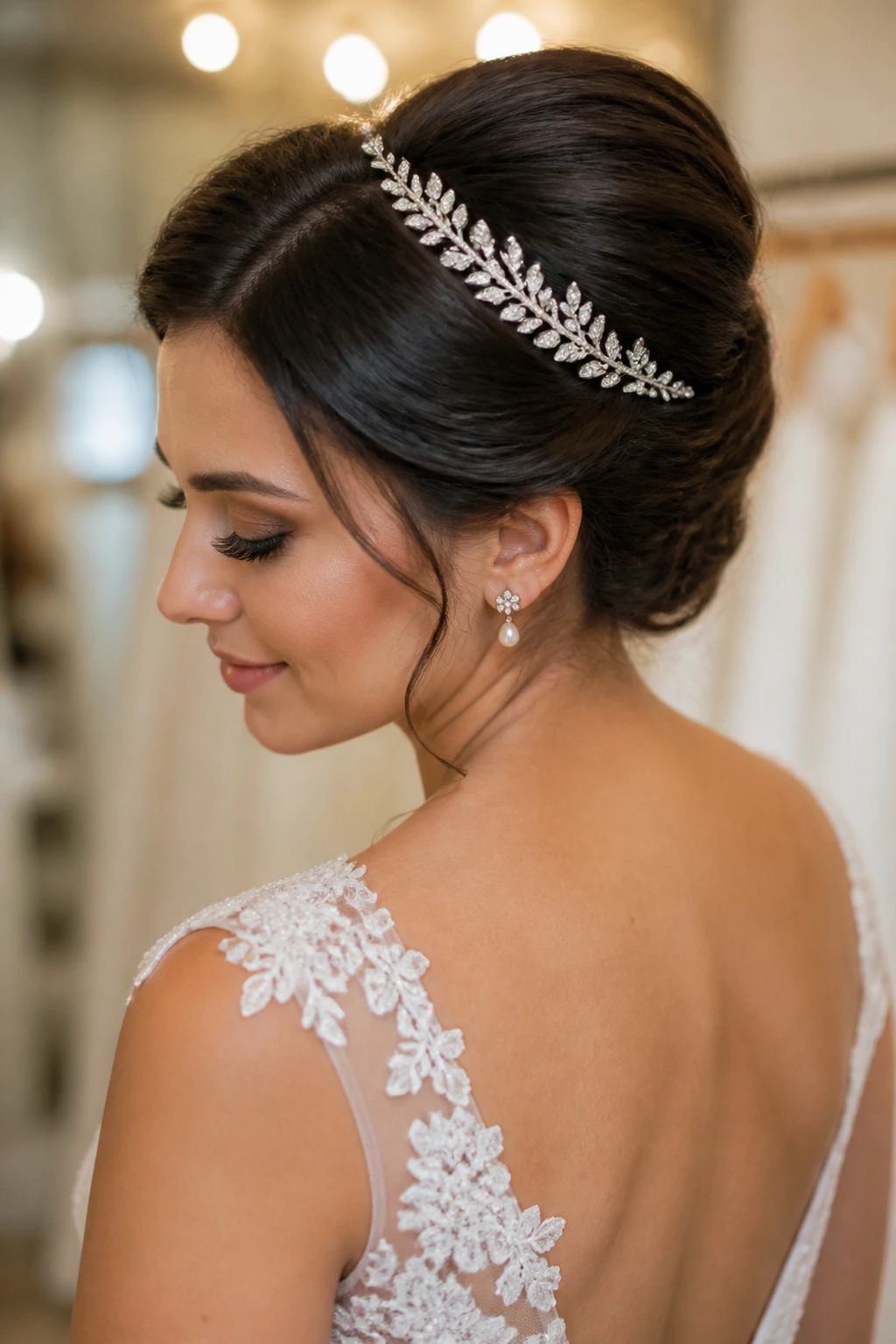
French twists still have a quiet authority about them. They feel formal without trying too hard, and a side tiara gives the twist a little asymmetry that keeps it from looking severe.
The twist should be smooth through the shell and tucked tightly at the back, with the headpiece sitting slightly off center where the curve of the twist begins to roll upward. That placement matters because it lets the tiara follow the hairstyle’s line instead of sitting like a separate object perched on top.
Key Details to Get Right
- Keep the twist compact so the tiara has a clear edge to rest against
- Use pins in more than one direction; one row is rarely enough
- Choose a tiara with moderate height so it doesn’t dwarf the twist
- Leave the top polished, not flat, so the style has shape from the front
This look is strong for evening weddings, formal venues, and dresses with clean tailoring. It has backbone. I like that.
21. Rope Braid Halo with a Floral Tiara
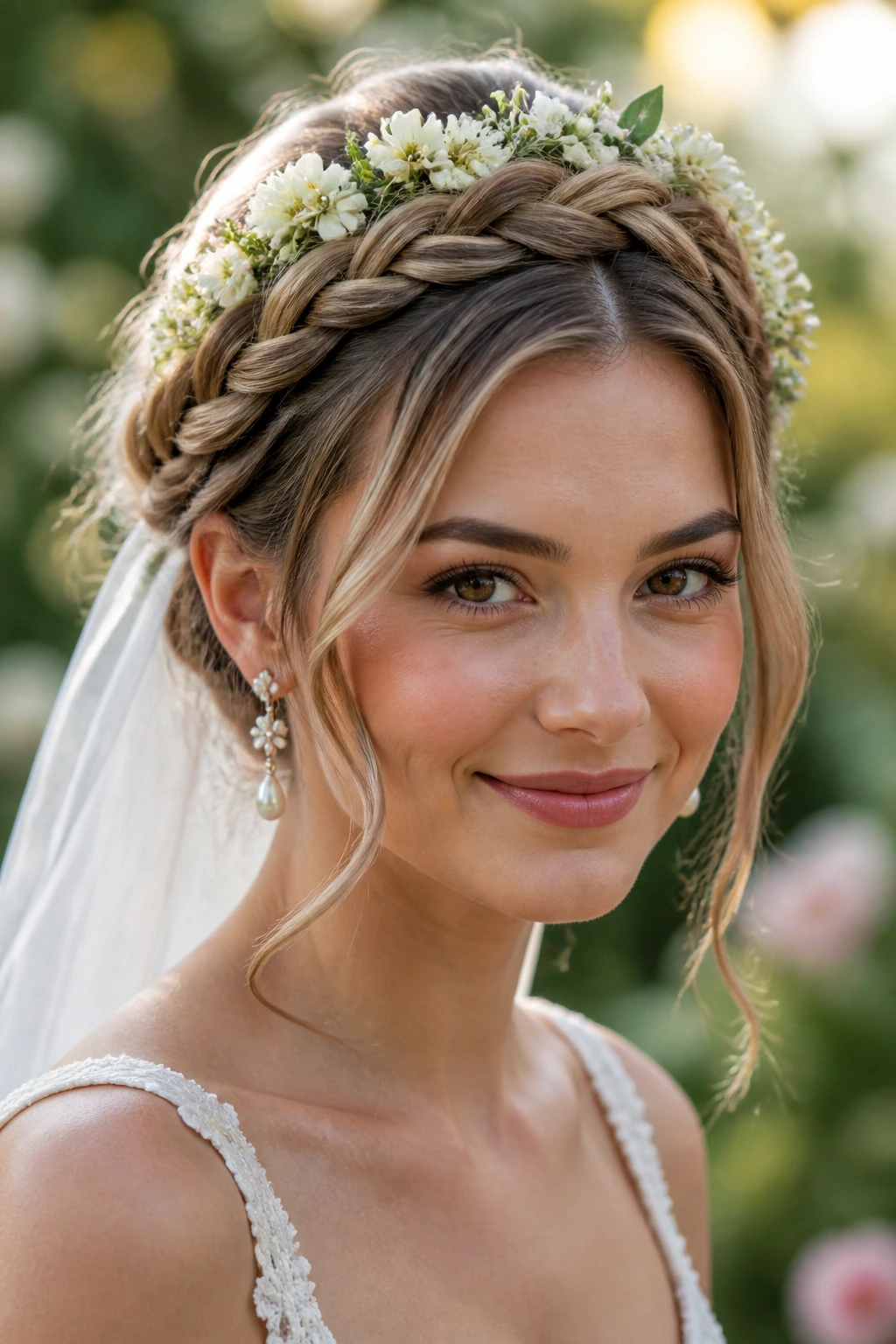
A rope braid halo wraps the head in a way that already feels decorative, so a floral tiara should stay light and woven into the same mood. Heavy stonework would feel off here. Petal shapes, leaf edges, and small pearl details make more sense.
The braid forms a soft ring that keeps the hair away from the face and neck. That ring also gives the tiara a natural path to follow, which helps with placement. If the braid is too tight, the style can look stiff. If it’s too loose, the shape falls apart before the first dance. The middle ground is what you want.
This combination suits outdoor settings, garden settings, and dresses with airy fabrics. It has a gentle feel without turning vague or overly sweet. The braid gives the structure. The tiara gives the polish.
One thing I’d avoid: piling on extra floral pins. The halo and the tiara already do the decorative work. Too much more and the whole head starts to look busy.
22. Tiara and Veil Pairing for the Ceremony-to-Reception Switch
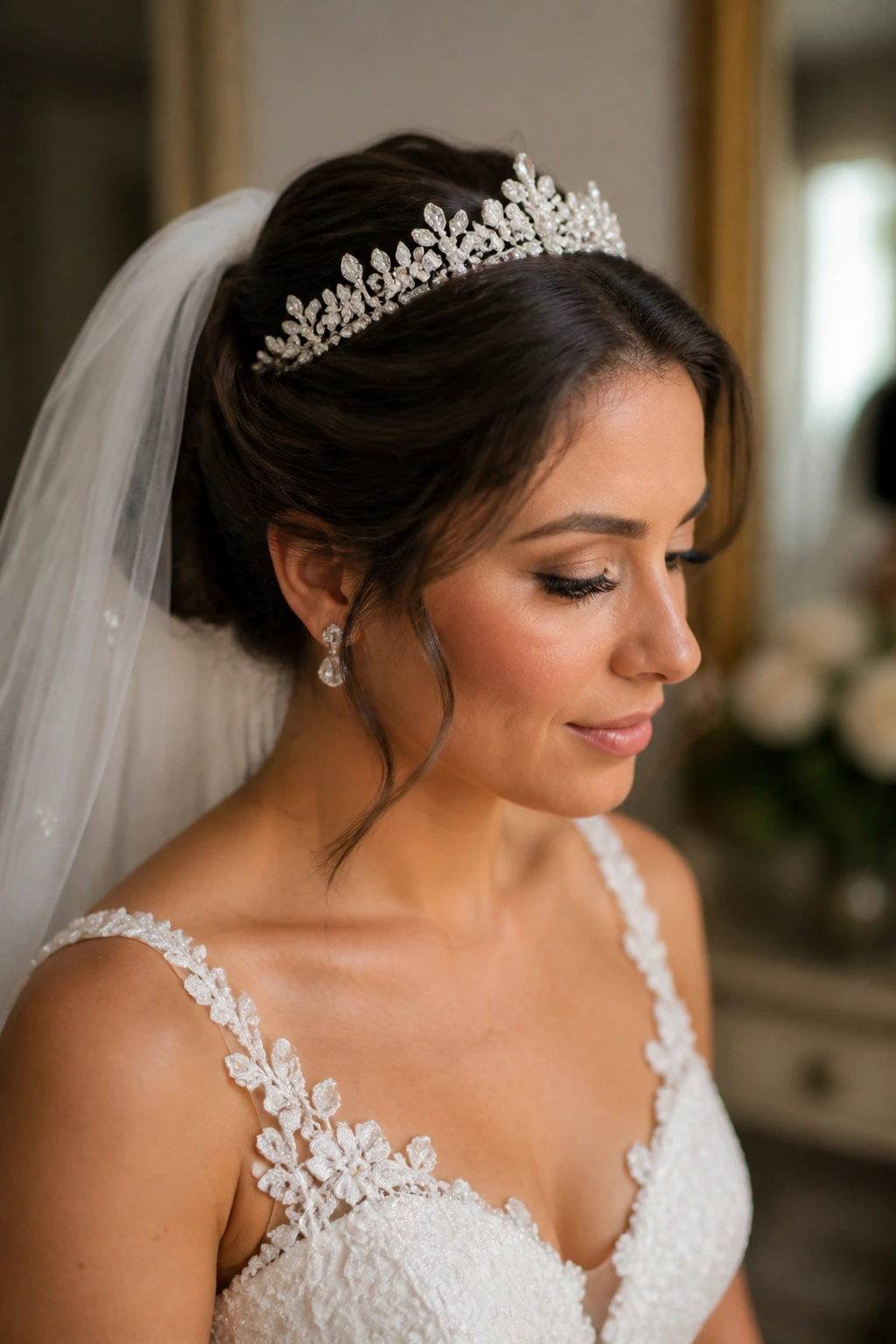
The tiara and veil pairing matters as much as the hairstyle itself. A beautiful updo can still fail if the veil fights the headpiece for the same real estate.
The easiest method is to decide where the tiara sits first, then place the veil comb below it or just behind it depending on the shape. A low veil usually tucks under the back point of a tiara more cleanly than over it. If the veil is very full, the tiara needs enough height to stay visible when the veil is attached. Thin tiaras can disappear under dense tulle fast.
For a ceremony-to-reception switch, ask the stylist to build two anchor points. One set should support the tiara alone. The other should keep the veil stable without pulling the tiara forward. If both pieces hang off the same weak base, the front of the hairstyle starts to sag halfway through photos.
This is not the place to guess. Bring both pieces to the trial. Wear them together. Take photos from the side. That tiny bit of prep saves a lot of fiddling later.
23. Boho Waves with a Floral or Leaf Tiara
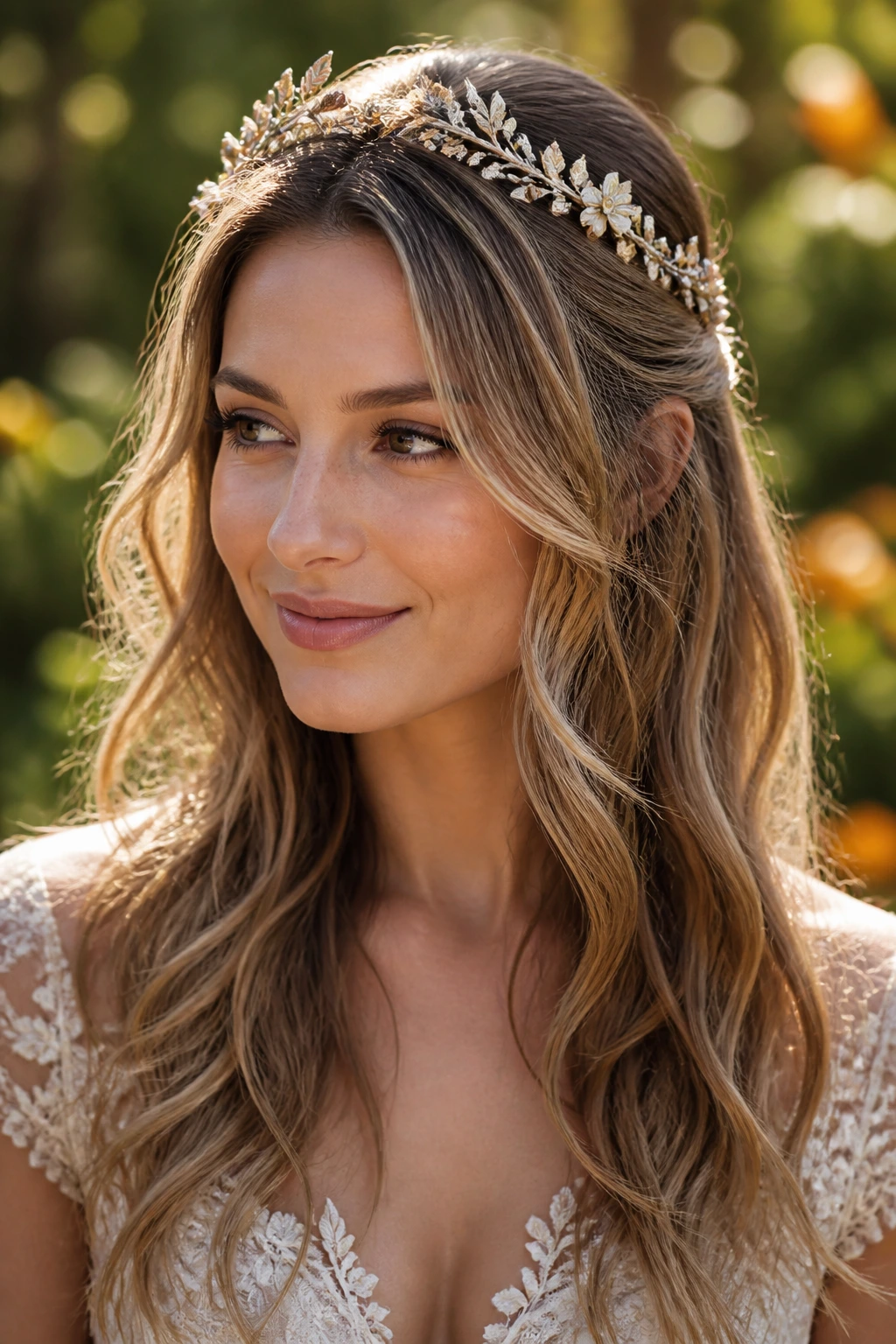
How soft should boho waves be under a floral tiara? Soft enough to feel relaxed, but not so loose that the headpiece disappears into the hair.
The waves should bend, not curl into neat spirals. That looser texture suits leaf-shaped and vine-style tiaras because the whole look shares the same relaxed line. A little frizz around the ends is fine. A lot at the crown is not. Keep the top smoother so the tiara has a surface to sit on, then let the length stay airy.
This is one of the easiest styles to personalize. You can keep the part centered, shift it slightly off center, or pin one side back with a small comb. Each choice changes how the tiara reads in photos. Centered feels balanced. Off-center feels softer. One-side pinning adds a little sweep.
The biggest mistake here is overstyling the waves. Once the texture turns too neat, the boho feeling disappears and the tiara starts to look pasted on. Leave a little looseness. Just enough.
24. Pearl Tiara with a Sleek Center Part
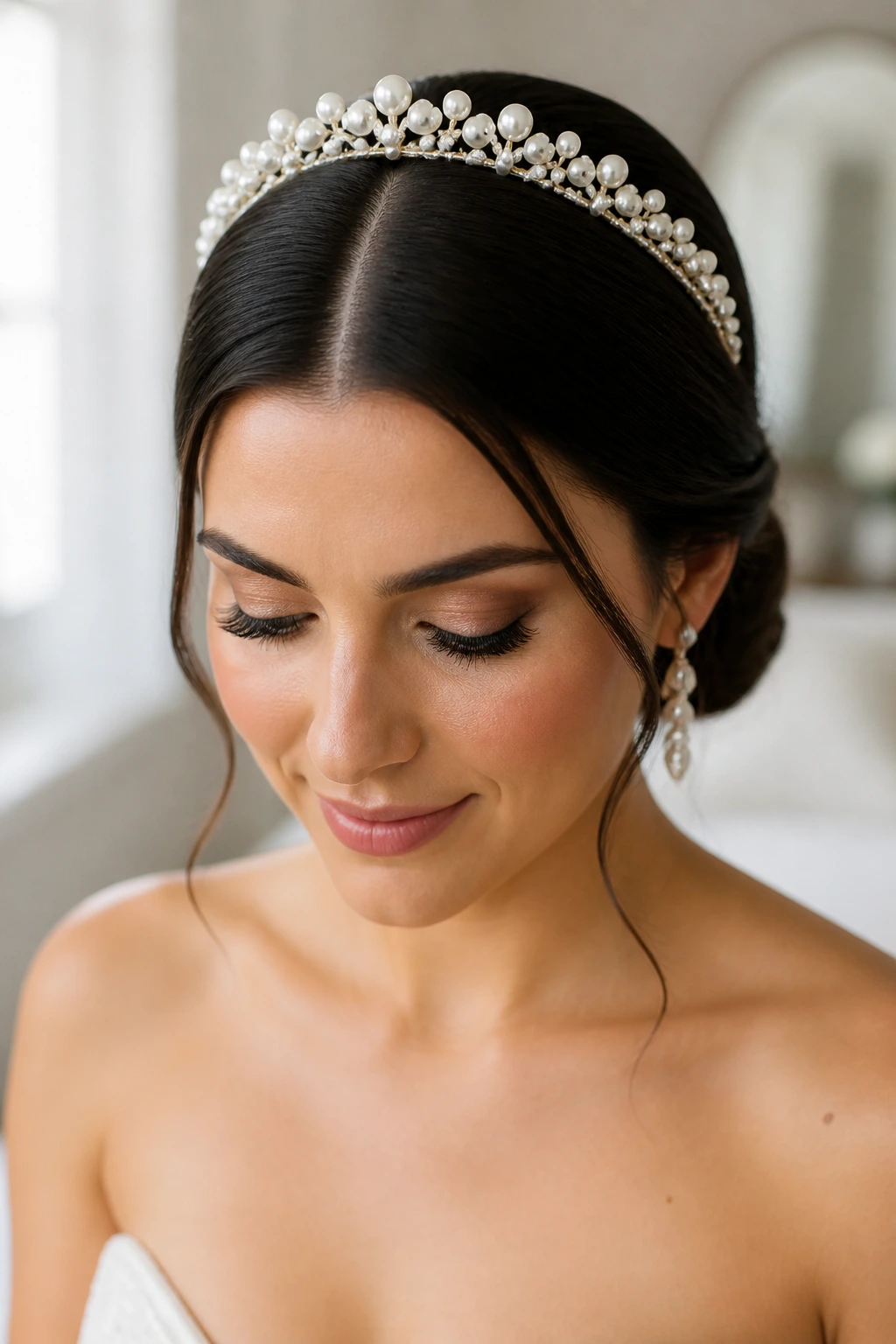
A pearl tiara needs a smooth center part more than it needs extra volume. Pearls already have softness; the hair beneath them should stay calm enough to let that softness show.
This pairing works because the line of the part leads straight into the symmetry of the headpiece. If the hair is too textured, the pearls can look crowded. If the crown is too tall, the tiara can feel detached from the head. A clean root, a low-shine finish, and a centered shape solve most of that.
I’d use this with a low bun, a tucked chignon, or even straight lengths that have been smoothed with a flat iron and rounded slightly at the ends. Pearl tiaras tend to look best when the hair does not compete for attention. They’re about refinement, not noise.
This is a strong choice for brides wearing satin, crepe, or a dress with simple lines. It keeps the whole look controlled, which sounds plain until you see it in a photo. Then it suddenly makes sense.
25. Cathedral-Ready Sculpted Updo with a Heavy Tiara
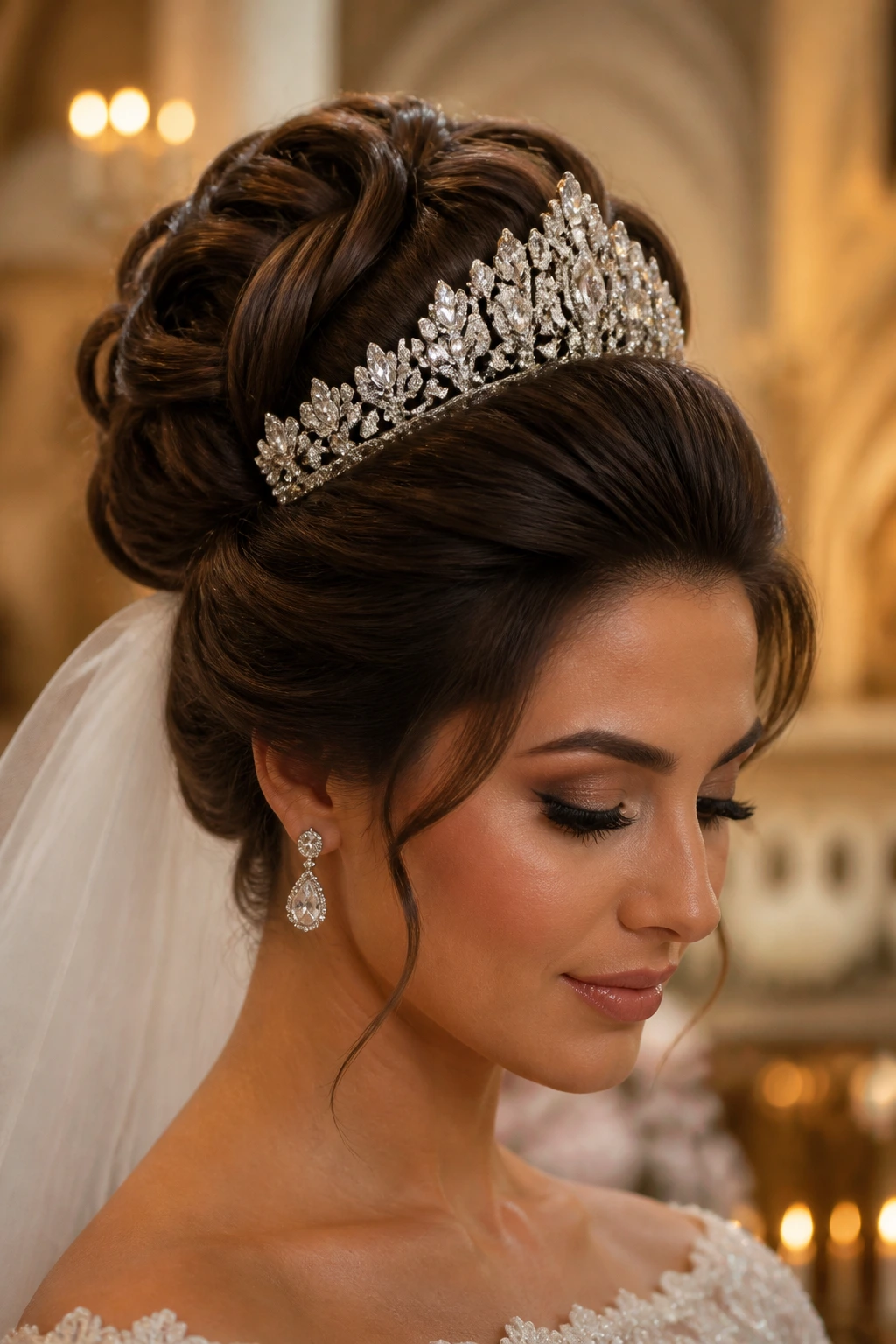
When a tiara has height, weight, and a lot of stonework, the hairstyle beneath it needs to act like a real foundation. A cathedral-ready sculpted updo does that better than anything else on this list.
The updo should be built in layers: a firm base at the crown, hidden anchor pins near the temples, and a back section that holds its shape from every angle. If the hair is fine, a few interior braids or a padded base can make the difference between stable and sagging. If the hair is thick, the job becomes shaping, not padding.
This is the place for a tiara that deserves attention. Tall pieces with more structure need a hairstyle that doesn’t collapse under the weight. The front should look smooth enough to let the headpiece sit proudly, but not so flat that the style feels severe. A soft edge around the temples helps.
It’s a formal look, no question. But formal does not have to mean cold. When the base is done well, the whole thing feels steady, elegant in a plain-spoken way, and ready for close-ups from every side.
Final Thoughts
The best bridal tiara hairstyle is the one that gives the headpiece a stable shape and still looks like you. That sounds simple. It usually takes a few pin adjustments and one honest look in the mirror to get there.
Bring the tiara to the hair trial. Wear the earrings, too. If the veil is part of the outfit, test it with the hairstyle instead of guessing how the pieces will behave later. The front, side, and back views tell you more than a dozen opinions.
One last thing: take a photo before you leave the chair, then take another after you put on the dress. The difference between “fine” and “right” often shows up in that second picture.
