



A bridesmaid with fine, thin hair can do everything right and still watch her bun slide south by dessert. That’s the annoying part. The style looks fine in the mirror, then one hug, one windy step outside, one round of dancing, and the whole thing starts to soften in the wrong places.
Bridesmaid updos for fine thin hair work best when they lean on structure instead of wishful thinking. A little grit helps. Day-old hair, a mist of dry shampoo, a few hidden bobby pins, and one smart anchor point can do more than a gallon of hairspray sprayed from too far away.
Fine hair and thin hair are not quite the same thing, and that distinction matters. Fine hair has a small strand diameter. Thin hair has less density. Some bridesmaids have both, which means the style has to create shape without asking the hair to do a job it cannot do alone.
The good news is that some of the prettiest formal updos are also the most practical for this hair type. Low buns, twisted knots, braided crowns, and tucked rolls can all look fuller than they are, as long as they’re built with a little intention. No drama. No fluff for the sake of fluff.
1. Low Twisted Chignon with a Teased Crown
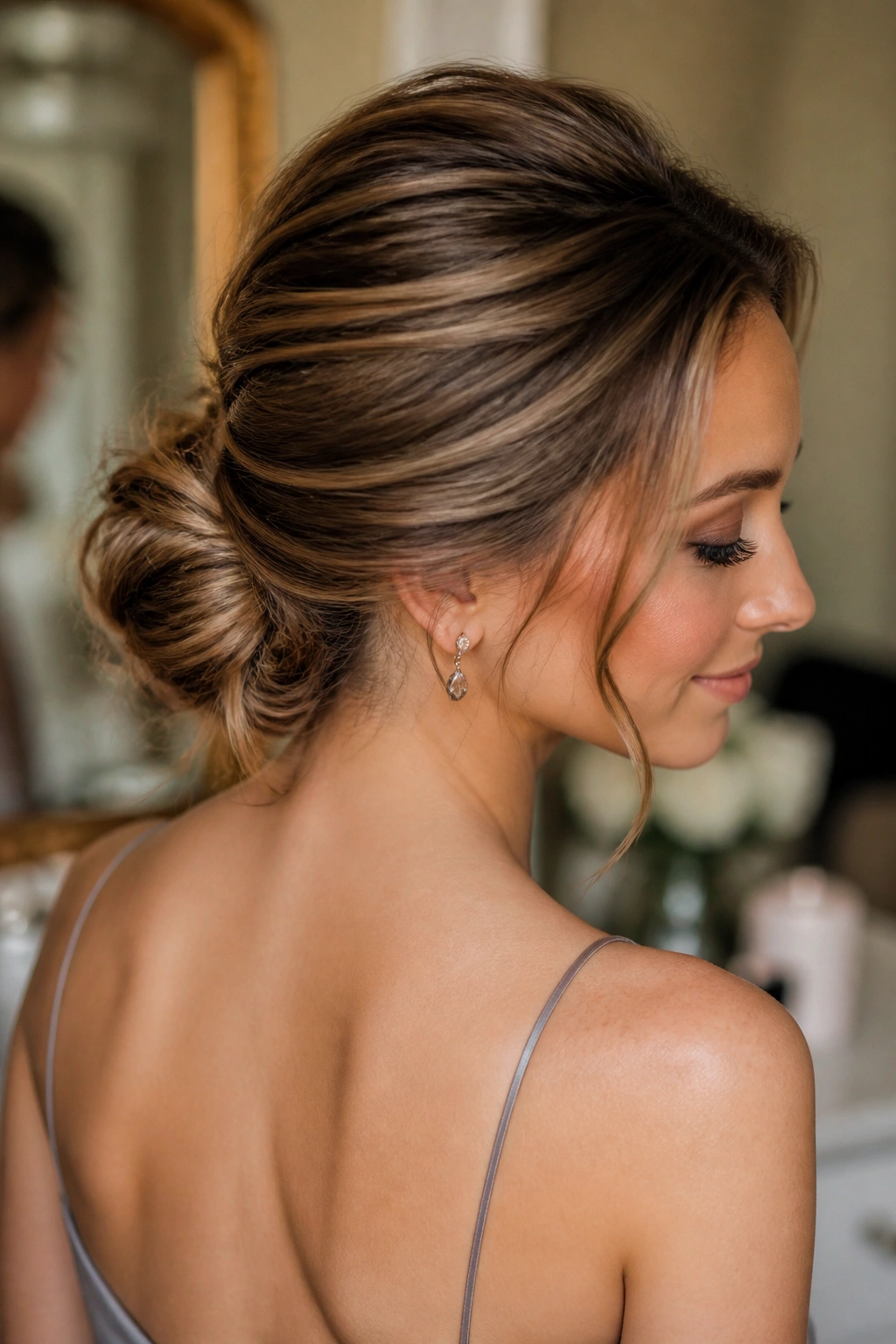
A low twisted chignon is one of those styles that looks more expensive than it is. Fine hair takes to it nicely because the shape stays compact, and compact is your friend when density is low. A little tease at the crown gives the whole style lift without turning it into a helmet.
Why it works on fine hair
The trick is simple: the bun sits low, but the volume lives higher up. That keeps the head shape from looking flat in photos while giving the nape a clean finish. I like this one for bridesmaid groups because it looks calm beside a busy dress or big earrings.
A stylist can create the crown lift with a 1-inch section of hair at the top, lightly backcombed once or twice, then smoothed over. The rest is just two twisted sections pinned into a tight coil. If the hair is slippery, a dusting of volumizing powder at the roots changes the feel fast.
What to ask for
- A low placement at the nape, not mid-head
- Soft twist sections instead of one big roll
- 6 to 10 hidden pins crossed over the base
- A mist of flexible spray, not a crunchy shell
Best for: medium to long hair, especially if the dress neckline is open.
Small warning: don’t let the crown get over-teased. Fine hair looks chic when it has shape, not when it looks swollen.
2. Braided Crown Bun with Hidden Ends

If thin hair tends to slip out of smooth styles, braid it first. That’s the whole logic here, and it’s a good one. A crown braid gives the stylist a built-in grip, which means the bun at the back has something to hold onto instead of floating on top of silky strands.
The look starts with two small braids, usually from the temples or just behind the ears, drawn back toward the nape. Those braids wrap around the head like a soft halo, then disappear into a tucked bun. It reads romantic in photos, but it also behaves well in real life.
I prefer this style for bridesmaids who want softness around the face without loose hair at the shoulders. It keeps the shape tidy. It also survives better than you’d think if the wedding runs long and the dance floor gets crowded.
One detail matters more than people expect: keep the braids fairly small. A chunky braid can eat up too much hair on a fine head and make the rest look sparse. Small braids make the whole style look fuller.
3. Sleek French Twist with a Fine Side Part
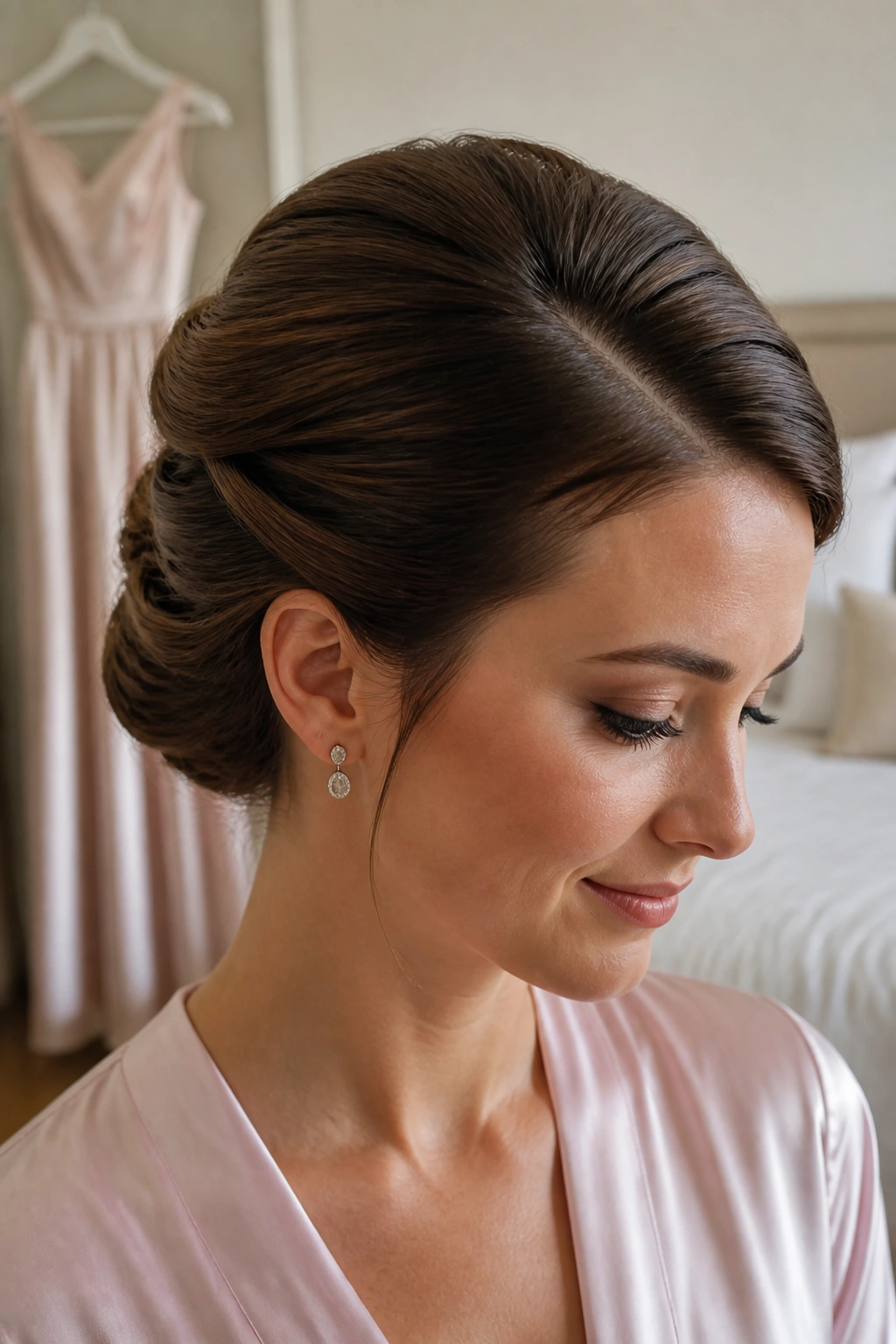
A French twist can look severe on thick hair. On fine hair, though, it can look sharp, polished, and clean in a way that photographs well with satin or silk dresses. The side part softens it immediately. A center part can feel too strict here; a fine side part gives the face a little bend and keeps the top from lying too flat.
This is the style I’d choose for a bridesmaid who wants something grown-up. Not stiff. Grown-up. There’s a difference. The twist should sit close to the head, then fold upward into a neat vertical line with the ends hidden under the roll.
Use a few U-pins along the seam rather than one giant clip. That makes the twist easier to anchor without crushing the shape. A light mist of shine spray on the surface is enough. No need to drown it.
It’s a good match for high necklines, square necks, and dresses with clean tailoring. If the gown already has a lot going on, this keeps the hair from competing with it.
4. Bubble Ponytail Folded Into a Knot
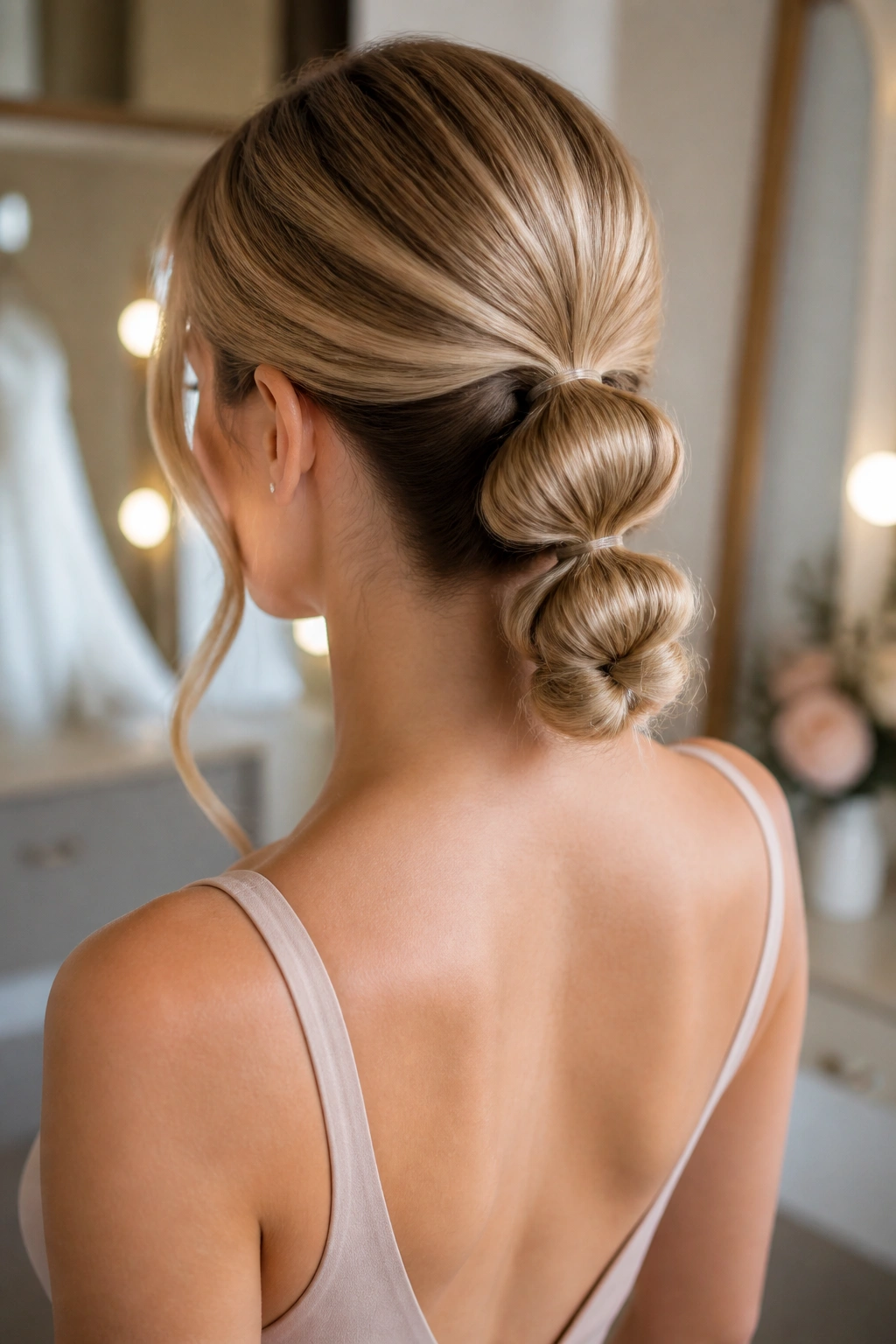
Why does a bubble ponytail work so well on fine hair? Because every elastic gives you a grip point. That’s the whole trick. Fine hair can look flat when it’s just gathered once, but a series of small sections creates shape all the way down the shaft.
Start with a low ponytail, then place clear elastics every 1.5 to 2 inches. Gently pull each section outward until it rounds into a soft bubble. After that, fold the length back up into a loose knot at the nape and pin the tail under itself. The bubbles give texture. The knot makes it formal.
The part that keeps it from collapsing
Use a texturizing spray before the elastics go in, not after. Hair that’s already slick is harder to shape once it’s tied. A little roughness in the strand makes each bubble hold its form instead of sliding into the next one.
This style has a nice bit of movement, which helps if the bridesmaids are wearing softer chiffon dresses or if the bouquet photos need something a little less stiff. It feels modern without trying too hard.
5. Gibson Tuck with Pearl Pins

The Gibson tuck is one of my favorite answers for hair that needs to look full but not bulky. It has that old-school softness bridesmaids often want, and it does not ask for much length. The hair rolls inward at the nape, then tucks back on itself until the ends disappear.
Fine hair actually benefits from the smooth curve here. You’re not fighting for height. You’re building a clean shape and letting the tuck do the visual work. A pearl pin, or a line of two or three tiny pearl pins, finishes it without making the style feel precious.
I like this look when the dresses are simple and the jewelry is light. It has a quiet kind of polish. The roll should look snug, almost like folded ribbon, not loose and sleepy.
One thing to watch: the top section needs a little lift before it’s tucked. Just a little. If it lies too flat, the whole style sinks toward the neck and loses its line.
6. Side-Swept Braided Updo with Soft Tendrils

A side-swept braided updo is one of the easiest ways to make fine hair look fuller without faking anything. The braid gives texture, the side sweep adds asymmetry, and the tendrils keep the front from feeling too severe. That combination works.
Why it’s a bridesmaid favorite
The braid should start on the heavier side of the part and travel toward the opposite nape. Then it gets tucked into a low knot or twisted bun. If the braid is pancaked a little—meaning the outer loops are gently widened with your fingers—it looks thicker right away.
Leave just two tendrils around the face. No more. Fine hair can get wispy fast, and too many loose pieces start to look accidental. Two clean strands, curled lightly with a 1-inch iron, are enough.
- Best with off-the-shoulder dresses
- Looks good with drop earrings
- Needs 6 to 8 pins near the nape
- Holds better if the braid is started on day-old hair
My take: this is one of the safest formal looks for bridesmaids with soft hair that doesn’t hold big volume for long.
7. Knotted Low Bun with Texture at the Roots

This style is a little more modern than the usual bridesmaid bun, and I like that. It starts with texture at the roots, then uses two or three small knots to build the bun instead of forcing one giant shape. That matters for fine hair, because smaller parts are easier to control.
The texture should stay at the crown and upper sides. The bun itself can be neat, but not glossy-flat. That mix keeps the look from turning dull in photos. A tiny bit of root lift makes the whole head shape feel more alive.
What sells this one is the way the knots overlap. They make the bun look fuller than it is, almost like the hair has more density than anyone would guess. It is a good option for bridesmaids who want something soft but not romantic in the usual curled-up way.
A light mist of spray between each knot helps. So does pinning each knot separately instead of clamping the whole thing at once. Small moves. Better hold.
8. Double-Twist Halo into a Nape Coil
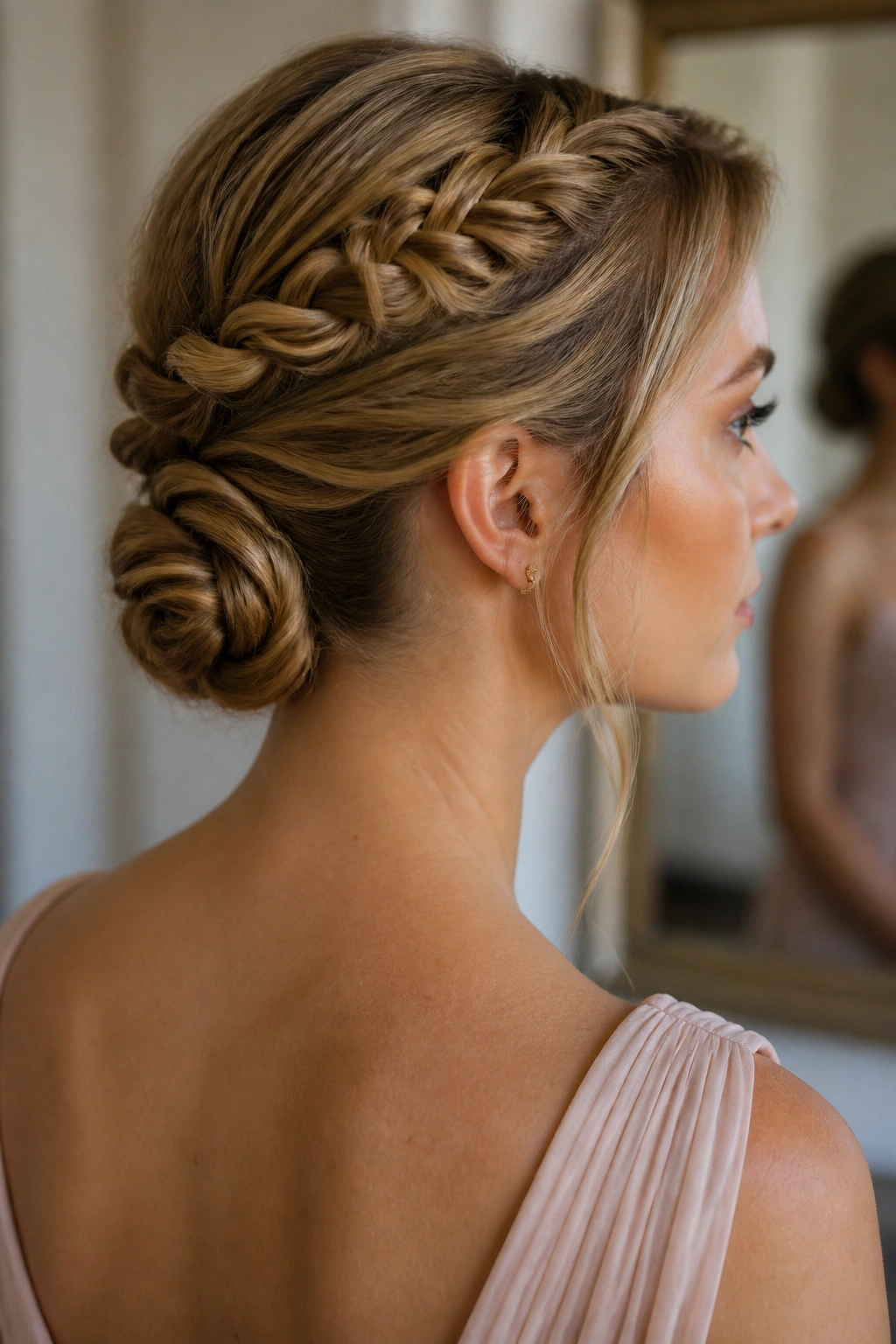
Unlike a full braid crown, the double-twist halo leaves more hair available for the bun itself, which is smart if the hair is thin. Two twists run from either side of the part, trace the head like a narrow halo, and feed into a low coil at the back.
The result is cleaner than it sounds. The twists sit close to the scalp and act almost like rails guiding the eye toward the bun. That makes the nape look fuller, even when there isn’t much hair to work with.
This one suits bridesmaids wearing dresses with open backs or narrow straps because it keeps the neckline clear. It also stays neat in humidity better than styles that depend on loose curl volume.
If you want a softer finish, pull one tiny section at the temples after the twist is pinned. Not a lot. Just enough to remove the hard line. Too much and you lose the shape.
9. Pin-Loop Bun with a Deep Side Part
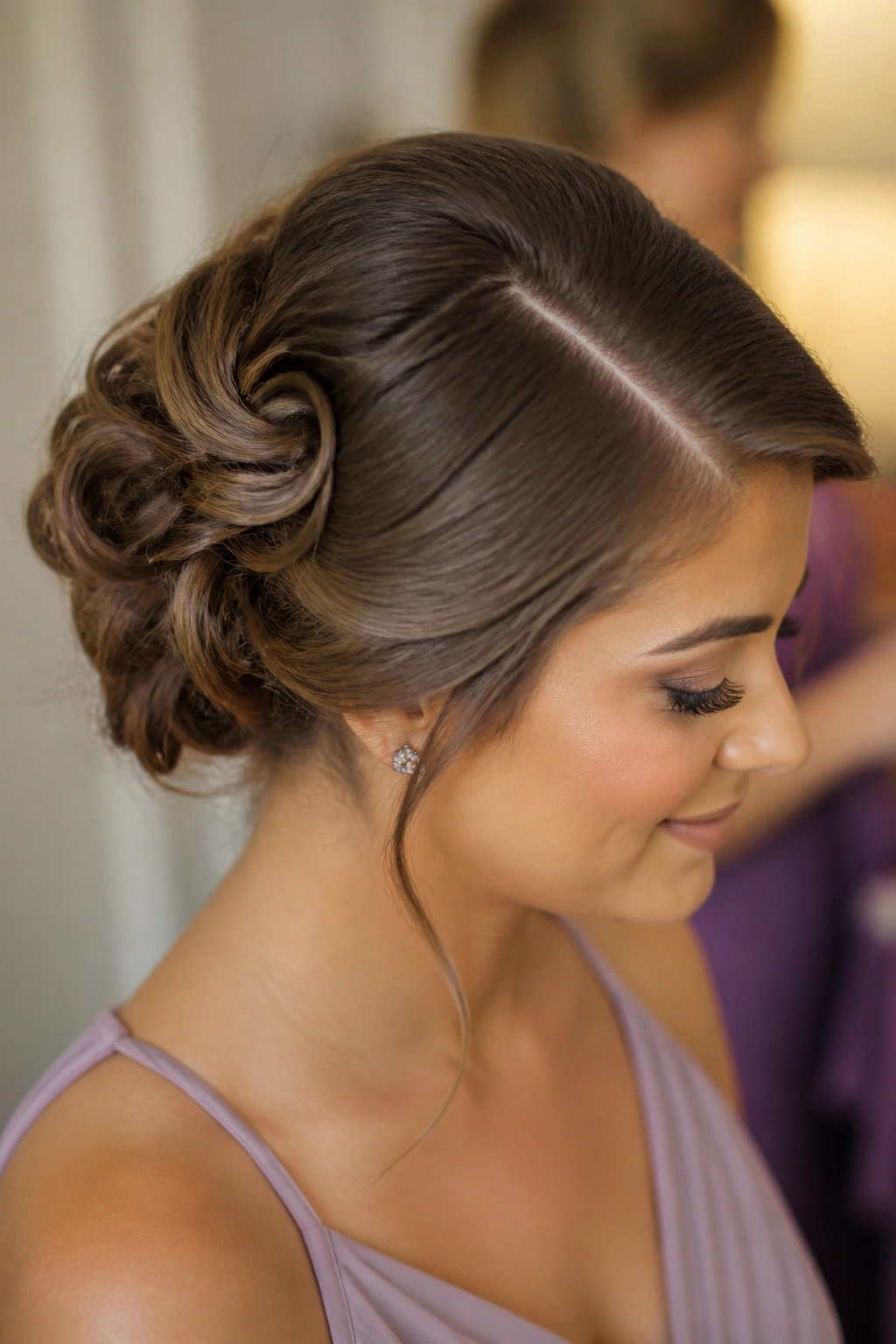
Can a bun look full when most of it is actually hidden pins and loops? Yes, and this is the proof. A pin-loop bun builds itself in layers: a deep side part up top, a series of small loops at the nape, and a pinned core that stays tucked under the outer shell.
How to get the loops right
The loops should be wide enough to show shape, but not so loose that they sag. Think of each one as a folded ribbon. If the hair is fine, those loops create the visual bulk that the hair itself does not have.
A deep side part matters here because it gives the style a stronger front edge. Without it, the bun can look too even and a little flat. With it, the hair feels intentional, and the sweep across the forehead helps balance a low profile at the back.
This is a good choice for bridesmaids who want a sleek face shape but refuse to wear their hair pulled tight. It has control, yet it still breathes a little.
10. Rolled Vintage Updo with Face-Framing Pieces

Some styles feel made for old hotel ballrooms and candlelit dinners. This is one of them. A rolled vintage updo gives fine hair a smooth, rounded shape, and the face-framing pieces keep it from feeling locked in place.
I like the roll to sit low and slightly off-center. That tiny shift keeps the style from becoming too formal in a stiff way. The front pieces can be curled once with a medium iron, then brushed out just enough to leave a soft bend.
The important part is the roll itself. It should look padded, even if there’s no padding at all. That can be done by rolling the hair over itself in one direction, then pinning the edge underneath so the surface stays clean.
This one works especially well when the dress has lace or a vintage cut. It nods to the gown instead of competing with it. And yes, pearl earrings look right here. They just do.
11. Dutch-Braid Bun with a Padded Base
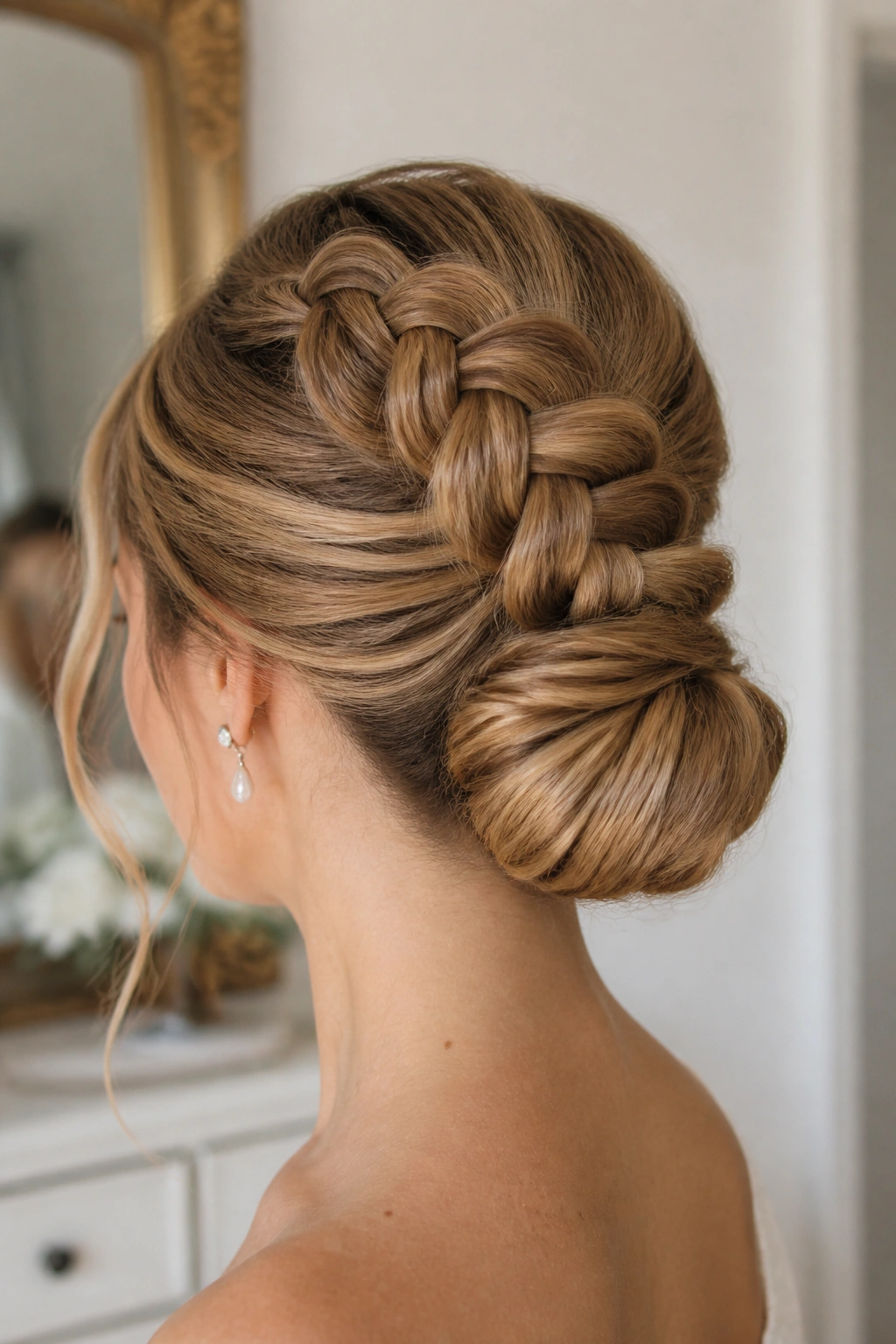
A Dutch braid is one of the best ways to make fine hair look thicker because the braid sits on top of the section instead of disappearing into it. Add a small padded base under the bun, and the whole shape gains height without needing extra hair.
What makes it different
The braid should start near the crown and move back toward the nape. Once it’s secured, the tail gets wrapped around a soft bun base or a small donut. That base is doing more work than people think. It gives the bun something solid to rest on, which matters when the hair is thin.
- Best for bridesmaids with medium-length hair
- Works well with a center or side part
- Needs 8 to 12 pins around the bun base
- Looks fuller if the braid is gently widened after it’s secured
The style reads polished from every angle. From the front, you get the braid. From the back, you get the bun. From the side, you get shape. It’s a nice all-rounder.
12. Soft French Twist with Loose Ends
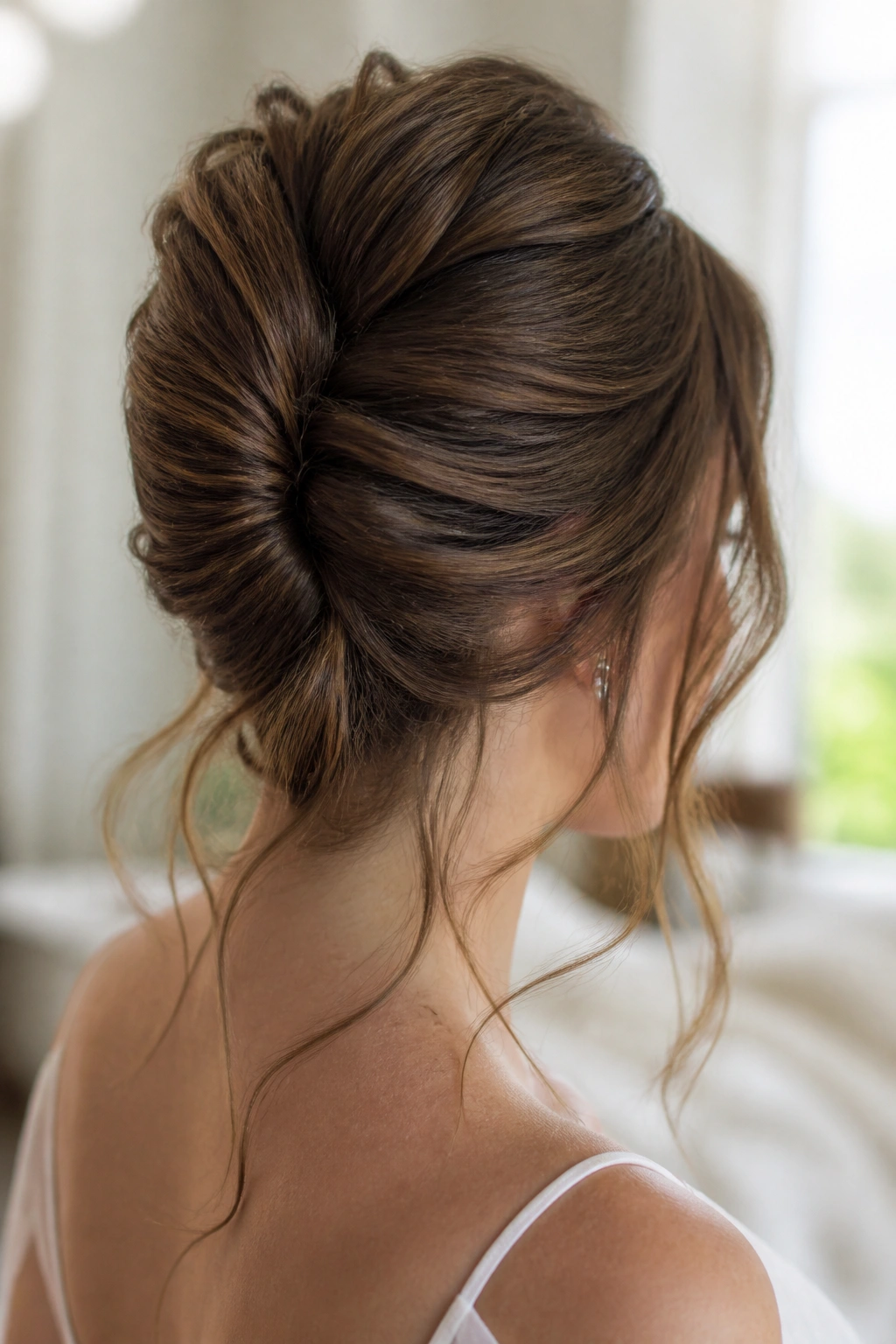
A soft French twist is cleaner than a messy bun and less severe than a classic twist. That middle ground is exactly why it works for fine thin hair. The hair is pulled up and inward, but a few small ends are left soft at the edges so the style does not feel overworked.
The line of the twist should be smooth, yet not shiny to the point of looking wet. I prefer a satin finish here. It looks better in natural light and it hides the fact that the style is propped up with pins and a bit of teasing at the back.
This one is especially good when the bridesmaids’ dresses are all the same color and shape. The hair needs to behave, not shout. That makes the whole bridal party look cleaner in photos.
A little detail goes a long way: tuck the ends under in the same direction every time. Mixed directions create little bumps that show up more than you’d expect on fine hair.
13. Rope-Braid Crown into a Low Coil

If you want texture without a lot of fuss, rope braids are underrated. They are smoother than a regular three-strand braid, and on fine hair that can be a blessing. The twist pattern gives the hair a tighter, more controlled look while still adding visible structure.
Start by dividing each side into two sections, twist them in one direction, then wrap them around each other in the opposite direction. That opposite motion is what makes the rope braid hold. Bring both sides back toward the nape and coil the ends into a low bun.
Why it clings so well
The twisted strands lock together better than loose waves do. That means less slipping, which is useful if the hair is soft and silky. A little spray at the ends before twisting can make the braid easier to manage, but don’t soak it.
This style fits bridesmaid hair that needs to stay neat for hours without looking severe. It has a little movement, a little gloss, and enough grip to survive a long evening.
14. Sculpted Side Bun with a Hidden Cushion

A sculpted side bun is a smart answer for fine hair because the side placement gives the illusion of more width. Put the bun low and slightly behind one ear, then support it with a hidden cushion or small bun form beneath the outer hair.
That hidden support matters. A side bun without help can collapse into a slim knot. A cushioned one keeps its curve and gives the jawline a softer frame. It’s also a nice match for one-shoulder dresses or necklines that already lean to one side.
What I like most is how deliberate it looks. The style has shape from the front, not only the back. That makes it photograph well when the bridal party is angled in rows or standing in profile.
If the hairline at the temple is a little sparse, leave a narrow front section out and tuck it behind the ear with one pin. It relaxes the whole look without making it sloppy.
15. Mini Braid Cluster into a Braided Bun
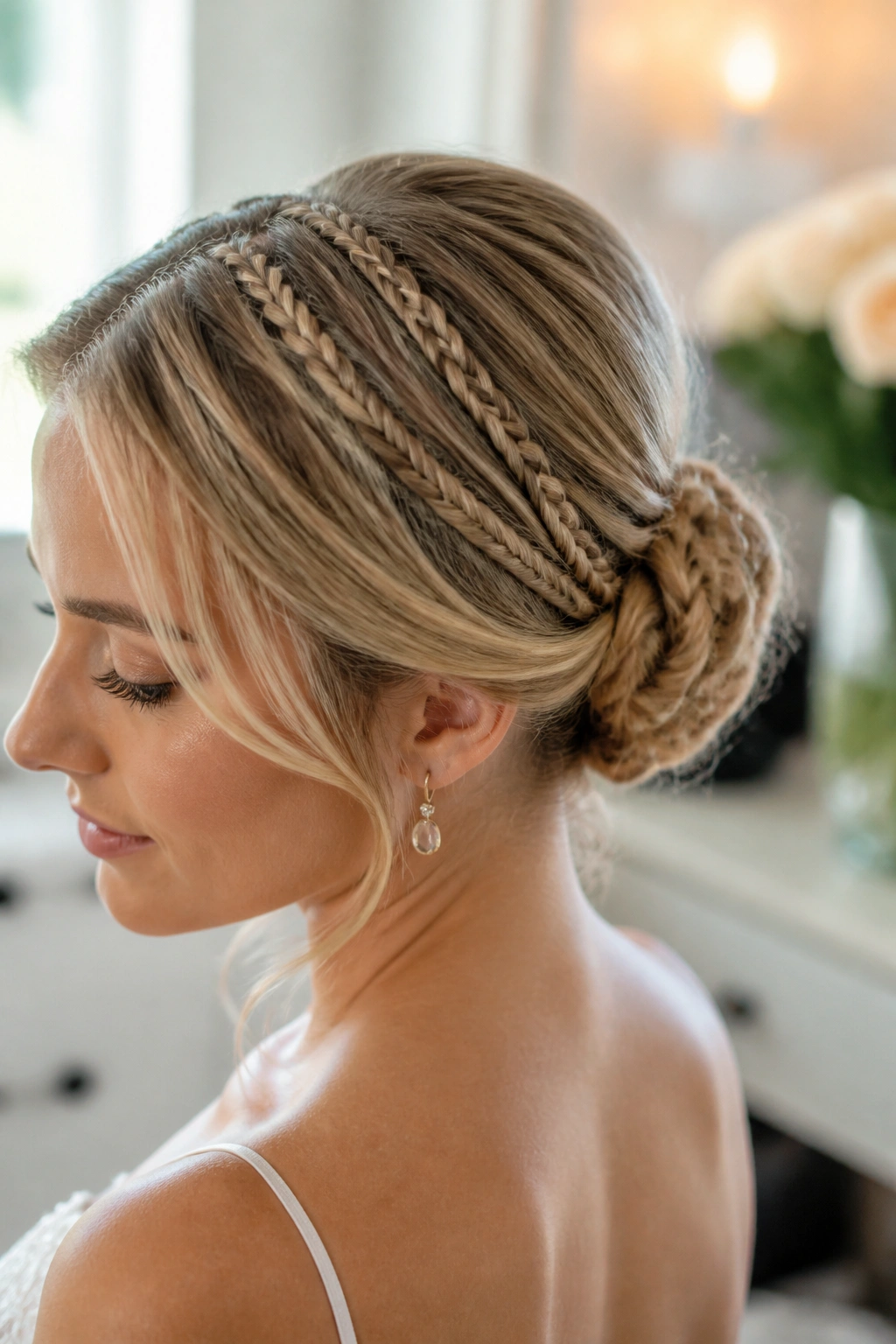
What happens if the hair doesn’t have enough density for one impressive braid? Make three or four tiny ones instead. That’s the whole idea behind a mini braid cluster, and it is a clever fix for bridesmaid hair that looks better with texture than with height.
The braids can come from the crown, the sides, or the nape. Once they’re secured, gather them into a braided bun and pin each braid end separately. The separate pinning keeps the bun from unraveling at the edges, which fine hair tends to do if everything is bundled too fast.
A small detail that helps
Braid sections should be around half an inch to three-quarters of an inch wide. Wider sections make the braid look thin and sad. Smaller sections make the style feel intentional and fuller than it actually is.
This one is pretty adaptable. It works for bridesmaids with layered hair, and it can be dressed up with tiny metallic pins or a narrow comb. It does not need much else.
16. Wrapped Ponytail Chignon with a Hairnet
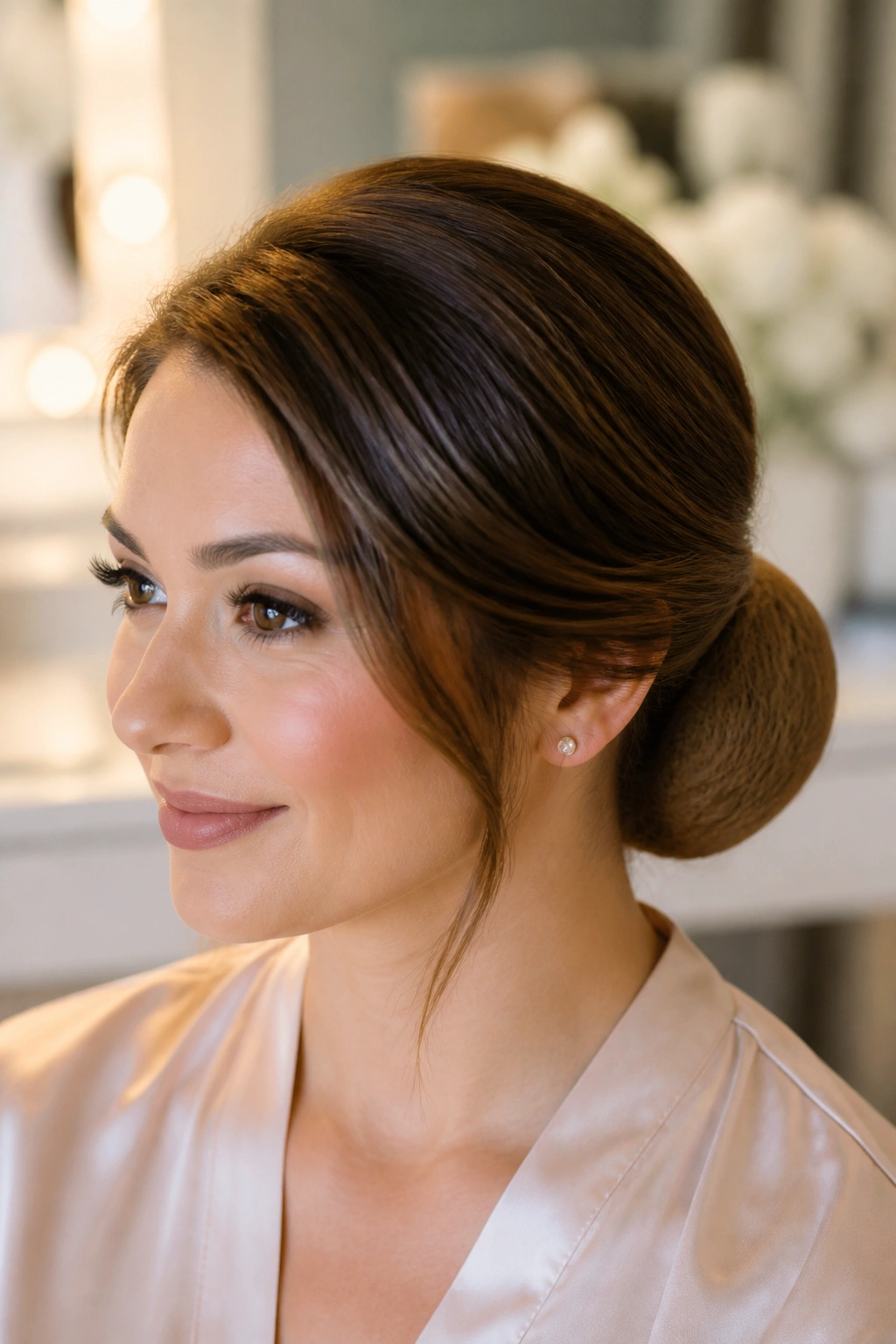
A hairnet sounds old-fashioned until you use one on fine hair and watch the style stay in place. Then it sounds smart. A wrapped ponytail chignon hides the anchor point, and the hairnet holds the shape without adding bulk where you do not want it.
The ponytail sits low, the length wraps around the base, and the hairnet disappears under the coil once it’s matched to the hair color. That last part matters. A black net on blonde hair is not subtle. A net that matches the roots is nearly invisible.
The bun itself can be smooth or lightly textured, but the outer wrap should stay clean. That gives the style a finished edge. I’d use this for bridesmaids who need a no-nonsense look that survives heat, dancing, and a dozen hugs from relatives.
A good hairnet is not a sign of weakness. It is a sign you want the style to stay where it belongs.
17. Messy Knot with a Smooth Crown

This is the style I reach for when the dress is doing a lot of the talking. A messy knot on fine hair only works when the crown stays smooth and controlled. If the whole head is teased out, the look falls apart fast. If the top is neat and the knot is loosely folded, the contrast looks deliberate.
The knot should sit low, almost at the crease of the neck. Then the stylist can pull a few pieces out of the coil to create a looser shape. Not a nest. A knot. There’s a difference, and people can spot it immediately in photos.
It works well for bridesmaids who want a softer look than a French twist but do not want curls hanging everywhere. The hair ends up looking relaxed, yet not lazy.
A tiny spritz of texture spray at the ends before folding them in helps the knot hold. Fine hair without texture can unspool fast, so that one step saves a lot of pinning later.
18. Faux Bob Updo with Tucked Ends

A faux bob can be a lifesaver when the hair is too short or too fine for a full bun to feel secure. The ends get curled under, pinned close to the neck, and hidden so the whole shape reads as a tucked updo from the outside.
I like this one for shoulder-length hair especially. It gives the illusion of more styling than there really is, which sounds odd until you see it in motion. The neck stays clear, the shoulders stay visible, and the style still feels formal.
The front can be parted in the center or slightly off-center. Both work. What matters is that the lower section is pinned in small increments so the bob shape does not sag at the back.
If the wedding has a vintage angle, this style fits naturally. If it does not, it still works because the finish is clean. No one needs to know the ends are tucked like a secret.
19. Twisted Half-Up Folded Bun

Not every bridesmaid with fine thin hair needs a full updo, and I’m going to say that plainly. Sometimes the smartest move is a twisted half-up folded bun: hair is lifted off the face and upper shoulders, then tucked into a small bun at the back while the rest stays loose and controlled.
The half-up part gives the illusion of volume because the top section is pulled together in a compact shape. The lower length remains free, which is useful if the hair is too delicate to support a full crown of pins. It also gives the style a softer finish.
This works best on medium-length hair with a little bend or wave. Straight hair can still do it, but a few loose curls at the ends help the style feel fuller and less rigid.
It’s a good compromise when the bridal party wants some matching structure but not identical heavy buns on every head. Which, honestly, is a relief for everyone involved.
20. Flower-Pin Low Bun
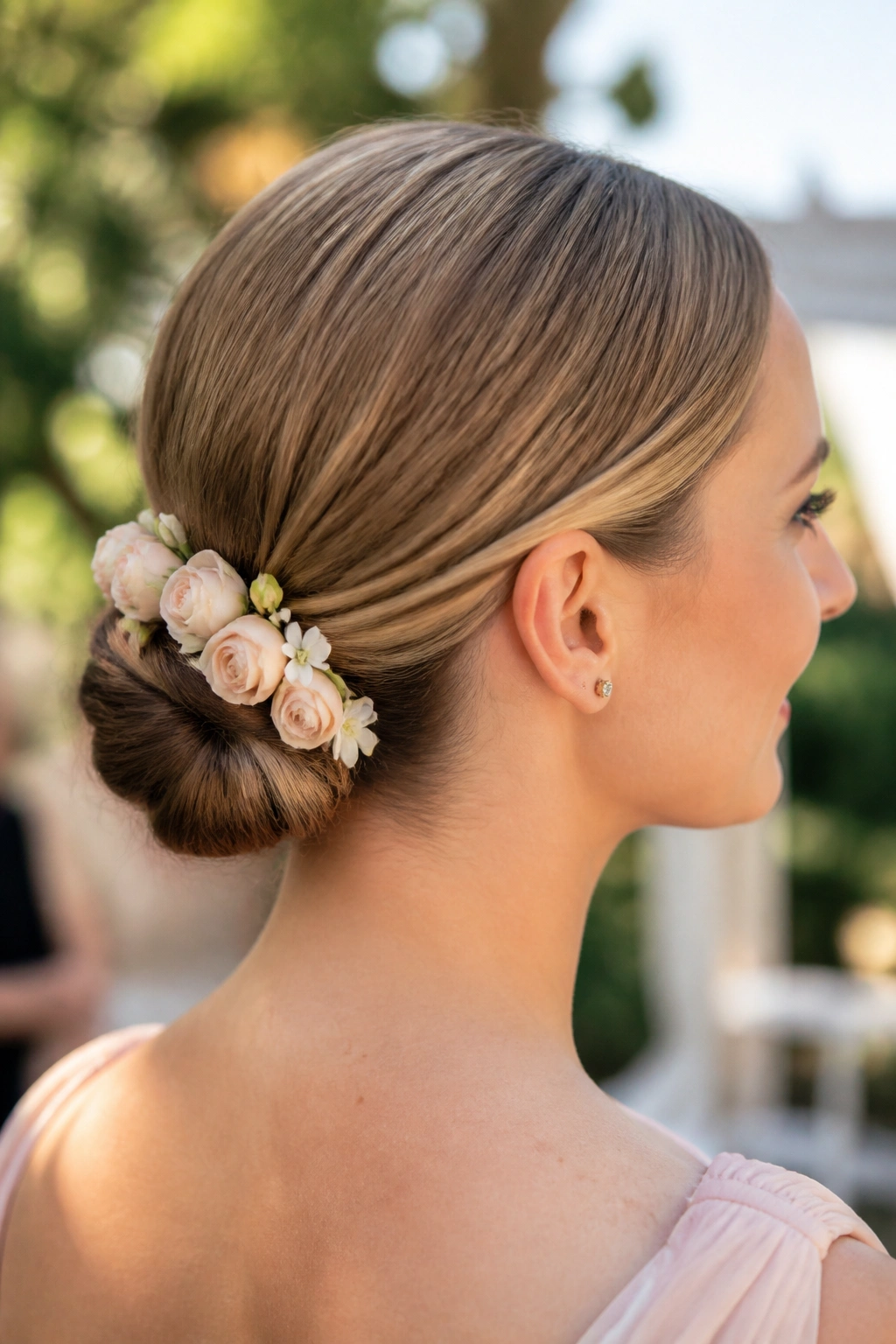
A flower-pin low bun is a smart way to bring in wedding-day detail without asking the hair itself to do more work. Tiny blooms, silk petals, or scattered floral pins can make a simple bun feel intentional, even when the bun is built on fine hair.
The bun should stay low and compact. Then the flowers sit on one side or trace the curve of the bun like a small arc. Don’t spread them everywhere. A few well-placed accents look elegant; too many start to look like a craft project.
Choosing the right flowers
- Small blossoms work better than large heads
- Fresh flowers should be wired before pinning
- Silk flowers are easier for long events
- Tiny green sprigs can soften a tight bun fast
This style is lovely for outdoor ceremonies and garden settings, but it can also work indoors if the gown is simple. The floral detail does a lot of the visual lifting, which is handy when the hair itself is not naturally full.
21. Clip-In Supported Volumized Bun

Sometimes the right answer is not pretending the hair is thicker than it is. Sometimes you add a little help. A clip-in supported bun uses a small extension piece or a bun filler to give fine hair enough mass for a proper updo, and that can make all the difference.
The key is restraint. One small clip-in weft or a discreet bun form is enough for most bridesmaids. You want support, not a giant extension cloud. The added hair should match texture and color closely, then be hidden under the outer wrap so the finish still looks like the wearer’s own hair.
This style is ideal when the bridal party needs everyone to match in photos. It creates a more even silhouette from one person to the next, which matters when some heads have more density than others.
A stylist can pin the support into the base, wrap the natural hair around it, and finish with a few pins at the seam. It feels a bit like cheating. It’s not. It’s just practical.
22. Clean Low Bun with a Veil Anchor

If I had to choose one style for the bridesmaid who wants to look polished, stay comfortable, and avoid fuss, I’d pick a clean low bun. The shape is compact, the finish is neat, and the style leaves very little room for gravity to mess with it. Fine thin hair tends to behave better when the silhouette is calm.
A veil anchor can be built into the bun even if there is no veil at all. That extra support point makes the style sturdier and gives the back of the head a more finished line. For a wedding party, that is useful. It keeps the hairstyle from drifting into the dress collar or collapsing after an hour of photos.
The nicest thing about this bun is how easy it is to adapt. Add a side part, keep it center-sleek, pin in a comb, leave one soft piece at the temple, or keep it bare and architectural. It still works. And when the dresses are detailed, the jewelry is bold, or the bouquet is already doing enough visual work, a clean low bun is often the right call.
That’s the quiet truth with bridesmaid updos for fine thin hair: the best one is usually the style that knows exactly what it is. Small. Controlled. Secure. And still pretty from every angle.
