



A good haircut does more for gray hair than most styling products ever will. Once hair loses pigment, it often changes shape too — it can feel coarser, drier, or a little more stubborn at the ends. That means the cut has to do some heavy lifting. The wrong one can make silver strands look puffy, flat, or oddly stiff. The right one gives the hair a clean line, movement where you want it, and enough softness around the face that the whole look feels fresh instead of fussy.
The best haircuts for older women do not chase some imaginary “youthful” template. They work with density, texture, and the way gray hair behaves once it dries. A blunt edge can make fine hair look thicker. A few smart layers can stop thick hair from ballooning. A fringe can soften a forehead without hiding your face. That is the real trick. No drama. No gimmicks.
There’s also a pleasant side effect here: gray and silver hair shows shape beautifully when the cut is honest. Bad layers show, too. So do over-thinned ends and sloppy blending around the ears. That is why the details matter so much — the length at the jaw, the angle at the nape, the weight left at the perimeter, the way the fringe sits when you tuck one side behind an ear.
So let’s talk about cuts that actually earn their keep. Some are short and crisp. Some keep a little more length. All of them can look smart on gray hair when they’re cut with a clear shape and styled with a light hand.
1. Soft Chin-Length Bob
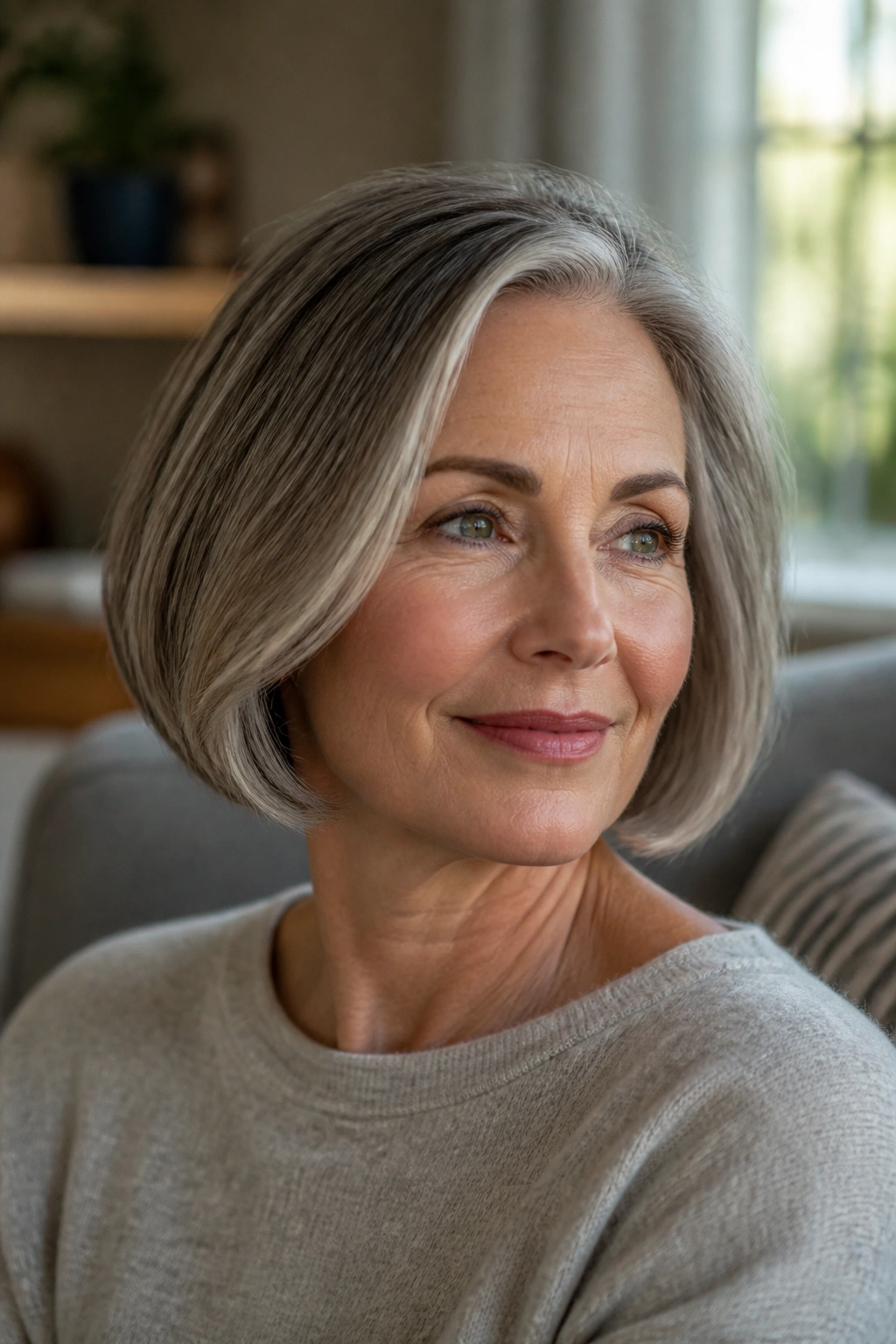
A chin-length bob is one of those cuts that keeps proving itself because it does so much with very little effort. It gives gray hair a strong outline, and that outline matters when the hair has a mix of coarse silver strands and finer regrowth at the temples. The best version is not boxy. It sits just at the chin, with ends that skim instead of stab into the jaw.
Why It Flatters Gray Hair
The chin line pulls attention upward to the eyes and cheekbones. That makes the face look open without making the cut feel severe.
If your hair is fine, a chin-length bob can make it look fuller at the bottom. If it’s thick, the length keeps the shape grounded. Either way, the cut feels neat without being stiff.
- Best for straight, slightly wavy, or lightly textured hair.
- Looks sharp with a side part or a soft center part.
- Needs a trim about every 6 to 8 weeks to keep the line clean.
- Works well with a blow-dried bend at the ends, not a pin-straight finish.
Tip: ask for the perimeter to stay full. Too much thinning turns this cut wispy in a bad way.
2. Layered Pixie

A layered pixie is a bold little cut, and I mean that in a good way. It works because it gives gray hair lift where it tends to collapse — at the crown, around the temples, and behind the ears. The shape can be soft or sharp, but the real win is movement. No helmet hair. No waiting for the ends to “settle.”
The best layered pixies keep the sides tidy and the top a touch longer so the hair can be brushed forward, swept over, or roughed up with a dab of paste. That top length matters. Without it, the cut can feel too severe, especially on a face that needs a little softness.
A pixie also makes silver strands look deliberate. Every piece has a job. The cut catches light in a clean way, which is useful when the hair has different shades of gray, white, and silver running through it.
Use a pea-sized amount of styling cream or lightweight paste. Warm it between your fingers, then push it through the ends and crown. That’s enough. More product turns the cut greasy fast.
3. Long Pixie With Side-Swept Fringe

Does short hair have to mean exposed forehead and sharp edges? Not at all. A long pixie with a side-swept fringe is the answer for anyone who wants the ease of short hair but still wants a little face-framing softness.
The fringe is the important part here. It should fall diagonally, not straight down like a curtain. That diagonal line softens the forehead and gives the cut a more relaxed feel. On gray hair, which can sometimes look a bit brassy-free but very plain, that one soft angle makes a real difference.
How to Style It
Dry the fringe first, while it’s still damp, using a small round brush or a flat brush with a quick bend at the roots. If you wait until the end, the front often dries in the wrong direction and stays there.
Keep the crown piecey, not fluffy. A little root lift is enough. A long pixie looks best when the top has shape but the sides stay close to the head.
This cut suits women who want polish without looking overdone. It’s tidy. It’s easy. And it grows out better than a lot of shorter styles.
4. Textured Crop
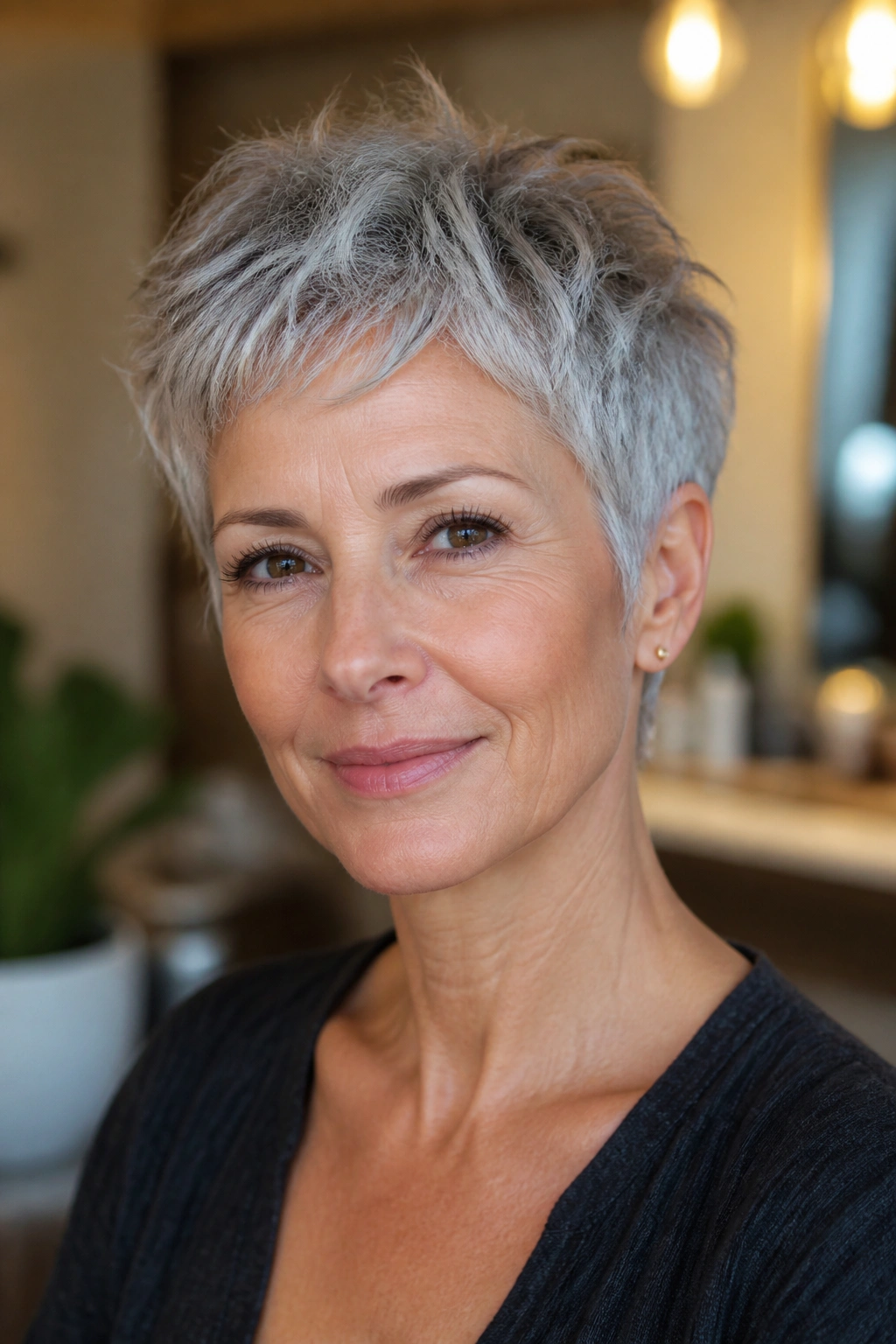
There’s a reason so many stylists reach for a textured crop when gray hair starts to feel heavy or stubborn. The shape takes away bulk, but it doesn’t make the hair look thin. That balance is hard to get, and when it works, the result feels light without looking sparse.
This cut is especially good if your hair has a bit of natural wave or if it tends to puff at the crown. The texture breaks up the solid block of hair, so the shape moves instead of sitting like one dense shape. On silver hair, that piecey finish can look expensive in the plainest sense of the word — crisp, lively, and easy to wear.
Ask for short, uneven layers through the top and a clean outline around the ears and neckline. Not razor-sharp, though. Gray hair can get fuzzy if it’s cut too aggressively.
A little styling mousse at the roots works well here. Scrunch, dry, and stop before it gets too perfect. Perfect is not the goal. A little softness is the whole point.
5. Shoulder-Length Lob

A shoulder-length lob is the haircut I keep coming back to for women who want options. It gives gray hair enough length to tuck behind the ears, pull into a clip, or wear in loose bends, but it does not carry the maintenance load of longer hair that starts to drag at the roots. That middle ground is useful.
The shape works especially well if your hair has lost some density through the ends. A lob can restore the look of fullness because the weight sits in a clean, even line at the shoulders or just above them. It also plays nicely with silver hair that has a mix of textures. The haircut doesn’t try to fight the variation; it uses it.
I like this cut with a soft side part and a slight bevel at the ends. Too much layering here can make the hair sit oddly at the collarbone. Too little can make it feel flat. The sweet spot is a clean perimeter with just enough internal movement to keep it from looking heavy.
It’s also one of the easiest cuts to live with. Air-dry it with a little smoothing cream. Blow it out straight if you want polish. Add a few bends with a medium iron if you want body. Simple.
6. Blunt Bob With Soft Ends
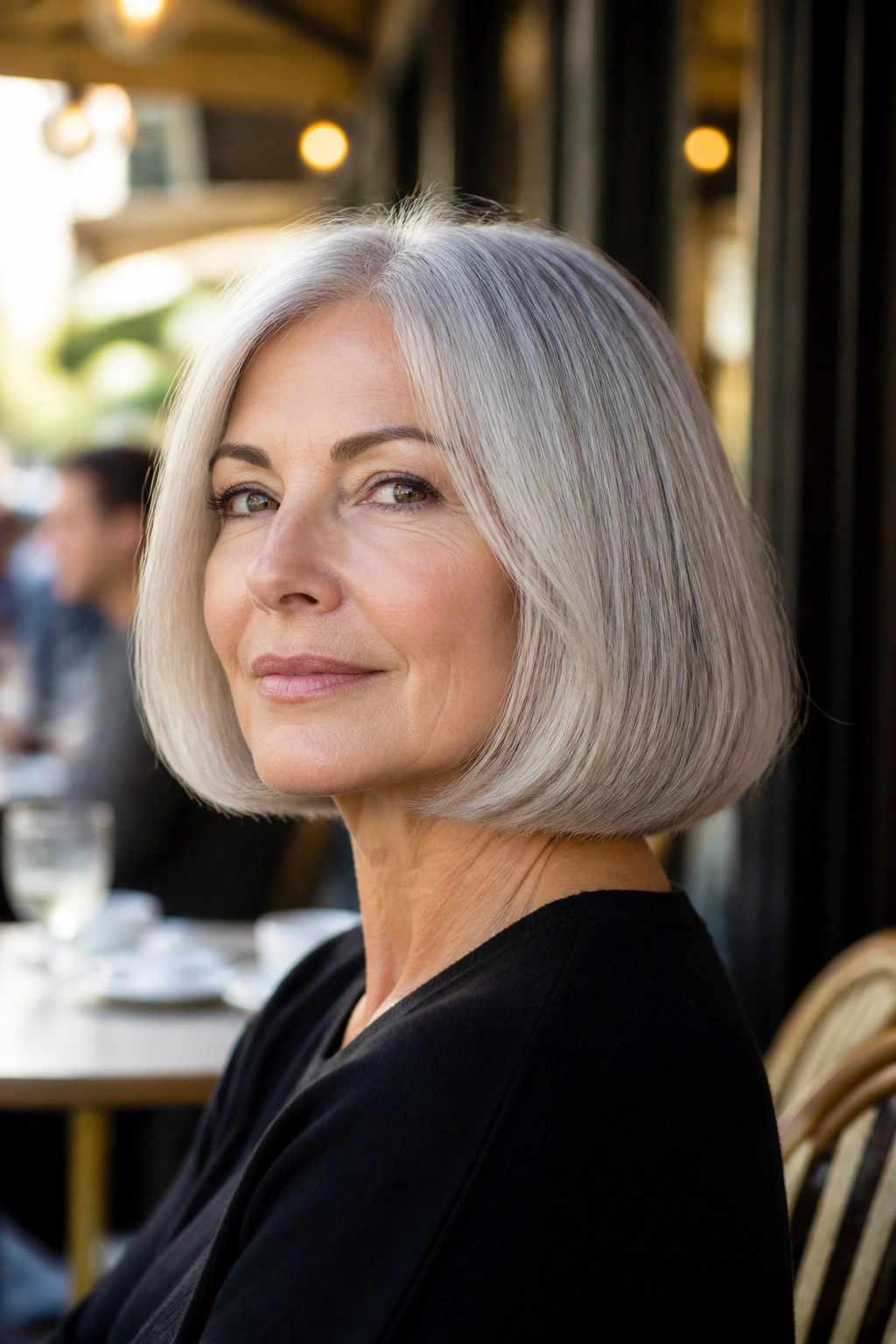
A blunt bob can be a small miracle for fine gray hair. The blunt edge makes the hair look thicker because every strand ends in the same place, so the perimeter reads as denser. That said, a truly hard, chopped line can feel severe on older faces. The smarter version keeps the overall shape blunt but softens the ends just enough that the cut doesn’t look like a ruler.
That softening matters more than people think. Gray hair often reflects light in a cleaner, cooler way than pigmented hair, so a blunt shape can look extra crisp. Good. But if the cut is too boxy, the whole thing starts to feel rigid. A tiny bit of texturing at the tips solves that.
What Makes It Different
Unlike a heavily layered bob, this cut keeps the fullness at the bottom. That’s what gives the hair a thicker read.
- Best for fine to medium hair.
- Looks strong with straight styling or a slight undercurve.
- Needs precise trims, usually every 5 to 7 weeks.
- Works well with a deep side part if you want extra lift.
This is one of those haircuts for older women that makes people assume the hair is naturally thicker than it is. I always count that as a win.
7. Shag With Curtain Bangs
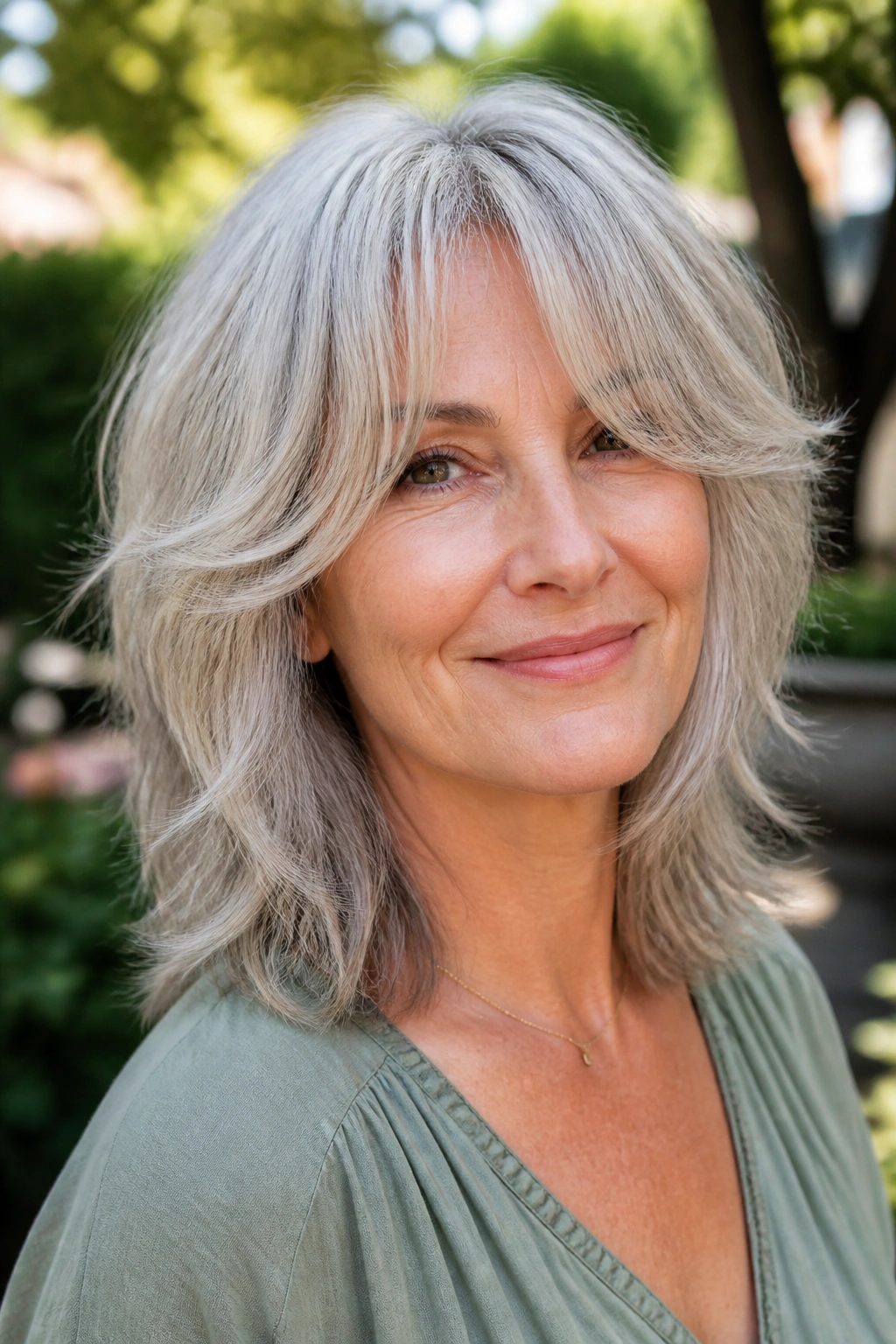
A shag can save gray hair that feels flat at the roots but puffy at the ends. Sounds contradictory, I know. It isn’t. The layered structure removes weight from the sides and keeps the top from collapsing, which is exactly why this cut works so well on hair that has changed texture over time.
Curtain bangs do a lot of the visual work. They break up the forehead, soften the face, and let the haircut feel relaxed instead of heavily styled. On silver hair, curtain bangs also help blend the transition around the front hairline if your natural growth pattern is a little uneven.
This cut likes movement. Air-dried waves are fine. A diffuser works too. A round brush is useful if you want the bangs to sweep away from the eyes, but do not overwork the rest of the cut into a polished blowout unless that’s your thing. The shag looks best when the texture is still visible.
Best Way to Wear It
Keep the layers soft around the cheekbones and longer through the back. If the layers start too high, the cut can frizz out fast. That’s the trap.
8. Feathered Layers

Feathered layers have a softer feel than a choppy cut, and that is exactly why they suit many women with gray hair. The layers taper away from the face instead of landing in hard steps, so the style keeps a gentle outline while still adding movement. If your hair has started to sit flat at the crown or hang in one heavy block, feathering can fix that without making the cut look trendy in a way you’ll regret later.
The best feathered layers start around the cheekbones or just below them. That placement keeps the face open and gives the hair a sense of lift. On fine hair, the effect is airy. On thicker hair, the layers remove enough bulk to stop the cut from feeling helmet-like.
What I like here is the way the silver tones show through the movement. Each feathered section catches the light a little differently, so the hair looks dimensional without asking for highlights or fuss. That’s useful if you’ve embraced natural gray and want the cut to do the visual work.
A light blow-dry with a round brush gives the shape its nicest finish. Flip the brush away from the face at the ends. Tiny motion. Big difference.
9. French Bob

A French bob is short, cheeky, and a little bit smug in the best possible way. It usually lands somewhere between the cheekbone and jawline, often with a bit of bend or a soft fringe. On gray hair, that compact shape can look chic fast because there’s nowhere for the cut to hide. The line has to be good. The good news is that gray hair often holds a strong bob shape beautifully when the perimeter is precise.
This is a smart choice for women who want a short cut that doesn’t feel sporty or severe. A French bob has personality. It can be paired with a side-swept fringe, a tiny bit of wave, or a straight finish with the ends tucked under just a touch.
How to Wear It Without Looking Too Severe
Keep the length slightly below the cheekbone if your face is narrow. Shorter can look harsh unless your features are very balanced.
A soft fringe works better than a heavy one. Heavy bangs can box in the face, and that’s the opposite of what this cut should do.
If your hair is naturally wavy, let it dry with a little bend and don’t chase every wave flat. The charm is in the slight movement.
10. Curly Bob

Curly hair and gray hair can become a bit unpredictable together. The texture often gets springier and less uniform, which means a one-length cut can create a triangle you did not ask for. A curly bob solves that problem when it’s cut with curl pattern in mind and enough layering to let the shape breathe.
The key is length. For many women, a bob that lands just below the chin or right at it gives curls enough room to stack softly instead of ballooning outward. If the hair is very springy, leaving it a touch longer can keep the finish from shrinking too far.
Cutting curls dry is often smarter than cutting them wet, because curls lie to you when they’re stretched out. A good stylist will watch where the curl wants to sit and trim with that in mind. That detail matters. A lot.
- Ask for curl-by-curl shaping if your pattern is uneven.
- Keep some weight at the bottom so the bob doesn’t turn into a round puff.
- Use a cream or light gel while the hair is damp.
- Avoid brushing once it’s dry.
A curly bob can look joyful rather than controlled. That’s the point.
11. Wavy Collarbone Cut

A collarbone cut hits a nice middle ground: long enough to feel soft, short enough to stay manageable. On wavy gray hair, it gives the texture somewhere to move without letting the ends disappear into frizz or drag down the face. I find this length especially good for women who want to keep some styling freedom without spending half the morning on it.
The collarbone acts like a natural anchor. The hair can skim it, tuck under it, or flip away from it depending on how you dry it. That little bit of interaction keeps the cut from looking static. Silver strands pick up the movement well, so even a simple air-dry can look intentional when the ends are healthy.
This length is also kind to women whose hair has thinned at the temples or along the part. You get enough length to disguise sparse spots, but not so much that the weight exposes them. That’s the sweet spot.
A middle part can feel modern here, but a slight side part often gives more lift at the crown. If your hair bends naturally, let it. The whole cut depends on movement, not control.
12. Asymmetrical Bob
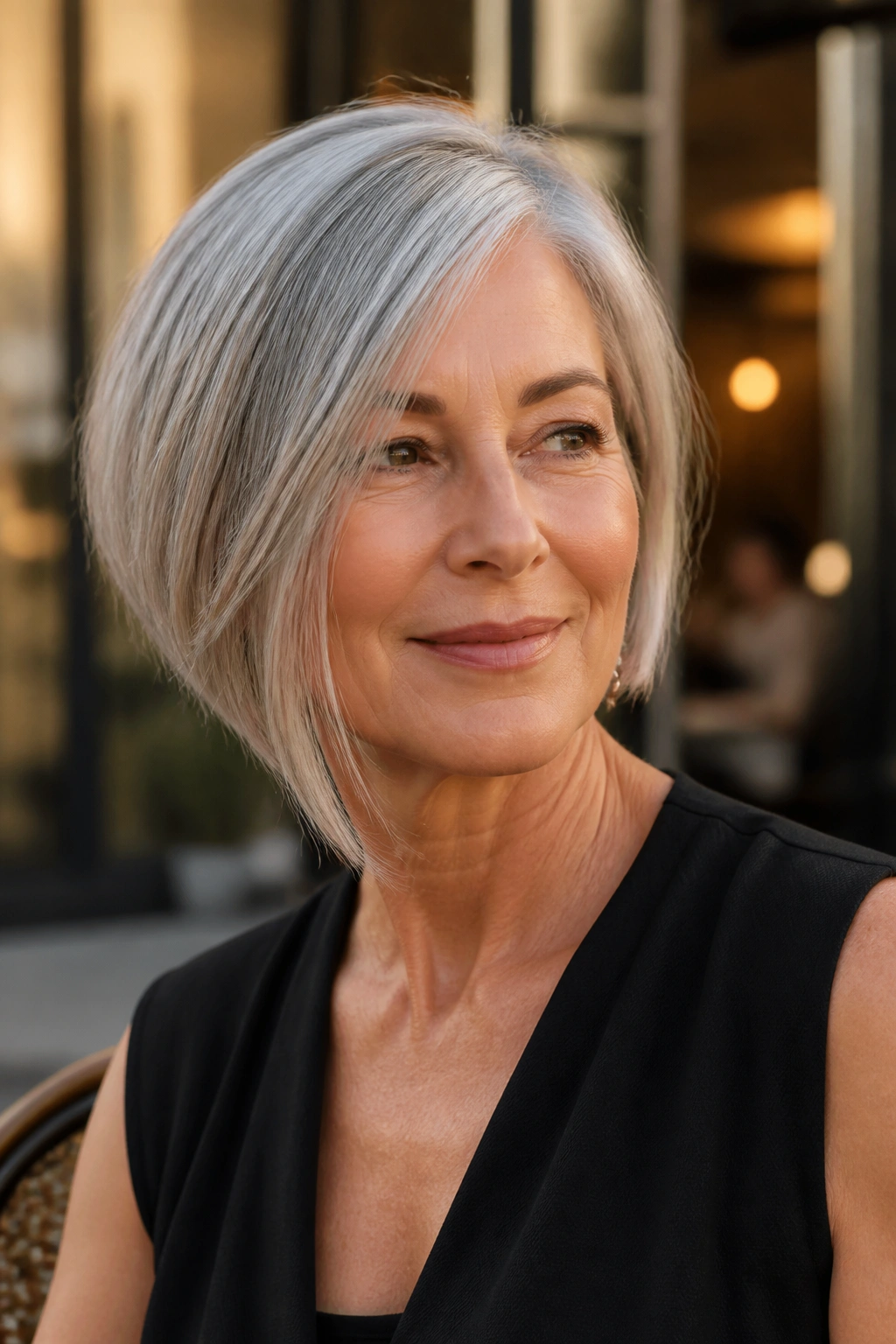
An asymmetrical bob gives a familiar shape a little edge. One side is slightly longer than the other, usually by less than an inch or so. That small difference is enough to make the cut feel alive without turning it into a statement piece that wears you instead of the other way around.
Compared with a classic bob, the asymmetrical version draws the eye diagonally, which is useful if you want to soften a wider face or distract from a strong jaw. It also helps gray hair look less blocky. The angle gives the silver strands a bit of direction.
The trick is restraint. Too much difference between the sides can feel fussy, and gray hair is unforgiving when a shape tries too hard. Keep the longer side subtle. Let the cut whisper, not shout.
This style suits straight to slightly wavy hair best. It can be worn sleek for polish or with a little texture for a softer finish. If you like one ear tucked and one side loose, this cut is built for that habit.
13. Tapered Pixie

A tapered pixie is clean at the nape and fuller on top, which is why it works so well on gray hair that needs shape without bulk. The taper around the neck and ears keeps the haircut neat, while the top length gives enough room for movement and lift. It’s a short cut, but it does not feel flat.
Why It Works
The short nape removes the puffiness that can build under the back of the head. That alone changes the whole silhouette.
The top can be styled forward, to the side, or lightly tousled. A little height at the crown is enough.
- Best for fine hair that needs lift.
- Also good for thick hair that feels bulky at the neck.
- Needs regular trimming to keep the taper crisp.
- Looks sharp with earrings, glasses, or a strong brow line.
A tapered pixie has a polished edge, but it’s not fussy. The cut does the hard part. You only need a touch of product and a quick finger-style in the morning. If your hair has a stubborn growth pattern at the nape, this cut can tame it better than most.
14. Neck-Grazing Stacked Bob

A neck-grazing stacked bob gives you the benefits of a bob without the heaviness that sometimes collects at the back. The stacking at the nape creates lift, while the front stays long enough to frame the jaw. For women with gray hair that feels dense underneath or flat on top, that combination can be a lifesaver.
This cut is especially useful if the back of your head tends to look wide when your hair grows out. The stacked shape narrows that area and gives the crown a little more height. Gray hair shows the stacked layers cleanly, so the shape reads well even with minimal styling.
The back matters here. If the stacking is too steep, the cut can look dated fast. If it’s too soft, the bob loses its shape and becomes another shapeless medium cut. Ask for a gradual stack and keep the front line smooth.
This is a strong choice for women who want something neat enough for daily wear but not severe enough to feel stern. The neckline stays visible. The jawline gets a little polish. Easy enough.
15. Bixie

A bixie is the in-between cut that lives somewhere between a bob and a pixie, and that’s why it has become such a useful option for older women with gray hair. It keeps more length than a classic pixie, but it still has the cropped energy that makes short hair feel fresh. If you’ve ever grown out a pixie and thought, “I like this better than I expected,” you already understand the appeal.
The bixie works because it keeps softness around the ears and cheekbones while letting the top and crown stay light. That makes it good for hair that’s thinning a little but still needs body. It also handles cowlicks better than many fully short cuts, since the extra length gives the hair somewhere to go.
How to Style It
Use a small amount of mousse at the roots when the hair is damp. Dry the top forward, then sweep it to the side with your fingers.
A little wax on the ends can define the shape, but keep it light. Heavy product turns the cut clumpy.
This style is a nice bridge if you want short hair but are not ready to go all the way to a pixie. It grows out gracefully, which matters more than people admit.
16. Layered Shoulder Cut

A layered shoulder cut can look plain in a photo and brilliant in real life. The reason is simple: the layers start low enough to preserve fullness near the face, but they break up the length before the hair turns into a heavy curtain. On gray hair, that balance is gold.
This cut works well if you still like to pull your hair back, clip it up, or wear it half-down. The shoulder length gives you practical options, while the layers keep the style from feeling blocky. If the hair has some natural bend, even better. A few loose waves can make the layers sit beautifully.
I’d avoid very short top layers here unless the hair is thick and needs the weight removed. On fine hair, too much layering around the crown can expose the scalp or make the ends look thin. Better to keep the face-framing pieces modest and leave the longer lengths intact.
The result is soft and easy to live with. That matters. Not every cut needs a performance.
17. Face-Framing Long Layers

If you like your hair longer, face-framing layers are the safest smart move. They let you keep length while adding shape around the eyes, cheekbones, and jaw. On gray hair, those front pieces are especially useful because they stop the length from hanging like one long sheet.
The first layer should land somewhere between the lip and the chin, depending on face shape. That gives the front some motion without cutting too much away. The rest of the length can stay long and soft, which is useful if you wear your hair in a low ponytail, a twist, or loose waves.
This cut is good for women who don’t want a dramatic change but know their hair needs help. It can also be the easiest style to grow out after years of shorter cuts. You still get shape. You still get softness. You just keep the length.
Use a round brush only on the front pieces if you want a polished finish. The rest can air-dry or be lightly waved. No need to over-style the whole head when a few well-placed layers do the job.
18. Sleek One-Length Bob

A sleek one-length bob is the opposite of airy layers, and that is why it can be so effective. Straight gray hair often looks strongest when it’s given one clean line from side to side. The shape feels modern, but more than that, it makes fine or medium hair look denser because nothing is broken up.
This cut is best when the hair is naturally straight or only slightly wavy. If the texture is very curly or highly bent, a one-length bob can fight the hair every morning. Nobody needs that battle. For the right texture, though, the result is crisp and calm.
Compared with layered bobs, this version asks for precision. The ends need to be even. The line at the back needs to sit cleanly against the neck. The whole look depends on sharp geometry, so trims matter more than with softer cuts.
A center part makes this feel modern. A side part makes it softer. Either way, the cut gives silver hair a strong frame and lets the color speak for itself.
19. Tousled Crop With Volume at the Crown

A tousled crop with volume at the crown is a friend to hair that has gone a little flat where it matters most. The top gets enough lift to keep the face from looking dragged down, while the sides stay shorter and neat. That crown height changes the silhouette fast. You can see it instantly.
This cut is a smart choice if your hair is fine, if your roots lie close to the scalp, or if you want a low-maintenance shape that still feels lively. The tousled finish keeps it from looking helmet-like. A little mess is part of the charm.
What Makes It Different
The volume sits high enough to lengthen the face a bit without turning the cut into a tall pompadour. That’s the mistake some people make.
- Works best with light mousse or root spray.
- Needs finger drying or a small round brush at the crown.
- Looks best when the ends are piecey, not stiff.
- Can be worn side-swept or slightly forward.
If your gray hair tends to flatten by noon, this cut gives you a fighting chance. It is not magic. It is just well-placed shape.
20. Soft Medium Cut With Wispy Bangs

A soft medium cut with wispy bangs is the kind of haircut that quietly flatters from every angle. The length usually sits between the jaw and shoulders, and the bangs are light enough to soften the face without crowding it. That balance is especially useful on gray hair, where a heavy fringe can make the whole cut feel dense or too youthful in the wrong way.
The wispy bang should never be a thick wall. It needs air between the pieces. That little gap keeps the forehead visible and prevents the cut from closing in on the eyes. On women with fine hair, this also stops the front from looking heavy. On thicker hair, it keeps the bangs from turning into a solid block.
This is a good choice if you want softness around the face but do not want to go short. It works with loose bends, a blow-dry with a round brush, or even an air-dried shape if the hair has enough natural movement. The key is keeping the bangs light and the rest of the cut gently layered.
A tiny trim on the bangs every few weeks helps. They grow fast enough to change the whole balance of the haircut.
Final Thoughts
The best haircuts for older women are the ones that respect the hair you actually have. Not the hair you had twenty years ago. Not the hair someone else has on a mood board. The hair on your head, with its real thickness, its real gray pattern, and its own habits at the crown and nape.
A sharp bob, a soft pixie, a layered lob — each one can work beautifully when the shape matches the texture. That part matters more than trends, and more than most people admit. Gray hair looks especially good when the cut has purpose.
If you’re sitting on the fence, bring two photos to the salon: one of a cut you love and one of a cut you hate. That little contrast makes the conversation easier. And it usually leads to a better haircut than waving vaguely at a magazine picture and hoping for the best.
