



A French bob with long bangs can look polished in five minutes, or a little too precious if the shape is off by half an inch.
That’s the part people miss. The bob itself is only half the story; the fringe decides whether the cut feels airy, cheeky, sharp, or soft around the eyes. A long bang can pull the whole haircut forward, then relax it again.
And that’s why this cut stays interesting. The same jaw-length outline can read sleek on one person, messy-cool on another, and almost romantic on someone else, all because the bangs land in a different place. Cheekbone length does one thing. Brow-skimming length does another. A side sweep changes the mood again.
The styles below cover the versions worth asking for: clean and classic, rough and lived-in, thick-hair friendly, fine-hair friendly, curly, grown-out, and a few that give the face a little more edge without losing that French-bob ease. Tiny differences. Big ones.
1. The Classic Chin-Grazing French Bob With Curtain Bangs

This is the version people picture first, and for good reason. The line sits close to the chin, the bangs split softly in the middle, and the whole shape has that easy, slightly undone swing that makes the French bob with long bangs feel like it belongs on a real head, not just a mood board.
Why the Length Matters
A chin-grazing cut gives the jaw some room. It does not box the face in the way a shorter crop can, and it leaves enough length for the ends to flick under or away, depending on how you dry it. The long curtain fringe keeps the forehead from looking too open, but it never steals the whole show.
What I like here is the balance. The bob feels neat, but not strict. The bangs soften the front, but they do not hide the face. That mix is the whole point.
- Ask for the perimeter to hit right at or just below the chin.
- Keep the bangs long enough to hit the cheekbone when they split.
- Blow-dry the fringe side to side so it opens naturally.
- Use a light mousse or foam if your hair tends to fall flat.
Best for: oval, heart, and square faces that want softness without losing structure.
A small bend at the ends matters more than people think. If the line is too straight, the cut can feel stiff. If it’s too layered, the bob loses its shape and starts looking like a grown-out mishap instead of a choice.
2. The Sleek Jaw-Length French Bob With Side-Swept Bangs

This one has a little more polish. Not stiff, not fussy. Just cleaner. The jaw-length edge sits close to the face, and the side-swept fringe gives the cut a diagonal line that makes the whole thing feel a bit sharper and more intentional.
It’s the French bob for someone who likes a neat finish but doesn’t want a blunt helmet. The side sweep keeps the forehead open on one side, which is useful if you do not want bangs hanging straight down all day. It also plays well with straight hair, especially if your texture naturally dries smooth with a slight bend at the ends.
A cut like this looks best when the top is not too bulky. The front should move. If the crown gets over-layered, the bob can puff out at the sides and lose that sleek, close-to-the-head feel.
This style is also one of the easier ones to tuck behind one ear without destroying the shape. That sounds minor. It isn’t. Hair that can be tucked, flipped, or reset during the day usually earns a spot in the real-world rotation.
3. The Choppy French Bob With Piecey Long Bangs

Do you want the version that looks better when it is not too perfect? This is it. The choppy French bob leans into texture, with ends that are slightly broken up and bangs that fall in separated pieces instead of one smooth curtain.
How to Keep the Pieces Separated
The trick is restraint. You want point-cutting through the ends, not heavy thinning. A stylist who sculpts too much into the fringe can leave it wispy in a bad way, especially after a few washes. The better approach is to keep the overall line solid and let the bangs do the messy work.
This cut works especially well if your hair has a little wave, or if it’s straight but stubbornly flat unless you give it some grit. A mist of texturizing spray at the roots, then a quick twist with your fingers, is often enough. Nothing fancy.
- Dry the bangs with your fingers first, then shape them with a round brush only if needed.
- Keep the ends slightly jagged, not ragged.
- Add a pea-sized amount of matte cream to the mid-lengths.
- Skip heavy oils near the fringe; they make the pieces stick together.
A choppy bob is not lazy hair. It still needs a shape. It just looks better when the shape has a little air in it.
4. The Air-Dry Wavy French Bob With Soft Fringe

You wash it. You squeeze out the water with a T-shirt. You scrunch in a small amount of cream and leave the room while it does its thing. That’s the appeal here, and if you have natural wave, the French bob with long bangs can be one of the easiest cuts to live with.
The fringe should not fight the wave pattern. That’s where people go wrong. Long bangs that are cut too blunt can bend in odd directions once they dry, and then the whole front feels heavy. A softer fringe, lightly connected to the front pieces, moves with the hair instead of against it.
This style is at its prettiest when it looks touched by air, not brushed into place. A diffuser helps if you need it. So does a little patience. Let the hair dry halfway before you poke at it.
- Use a curl cream or light wave cream from mid-length to ends.
- Scrunch the fringe gently, then let it fall where it wants.
- Dry on low heat or no heat if your wave pattern is loose.
- Part the front while it’s damp, not after it’s stiff.
The result is relaxed, but not sloppy. There’s a difference. You can feel it the minute the hair starts moving around your cheekbones.
5. The Blunt French Bob With Feathered Bangs

A blunt bob with feathered bangs has more backbone than people expect. The outline is straight and decisive, which gives the haircut weight, but the bangs are softened at the edges so the front doesn’t turn severe. That contrast is what makes it interesting.
I like this version on straight or slightly wavy hair that already falls in a clean line. The blunt perimeter shows off the density of the hair, while the feathered fringe keeps the face from getting boxed in. It’s a smart cut for someone who likes shape more than fluff.
The danger is over-thinning. Feathered bangs should feel light, not stringy. If the stylist removes too much hair from the fringe, the front can look see-through in daylight, and that is rarely the goal unless your hair is extremely thick.
Another thing: this cut needs a good dry. Not a rushed one. A quick pass with a paddle brush and then a small round brush at the bangs keeps the line crisp without making it too sleek.
If you like a sharp silhouette with just enough softness to keep it wearable, this one earns its keep.
6. The Rounded French Bob With Bottleneck Bangs
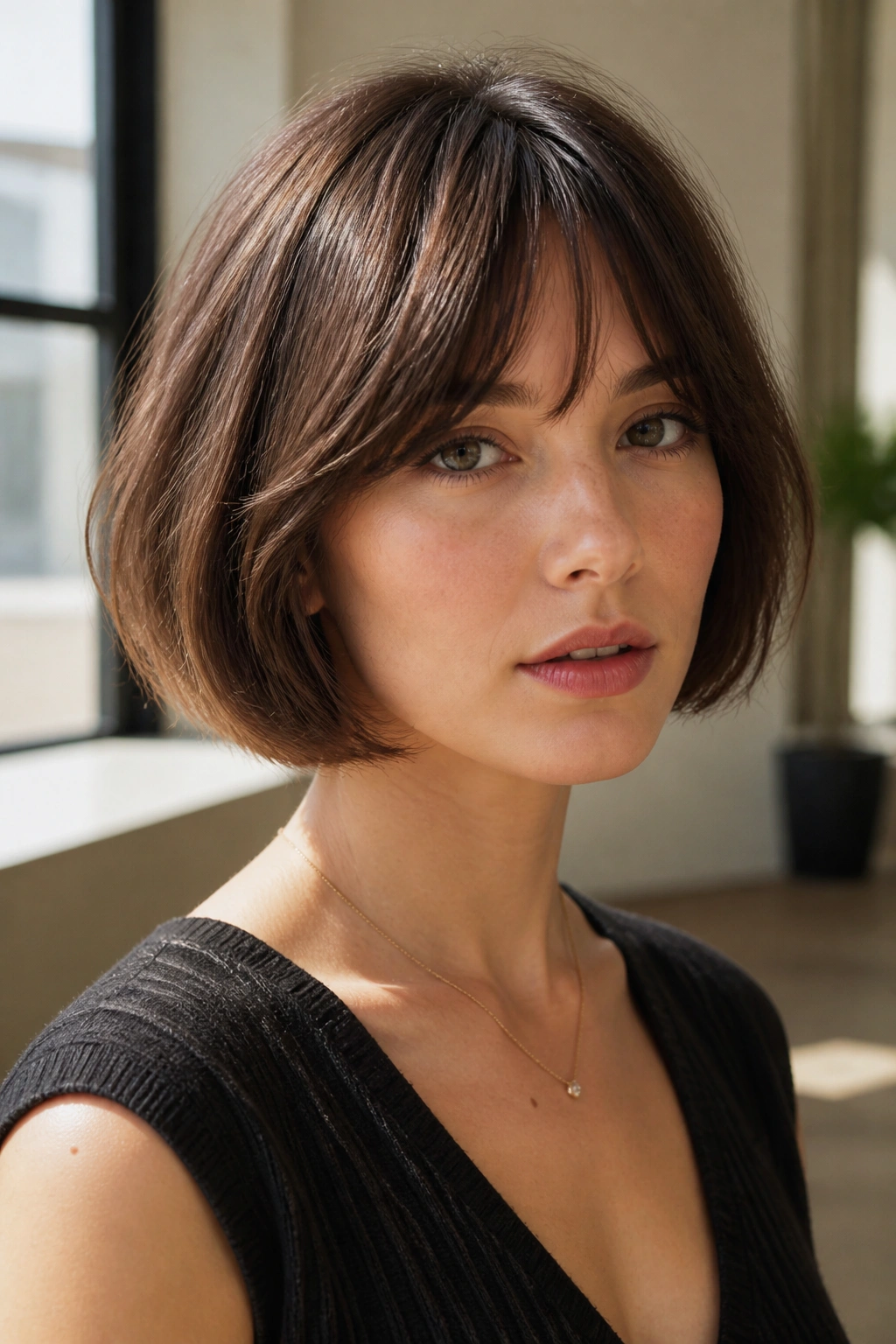
Bottleneck bangs change the whole face of a bob. They start narrow between the brows, then open out around the eyes and cheekbones, which gives the haircut a rounded, slightly sculpted look that feels softer than blunt fringe and more structured than a curtain bang.
Why Bottleneck Bangs Change the Face Shape
The width of the fringe matters. Narrower at the center, wider at the sides — that shape pulls attention toward the middle of the face and then lets it drift outward again. If you have a longer forehead, a narrow face, or cheekbones you want to bring forward, this is a strong choice.
The bob underneath should curve with the head a little. Not tucked too hard under, not flipped out like a 1970s round brush fantasy unless that is the point. A gentle roundness keeps the haircut from feeling boxy.
- Keep the center of the fringe just below the brows.
- Let the side pieces skim the top of the cheekbones.
- Blow-dry with a small round brush for a soft curve.
- Avoid a razor-heavy finish if your hair is already fine.
This is one of those cuts that looks deliberate even when it grows out a bit. The shape does some of the work for you.
7. The Full-Perimeter French Bob for Fine Hair
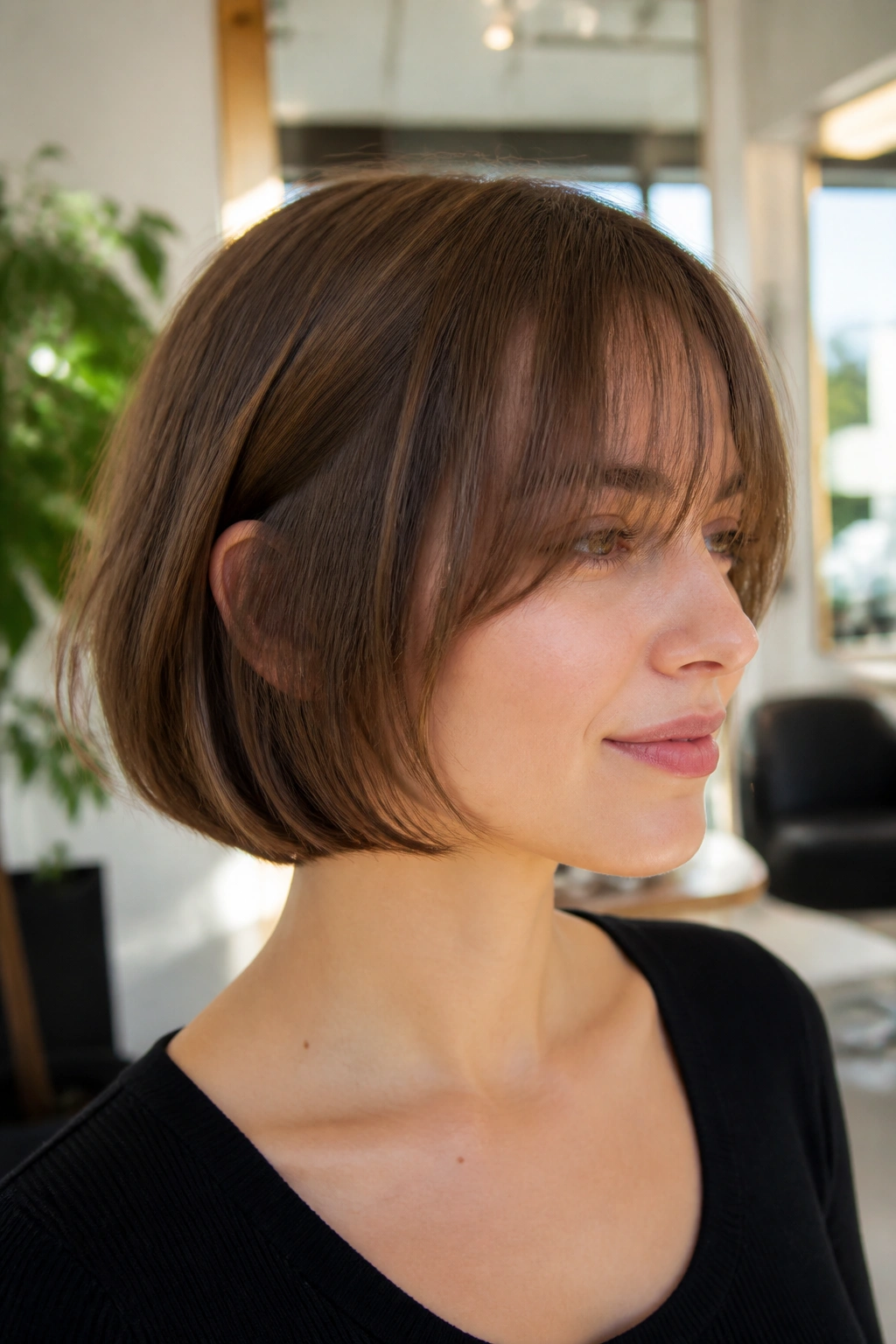
Fine hair needs a clean perimeter. That’s the whole game. A bob with too many layers can make fine hair look thinner at the ends than it actually is, which is why this version keeps the outline fuller and lets the bangs do the softening.
A long fringe helps because it gives movement without carving away too much density from the sides. The front still feels light, but the body of the cut stays solid. That’s what you want if your hair collapses by lunchtime or goes flat the minute humidity sneaks in.
You do not need a lot of shape inside the cut. You need enough length to hold a line. A slight bevel at the ends, a side-to-side dry on the bangs, and a root-lifting mousse near the crown can make a surprising difference.
- Ask for minimal internal layering.
- Keep the bangs long and lightly connected to the front.
- Use a root spray or mousse at the crown.
- Dry with your head slightly forward for more lift.
A lot of thin-hair advice gets too cute. Not here. Density at the ends is your friend.
8. The Airy French Bob for Thick Hair

Thick hair can carry a French bob beautifully, but it needs smarter shaping than a lot of salon photos suggest. If the bulk is left in the wrong places, the cut can bell out at the sides and make the head look wider than it is. That’s where the right long bangs help.
The fringe should have enough weight to sit down, but not so much that it swallows the face. I prefer a slightly longer bang with some inner removal, not a razor-thin fringe that springs back into place and frizzes out the second the weather shifts.
What to Ask for in the Chair
Tell the stylist you want the weight removed from the inside, not hacked off the perimeter. That keeps the shape full from the outside while making it easier to move.
- Keep the bottom line clean and strong.
- Remove bulk only where the hair stacks too much.
- Leave the bangs heavier at the base so they lie flat.
- Use a smoothing cream if your hair puffs when it dries.
This version is good when you want your hair to feel lighter without losing the sense of a real cut. It should still feel like hair. Just less of it in the places that cause trouble.
9. The Curly French Bob With Stretched Bangs

Curly hair and French bobs get along better than people assume. The trick is length. Curls shrink, and long bangs that look generous when wet can land far shorter once dry. So the fringe needs to be cut with that in mind, not guessed at by eye while the hair is damp and stretched.
A curly French bob should follow the curl pattern, not bully it. The bangs can sit longer at the center and curve into the rest of the cut, or they can be left as a soft fringe that blends into the face-framing pieces. Either way, the shape should look designed, not accidental.
I also like this cut with a little stretch in the bang area. Not a straight blowout. Just enough tension with a diffuser or a brush to lengthen the curl slightly so the fringe doesn’t spring up into the middle of the forehead.
Curls want room. Give them that, and the bob becomes lively instead of puffy.
One small thing matters here: dry cuts or curl-by-curl shaping usually help more than a blunt chop. The curl decides where the line lands. The scissors should respect that.
10. The Side-Part French Bob With Long Fringe

Some people hate a center part. Fair enough. This is the clean workaround, and it gives the French bob with long bangs a little motion without asking the fringe to fall symmetrically across the face.
The side part makes the haircut feel softer on one side and a touch more dramatic on the other. That tiny shift changes the geometry right away. It is also useful if one side of your hair tends to fall flatter, because the part helps disguise the mismatch instead of fighting it.
What Makes It Different
A side-part bob gives you forehead coverage without the heaviness of full bangs. The fringe can sweep across the brow and end near the cheekbone, which keeps the face open while still framing the eyes.
- Works well if your hair naturally leans to one side.
- Grows out quietly.
- Plays nicely with straight or slightly wavy textures.
- Lets you tuck one side behind the ear and keep the other soft.
If you want something that feels a little more casual than a centered curtain fringe, this is the move. It has less symmetry, more movement, and a bit of that borrowed-from-your-favorite-old-photo energy.
11. The Collarbone-Skimming French Bob With Grown-Out Bangs

This is the version for people who want a bob, but not a bob that feels boxed in. The length drops toward the collarbone, the bangs sit long enough to brush the cheekbones, and the whole cut slides into that in-between place where a bob starts flirting with a lob.
Unlike the chin-grazing versions, this one gives you room to play. You can wear it tucked, half-up, bent under, or left loose with a little wave. The bangs are the important part here; they stop the length from becoming ordinary.
I like this shape for anyone who wants a haircut that still looks considered after six or eight weeks of growth. The longer length helps. So does the fringe. It can be pushed to the side on rushed mornings and brought back to center when you want more face framing.
The cut does need discipline at the ends. If the perimeter gets too blunt and too long, it stops feeling French and starts feeling like you just avoided the salon. There’s a difference. Small, but obvious.
This is one of the easier picks if you are nervous about going too short. It gives you space to adjust.
12. The Glasses-Friendly French Bob With Soft Face-Framing Bangs

Glasses change how a fringe behaves. The frames sit where bangs often want to live, which means the cut has to cooperate instead of crowding your lenses. This version does that well because the bangs are soft, split a little off center, and shaped to skim the face rather than sit straight across it.
A good glasses-friendly French bob leaves the brow area open enough that your frames can do their job. The bangs can rest at the top of the frame, then slide out toward the temples in a gentle curve. That keeps the eyes visible and stops the cut from feeling busy.
How the Bangs Clear the Frames
Length matters, but so does angle. The fringe should angle away from the center of the face and land near the upper cheek rather than dropping straight into the glasses line.
- Ask for bangs that stop just above the frame line.
- Keep the side pieces soft, not chunky.
- Blow-dry the fringe with a small brush so it bends away from the lenses.
- Avoid too much product at the roots; it can make the bangs sit heavy.
I’ve always thought this was one of the most practical French bob options. It looks intentional, and it stays out of your way, which is more than some prettier cuts can say.
13. The Shag-Bob Hybrid With Longer Bangs

A little roughness can be a good thing. The shag-bob hybrid takes the neat outline of a French bob and loosens it with internal texture, then keeps the bangs long enough to soften the front without losing the bob shape.
This is the cut for someone who wants movement first. The ends are not dead straight, the layers are not too tidy, and the fringe has that slightly slept-in look that makes hair feel less formal. It still reads as a bob, though. That part matters. If the layers climb too high, the cut stops being a bob and turns into something else entirely.
The best part is how it behaves on day two. A little dry shampoo, a finger rake, maybe a touch of cream through the ends, and the shape comes back without a full reset. That’s useful. Most people do not want a haircut that only looks good the morning it’s blown out.
A shag-bob needs one thing more than shine: placement. The layers should live where the hair bends naturally, not where a diagram says they should. That’s why a good stylist matters here.
14. The Asymmetrical French Bob With Sweeping Bangs

A slight asymmetry gives the French bob a sharper edge. One side sits a touch longer, the fringe sweeps across the forehead instead of splitting evenly, and the whole haircut gets a bit of attitude without losing its ease.
This is not the haircut for someone who wants perfect symmetry. It’s for someone who likes a little visual movement. The asymmetry can be subtle — half an inch, maybe a bit more — and still change the way the hair frames the face. The sweeping bangs help soften the imbalance so it looks deliberate, not uneven.
Why It Works
The eye follows the longer line first. That means the face can appear a little slimmer on the side where the line drops, while the sweep across the forehead keeps the top from feeling heavy.
If your jaw is strong, this cut can soften it. If your face is round, the diagonal line can add length. If you just want hair that looks a little less expected, that counts too.
- Keep the longer side only slightly longer.
- Sweep the fringe with a brush while drying.
- Do not over-texturize the front; the shape needs presence.
- Use a light hairspray at the end if the sweep falls flat.
Subtle asymmetry is a nicer gamble than an extreme one. It reads as choice, not drama.
15. The Soft Grow-Out French Bob With Long Bangs
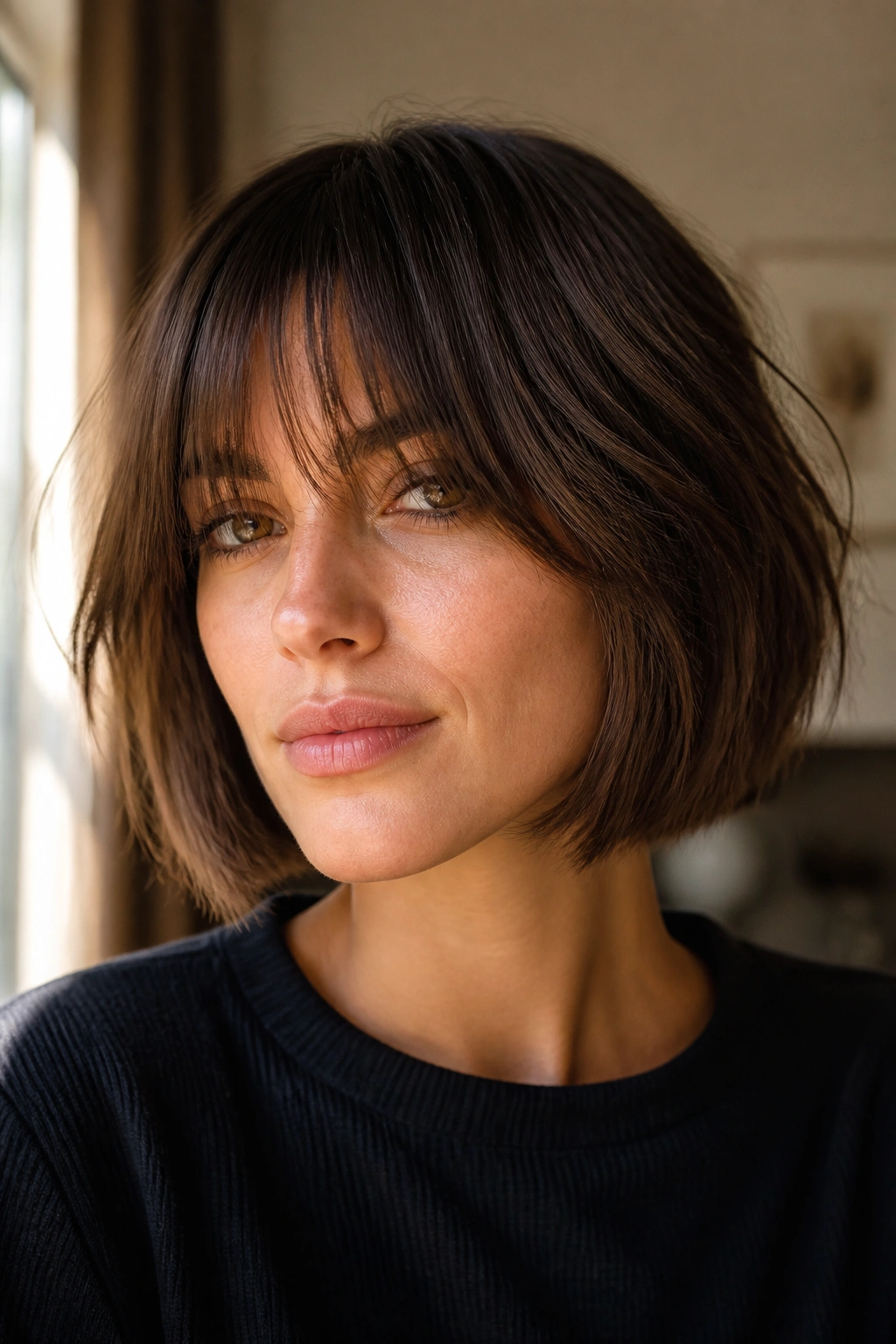
This is the one I would recommend to anyone who wants a French bob with long bangs but does not want a hard maintenance schedule hanging over their head. The line sits a little lower, the bangs stay generous, and the whole shape can stretch as it grows without looking forgotten.
The beauty here is that the cut still looks good after it loses some precision. The fringe can tuck back, split apart, or fall over the cheekbone, and the bob line becomes a little softer rather than shapeless. That makes it easier to live with between trims.
Salon Notes That Help Later
A good grow-out starts in the chair. Ask for a perimeter that stays solid even as it lengthens, and avoid bangs cut so short that they need weekly babysitting.
- Keep the fringe past the brows from the start.
- Leave enough length around the face to tuck behind the ear.
- Ask for soft internal texture, not heavy thinning.
- Trim every 6 to 10 weeks if you want the shape to stay clean.
If you like to air-dry more than you like to fuss, this is the smartest version in the bunch. It gives you room. It gives you options. And when it grows a little, it still looks like a haircut on purpose, which is half the battle with any bob.
A French bob should move. A fringe should help, not fight. That’s the real thread running through all fifteen versions here, and it’s why long bangs are such a good match for the cut. They give the face softness, they let the bob feel less severe, and they make the whole thing easier to wear when life is doing its usual messy thing.
