



Half up half down bridesmaid hairstyles solve a very specific wedding problem: the hair needs to look styled in photos, but still move when someone hugs the bride, fixes a strap, or leans into a windy cocktail hour. A full updo can feel stiff. Loose hair can fall flat by dessert.
The middle ground works because it gives shape at the crown and softness through the lengths. That balance matters more than people think, especially when bridesmaids are in different dresses, different shoe heights, and often different hair textures. A style that looks tidy on straight hair can collapse on fine waves if the top section is too heavy.
The trick is not picking a generic half-up look. It is choosing the version that matches the neckline, the venue, and how much time the person in the chair actually has before everyone piles into cars.
Some styles need strong pins. Some need a clean part. Some need a bit of grit from texture spray and nothing more. The right one is usually the one that still looks good after three embraces and a thousand photos, not just when the mirror is still.
1. Soft Twisted Crown for Half Up Half Down Bridesmaid Hairstyles
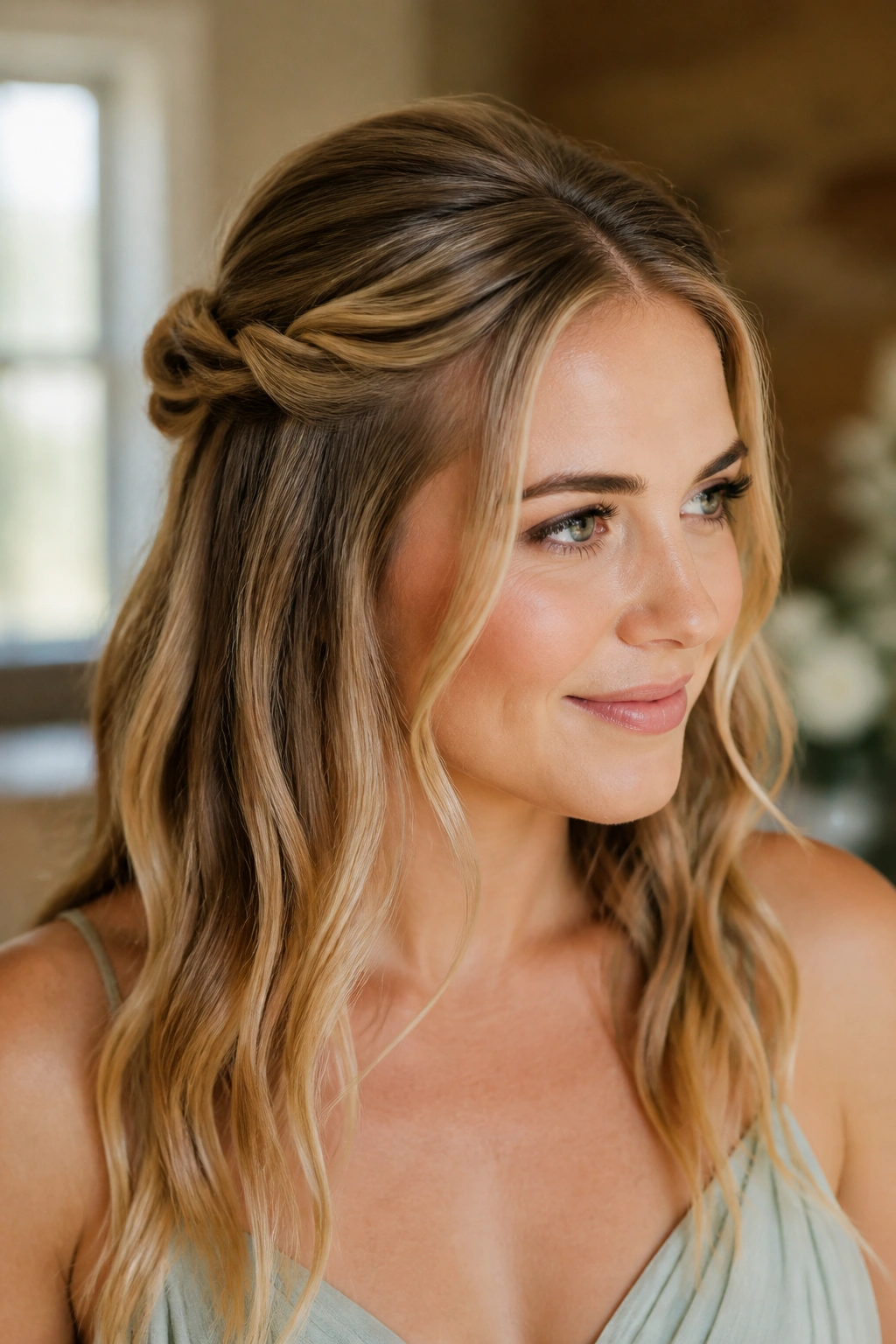
A soft twisted crown is the place I start when someone wants polish without the feeling of overdone hair. It gives you structure at the top and leaves the length free, which is a nice balance when bridesmaids are wearing different necklines or carrying bouquets that already do a lot visually.
Ask for two loose sections from each temple, twisted back toward the center, then pinned where they meet just above the back of the head. The lower hair should stay in soft bends, not stiff ringlets. A 1-inch iron or hot rollers will usually give enough movement without turning the ends into little springs.
Why It Works on Most Hair Types
Fine hair likes this style because the twist creates the illusion of thickness without piling on extra product. Thick hair likes it because the crown sits close to the head and keeps the weight from dragging everything down. Medium hair sits right in the sweet spot. Easy. Clean. Done.
- Best for: shoulder-length to long hair with soft waves or loose curls.
- Tools: 4 to 6 bobby pins, a 1-inch curling iron, light texture spray, and a tail comb.
- Hold level: medium, which is enough for a ceremony and reception if the pins are crossed properly.
- Face shape note: flattering on round and oval faces because the twist lifts the eye line.
Pro tip: pin each twist into the other twist, not straight into the scalp. That little cross-lock makes the style stay put instead of sliding flat an hour later.
2. Braided Half-Up Halo
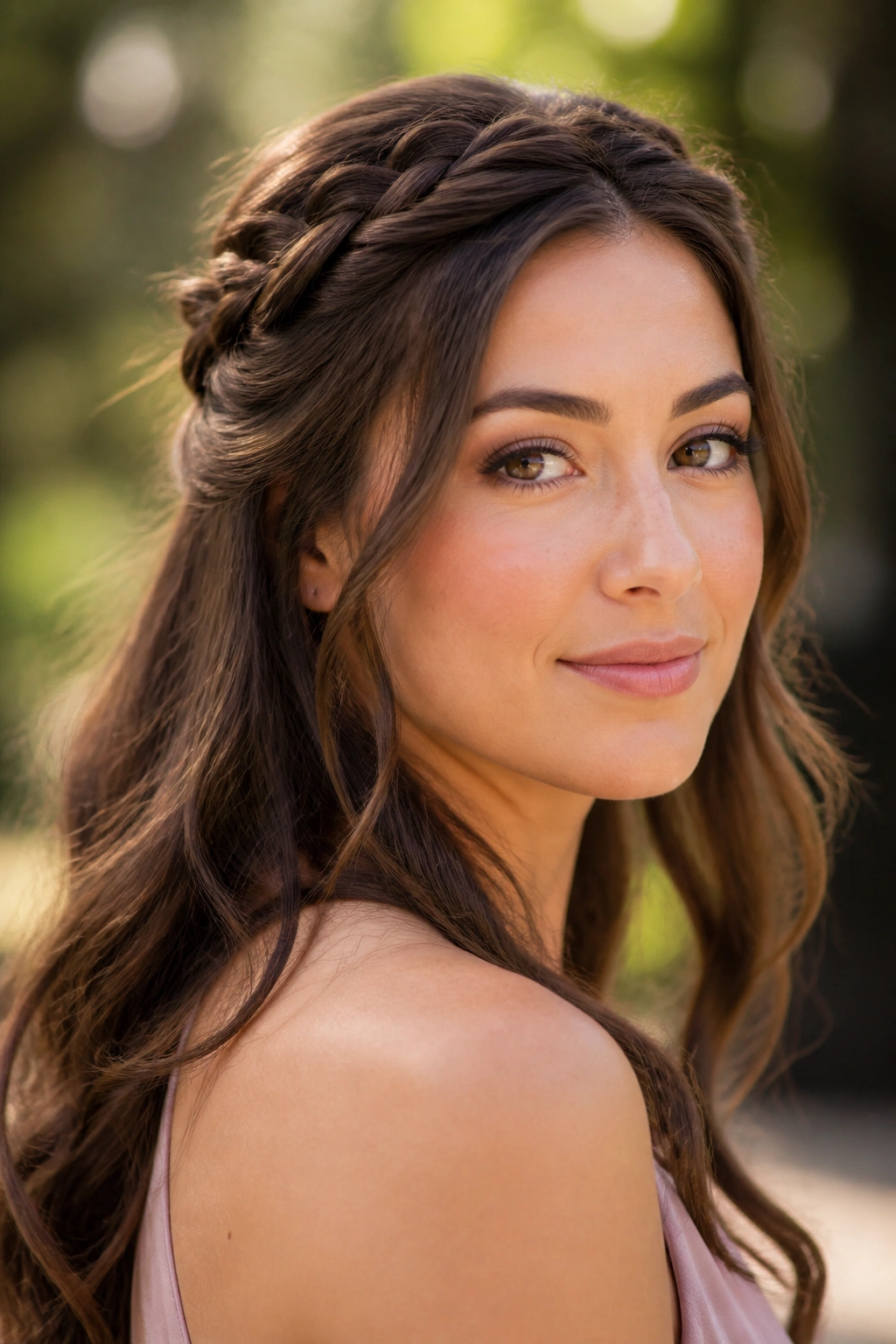
Why does a braid keep showing up in wedding hair? Because it adds grip. A braid does not just decorate the style; it gives the half-up section something to hold onto, which is why this version survives long photographs, outdoor vows, and people pulling on earrings while they chat.
The halo shape works especially well when you want the back of the hair to feel fuller without using a ton of teasing. A thin braid from each side, or one braid wrapped across the back, creates a soft frame that looks better when it is loosened slightly with fingers after it is pinned. Tight braids can read sharp. A little pull-through makes them feel more relaxed.
How to Braid It Without Making It Too Busy
Keep the braid narrow near the temples, around 1/2 to 1 inch wide, so it does not compete with the dress. That matters if the gown already has lace, beading, or a big neckline. Once the braid reaches the center back, pin it under the gathered hair and tuck the ends out of sight.
A braid can also hide the awkward bits that sometimes show up in bridesmaid hair — shorter layers, uneven growth, those pieces that refuse to sit still. It is forgiving in a way that a slick style is not.
- Use a soft Dutch braid if you want more texture and shape.
- Use a classic three-strand braid if the dress is already detailed.
- Keep the braid close to the head for a cleaner finish.
- Leave a few front pieces out if the face needs softness.
Watch for this: do not braid too tightly at the hairline. It can look severe fast, and nobody wants a pulled-back look that feels like it belongs at a gym class, not a wedding.
3. Sleek Half-Up with a Barrette Cluster
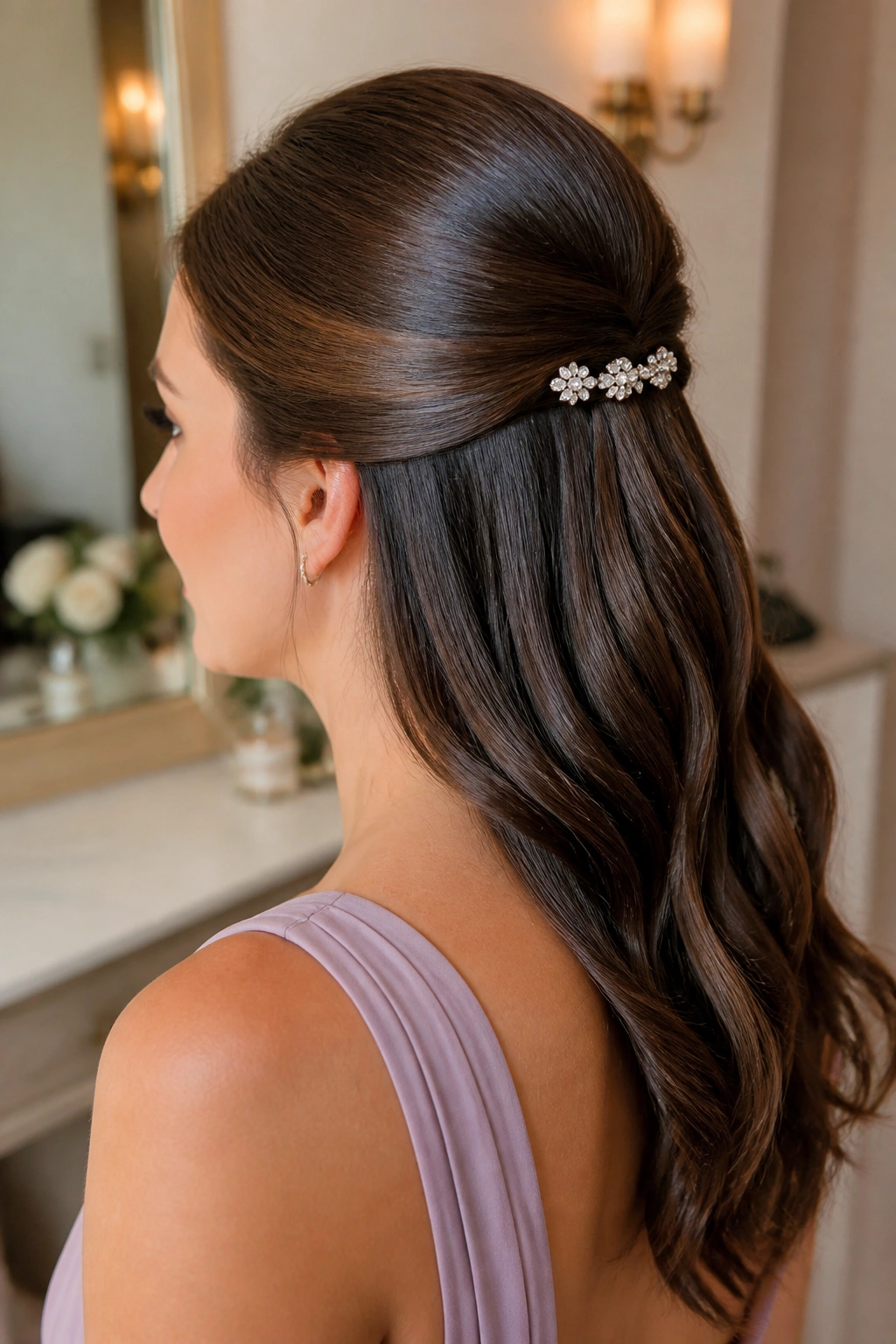
If the dress has beadwork, sequins, or a sharp neckline, sleek hair is usually the smarter move. It lets the gown do its job without fighting for attention, and that is a useful thing when several bridesmaids are standing side by side in the same room.
I like a clean center or soft off-center part with the top section smoothed back into a narrow half-up shape. Then I add a barrette cluster — usually two or three small clips, or one wider clip with a little shine. The key is restraint. A giant crystal piece can feel heavy and distract from the rest of the look. Smaller pieces sit flatter and look calmer.
A flat iron, a small amount of smoothing cream, and a fine-tooth comb are enough here. Put the product only on the top section, not through the lengths, or the lower hair can lose its shape and start looking stringy. That is the part people miss. The front should be sleek; the rest should still move.
Small shine. Big payoff.
I also like this style on bridesmaids with straight hair who want something a little more dressed up than a blow-dry, but not a full curl set. If the hair is naturally wavy, smooth the crown first, then keep a gentle bend through the ends so the whole look does not turn rigid. The contrast is what makes it feel intentional.
4. Rope-Twist Half-Up for Boho Dresses
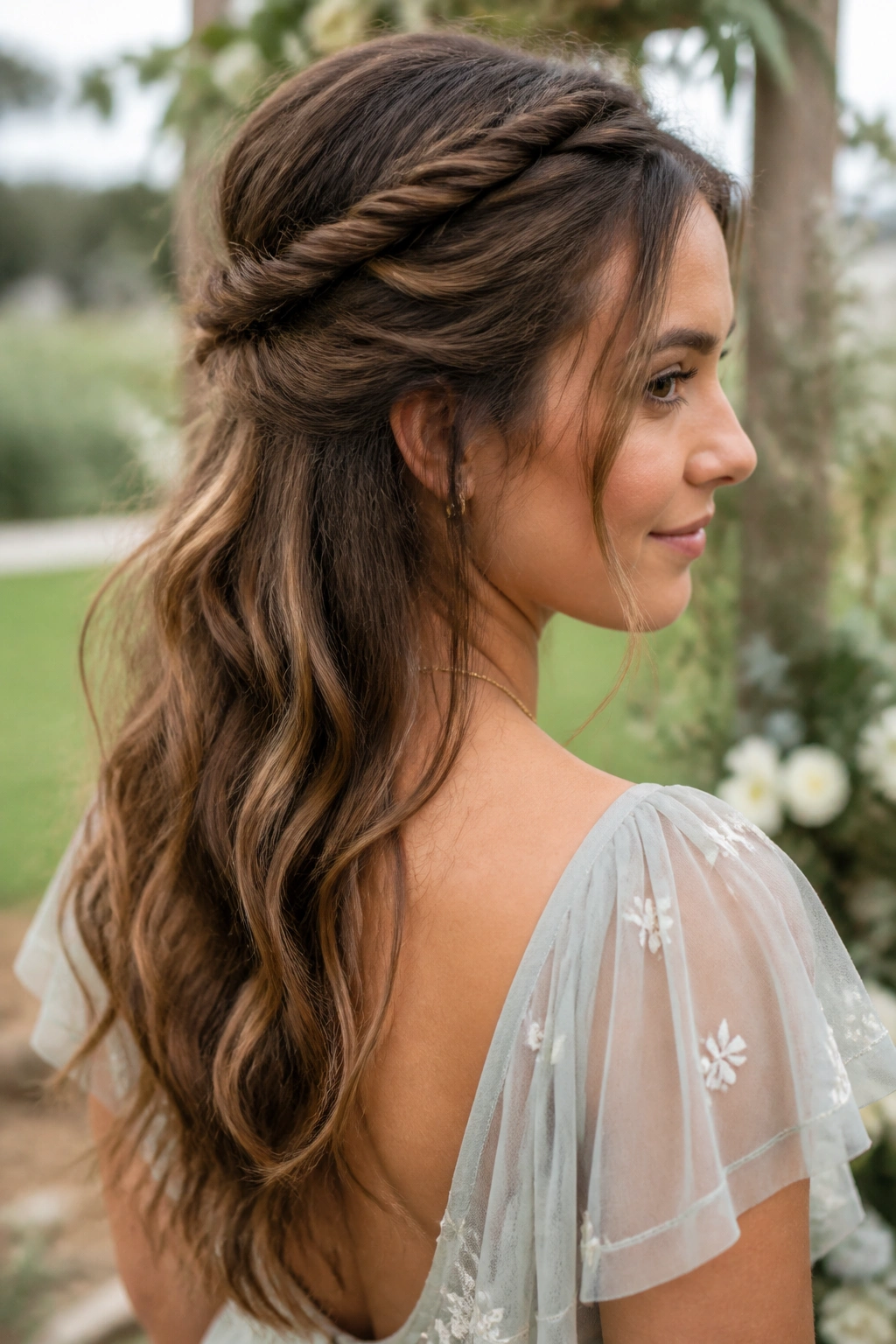
Picture a garden ceremony, damp grass, and a bridesmaid dress with fluttery sleeves. A rope twist makes sense there in a way a rigid updo never will. It feels easy, but not lazy, which is a hard line to walk and usually the sweet spot for wedding hair.
A rope twist uses two strands instead of three, and that alone changes the look. The twist has a softer, more linear texture than a braid, so it works well when you want a little movement without building a heavy wall of hair across the back. It also takes less time than a braid once your hands know what they are doing.
- Best hair length: collarbone length and longer.
- Best texture: wavy hair, light curls, or hair with a bit of grit from texture spray.
- Accessory match: wooden pins, tiny gold clips, or nothing at all.
- Weather note: holds better than loose waves in humid air because the twist gives the crown some structure.
The thing I like most is the way it lets the lower hair stay loose without looking unfinished. A rope twist has enough shape to say “styled,” but it does not swallow the dress.
Braids are not the only answer. Rope twists can read softer.
5. Full-Body Blowout for Half Up Half Down Bridesmaid Hairstyles
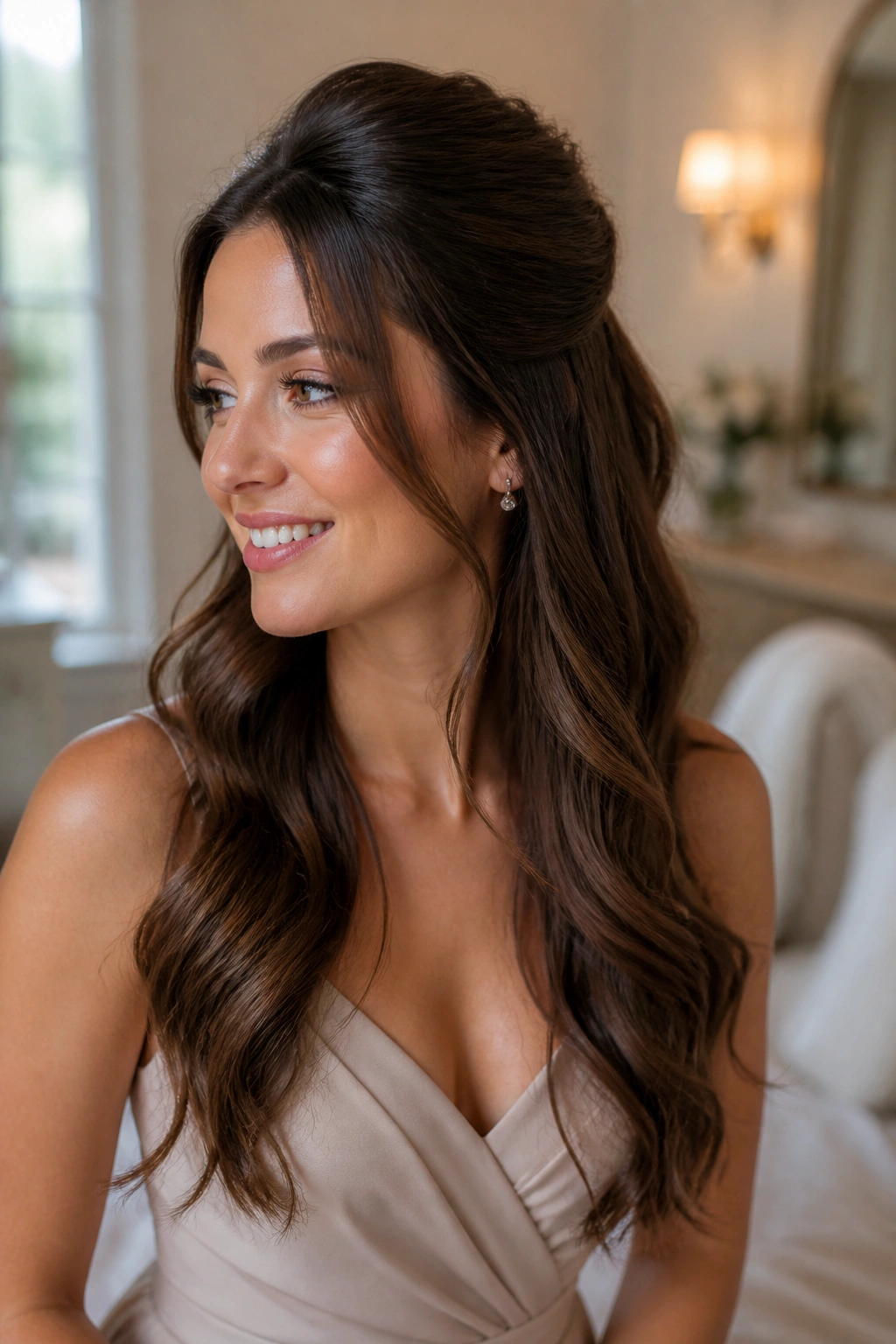
A half-up style does not have to mean curls with a clip hidden at the back. A full-body blowout version feels cleaner and more grown-up, especially when the bridesmaid dresses are simple and the whole look needs a bit of lift rather than more decoration.
The top section should be smooth, lifted at the crown, and pinned back with almost no visible bend. The lower hair gets the attention: a brushed-out wave, soft bounce at the ends, and enough movement that it still looks alive when someone turns their head. I prefer this when the fabric is matte, because the hair then brings the shine.
What matters most here is the brush-out. If the curls are set too tightly and never softened, the style starts to look dated in a hurry. If they are brushed while still warm, the shape falls too much. Wait until the hair is fully cool, then use a paddle brush or wide brush to loosen the wave just enough that it moves in one smooth line.
Shape beats volume.
This is also the version I reach for when a bridesmaid has thick hair that can look puffy in a more textured half-up. A controlled crown with soft length keeps the silhouette narrow at the top and fuller below, which feels balanced in photos. It does not need a lot of decoration. Sometimes a small pinned section and a great blowout are enough.
6. Curly Half-Up with Face-Framing Spirals
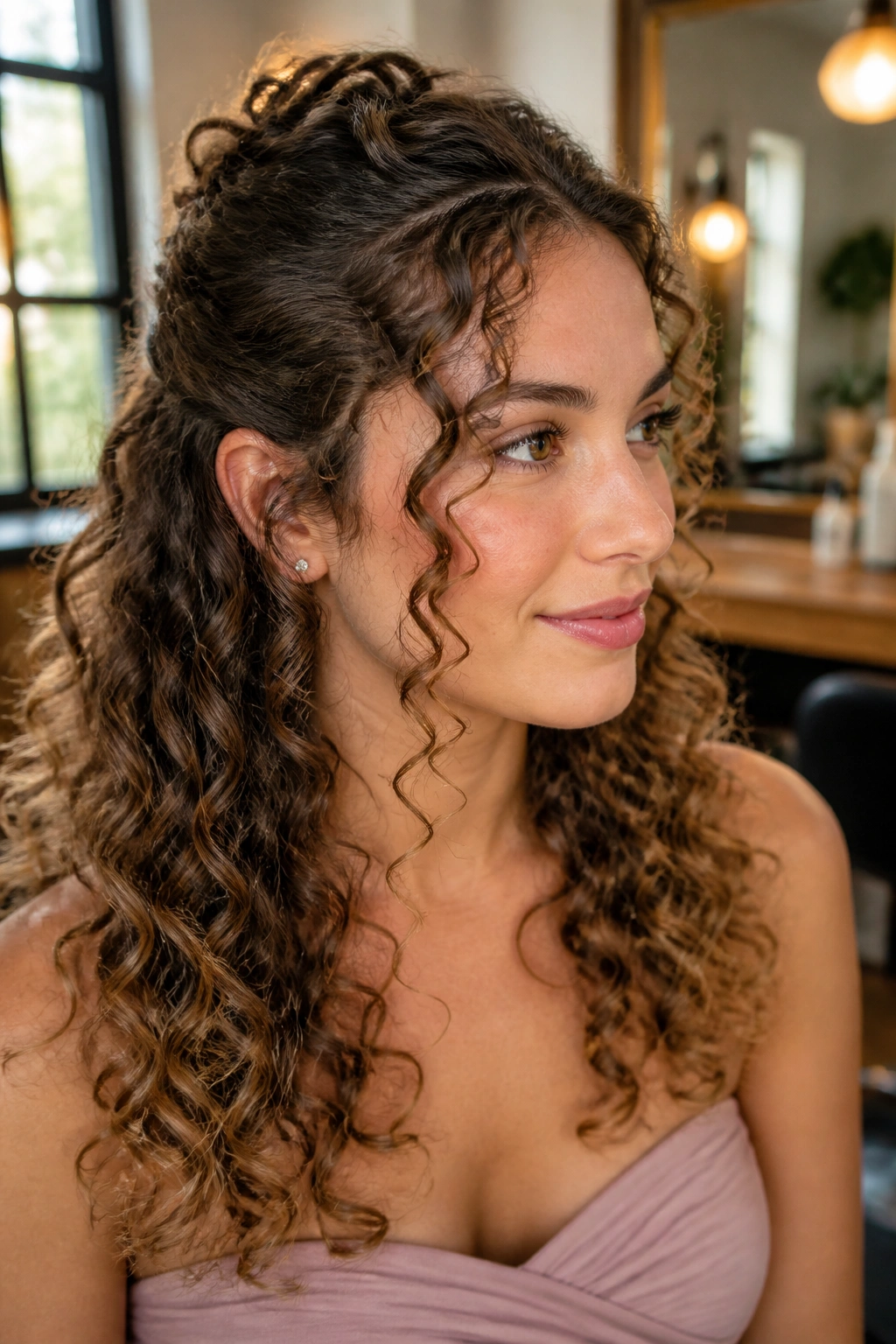
Curly half-up hair feels different in the chair. It has spring. It has texture. And if the curl pattern is healthy, the front pieces almost bounce when they move, which gives the whole style a nice sense of life without needing extra ornament.
The trick is to respect the curl pattern instead of fighting it. That means no brushing dry curls into fluff, no yanking the crown back so tightly that the top loses shape, and no heavy clip that crushes the curl at the back. Use your fingers, a wide-tooth comb, or a detangling brush on wet hair only, then let the curls set before pinning the upper half.
What to Protect Before Pinning
The crown should be gathered from the top third of the head, not scooped from the sides so aggressively that the face goes bare. Two face-framing spirals usually read better than one heavy section on each side. They soften the jawline and keep the style from feeling pulled back too far.
- Use curl cream or lightweight gel to keep the curl clumped.
- Diffuse on low heat until the hair is about 90% dry.
- Pin the half-up section with covered bobby pins so they do not snag.
- Leave the front curls loose enough to move, but not so loose that they fall into the eyes.
If the weather is humid, this is one of the safer choices because a good curl pattern often looks better with a little moisture than blown-out hair does. The shape already has movement built in.
7. Bow-Back Half-Up with a Ribbon Detail
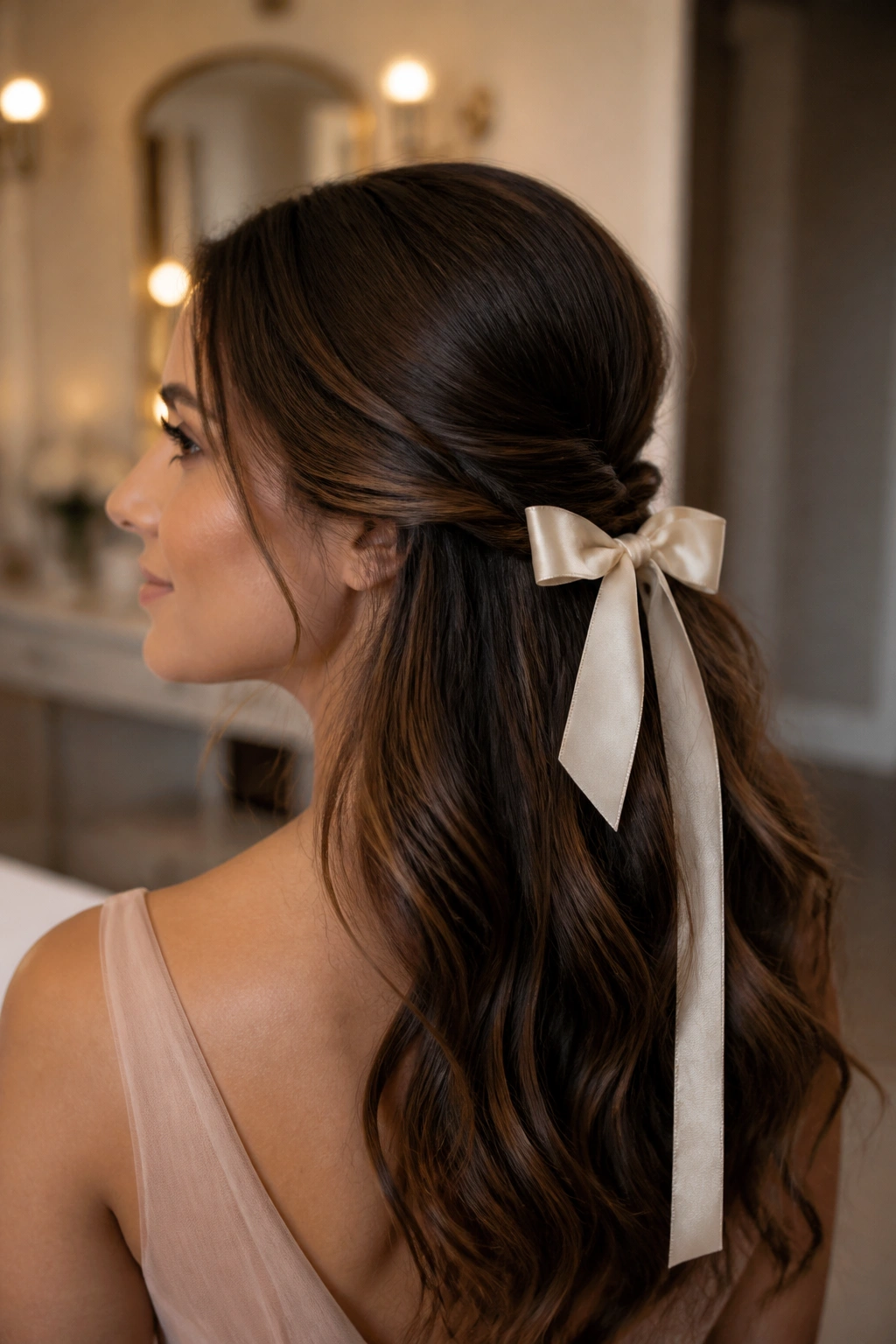
Can a ribbon feel grown-up? Yes. Easily. The answer changes with the size of the bow, the fabric, and where you place it. A narrow satin ribbon tied under the gathered section reads romantic. A huge stiff bow on top of the crown can go childish fast.
I like this style most when the bridesmaid dresses are soft and the accessories are restrained. A ribbon in the same color family as the gown, or a shade pulled from the bouquet, keeps the whole thing from feeling random. Velvet works in a richer setting. Satin feels lighter. Organza is airy and a little more delicate.
The half-up section itself can be simple — a smooth gather or a small twist — because the ribbon is the visual note. You do not need a lot of curls fighting for attention behind it. Keep the bow low, around the back of the head, and anchor it with a clear elastic before you tie the ribbon so the whole thing does not drift out of place.
How to Keep It from Slipping
Fine hair needs a hidden pin or two through the knot. Thick hair usually needs a slimmer ribbon so the knot does not get bulky. If the bow is wide, it starts to read like a present. Nice for gifts. Less nice on a bridesmaid.
This style works especially well with soft chiffon, slip dresses, or anything with a romantic drape. It has charm, but not fuss. That is the part that wins.
8. Fishtail Accent Half-Up
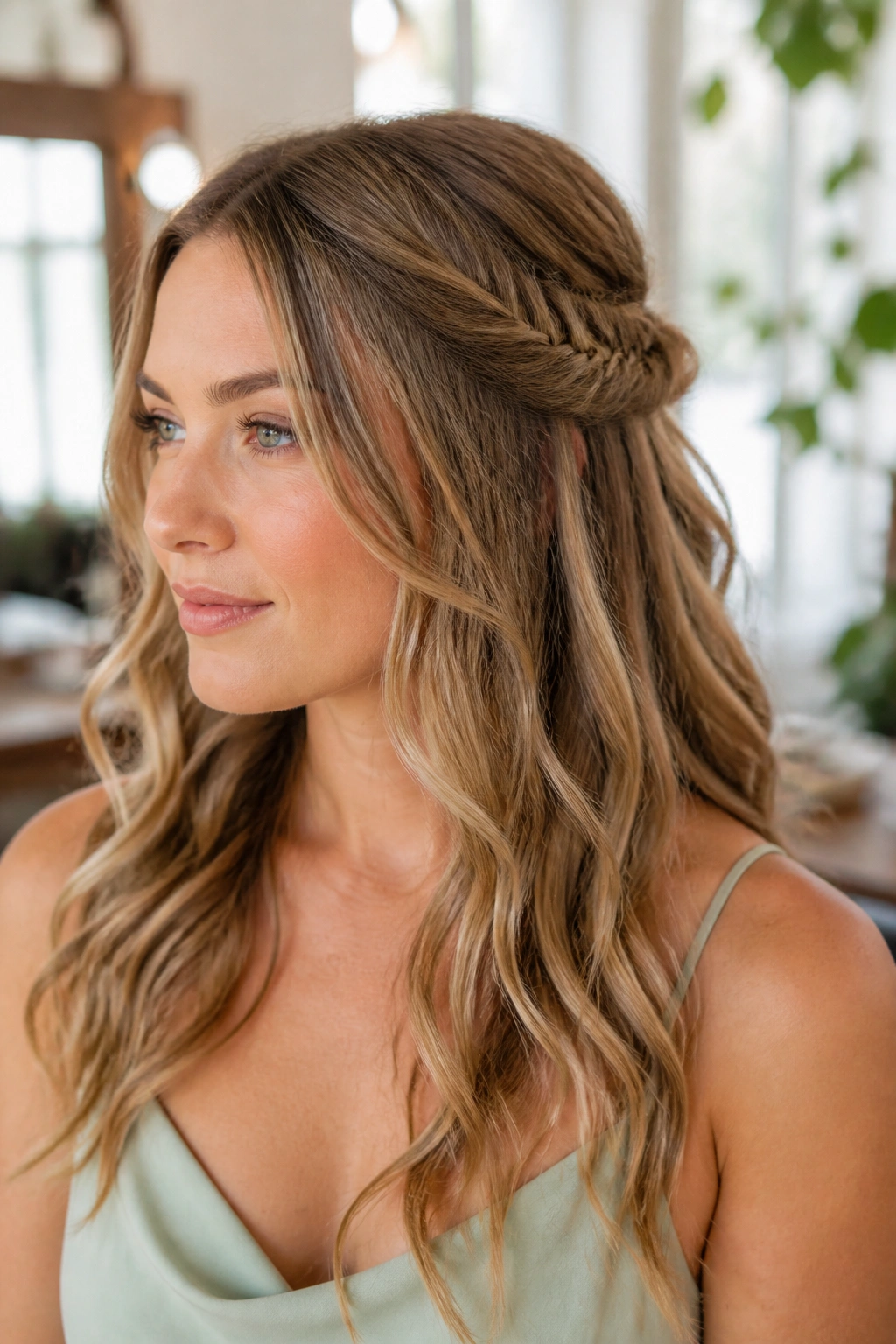
Unlike a standard three-strand braid, a fishtail reads finer and a little more detailed. It looks like someone spent a lot of time on it, even when the actual technique is mostly patience and small hand movements. That makes it a good choice for bridesmaid hair when you want texture without a heavy braid line across the head.
A fishtail accent is usually better as a partial braid rather than a full crown. Pull a small section from each side, weave it into a narrow fishtail, then pin it into the center back or let it join a loose half-up gather. Keep the braid slim if the hair is fine, because a thick fishtail can overpower the rest of the style and make the back look crowded.
This one works beautifully on longer hair because the weave has room to show. On shoulder-length hair, it still works, but the braid should stay smaller and closer to the head. Otherwise the ends can look stubby.
A few details make the difference:
- Use dry texture spray before braiding so the strands do not slip apart.
- Keep the braid loose enough that the weave looks soft, not rope-like.
- Secure with two crossed pins if the hair is heavy.
- Add one small comb or pearl pin if the dress needs a little shine.
I like fishtails for bridesmaids who want texture but do not want anything that feels too sweet. There is a bit more edge here. Just a bit.
9. Center-Part Sleek Half-Up for Bridesmaid Hairstyles
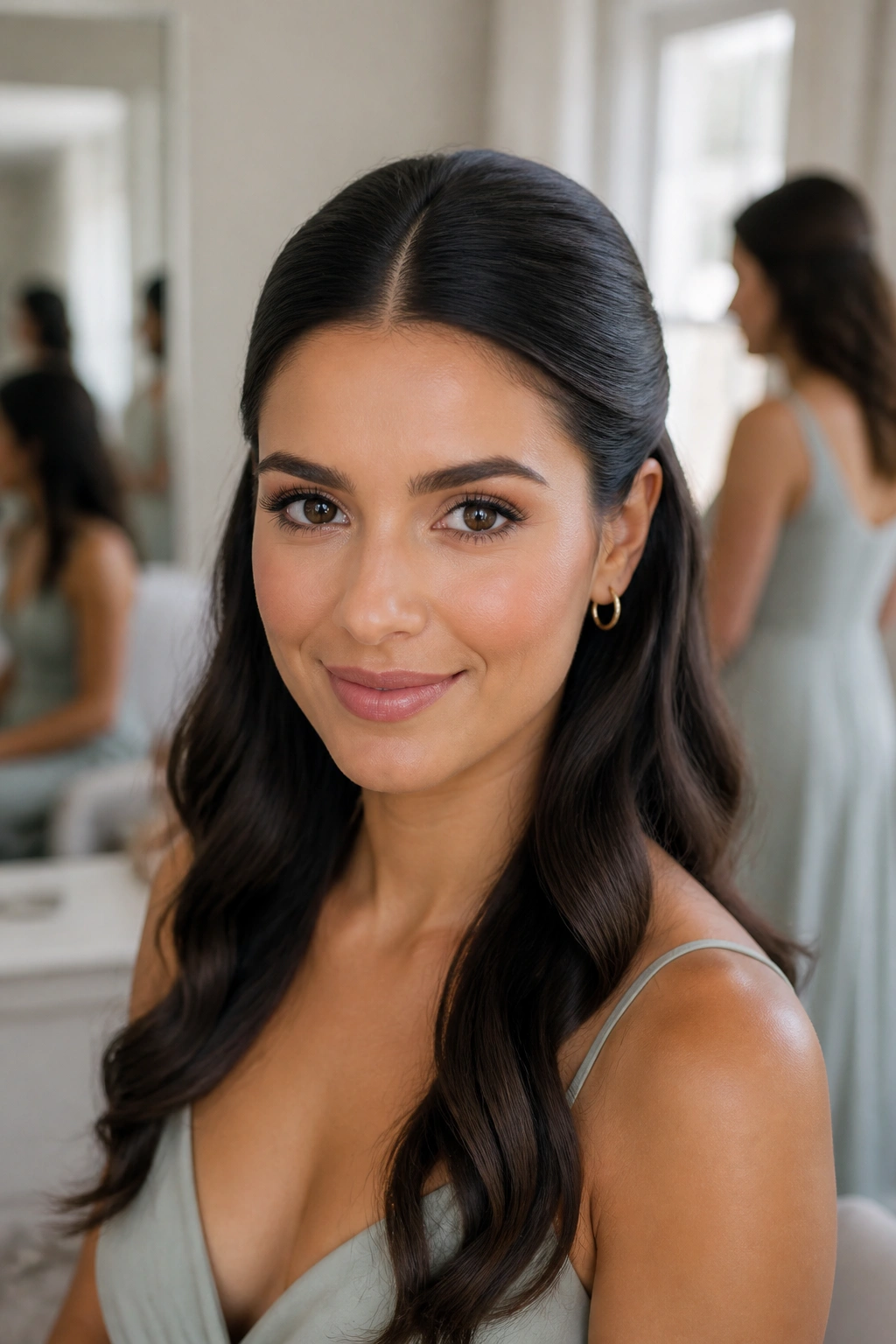
If the neckline has structure, the hair should usually get out of the way. That is the rule I come back to with this style, because a sleek center-part half-up lets a sculpted dress, a strong shoulder line, or bold earrings take the lead without the hair fighting for space.
The front section is the whole point. Make the center part clean, smooth the top with a fine comb, and gather the hair back tightly enough that it lies flat but not so tight that it pulls at the temples. The lower half can stay straight, softly waved, or brushed into a gentle bend, depending on the mood of the dress. The top should stay calm either way.
Clean lines win here.
This style does best with a bit of product at the roots — not a helmet, not a sticky mess, just enough hold to keep flyaways from blooming near the part. A touch of shine spray on the crown helps too, especially if the hair is dark and the room lighting is strong. Too much shine, though, and the top can look greasy in photos. That is the line to watch.
I especially like this for bridesmaids in high necks, halters, or gowns with a lot of detail around the chest and shoulders. It keeps the eye moving downward, which makes the whole silhouette feel longer. A very good thing when the dress already has a strong personality.
10. Floral-Pinned Half-Up Waves
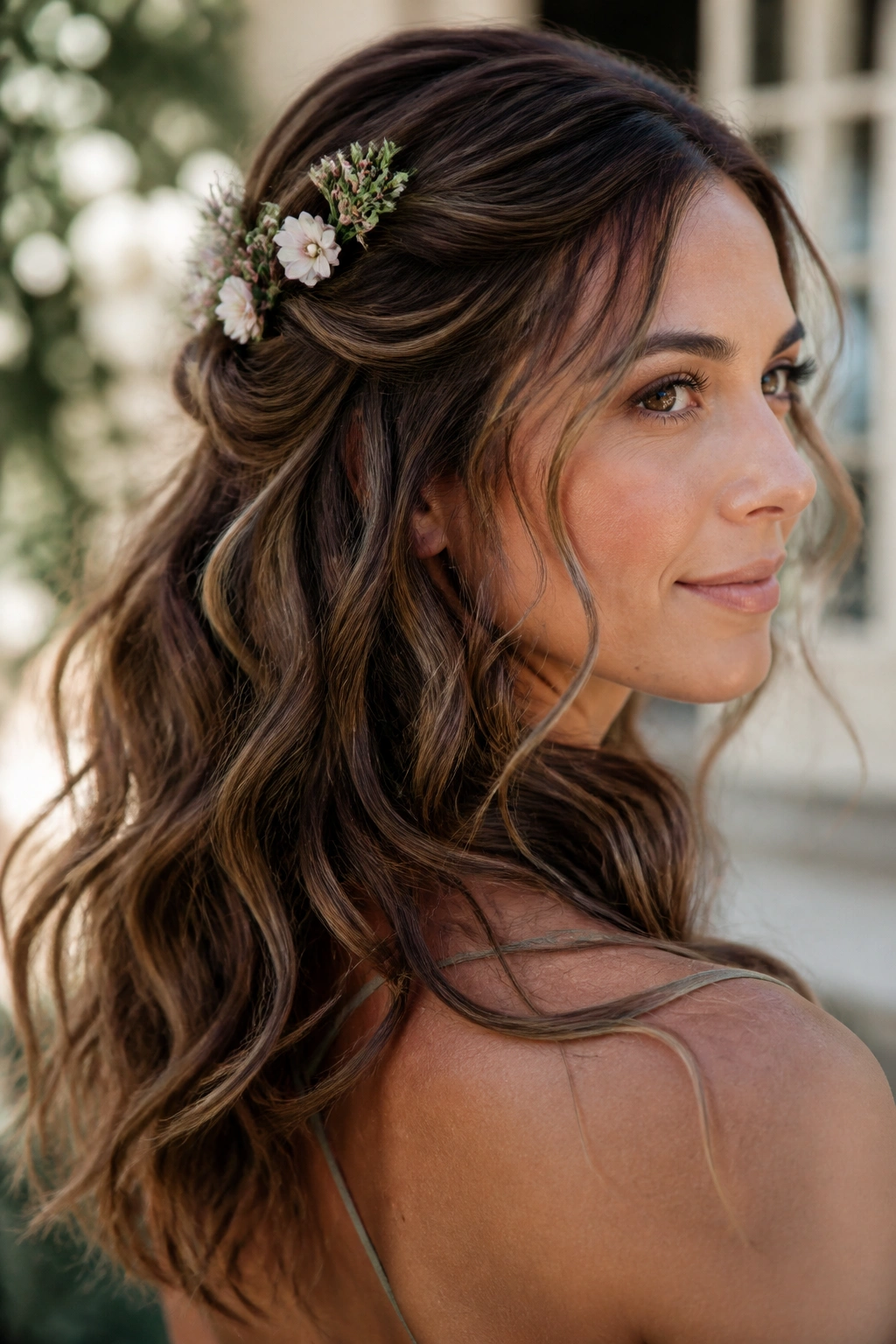
At garden weddings, this one always makes sense to me. The flowers do not feel pasted on; they feel like they belong there, especially when the bouquet has small blooms and the rest of the styling stays light.
The trick is keeping the flowers small. Three to five tiny stems, wired in or tucked into a comb, usually do the job. More than that starts to look like a bouquet clipped into the hair, and that is too much for most bridesmaid looks. Silk flowers can be a smart move if the ceremony runs long or the day is warm, since fresh blooms can wilt or bruise faster than people expect.
Where the Flowers Should Sit
The safest place is just off center at the back or slightly behind one ear. That keeps the front view clean and lets the flowers show when the head turns. If the bridesmaid is wearing a busy neckline, move the blooms lower so they do not crowd the shoulders. If the dress is plain, a little more height at the back can work.
- Best bloom sizes: small roses, spray roses, baby’s breath, tiny orchids, or preserved buds.
- Avoid: oversized stems that poke out of the hair like little antennae.
- Match the finish: matte flowers suit soft waves; glossy blooms suit sleeker hair.
- Security tip: wire the stems to a small comb before pinning them in.
Less is kinder.
The best floral half-up looks never feel like an afterthought. They look placed. That means the flowers should echo the bouquet or the ceremony setting, not shout over it.
11. Textured Knotted Half-Up
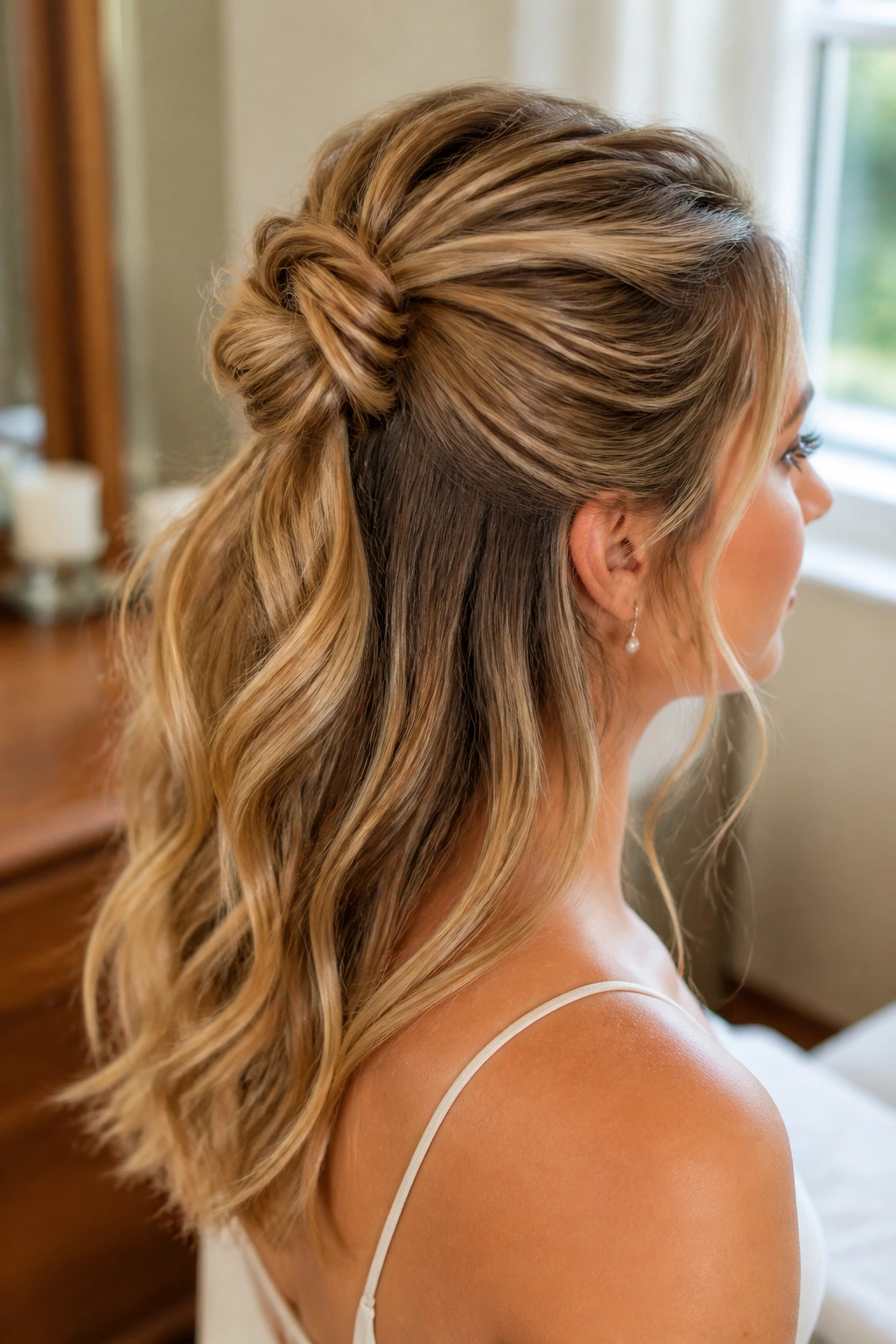
Knots are the unsung fix for bridesmaid hair that needs to look styled fast. They are quicker than braids, less fussy than a twist crown, and they work especially well when the wedding morning is moving at that slightly panicked pace every bridesmaid knows.
The texture does most of the work. A little spray at the roots, a bit of grit through the mid-lengths, and then two sections crossed and tied into a soft knot. That gives the upper half enough shape without making it feel stiff. The lower hair can stay wavy or loosely curled. I like it because it does not ask for symmetry to look good.
What Makes the Knot Hold
This style is a gift for shoulder-length hair, layered cuts, and fine hair that does not love heavy styling. A tiny clear elastic under the knot can keep the shape from loosening, and a pair of crossed pins can hide that elastic once the knot is set. The knot itself should sit flat, not bulky.
- Use texturizing powder at the roots if the hair is very slippery.
- Twist each side once before knotting if you want a firmer hold.
- Keep the knot small and close to the head.
- Add one decorative pin if the dress needs a little sparkle.
That is the whole point.
I also like this one for mixed bridesmaid groups, because it is easy to adapt on different hair lengths. A knotted half-up can look soft on fine hair and more dramatic on thick hair without changing the basic shape. That kind of flexibility saves time and keeps the wedding party from looking too matchy in the wrong way.
12. Old-Hollywood Half-Up Waves
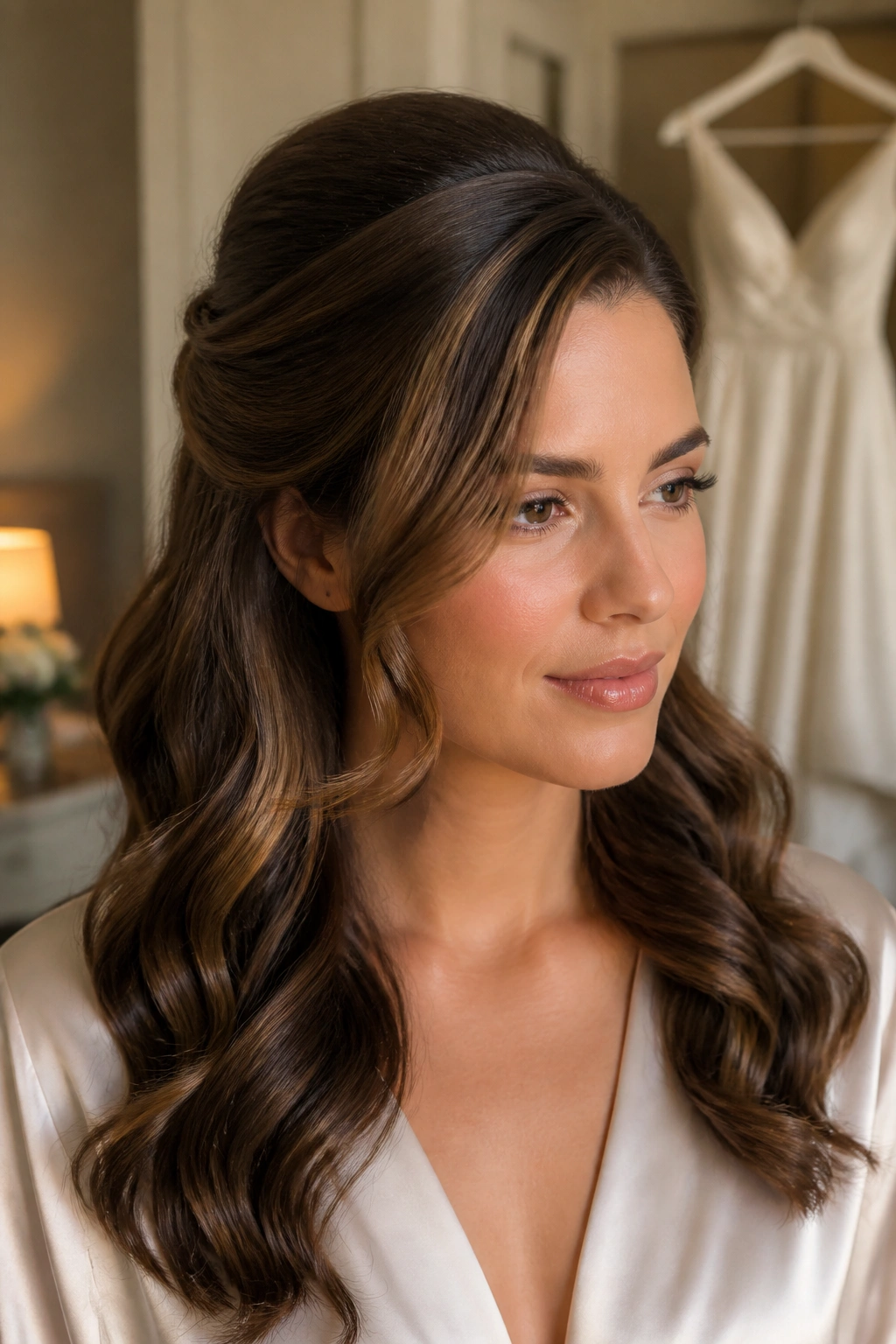
Some wedding hair wants softness; some wants shine; this one wants both. Old-Hollywood half-up waves bring a polished curve through the length and a clean lift at the crown, which makes them feel dressy without turning severe.
The part is usually deep or slightly off-center, though a centered version can work if the face shape and gown call for it. The front hair gets smoothed back into a discreet half-up section, then the lengths are curled with a 1.25-inch iron and brushed into those broad, smooth waves that bend rather than frizz. Clip the curls while they cool if you want the shape to last. That part matters more than most people think.
This style loves satin, silk, and gowns with a little structure. It also suits statement earrings because the hair stays neat around the face and does not steal the whole frame. If the bridesmaid dresses are simple, the waves can be slightly fuller. If the dresses are ornate, keep the wave pattern tighter and the crown cleaner.
What I like most is the way this look handles photos. From the front, it reads elegant and calm. From the side, the wave line gives movement. From the back, the half-up section keeps the top from collapsing into the lengths. It is one of those styles that can look formal without feeling frozen.
If you are choosing between several bridesmaid hairstyles and want one that sits comfortably between romantic and polished, this is usually the one I would put on the trial list first. It gives you room to adjust the part, the wave size, and the amount of lift at the crown, which is useful because hair behaves differently once pins, earrings, and dress straps all enter the picture. That one-inch shift at the part can change the whole face. It is worth checking.
