



The best junior bridesmaid hairstyles do something adults’ wedding hair sometimes forgets to do: they keep a younger attendant looking polished without turning her into a sculpture. That matters more than people admit. A junior bridesmaid is usually old enough to care about how she looks, old enough to spot every loose pin in a mirror, and young enough to get cranky if the style pulls at her scalp or takes half the morning to set.
A wedding hairstyle for this age group has to survive the ceremony, the photos, the hugging, the cake, the dance floor, and the inevitable hand that reaches up to touch the hair. The hair should hold its shape. It should also feel like something a real child can wear for hours. Those two goals do not always match, which is why so many junior bridesmaid looks go wrong. They get too tight. Too stiff. Too grown-up.
Hair texture changes the whole conversation. Fine hair slips out of pins faster than people expect. Thick hair gets heavy at the nape. Curly hair often looks better when it’s shaped and supported, not flattened into a smooth shell. The most reliable junior bridesmaid hairstyles work with the hair that’s already there, then add just enough structure to make it wedding-ready.
The fifteen looks below lean practical, flattering, and age-appropriate. Some are soft and low. Some keep the hair off the face. Some let texture do the talking. Start with comfort, then length, then the dress, and you’ll land on a style that lasts longer than the first bouquet toss.
1. Soft Low Chignon with Face-Framing Pieces

A low chignon is the hairstyle I reach for when a junior bridesmaid needs to look finished and still be able to move her head normally. It sits close to the nape, so it doesn’t fight with a high neckline, a collar detail, or a veil comb. That low placement also keeps the style from feeling fussy, which is a bigger deal than people think.
Why It Stays Put
The trick is to keep the bun soft, not tight. Ask for the hair to be gathered into a loose knot or rolled chignon, then pinned in a crossed pattern with 4 to 6 bobby pins. A light mist of flexible hairspray is enough. Heavy spray makes the hair feel crunchy, and crunchy hair never lasts well on a child because she will touch it the second she gets bored.
Leave a few thin pieces around the temples and cheekbones. Those strands soften the whole look and make it feel less severe, especially if the dress has lace or beading.
- Best for: shoulder-length hair and longer
- Works well on: medium to thick textures
- Try this accessory: a small pearl comb tucked just above the bun
- Avoid: a bun placed too high on the head, which can look awkward with formal dresses
Tip: Keep the front pieces long enough to tuck behind the ear. If they’re too short, they’ll spring back into the face all afternoon.
2. Half-Up Curls with a Satin Bow

Why does this style keep showing up? Because it solves two problems at once. The hair stays off the face, but the length still hangs down in a way that feels soft and youthful. For junior bridesmaid hairstyles, that balance is gold.
The easiest version starts with a center or soft side part, then a half-up section gathered at the crown and secured with a clear elastic. Curl the lower half with a 1-inch curling iron or wand, letting the curls cool before you touch them. That cooling step matters. If you brush them out too soon, the curl falls flat fast.
How to Make the Bow Do the Work
A satin bow tied over the elastic is the whole point. Pick one that’s about 2 to 3 inches wide if the child is small, a little wider if her hair is thick and dense. The bow should look like an accent, not a costume piece.
This is a good choice for wavy, straight, or lightly textured hair. It’s also kind to kids who do not want a full updo. They get movement, but not chaos. That’s the sweet spot.
Best move: place the bow at the half-up anchor, not higher on top of the head. Too high and it starts to read playful instead of polished.
3. Sleek Low Ponytail with a Wrapped Base
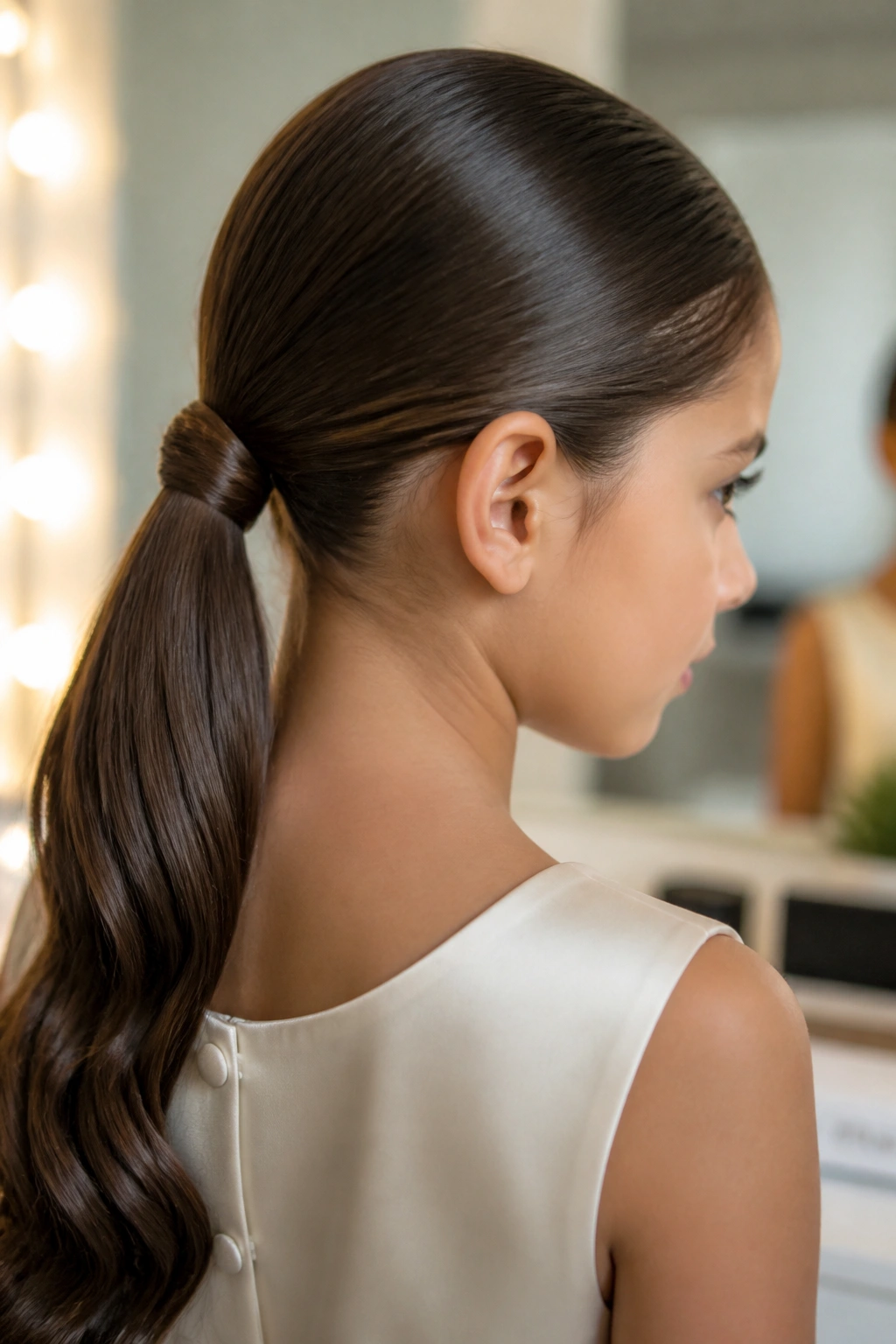
Sometimes the cleanest answer is the right one. A sleek low ponytail gives a junior bridesmaid a neat, elegant shape without adding bulk, and it works especially well when the dress already has a strong neckline, sparkle, or a lot of detail at the bodice.
The ponytail should sit just above the nape, not smack in the middle of the back of the head. Smooth the hair first with a soft bristle brush and a small amount of smoothing cream. Then wrap a one-inch strand around the elastic so the base looks finished. That tiny move changes everything. A basic ponytail looks school-day plain. A wrapped base looks deliberate.
This style is a good pick for fine hair that gets weighed down by curls, and it’s also a smart choice in humid weather because there’s less to frizz up. Straight hair holds it easily. Curly hair can do it too, but the ponytail should stay a little loose so the natural texture doesn’t get stretched into a sad rope.
What to watch for: don’t pull the crown too tight. If the front looks snatched, the whole style starts fighting the child’s face.
4. Braided Crown with Loose Ends

A braided crown makes sense for a junior bridesmaid who can’t sit still for long but still needs her hair to look special. It keeps hair away from the face, and it holds up better than a style that depends on perfect curls staying perfect all day. That alone makes it worth considering.
The Shape That Matters
The braid can run from one temple across the crown to the other side, then tuck into a low ponytail or small bun. A Dutch braid gives more visible texture than a regular braid, which is nice if the hair is fine or a little slippery. If the child has thicker hair, a looser lace braid works just as well and feels a bit softer.
A few things make this style behave:
- Start with dry hair that has a little grip, not freshly washed hair that feels silky and slippery.
- Use small clear elastics to secure the ends.
- Pancake the braid lightly by pinching the outer loops, but do not pull it apart too much.
- Keep the ends tucked low so the style doesn’t puff out at the crown.
The result is sweet without being fussy. It also photographs cleanly from the front, side, and back, which is a pleasant thing to say about a hairstyle because a lot of braided looks only behave from one angle.
Tip: If the child has baby hairs or short layers near the hairline, leave them alone. A little softness around the face makes the whole look better.
5. Twisted Half-Up Style with Pearl Pins

This one feels airy the moment it goes in. Two twisted sections pulled from each side of the head, pinned at the back, give a junior bridesmaid the polish of an updo without hiding her hair completely. It’s a nice middle ground, and honestly, that’s why so many parents and stylists keep coming back to it.
The twists should begin above the ears and gather just enough hair to create shape. Keep the sections roughly 1 to 2 inches wide so the style doesn’t get too bulky. Once the twists meet at the back, secure them with a small elastic or several hidden pins, then finish with 2 or 3 pearl pins placed asymmetrically for a softer look.
How to Keep the Twists Neat
Twists can unravel if the hair is too smooth, so a touch of texturizing spray at the roots helps. You do not need much. A light mist is enough. Use your fingers to twist rather than a comb if the hair is fine. A comb can make the sections look too stiff, and stiff is the enemy here.
This style is especially nice on medium-length hair that sits between shoulder length and a bit longer. It gives shape without needing a full bun, which many younger bridesmaids find uncomfortable.
The pearl pins are the charm point. Tiny, not flashy. That’s the right scale.
6. Side-Swept Waves with a Sparkly Clip

Two things make this look work: a deep side part and one strong clip. That’s it. No need to pile on accessories or force the hair into a complicated shape that will fall apart once the dancing starts.
Side-swept waves are a good answer for junior bridesmaid hairstyles when the dress is simple and the child’s hair has enough length to move. Curl the hair loosely with a 1.25-inch iron, then brush the curls out with your fingers so they turn into soft waves instead of ringlets. Sweep the fuller side back and pin it with one decorative clip near the temple.
What Makes It Different
This style reads more grown-up than a half-up bow, but it still feels age-appropriate because the hair stays loose. It’s also a smart choice if the child is wearing earrings or a neckline that deserves to stay visible.
- Works best on: shoulder-length to long hair
- Best texture: straight, wavy, or soft curls
- Good accessory choice: a crystal barrette or a small comb with stones
- Skip if: the hair falls very flat at the roots and can’t hold a side sweep
A clip should hold about a third of the hair from one side, not all of it. If the clip is trying to do the work of ten bobby pins, it’s too small or the section is too heavy.
7. Bubble Ponytail with Tiny Ribbon Ties

A bubble ponytail is cheerful, neat, and a little more playful than the average wedding style, which is exactly why it can be such a good fit for a younger attendant. It has shape, but it doesn’t ask for perfection. That makes it easier to wear and easier to keep tidy.
Start with a smooth low ponytail or a mid-height ponytail, then add clear elastics every 2 to 3 inches down the length. After each elastic goes in, gently tug the hair between them to create the rounded “bubble.” That little pull is the whole effect. Too much and the style looks lopsided. Too little and it just looks like a ponytail with extra bands in it.
A narrow ribbon tied around one or two of the elastics gives the whole thing a softer finish. I like this look on medium to long hair, especially when the child likes movement and does not want every strand pinned down. It’s also good for hair that tangles easily, because the style keeps the length controlled.
- Use a soft brush before you start so the top stays smooth.
- Keep the bubbles evenly spaced, about 2 inches apart.
- Add tiny ribbon ties if the wedding palette wants a little color.
Closing thought: this is one of the few styles that stays cute even after the first few hours. It loosens a little, and that actually helps.
8. Dutch Braid into a Low Bun

Tight-looking hairstyles are not the enemy. Tight looking hairstyles are. There’s a difference, and this one matters for a junior bridesmaid who needs a style that feels secure without looking severe.
A Dutch braid from the hairline down toward the nape gives structure right away. Once the braid reaches low on the head, twist the remaining length into a bun and pin it underneath. The braid gives you the visual detail; the bun gives you the clean finish. Together, they do the job of a more complicated updo without needing ten extra minutes of fiddling.
The Part That Matters
The braid should start neat and gradually soften as it moves downward. If the sides are pulled too hard at the beginning, the face can look tense. If the braid is too loose from the start, it will slip. The middle ground is what holds.
This style is especially useful for thick hair, heavy hair, and humid weather. It keeps the bulk under control and keeps flyaways near the crown from taking over the entire look. If the hair is fine, use a little dry texture spray before braiding so the strands grab each other.
Finish with a few hidden U-pins and a mist of flexible spray. That’s enough. The braid itself does most of the visual work.
9. Shoulder-Length Loose Curls with a Slim Headband
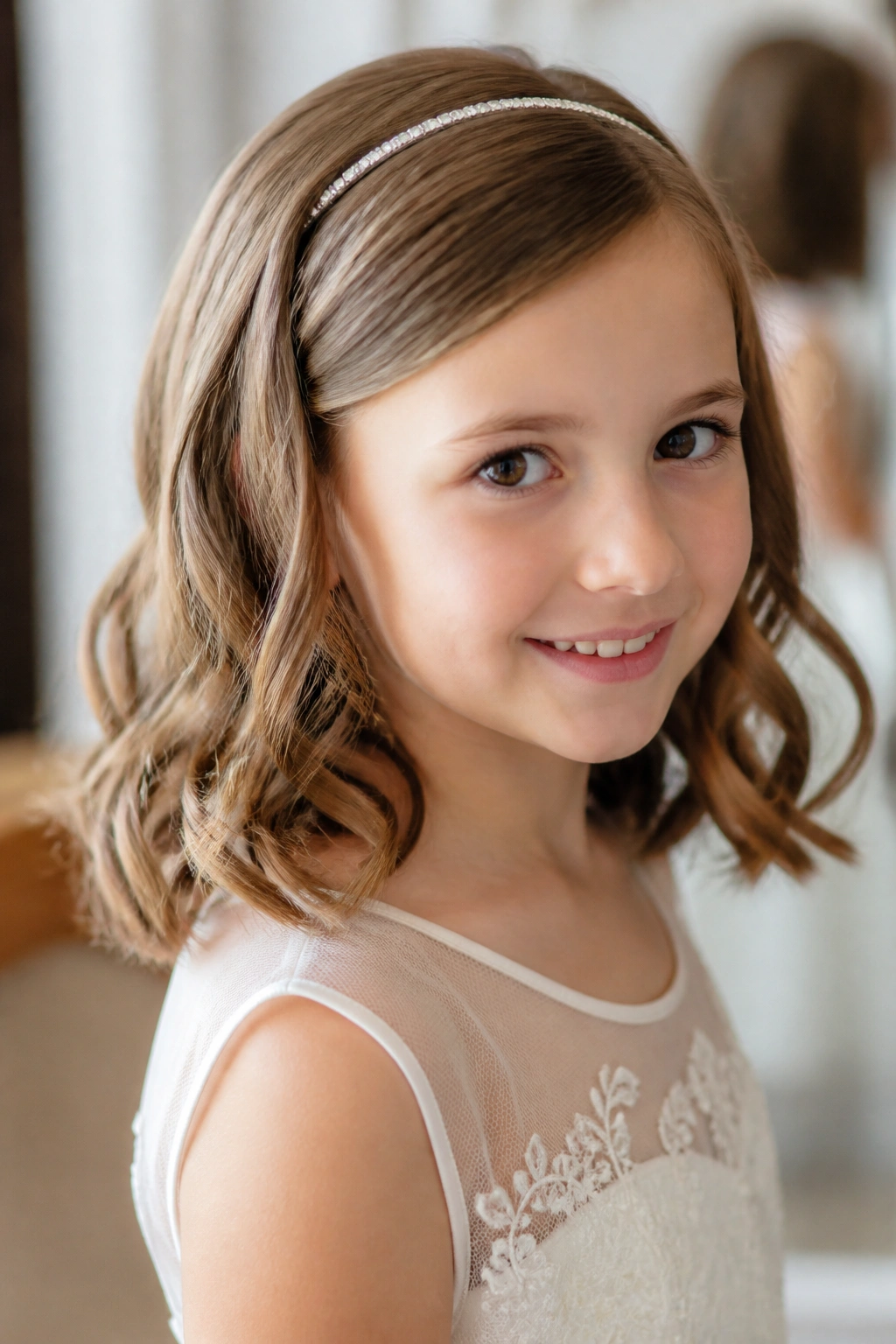
Not every junior bridesmaid needs an updo. If the hair sits at the shoulders or just below them, loose curls and a slim headband can look more elegant than a style that tries too hard to fake length or volume.
A shoulder-length cut has its own shape. Use it. Curl the mid-lengths with a ¾-inch to 1-inch iron, but leave the ends a little softer so the hair doesn’t turn into a row of tight spirals. Brush through once, not five times, and place a slim headband about 1 inch behind the hairline so it rests cleanly without sliding into the face.
Why I Like This on Shorter Hair
Shorter hair often gets overstyled at weddings. People pin it up until it loses all its charm. This look avoids that problem. It keeps the cut visible, which matters if the haircut itself is neat and fresh.
A satin headband works if the dress is simple. A pearl band works if the dress needs a little sparkle. Velvet can work too, but only if the fabric of the dress doesn’t already carry a lot of texture. Too much texture on top of texture gets messy fast.
This is a good one for kids who hate having pins near their scalp. There are fewer of them, which means fewer complaints before the photos.
10. Top Half Bun with Soft Ends

Easy. Fast. Less fussy than a full updo. That’s the appeal here.
The top half bun, sometimes called a mini top knot, keeps the hair off the face while leaving the rest of the length down. It works especially well on hair that has some natural wave or body, because the top section can be gathered without looking flat or sad. Pull the top half up from about temple level, twist it into a small bun, and let the lower half fall in soft bends or loose curls.
When It Beats a Full Bun
A full bun can sometimes feel too grown-up on a younger bridesmaid. A half bun keeps the whole thing lighter. It also gives the dress more room to breathe at the back, which helps if the neckline is high or the fabric is delicate.
Use a little texturizing spray at the crown before gathering the top section. That keeps the bun from slipping. Secure it with a small elastic and two or three pins. If the hair is very silky, a tiny bit of mousse at the roots helps more than extra spray at the end.
This style is one of the most forgiving junior bridesmaid hairstyles because it can look neat even when it loosens a little during the day. That’s rare. And useful.
11. Fishtail Braid Over One Shoulder

Unlike a three-strand braid, a fishtail braid looks detailed without demanding a huge amount of volume. That makes it a strong choice for long hair that needs to stay controlled but still show off its length.
The braid should sit over one shoulder and begin low at the back of the head or just off to one side. Keep the sections small and even. A fishtail uses tiny pieces, so the look gets tighter and more textured as it goes. If the hair is too slick, dust the lengths with a little braid spray or texturizing powder first. Otherwise the braid can slide apart while you’re working.
- Best on: long straight hair or long loose waves
- Holds best when: the hair has been washed the day before
- Good finishing touch: a thin ribbon woven through the bottom third
- Not ideal if: the child likes to toss her hair around a lot
This braid works because it feels special without requiring curls, buns, or a lot of heat. It’s the kind of style that can look very polished with only a few pins and some patience.
My preference: keep the braid loose near the collarbone. A braid that’s pulled too tight can look a little severe on a younger face.
12. Ribbon-Threaded Low Braid

A ribbon threaded through a braid can make simple hair look finished in a way that feels gentle, not flashy. That matters. This is one of the easiest junior bridesmaid hairstyles to adjust to the dress, the wedding colors, and the child’s comfort level.
Start with a low three-strand braid at the nape or just above it. Use a satin, grosgrain, or organza ribbon that matches the dress or floral accents, then weave it through one section of the braid as you go or thread it through after the braid is finished. Tie the ribbon at the end in a tidy bow or leave the ends long for a softer effect.
Where Ribbon Makes Sense
Ribbon is especially nice when the dress is very plain and the hair needs a little visual interest near the back. It also works if the child’s hair is too short for a full updo but too long for a simple clip.
Keep the ribbon width modest. A ribbon that’s too wide fights the braid instead of helping it. About ¼ to ½ inch wide usually works well on younger attendants. If the hair is thick, go a touch wider. If it’s fine, stay narrow.
This style is good for photos because the braid reads clearly from behind. It also survives movement better than a loose curl pattern. Once it’s secured, it stays where you put it.
13. Straight Hair with a Deep Side Part and Barrette

Not every wedding hairstyle needs curls. Straight hair, when it’s smooth and neatly parted, can look sharper than a lot of overworked styles that were curled into submission. That is especially true for a junior bridesmaid with naturally straight hair that refuses to hold a bend anyway.
A deep side part adds shape right away. Smooth the hair with heat protectant and a flat iron on a gentle pass if needed, then tuck one side back with a single strong barrette. Keep the finish glossy, not stiff. If the hair is frizzy, work a small amount of serum through the ends only. Too much product near the roots makes the crown collapse.
The barrette should do real work, not just decorate. Choose one with a metal clasp or a solid snap that grips securely. Decorative barrettes that slide around are a nuisance, and nobody wants to stop between the ceremony and photos to reset a hair clip.
This look suits dresses with clean lines, especially satin or crepe. It also lets the child’s face stay open and bright, which is often the nicest part.
14. Mini Floral Updo for Shorter Hair

Short hair is easier than people think. It just asks for a different plan.
A mini floral updo works for chin-length cuts, lob-length hair, or any shorter style that needs a wedding finish without pretending to be long. The hair can be twisted back from the sides, pinned near the crown, and joined with a small floral comb or a couple of wired blooms. If the length is too short for a full bun, that’s fine. Don’t force it. Use the cut you have and shape it around the face.
What to Ask For
- A soft twist or two near the temples
- Hidden pins that match the hair color
- One small floral comb instead of a heavy crown
- Flowers wired close to the base so they don’t flop
Fresh flowers can work, but they need support. Tiny roses, spray roses, or baby’s breath hold better than blooms with heavy heads. Silk flowers are easier if the ceremony is long or the weather is warm and dry.
This is one of those junior bridesmaid hairstyles that looks far more intricate than it is. The secret is restraint. A few pins. One good comb. Enough structure to frame the face, and no more.
15. Loose Knot Bun with a Veil-Ready Finish
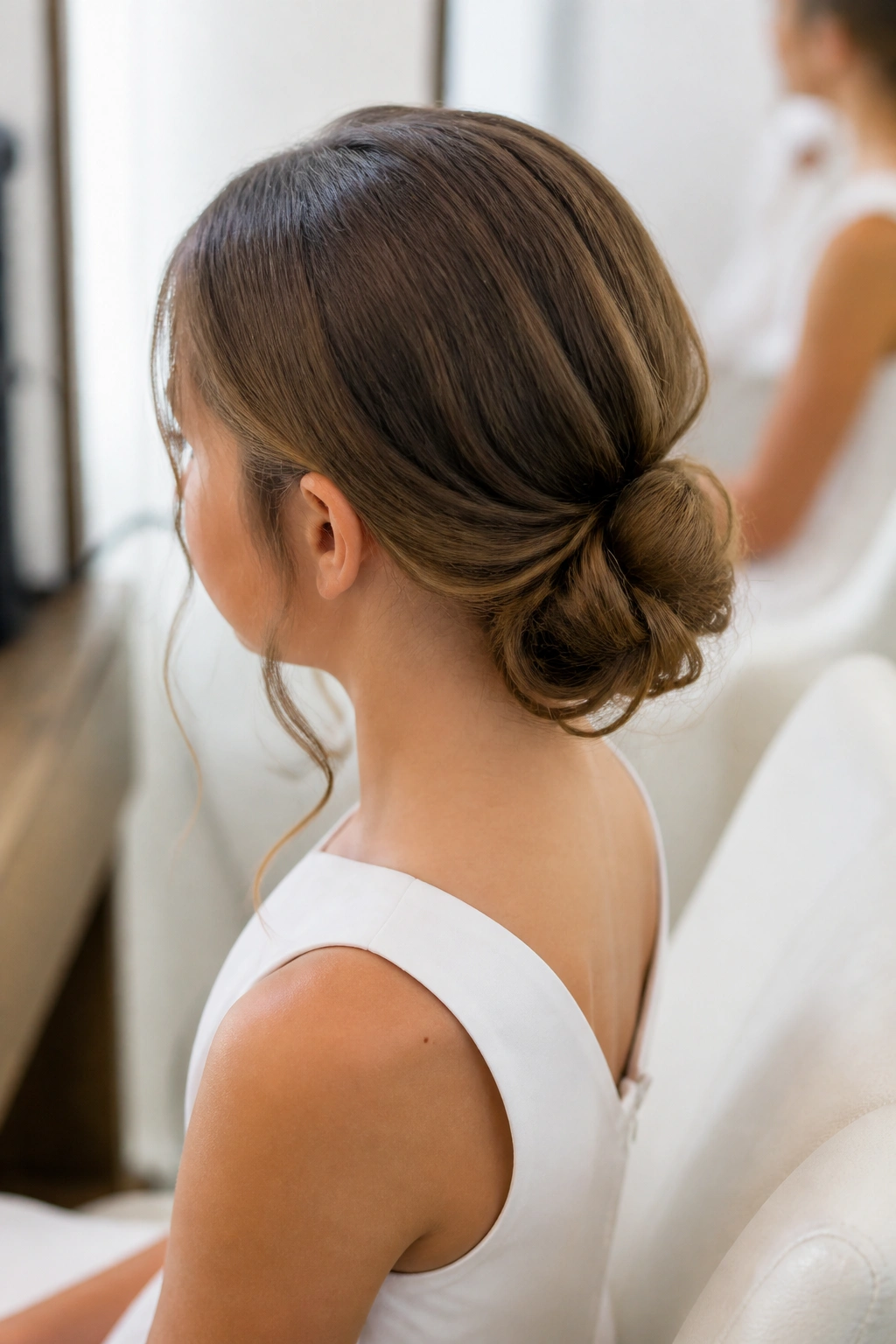
Want one style that can live under a veil, sit beside a hair comb, and still feel soft on a younger face? This is the one I’d choose first.
A loose knot bun sits low at the nape and looks a little more relaxed than a classic chignon. It can be twisted from a ponytail, folded back on itself, and pinned so the shape stays round but not perfect. That imperfection is what makes it work for a junior bridesmaid. The style looks intentional, but it does not demand adult-level polish.
A few face-framing pieces keep the look friendly. A clean middle part or soft side part gives the bun structure without making the hair feel severe. If the child has naturally curly hair, let the texture show through instead of ironing it flat. Curly ends tucked into a loose knot look far better than curls that have been pressed into obedience.
This is also the easiest style to dress up or down. Add a small comb and it feels formal. Leave it bare and it still looks neat. That flexibility makes it a safe last-minute choice when the dress, the weather, or the child’s mood changes. Which, if you’ve ever helped with wedding prep, is not a rare event at all.
